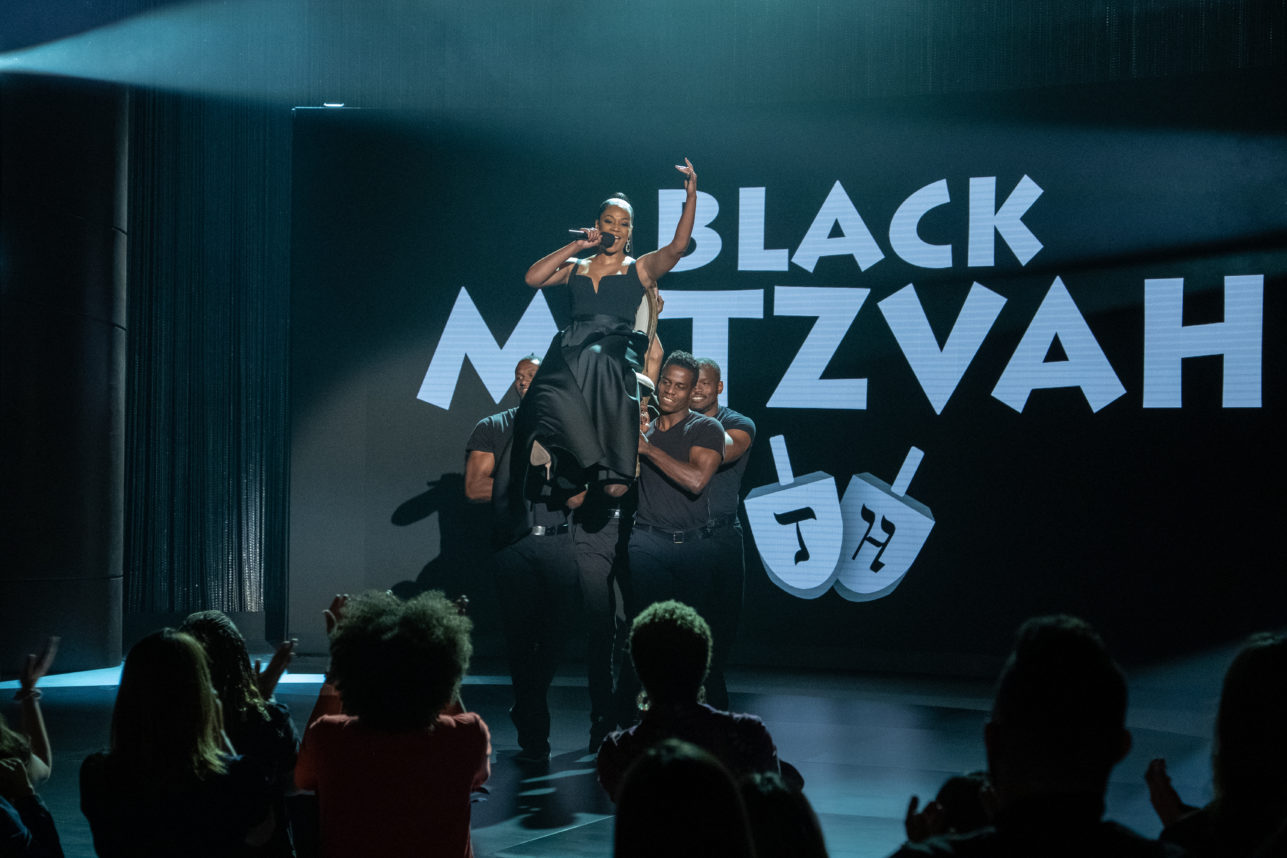
Tiffany Haddish celebrated her Netflix special “Black Mitzvah,” her real bat mitzvah and 40th birthday with at a party at the SLS Hotel in Beverly Hills, with MOTs Chelsea Handler, Billy Crystal and Sarah Silverman in attendance. Her friend Barbra Streisand couldn’t attend, but she messengered a gift to Haddish at the party: A Star of David necklace.
“Barbra Streisand is a good friend of mine,” Haddish told Access Hollywood. “I taught her about Cardi B, she taught me about where to get my nails done.”
Streisand congratulated Haddish on Twitter. “Mazel tov on your Bat Mitzvah!” Streisand posted.
“The Black Mitzvah Was EVERYTHING,” she wrote. “Last night was one of the best days of my life. I had so much fun. Thank you to everyone that came out to support one of my dreams. Thank you @netflixisajoke for being a great partner and helping to my dream come true. #SHEREADY.”
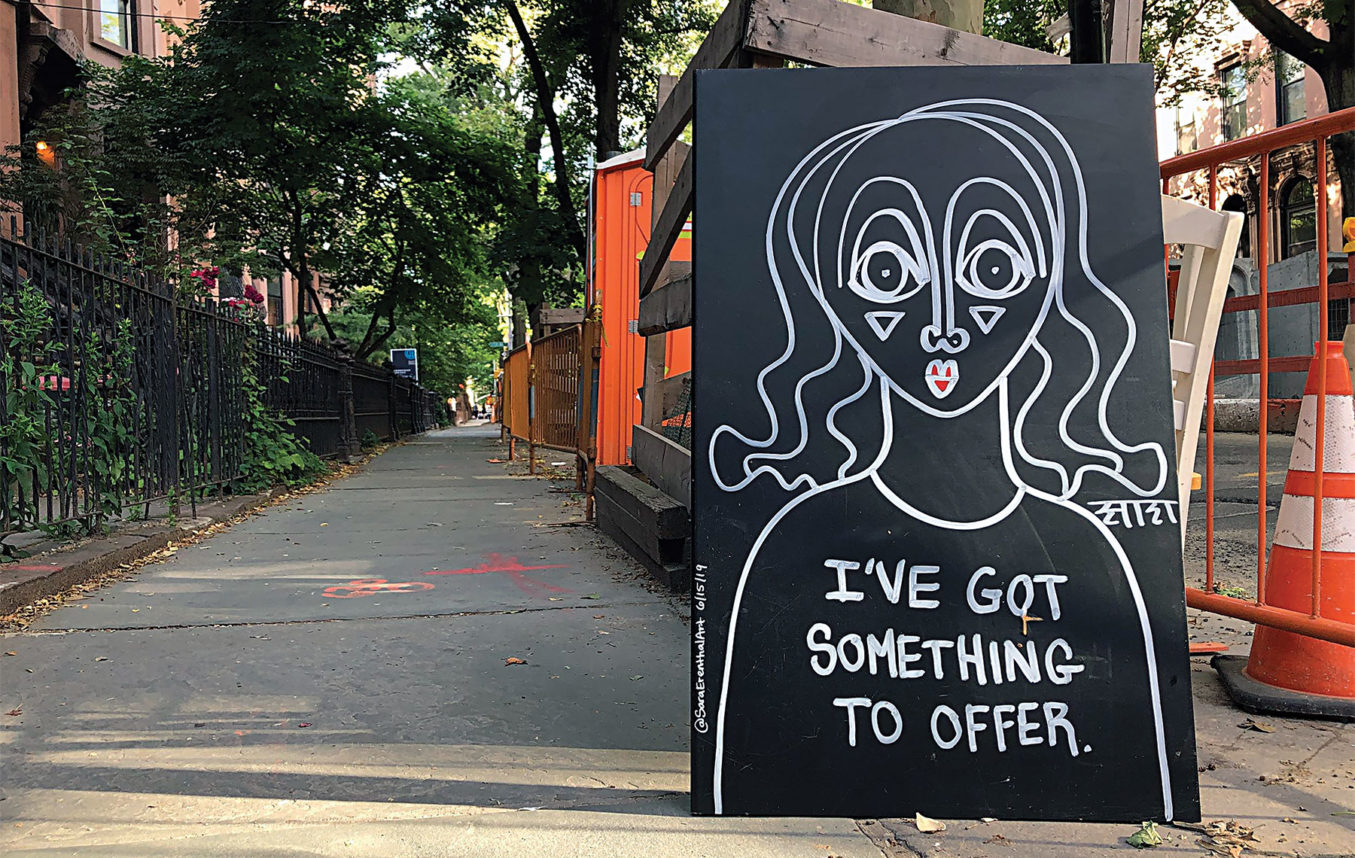
With phrases such as “Move forward,” “Listen carefully,” “Make art from your heart” and “Woman, speak up,” Sara Erenthal invites observers of her art to contemplation, if not action.
Erenthal upcycles found objects, everything from abandoned furniture and scrap wood to refrigerators and mattresses, then paints on them faces in black and white with large eyes and bright red lips. Her style is minimalistic and easily identifiable. Her portraits can be found from Los Angeles to New York, Berlin to Tel Aviv, as murals and on phone booths and mailboxes.
Self-taught, Erenthal displays her work on Instagram, sells studio pieces to private collectors and exhibits, and completes commissions internationally — all standard artist fare. But making public art is a radical departure from her upbringing.
Raised Ultra-Orthodox both in Israel, where she was born, and in New York, where her family later moved, her father subscribes to Neturei Karta, an ultra-Orthodox sect that opposes the creation of a modern Jewish state before the coming of the messiah.
At 17, when Erenthal’s parents arranged for her to marry a man she had never met, she ran away to relatives and enlisted in the Israeli army. During her service, she dropped her native Yiddish for contemporary Hebrew and began identifying as a secular Jew. Almost a decade after her discharge, she explored India, where she began drawing. That influence remains. Her works include what looks like the word “Art” somewhere on the right of most of her images. It is actually her signature in Sanskrit.
The Journal caught up with the Brooklyn-based Erenthal to discuss her work and her influences.
Jewish Journal: Your work focuses on themes of displacement, survival and liberation. Why do you call your trademark image a subconscious self-portrait?
Sara Erenthal: To me, it represents a feeling. It’s not literally me. It’s more of an emotion. I feel like that’s subconsciously me but it also represents women in general and also humanity. It’s very raw.
JJ: How do you describe her?
SE: That’s up to the viewer to interpret.
JJ: What do your images express?
SE: They tend to express my daily experiences, everything about life. Sometimes it’s really personal, sometimes less, sometimes political.
JJ: Your work appears in many different parts of L.A. How did that happen? And how much is here?
SE: I was there for 10 days in December 2018. Between posters and drawing on discarded objects and other little things, I must have made somewhere from 50 to 100 pieces.
Sara Erenthal;Photo by Janna Akimova
JJ: How many pieces have you made? Do you have any favorites?
SE: I have made thousands of pieces. Everything is my favorite because it’s all things that I need to express and what I’m going to through.
JJ: What prompted you to explore sexual themes?
SE: At this point in my life, I understand that it’s important for me to be truthful about reality. I see no limits of what I can express in my art. Life comes with all these experiences and sexuality is part of it. And lately, I am trying to be more open about that. People are afraid to talk about certain things, but I don’t see why we shouldn’t talk about it.
JJ: How would you characterize your work style?
SE: I’m always pushing myself and trying to outdo myself. Because I’ve been doing it for a while, I’m always hoping to grow and evolve and get better.
JJ: When do you work best?
SE: I’m nocturnal. I definitely have a lot more energy later in the day. It takes me a while to get myself to a place where I want to communicate or work with other people. It’s a slow process for me to get myself together. When I have a solo show or a mural [or] an international project and I have to finish by a certain time, it’s all open-ended.
JJ: How do you prepare before you visit a new place?
SE: I prepare a couple of different pieces that are ready to go, flyers or posters. Then it’s guerrilla art. [I post them] on a TV, the back side of an old shelf, a mirror, a refrigerator. Anything that is not someone’s property is fair game for me.
JJ: Which street artists inspire you?
SE: I think Banksy is an interesting artist. I am inspired by everyone who creates. I don’t like the label street artist. I like the term multidisciplinary artist. Public art to me is a really nice term because it makes art accessible to everyone and without any institution. You get to make your own choice of what you want people to see.
JJ: You posted a video of someone sawing a wooden piece you had previously painted. What are some of the strangest experiences you’ve had when it comes to your art?
SE: The most outrageous thing that has happened — it’s not that I did something outrageous — was someone cutting up mattresses to save the fabric with my art on it. I think about a mattress, what it’s been through. A lot of people ask me if I’m afraid of bed bugs.
JJ: Are you?
SE: No. But I wouldn’t bring [a mattress] into my home. For me, what is the most entertaining is the lengths people will go to have my art that they find. It’s also a huge compliment.
Corrections: A previous version of this article incorrectly stated the following: Erenthal was raised Chasidic; that she could have chosen to turn down a marriage proposal; and that she traveled to India immediately after leaving the army.
Lisa Klug is a freelance journalist and the author of “Cool Jew” and “Hot Mamalah: The Ultimate Guide for Every Woman of the Tribe.”
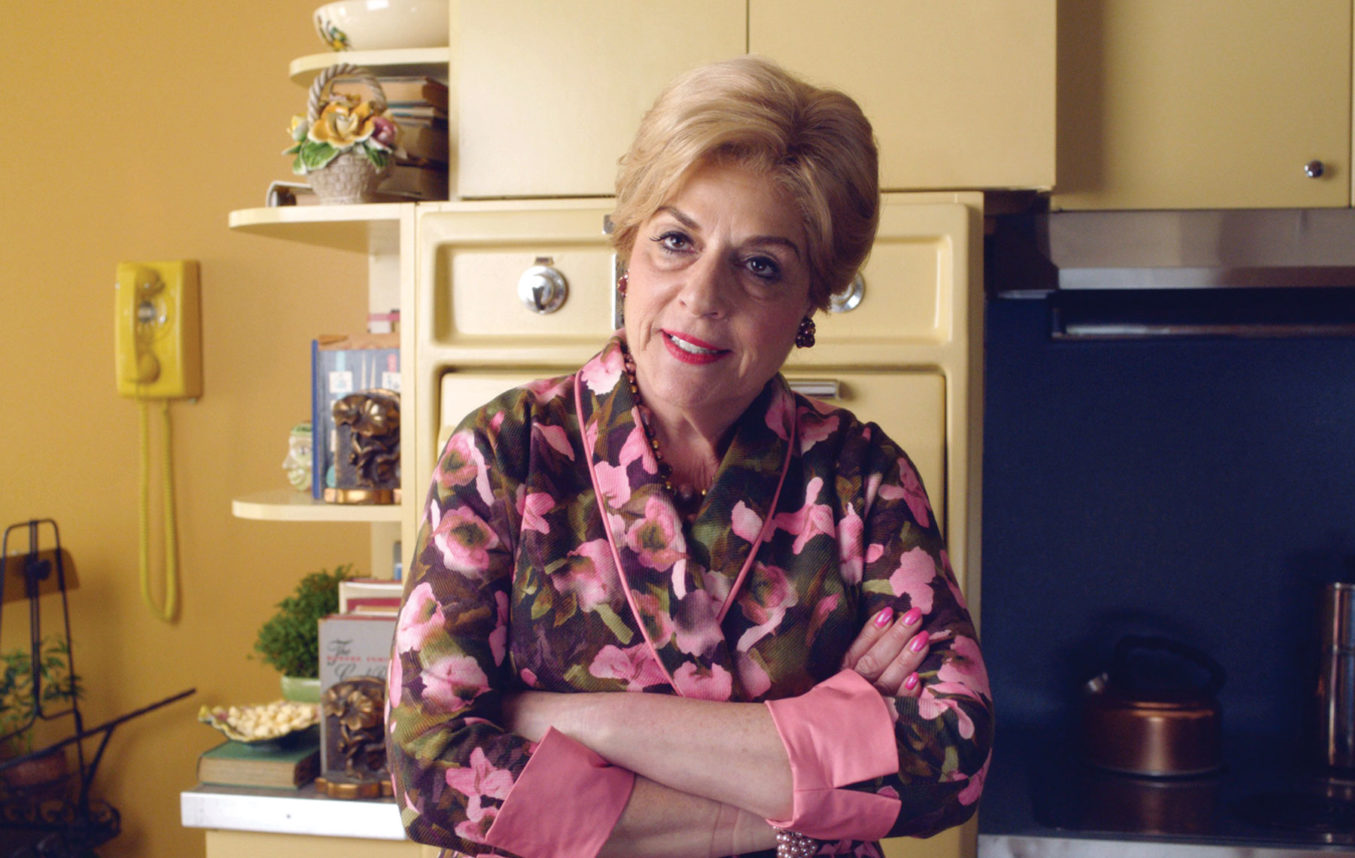
As Shirley Maisel, the loud and overbearing Jewish mother of Joel and former mother-in-law of the titular standup comedian in “The Marvelous Mrs. Maisel,” Caroline Aaron isn’t one to hold back. But when asked for details about the third season of the hit Amazon Prime series, which begins streaming on Dec. 6, there wasn’t a lot she was allowed to tell the Journal. So before getting into our interview, and without spoiling plot points under embargo, here’s what we can reveal, based on viewing the first five episodes.
As the opening act for singer Shy Baldwin (Leroy McClain), Miriam “Midge” Maisel (Rachel Brosnahan) hits the road with her manager, Susie Myerson (Alex Borstein), performing in a USO show and in Miami and Las Vegas. Sterling K. Brown (“This Is Us”) recurs as Baldwin’s manager and Liza Weil (who had a major role in the creators’ earlier production of “Gilmore Girls”) plays a band member that Midge befriends.
Midge gets a little closer to a male friend, but she and her ex, Joel (Michael Zegen), are still very much in each other’s lives — and not only because he takes care of their kids while she’s away. Joel begins a new venture, a nightclub, but gets a big surprise after he signs the lease.
Susie takes on a new client and may live to regret it. Midge’s father, Abe Weissman (Tony Shalhoub), becomes involved in social activism and we learn the source of his wife Rose’s (Marin Hinkle) family wealth. The upwardly mobile Shirley and Moishe Maisel (Kevin Pollak) have moved to a big house in Queens and changing circumstances put a strain on their relationship with the Weissmans.
Aaron described the season as “funny and important and sexy and musical,” giving credit to the “single vision” of husband-and-wife creators Amy Sherman-Palladino and Dan Palladino and the “A+ quality” creative team. She acknowledged that the accolades and honors the series has received raised the bar, “but Dan says that we just keep doing what we’ve been doing. The heavy lifting is on them,” she said. “I’m just glad I got invited to the party.”
Asked if she thinks Shirley plays into Jewish mother stereotypes, Aaron said her character “is a liberated woman for the times (the 1950s). She’s part of the family business; a participant in every way. She and Moishe are devoted parents but want to belong and climb, which is both an archetype and true. People always tell me that Shirley reminds them of someone they love, so there must be something authentic about her.” She added that the character “says everything to Joel that I would like to say to my son but can’t get away with.”
Aaron channels a loud, unfiltered cousin of her mother’s in playing Shirley, but her real-life inspiration was her own mother. She was a civil rights activist and Alabama-born Hungarian Jew who worked full time to support her three kids after Aaron’s father, a Lebanese Jew, passed away. “She taught me responsibility and gave me permission to follow what I wanted to do with my life. She also made it clear we had to leave the world a better place than we found it. I’m so grateful to have had her as a role model,” Aaron said.
Kevin Pollak, Caroline Aaron; Photo courtesy of Amazon Studios.
Raised in Richmond, Va., in a community with few Jews and one synagogue, Aaron said she had no idea there was “cultural Judaism” or what brisket was, and she didn’t have a good bagel until she moved to New York in 1980. “For me, the content — understanding what Judaism was about — was the only way by which I could identify myself,” she said. But her family did celebrate the secular aspects of Christmas because Aaron’s mother didn’t want them to feel left out or resentful and turn away from Judaism.
As an adult, Aaron “had to figure out what being Jewish meant to me. I love the ritual, the tradition and being part of a community.” She lived in Los Angeles for 24 years and belonged to Wilshire Boulevard Temple, where her children became bar and bat mitzvahs. She and her real estate broker husband, who met in New York and married in 1981, have relocated there for “Mrs. Maisel.”
“I go wherever the job is,” Aaron said, noting that acting has been a “longstanding passion” since her summer camp days. “I knew it was a risky thing to do but I really loved it. It has sent me down so many different pathways, walking in other people’s shoes.” Starting out in the New York theater, Aaron was studying with Uta Hagen when director Mike Nichols saw her perform a scene and cast her in the film “Heartburn.” She segued to “Crimes and Misdemeanors” and three other Woody Allen films, amassing 100-plus film and television credits.
Early on, Aaron worked hard to lose her Southern accent and played down her Jewish identity out of concern she’d be typecast and her opportunities would be limited. Now she has found her greatest success playing a Jewish role. “ ‘Maisel’ is everybody’s big break, no matter how much work we’ve done individually and collectively,” she said. “No one knew it would be this big of a hit. It’s once in a lifetime.”
Aaron’s future goals include returning to the theater as a playwright and an actor. She would especially like to resurrect her Southern drawl in a Tennessee Williams play. “I’m interested in the arts, whether it’s onstage or in music or painting,” she said. “These things we create bear witness to the time we’re living in after we’re all gone.”
Season Three of “The Marvelous Mrs. Maisel” begins streaming Dec. 6 on Amazon Prime.
Two things set apart “Mistletoe & Menorahs” from the other holiday romantic comedies airing on Lifetime this month. As the title suggests, it celebrates both Hanukkah and Christmas. But the story about an interfaith relationship also reflects the real-life love stories of its writer, Guy Yosub, and its lead actor, Jake Epstein. Both are Jewish and in interfaith marriages.
“It’s the story of two people who find each other and love the differences about each other. In today’s world I think that’s a beautiful message,” Epstein said. “And at this time of year when we’re inundated with Christmas programming, it’s a nice reminder that there are other cultures that celebrate in different ways.”
In the film, the couple falls in love as they learn about each other’s holiday traditions. Israeli-born Yosub recalled that his wife, Julianna Hays, an executive producer on the project, didn’t know much about Hanukkah when they met. “I had to do a lot of explaining. She had no idea what sufganiyot were,” he said.
Yosub endeavored to put as many Hanukkah touchstones as possible into the movie, including dreidels, jelly doughnuts, lighting the candles and making latkes. In a caroling scene, Broadway veteran Epstein sings “Hanukkah, Oh Hanukkah.”
Epstein met his wife, actress Vanessa Smythe, in high school. “We were friends, then sweethearts, then broke up. We kept in touch through the years, got back together and got married a year ago,” he said. He has fond memories of Hanukkah parties with his extended family in Toronto, where he once again resides after seven years in New York. “If you want to eat, you have to get up and tell a bad joke. It’s become a fun and competitive event.”
He had a “somewhat observant upbringing” that included Hebrew school, a bar mitzvah and celebrating holidays with family. “I would consider myself spiritually Jewish rather than religiously Jewish,” he said. “It was certainly a big part of my upbringing and certainly a big part of my identity.”
“At this time of year when we’re inundated with Christmas programming, it’s a nice reminder that there are other cultures that celebrate in different ways.”
— Jake Epstein
Exposed to theater early by arts aficionado parents, Epstein and his sister became actors at an early age. “It’s not always the easiest job to be an actor. You’re constantly looking for the next job,” he said. “I consider myself one of the luckiest people in the world to get to do this and that I’ve been able to have a pretty good career so far.” His credits include “Degrassi: The Next Generation,” “Designated Survivor,” “Suits,” and the musicals “Spring Awakening,” “Billy Elliot” and “Beautiful.”
Also in Lifetime’s “A Storybook Christmas,” premiering Dec. 7, Epstein currently is starring in “Dear Jack, Dear Louise” at the Arena Stage in Washington, D.C., and will appear in “Indecent” in Toronto in May. “Boy From the Sky,” his autobiographical one-act play that premiered earlier this year in Toronto, will be restaged there in 2020.
“I’m interested in writing and being part of great stories,” he said. “I love doing these Lifetime movies because they’re comedies. They’re really joyful and funny and fun to be part of. They’re really sweet and perfectly predictable. I think these movies are really comforting and I know a lot of people look forward to them every year.”
Yosub, whose parents are from Romania and whose father is a Holocaust survivor, was born in Ramat Chen outside Tel Aviv but grew up in Queens, N.Y., in a Reform Jewish home. He went to a Jewish day school, had a bar mitzvah and regularly attended synagogue. “The traditions, the lifestyle, are very important to me. I feel very connected,” he said, noting that Hays, whom he met at a poker game in 2008 and married this September, has been an eager student of the traditions. “We celebrate Hanukkah and Christmas, Easter and Passover now. If we’re lucky enough to have children, we’ll focus on the traditions of the holidays and the importance of family.”
Armed with a master’s in writing from Queens College, Yosub moved to Los Angeles in 2006 to pursue screenwriting, but after the economic crash and the writers’ strike in 2008, he took a job casting extras for film and TV. But with Hays’ encouragement, he eventually returned to writing scripts, several of which have sold. They include “Sign for Revenge,” a woman-in-jeopardy movie, and “Love at Daisy Hill,” set in Hays’ home state of Kentucky. While writing “Mistletoe & Menorahs,” he binged on rom-coms including “When Harry Met Sally” and “Sleepless in Seattle” for inspiration.
“These movies are becoming part of the lexicon of the season,” he said. “The whole family can gather round to watch. There’s a familiarity to it. All the joy of the holidays and the feeling of family and tradition shine through; the similarities between people and the family and tradition aspects of the holidays that are universal and we all share.”
He added, “I could not be more excited, happier and proud about it. I hope this becomes a tradition and we see a Hanukkah movie every year.”
Meanwhile, he has an idea for a sequel: “A Very Easter-Passover Wedding.”
“Mistletoe & Menorahs” premieres Dec. 7 on Lifetime and OnDemand.
Producer Elisabeth (Lizzie) Bentley, the spearheading force behind director Terrence Malick’s new biopic, “A Hidden Life,” first became aware of the film’s protagonist, Franz Jägerstätter, an Austrian conscientious objector during World War II, when her father urged her to read “In Solitary Witness,” sociologist Gordon Zahn’s biography of the unlikely and largely unknown hero. Bentley was 14 at the time.
Bentley spoke with the Journal on the phone from her home in Los Angeles and acknowledged that as a teenager she found the scholarly work a tad dry and did not complete it. Still, she was affected by Jägerstätter’s personal drama and stunning bravery. He was an uneducated, politically unaffiliated farmer who, on moral grounds, simply could not pledge his allegiance to Hitler. This resulted in his being tried, convicted of treason and finally executed in 1943.
In 2007 — the year Jägerstätter was declared a martyr and beatified by the Catholic Church — Bentley rediscovered Zahn’s work. This time she read it cover to cover and knew it was the movie she was destined to make. Her earlier credits included producing the documentary “Nanking” (2007), about the Japanese invasion of China in 1938, and co-writing “Beautiful Darling” (2009), a biopic about Candy Darling, a transgender pioneer. But Jägerstätter had special resonance.
“He was the answer to the big question, ‘Why didn’t more people resist?’ ” she said. “Here was someone who did just that.”
In some oblique (or perhaps not so oblique) way, his story brought together the unarticulated strands of her own life: her Jewish mother, her childhood home in Cambridge, Mass., awash in Holocaust refugees and, most central, her pacifist Catholic father. Following his tour of duty in World War II, he became even more radicalized when he learned about the boats of Jewish refugees who were turned away from American shores and sent back to Germany, where those Jews perished. Bentley’s father had recently died and while she was thinking about his life and mourning his passing, she encountered the book.
“It’s a downer, the idea that Franz doesn’t get away with it and no one is saved. Still, he did the right thing and that was reason enough for me to tell his story.”
Within two years, Bentley acquired the rights to the work and another, “Franz Jägerstätter: Letters and Writings from Prison.” The publishers were enthusiastic about the prospect of a movie. So too were German producers; Hollywood, not so much.
“There was a lot of fear,” Bentley said. “It’s a downer, the idea that Franz doesn’t get away with it and no one is saved. Still, he did the right thing and that was reason enough for me to tell his story.”
Bentley wrote an initial draft of the film and continued pitching for more than seven years until word somehow reached Malick (“Days of Heaven,” “The Tree of Life”), who was interested in making the film, at which point the investors surfaced.
“Terry has a unique sensibility in using the medium to capture spiritual truths and internal battles,” Bentley said. “His movies, not including ‘Badlands,’ catalyze experiences for viewers that are neither visible on screen nor in the dialogue.”
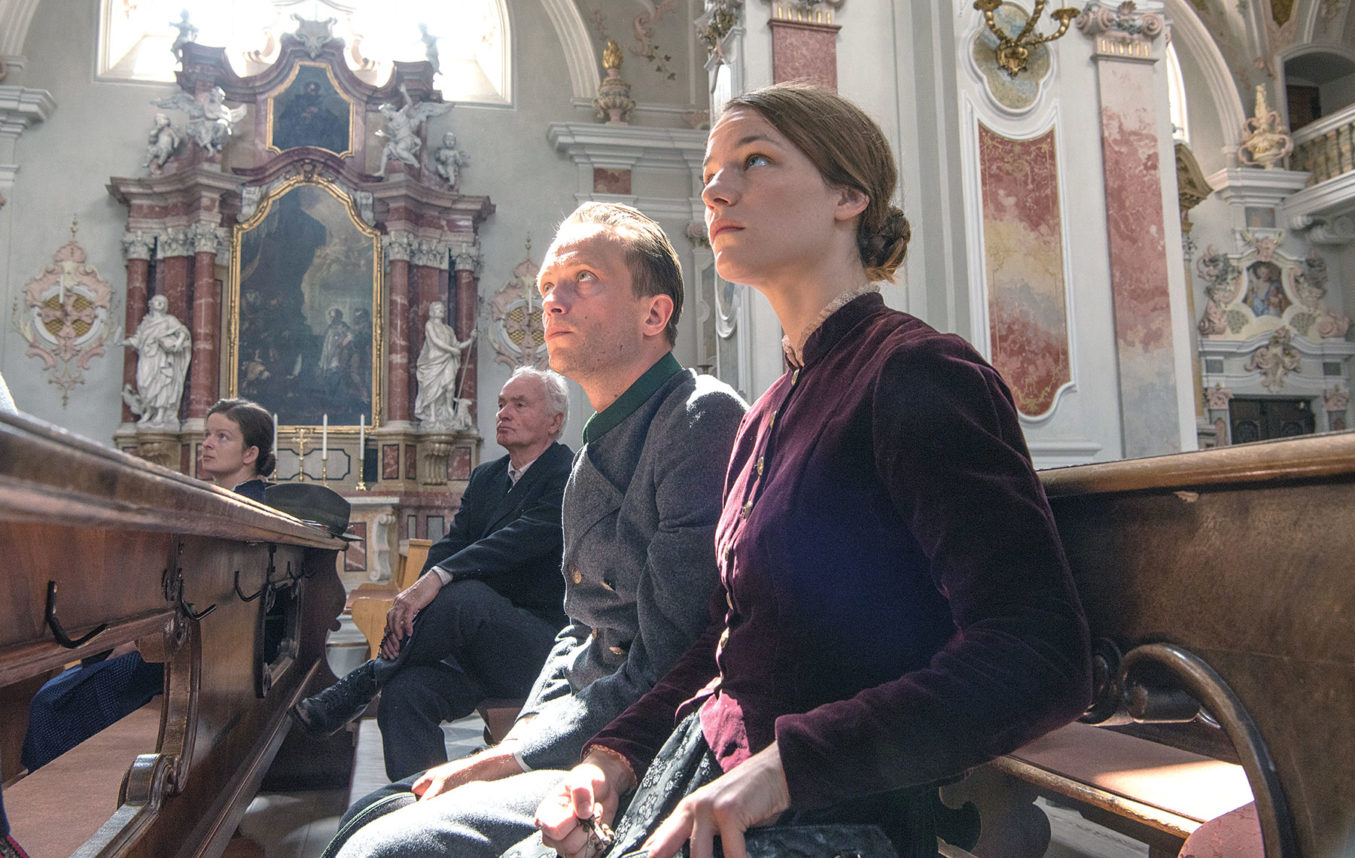
Set against a lush bucolic Austrian landscape, the close to three-hour film explores the inner turmoil of Franz (August Diehl), a husband and the father of three small children, who understands that his decisions will not only cost him his life but endanger the lives of his wife (Valerie Pachner) and daughters. Indeed, the family is flanked on all sides by Nazi sympathizers. Throughout, Franz is given the chance to recant his position and be freed. And repeatedly, he refuses. “A Hidden Life” is also an extraordinary love story in dramatizing a wife who fully supports her husband despite the onerous sacrifices involved.
It’s never entirely clear — and perhaps it’s a cinematic virtue — where Franz is coming from. No backstory is offered. He is simply an embodiment of a higher morality, though some might not find him all that moral in light of what it cost his family and the fact that no one else was helped in the process. Bentley loves the conversation the film evokes, though she herself has no doubt that Franz was right.
Asked how her views of Franz Jägerstätter have evolved, she admitted that early on she saw him through a rather childlike, one-dimensional lens. “Though I initially thought he was a saint, later through my research and interviews — I actually met with and corresponded with his wife — I found that he was a real human being,” Bentley recalled. “He was the father of an illegitimate child and had served time in jail for beating a man up. He was
very much a mixed bag and did not come to his conclusions easily.”
As for the language in the film — the Nazis occasionally speak German, mostly sputtering and bellowing, and German can be heard sporadically in the background — the leading characters are English-speaking. “I have no problem with that decision,” Bentley said. “I want Americans to see the film and for many, a foreign-language film would keep them away. Accessibility is the key.”
Bentley came of age in a heady world with two parents (though they separated early) who were left-leaning activists. Immersed in literature and movies of all stripes, Bentley enjoyed writing and telling stories. At Harvard, she majored in philosophy and religion, where “intellectual pursuit was valued in and of itself,” she said, before earning her master’s in filmmaking from USC.
To date, “A Hidden Life” is her most significant project, marking a major transformation in her sense of herself as she studied Franz’s journey, visited the important sites in his life and along the way spent time at Mauthausen concentration camp.
“That was not my plan, but my Austrian guides, including the editor of Franz’s letters, felt it was important that I see it,” she said. “Being there is not the same as reading about it. I had a visceral response realizing that had I been alive at the time of the Holocaust, I would have been indicated as a Jew.”
Bentley has recently formed a film production company, Marginalia, dedicated to fostering voices from the margins, which will ideally serve as a “cultural corrective,” she said.
“A Hidden Life” opens Dec. 13 at the Landmark and Arclight theaters.
Simi Horwitz is an award-winning reporter and film reviewer whose work has appeared in The Hollywood Reporter, Film Journal International, American Theatre and the Forward, among others.
In her new book, “Good Habits, Bad Habits: The Science of Making Positive Changes That Stick” (Farrar, Straus and Giroux), Wendy Wood, a professor of psychology and business at USC, opens with an anecdote that likely will feel familiar to anyone who has ever made a new year’s resolution.
It is the story of her cousin, who made a heartfelt proclamation on Facebook that she was going to change her life and lose weight. Friends cheered her on. And in the first two weeks, she did lose two pounds. But that was all.
Wood shares this not to throw her cousin under the bus — her telling is empathetic and nuanced — rather, to illustrate the point that “it’s pretty hard” to change ourselves but not impossible.
That possibility is no doubt what drew many of the 100 or so women who attended a Nov. 21 lunch-and-learn session with Wood sponsored by University Women of American Jewish University at AJU’s campus.
“I think in the Jewish tradition we have several ideas that engage with continuous self-improvement: the branch of Mussar which concerns itself with tikkun middot and continuous development and refinement of one’s character for instance,” said Beryl Bessemer, special projects manager at AJU and one of the event organizers.
“Habits by their nature are part of our non-conscious,” Wood told attendees. “So we don’t always know it when we are acting out of habit,” she said, adding, “Habits come to mind very quickly. You tend to respond based on habit first and your thought processing comes next.”
One strategy Wood recommends to try to get away from unwanted habits is creating friction. “Friction can be very simple,” she said. In one study she shared, participants were served two snacks: buttery popcorn and apple slices. The only difference was the distance of the respective snacks from participants. Some were served the popcorn immediately in front of them and had to reach for the apples. The others had the opposite setup.
“People ate three times more calories when popcorn was right in front of them than when it was something they had to reach for,” she said. “It doesn’t make sense consciously. But that’s not how habits work. Habits work on what is in close proximity to us so we can easily repeat it and form it into a habit. You can make the connection to your own kitchens and dining rooms.”
“Dopamine works for less than a minute so a reward you give yourself in a week or a month doesn’t help a whole lot in creating a habit right now.” — Wendy Wood
Friction, or lack of it, impacts our exercise habits, too, she said. Citing a 2017 study, Wood said researchers found that people who belonged to a gym 3.6 miles from their home exercised an average of five times a month while those who lived 5.1 miles away exercised an average of once a month. So proximity matters, whether it’s a gym or snack foods.
The way our brains work is that when we get a good outcome, there is a release of dopamine, Wood said. “But dopamine works for less than a minute so a reward you give yourself in a week or a month doesn’t help a whole lot in creating a habit right now,” she said. “The behavior you’re engaging in has to be enjoyable now in order to form a habit.”
Finally, she said, remember that it takes time to create new habits. Wood said research done by one of her post-doctoral students revealed that adding even a simple healthy behavior to your routine can take two or three months of repetition to become semiautomatic and longer for more complicated habits.
“The wonderful thing about this,” she said, “is because habits are such a slow learning mechanism, you can quit for a day or two and habit learning will be just about where you left off.”
Good Habits, Bad Habits: The Science of Making Positive Changes That Stick is available on Amazon.
The organization was formed in 1998 to promote awareness and education about the Holocaust. The IHRA definition of anti-Semitism, which is the definition the State Department uses, states that illegitimate criticism of Israel is anti-Semitism, including double standards and comparing the Israeli government to the Nazis.
Israeli Foreign Minister Israel Katz said in a statement, “Preserving memory of the Holocaust and the fight against anti-Semitism are connected to each other. The past must be recognized and remembered in order to guarantee the future.”
Anti-Defamation League CEO Jonathan Greenblatt also praised the move.
“Congratulations to Portugal for becoming a full member of @TheIHRA,” he tweeted. “As the number of survivors dwindles, it’s especially vital that nations worldwide commit to keeping the memory of the Holocaust alive.”
Congratulations to Portugal for becoming a full member of @TheIHRA. As the number of survivors dwindles, it’s especially vital that nations worldwide commit to keeping the memory of the Holocaust alive. https://t.co/MbIYRd4Ozp
The American Jewish Committee similarly tweeted, “We welcome Portugal’s decision to join the International Holocaust Remembrance Alliance. This is an important step in the effort to combat rising anti-Semitism.”
We welcome Portugal's 🇵🇹 decision to join the International Holocaust Remembrance Alliance. This is an important step in the effort to combat rising antisemitism. Thank you @nestrangeiro_pt for taking action!https://t.co/VZiofrKmxN
On Dec. 3, the France National Assembly – the lower house of the French parliament – voted to adopt the IHRA definition of anti-Semitism with 154 in favor and 72 against.
Liz Vogel, the Los Angeles executive director of the nonprofit Facing History and Ourselves, recalls the moments in her young adulthood where she experienced anti-Semitism. And yet, she told the Journal, she never expected to see and discuss “increased levels of anti-Semitism and hate speech on school campuses at this level in 2019.”
According to the Anti-Defamation League’s Anti-Semitism tracker, more than 40 incidents of anti-Semitism were reported in the United States in November alone. And after its September “Hate Beyond Borders” report, the organization stated, “Over the past decade, we have seen surging violence in the United States and Europe motivated by right-wing extremism.”
Even the United Nations released its first report on anti-Semitism on Sept. 20, warning American Jews about white supremacy and anti-Zionism.
Since its founding in 1976, Facing History has provided in-depth curricula on race, the Holocaust, genocide and human rights in America for charter, private and public middle and high schools around the country. Its goal is to teach students to stand up to bigotry and hate.
The organization also provides resources nationally and internationally. In Los Angeles, those resources have been sent to around 1,600 educators in the Los Angeles Unified School District covering 250 middle and high schools. And in Southern California as a whole, Facing History has provided educational material to 8,500 educators teaching in 1,300 schools.
Vogel, who has been a part of Facing History since 2001, said lately its members have been providing more information on the Holocaust along with other forms of racial injustice. At the heart of every program, she said, the first thing is to encourage young people to be “upstanders” rather than bystanders.
“We are looking to engage teachers and students in a study of the Holocaust through a particular lens which is human behavior,” Vogel said. “[Holocaust education is] about the specific choices that people made at a certain place and time,” she said, “and the factors that contribute to the way they make choices, which start with individual and collective identity. … As students start to explore their own identities, they navigate profound questions about the world and they are connecting history to their lives today.”
One way Facing History accomplishes this is by creating extensive programs that go beyond English and history classes. In May, 10th-graders from Ánimo Jackie Robinson Charter High School in downtown Los Angeles took part in Facing History’s six-week Holocaust education program, implemented in English, history, math, science and art classes.
Students also read Holocaust narratives and met survivors to learn from their firsthand experiences what it meant to play a role in propaganda and how to stand up for others.
“We don’t tell them what to believe. We don’t tell them what they need to do in terms of what action they need to take but we help them develop a framework and a language in the sense that their voices matter.” — Liz Vogel
Vogel said narrowing in on “bystanders” is crucial because “most people were not victims; most people were not perpetrators; most people were bystanders.” By acknowledging that first, students see how they play a part in preventing history from repeating itself, she said.
Vogel added one of the ways the organization has evolved over the years is by using younger historical upstanders. One voice that resonates, she said, is Anne Frank. Facing History partners with the Museum of Tolerance to bring other young voices from the Holocaust to the classroom for an experience that goes beyond text.
“Facing History students are more likely to feel a responsibility to be physically active and believe they can make a difference in the community,” Vogel said. “We don’t tell them what to believe. We don’t tell them what they need to do but we help them develop a framework and a language in the sense that their voices matter.”
Facing History resources don’t apply only to students. The organization also holds workshops for educators. The most recent workshop took place in September at the Los Angeles Central Public Library. Vogel said frequent topics that come up in the workshops revolve around global immigration to issues of ignorance and hatred such as anti-Semitism. She said, unfortunately in recent years, these issues have become more prevalent in Southern California.
The workshops, while helpful to teachers and administrators, are also valuable to Facing History because they take the information and adjust their resources accordingly. This year, Vogel said she was shocked to learn that some teachers are now confronting Holocaust denial in classrooms.
“A few teachers actually said they are dealing with [this] and it is the first time in their careers,” she said. “These are veteran teachers. I think teachers are looking for tools and strategies for how to engage.”
In addition to teaching in-depth Holocaust education, Facing History also teaches the Armenian genocide and incorporates it into the unit, something that not all California schools do even though it is required.
“Expanding education on injustice or genocide beyond the Holocaust is essential,” Vogel said. “It helps students draw a connection to the history and the present. It doesn’t relegate the history to one group of people or one set of victims. Expanding the study and perspective on anti-Semitism sort of safeguards the opportunity to distance ourselves from our actions.”
She added that by bringing together the two, students could see the steps in which each genocide occurred and what they can do to prevent it from happening again.
Vogel remains dedicated to Facing Values because, she said, it is the kind of education she wants her children and all children to have.
“I didn’t feel that democracy in our country was fragile but since I have moved through the world and working with Facing History for the past 18 years, there is a much more acute sense about that fragility and we are feeling it,” she said. “I don’t have to explain why Facing History is important anymore but it feels like we are in this place where having this kind of education to connect with young people is essential.”
A Jewish Sephardic vocalist backed by an Arab Moroccan string ensemble formed the backdrop to a unique event at the Beverly Hills Hotel when San Fernando Valley-based Em Habanim Sephardic Congregation honored Morocco’s longstanding respect toward its Jewish community.
The Nov. 19 event, titled “Salute to Morocco: Honoring a Dynasty of Tolerance,” featured a rare appearance by Princess Lalla Hasnaa, daughter of the late Moroccan King Hassan II and youngest sister of current King Mohammed VI, together with around 50 other delegates from the North African country.
UCLA anthropology professor Aomar Boum, who has devoted himself to the study of Moroccan Jewry, introduced Hasnaa.
Boum, who was raised Muslim in southern Morocco, told the close to 500 attendees, “From an early age, Her Royal Highness Princess Lalla Hasnaa has shown a keen interest in social issues, particularly the environment.”
Em Habanim Rabbi Joshua Bittan, who orchestrated the event, told the Journal, “It was a salute to Morocco and all they are doing, and honoring the dynasty of tolerance because not just the current king but his father was good to the Jews.”
Bittan, who hails originally from Morocco, also explained how the current king’s father, the late Hassan II, helped bring about peace between Israel and its Arab neighbors, while the king’s grandfather, Mohammed V, objected to the Vichy government in France during World War II. Working with the Nazis, the Vichy regime tried to order the deportation of Morocco’s Jews to European concentration camps. It didn’t happen, Bittan said, in part because of the Moroccan king.
Em Habanim Sephardic Congregation Rabbi Joshua Bittan escorts Moroccan Princess Lalla Hasnaa into the Beverly Hills Hotel banquet hall. Photo courtesy of Em Habanim Sephardic Congregation
Bittan came up with the idea of inviting the delegation after reading in The Jerusalem Post about the current Moroccan king’s efforts to incorporate Holocaust education into the curriculum of the country’s high schools.
“When we live in a period where there are Holocaust deniers, he had the courage to make it part of education in high school,” Bittan said. “I was very impressed.”
Bittan also noted that the king’s commitment to respecting the country’s Jewish history included refurbishing synagogues and cemeteries, and restoring the names of Moroccan streets named after the country’s Jews.
“He has been very good to us,” Bittan said. “We have to recognize and give credit to that and express gratitude.”
“We hope the model of Morocco can be emulated in other countries, in other societies, where people are respectful of each other, where Muslims and Jews have respect for each other.”— Rabbi Joshua Bittan
During the event at the hotel, Princess Hasnaa awarded four local Moroccan-born community members the Wissam al Arch, or Order of the Throne, an official state decoration of the Moroccan kingdom. The recipients included Em Habanim members and event co-chairs Maurice Marciano, co-founder and former chairman of Guess, and Jack Rimokh, chairman and CEO of Signal Brands.
“[Marciano] was born in Morocco. He is a major philanthropist and he is a source of great pride for the Moroccan people,” Bittan said.
The other recipients were Bittan as well as 93-year-old Em Habanim board member Sidney Chriqui, who was living in Morocco during the war and at 16 was slated for deportation to Europe. However, days before the deportation, the Allies landed in North Africa as part of Operation Torch, on Nov. 8, 1942. This, coupled with the then king’s consideration of Jews as equal to other Moroccan subjects, saved his life, Chriqui said.
“We were really saved by the king and then by the landing,” Chriqui told the Journal. “The king actually objected to the Vichy government.”
Casablanca native and Jewish Journal Publisher and Editor-in-Chief David Suissa also spoke at the event about his personal connection to Morocco, and how Moroccan culture instilled in him a “Judaism of the sun,” one of “warmth, community and optimism.”
It also was an evening of great pomp and ceremony, with former L.A. mayor Antonio Villaraigosa presenting the Moroccan delegation a proclamation by the City of Los Angeles declaring Nov. 19 as Morocco Day in the city. Models entered the event wearing Moroccan couture, and Bittan escorted the princess into the banquet hall.
Local attendee Yaffa Ben Harosh told the Journal she was excited to see the princess and managed to snap a photograph of her. She said the event was an opportunity for her to connect with her ancestral homeland and pass on the photo capturing the princess’ visit to the next generation. “I have a duty to send this to my daughter to teach her about her ancestors,” Ben Harosh said.
“I know all of you continue to hold Morocco dearly in your hearts. You are all outstanding ambassadors of what makes Morocco so special and nobody better than you can tell our story.”
— Princess Lalla Joumala
Ben Harosh added that the liturgical tunes performed by the Arab Muslim band singing with a Jewish performer were akin to “praying with music. It’s very important in the Moroccan Jewish tradition,” she explained.
Bittan added, “The same melodies that are used by the Muslims are the same melodies we use in our liturgy in our synagogue.”
The event was the third in a brief visit for the delegation, which made its first stop at Em Habanim in Valley Village on Nov. 17 followed by a visit with The Jewish Federation of Greater Los Angeles on Nov. 18.
Speaking at Em Habanim, Boum discussed Morocco’s continued embrace of Jewry through its preservation of Jewish sites, welcoming Jewish tourists and educating its Muslim community about Judaism.
Moroccan Princess Lalla Hasnaa (right) presents an official Moroccan state decoration to businessman and philanthropist Maurice Marciano. Photo courtesy of Em Habanim Sephardic Congregation
“It is not a coincidence,” he said, “that Jewish life is thriving in Morocco today even as the number of Jews living in Morocco is plummeting.”
Princess Lalla Joumala, ambassador of Morocco to the United States and Princess Hasnaa’s cousin, also spoke at the Em Habanim event, saying she appreciated the L.A.-based Moroccan community’s connection to its ancestral country.
“I know all of you continue to hold Morocco dearly in your hearts, and I encourage you to continue representing and supporting your country in your various capacities,” she said. “You are all outstanding ambassadors of what makes Morocco so special and nobody better than you can tell our story.”
Bittan said other Arab countries would do well to follow the lead of Morocco and, rather than demonizing Jews, celebrate their connections.
“We hope the model of Morocco can be emulated in other countries, in other societies, where people are respectful of each other, where Muslims and Jews have respect for each other,” he said. “This is what Morocco is doing and that is something that should be emulated by others, and that was the spirit of the evening and the spirit of this week.” n
The word on the street is that polenta must be stirred constantly while it cooks, similar to risotto. There are even automatic polenta stirrers made in Italy to alleviate the monotony of the task. For $165, plus $60 shipping, you can get a bronze automatic polenta maker delivered to your doorstep.
But you can make polenta without stirring constantly. You just need to stir it every 10 minutes to get a lump-free, creamy polenta, and even for the luxurious folks out there (read: lazy), that’s doable.
Here’s a vegetarian ragù that won’t make you miss meat. It’s hearty and deeply satisfying. But what takes it over the top is the sweet and tangy red wine reduction stirred in at the end. Simmer red wine with onion, thyme and a cinnamon stick. Finish it with a grated truffle sheep’s milk cheese — because my cooking students really like cheese and truffles.
The first time making this, in order to get the timing right and to be relaxed while cooking, I recommend getting the ragù done first before starting the polenta, and reheating it when you’re ready for it.
No-Stir Polenta with Lentil Ragù
with wine reduction and truffle cheese, from “Meal and a Spiel: How to Be a Badass in the Kitchen”
Wine reduction sauce:
1 tablespoon unsalted butter
1/2 cup red onion, finely chopped
1 carrot, cut into 1-inch pieces
1 celery stalk, cut into 1-inch pieces
1 cup red wine
1/2 cup water
1 teaspoon raw honey
1 stick cinnamon
3 to 4 sprigs fresh thyme
Lentil ragù:
1/4 cup extra-virgin olive oil
1 large onion, halved and thinly sliced
1 pound portobello mushrooms, stems removed and cut into 1/2-inch slices
(or 1 pound cremini mushrooms, stems removed and halved)
1 bunch chard, bottom stems removed
and cut into 1/2-inch strips
1 cup French green lentils, cooked(see note)
1 1/2 teaspoons kosher salt
10 to 20 grinds of the pepper mill
Wine reduction sauce (recipe below)
Polenta:
4 cups water
1 teaspoon kosher salt
1 scant cup polenta or coarsely groundyellow cornmeal
2 tablespoons unsalted butter
3/4 cup grated Parmigiano Reggiano
4 ounces Moliterno al Tartuffo(or another truffle cheese)
For the wine reduction sauce:
In a small saucepan over medium heat, sauté onions in butter until soft and golden, about 10 minutes.
Add carrot and celery and sauté for another 5 minutes.
Add the wine, 1/2 cup of water, and whisk in honey. Add cinnamon and thyme.
Reduce mixture until there is about 1/4 cup of liquid. Let cool.
Remove the carrot, celery, cinnamon and thyme.
For the lentil ragù:
Heat a heavy-bottomed pan over medium-high heat for a couple of minutes.
Add the olive oil followed by the onion, and cook without much stirring until you see dark brown spots form on the edges, 7 to 10 minutes.
Lower heat to medium and continue to cook until onion is caramelized, another 7 to 10 minutes.
Add mushrooms, stir and sauté for a few minutes.
Add chard, stir and sauté until it wilts.
Add cooked lentils along with any remaining cooking water, not exceeding 1/2 cup.
Add salt and pepper, and cook until the mushrooms and chard are tender.
Add wine-reduction sauce and stir to combine.
For the polenta:
In a medium saucepan fitted with a lid, bring 4 cups of water to boil with a teaspoon of salt.
Add the polenta slowly, whisking the entire time to prevent lumps. After all the polenta has been added, reduce heat to low and whisk for two minutes. Cover. Set a timer for 10 minutes.
After 10 minutes have passed, uncover polenta and whisk for one minute. Reset your timer for 10 minutes. Continue the process, being sure to scrape the sides and corners of the pan. Switch to a wooden spoon after the polenta has thickened. After the polenta has cooked for about 45 minutes, remove from the heat.
Stir in the butter and Parmigiano. Taste and adjust salt, if needed. Cover and let rest for 5 minutes.
Serve topped with the lentil ragù and shaved truffle cheese.
Serves 4 to 6.
Note: To make the one cup of lentils, I cook lentils in a rice cooker using 1/2 cup of water for 1/4 cup lentils. Lentils also can be cooked on a stovetop, using 3/4 cup of water for 1/4 cup of dry lentils. Bring to a boil, cover, reduce heat and simmer until tender, about 25 minutes.