fbpx

October 25, 2019

Australian Teen Charged with Allegedly Threatening to Kill Jewish Student

A 16-year-old Australian teenager was charged on Oct. 24 for allegedly threatening to kill a Jewish student who was bullied over the summer.

In July, the unidentified 12-year-old student was forced to kiss the feet of a Muslim student, which was filmed and spread on Instagram. The teen was allegedly infuriated at the media attention the incident received, prompting the alleged threats to the student as well as his mother. The messages reportedly included the teen encouraging the Jewish student to commit suicide.

The mother filed a complaint to police over the alleged messages, prompting the 16-year-old to be arrested earlier in the month. He is scheduled to go to court in November.

A police spokesperson told the Sydney Morning Herald, “Police have charged a 16-year-old Moorabbin boy with make threats to kill, use telecommunications device to harass and stalking in relation to alleged incidents involving a 49-year-old woman and 12-year-old boy between October 7 and 9.”

The Jewish student had reportedly been subjected to further anti-Semitic harassment after the video of him kissing the Muslim student’s shoes became viral; the school, Cheltenham Secondary College, didn’t classify the incident as anti-Semitic. The student has since left the school.

Additionally, a five-year-old Jewish student left Hawthorn West Primary School after being subjected to anti-Semitic slurs about being circumcised and called a “dirty Jew.” The student’s mother told Australia Jewish News that the school wouldn’t admit “there was an anti-Semitic issue,” resulting in the student being homeschooled until his parents find him a new school to enroll in.

Australian State Education Minister James Merlino announced on Oct. 4 that one of the students involved in the student being forced to kiss the Muslim student’s shoes was suspended. However, the ministry will still investigate both incidents, as Merlino said that he’s “still very concerned by the parents’ reports and I have asked for an immediate review into how both schools have handled these matters, to ensure they were dealt with appropriately.”

Australian Teen Charged with Allegedly Threatening to Kill Jewish Student Read More »

Before the Beginning – Thoughts on Torah Portion Bereisheet

The rabbis of the Talmud don’t agree with the beginning sentence of the Torah. The book of Genesis begins, as it is usually translated, “In the beginning, God created the heavens and the earth.” The ancient ones knew that there had to be more to the story than this.

The rabbis knew that there was a beginning before the biblical beginning – they knew that will precedes action, and ideally, thought precedes will. In the Midrash (early rabbinic commentary on the Bible), the rabbis discussed what was in the Divine Mind that preceded creation. The real beginning, you might say.

They seemed to agree that one had to assume a Divine mind and will that generated creation. The ancient rabbis’ term for the Divine mind and will that preceded creation was “supernal wisdom of the Divine Mind” – “chochmah shel ma’alah” – “Upper Wisdom”. A synonym for this supernal wisdom is “Torah”, referring not to the book we possess, but to Divine intelligence. Remember, that the word “Torah” literally means “teaching”, but in the ancient world the Hebrew word “Torah” was used to translate the philosophic term “Logos” – the aspect of the Divine mind that orders creation.

In fact, the Midrash tells us that the Five Books of Moses that we have is but a “novelet” (unripen fruit) of the upper wisdom (Bereishit Rabbah 17:5). In Midrashic thought, the Torah we have is a placeholder in the material universe for the mind of the Divine in the metaphysical world – an access point for entry into the upper wisdom. The beginning was the mind of God, which has no beginning.

What are the contours of the upper wisdom? “R. Zutra bar Tobiah said in the name of Rav: The world was created by means of ten capacities and powers: By wisdom, by understanding, by reason, by strength, by moral correction, by might, by righteousness, by judgment, by loving-kindness, and by compassion.” (Talmud, Chagigah 12:a).

In the world view of the ancient rabbis, before the beginning, Torah came into being, but not Torah as the text, but rather Torah as an energy, the Logos of the Divine Mind. Divine qualities compressed themselves into a singular thing that became the means by which the Divine could create.

Imagine you are trying to write a poem or a song, or any work of art, and imagine the prodigious mental and spiritual effort that precedes the act of creation. If the creative work flows outward, it means the living waters of meaning had already been taking shape down within the soul. Thought and will precede creation, even thought and will hidden in chambers of the unconscious.

Now imagine that the first words of the Torah were, “In the beginning there was a great song, a song sung in the darkness, singing out, hovering over the limitless abyss.”

The ancient Rabbis saw the Torah that preceded creation as such a song, an unarticulated poem put into words. They thought that every human being was trying in the depths of their souls to sing this song and recite these words.

https://pin.it/miqff4fzo6jzoc

An aspect of the Divine song was compressed into a singular phenomenon where divine energy took on physical mass, just enough for the universe to explode into being.

Other aspects of the Divine song – the song of creation – fill the universe and fill our souls.

The biblical authors had to begin somewhere, so they sighed and began at a beginning, “In the beginning”, that was no beginning, but at least that beginning pointed toward a deeper beginning that is trying to sing its way into our consciousness. 

Shabbat Shalom,

Rabbi Mordecai Finley

Before the Beginning – Thoughts on Torah Portion Bereisheet Read More »

Rosner's Domain Podcast

Danny Ayalon: The future of the relationship between Israel and American Jewry


Shmuel Rosner and Danny Ayalon discuss Israel’s relations with American leadership, Jewry and more.

Danny Ayalon is an Israeli diplomat, columnist and politician. He served as Deputy Foreign Minister and a member of the Knesset for Yisrael Beiteinu. He served as Israeli Ambassador to the United States from 2002 until 2006. He frequently writes in Israeli and international newspapers, notably in The Jerusalem Post and The Wall Street Journal.

danny ayalon

Follow Shmuel Rosner on Twitter.

Danny Ayalon: The future of the relationship between Israel and American Jewry Read More »

What Do Jews and Kurds Have in Common?

Kurds have more in common with Jews than I had ever imagined before I arrived in northern Iraq last week to interview refugees fleeing Turkish aggression.

Kurds are an ethnic group that alleges to have existed since biblical times. They have a clear sense of their homeland, and their loyalty to their people extends well beyond transitory changes to borders, language and religion. Kurds have lived in a warped form of diaspora since external powers superimposed countries where they existed for centuries. They are a people struggling to survive in the very place they have lived for centuries. Sound familiar?

There are 30 million Kurds in the world today, approximately twice as many as there are Jews. In 1916, a secret plan to carve up the Middle East, known as the Sykes-Picot Agreement between France and Britain, was put into effect, for which we are all still paying the high cost. The Kurds, who at the time did not have a nation, found the territory in which they had lived for centuries had been assigned to Turkey, Syria, Iraq and Iran.

Kurds are without a state although they occupy a mountainous borderlands region that includes parts of Iran, Iraq, Syria and Turkey that often is referred to as Kurdistan.

Since their alienation by the imposition of the new countries, Kurds have had to navigate the rivalries and wars of the countries in which they live while maintaining their identities. Kurds who live in the northern part of Syria face a new peril as Turkey consolidates its position there through its agreement with Russia.

We know from the study of not only the Holocaust but also the 20th-century genocides that targeted Armenians, Tutsi Rwandans, Bosnian Muslims and indigenous Guatemalans that the cover of military objectives is used by powers to execute more sinister goals.

The term “ethnic cleansing” has been used to describe Turkey’s goals but this is a euphemism that makes the removal of civilians seem more palatable. The Nazis used their own ethnic cleansing euphemism “Judenrein” — cleaned of Jews — to hide their genocidal killing from plain sight. “Ethnic cleansing” is not an end in itself, it is a means to bring the life of a community in a particular place to an end. Deadly, violent or nonviolent, ethnic cleansing is motivated by ethnic hatred and violates many international conventions and laws.

“Like Jews who fled Germany in 1933, before it was too late, the families I have been speaking to decided not to wait to find out how lethal Turkey, Russia and Syria will be.”

In situations like the one unfolding in northern Syria, as the crisis ramps up, the voices of the victims become increasingly silenced. News agencies are interested in the politics, the casualties, the body count. But victims who know more about what is happening than anyone tend to get silenced.

During World War II, the media gave astonishingly short shrift to the Holocaust. When the atrocities were covered, the news was often downplayed. Consider this headline — discovered in a recent project by the U.S. Holocaust Memorial Museum — in the Nov. 25, 1942, edition of the Los Angeles Times: “Half of Jews in Europe Dead.” Front-page news? Guess again. It ran on page two.

Or this piece in the New York Daily News the same month: “Jews Declare 5,000,000 Face a Nazi Death.” Page 45.

The Jews facing persecution were acutely aware of the neglect. This is why Jews in the Warsaw Ghetto were feverishly documenting their story, as depicted in Roberta Grossman’s most recent docudrama, “Who Will Write Our History?” They knew if they did not tell their story, who would?

I am currently in northern Iraq to research why refugees who are crossing the border into southern Kurdistan decided to leave their homes. It may seem obvious because they have been living under a hail of Turkish shells. However, it is clear that the only reason that Turkey is in Syria at all is to displace the Kurds. Like all other dangerous regimes, they blame the victims, labeling Kurdish separatist militias as terrorists, which is no reason to terrorize the entire population in return.

The refugees I have met to date confirm my suspicion that there are two distinct reasons for their hurried departure from northern Syria. The first is the immediate threat of death from the military operation. The second is a longer-term visceral understanding that they cannot survive in a region occupied by powers that do not want them there. If they sense their community is in danger, then it probably is because they understand the threat more than any of us. Like Jews who fled Germany in 1933, before it was too late, the families I have been speaking to decided not to wait to find out how lethal Turkey, Russia and Syria will be. They know it is far from over.

Kurds in southern Kurdistan have a regional government in northern Iraq where, unlike many countries across the Middle East, they believe in a multicultural society. They recently renamed their Ministry of Muslim Affairs to the Department of Religious Affairs to ensure all religious traditions are represented. There are Christian Kurds, Zoroastrian Kurds, even a handful of Jewish Kurds (living in Israel now).

Like Jews in the past who needed non-Jews to speak out for justice, Kurds need vocal advocates who understand the threat they are facing to speak up now.


Stephen Smith is the Finci-Viterbi executive director of USC Shoah Foundation and UNESCO Chair on Genocide Education.

What Do Jews and Kurds Have in Common? Read More »

Connecticut Synagogue Evacuated After Receiving 2 Bomb Threats

(JTA) — A synagogue in Connecticut has been evacuated after it received two bomb threats.

Congregation B’nai Israel, a Reform congregation in Bridgeport, was evacuated on Friday while police investigated the threats, the city’s police said on Twitter.

The police department said all had been evacuated safely.

Sunday marks the one-year anniversary of the shooting at the Tree of Life Synagogue in Pittsburgh, in which a gunman killed 11 people.

The American Jewish Committee is organizing a campaign urging people to attend synagogue this Shabbat to show solidarity with Jews in light of the anniversary. The group said that the Bridgeport synagogue had signed up to participate in the campaign.

Connecticut Synagogue Evacuated After Receiving 2 Bomb Threats Read More »

Canadian School Expels Several Students Over Alleged Anti-Semitic Posts

A private school in Vancouver, Canada announced on Oct. 17 that they expelled several students over allegedly anti-Semitic social media posts.

St. George’s School, an all-boys preparatory school grades 1-12, said in a statement that an unspecified number of students took part in “deeply offensive behavior online” that they said ran contrary to the school’s values. 

However, the statement noted that the students’ behavior did not amount to criminality and they did not find anyone in the community at risk of being harmed. A police investigation on the matter is ongoing.

A parent of a student at the school told CTV News Vancouver that the content in question included “anti-Semitic posts online celebrating the Holocaust” as well as a “Nazi salute on campus.” Global News Canada similarly reported that they had sources say that “the students were involved in a neo-Nazi Facebook group,” although some said it was mainly Instagram posts in question.

B’nai Brith Canada CEO Michael Mostyn told the Algemeiner on Oct. 24, “We commend St. George’s for taking this deeply offensive and racist behavior seriously,” adding that Canadians “need to uphold a zero-tolerance policy on hate, bigotry, and discrimination.”

The Anti-Defamation League tweeted on Oct. 25, “Making Nazi salutes on campus, mocking the Holocaust, and making #racist and #antiSemitic comments is reprehensible. Good that this school in Vancouver took strong action immediately.”

Canadian School Expels Several Students Over Alleged Anti-Semitic Posts Read More »

UK University Expels Student Who Posted Photo of Palestinian Flag Over Jewish Man

Nottingham Trent University (NTU) expelled a student for posting a photo of himself next to a Jewish man with a Palestinian flag sticker photoshopped over the man’s mouth.

The photoshopped picture shows the student, identified only as Jonathan, sitting next to a Charedi man sleeping on the metro; it was used for the student’s Tinder profile.

A university spokesperson told the Jewish News on Oct. 25 that the student was “permanently excluded from the university” before he had even started his first year on campus.

“This behavior was completely unacceptable and is not recognized as part of our university’s culture,” the spokesperson said. “We have a diverse, inclusive and global community of which we are proud, and we endeavor to create an atmosphere of mutual trust, harmony and respect. Any behavior which deviates from this will not be tolerated at NTU.”

The photo first circulated on social media on Sept. 26; the university announced on Oct. 4 that the student had been suspended. The student told the UK Tab when the story first broke, “That was indeed a terrible picture, absolutely insensitive and should not have been taken in the first place” and stressed that he wasn’t anti-Semitic.

Both Union for Jewish Students Campaigns Organizer Daniel Kosky and Campaign Against Anti-Semitism Program Manager Binyomin Gilbert praised NTU for “swiftly” handling the matter in statements to the UK Independent.

UK University Expels Student Who Posted Photo of Palestinian Flag Over Jewish Man Read More »

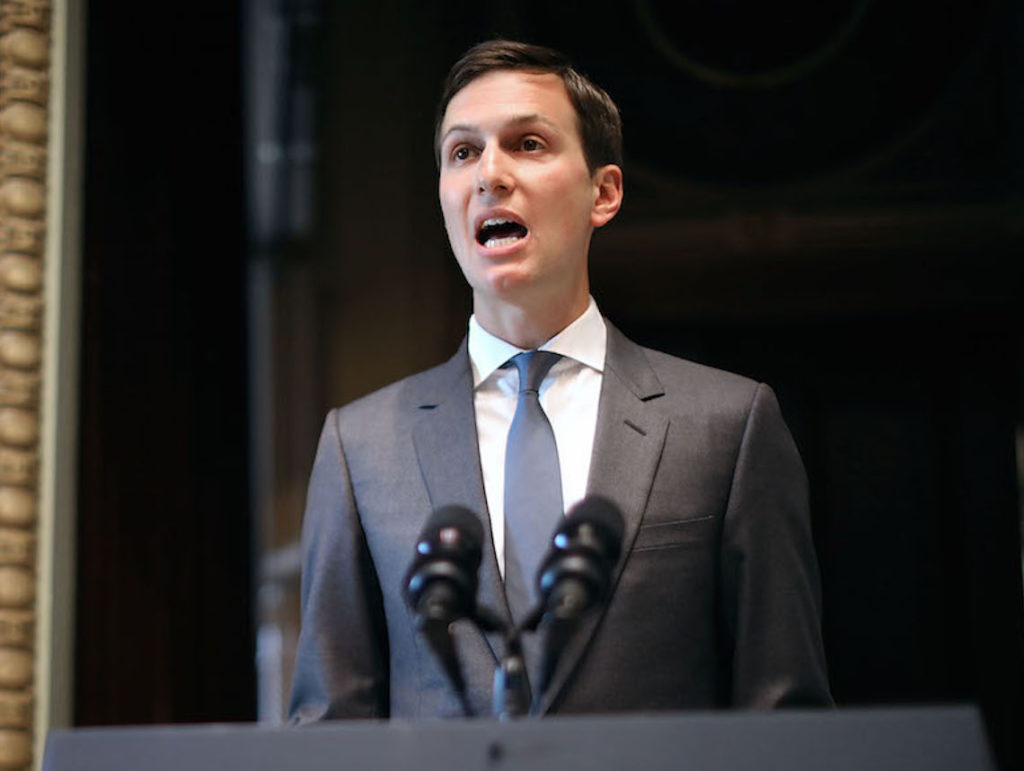
Trump Campaign Invokes Jared Kushner’s Survivor Grandparents in Defending Middle East Peace Record

WASHINGTON (JTA) — President Donald Trump’s reelection campaign defended senior advisor Jared Kushner’s record on Middle East peace by citing his work to engineer the U.S. embassy move to Jerusalem and the fact that Kushner’s grandparents survived the Holocaust.

“Jared, the grandson of Holocaust survivors, was instrumental in moving the U.S. Embassy in Israel to Jerusalem,” the campaign said in a statement Friday.

The statement came in response to a video clip released by CBS in which former Vice President Joe Biden suggested that Kushner brought little expertise to his role as a Mideast peace broker. The clip is part of an interview due to air over the weekend on “60 Minutes.”

In the interview, Biden was asked about Trump’s unsubstantiated charge that he assisted his son, Hunter Biden, who served on the board of a Ukrainian company beset by corruption allegations. Biden claimed his son had done nothing wrong before turning to a question about whether Trump’s children have acted properly.

Kushner and his wife, Trump’s daughter Ivanka, both serve as senior advisers in the White House. Trump is also alleged to have steered government business to Trump properties now run by his sons, Don Jr. and Eric.

“The idea that you’re gonna have — go to the extent that he has gone to have our, you know his children, his son-in-law, et cetera, engaged in the day-to-day operation of things they know nothing about,” Biden said.

“You don’t think that Jared Kushner should be negotiating a Middle East peace solution?” interviewer Norah O’Donnell asked.

Biden laughed. “No I don’t. What credentials does he bring to that?”

Kushner has yet to unveil the “vision” for Middle East peace he he has been working on for over two years. Palestinians dropped out of the process in 2017 after Trump announced he would move the U.S. embassy to Jerusalem.

Trump Campaign Invokes Jared Kushner’s Survivor Grandparents in Defending Middle East Peace Record Read More »

Jewish Minneapolis Mayor Jacob Frey on His Feud with Trump and Becoming a Sex Symbol

(JTA) — Earlier this month, Jacob Frey went from being the relatively unknown mayor of Minneapolis to an instant internet celebrity—thanks to some attacks by President Donald Trump on Twitter.

In a series of tweets, Trump lashed out at Frey, whom he called a “lightweight mayor,”after Frey announced that his city would not cover the costs of Trump’s security for a rally there. The Minneapolis Target Center, which was set to hold the event, threatened to cancel it if the Trump campaign didn’t pay $530,000 to cover the costs ahead of time.

As fans rallied behind Frey, some weren’t only paying attention to his jabs at the president.They also began to swoon over his looks, terming him “the hot mayor.”

It was a “bizarre” turn of events, the 38-year-old Democrat told the Jewish Telegraphic Agency in a phone interview from Minneapolis on Thursday.

“You don’t wake up in the morning expecting to have the president of the United States tweeting out garbage about you and the city you represent,” he said.

Despite the controversy, the company managing the event’s venue ended up backing down from its initial demand that Trump cover the security costs beforehand. Frey told JTA that the city won’t cover the cost, and it will be up to the venue to decide how to pay for it. During the Oct. 10 rally, Trump called Frey “a rotten mayor.”

Frey doesn’t mince words when speaking about Trump.

“His rhetoric is so hateful and stupid and childish, I don’t even want to dignify it with a response,” he said. “The fact that we stooped to a level where the president of the United States has time to be tweeting out this garbage—not withstanding an impeachment inquiry and a war in Syria and all the crises we have domestically—is nonsensical.”

But for his new fans, including those who praised his appearance, he has nothing but fond feelings, saying he “appreciate[s] the kind words.”

“In seriousness, traditionally Jewish males are stereotyped through Nazi propaganda to be ugly and weak,” he said. “And if nothing else, I think it’s good when media and community rejects that notion.”

Frey has a colorful resume. He went to college on a track scholarship and competed as a professional runner afterwards, including in the 2007 Pan American Games, where he finished fourth with an impressive marathon time of 2:16:44.

He describes running as his “original passion.”

“I loved and continue to love the direct correlation between hard work and success,” he said. “If I worked harder than the person standing next to me on the starting line I was probably going to win.”

The realization that many other areas of life weren’t so simple is what led him to law and later to politics.

“That correlation does not exist in life in general. It’s so dependent on who you parents were and what side of the tracks you grew up on, and that’s something that inspires me to change it,” he said.

In 2009, he graduated from Villanova University’s law school and moved to Minneapolis where he got a job at a law firm.

During his time as a lawyer, he offered legal aid to Minneapolis residents whose homes were destroyed by a tornado in 2011. He also organized the Big Gay Race, a 5k run to raise money for a Minnesota group supporting same-sex marriage.

Four years after he got his start in law, he decided to change direction and ran for a seat in the city council. After winning that, he successfully ran for mayor in 2017.

“This is my dream job,” he said. “I’m working like a dog, but I’m having a ball. To be able to work hand in hand with the community to not just talk about but fully attack some of these institutionalized problems, it’s fulfilling, it’s tough, it’s controversial.”

One of Frey’s passions is the issue of affordable housing.

“I believe everyone should have a safe place to go home to at the end of the night, to rest their head on the pillow and to rejuvenate for the next day,” he said. “And obviously that right is not afforded to everyone.”

Last year, his budget for the city included a record of $40 million funding for affordable housing. This year he is looking to add another $31 million to the budget for that purpose.

Frey grew up in Oakton, Virginia, in a Reform Jewish household, the son of parents who both worked as professional ballet dancers.

“We weren’t as much religiously Jewish,” he said. “I’m not even sure [whether] my mother believes in God or not, but she took tradition very seriously—bagels and lox on Sunday, no questions.”

Earlier this month, following Trump’s tweets, Frey received threatening social media messages and phone calls. Some contained anti-Semitic rhetoric, he said.

Frey attends two Reform synagogues in Minneapolis—Temple Israel and Shir Tikvah—together with his wife Sarah Clarke, a community organizer and lobbyist who recently converted to Judaism.

The mayor draws inspiration from Jewish values.

“The moral imperative outlined by tikkun olam,” he said referring to the Hebrew phrase for the Jewish precept to heal the world, “is something I believe in strongly and is foundational both to Judaism but also my philosophy in government.”

Jewish Minneapolis Mayor Jacob Frey on His Feud with Trump and Becoming a Sex Symbol Read More »

Officers Wounded in Pittsburgh Synagogue Attack Thank Jewish Community for Support

(JTA) — Police officers involved in the response to last year’s attack on Pittsburgh’s Tree of Life synagogue, some still recovering from injuries they sustained, thanked the city’s Jewish community for its support.

Officers Michael Smidga, John Persin and Tyler Pashel are all back at work. Pittsburgh Police Officer Dan Mead and SWAT Officers Anthony Burke and Timothy Matson are still in the process of recovering, KDKA 2 CBS Pittsburgh reported Thursday.

They all conveyed their sentiments in letters they wrote ahead of Sunday’s one year anniversary of the attack that left 11 victims dead and six wounded.

“There’s no reason why I should still be living, but I am and I want to thank everyone for everything they did and continue to do to support me,” Mead wrote. “I want to thank the Jewish Community, my family including my sister Diane and my girlfriend Lisa, Pittsburgh Police and all the other police departments, the firemen, the medics, the doctors — everybody.

“The Jewish Community’s support and the ways they have shown their appreciation — I’m not used to that,” Mead, who was shot in the hand, also wrote.

Burke, who was also shot in the hand, wrote a note that read: “I would be remiss if I didn’t specifically thank the Jewish Federation of Greater Pittsburgh for their enormous and unparalleled support, without which the burden of everyday life would be unbearable. I sincerely cannot thank you enough.”

Read the rest of the officers’ letters here.

Officers Wounded in Pittsburgh Synagogue Attack Thank Jewish Community for Support Read More »