This June, the KeHILLAT mogen David Spivak Educational Center (KMDSEC) in the Pico-Robertson area will graduate its first fifth-grade class. The Orthodox Jewish Day School, created by Head of School Cecelie Wizenfeld and Academic Director/Principal Rabbi Gabe Elias, opened its doors as a preschool in September 2009.
“We opened up with 13 kids and two teachers,” Wizenfeld, who has more than 30 years’ experience in early childhood education, told the Journal. The school, which teaches both secular and Judaic studies, had 30 students at the end of the first year, and 45 by the end of the second. “When we got to the point where the kids would potentially go on to a day school, the parents didn’t want to leave,” she said.
“The school was so warm and friendly, both student-wise and parent-wise, that the alternative of going and changing to a different school didn’t sit well,” Elias, the former senior rabbi and executive director at Mogen David, added. “They asked us to start an elementary school.”
“We looked at each other and we were like, ‘Let’s do it,’” Wizenfeld said.
SEC was named two years ago in honor of the school’s original donor — Al Spivak — who died a few months after the school changed its name. The building, which is next door to, but no longer affiliated with Congregation Mogen David, has an indoor courtyard and yard, graas well as three preschool and six elementary school classrooms.
SEC is currently building resource and social skills programs to enhance its academics, as well as a “Parent and Me” program, and hopes to start adding middle-school grades in fall 2020.
Mindful of the cost of a Jewish education, Wizenfeld and Elias keep their overhead — and as a result, their tuition — low. Among her duties, Wizenfeld deals with the finances and legal operations, and a total staff of 30 ensures the school runs smoothly for its 130 students.
“Our tuition is half the price, if not less than that of any other institution,” Elias said. “Whether it’s Orthodox, Conservative or Reform, we offer an education to everybody.”
“I think our school is special because we’re all about the kids,” Wizenfeld said. “We aspire to bring in midot (respect, morals, and values) and mitzvot into everything we do.”
Quoting from Mishlei 22:6 Elias said, “Chanoch Le’naar Al Pi Darko,” (educate every child according to the needs of that child). “Every child is special.”
“We want the kids to have as much experiential learning as possible. Not just book and paper, [we want them] to get their hands dirty, to feel it, to live it, to become part of what they’re doing.” — Cecelie Wizenfeld
One program the school teaches is Ivrit B’Ivrit — Hebrew in Hebrew, where students read poetry and books and converse in Hebrew. “Our model is to chart and emulate some of the Israeli programs, so when the kids leave us, they will be conversing in Hebrew very well,” Elias said.
The school has also been praised for its Israeli, kibbutz-like feel.
“You literally walk into a garden,” Wizenfeld said. “We’re not just four walls, kids-sitting-at-a-desk classrooms. They come outside of their rooms to branch out a little bit. We want the kids to have as much experiential learning as possible. Not just book and paper, [we want them] to get their hands dirty, to feel it, to live it, to become part of what they’re doing.”
“The kids always seem happy to come to school,” Elias said. “It’s an environment of enjoyment.”
In a conference call with the Jewish Democratic Council of America (JDCA), Rep. Adam Schiff (D-Burbank) took President Donald Trump to task for invoking executive privilege to prevent the release of the unredacted Mueller report.
The Trump administration’s actions were “completely overbroad and baseless,” Schiff said. “Their goal is to stonewall. Their goal is to draw the process out while simultaneously blaming the Democrats.”
The May 9 conference call with approximately 50 JDCA leaders and supporters came on the heels of multiple U.S. House committees, including Schiff’s House Intelligence Committee, demanding access to the unredacted Mueller report and related documents and witnesses.
Schiff said he hoped the fight over the release of the unredacted report and other documents would not result in a drawn-out battle in court but “that may be where we end up.”
He added that the unprecedented confrontation between the executive and legislative branches would have significant implications for Congress’ oversight of future administrations.
“Here is what is at stake,” Schiff said. “It is not just whether the country gets the facts about what the Trump campaign did … it is about future presidents, too. To avoid oversight by making claims of privilege and litigating them, if they can succeed with that type of gambit, there is no way to hold this president or future presidents accountable.”
JDCA Board Chair Ron Klein also spoke about what he saw as the threat the Trump administration presents to democracy, the rule of law and the pursuit of justice.
“Today we’re in a critical point in our history when such values have been threatened by the president, and we believe it is incumbent upon Democratic leaders in Congress to conduct oversight of the executive branch and fully investigate the findings of the Mueller report,” he said.
“Here is what is at stake. It is not just whether the country gets the facts about what the Trump campaign did … it is about future presidents, too.”
— Rep. Adam Schiff
JDCA Vice Chair Barbara Goldberg Goldman added, “In the aftermath of the Mueller report’s release, it has become crystal clear to all of us that Attorney General [William] Barr has failed in his duty to serve the American people. He is no longer the people’s chief law enforcement officer; instead, he appears to be the president’s personal defense attorney.”
Schiff also spoke about what he termed “deep fakes,” which he said was technology that allows people to create digital forgeries and spread false information.
“Nothing is more corrosive in a democracy than the idea that there is no truth,” he said. “There is potential for enormous mischief and a tech race between those creating the technology and those trying to create the technology to detect these fakes.”
JDCA Executive Director Halie Soifer posed questions to Schiff that had been submitted in advance by attendees on the call, including one about whether there would be Russian meddling in the 2020 election and whether Trump would leave office quietly if he loses.
“I don’t think there is much risk that Donald Trump will call out the military and there will be tanks in the streets,” Schiff said, “but you could foresee how a large part of the country would feel disenfranchised if there was again Russian meddling that went unanswered by a president who may even welcome that help.”
In an interview with the Journal following the discussion, Soifer said she hoped the call with Schiff provided an opportunity to understand JDCA’s role in supporting officials who are driven by Jewish and democratic principles.
“The reason we are having a conversation like the one we had today,” she said, “is because we want to give voice to those values and ensure the Jewish community has the opportunity to engage with members of Congress like Chairman Schiff who are defending those values each day.”
I don’t know why it surprised me. I should have expected it when I wrote a story some months back headlined “Hummus Is the Peacemaker.” I was swiftly barraged with accusations of culturally appropriating an Arab food. One tweet even rebuked me by saying, “Go back to Poland and stop stealing people’s cuisine!” The fact that I’m not Polish didn’t matter much to the tweeter; only the sentiment behind the comment was important: Jews who came from Eastern Europe had better skedaddle on back there and stop trying to take credit for the cuisine of the “indigenous population.”
Clearly the idea that Jews are indigenous to the Middle East and that Judea is named after us triggers some folks, but that pesky detail is the least of my concerns. What about the fact that so many of Israel’s national foods are modern mashups of a plethora of dishes from ancient cultures far and wide?
Consider falafel, Israel’s most popular fast food — as culturally synonymous with the country as burgers and fries are with the United States. Just as hamburgers are not technically an American invention (origin: Hamburg, Germany), falafel, deep-fried balls of fava beans or chickpeas, can be traced to India, where frying fritters made of chana dal was a common cooking practice, thought to have been brought west by Turkish or Arab traders.
Another theory about the origins of falafel is that it was invented by Egyptians using fava beans, a vegetarian alternative to meat for Egypt’s Christian population to eat during Lent. Food historians speculate that when the dish migrated toward the Levant, the fava beans were replaced by the more common chickpea, which lends credence to the notion that falafel made of chickpeas may have roots in Jewish Yemenite cuisine.
“So many of Israel’s national foods are modern mashups of a plethora of dishes from ancient cultures far and wide.”
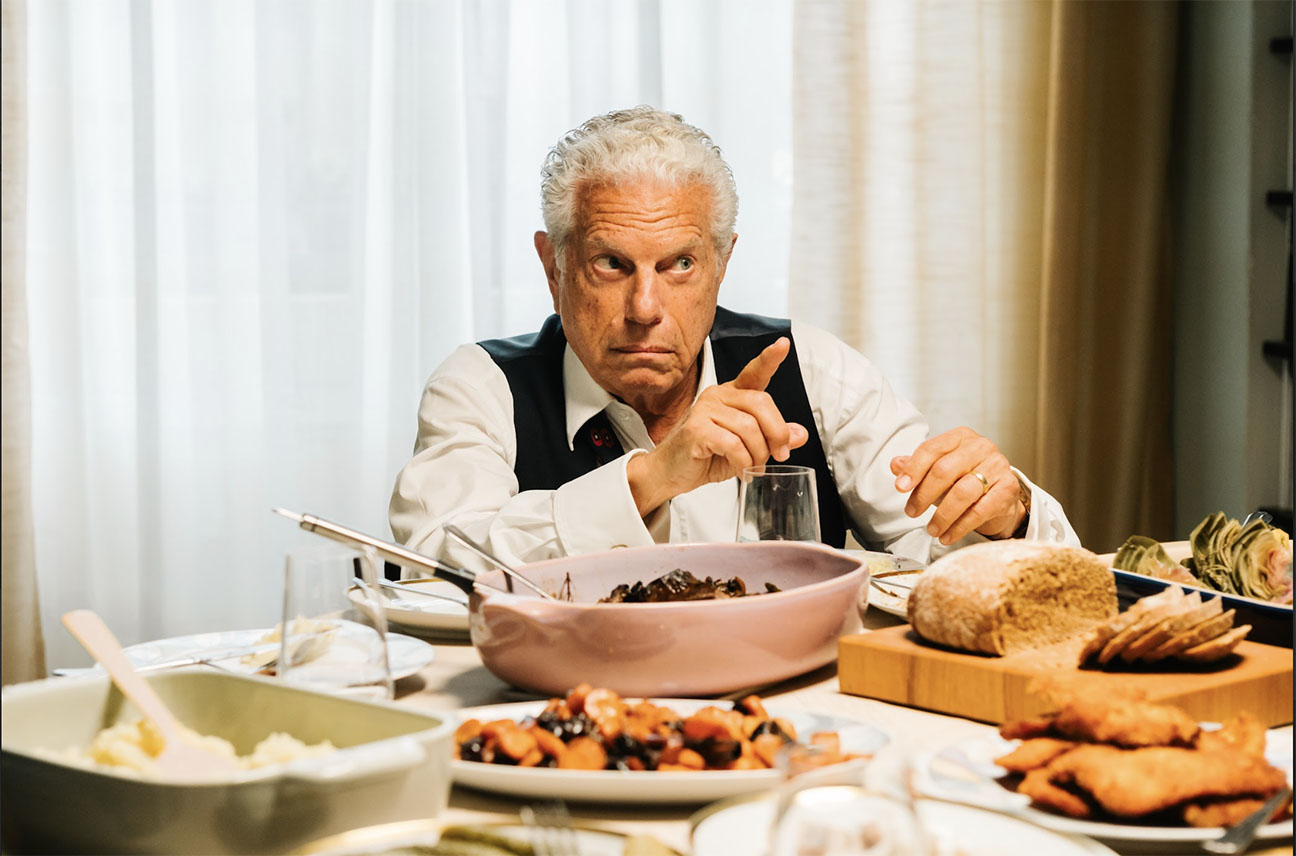
But what is not theory is that the modern falafel sandwich, eaten standing up and on the go with plenty of napkins on hand to catch spills, is as Israeli as “Hatikvah,” its national anthem. The messy hand-held pita stuffed with seasoned, deep-fried chickpea balls, tomato and cucumber salad, hummus, pickled vegetables and usually accompanied by some version of fried eggplant and potato, tahini and hot sauce, has all the elements of today’s multicultural Israeli society and the very essence and spirit of a diverse Jewish Diaspora. With additions as varied as Iraqi fried eggplant slivers and amba (a pickled mango condiment), German sauerkraut, pickled cucumbers, beets and turnips or the Yeminite schug (a garlic, pepper chili sauce), falafel is eaten by everyone in Israel — rich, poor, Arab, Sephardic or Ashkenazic Jew, Ethiopian, vegetarian or carnivore, resident or tourist. When folks are hungry for a cheap, quick, filling and delicious meal in Israel, they often choose falafel.
My reply to the tweeter about my hummus story was this: “Hummus is my food and your food, and a lot of other people’s food. Food is for everyone.” But what I really wanted to say is this: Politics doesn’t belong in the kitchen. Discussions about food are always an opportunity to bond over a shared experience. What we eat not only tells a story about who we are and where we’ve been but it is, by definition, a reminder of our commonalities. Food is a primal need that illuminates our identity, but it doesn’t define us.
Just as it’s a universally regarded cultural taboo while dining with clients to discuss business before the meal commences, fighting over the origin of a food is a zero-sum game. People have been traveling and migrating since the beginning of time, and so has food. Although you can borrow a recipe, you can never truly own it — not even if you are the one who invented it. Great food is meant to be shared, not possessed. And if you can’t find it in your heart to do so willingly, food has a way of finding its rightful place.
YAMIT’S FALAFEL
1 pound dried chickpeas (uncooked, rinsed well and soaked overnight in cold water)
1 medium yellow or red onion (about 1 cup), finely chopped or grated
5 garlic cloves, squeezed through a garlic press
2 teaspoons salt
2 teaspoons cumin
2 teaspoons coriander
1/2 teaspoon black pepper
1/2 teaspoon cayenne pepper 2 teaspoons sweet paprika
1 tablespoon fresh ginger, finely grated
1 pinch ground cardamom 1 pinch ground nutmeg
2 tablespoons chickpea flour (chickpea flour is gluten free but all-purpose flour can be used)
2 teaspoons baking powder
1 cup fresh cilantro, finely chopped
1/2 cup fresh flat leaf parsley, finely chopped
4 cups vegetable oil (canola, grapeseed, corn) for deep frying
Soak dried chickpeas in double their volume of cold water overnight. The next day rinse and drain well.
Place chickpeas and rest of ingredients except cilantro, parsley and oil, in food processor and pulse until a coarse mixture forms. Scrape down sides of food processor between pulses to ensure the chickpeas are evenly ground. The optimal result has a bit of texture but no large pieces of chickpeas. It’s important not to create a paste but mixture shouldn’t have chunks.
When mixture is homogenous, transfer from food processor into a bowl and, using a fork, mix in chopped parsley and cilantro. Leave in refrigerator for at least 2 hours or even overnight. This is a crucial step to give the flavors time to mingle but also so that the balls hold together better.
When ready to fry, heat oil in heavy-bottomed pan until hot (350 degrees F.)
Wet hands and form balls using two tablespoons of the mixture, or about the size of a walnut. Fry one test ball.
When balls are golden brown on one side after about 2 minutes, rotate and continue to fry another 2 minutes. Taste to adjust salt and pepper. If balls are falling apart, the chickpeas might not have been ground enough. If this happens, add 1 egg to the mixture and repeat with a test ball to see if it holds together.
Fry remaining balls 6 at a time, making sure to leave enough space so they fry evenly and aren’t overcrowded. When golden brown on all sides, drain balls on paper towels and put on a wire rack to stay crisp.
Serve in a pita with hummus, salads, pickles, tomatoes, cucumber, tahini and chili sauce for drizzling on the side.
Makes 35 balls.
Yamit Behar Wood, an Israeli American food and travel writer, is the executive chef at the U.S. Embassy in Kampala, Uganda, and founder of the New York Kitchen Catering Co.
One verse, five voices. Edited by Salvador Litvak, Accidental Talmudist
“Command the children of Israel, and they shall take to you pure olive oil, crushed for lighting, to kindle the lamps continually.” – Leviticus 24:2
This week Table for Five features commentaries by students
at Jewish high schools in the Los Angeles area.
Robert Carlson Milken Community Schools
I am continuously struck by the importance of continuity in Judaism. With every Kiddush recited over a Passover cup of wine, and every Shema recited at bedtime, we declare our dedication to the Jewish tradition. The importance of active continuity is echoed throughout the Torah. In Parashat Emor, (Leviticus 24:2), we read that Moses commands the Israelites to bring olive oil for the ner tamid, the eternal flame, in the Temple. The ner tamid was not lit once and left alone, but rather it was to be rekindled daily in every age. Therefore, the ner tamid requires action by the children of Israel in every generation to keep the flame ignited.
The obligation of bringing oil for the lamp teaches us that we must take active roles in our Jewish lives. Whether this role be by deepening our Jewish education or observance of commandments, every generation must take the responsibility to rekindle their own ner tamid. Preserving my Sephardic traditions, Ladino language and Jewish rituals are ways that I actively affirm my dedication to the Jewish tradition, bringing oil for the lamp in my own way.
Singing Ladino songs such as “Un Kavretiko” during Passover and praying in the Turkish-Jewish nusach, liturgy, connects me to my past, but these traditions also embody the strength of my Jewish identity in the present. Ultimately, rekindling the ner tamid links us with our past, and builds a bridge to the next generation, which bears the responsibility of preserving the fire of its own lamp.
Natalie Anne Silberberg YULA Girls High School
After listing the holidays in Leviticus, and the minutiae of their laws, Moshe is told to ensure the lamp burn continually.
Why must the candle be lit tamid, continually, and not extinguished? Is there a hidden metaphor since, even with the purest olive oil, this is impossible?
Perhaps Moshe is subliminally teaching that no matter how bogged down we get with life’s details or challenges, we must always keep our inner light ignited. This ability is the reason Chazal, our great sages, entreat us to be an Ohr Lagoyim, a light unto the nations. The light of the menorah burned continuously while in the Beit HaMikdash, the Holy Temple. That light is continued in the ner tamid, continual light, found today in our synagogues. This should be an inspiration to follow the commandments listed in Parashat Emor.
This ner tamid with the potential to light others comes from within, like the fire of our souls. Even after the torturous Holocaust, my grandparents continued to fight for their beliefs and taught subsequent generations the importance of the everlasting light of Judaism. Instead of extinguishing their excitement for Torah and Judaism, overcoming their struggles pushed them to educate others. Like the burning candles that remained lit in the Beit HaMikdash, we have the responsibility to remain strong and enlighten others with the brightness of Jewish belief. In light of the recent tragic events in Poway, Rabbi Yisroel Goldstein reminded us what the Lubavitcher Rebbe said beautifully, “A little bit of light dispels a lot of darkness.”
Jonah Rudner de Toledo High School
Birth, holidays and death. What do these things have in common that is so intrinsic to our culture? All three bring people together. Whether it is the birth of new member of the family, a Passover seder or the death of a loved one, people tend to turn these types of events into communal gatherings. But why do we take individual events like these and turn them into communal gatherings?
In Parashat Emor, specifically Leviticus 24:2, God asked Moses to command all of the children of Israel to take pure olive oil to him for lighting the lamps continually. God could have asked just one person. Instead, this was tasked to everyone, turning an otherwise individual act into a communal activity.
Why include everyone? In order to bring them together. There are very few commandments like this, and by creating one, God created an opportunity for bonding as a people.
The strongest nations are those that stand by one another and care for one another. Creating a nation like that is incredibly difficult, but when it works, such nations stick around the longest. By creating a communal bonding activity like lighting the menorah, God started a bonding project that eventually would lead to the type of community that the Jewish people are today — community members who stand by one another and care not just for themselves but for the whole world.
Sheyna Schusterman Shalhevet High School
In this Torah portion, God commands Moshe to assemble a menorah. Upon completion, the menorah was placed in the Tent of Meeting to burn each day. Aaron had the responsibility of ensuring the menorah was always lit, so that the light would be visible to all.
God wanted to ensure that the lamp was present for all generations to come. Obviously, physical illumination like the flames of the menorah cannot last for generations. We can interpret the long-lasting light in this section of the parsha as referring to spirituality. The powerful image of the ever-burning flames of the menorah presents a guiding principle that we all can apply to our daily lives. We live in a physical world filled with mundanities and distractions. However, that shouldn’t mean that we don’t fill our lives with meaningful, spiritual experiences as well. Just as God wanted the flames of the menorah to burn for generations, the Torah is an everlasting source of light for the Jewish people, illuminating our path forward no matter the state of the world or our place in it.
In order for the world to be encompassed by the light of Judaism, we need to spread spirituality to those around us, whether it be friends, neighbors or strangers. Whether spreading Judaism through a love of Torah or chesed acts of lovingkindness, we have the opportunity to ensure that the light of the menorah will truly be radiant for generations.
Yoni Merkin YULA Boys High School
The command to use pure olive oil to light the menorah continuously seems unnecessary. What is the need to specify the continuous burning of the menorah?
In tractate Shabbat 22b the Talmud explains that the lighting of the menorah was a testimony to humanity that the presence of HaShem rests in Israel. Rav Shimshon Raphael Hirsch explains further that this menorah is a message to all the children of Israel that HaShem’s constant active presence is not only in Israel but in our daily lives as well. If we focus only on the holidays or the special customs that we observe in Judaism, we begin to forget that HaShem’s presence always can be found in our lives.
Although nowadays we don’t have a menorah to remind us of HaShem’s interaction in our lives, the same principle remains: We need to look for HaShem’s presence in all the things we do.
Additionally, the verse uses the uncommon word lehaalot, to rise up, instead of just saying to kindle when describing the use of the oil. The common explanation for this is to emphasize the use of good wicks and oil for the menorah so that it doesn’t require further fiddling. Rav Kook, however, explains that lehaalot can be seen as a metaphor for our lives. Our bodies are the wick that we must strive to improve spiritually and physically in order to rise up and receive the fire of HaShem’s presence.
Hours before the last days of Passover began, it was very busy at Judge Rachel Freier’s house in the Borough Park neighborhood of Brooklyn, N.Y. Bustling in the Pesach kitchen built into a walk-in closet off her main kitchen, Freier prepared for the holiday with her youngest married daughter, stirring pots on the stove, readying salads and putting spongecake in the oven, while a son-in-law and a friend peeled apples and schmoozed at the kitchen table.
The streets outside were empty of women, who, like Freier, likely were at home preparing for the holiday. Men in the long black coats of Chasidim strolled about the avenue, while young men with payot (sidelocks) as long as their fur hats were high dashed by. A pair of little girls — sisters, to judge by the matching pink dresses, white tights and sweaters — rushed down the sidewalk on scooters.
Inside the Freier house, though, the mother of six and grandmother several times over paused from her pre-yom tov tasks to speak with a visiting reporter in her living room, where a sideboard was covered with awards she received from Israeli emergency medical service United Hatzalah of Israel, the Satmar rebbetzin of Kiryas Joel and many others.
“Leah, is the gefilte fish burning?” she called to her youngest married daughter, who is 20 and has a twin sister. Freier has three sons, the oldest in his 30s, and three daughters.
Freier is 54, trim and just 5 feet tall. Demurely attired in clothing appropriately modest for a Chasidic woman, she wore a two-way radio on a belt around her waist. Freier is director of Ezras Nashim, the women’s Chasidic volunteer ambulance corps approved by the state in 2014, and is on call whenever she is home.
Ezras Nashim means both “women’s help” and refers to the Hebrew words for the women’s balcony in an Orthodox synagogue, a space that in theory is intended to be separate but equal.
“I’m not afraid. It’s God’s endorsement that is most important, and I believe we have God’s endorsement, so we move on.” — Judge Rachel Freier
As she bustles about her house, it’s hard to picture Freier ruling over a Kings County Civil Court in downtown Brooklyn as the first Chasidic woman in the world to be elected judge. Last year, a second Chasidic woman joined her ranks in Israel, when London-born Chava Tucker was appointed to the Jerusalem Magistrate Court.
But not everyone views her in such glowing terms. Critics say few women actually call Ezras Nashim in medical emergencies, and that most continue to call Hatzalah, the longtime, all-male Orthodox volunteer ambulance corps. To be sure, Ezras Nashim currently is limited in what it can offer women needing assistance. It is in the process of applying to be licensed by the state as an ambulance company and recently raised enough money to purchase two ambulances, with one funded through an allocation of public funds by Dov Hikind, who was a member of the New York State Assembly until losing his last race in December 2018. At the moment, if a woman needs to be transported to the hospital, Ezras Nashim emergency medical technicians (EMTs) must call 911 like anyone else.
Yocheved Lerner-Miller originally had the idea for an all-female Orthodox volunteer emergency medical services corps when she worked as an EMT in the Catskills in the 1990s, before she became religious. In the summertime, when thousands of Chasidim go upstate to vacation in bungalow colonies, Hatzalah also was there. Lerner-Miller said she asked Hatzalah members why they didn’t have female volunteers. “Their answers were not satisfying,” she recalled.
After moving to Brooklyn in 2007, Lerner-Miller and a few other women started trying to organize an all-female Orthodox emergency medical technician corps. When Freier heard about it, she offered to help. Freier ended up taking over and made it a highly publicized, controversial — and ultimately successful — effort.
But Lerner-Miller told the Jewish Journal, “I don’t believe this organization is a success. It doesn’t get the calls. I ask people all over the place, ‘Would you call?’ and they say, ‘No.’ ”
A male leader in Borough Park agreed. Ezras Nashim “is not a household name in any form,” he said. “No woman I know would call Ezras Nashim. They call Hatzalah. To many here, she is no longer with us. That car is no longer connected to the long train of the Chasidic community.”
Initially, the women appealed to Haztalah to let them start a female division. Hatzalah — which has 13 independent chapters in New York state alone, as well as many more across North America and around the world — is built on a neighborhood network of volunteers. The idea is that if someone is having chest pains, his or her neighbor — an accountant and a trained EMT — lives close by and can get there quickly. The problem is that when it comes to women in unexpected labor or having chest pains or anything else that requires them to bare parts of their body that are usually covered, they don’t want their neighbor or their friend’s husband to see them exposed.
“I had a friend screaming to her husband, ‘Make them go away! Make them go away! What is this, a minyan?’ ” Lerner-Miller said. “There were 10 men gawking at her while she was miscarrying, and it was mortifying.” The husband of another woman she knows of called Hatzalah when she went into unexpected labor. A neighbor, an EMT who is her friend’s husband, answered the call. The baby was born in the house and the new mother “couldn’t look her friend in the face because it was too embarrassing,” knowing the woman’s husband had seen her most intimate body parts. “She wanted to move” out of the neighborhood, Lerner-Miller said. This is why Lerner-Miller had the idea of female EMTs and paramedics being available to treat other women: for modesty’s sake.
“ ‘Feminism’ is a bad word with a negative connotation in the Chasidic community.” — Judge Rachel Freier
The group’s attempts to join Hatzalah initially garnered them little more than anger and resentment in Borough Park and other area Chasidic communities. A documentary film by Paula Eiselt about Ezras Nashim and Freier, titled “93Queen” for the fire department radio handle they were assigned, shows men telling Freier’s husband, David, in Yiddish, how much hatred she has aroused as a woman stirring the pot in a community in which showing deference to men, particularly rabbis, is paramount. The movie shows Freier trying to find a rabbi who will publicly endorse them, setting out with a group of women to meet with a rabbi in the far suburbs she was told would do so. But in the end, he does not, and neither does anyone else.
“I spoke to a rabbi and asked, ‘Why is everyone so afraid?’ He said, ‘Why rock the boat? We don’t know if you women will be good,’ ” Freier told the Journal.
“When I first got involved, I had no intention of becoming an EMT,” Freier said. “I just wanted to be their advocate. I put my whole self into it, took the EMT course with my mother. Then I became a paramedic and slowly I realized, ‘This is what HaShem wants me to do,’ ” she said, referring to God.
The film shows that while Freier campaigned for the court seat she now holds, someone anonymously booted her car, and Hatzalah sent a message to every WhatsApp group used by Borough Park Chasidim. It was a recording of a man saying, “You have reached Ezras Nashim. Our primary vehicle has been booted. Please call this number” — which went to Hatzalah.
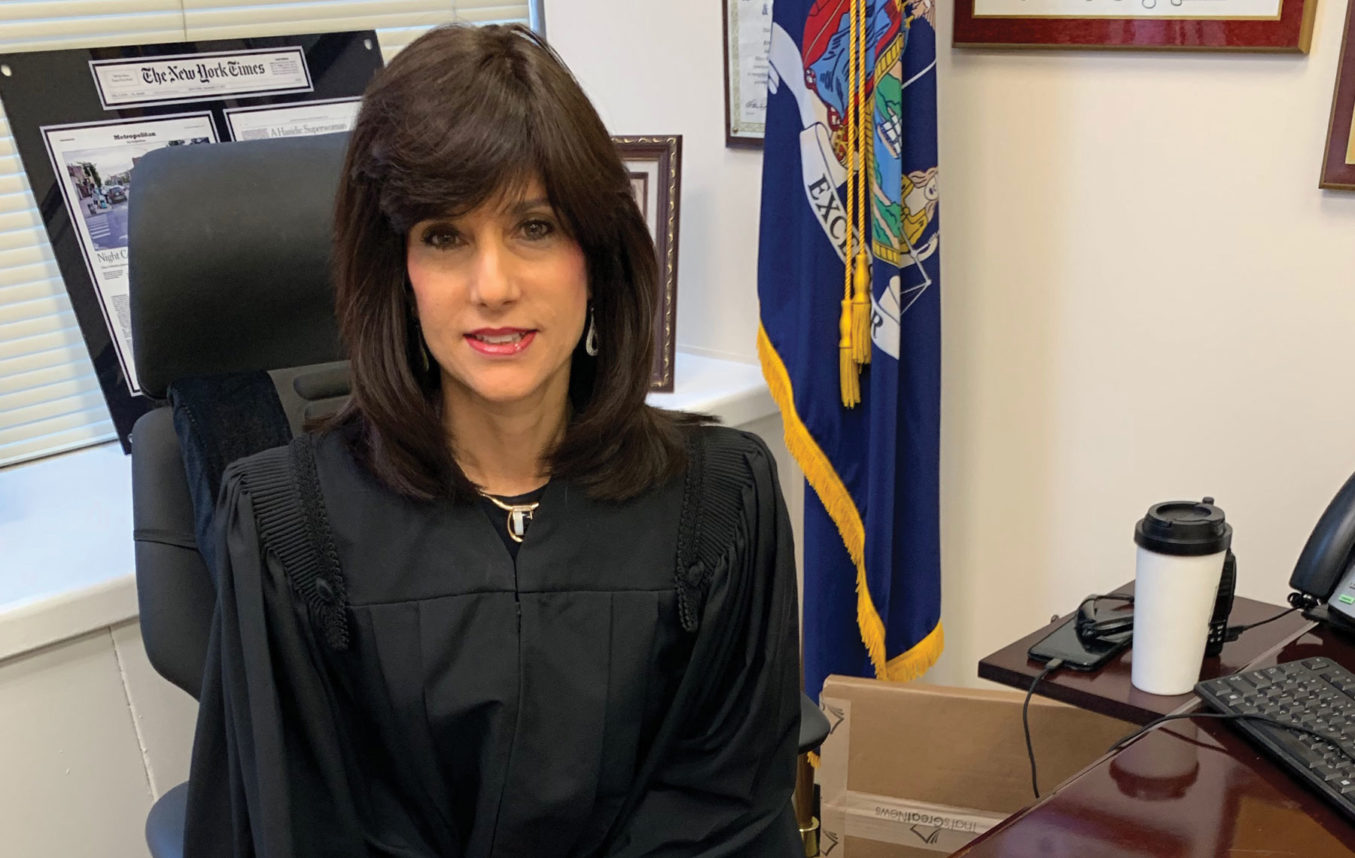
Judge Ruchie Freier at her home.
All the calls Ezras Nashim fielded on its first day in 2014 were pranks. Hatzalah members also sent around WhatsApp memes mocking Ezras Nashim. “93Queen” shows Freier saying the Borough Park Hatzalah threatened to boycott North Shore Hospital, which ran EMT training sessions for the women. “They’re saying that women aren’t capable enough, strong enough, fast enough, smart enough,” Freier says in the movie. “They are painting a picture in the Chasidic community that we are defying the rabbis. … I went to the CEO of Hatzalah, who had us sign papers that we were not taping the meeting, and then he yelled and insulted us. It was an attempt to tell me I was going against daas Torah,” the Torah’s wisdom. “I was warned. He said, ‘Or else.’ Or else what? I’ll find out.”
But Freier doesn’t focus her energy on the haters. “We just kept going and going,” she said in her judge’s chambers during an interview. “I’m not afraid. It’s God’s endorsement that is most important, and I believe we have God’s endorsement, so we move on.”
“We have a lot of endorsements from rabbonim,” she told the Journal in her chambers. “A lot of them were verbal, some of them were written.” Asked who some of the rabbis were, she replied, “I’m not going to name names. At this point, it was just done for our women. We won the war without fighting a single battle.”
The documentary shows that while the women worked to obtain rabbinic approval and generate community support, a conflict emerged over whether they should allow unmarried females to volunteer. Freier — who has been married since she was 19 — opposed the idea, while Lerner-Miller and other women backed it. Lerner-Miller was in her 40s and single as well a longtime EMT in the Catskills.
Lerner-Miller and three other founding members quit Ezras Nashim just after it opened in 2014. Asked why they could not work with Freier, Lerner-Miller said in an interview, “Ruchie wasn’t able to work with us,” using Freier’s nickname. Lerner-Miller has since gotten married and is a successful matchmaker in Crown Heights.
An Ezras Nashim board meeting in the documentary shows Freier saying, “No one else comes into this organization if they don’t follow my rules. No one gets away with it.” It was that kind of autocratic attitude that led Lerner-Miller and a few others to decide they had to resign, Lerner-Miller told the Journal. “We realized [that being at loggerheads with Freier], it’s going to be a continuous thing, that our power was usurped,” she said. “We left because we realized there was nothing more we could do.”
Asked how many emergency calls Ezras Nashim members go on, Freier demurs, saying, “We’re not supposed to share those numbers because of HIPAA requirements.” (The Health Insurance Portability and Accountability Act is a federal law designed to provide privacy of patients’ medical records.) When pressed, she offers that the women’s volunteer group “definitely gets hundreds of calls” a year.
“I love being able to make a difference in people’s lives. It’s a very important day for anyone who is in court. For me, it was always so important to be able to accomplish this without compromising my beliefs.”
— Judge Rachel Freier
The idea of an all-female Orthodox volunteer EMT service didn’t start with Lerner-Miller, Freier said. “There were 300 trained women from Borough Park, Williamsburg and Monroe (in New York’s Rockland County) in the late 1970s and early ’80s. A handful of those 300 are still around and part of Ezras Nashim,” she said.
While Freier said she is not a feminist, because “ ‘feminism’ is a bad word with a negative connotation in the Chasidic community,” she also makes no apologies for her forthrightness or for what she has accomplished. The women who wanted to start something like Ezras Nashim 35 years ago “are so camera shy and modest and quiet, they weren’t able to get the support they needed,” she said.
While widely hailed as revolutionary, Ezras Nashim is also not the first place in which Chasidic women have served as members of a volunteer ambulance corps. In the upstate Skver Chasidic village of New Square, some women are part of the local Hatzalah. New Square village and Hatzalah officials did not respond to inquiries for this story.
Photos of Judge Freier’s great-grandparents.
Speaking in her judicial chambers a few days after Passover ended, Freier plucked a note from a folder from a woman who, with Freier’s help, unexpectedly gave birth at home. In her note, the new mother is full of appreciation. “I truly felt HaShem’s presence and you were His shaliach (messenger),” wrote the new mother. “May HaShem give you all the strength you need to fulfill your avodas hakodesh (holy work),” she wrote.
Also on Freier’s desk in her chambers were case files and a small, worn purple siddur (prayer book), from which she prays each day.
After moving to her chambers from the courtroom, where the judge sits high up behind a massive desk and Freier appears to be nearly swallowed up by the large black chair, I asked about the sparkly rick-rack on her robe’s sleeves.
“Did you add that?” I asked.
“Of course I did,” she said, laughing. “I went to a trimmings store and picked it out. I had to add some of Borough Park to my judicial robe.” Later asked if she added it to distinguish it from a male judge’s robe in order not to violate the prohibition against women wearing men’s clothes (and vice versa), she said no. She just wanted to make it pretty.
Covering every wall of her chambers are framed articles about her in English, Hebrew and Spanish. On a side bookcase are photos of her great-grandparents, gold-framed family photos of her husband and children from several years ago, and her law school graduation photo.
Although she was elected in 2016 as a civil court judge, Freier at first was assigned to cover criminal court. She took a particular interest in young male defendants. They reminded her of the Chasidic boys she took under her wing through an organization she started in 2008 called B’Derech, meaning “On the Path,” as opposed to “Off the Derech.”
The staff at B’Derech worked with teenagers to help them get counseling and see their potential within the community. In 2011, Freier set up a program with the New York branch of Bramson ORT College that enabled students without high school diplomas to enroll and earn their GEDs. Freier also worked with rabbis, educators and parents to try to shift Chasidic culture from rejecting those who didn’t fit into communal expectations toward acceptance and inclusion. B’Derech took “a backburner position when the work at Ezras Nashim became so overwhelming,” Freier said. The only remaining remnant is some one-on-one tutoring Freier provides to young men at risk, she said.
Freier said she loves how her life experiences all come into play when she is judging a case.
“When I first did arraignments [in criminal court] and saw how many young kids were getting arrested … these kids were no different than the kids I met through B’Derech,” she told the Journal. “You have no idea how many men would cry in my courtroom. I felt like I was relating to them. A prosecutor would say, ‘Your honor, I want to show you the injuries to the victim,’ and I’d say, ‘Show me the pictures.’ As an EMT, I could understand the injuries.”
“I looked at them in the eye and said, ‘Never give up hope. You can change your life’ — all the concepts we grew up with but they didn’t,” she said. “My own unique personal experience in my Chasidic community ends up helping because people are people. There is so much more we have in common than we ever know. I tell [defendants] my mother always told me, ‘Don’t be right. Be smart.’ ”
Raised in “a heimishe Hasidishe family” in Borough Park, Freier attended Bais Yaacov girls’ schools. After marrying a Bobover Chasid at age 19, she began working as his secretary. She started college at age 30, already the mother of three young sons, and gave birth to her oldest daughter in her first semester at Touro, a private college open to everyone but geared toward Orthodox students. It took Freier six years to finish her bachelor’s degree, then she enrolled in Brooklyn Law School, graduating with her J.D. at age 40. She began working as a real estate lawyer, with offices in Borough Park and upstate Monroe, near several large Chasidic communities.
“I love that I can use my background, my life experience and legal experience in a very meaningful way,” Freier said. “I love being able to make a difference in people’s lives. It’s a very important day for anyone who is in court. For me, it was always so important to be able to accomplish this without compromising my beliefs.”
Ezras Nashim now permits unmarried women to join and just opened its first branch, at Yeshiva University’s Stern College for Women in Manhattan.
Ailin Elyasi organized the program at Stern. Slated to intern last summer with Freier, when the judge looked over her resume, Freier saw under “hobbies” that Elyasi listed “EMT.” “That should be the first line of your resume,” Freier recalled joking. Rather than work for the judge in her chambers, Elyasi spent most of her time in Borough Park interning with Ezras Nashim.
In an interview, Elyasi told the Journal, “We started two days ago and had a call, our first call — a girl who was having a panic attack for two hours straight. She refused to call anyone, wouldn’t accept oxygen or having her blood pressure taken, but because we’re just Stern students, her friends, her roommates felt she would accept help from us.”
“Having a culturally sensitive responder can make all the difference during a medical emergency.”
— Ailin Elyasi, Ezras Nashim EMT and Stern student
Stern’s Ezras Nashim branch currently has 13 EMT-certified members and another dozen or so training for the role. “We were able to practice breathing with her and calm her down,” said Elyasi, who is majoring in biology and political science. “Having a culturally sensitive responder can make all the difference during a medical emergency.”
Now a group of women from the heavily Orthodox Five Towns section of Long Island is working toward getting its own branch off the ground, Freier said.
Meanwhile, Freier also serves as a role model to even younger Orthodox girls. She constantly is invited to speak at modern Orthodox synagogues, at the schools she attended and other Orthodox organizations. She also recently spoke at Harvard Law School’s Julis-Rabinowitz Program on Jewish and Israeli Law.
A girl in eighth grade at nearby Modern Orthodox Maimonides School left class early just to go hear Freier speak at Harvard. The young girl “took meticulous notes, and was beaming with excitement throughout the lecture,” said one of the event organizers, who asked not to be named. “She had an opportunity to speak with Judge Freier at the end of the event” and still is too overwhelmed to speak about it, he said.
The Borough Park community leader who spoke with the Journal, although critical of Freier and Ezras Nashim, compared the judge to the early 20th-century Polish Chasidic woman who revolutionized religious girls’ education by opening schools, convinced that if girls were Jewishly educated, they would better appreciate their Judaism.
“When Sarah Schenirer went around opening Bais Yaacovs, probably not everyone was in favor,” he said. Of Freier and her groundbreaking efforts, he said, “History will judge.”
Debra Nussbaum Cohen is the Jewish giving maven at Inside Philanthropy and is a freelance journalist in New York City.
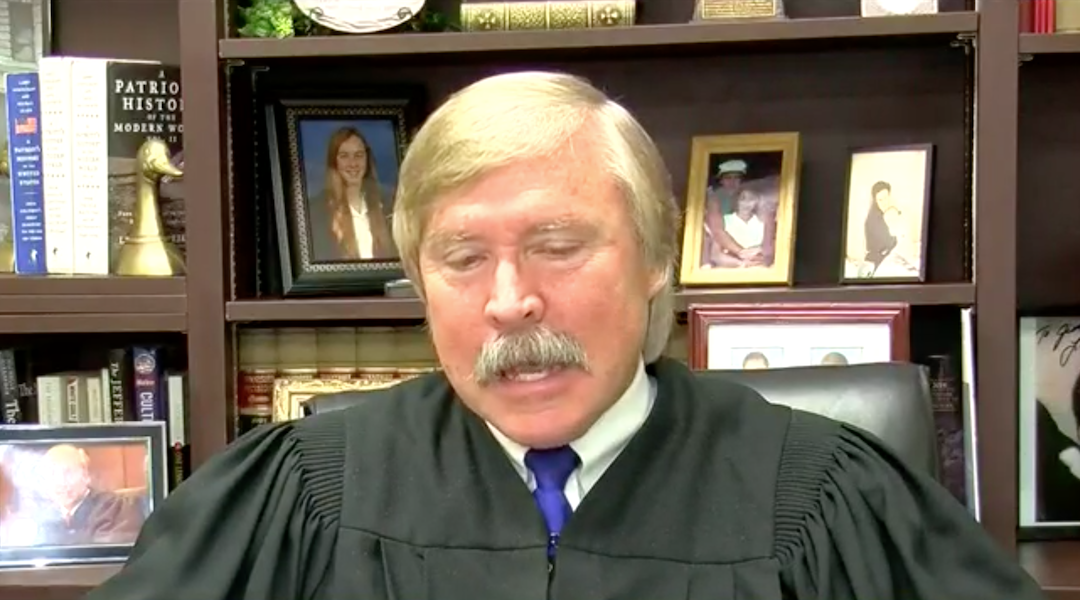
(JTA) — A Tennessee county commission has voted in favor of censuring a judge who posted racist and anti-Semitic articles on his Facebook page.
Prior to the Monday evening hearing, Criminal Court Judge Jim Lammey wrote a letter to the Shelby County Commission to say the article he linked to saying the Jews should “get the f**k over the Holocaust” and called Muslim immigrants “foreign mud” was not written by a Holocaust denier, as had been widely reported, but by a Jewish writer, David Cole, the Commercial Appeal reported.
“The local newspaper’s initial dramatic heading, tying me to a Holocaust denier, and accompanying article was all based on a falsehood,” the letter said. “This is character assassination at its best.”
Cole, who also has gone by the name of David Stein, is considered by historians to be a Holocaust denier. He has claimed that Auschwitz was not an extermination camp and that there was no genocidal plan against the Jews, but rather a plan to use them as slave labor. He also has disputed the 6 million Jews killed figure as too high. He says he prefers to be called a Holocaust revisionist.
The commission cannot directly censure Lammey. Its resolution, which was approved unanimously, will ask the Tennessee Board of Judicial Conduct to issue a statement finding judicial misconduct.
Lammey did not appear in person at the hearing, saying in the letter that his court docket keeps him too busy to come defend himself, and that he believed the commission had already reached a conclusion.
“We wholly reject Judge Lammey’s argument that he is not associating himself with a Holocaust denier,” Jewish community representative Katie Bowman said, according to WMC5 Action News. “David Cole continues to deny historical facts surrounding the genocide of the Jewish people. Judge Lammey’s reliance on Cole’s words only reinforces any assessment in the Jewish community that Judge Lammey is unable to adequately interpret and understand fact.”
(JTA) — The Metropolitan Museum of Art in New York City announced that it would not accept new gifts from members of the Sackler family linked to the company that produces Oxycontin, which is accused of fomenting the opioid crisis.
Also on Wednesday, the American Museum of Natural History said that it has stopped accepting Sackler donations.
“The museum takes a position of gratitude and respect to those who support us, but on occasion, we feel it’s necessary to step away from gifts that are not in the public interest, or in our institution’s interest,” said Daniel H. Weiss, the president of the Met, told the New York Times. “That is what we’re doing here.”
The museum will not, however remove the family’s name from its Sackler Wing, which houses the famed Temple of Dendur, Weiss told the newspaper.
Sackler family members with ties to Purdue Pharma said in a statement that “while the allegations against our family are false and unfair, we understand that accepting gifts at this time would put the Met in a difficult position.”
Sackler family contributions to the Met go back about 50 years, according to The Times.
Some members of the Sackler family have been accused of directing their pharmaceutical firm, Purdue Pharma, to mislead doctors and patients about the dangers of the opioid painkiller Oxycontin produced by the company.
The family has supported Tel Aviv University’s School of Medicine and the Jewish Museum in Berlin.
More than 200,000 people have died in the United States from overdoses involving prescription opioids, and Purdue Pharma has been the target of numerous lawsuits.
Pennsylvania on Tuesday became the 39th state to sue Purdue Pharma for damages caused by the over-prescription of Oxycontin.
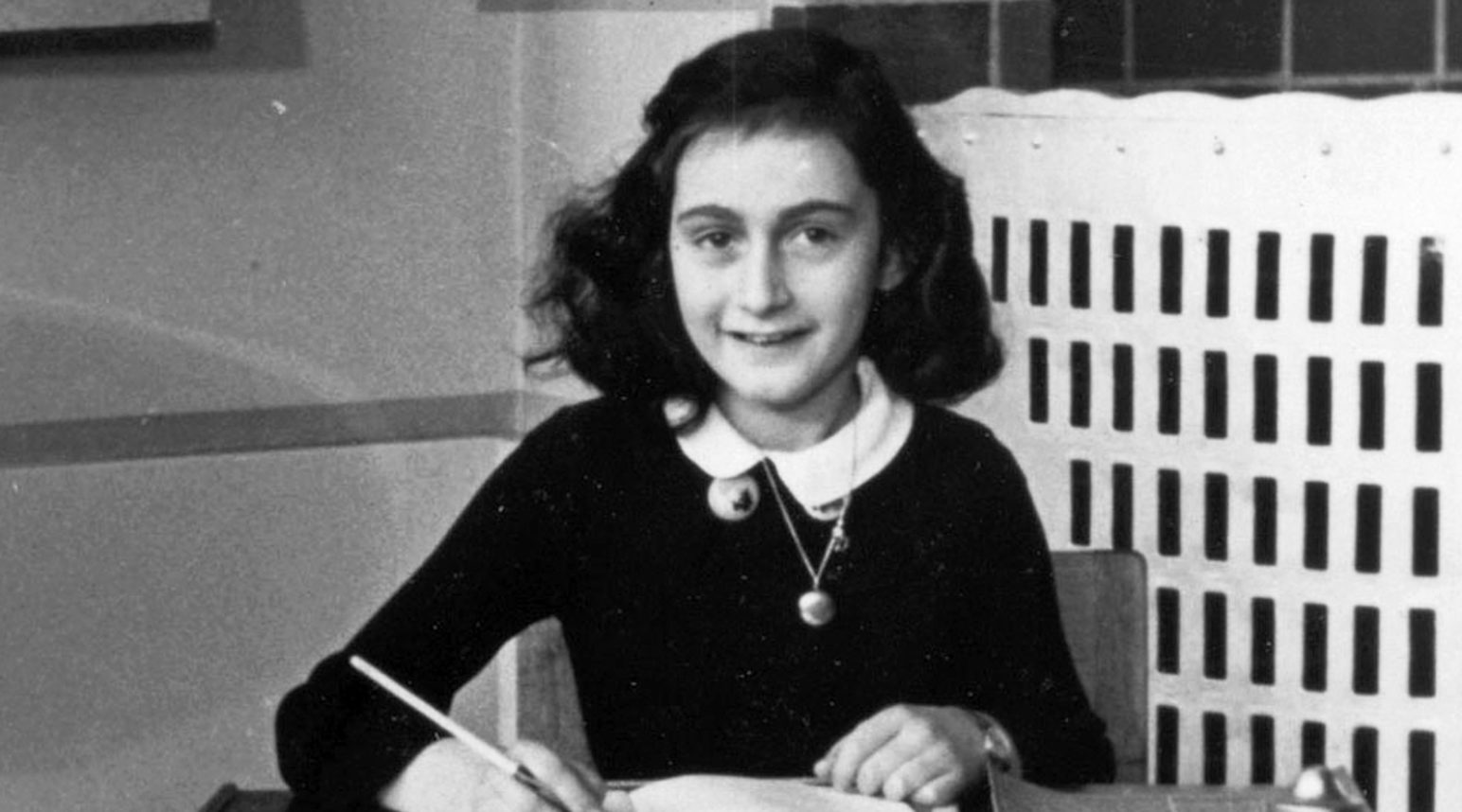
(JTA) — A student-run humor magazine at Harvard apologized for publishing an image of Anne Frank’s face on the body of a voluptuous woman in a bikini.
The image published in the latest edition of the Harvard Lampoon was condemned as anti-Semitic and misogynistic.
The text accompanying the doctored photo read “Gone Before Her Time: Virtual Aging Technology Shows Us What Anne Frank Would Have Looked Like if She Hadn’t Died.” Also: “Add this to your list of reasons the Holocaust sucked.”
“We realize the extent of offense we have inflicted and understand that we must take responsibility for our actions,” the Lampoon said.
“We as individuals and we as an organization would like to apologize for our negligence in allowing this piece to be created for and printed in our latest issue. We are sorry for any harm we have caused. Furthermore, we want to both affirm and emphasize that the Lampoon condemns any and all forms of anti-Semitism.”
The magazine said it would “restructure our review process for issues to prevent the publication of content like this.”
1. In less than two weeks, Israel is slated to install its new government. Its policies aren’t yet known, its direction unclear, its exact contour under discussion. But one thing is known: The right-religious camp added another layer of arrogance when voters gave it another term.
Some of the parties have over-the-top financial demands. Some want to use their acquired power to pass hasty, radical legislation. During previous terms, Prime Minister Benjamin Netanyahu was usually the man reining in the bandits and preventing them from doing “stupid s—” (to borrow from former President Barack Obama’s term).
But Netanyahu is currently more vulnerable to manipulation. He must have his allies at his side to overcome his legal trouble. The result could be a lot of stupidity — and all it involves (that is, the s—).
2. President Donald Trump’s administration’s peace plan, slated to be made public soon (but not very soon), is more of an opportunity to focus the mind than a real opportunity for the advancement of peace. The Palestinians will reject the plan, the Arab world will meekly follow, and in Israel, some political factions might also voice reluctance toward parts of the plan (example: Jerusalem as a capital of both Israelis and Palestinians). The plan isn’t fully known. The reaction to it is less of a mystery.
And yet, the Trump plan is likely to mark an official recognition of a historic departure: The orthodoxy of a two-state solution is badly shaken, possibly gone. That’s why all involved parties ought to use the Trump plan as an opportunity for rethinking their aims and strategies. For the Palestinians, it’s an opportunity to reconsider the maxim that time is on their side. For Arab states, an opportunity to reexamine their commitment to a Palestinian lost cause. For European agents, an opportunity to readjust to realities.
It is also an opportunity for Israel and its supporters to recalculate their presumptions and aims. What do we want? What is the end game? When there’s no clear path forward, navigation becomes more difficult because there’s no road map. On the other hand, no clear path forward means that all options are still open. A new way can be carved.
3. Paying attention to Iran could be tedious. It’s far away, it’s complicated and there’s a lot of nuance involved, from sanctions, to threats, to diplomatic talks, to reinforcement of troops, to mystery sabotage. And yet, the most important news of the week concerns Iran. Possibly, the beginning of a showdown. Possibly, the beginning of renegotiation. Trump applies pressure; Iran is testing how serious he is. This means two things: Iran no longer believes that Trump will soon be leaving office; and/or Iran no longer has the ability to wait out Trump’s term.
What we’re currently witnessing in the Persian Gulf is an exchange of messages. Iran signals that it is no longer willing to accept a deteriorating situation, hat in hand. From this, it can attempt one of three things: to scare away the United States by making threats or using power; to surrender and accept America’s terms; or to renegotiate. Trump already handed his phone number to the Swiss, in case Tehran wants to make the call. What happens if it makes the call?
A lot depends on Trump. If his main interest is politics, all he has to do is slightly improve the botched nuclear agreement and claim victory. His point made: Trump is a better dealmaker than Obama. Israeli policymakers, while having a lot of confidence in Trump, still fear such a result. Mainly because unlike in Obama’s case, an Iran deal signed by Trump will be much harder to oppose.
But senior Israeli leaders believe that Trump’s interest is his policy. They believe that if there are negotiations, they will be much tougher, and might not produce a positive outcome.
All this becomes dangerous because both parties, the U.S. and Iran, pretty much exhausted all their signaling options short of violent action. The U.S. is using all available sanctions. Iran announced that it will move to reproduce enriched uranium in a few weeks. It’s a game of chicken, with two players whose main apprehension is to be suspected of being chicken.
Shmuel Rosner is senior political editor. For more analysis of Israeli and international politics, visit Rosner’s Domain at jewishjournal.com/rosnersdomain.