fbpx

May 1, 2019

Shadows at My Feet

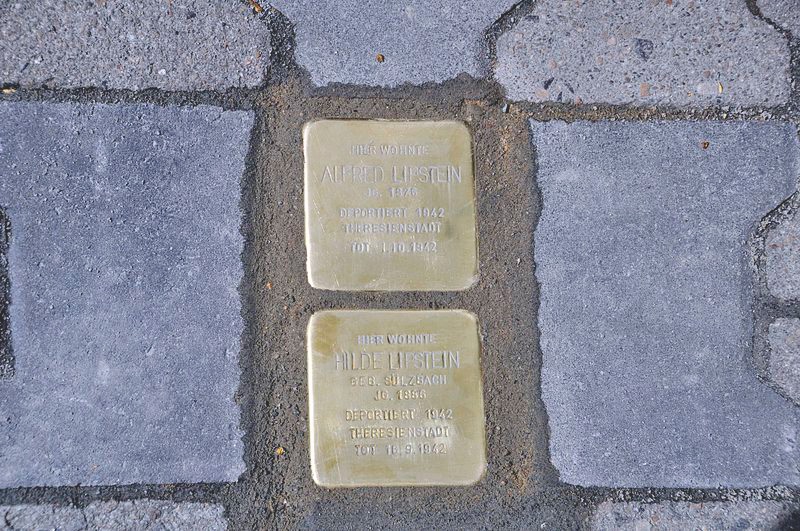
Fueled by the excitement of a newly arrived tourist, I was barreling back to the Villa Florentina, a charming 19th-century home turned boutique hotel in Frankfurt, Germany, when steps away from the driveway entrance, two brass plaques, shining in the afternoon sun, brought me to an abrupt halt. Instantly, my buoyant spirit faded. Embedded in the sidewalk, at my feet, were two stumbling stones, markers that commemorate victims of National Socialism at their last known residence.

Years ago, it was neither tourists nor business travelers who passed through the doors of this quaint four-story structure, but just two people: Alfred and Hilde Lipstein. What is now a popular boutique hotel had been the Lipsteins’ home until their deportation to Terezin in 1942.

 I imagined an elderly, elegant couple, suitcases in hand, slowly making their way down the front path, leaving their home for the last time.

The Lipsteins would have slipped from my memory if not for my next stop, the Hotel am Markt in the famed spa town of Baden-Baden. Another boutique hotel, another stumbling stone. This marker commemorated Frieda Hehl, a victim of the “Aktion T4,” the Nazis’ involuntary euthanasia program designed to rid the nation of the mentally ill and handicapped.

Somehow these inanimate 4-inch-square brass squares, etched with few words — the victim’s name, and dates of birth, deportation and death — seemed to have taken on a life. They had shadowed me on my travels. I began to wonder, who were these people who once inhabited the lodgings that I now used for rest and sleep after a busy day of touring?

I decided to delve into the stories behind these names, beginning with Frieda Hehl, a Catholic woman from Baden-Baden. In early November 1925, Hehl then 27 years old and unable to work because of her mental illness, joined her mother at what was then the Green Tree Hotel. They were not guests. Dagmar Rumpf, director of the Baden Archives, believes that Hehl’s widowed mother was a hotel maid. The challenge of working and caring for Frieda may have become overwhelming for her mother, prompting the mother to make an agonizing decision. Frieda Hehl was institutionalized on Nov. 30, 1925, and would remain so for the rest of her life.

Single and without children, Hehl didn’t leave behind descendants who could create a picture of her life. What can be reconstructed, is her last day of life. T4 authorities left behind ample documentation of their crimes.

On Aug. 8, 1940, a bus from the Charitable Foundation for the Transport of Patients, a T4 front organization, pulled up to the Emmendingen Institute in Baden-Württemberg. For reasons of “economic planning,” Hehl and other patients had been selected for transfer to another facility.

Hotel Villa Florentina.

At the Nuremberg Trials, Viktor Brack, a top T4 organizer and administrator, claimed the victims, “simply went to sleep without even knowing they were going to sleep.” A worker at the Hadamar killing facility, described a different scene.

Before placing Hehl, now 42, on the bus, the staff would have inked her name on her bare back or on a piece of tape that would have been pressed on to her back. Patients weren’t told the name of their new institution. Nor, if they had been capable, could they have gotten their bearings by looking at the passing landscape. All bus windows had been covered with paint or fitted with curtains.

The destination was Grafeneck. Originally a castle in Southern Germany, it had been a Protestant hospital for the handicapped until its seizure by the Nazis in 1940. Perched on a hill, its isolation made it suitable for conversion to a T4 killing center.

As soon as Hehl stepped off the bus, the macabre theater began. She first was asked to disrobe. Her clothes were labeled so they could later be returned. Hehl was weighed, measured and photographed. A doctor gave her a quick exam, verifying her identity and searching for any sign of an illness that later could be cited as a cause of death. The procedures were designed to calm and deceive, having the patients believe that after this orientation, they could settle into their new hospital.

But there was one additional step. Behind the castle was the carriage house, which, using some pipes, sealant and nozzles, had been converted to a gas chamber disguised as a shower room. It is commonly assumed that T4 victims were limited to the mentally ill and handicapped. In truth, those sitting on the wooden benches next to Hehl, waiting for their “showers,” may have included Germans who were blind, deaf, epileptic or elderly individuals with incurable diseases. 

Once the gas started filtering out of the shower heads, Hehl would have been unconscious in five minutes; death would have occurred at the 10-minute mark. After ventilating the chamber, a crew came in to bring the bodies to the crematorium.

At the Nuremberg Trials, Viktor Brack, a top T4 organizer and administrator, claimed the victims, “simply went to sleep without even knowing they were going to sleep.” A worker at the Hadamar killing facility, described a different scene. “In the chamber there were patients, naked people, some semi-collapsed with their mouths terribly open, their chests heaving. … I have never seen anything more gruesome. … I could not imagine that this was completely without pain.”

Frieda Hehl was murdered on Aug. 8, 1940, the day she arrived at Grafeneck. “The killing centers,” wrote historian Henry Friedlander, “processed living human beings into ashes in less than 24 hours.” In its one year of operation, an estimated 10,654 victims were murdered at Grafeneck.

Ten days after Hehl’s death, a waiting period instituted to avoid arousing family suspicions, a condolence letter would have been sent to Hehl’s family, informing them that Frieda had died “suddenly and unexpectedly.”

Two years later, Hilde and Alfred Lipstein, commemorated by the stumbling stones at the Villa Florentina in Frankfurt, were also caught in the Nazis’ vortex of death. But they would meet their end under different circumstances.

In 1907, when the couple married, and began life together in their stately home, a wedding gift from Hilde’s parents, their future must have seemed limitless. Alfred, a 31-year-old doctor specializing in gastroenterological diseases, had married well. His wife Hilde, 10 years his junior, was the granddaughter of Rudolf Sulzbach, a commanding figure in Frankfurt’s commercial world. A dynamic financier, Sulzbach co-founded or participated in the establishment of the Mitteldeutsche Credit Bank, the German mortgage bank
Meiningen, the S. Sulzbach Bank and the South German Real Estate Co. When
Deutsche Bank was established, in 1870, Sulzbach was the largest shareholder, serving on the board of directors until his death.

While acknowledging  his  grand-mother’s illustrious family lineage, Mark Lipton, a chemistry professor at Purdue University, notes, “my grandfather was no slouch either. He was actually quite good friends with Max Born, a Nobel prize-winning physicist, who was a relation by marriage in his family.”

The grand and imposing West End Synagogue, a short walk from the Lipstein home, indicates that their neighborhood had a significant Jewish presence. But the Lipsteins were not part of this community. Great niece Maureen Kirchholtes recalls being told that Beate, the Lipstein’s older daughter, “never knew she was Jewish until she went to school and the kids started calling her names.” Ironically, although there is no evidence that they practiced their new religion, Beate and her siblings had been baptized.

Perhaps the children bullying Beate were unaware of her baptism. Or perhaps, their jeers were a foreshadowing of Nazi ideology that contended a trip to the baptismal font couldn’t erase one’s Jewish identity.

When the Nazis assumed power in 1933, Alfred Lipstein admonished his children to “get the hell out of Germany.” By 1938, all four Lipstein children had set off to embark on new lives. Beate eventually settled in Palestine, building the new State of Israel and pursuing a career as a gynecologist. Walter, the Lipstein’s younger son, became a psychiatric social worker in the United States. The other two children entered the legal world. Kurt Lipstein, a distinguished professor, pioneered the field of comparative law at Cambridge University. Margot, their youngest child, who had settled in the U.S., returned to Germany in 1945 as the legal assistant for Robert Kempner, an assistant U.S. chief counsel at the Nuremberg Trials.

Why hadn’t the Lipsteins joined their children, leaving Nazi Germany as early as possible? The likely answer is family responsibility. Before they died, Hilde Lipstein had promised her parents that she would take care of her brother, who had epilepsy, a condition that would have prevented entry into the U.S., under the U.S. Immigration Act of 1917, and may have hindered admission to other nations.

Grandson Joram Davidson, of Israel, believes there may have been an additional reason his grandparents stayed in Germany until it was too late, when all hopes of emigration had faded. “I think my grandfather took care of a lot of older relatives, not just financially but spiritually. From talking with people, that is the impression I got of him.”

It is unclear from Hilde Lipstein’s Terezin death certificate whether she died of natural causes or committed suicide on Sept. 16, 1942, the day after her arrival at the camp. Regarding her husband, Alfred, the record is clear; he committed suicide the following month.

German artist Gunter Demnig created the stumbling stone in 1995. Today they can be found in more than 610 German towns, cities, and villages. The stone for Frieda Hehl, a middle-aged woman, with working-class roots, who was afflicted with a severe mental illness, and the markers for the Lipsteins, an elderly couple, who were the quintessential German Jewish success story, are linked together as part of a virtual stumbling stone path that winds its way through Germany. Welcome or unwanted, these testimonies to Nazi genocide and persecution are everywhere, shadows at our feet.


Charlotte Bonelli is the author of  “Exit Berlin: How One Woman Saved Her Family From Nazi Germany” (Yale University Press, 2014).

Shadows at My Feet Read More »

Go to a Synagogue This Shabbat

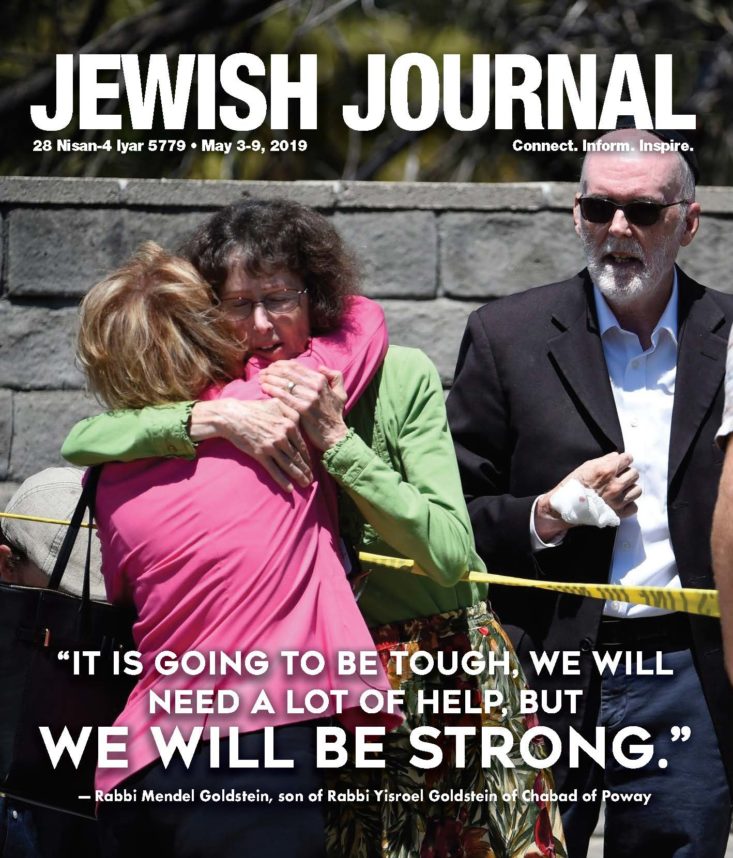
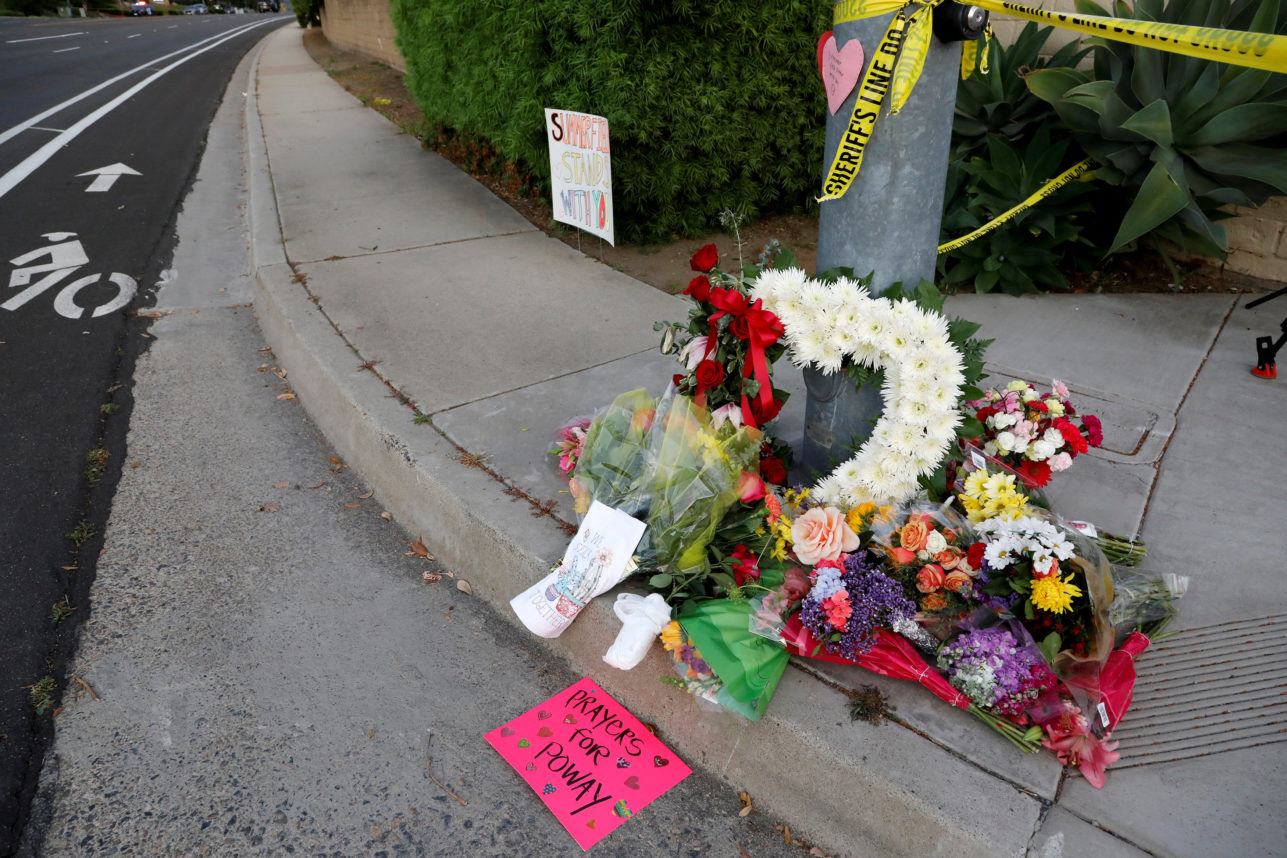
We are all heartbroken over the horrific shooting at the Chabad of Poway on April 27, six months to the day after the shooting at Tree of Life synagogue in Pittsburgh.

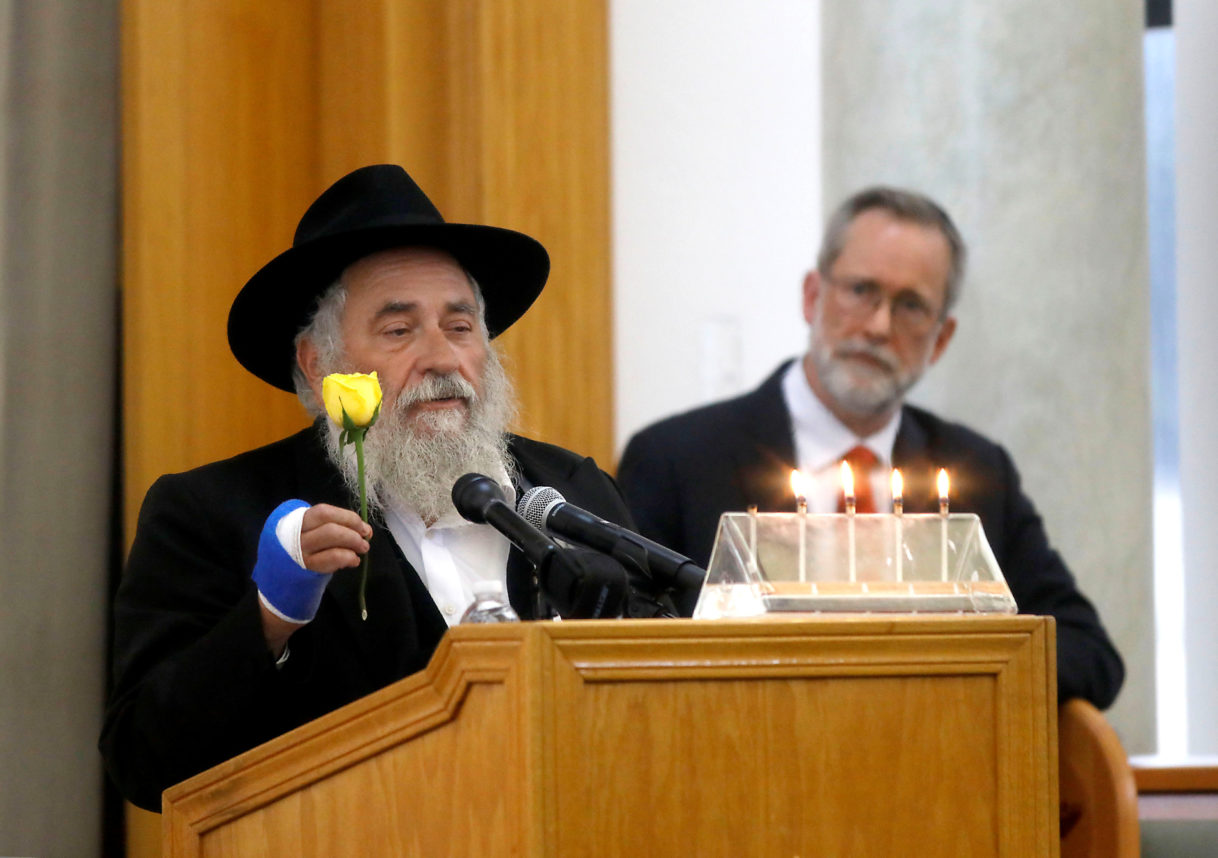
We grieve the tragic death of Lori Gilbert-Kaye, who was a pillar of her community and who heroically gave her life to protect her rabbi. We are inspired by the courage of Rabbi Yisroel Goldstein, who even after he was shot and wounded continued to preach a message of optimism and courage to his followers. We pray for little 8-year-old Noya Dahan, injured in the shooting, whose family moved to the U.S. from Sderot, an Israeli town on the Gaza border bombarded regularly by Hamas rockets, hoping for a quieter, more peaceful life here. We pray for healing for Rabbi Goldstein and all those who were injured physically and those who are emotionally traumatized by this anti-Semitic act of violence and hatred. We pray for the parents who were frantically searching for their children and for the frightened children hiding and huddled beneath chairs in their house of prayer. We pray for safety for our people everywhere. And in the wake of unspeakable acts of hatred committed in synagogues, churches and mosques, we pray for all people of faith who seek nothing more than to worship God in peace.

When will it end?

When will sanity return?

Throughout our history, prayer has never been a passive activity. Prayer has always been an act of defiance. It was so for Jews who continued to study and to teach and to pray in defiance of the Roman ban on Torah study, it was so for Jews in Spain during the Inquisition who prayed and practiced in secret. It is so for us today. Coming together to synagogue is taking a stand that we choose faith over fear, that we see ourselves as blessed not cursed even in the face of rising anti-Semitism. Prayer doesn’t end in synagogue. Prayer fills us with the courage to speak out, to stand up, to rally, to teach, to preach and to pass laws that will transform our society and our world. Those who offer lip service to “hopes and prayers” don’t understand the radical power of prayer.

Last Shabbat, I was in synagogue sitting beside my longtime congregant and dear friend Louis Sneh. Louis and I both came to pray the Yizkor service remembering our departed loved ones. Louis, who is 92 and a survivor of Auschwitz, sighed in grief for his family and his entire community who were slaughtered in the Holocaust.

After Yizkor, the somber mood of the service gave way to the hopeful words of the Ashrei prayer: “Blessed are those who enter Your house, God.”

As we chanted those words, an air of hope descended on all of us mourners. Yes, sitting here in God’s house is a blessing, I thought. At that moment, Louis turned to me and said,

“Naomi, can you believe we prayed these same words in Auschwitz?”

I said, “Yes, I can believe that.”

Prayer has always strengthened our resolve, even in the most horrific situations.

Little did we know that our conversation was taking place at the very moment when the shooter entered Yizkor services at the Chabad of Poway. “Blessed are those who enter Your house to pray.”

Today is Yom HaShoah. Together we will honor the memory of the Six Million at Nashuva this Friday night. And May 9 is Yom HaAtzmaut, Israel Independence Day. We will celebrate Israel’s birthday as well this Friday night with songs of hope and peace.

Together we will transform hate into love, fear into hope, and sadness into joy.

“Blessed are those who enter Your house, God.”

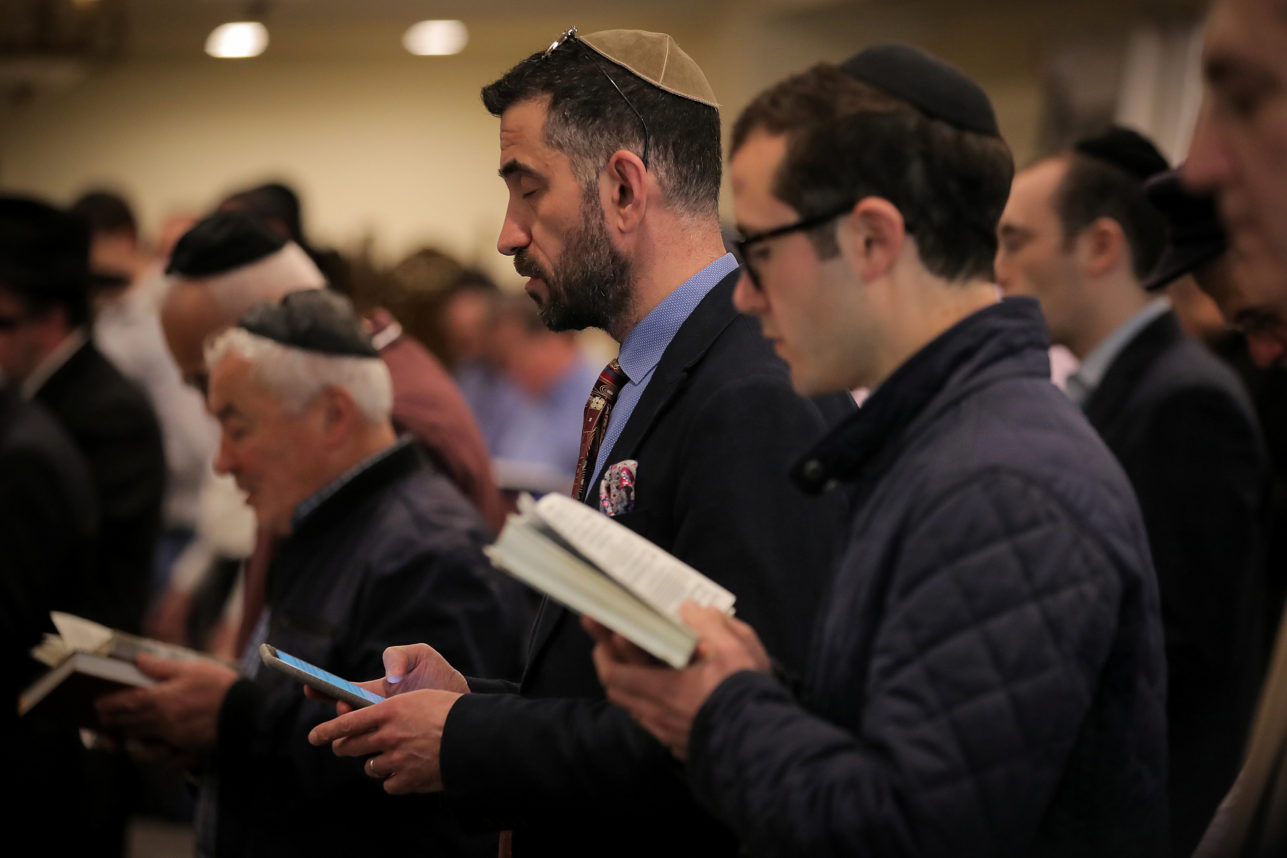
I hope you will go to your nearby synagogue this Shabbat and experience the blessing of courage, of hope, of defiance and of love.

Blessings to you, Amen


Naomi Levy is the founder and rabbi of the Los Angeles-based Jewish spiritual community Nashuva.

Go to a Synagogue This Shabbat Read More »

Life After Hate

It wasn’t a coincidence that our live band played the song “Sympathy for the Devil” as congregants entered Yom Kippur services. There was a message to deliver. “At some point in this service,” I told them, “we are going to be asked to offer expiation to a demonic god of the ancient Near East named Azazel. Why doesn’t anyone talk about that on Yom Kippur?”

During the Torah reading, as the name Azazel came up, I pulled out my Chumash and read Leviticus 16:8: “And he shall place lots upon the two goats, one marked for the Lord and the other marked for Azazel.”

Explaining how Azazel was an ancient Near Eastern demonic god, I asked, “What in our human capacity would compel God to ask us to give expiation to the devil?”

As I read, images from Charlottesville appeared on the screen above my head. The men in white shirts. The orange flames. The chants of “Jews will not replace us.”

A man rose from the congregation. “That was me,” he said. “I used to hate just like them. I was a neo-Nazi for 20 years.”

“Can you come down here and explain yourself?” I asked. 

I had met Logan through an organization called Life After Hate (LAH). I reached out to the group in the wake of Charlottesville, haunted by images of young men with torches at night. As a descendant of an intermarried family of Jews and German Lutherans who fought for Hitler’s cause, these images were a graphic and painful reminder of the evil that lurks in darkness.

So, I invited Logan, an alumnus of LAH, to speak at Open Temple for the High Holy Days and share his story. 

He grew up in Orange County, falling in with a “bad group of guys” and quickly finding himself selling drugs to immigrants. He was told by this gang of white supremacists to focus sales on minorities in order to “mess them up.” He shared how he ended up in jail, first for drugs and later for being complicit in a murder. While in prison, he met compassionate Christians. He studied the Bible. And he discovered the power of God’s ability to forgive. 

“I have come here today to ask for your forgiveness,” he told us. “I was young and stupid and was taught to hate Jews. I did things I wasn’t proud of. You can see here my tattoos I am trying to get removed. I want to say that I am sorry for who I was and ask if you can forgive me and see me as the man I have become. I am a father now. I have two sons. Their mother and I are married and trying to make our way. It isn’t easy. But I know now that there is a better way to be and I need to raise my sons with that knowledge. Will you forgive me?”

A crowd of congregants descended on him, and through tears and the mixed emotions of relief, fear, compassion and pure acceptance, we chanted the misheberach prayer for healing and forgave him. 

The morning of April 28, as the world woke up to the tragedy at the Chabad of Poway, I received this text:

“Once again I am saddened by my past and embarrassed to have ever been involved with idiot groups. I apologize to you and your temple for the actions of the confused idiot in San Diego. I don’t know why but feel I need to apologize for idiots but I do. I hope all is well with you. Much love. Logan.”

Where can we find life after hate, I wondered?

At this very moment, we can find it in Rabbi Yisroel Goldstein’s call for spreading light into darkness, and in the very word for Chabad itself. Chabad is an acronym for chochmah (wisdom), binah (woman’s wisdom) and da’at (Godly knowledge). Rabbi Goldstein upheld the integrity of this acronym through his words encouraging us all toward the light; invoking Lori Gilbert-Kaye’s maternal love and final sacrifice; and reminding us of our potential to redeem the holy sparks through acts of loving kindness. 

We can find life after hate also in the words and actions of a former neo-Nazi, a man who had the courage to redeem his own Azazel and turn it into light.


Rabbi Lori Shapiro is the founder and artistic director of The Open Temple in Venice.

Life After Hate Read More »

San Diego Victims Mourned at L.A. Yom HaShoah Ceremony

Gathering April 28 to commemorate the Holocaust, elected officials, rabbis and community leaders spoke of how the anti-Semitism of the Shoah reared its head at Chabad of Poway last Shabbat on the final day of Passover. During the attack, a 19-year-old allegedly gunned down 60-year-old Lori Gilbert-Kaye and wounded 57-year-old Senior Rabbi Yisroel Goldstein, 8-year-old Noya Dahan and her 34-year-old uncle, Almog Peretz.

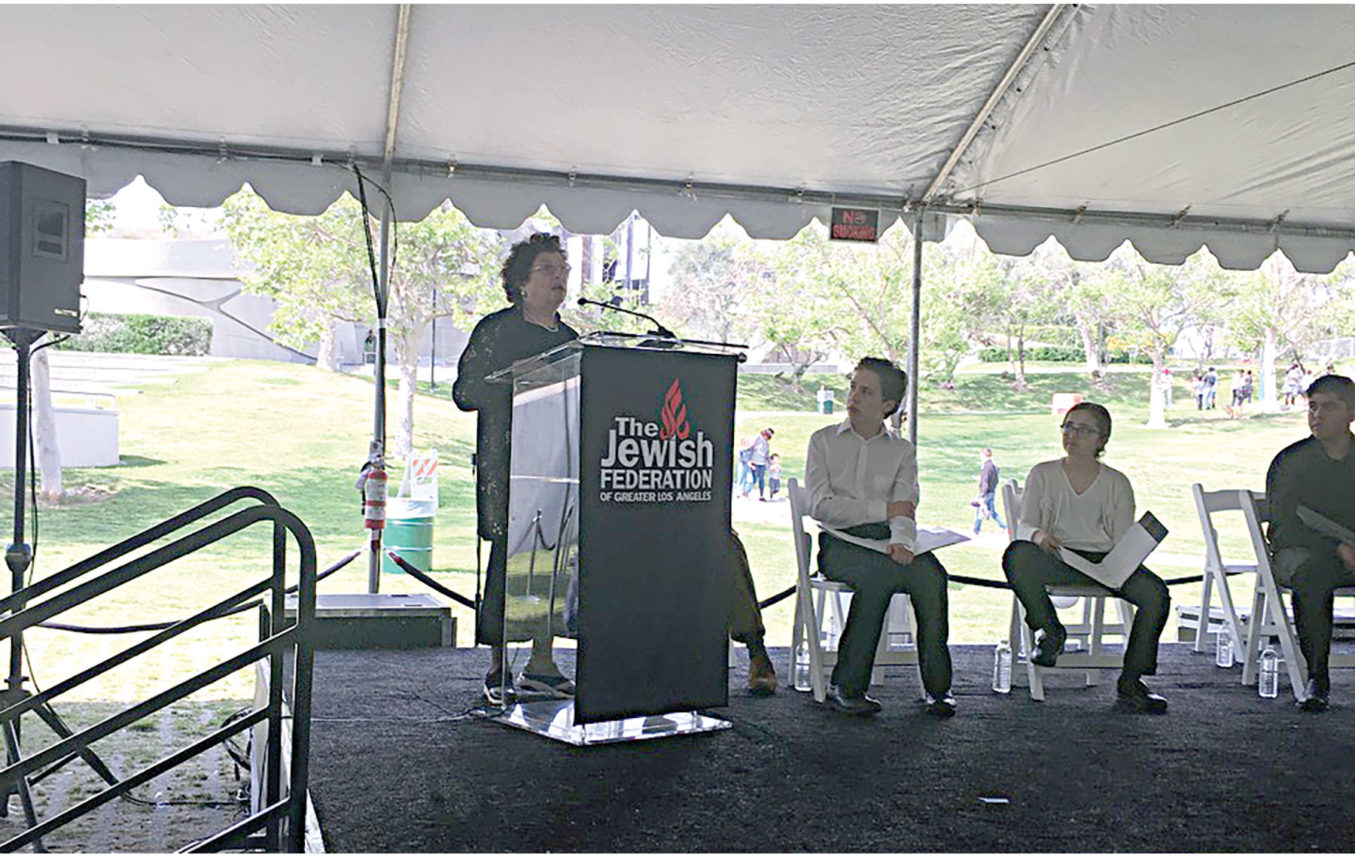
“We know this is a heavy day to gather,” Los Angeles Mayor Eric Garcetti said inside a tent erected at Pan Pacific Park. “There have been too many heavy days recently … as we remember Lori Gilbert-Kaye, an Eshet Chayil (woman of valor) as one of her friends called her, a woman who literally took a bullet for her rabbi, as hatred we just don’t remember in the past but live with in the present surrounds us.”

Jewish Federation of Greater Los Angeles President and CEO Jay Sanderson lead the estimated 1,000 attendees in a moment of silence for Gilbert-Kaye. He spoke about the impact of the shooting and urged people to show strength in the face of adversity. “The hatred that caused the Shoah is a hatred that still flickers in certain corners of the world,” Sanderson said. “We have to stand strong on days like today.”

Stephen Wise Temple Senior Rabbi Yoshi Zweiback said people could not undo the hatred of the distant past, “nor the past of yesterday just a few hours drive from this spot.”

State Sen. Ben Allen (D-Santa Monica), chair of the California Legislative Jewish Caucus, recalled visiting Auschwitz-Birkenau two decades ago as a college student. The “hallowed, ghost-filled grounds” of the concentration camp continues to haunt communities, from Charlottesville to Poway, he said. “I can’t quite believe the dark fire that led our people down those train tracks into those chambers still has a flicker in some of our most beautiful cities.”

From right: L.A. Mayor Eric Garcetti, Jay Sanderson, president and CEO of the Jewish Federation of Greater Los Angeles, Beth Kean, executive director of L.A. Museum of the Holocaust and Liebe Geft, director of the Museum of Tolerance, attended the ceremony. Courtesy of the Jewish Federation of Greater Los Angeles

Holocaust survivor Eva Brettler, 82, spoke of her childhood in Romania and the numerous challenges she experienced during the Shoah, including having her grandmother taken away, hiding in the woods as a child, and her own imprisonment in the Ravensbrück and Bergen-Belsen concentration camps.

“I make a point of sharing my story for multiple reasons,” Brettler said. “I put tremendous emphasis on education. That’s one thing no one can take away from you.”

After the April 27 shooting, Adeena Bleich, deputy chief of staff for L.A. city councilmember David Ryu, said she was concerned about congregating with other Jews for Yom HaShoah. Ultimately, her commitment to Jewish community won out, she said.

“It was the first time in my life that I was afraid to attend a Jewish community event,” Bleich said in an email. “But then I thought about my two young children and the work we do in the city council office every day to make Los Angeles safe for all, and I realized that that fear I felt was exactly the reason I needed to show up to a commemoration of the Shoah — so that those trying to harm us and scare us with hate and discrimination don’t ever gain power.”

San Diego Victims Mourned at L.A. Yom HaShoah Ceremony Read More »

The NYT cartoon leaves no doubt: “classic” Antisemitism is back!

A photo is worth a 1000 words. This means that it’ll take much more than a plain apology (with probably zero intention behind it) to erase what The New York Times did last week.

In case you missed it, the popular paper’s international print from Thursday included a cartoon showing “blind” Donald Trump holding Israeli Prime Minister Benjamin Netanyahu, depicted as a dog on a leash. As you can see, this image contains several, clear, Antisemitic characteristics, most visible is Israeli PM being presented as a dog, having a particularly big nose, and wearing a star of David on his neck. A classic Antisemitic cartoon.

It didn’t take long for the backlash to begin, and on Saturday, NYT posted an editor note that’s said to be printed in Monday’s edition: “A political cartoon in the international print edition of The New York Times on Thursday included anti-Semitic tropes…The image was offensive, and it was an error of judgment to publish it. It was provided by The New York Times News Service and Syndicate, which has since deleted it.”

The apology was not accepted by a lot of members of the Jewish community. The American Jewish Committee tweeted: “Apology not accepted. How many @nytimes editors looked at a cartoon that would not have looked out of place on a white supremacist website and thought it met the paper’s editorial standards? What does this say about your processes or your decision makers? How are you fixing it?”

Frankly, I’m with them. Apology not accepted, and, if you ask me, not really intended either. The New York Times has been leading an anti-Israel agenda for a long time now, and the line between that and Antisemitism is extremely fine.

This cartoon came out in perfect timing, actually. A week before our national Holocaust Remembrance Day, which is a great opportunity to contemplate on how far we’ve come on the one hand, and how close we are to having history repeat itself.

That NYT cartoon is a clear representation of classic Antisemitism. In comparison, look at this one, from 1940, showing Churchill led by what can be described as a classic anti- Semitic representation of a Jew. Can you spot the similarities?

This “classic” Antisemitism has been hidden for 7 decades almost. People were embarrassed to express their hateful, awful opinions, from the fear of being criticized and shut out from their communities. Those opinions, of the Jews running the world and being the reason for all the ills of society, were automatically compared to the ones held by the Nazis and their followers before and during WWII, and those who held them kept them tucked in, only letting them crawl out in the shadows.

But something has changed, and that’s a lot thanks to the “new” Antisemitism. The one that uses the Israeli-Palestinian conflict to legitimize Antisemitic opinions and ideas being expressed out loud. It hides behind the legitimate criticism over Israel’s way to handle the conflict, but if a discussion begins, it somehow always ends with “but the Jews…”

The New Antisemitism is not direct and straight forward. It does not compare Jews to vermin or directly ask people to carry on Hitler’s legacy. Instead, it uses an innocent and peaceful rhetoric to gradually delegitimize the state of Israel and the right of the Jewish people to their own country. By using the same method many anti-Israelis often use, the new anti-Semites create hatred toward the Jewish people as a group modernly turning us into a villain of some sort. With a fair share of lies and that peaceful rhetoric, “the Jew” becomes a person to blame for all the world’s suffering, and the Holocaust turns into an event that is only second to what the Palestinians are going through nowadays.

Instead of denying the Holocaust, this rhetoric wisely connects it with the Israeli-Palestinian conflict thus incites hatred toward “The Jews” for surviving the Holocaust and later forming an independent state. It is very important to remember that while the State of Israel often makes the connection between the Holocaust and the state (משואה לתקומה, From Holocaust to Heroism), it is not an actual narrative. Many of the Jews who founded the state of Israel lived there many years before the Holocaust took place.

The Holocaust has no direct relation with the Israeli-Palestinian conflict. The Genocide of the Jewish people did not directly cause the ongoing dispute over the small, strategic piece of land at the heart of the Middle East, and the survival of a few 70 years ago is heroism, not an attempt to bring suffering into the world. But with enough free time, malicious intentions and viral activity, any story can be believed to be the objective truth.

This “new” Antisemitism still exists, and The New York Times, even if not pushing is directly, takes part in helping those who do by taking a very imbalanced, anti-Israel agenda, that’s not always being pointed out in a way to allow people to activate their own judgement, but in the form of “fact framing.”

Therefore it’s hard for me to believe the sincerity of their apology. All they did was allowing themselves a bit more liberty, joining the new wave of the old, “classic” Antisemitism.

It didn’t happen overnight. It took some time. But slowly, they all stepped out of the shadows, not fearing to let their dark opinions be heard. They enjoyed the “new” Antisemitism and watched how it’s becoming legitimate to, basically, blame the Jews for stuff, and sought the opportunity to go all the way.

The problem? In the age of the interned, it has become very hard to stop them. And seeing that people who hold such dark, scary opinions are our next door neighbors (and not only tattooed skinheads,) makes it seem almost okay…

The “new” Antisemitism was very hard to stop, because it was hidden. We failed to stop it, and the old one kicked back in. We cannot allow cartoons such as the one published on NYT be published again! We cannot and should not rest until it becomes very clear that Hitler’s legacy has no place in today’s society. History CAN repeat itself. You can see it happening already in the form of businesses not allowing  Jews in, or in the form of Antisemitic cartoons being published in popular papers.

This is out chance to take a stand, without even leaving the comfort of our homes. We must take a sand behind our keyboards, and fight for the sanity of this society, before it will devour itself again.


The NYT cartoon leaves no doubt: “classic” Antisemitism is back! Read More »

Letters: Don’t Demonize Strong Women, Trump and Immigration, Changing Religious Fanatics, Don’t Excuse N.Y. Times’ Bias, Poway Chabad Shooting

Don’t Demonize Strong Women

In “Toxic Femininity” (April 26), Karen Lehrman Bloch states we need to embrace strong female role models. That’s not achieved by throwing women under the bus whose politics we don’t like or demonizing strong and responsible women in the #MeToo movement who speak out against sexual abuse. Bloch cites several examples of Rep. Alexandria Ocasio-Cortez’s (D-N.Y.) views that don’t jibe with hers; and contrasts her with Nikki Haley, who uses “softness to make tough points” and isn’t “emotional.”

Haley, like AOC, is attractive; and in our looks-based society, that may attract votes. Far from “ditzy,” AOC is extremely intelligent and passionate about issues. AOC actually downplays her attractiveness with a conservative hairstyle, frequently wears glasses, and professional attire. She doesn’t need to conform to antiquated notions of how women should talk and act. Demonizing strong, brave and outspoken women perpetuates sexism and misogyny.

Andrea de Lange, Los Angeles


Trump and Immigration

I am the son of a German immigrant who came to the United States in January 1937. He lived in Cincinnati with his brothers and parents and became an outstanding citizen of our country. He served in the U.S. Army and became the president of Adath Israel Congregation in Cincinnati. He never considered himself a German American. He died on Sept. 9, 2001, and thankfully never go to see what happened to our country on Sept. 11.

My uncle Jerome Teller was president of HIAS and a lawyer in Cincinnati. He worked tirelessly to help Russian and Persian Jews escape persecution and find homes in the United States. He spent the latter part of his life helping those who could not help themselves, both in and outside of the Jewish community. He died a few years ago.

It would bother my father and uncle to see what President Donald Trump said in an address to the Republican Jewish Coalition recently. During World War II, Jews were sent back on ships to their homeland because our government closed its borders. Most of the Jews who were sent back died in the countries where they were being persecuted.

Now, our president is saying that “our country is full” and we cannot accept any more immigrants. How can anyone support this policy and our president in his belief that we don’t need to help out people who are escaping a dangerous situation?

Ralph Hattenbach, Los Angeles


Changing Religious Fanatics

Ever since religious terrorism was born, the world has not found the way to prevent it other than identifying and destroying religious fanatics before they can kill and terrorize in the name of their god (“Shaming Religious Fanatics,” April 26).
Do we really understand the mindset of a person who would strap on a suicide vest or persuade their children to do so? With all due respect to David Suissa, I doubt such people or their children could be shamed into becoming peaceful advocates of their religion, especially when many of their religious leaders advocate violence in the name of their God. Nor do I think shaming them would rehabilitate religion.
But surely there must be a way to convert religious fanatics into peaceful advocates of their religion. Who has the answer? I wish I did.

David Rothman, via email


Don’t Excuse N.Y. Times’ Bias

Not surprisingly, it took reading to the last paragraph of Jonathan Kirsch’s review of Jerold Auerbach’s “Print to Fit: The New York Times, Zionism and Israel, 1896-2016,” to find his defense of the blatant anti-Israel bias of the New York Times (“New York Times Seen as Bad News for Jews,” April 26).

Whatever his opinion of Auerbach’s treatise, Kirsch does an injustice in excusing the reality of the often inaccurate and sometimes immoral coverage of the newspaper. From biased news coverage to editorial columns, the Times’ penchant for depicting Israel in a negative and demeaning manner makes it unworthy of the description of the paper as the “gold standard in world journalism.”

Alice Greenfield, via email


Poway Chabad Shooting

There has been a turning point now and there is no going back. Something has changed. Our safety in worship can no longer be assured.

There will probably be more copycat synagogue shootings in the U.S. The political climate that has enabled the ultra-right fringe element, with its access to guns and explosives, to live out its long-held, ill-informed and misguided goal to kill Jews, fueled by social and other media misinformation, is now upon us. And what better place than a house of prayer? Just ask people in Muslim countries where massacres and bombings are commonplace in mosques.

We may soon become like European countries such as France and the Scandinavian states that have automatic weapon-armed troops and police on every Shabbat outside most synagogues. It’s important to feel safe, but at least now I know how my ancestors felt when going to worship in Russia and Poland.

And I hope this isn’t left up to individual synagogues to ensure the safety of their congregants. Nor should it be. This is a societal problem and government must ensure the safety of its citizens. Although I may not like it, there is now no alternative. We need to have police as well as private security at every major synagogue, sooner rather than later. How many more need die to make it happen? As I said, there is no alternative now and no turning back. Sad. Very sad.

Jay Schuster, Sherman Oaks 


Let me make it clear I am saddened, appalled and outraged at the attacks on churches, mosques and houses of worship in Sri Lanka, New Zealand and other countries. These events may be an indication of a relatively recent international revival of right-wing nationalism.

But the media has it all wrong when it conflates the recent synagogue murders with acts of international terrorism toward minority groups.  The synagogue murders in Poway and Pittsburgh are not recent indicators of anti-Semitism in the United States. Jewish houses of worship in our country have long been the object of threats. There is hardly a synagogue of any denomination I have attended in recent years where the first person who greets me is not an armed guard or security person. This is nothing new for the Jews. We know that anti-Semitism is real and continues to persist and yes, is growing even in America.

Stu Bernstein, Santa Monica


On the holy day of Shabbat, at the conclusion of Passover, the peace of sacred worship was shattered.
We are deeply saddened to hear the news of the tragic shooting at the Chabad of Poway. One member of the congregation was slain; three others were injured, including a child. We hope and pray for the dead and injured, their families and community, and for the law enforcement officers who prevented further injury and loss of life.
In yet another attack on our brothers and sisters, we are reminded of the dark shadow of hate that lies in the hearts of many, and that there are those would would do the Jewish people harm as we attempt to worship in peace. This unspeakable act was committed on the six-month anniversary of the tragedy in Pittsburgh, when another attacker is charged with storming into a synagogue and killing 11 Jewish worshippers, changing a community forever.
This is also a painful and urgent reminder of the consequences of hate speech. Attacks like this don’t occur in a vacuum; when hateful rhetoric and nonviolent hate crimes are allowed to become a “normal” occurrence, this is the inevitable result. We can no longer afford to treat hate speech against Jews or any other minority as anything less than a precursor to violence and bloodshed.
We sincerely hope that, in time, Poway’s Jewish community will find some measure of peace. All Americans must join together to halt the expansion of hate, to protect ourselves, our country and our future.

Jack Rosen – President, American Jewish Congress


CORRECTION

The parents of a Japanese American veteran referred to in a story about a documentary (“ ‘Liberation Heroes’ Bear Witness to the Holocaust,” April 26) were not in an internment camp during World War II.

Letters: Don’t Demonize Strong Women, Trump and Immigration, Changing Religious Fanatics, Don’t Excuse N.Y. Times’ Bias, Poway Chabad Shooting Read More »

Da’as Torah and Anti-Vaxxers

In a recent article in the Forward, Rabbi Avi Shafran, the spokesman for Agudath Israel of America, the umbrella organization of American Charedi Jews, complained that the media was singling out the ultra-Orthodox as the prime culprits responsible for the measles outbreak in the United States. He implied that what underlay these media reports was not only anti-Charedi sentiment but actually unvarnished anti-Semitism. He pointed out that on the one hand there are many “anti-vaxxers” who are not Jewish, much less Charedim. On the other hand, what he called the “vast majority” of Orthodox Jews do have their children vaccinated.

On its face, Shafran is not incorrect. The problem is that he simply is not telling the whole truth. Indeed, it is the very leaders of his own organization who are telling their followers not to vaccinate their children if, for whatever reason, they don’t want to. Even more troubling, these same leaders are forbidding schools under their religious aegis to deny attendance to unvaccinated children.

Although ground zero for the outbreaks in America have been the Chasidic strongholds of Brooklyn’s Williamsburg and Borough Park neighborhoods, it is the non-Chasidic leaders of Agudath Israel who not only have justified opposition to vaccinations, but explicitly condemn schools that require vaccines as a prerequisite for attendance. They draw upon on mostly discredited studies and argue that the risk of complications from measles is minimal. They overlook the fact that the saving of life (pikuach nefesh) applies even in cases where the risk of death is minimal. Yet the risk is very real. I should know. Many years ago, my younger brother nearly died from complications of measles. It was only thanks to the proximity of a talented and energetic doctor that he survived the trip to the hospital.

The risk is very real. I should know. Many years ago, my younger brother nearly died from complications of measles.

And yet these rabbis assert their opinion is nothing less than what has come to be called da’as Torah, or Torah authority, elevating their erroneous and dangerous views to the level of near prophesy. No wonder ordinary Charedim are loathe to challenge the views of their respected leaders. To do so would be to risk expulsion from their tightly-knit communities.

Who are the men issuing these pronouncements? Two of them lead the Beis Medrash Govoha of Lakewood, N.J.: Rabbi Malkiel Kotler, its chancellor or Rosh HaYeshiva, and Rabbi Matisyahu Solomon, its moral tutor (to borrow a term employed at Oxbridge colleges) or mashgiach. They lead a yeshiva that is the most prestigious and the wealthiest school of its kind in the United Stares — in effect, the Harvard of yeshivas. No wonder their word is taken as law.

But these men are not alone among the rabbinical anti-vaxxers. Rabbis Shmuel Kamenetsky and Aaron Schechter are, like Rabbi Kotler, members of the Moetzes Gedolei HaTorah — the Committee of Torah Sages — that dictates Agudah’s religious and secular policies. Rabbi Chaim Kanievsky, a leading Israel-based decisor for thousands of Charedim worldwide, has also, in the words of Rabbis Kotler, Solomon and Kaminetsky, “explicitly ruled that schools cannot refuse such [unvaccinated] children.” These rulings are not merely flouting science; their da’as Torah is endangering hundreds, perhaps thousands of younger children and older people who are especially vulnerable to complications from measles.

In the previous century, Agudah’s rabbis invoked da’as Torah to urge Europe’s Orthodox Jews not to emigrate to America or Israel in order to escape the Nazi onslaught. Until May 1948, they invoked the same principle to oppose the creation of the State of Israel. In the 1970s and ’80s, they invoked da’as Torah again to counsel against public demonstrations on behalf of Soviet Jewry. Now they invoke it to oppose vaccinations. And once again, as before, they find themselves on the wrong side of history.


Dov S. Zakheim was Under Secretary of Defense in the George W. Bush administration and Deputy Under Secretary of Defense in the second Ronald Reagan administration. He holds a doctorate from Oxford.

Da’as Torah and Anti-Vaxxers Read More »

Don’t Give Anti-Semites What They Seek

When you look at a rabbi with a white beard wearing a black hat, a long black coat and a gartl, what do you see? Anti-Semites see a refugee from the ghettos of Europe, a secret emissary of a global power intent on ruling from within. But what do you see?

When you look at an Israeli living in Sderot, what do you see? Anti-Semites see an emissary of Israeli intolerance, a thumb in the face of Palestinians, a hypnotizer of the world. But what do you see?

When you look at a 60-year-old Jewish woman living near San Diego, what do you see? Anti-Semites see a recipient of privilege, an inherent victimizer in the hierarchical power structure. But what do you see?

Anti-Semites see the Jews as part of a pattern. Each Jew is a data point in that pattern; every Jew can be pigeonholed as a member of a broader conspiracy. Right-wing white supremacist anti-Semites see the Jews as an eternal threat, a racially “mongrelizing” threat to white purity, a religious blot, a nefarious group of schemers threatening their race-based civilization. Radical Islamist anti-Semites see the Jews as the sons of pigs and monkeys, religious threats who must be exterminated. Left-wing anti-Semites see the Jews as defenders of brutal hierarchies, purveyors of exploitation.

Each of these types of anti-Semitism carries its own level of threat. White supremacist anti-Semitism, in the United States, is the type most likely to end with dead bodies: White supremacists have been responsible for an ever-increasing number of terrorist attacks, as more and more young men are radicalized through online forums. Radical Islamic anti-Semitism is the type most likely to end with dead Jews worldwide, in anti-Semitic attacks throughout Europe, as well as terrorist attacks against Jews in Israel. Left-wing anti-Semitism is the type most likely to be mainstreamed — just view The New York Times’ decision to print a virulently anti-Semitic cartoon that could have come from the pages of Der Sturmer. The fact that the Times’ editors didn’t even notice the anti-Semitism shows how easily anti-Zionism has merged, for the mainstream left, into outright anti-Semitic propagandizing.

If you don’t oppose all types of
anti-Semitism, you don’t oppose
anti-Semitism.

Members of the media, unfortunately, wish to distinguish the three types of anti-Semitism. Because the media lean to the left, they wish to downplay left-wing anti-Semitism, even as they engage in it — and thus media members come out of the woodwork to defend both Rep. Ilhan Omar (D-Minn.), who has engaged in anti-Semitism openly and repeatedly, and the Democratic Party that rushed to cover for her. Because the media generally dislike Israel and see it as an imperialist power, they have sympathy, too, for the claims for the radical Islamist brand of anti-Semitism — they simply dismiss the murderous anti-Semitism of radical Muslims as a form of anti-Zionism. They’re more than happy to point out white supremacist anti-Semitism, however, because they believe they can blame that type of anti-Semitism on President Donald Trump.

Here’s the truth: If you don’t oppose all types of anti-Semitism, you don’t oppose anti-Semitism. Unfortunately, many Jews are just as political as media members when it comes to anti-Semitism. We find excuses to let purported allies off the hook by disassociating with our co-religionists. Thus, I ask: What do you see when you see a fellow Jew? Do you see an “other” — a person with no relationship to you, who can be safely excised? Do you see a tool, to be used for political purposes? Or do you see that fellow Jew as a brother or a sister — a person who, if attacked for their Jewishness, must be defended? Do you see the rabbi in Poway as a Trump supporter who supports gun ownership — or as a Jew shot for his identity? Do you see Almog Peretz as an Israeli citizen, and thus as a victim of anti-Zionism — or as a Jew shot for his identity? Would you feel the same way if a rocket had hit his home in Sderot? Do you see Lori Gilbert-Kaye as a woman of intersectional privilege — or as a Jew shot for her identity?

The anti-Semites are evil. But they are right in one respect only: Jews are members of a family. If we fail to see one another as members of the same family — a family wherein an attack on one is an attack on all — then we will be giving anti-Semites that which they have so long sought: an end to the Jewish people.


Ben Shapiro is a best-selling author, editor-in-chief at The Daily Wire and host of the conservative podcast “The Ben Shapiro Show.”

Don’t Give Anti-Semites What They Seek Read More »

May 3, 2019

May 3, 2019 Read More »

Light Begins With Truth

Four years ago, when my son Alexander was 5, an Aryan-looking 7-year-old told him: “I don’t like Jews.” The remark was astonishing not just because it was made in New York City and not just because the boy was 7. It was the offhand manner in which he said it, not taking his eyes off of the video they were watching; he could have easily replaced “Jews” with “vanilla.”

I knew something was awry — my entire life I have never encountered direct anti-Semitism. But like most of us, I couldn’t quite put all of the pieces together.

I think after the horrific events of the past week, we can finally start to put the pieces together. An environment has been created where people feel free to publicly blame Jews for everything, and where those with violent tendencies are kicking baby carriages and beating up the Orthodox in Brooklyn and shooting up synagogues in Pittsburgh and Poway.

Anti-Semitism is being mainstreamed in America. I shudder at the thought that our honeymoon with this great country may be ending.

Who is responsible for this normalization? Sorry, it’s too easy to scream, “Trump!” If anything, it’s becoming increasingly clear that the alt-right hates Trump as much as the alt-left, with the common bond being his embrace of Jews and Israel.

The truth is, this new atmosphere kicked into high gear during the Barack Obama years, when the hard left publicly launched its anti-Israel Kool-Aid machine. Spout a lie about Israel in a classroom, in an op-ed, on MSNBC, and wait for the nonreaction. Then spout more!

The culmination of this anti-Israel hatefest came two days before the Poway attack, when an editor at The New York Times International Edition saw no reason why a grotesquely anti-Semitic cartoon shouldn’t be published. And really, why think otherwise? The Times regularly prints lies about Israel; even its own columnist Bret Stephens calls the Times’ coverage of Israel “intensely adversarial.”

The new Kool-Aid intersects the mainstreaming of leftist anti-Semitism with the dark, conspiracy-laden world of the alt-right internet. Leftist anti-Semitism has infected a far larger swath  of Americans, but — and this is a very big but — the alt-right is enthralled with guns, and shows no shyness in using them.

This thought plagued me through the first 24 hours after the Poway attack, when we thought there had been an armed guard outside the  synagogue. Most synagogues in New York City have had top-notch security since 9/11. I couldn’t stop thinking: If they now can get through security, how do I drop off my son at Hebrew school?

Online hate and incitement need to finally be taken seriously, but so do guns. How did a 19-year-old have access to an assault rifle?

As I write this, the Times — despite two apologies — still hasn’t fired the editor who published the Nazi-worthy cartoon, who may or may not be the same editor who published a second offensive cartoon on the day of the Poway attack. I wonder if the top brass realize they even have a problem. I know what the paper was like 10-15 years ago: I did short stints as an editor and wrote for the Book Review regularly. Its Israel coverage was clearly biased, but that hadn’t yet spread. Now it has.

How to tackle leftist anti-Semitism? Maybe we can start with our own: Leftist Jews who support the boycott, divestment and sanctions movement. It doesn’t matter if you’re a rabbi or professor: You don’t get to use our people as hostages to boost your self-esteem; you don’t get to put our lives at risk to further your social standing. Criticism of Israeli policies is fair game; providing fodder for the anti-Semitic movement to delegitimize the only Jewish state is not.

Rabbi Yisroel Goldstein has instructed each of us to bring more light into the world — an exquisitely beautiful message that only someone deeply spiritual can utter after a personal tragedy. But light begins with truth. Leftist Jews need to use this past week to do some soul searching.

Meanwhile, after I picked up Alexander from Hebrew school today, he kept his
kippah on for our walk home. He often keeps it on because he forgets to take it off, but today he wore it with purpose, somewhat defiantly. I felt the light of truth; I’m pretty sure he did, too.


Karen Lehrman Bloch is an author and cultural critic living in New York City.

Light Begins With Truth Read More »