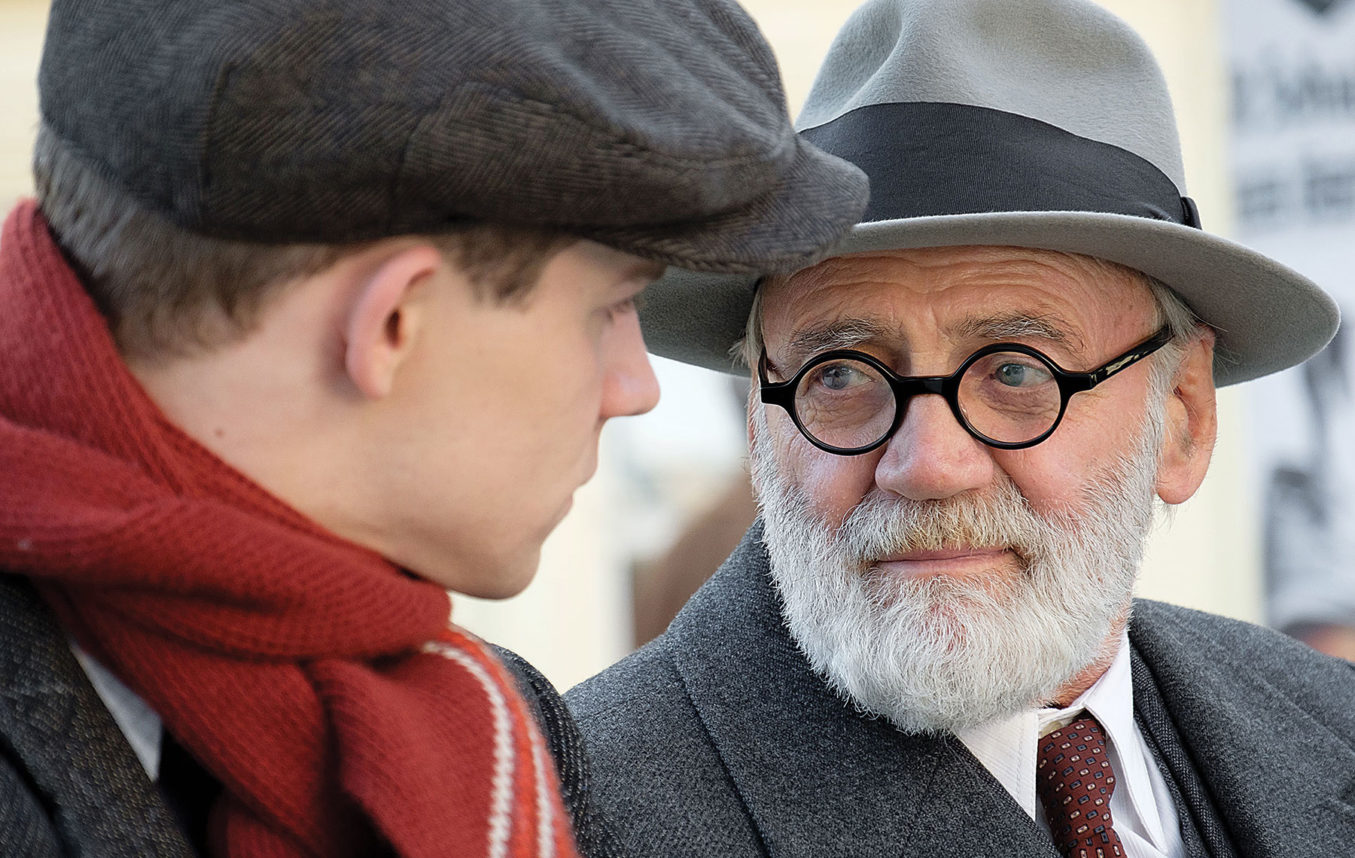
The international 2012 best-selling novel “The Tobacconist” by Robert Seethaler tells the story of 17-year-old Franz Huchel, a newly hired smoke-shop clerk who befriends regular customer Sigmund Freud amid rising anti-Semitism in Nazi-occupied Vienna.
The 2018 film, co-written and directed by Austrian filmmaker Nikolaus Leytner, stars the late Bruno Ganz as Freud and Simon Morzé as Huchel. “The Tobacconist” makes its Los Angeles debut May 5 at the Los Angeles Jewish Film Festival.
“What was special to me was this unusual friendship between a naive but curious country boy and the world-famous inventor of psychoanalysis, Sigmund Freud, and that this friendship arises in a politically very heated time,” Leytner told the Journal via email. “The story itself follows the novel very closely, but I have added some elements to make the thoughts and feelings of Franz Huchel, which the novel describes, also visible in the film. These are the dream sequences and Franz’s daydreams.”
Although the story is fictional, Leytner found it “quite conceivable for me and therefore true in a higher sense” and he strived for verisimilitude in its presentation. “We did a lot of research, both the political situation and the living conditions in the society then, and the historical personality of Sigmund Freud,” he said. “It was important to me to be as accurate as possible.”
Leytner said that when adapting a novel for the screen, “You’re always doing a remake — a remake of all the movies that hundreds of thousands of readers have read in their minds. I have tried to bring to the screen the pictures I saw in my mind while reading the novel.”
In one of his last appearances onscreen, Ganz, known for playing Hitler in “Downfall,” dispenses romantic advice to young Huchel as cigar-aficionado Freud. Ganz passed away in February.
“The work with Bruno Ganz was very intense, but also uncomplicated because he was an obsessed worker,” Leytner said. “He prepared himself very well and was always open to new ideas on the set.”
Born in Graz, Austria, Leytner fell in love with cinema as a child and aimed to follow in the footsteps of role models François Truffaut, Claude Chabrol, Ingmar Bergman, Bernardo Bertolucci and Michelangelo Antonioni. Leytner studied at the University of Music and Performing Arts in Vienna, and founded the Academy of Austrian Film in 2009.
Leytner is not Jewish but said, “This subject — the greatest catastrophe of the last century in Europe — has occupied me as a person and artist for a long time. I am very proud my film is being shown at the Los Angeles Jewish Film Festival and hope the audience will like it.”
“The Tobacconist” will screen at 4:30 p.m. May 5 at Laemmle’s Music Hall, 9036 Wilshire Blvd., Beverly Hills.
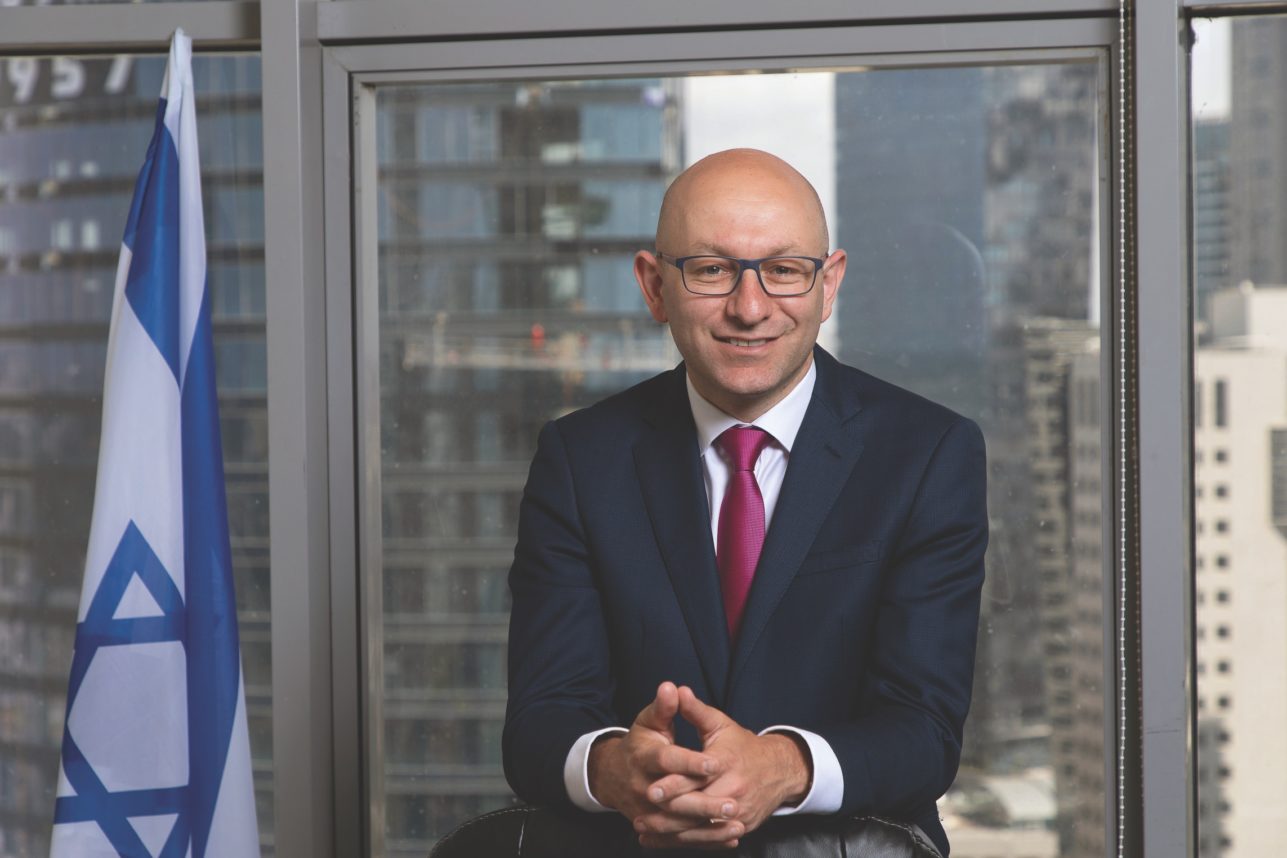
Arsen Ostrovsky is a loving husband and doting father, a shameless carnivore and an Israeli breakfast aficionado with as much zeal for shakshuka as sirloin steak. However, it’s his fierceness in defending the Jewish people and the Jewish state that makes him stand out online and in real life.
An international human-rights lawyer, Ostrovsky has taken his debating skills to the digital sphere – what he calls the “central battleground” – in fighting modern anti-Semitism. His advocacy has not gone unnoticed. The Jewish Telegraphic Agency named Ostrovsky to its list of the 25 most influential Jews on Twitter; he has almost 50,000 followers. Nefesh B’Nefesh awarded him its prestigious Bonei Zion Prize for Israel Advocacy, and he regularly is featured defending Israel on television and in print.
While Ostrovsky spoke with the Journal, a news story broke that Sydney’s Central Synagogue, the synagogue Ostrovsky attended growing up, had received an online threat of a shooting attack – less than 24 hours after the Chabad of Poway shooting in San Diego County.
“The acts of pitiless slaughter and violence like we saw [at the] Tree of Life [synagogue] and yesterday in San Diego don’t occur in a vacuum,” Ostrovsky said. He thinks the mainstream legitimizes a culture of hatred, whether it’s cartoons in the media featuring anti-Semitic tropes or anti-Israel sentiments elected officials freely express. “Words lead to actions and actions lead to violence,” Ostrovsky said.
“Words lead to actions and actions lead to violence.” — Arsen Ostrovsky
The Talmudic dictum of “kol yisrael arevim zeh le’zeh” (all Jews are responsible for one another) has been a guiding principle in Ostrovsky’s life and work. “An attack against a Jew anywhere ought to be seen as an attack against Jews everywhere,” he said.
Ostrovsky currently serves as executive director of the Israeli-Jewish Congress (IJC), an NGO that works with Jewish communities around the world to combat anti-Semitism and the boycott, divestment and sanctions movement. Last month, he defended Israel at the UN Human Rights Council in Geneva. He began working for IJC soon after making aliya from Sydney in 2012. His family fled to Australia from the Soviet Union and Ostrovsky’s birthplace of Odessa when he was 7 years old.
“[In Odessa] we were made to know our place as Jews in society,” he said. “We felt the full brunt of anti-Semitism.” The same was not true of Australia.
“It’s not that I ever felt I did not belong in Australia,” he said. “It’s just that in Israel, it feels as if I have returned home, where I truly belong. It is the yearning for an emotional connection to the land and people of Israel that, for me, could only be fulfilled in the Jewish state.”
Three months after he arrived in Israel, war broke out with Hamas. Ostrovsky recalls huddling in the bomb shelter of a supermarket. An Israeli turned to him and said, “I bet you regret making aliyah now.” Ostrovsky’s response was unequivocal. He said, “I have never been more certain of anything in my life. This is my country and my people. Just as we rejoice and celebrate together, so, too, do we grieve and fight together. I wouldn’t want to be anywhere else now.”
Since the birth of his daughter two years ago, Ostrovsky knows the kind of future he wishes for her. “One where she does not have to be concerned with anti-Semitism and delegitimization based on her nationality.”
According to a 2015 Brandeis University study, an estimated 11.2% of the 7.16 million Jews in the United States are not Caucasian. The issues facing Jews of color can test — or reinforce — faith and identities or make them stronger. These issues play out in the true stories told in Jewish Women’s Theatre’s latest production, “True Colors.”
“I felt that this was a Jewish story that hasn’t had a voice on stage,” JWT artistic director Ronda Spinak said at a rehearsal. “This next generation is [increasingly] of mixed race and growing up Jewish: Being bar and bat mitzvahed, going on Birthright tours, joining Hillel in college and feeling not being accepted by other Jews. This is about sharing their stories so that we can understand the differences and the similarities.”
With the help of consultant and co-producer Eric Greene, a Jewish civil rights activist of African-American, Native American and European descent, Spinak assembled a diverse array of stories about Jewish identity. One such story was from Korean-born Angela Buchdahl, the first Asian-American rabbi.
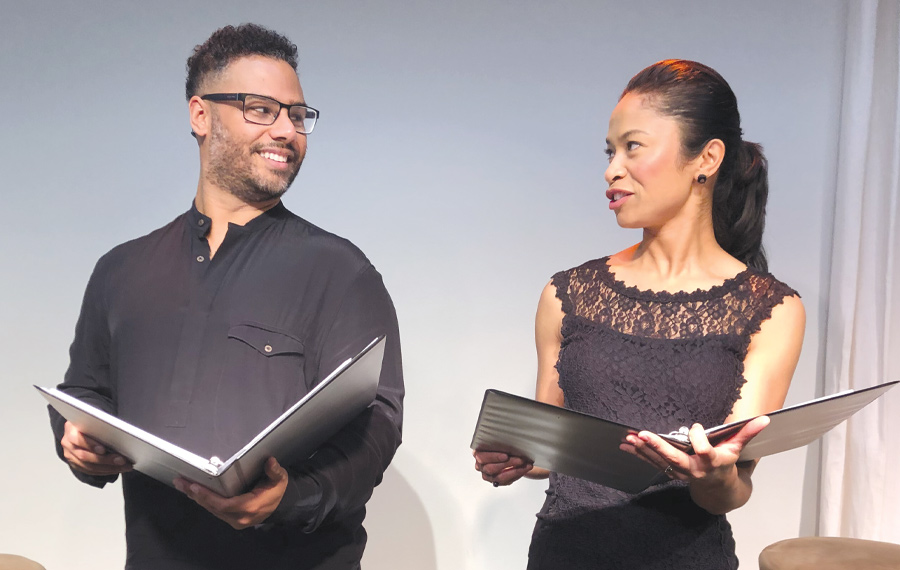
Kimberly Green plays the role of Buchdahl and others in the show. Green was born Korean-Puerto Rican, but a Caucasian man adopted and raised her. She is engaged to a South African Jew and is in the process of converting to Judaism. Green told the Journal she relates to several roles she portrays. “Some things in the stories have actually happened to me,” she said, including being called the “N” word while attending school in a “very white town” in Indiana.
Now halfway through conversion classes and choosing a synagogue, Green said she hopes the show “turns [perceptions] of people of color around and opens eyes. I know Jews who [are] not observant. I think living in a Jewish way is more important. You don’t have to be born and raised Jewish to appreciate the beautiful ceremonies and the reason why you have Shabbat.”
Actor, performance artist, beatboxer and sketch comedian Joshua Silverstein performs three pieces in the show, including one he wrote based on his experiences growing up the son of a black Christian mother and Ashkenazic Jewish father. “There was always pushback,” Silverstein said. “ ‘You’re not a real Jew because your mother’s not Jewish.’ ‘Your people killed Jesus.’ Some white teachers treated me differently because of the color of my skin. I definitely saw [prejudice] but I didn’t let it poison me.” He added, “We live in a very ignorant world. We’re still very limited in our thinking, and shows like this force people to broaden their horizons.”
Raised in Los Angeles in a liberal, progressive, Democratic, Reform Jewish home, Silverstein has followed in his parents’ and paternal grandparents’ activist footsteps. He has joined social-justice organizations and toured with Norman Lear’s voter-registration campaign. “My grandparents’ activism was rooted in Judaism and it’s part of my heritage,” Silverstein said.
“We live in a very ignorant world. We’re still very limited in our thinking, and shows like this force people to broaden their horizons.” — Joshua Silverstein
Silverstein is married to a Latina who was born Catholic but converted to Judaism before they met. “She loved the culture and related to the idea of always asking questions,” he said. She’s now pregnant with their third child, who will be named Shel, after author Shel Silverstein. “We already have all the books,” he said.
Spinak hopes that “by understanding the pain and struggles and obstacles and the triumphs of Jews of color, those of us who are not part of that group will have greater understanding and can act with greater kindness in the future. I think there will be a lot of talk about race and what it means to be a diverse Jew. I think you’ll have a greater understanding when you meet a Jew of color after you see the show.”
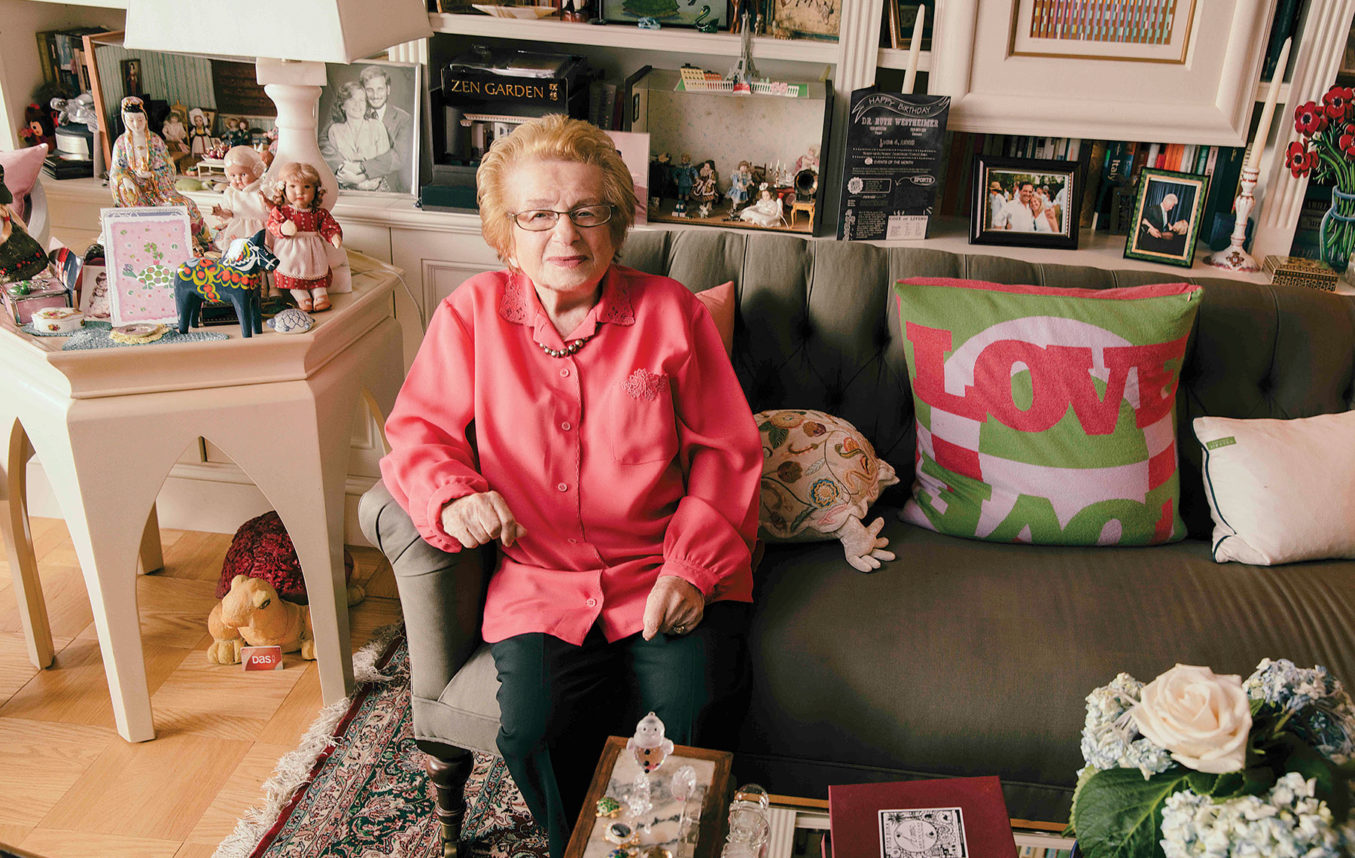
In much the same vein as theRuth Bader Ginsburg documentary “RBG,” “Ask Dr. Ruth” is about a diminutive Jewish woman who defied obstacles to accomplish remarkable things. A similarly crowd-pleasing bio, it incorporates interviews, archival footage, photos and animation to chronicle the life and career of renowned sex therapist Dr. Ruth Westheimer.
“Ask Dr. Ruth” already is earning Oscar buzz in advance if its May 3 theatrical release and June 1 premiere on Hulu.
However, before a radio guest appearance in 1981 led to her own “Sexually Speaking” broadcasts on radio and TV, talk-show guest spots, lectures, a book deal, commercials, sitcoms and the cover of People magazine, Westheimer lived a very different life.
Born Karola Ruth Siegel in Frankfurt, Germany, in June 1928 to Orthodox Jewish parents, she lost her entire family in the Holocaust. When she was 10, her mother put her on a Kindertransport train to Switzerland, where she spent the war in an orphanage, awaiting letters from home that eventually stopped coming. “My parents gave me life twice,” she says in the documentary.
Sitting down with the Journal, Westheimer explained why she allowed filmmaker Ryan White to film her over a year and a half. “It’s very important for me to stand up to Holocaust deniers and the people who talk about Holocaust fatigue and say ‘stop talking about it,’ ” she said. “There has to be a reason why I was not killed. I have an obligation as an orphan of the Holocaust to stand up and be counted. I’m an example for those people who say the Holocaust didn’t happen. This film is going to make a difference.”
Although she sometimes found herself asking God, “Why did I have to be an orphan?” Westheimer said, “My faith was never shaken.” Today, she belongs to two New York synagogues, is on the board of the Museum of Jewish Heritage, and celebrates Jewish holidays and Shabbat. “I don’t keep kosher but I’m very Jewish. I raised my children very Zionist. I go back to Israel every year.” In the film, she’s seen visiting Yad Vashem in Jerusalem.
“I will never retire. I tell everybody not to retire but to rewire. I’m very fortunate that I’m very healthy. But I think the more important issue is that I’m also really interested.”
After World War II, Westheimer immigrated to Palestine, where she lived on a kibbutz and became a sharpshooter in the underground army, the Haganah. She was badly injured in a bombing during the War of Independence in 1948 and nearly lost her foot. She recovered, taught kindergarten and married. In 1950, Westheimer moved to Paris, where she studied psychology.
After her marriage ended and her husband returned to Israel, she relocated to New York. After ending a second brief marriage that resulted in daughter Miriam, she met and married Fred Westheimer, the father of her son, Joel. Joel and Miriam, both educators and parents of two children each, are in the documentary. Westheimer calls her grandchildren her greatest accomplishment, as they’re the result of her survival. “Hitler lost and I won,” she said.
As for her many career achievements, she believes “having been a pioneer in talking openly about issues of sexuality, issues of homosexuality, that everyone has the right to be treated with respect” is her greatest legacy.
While she’s encouraged by positive changes in attitudes toward these topics, “We need more research about issues of gender, sexuality, new studies from reputable scientists, validated data from a university to know more about sex and relationships,” she said. “We need more information about sexually transmitted diseases like AIDS.”
The author of more than three dozen books, Westheimer has two more coming: an updated version of her 1995 “Sex for Dummies,” targeted toward millennials, and a children’s book about diversity called “Crocodile, You’re Beautiful! Embracing Our Strengths and Ourselves,” due out in August.
At nearly 91, she is energetic and active, traveling for speaking engagements and teaching a course at Columbia University about the changing image of the family in media and at Hunter College on the history of sex education. “In my classroom, nobody sits with a computer,” she said. “They have to talk to each other.”
A fan of concerts and musical theater, Westheimer recently saw the Israel Philharmonic play at Carnegie Hall and has seen “Phantom of the Opera” more than 20 times. She doesn’t cook but enjoys dinner with family and friends, including the two young men who live across the hall from her apartment in Manhattan’s Washington Heights. “I don’t use a cane,” she said. “I walk with good-looking guys instead.”
Reflecting on the twists and turns in her life, “I’ve lived many lives. I didn’t know that I’d be talking about sex from morning to night,” she said with a laugh. However, she believes she has found the key to living a long, productive and happy life.
“I will never retire,” Westheimer said. “I tell everybody not to retire but to rewire. I’m very fortunate that I’m very healthy. But I think the more important issue is that I’m also really interested.” n
“Ask Dr. Ruth” opens in theaters on May 3 and begins streaming on Hulu on June 1.
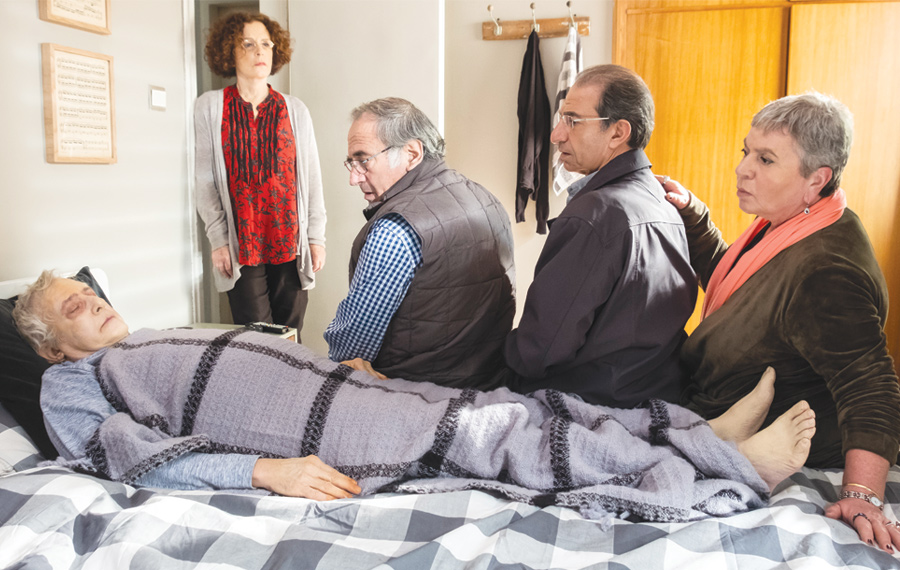
It’s one thing to keep the memory of a dead friend alive. It’s quite another to hide his body and pretend he’s still alive. This darkly comedic premise drives the plot in the Israeli miniseries “Stockholm,” which will have its West Coast premiere May 6 at the Los Angeles Jewish FilmFestival.
In the miniseries, four seniors conceal the death of their friend Avishai — the front-runner for the Nobel Prize in Economics — for five days until the official announcement is made. Suffice it to say that things don’t go according to plan.
The four-part miniseries is based on renowned author Noa Yedlin’s 2016 novel of the same name. Israeli broadcasting company Keshet bought the rights to the book before it was published. “I never thought of adapting the novel. I’d never done it before,” Yedlin told the Journal. “But I knew these characters so well I thought I was the woman for the job.”
Yedlin characterized the miniseries’ plot as similar to but much funnier than the novel. The novel relies a lot on the internal thoughts of the characters. Yedlin published her latest novel, “People Like Us,” last month. “People have been telling me that it will make a great series or movie. We’ll see,” she said. “Stockholm” has been translated into English and is now in the market for a publisher, Yedlin said she hopes that all her other novels will be, too.
“I was interested in the limits and boundaries of friendships. Also what nearing death does to you,” Yedlin said. “When you’re 70 and a very close friend dies, it’s a big reminder of your mortality. Does it make you give up or does it make you want to correct whatever needs correcting in your life? I thought it would be interesting to explore that, and also what happens to a group of friends when one friend gets enormous success and recognition.”
Yedlin also wanted to explore the lives of modern septuagenarians who “are not only grandparents, they are not only getting to 70, but they’re deciding that it’s the age to divorce or go abroad or study. They go on Facebook and Tinder and they cheat and have sex. They have complicated relationships with their grown children,” she said. “When I write, I try to raise as many questions as possible and ask questions that interest me and not necessarily give answers. I’m interested in human beings and the human soul.”
“I was interested in the limits and boundaries of friendships. Also what nearing death does to you. When you’re 70 and a very close friend dies, it’s a big reminder of your mortality.” — Noa Yedlin
Yedlin was on set for all but a few days during production and participated in every step of the process, including casting. In “Stockholm’s” second season, which she’s writing now, veteran Israeli stars Sasson Gabai, Doval’e Glickman, Liora Rivlin and Tikva Dayan will return, and a yet-to-be-announced male actor will join them.
Plans for the series include international sales and selling the remake rights, and Yedlin has a cast wish list that includes Lily Tomlin, Judi Dench, Diane Keaton and Jack Nicholson. “I think [Nicholson] would be a hilarious Avishai,” she said. “Playing a dead body would show his sense of humor, but if he wants to play a live one, I’m OK with that, too.”
Born in Tel Aviv to parents who came from Argentina, met in Israel and later split, Yedlin had a “100% secular upbringing,” but [Judaism] is a very big part of my identity and influences my life very much,” she said. “I live and raise my children in a country where Judaism is a part of day-to-day life. It’s part of the cultural and intellectual arena and part of me, as well.”
Yedlin became a journalist after her military service but realized that her newspaper job was the wrong fit. “As a journalist, you have to write the truth, and I wanted to make up stories.” She began writing novels and won the prestigious Sapir Prize for her second novel, “House Arrest,” in 2013. “It was terrifying, but I felt that was a good point to make the switch,” she said. “I became a full-time author.”
Yedlin published her latest novel, “The Landlady,” last month. “People have been telling me that it will make a great series or movie. We’ll see,” she said. “Stockholm” has already been translated into English and Yedlin said she hopes that all her other novels will be, too.
Yedlin lives in Jaffa with her husband, who teaches philosophy, her 4-year-old son and her 8-year-old daughter, who appears briefly in “Stockholm” as the grandchild of Dayan’s character. Yedlin won’t be able to attend the Los Angeles Jewish Film Festival but she’s happy to be included and “very interested to hear how people react” to “Stockholm,” she said. A big hit in Israel, it won best miniseries and Dayan won best actress at the 2018 Israeli Television Academy Awards. Yedlin, Gabai and Glickman received nominations.
Asked about her hopes for the future, Yedlin said, “I’m very lucky. To write and to get recognition for it is nothing less than a miracle. I hope that nothing goes wrong and things keep going the way they have so far.”
“Stockholm” will screen at 7:30 p.m. May 6 at Laemmle’s Town Center in Encino.
Three weeks later, Israel’s elections seem almost like an afterthought. Was there a round of elections? There was. And what was the outcome? Well, it’s a little complicated as we are still waiting for Prime Minister Benjamin Netanyahu to form a coalition. Doesn’t he have a majority? That depends on one’s definition of majority. There is a majority of members of Knesset (MKs) who agree to join a coalition under Netanyahu, but they don’t yet agree on the terms, on some of the guiding principles for forming the coalition.
Looking at the debates between the parties that will ultimately form the coalition — assuming that all look to compromise and not to clash — is interesting. First, because it says something about Israel and its main dividing lines. The coalition is going to be right-wing. And for those thinking that the election was close, or that Israel is divided on right-left issues, in fact, the coalition will be less right wing than it ought to be. Or, put another way, Israel is more right-wing than election outcomes indicate.
Israel’s 3.25% electoral threshold is the key to understanding the real strength of the right. As professor Dan Ben-David of the Shoresh Institute shows in a short paper he published earlier this week, this relatively high threshold prevented three additional rightist parties from entering the Knesset. The right-wing-religious bloc thus lost close to 8% of the vote. On April 30, when the new Knesset was sworn in, this bloc seated 54 percent of the new MKs. But on election day, 57 percent of Israel’s voters cast their votes for right and religious parties.
Such majority is a blessing and a curse for the winning side. It gives it a sense of invincibility. It prompts an appetite for more achievements. The prospective partners of the coming coalition are having this fight because of this appetite for power. The main issue of debate: Will the next government implement policies promoted by the religious parties? Will it let Charedi men evade the draft and further enforce religiously-motivated policies in the public sphere?
This is important because it points to a possible crack in the natural coalition of the right that could be exploited by other parties. The religious parties know that they hold the key to the rule of the right (see graph, right). This could lead to miscalculation and overreach. They assume that their ideals won, when in fact their ideals won only because of their marriage with the ideals of the right. Israelis want a hawkish government. They are willing to tolerate, up to a point, Charedi participation and demands as they understand this is the price they must pay for such a government.
Avigdor Lieberman, the leader of a right-wing party whose voters are mainly secular Israelis of Russian origin, is currently the one stomping on the brakes. He thinks that this time the price demanded by the Charedi parties is too high. That is, he calculates that there is room for a right-wing party whose alliance with the religious parties isn’t immediate and not unconditional. That’s a bold bet, a risky bet and an interesting bet.
Consider the following three scenarios:
Lieberman wins and the Charedi parties cave. The conclusion: If you are right-wing, like most Israelis, and have a dislike of Charedi power, like most Israelis, Lieberman is your best political choice.
The Charedis win and Lieberman stays out of the coalition. The outcome: A narrow, unstable coalition, disliked by many rightists who don’t appreciate its oppressive religious tendencies. In the next round, Lieberman has a claim on him needing more power.
The clash prevents Netanyahu from forming a new government. The outcome: Many blame Lieberman for a meager end to a promising beginning, but there are also those who blame the Charedis. These voters understand that there is a need to keep Charedi power in check so as not to put the right-wing rule at risk. Some of them might even vote for Lieberman to achieve this goal.
There is only one outcome that ends badly for Lieberman: If he loses the battle and caves. In such case, right-wingers who accept the reality of having to surrender to the Charedim can vote Likud — there is no advantage to voting for Lieberman. Those among them who do not accept this reality will need to search for another political home.
The bottom line: Lieberman identified a niche. His insistence on reducing the price of Charedi participation might not be a bluff.
Shmuel Rosner is senior political editor. For more analysis of Israeli and international politics, visit Rosner’s Domain at jewishjournal.com/rosnersdomain.
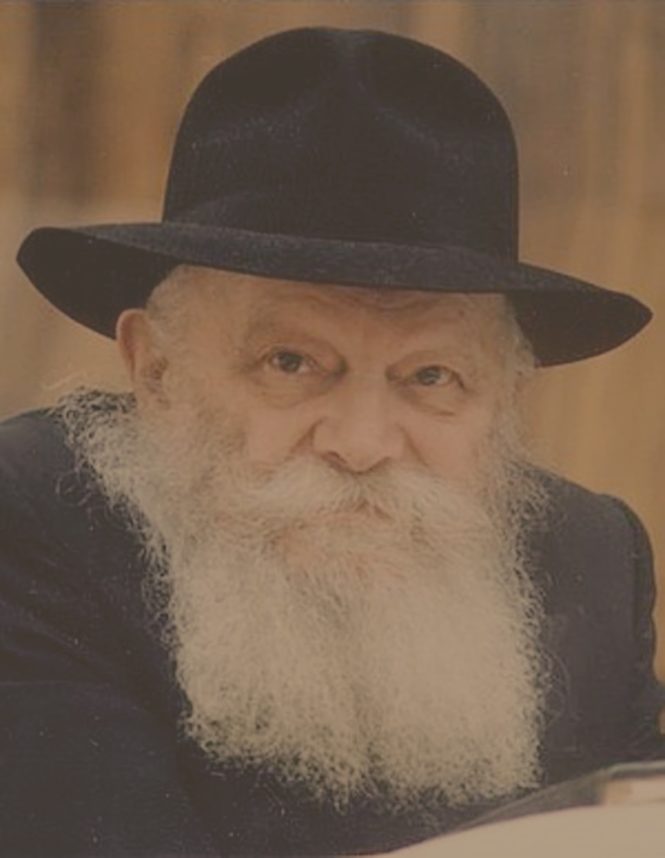
Immediately after the attack on Chabad of Poway on April 27, the last day of Passover, people were asking me, “What would the Rebbe say?”
Fair question. The building is the Rebbe’s building. Rabbi Yisroel Goldstein, who lost a finger in the assault, is his man. That makes the congregants who were traumatized, maimed, shot and killed the Rebbe’s congregants.
But also an unfair question because nobody ever second-guessed the Rebbe.
The most I can provide is precedent. In the 1960s, ’70s and ’80s, violence was increasingly on the rampage in the United States in a way not seen since the days of the Wild West. The Rebbe’s response then: Fix the educational system. How? Introduce a moment of silence every day into the school curriculum, and take it seriously.
Why do I think that’s a good fit for today’s plague of hate-driven violence?
Because the shooting in Poway is not a Jewish problem. It’s America’s problem. The same with the Pittsburgh massacre, which occurred exactly six months earlier and bears too many similarities to ignore. Both are symptoms of a malicious disease spreading unabated in the United States and in the world at large.
The Jewish people are no weaker for these attacks. Synagogues and temples aren’t about to empty because of a handful of disturbed, poisoned minds — and much to the contrary. As for those whose lives were taken — all very special Jews, all missed terribly — but don’t call them victims. There’s a title in Jewish tradition for any Jew who lost his or her life simply for being a Jew: a kadosh. A holy Jew. Jews don’t die as victims; we die with dignity. That is why we are still alive.
But this country is suffering. According to FBI figures, reports of hate crimes rose 17% last year, with similar increases over the previous two years. All this while other forms of violent crime continue to decrease. Something’s wrong.
Jews are an obvious target, but Muslims and Christian houses of worship have been under siege as well. Just a few days before the Poway shooting, authorities said a young war veteran plowed into a crowd crossing the street in Sunnyvale, Calif. Police said the suspect stated that he thought the pedestrians were Muslims.
You’re reading me right: I don’t believe the problem is rising anti-Semitism. The statistics don’t bear that out, and neither does experience on the street. The problem is people who will act out their hatred by perpetrating a mass killing.
That is a sickness, and it’s going untreated.
Jews don’t die as victims; we die with dignity. That is why we are still alive.
Americans are divided over gun law restrictions, yet there is one point that enjoys universal consensus: Gun restrictions alone are not enough because the problem isn’t the gun. The problem is the mind of the person who holds the gun.
What have American schools done for the mind of that criminal?
They taught him his ABCs. Did they teach him what makes it worthwhile to live?
They taught him to use his mind to solve problems with numbers. Did they teach him to apply his mind — rather than his fist — to solve problems with people?
They taught him how human beings first appeared on the planet. Did they teach him how to be a human being? Did they teach him to respect another human being?
They taught him anatomy. Did they teach him that a human life is more than the sum of blood, guts and bones? Or did they, perhaps inadvertently, give him the notion that the human soul has no place in today’s mind?
They taught him about laws and prisons. Did they teach him that even if he’s so smart that he doesn’t get caught, that it’s still wrong? Did they give him a conscience?
Did they ever demonstrate to him that these are the things that really matter in life — more than math, more than science, more than the niftiest technology? Did they ever give him a chance to stop and think about himself, about his life, about his family, about everything that bothers him in life? Is there a space and time for that in his school?
That’s all that a moment of silence in school is about. And, yes, it works wonders. Ask those who work in schools where it’s been implemented. They will tell you that a moment of silence means that a child might go home and ask Mommy and Daddy what he should think about. It means that a child might tell his his teacher about the troubles he’s going through. It means the school becomes a place not just for the child’s mind, but for his heart and his soul.
Or take it from this 2013 report on the Moment of Silence program at Paul Robeson High School in Brooklyn, N.Y., that describes it as “an ongoing, transformative experience.”
“… The Moment of Silence provided the students an opportunity to become more mindful and reflective of their experiences inside and outside the classroom. The students have become more introspective in their writing and have a greater appreciation, empathy, and understanding of their peers. … Students have also gained a greater understanding of educational objectives.”
Jews have to adapt to the times. The knee-jerk reaction, reinforced through thousands of years of history, has been to hunker down and strengthen the internal steel grid when under attack. But America in 2019 is not Shushan, not Rome, not medieval Spain, not Poland. True, anti-Semitism never died, even in this country. But here we have a voice, and therefore a responsibility to our country. Their problem is ours, and ours is theirs.
We can use our voices to heal America. Let American schools nurture the humanness of America’s children. Let children know the meaning of silence, so they can hear their own hearts pounding inside.
Rabbi Tzvi Freeman is senior editor at Chabad.org and teaches at West Coast Rabbinical Seminary and The Happy Minyan. His published works include “Bringing Heaven Down to Earth” and “Wisdom to Heal the Earth.”
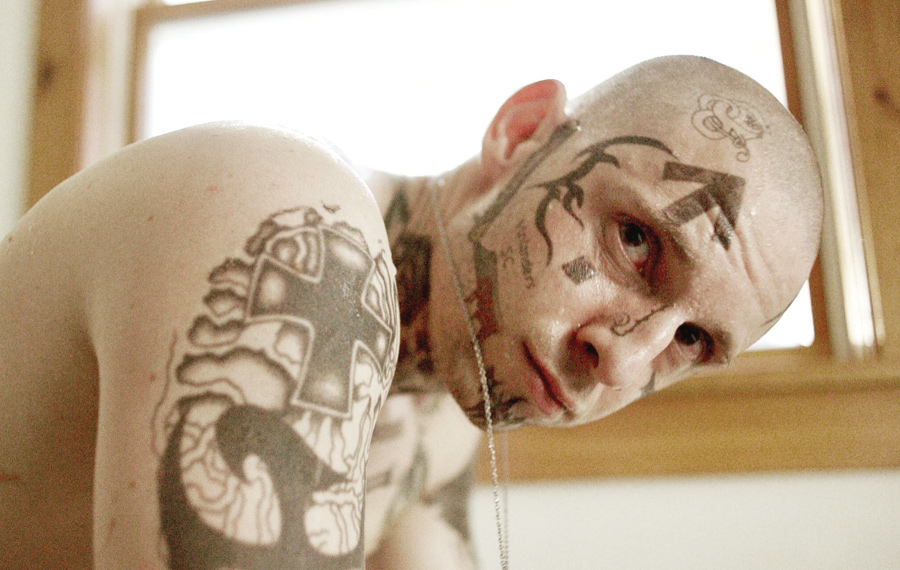
In February, a film abouta neo-Nazi skinhead who receives shocking retribution because of his racism won the Academy Award for best live-action short. No one was more surprised than Israeli writer-director Guy Nattiv, who made “Skin” with his wife, actress-producer Jaime Ray Newman. The short version of “Skin” was made as a stepping stone to a feature film of the same name.
The true story of Bryon Widner, a white supremacist who turned his life around, captivated Nattiv, who then acquired the rights to Widner’s story. Four years ago, Nattiv wrote the script for a full-length film. “But no one wanted to make the movie. Skinheads weren’t on the surface like today,” Nattiv told the Journal. “So I decided to make a short in order to make the feature happen.” With hate crimes on the rise, the timing was right.
“Skin,” starring Jamie Bell as Widner, will make its debut at the Los Angeles Jewish Film Festival on May 6. It will be released on DIRECTV June 27 and in theaters July 26.
“It’s a redemption story,” Nattiv said about Widner, noting they have become close friends. “It’s about a skinhead who falls in love with a woman and her girls, and wants to become a better person.” Widner had his racist tattoos removed in a painful process, but doubts remain. “ ‘What happens if they take all my tattoos off and I’m still the same piece of [expletive]? Do I
still have those demons inside of me?’ There’s no definite answer for that, but I wanted to arouse the question,” Nattiv said. “I’m asking the audience, ‘Do you have a place in your heart to accept someone who was a monster and wants to become a human?’ That’s a question we all have to ask ourselves today in order to start a dialogue.”
I’m asking the audience, ‘Do you have a place in your heart to accept someone who was a monster and wants to become a human?’ That’s a question we all have to ask ourselves today in order to start a dialogue.” — Guy Nattiv
Nattiv added, “This guy was an extreme neo-Nazi skinhead five years ago. People can change. We need to find a place in our hearts for forgiveness. We, as Jews, forgave the new generation of Germans. Israel made peace with Egypt. I think redemption is very Jewish. We have the place in our hearts as Jews to forgive, and I want to find this place within characters.”
Nattiv praised the contributions of actors Bell and Danielle Macdonald; “right hand and love of my life,” Newman; and producers Oren Moverman, Trudie Styler and Celine Rattray, “who had the balls to tell this story when everybody said no,” he said. “I owe them a lot.”
Having grown up on 1970s movies such as “Midnight Cowboy,” “The Deer Hunter” and “Taxi Driver,” Nattiv said he always aims to tell “hard, politically-charged stories that not only entertain but have a message.” Born in Tel Aviv, Nattiv is the grandson of Holocaust survivors from Romania and Poland. He said he “had a bar mitzvah like every Israeli boy, but I’m not religious. It’s more of a cultural thing for me. But I want my baby girl to speak Hebrew and know all about Judaism. It’s important to me that she has a Jewish heritage.”
His 7-month-old daughter, Alma, was born amid the whirlwind of the “Skin” Oscar campaign and finishing the feature. “We fought for many years to bring Alma into the world,” Nattiv said, explaining that Newman had a stillbirth and tried in vitro fertilization before finding a gestational surrogate. “It was a hell of a year. Overwhelming. But in a good way.”
Nattiv and Newman met in 2014 after his agent suggested Nattiv meet his girlfriend’s sister. “She came to Israel and we met at a coffee shop the day before she was to go back to the States. She didn’t get on the plane,” he said. “It was love at first sight.” He moved to Los Angeles the next year, and they’ve been marital and professional partners since.
Right now, they’re traveling for “Skin” appearances while gearing up for new projects. “The Oscar opens doors to meet with people that you wouldn’t meet [otherwise] and compete at a higher level,” Nattiv said. “It gives you a chance to bring your art and have a better chance of making it happen faster.”
The first project is based on a story about his maternal grandmother. Depressed and vulnerable as an empty nester at 55, she fell under the spell of a woman who was a professed healer. This woman took all his grandmother’s money, and lured her and other women to a cult-like retreat called Harmonia in Virginia. “My mother and her sister went there to bring her back home,” Nattiv said.
The other film is about Julie Ann Johnson, a pioneer stuntwoman in the 1970s and ’80s, who won a sexual-discrimination lawsuit decades before #MeToo. The story hits home, because Newman was one of Hollywood producer and director Brett Ratner’s accusers in the sexual-harassment case against Ratner.
Nattiv and Newman recently returned from a trip to Israel where, he said, “We got so much love. When I’m in Israel, I feel like it’s a gas station and I’m refueling myself. It feels like home.”
Reflecting on his greatest accomplishments, Nattiv puts his daughter at the top of the list. “Waking up next to her, seeing her smile and grow every day is magical,” he said.“You understand what’s important in life. Although my art and everything we did last year is very important to me, it’s a bonus. My wife and daughter are my base, my power. That’s what keeps me going.”
“Skin” will screen May 6 at Laemmle’s Music Hall, 9036 Wilshire Blvd., Beverly Hills,
followed by a Q&A with Guy Nattiv and Jaime Ray Newman.
We need to accelerate our exodus from a new and mounting tyranny, but not the way white nationalists — including the alleged Chabad of Poway shooter — use the term.
The truth is I had never heard the term “acceleration” in the context of white supremacy, until Anti-Defamation League (ADL) leaders hastily organized a call with the media on April 28, the day after the Chabad shooting.
We all know that a car accelerates when you step on the gas pedal and that tech investors put money into accelerators intended to bring promising new products to market quickly. ADL CEO Jonathan Greenblatt — speaking on the call from San Diego, where he flew immediately following the attack — said the alleged shooter reportedly posted a “manifesto” online before the attack. And that document posted on PasteBin and 8Chan — message boards beloved by extremists — referenced acceleration.
“Accelerationism is a term white supremacists have assigned to their desire to hasten the collapse of society as we know it,” the ADL posted on its website on April 16. “The term is widely used by those on the fringes of the movement, who employ it openly and enthusiastically on mainstream platforms, as well as in the shadows of private, encrypted chat rooms.”
Days before the Chabad shooting, the ADL posted, “We have also recently seen tragic instances of [accelerationism’s] manifestation in the real world.”
In the briefing, Greenblatt said, “Acceleration means ‘the time is now to attack our enemies because right now we have the numbers.’ We’re increasingly seeing it on all social media. We’ve been tracking individual extremists for many, many years and are constantly sharing individuals who we believe pose a threat with law enforcement around the country.”
Greenblatt and Oren Segal, director of ADL’s Center on Extremism, both said they had never heard of the alleged shooter before he acted in Poway. His anti-Semitic hunt was timed to the six-month anniversary of the massacre at Pittsburgh’s Tree of Life synagogue, in which 11 people were killed. The Chabad of Poway victims were attending services to celebrate Shabbat and the last day of our people’s celebration of our exodus from tyranny.
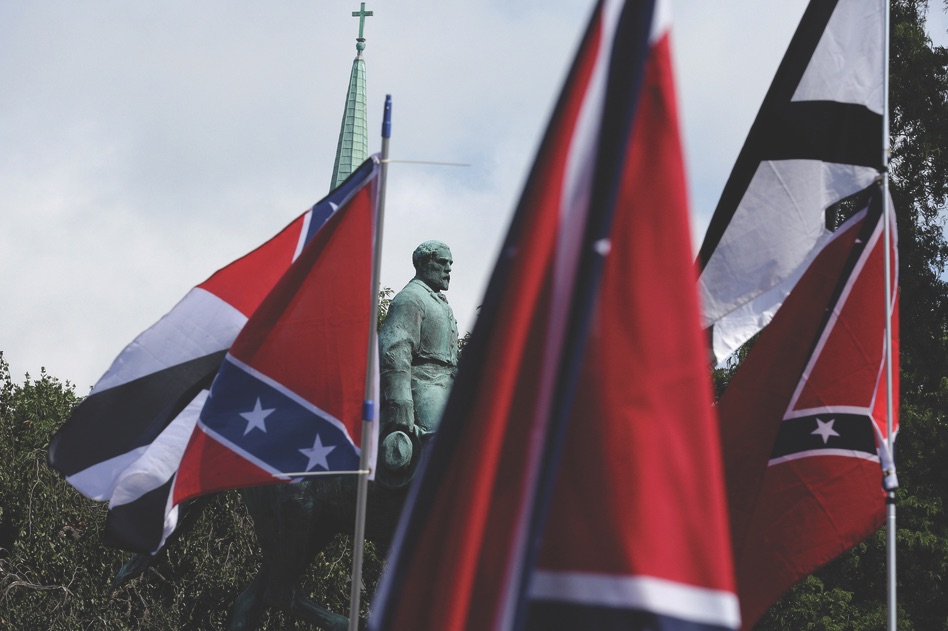
Many generations after we left Egypt and the experience of living under Pharaoh’s heel, a new kind of tyranny has taken hold in this country — a tyranny of intentional denial. The one that claims that there “are good people on both sides” when alt-right white nationalists rally in Charlottesville, Va., terrorize an entire city and kill a counter-protester.
We need our own acceleration and to bring the incontrovertible facts to the attention of lawmakers. Facts are not partisan. Facts are not “fake news,” though things described by President Donald Trump as fake news are just facts he doesn’t like revealed by the news.
What’s needed is not only condemnation of domestic terror attacks after they happen but, as Greenblatt said, “by enforcing norms before it happens. We desperately need our leaders to stop politicizing these issues.”
These are the actual facts: Extremists murdered 50 people in America last year, and 49 of them “were committed by people espousing extremist white-nationalist ideology,” Greenblatt said.
“The data does not lie,” he added. “It is not my opinion that there is a problem. We know anti-Semitism is on the rise because the FBI is telling us that. In 2017, hate crimes were up 37 percent against the Jewish community. We are the most targeted religious minority in the country despite our small numbers. Anti-Semitism is not some abstraction. Anti-Semitism is a clear and present danger right now in this country. This needs to serve as a wake-up call once and for all.”
We must get our political leaders to stop obsessing about brown people entering our country through the southern border or from Muslim-majority countries and convince them to start paying attention to the real threat: The home-grown white nationalist terrorists responsible for all but one of the extremist murders in this country last year.
The new tyranny paints equivalencies between far left-wing and far right-wing sources of anti-Semitism. It focuses more on reflections of anti-Semitism — like the hideous cartoon stupidly published in the The New York Times over the weekend — than on the actual violence taking Jewish (and black and Muslim) lives.
The mid-level editor with astoundingly poor judgment and anti-Semitism in his or her heart who unilaterally decided to publish that disgusting image should be fired. The Times has promised “significant changes.”
Anti-Semitism — surging in America and around the world — is coming from both the far left and the far right. But it is only the far right in America that is leading to the killings of Jews.
Between 2009 and 2018, “right-wing extremists accounted for 73% of the extremist-related murders in the United States,” Segal said. “Twenty-three percent came at the hands of jihadist, or radical Islamist, terrorists.”
Why then is 99.9% of our president’s attention focused on his largely invented dangers posed by brown people? They, of course, are victims of extreme-right nationalism just as we are. I know the conventional answer: Trump does so because he’s playing to his base. This poses a danger to us all. This white nationalist extremism is not going away. Instead, it is growing unchecked.
What’s needed is not only condemnation of domestic terror attacks after they happen but, as Greenblatt said, “by enforcing norms before it happens. We desperately need our leaders to stop politicizing these issues.”
My check of 8Chan late on April 28 revealed that an appreciation thread for the alleged Chabad shooter began the day of the attack. It’s full of the most nauseating anti-Semitic language and images imaginable. Someone posted a crude cartoon of a hook-nosed man shaking two other people and saying, “C’mon, accelerate.” Someone else wrote, “It is not acceleration if you kill only one kike. If that kike is not [George] Soros or [Jared] Kushner, it really is a waste of bullets.”
There is even more vile language on the thread that I won’t repeat here.
Greenblatt said on the call, “It’s not partisan to call out prejudice; it is, frankly, the patriotic thing to do.” I agree. It is time for us all — progressives and conservatives, Democrats and Republicans — to stand up to a president who for years has been bent on twisting reality to suit his dangerous fantasies, from President Barack Obama not being born in the U.S. to his most recent, in which he accuses doctors and new mothers of “executing” newborn babies.
Let’s use a Trump technique and repeat, repeat, repeat the fact that our president and other leaders of our country are ignoring the reality that nearly all extremist murders are being committed by homegrown white nationalists, not the immigrants over whom they obsess.
We need to accelerate their awareness of this fact. Our lives depend on it.
Debra Nussbaum Cohen is the Jewish giving maven at Inside Philanthropy and is a freelance journalist in New York City.
Join Lev Eisha, an inclusive community of Jewish women seeking to be elevated by a relevant, memorable experience, for Shabbat services led by Rabbi Toba August and cantorial soloist Cindy Paley. They are joined by a musical ensemble including percussionist Joy Krauthammer, vocalists Melanie Fine, Robin Winston and Sharon Alexander and violinist Ruth Belonsky. 9:30 a.m.-noon. Beth Shir Shalom, 1827 California Ave., Santa Monica. (310) 575-0985.
Jewish Women’s Theatre stages “True Colors,” a series of funny and inspiring stories by Jews of Color, in which the performers talk about identity, fitting into the community and how it feels to be Jewish in the present sociopolitical environment. Four performances will be at The Braid. Others are in the South Bay, the San Fernando Valley and a home on the Westside. Through May 14. 8 p.m. $45. $50 at the door. The Braid, 2912 Colorado Ave., Santa Monica. (310) 315-1400.
On the Shabbat between Yom HaShoah and Yom HaZikaron and Yom HaAtzmaut, UCLA professor Judea Pearl, father of slain journalist Daniel Pearl, discusses “From the Crucible of 1948: Reflections of a Counter-Holocaust Survivor.” Born in British Mandate Palestine, Pearl and his family became international symbols of grief in 2002 when Daniel Pearl, then a reporter for The Wall Street Journal, was kidnapped and murdered by Islamic militants. 9:30 a.m., Shabbat services. Approximately 11 a.m., Pearl’s lecture, free, RVSP requested. Westwood Village Synagogue, 1148 Westwood Blvd, Westwood. (310) 824-9987.
Teens and their parents are invited to hear inspiring and entertaining stories of Jewish connection by speakers including Disney animator and director Saul Blinkoff, television writer David Sacks, screenwriter David Weiss, musician Sam Glaser, Harvard attorney Diane Faber Veitzer and Rabbi Shlomo Seidenfeld. The speakers appear over the course of six Sundays. Call for the full schedule. 11 a.m.-noon. Free. No membership required. The Community Shul, 9100 W Pico Blvd., Los Angeles. (310) 429-7010.
Community-wide event “#knowyour-worth Day” brings teenagers together to explore tools that help them identify and understand their self-worth. Throughout the three-hour afternoon session, organized by the Advot Project, teenagers enjoy art activities, tikkun olam opportunities, an open mic, workshops, swag and food. Community service hours available. 1-4 p.m. Free. Valley Beth Shalom, 15739 Ventura Blvd., Encino. (323) 206-2448. RSVP at advotprojectorg4@gmail.com.
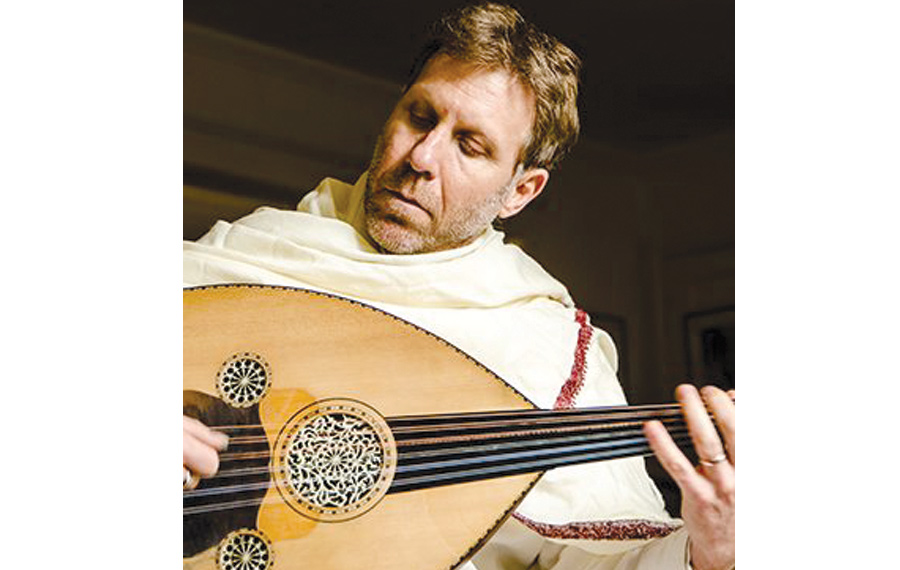
International musician, composer, producer and ethnomusicologist Yuval Ron is the featured artist in Temple Ner Simcha’s monthly Simcha Series that presents leading Jewish artists of the 21st century. Ron seeks to teach the deepest Jewish wisdom through both his music and his book, “Divine Attunement: Music as a Path to Wisdom,” winner of the Gold Medal Award for Best Spirituality Book at the 2015 Indie Book Awards. 7-8:30 p.m. Free. Temple Ner Simcha, 880 Hampshire Road, Westlake Village. (818) 851-0030.
In observance of Yom HaShoah, Holocaust Remembrance Day, young professionals, ages 22-40, of the Jewish National Fund’s JNFuture bake challah at the Los Angeles Museum of the Holocaust, joined by Shoah survivors with special connections to Israel. Guest speaker Shlomi Vayzer, the Jewish National Fund’s Israel Emissary in Los Angeles, discusses JNF’s role in the founding of the State of Israel and its contemporary activities in the Jewish state. 1-3 p.m. $18 general admission, $10 JNFuture Root Society and Sabra donors. RSVP required. Los Angeles Museum of the Holocaust, 100 The Grove Drive. (323) 964-1400, ext. 968.
Entertainment, religion and business and technology are spotlighted in the next “Israeli-American Exchanges” conference when Israeli and American speakers explore how their two countries have influenced each other in these three areas. In the morning, Rabbi Daniel Bouskila, international director of the Sephardic Educational Center, Chaya Gilboa of the Shalom Hartman Institute of North America, Member of Knesset Aliza Lavie, Rabbi Erez Sherman of Sinai Temple and moderator Joshua Holo, dean of
Hebrew Union College-Jewish Institute of Religion, share their views on religion before 10 different perspectives are heard in the afternoon on business and technology and entertainment. 10 a.m.-4 p.m. $35 general admission, $20 university faculty and young professionals 35 and under, $5 students. Pre-registration required. UCLA Covel Commons, Grand Horizon Ballroom, 10367 Bunche Hall.
(310) 825-9646.
In conjunction with the City of West Hollywood’s Human Rights series, three Jewish organizations present the screening of “The Long Way Home,” about the rebirth of the Jewish state 71 years ago this month. The Israeli-American Civic Action Network (ICAN), Congregation Kol Ami and the Iranian American Jewish Federation (IAJF) organize the showing, which is followed by a panel discussion featuring Rabbi Denise Eger of Congregation Kol Ami, Zohreh Mizrahi of IAJF and Hebrew Union College-Jewish Institute of Religion professor Yaffa Weissman, with Dillion Hosier of ICAN moderating. 6-9 p.m. West Hollywood City Council Chambers, 625 N. San Vicente Blvd., West Hollywood. RSVP required. Only one admission per RSVP. All names need to be on the list to enter. (323) 848-6460.
In contrast to the Israeli observance of Yom HaZikaron Remembrance Day, where all places of entertainment are closed and the country stops when sirens sound nationwide, the United States honors Israel’s fallen soldiers and terror victims with ceremonies such as the Yom HaZikaron Community-Wide Night of Remembrance at the Saban Theater. Jointly organized by Friends of the Israel Defense Forces, Temple of the Arts and the Consulate General of Israel, the program is in English and Hebrew. 6:45 p.m. doors open. 7:30 p.m. program. Free. The Saban Theater, 8440 Wilshire Blvd., Beverly Hills. (323) 843-2690.
Israeli investigative journalist and attorney Ronen Bergman discusses the latest of his six books, “Rise and Kill First: The Secret History of Israel’s Targeted Assassinations,” with Sinai Temple Senior Rabbi David Wolpe. The event is co-organized by the American Israel Public Affairs Committee and Sinai Temple. “Rise and Kill First” won the National Jewish Book Award for History and HBO is developing a series based on the book. 7-9 p.m. Free. Sinai Temple, 10400 Wilshire Blvd. Register: (323) 937-1184.
Temple Beth Am’s “Israel Talks” program celebrates Israel’s birthday on Yom HaAtzmaut. Attendees hear messages of love for Israel as speakers demonstrate how that feeling can be transformed into advocacy and a new understanding of closeness with the Jewish state. Mincha and Ma’ariv start at 7 p.m., marking the transition from Yom HaZikaron, a solemn day remembering fallen Israeli soldiers, to Yom HaAtzmaut, a joyful one commemorating the birth of the Jewish state. “Israel Talks” at 8 p.m. Free. Temple Beth Am, 1039 S. La Cienega Blvd., Los Angeles. (310) 652-7353.
Nearly six decades after Simon and Garfunkel became one of America’s favorite musical acts, Art Garfunkel, 77, lights up the stage at the Saban Theater. Garfunkel was only 22 when he and Paul Simon recorded their debut album; they would record hits such as “The Sound of Silence,” “Mrs. Robinson,” “Bridge Over Troubled Water” and “Homeward Bound.” The duo split in 1970 at the peak of their popularity but continue to perform as a solo acts. Anyone under 18 must be accompanied by a paying adult. 6 p.m. doors open. 8 p.m. show. $38, $58, $68, $78. The Saban Theater, 8448 Wilshire Blvd., Beverly Hills. (866) 448-7849.
“Golda’s Balcony,” the closing movie of the Los Angeles Jewish Film Festival, follows Golda Meir’s historic path from Russian immigrant to Midwestern schoolteacher to Israel’s fourth — and so far only — woman prime minister. In 2004, with Tovah Feldshuh playing Meir, “Golda’s Balcony” became the longest-running one-woman show in Broadway history. The film captures one of her performances. A Q&A with Feldshuh and Jewish Journal Managing Editor Kelly Hartog follows the screening. 7 p.m. doors open. 7:30 p.m. program begins. $25. Ahrya Fine Arts Theater, 8556 Wilshire Blvd., Beverly Hills. (310) 478-3836.
Coming along at a time in America when a little harmony is needed, Ruth Broyde Sharone’s “Interfaith, The Musical” features songs such as “Let’s Make Room at the Table” and “Spiritual but Not Religious.” Musicians and vocalists include former Broadway singer Mike Stein, Chinese-American rap artist Jason Chu and Shir Zehavy, a lead vocalist for the Israel Defense Forces Orchestra. 7-9:30 p.m. $27 general, $20 student/senior. The Pico Union Project, 1153 Valencia St., Los Angeles. (213) 915-0084.