fbpx

May 1, 2019

Trump Decries Rise in Anti-Semitism in Proclamation for Jewish American Heritage Month

(JTA) — President Donald Trump decried the rise in anti-Semitic hate crimes and referenced the shooting attacks on synagogues in Poway and Pittsburgh in a proclamation for Jewish American Heritage Month.

“As we observe Jewish American Heritage Month, our nation celebrates nearly 4,000 years of Jewish history and honors the numerous contributions of Jewish Americans to our country and the world,” read the proclamation dated April 30. Jewish American Heritage Month is marked in May.

“All Americans bear a moral responsibility to stand alongside our Jewish communities and learn the lessons of tolerance that run through the tragedies that have befallen the Jewish people — both long ago and, sadly, in recent times. Reflecting on these events steels our resolve that they never happen again.

“As Americans, we unequivocally condemn the pernicious, baseless hatred that is anti-Semitism.”

Rep. Nancy Pelosi, the speaker of the U.S. House of Representatives, in a statement marking Jewish American Heritage Month said that “the Jewish community’s vibrant culture and rich traditions have enriched our lives, enhanced our society and helped build a brighter future for all Americans. Every day, Jewish Americans’ ingenuity, creativity, courage and determination strengthen our communities and honor our most cherished values.”

The California Democrat’s statement also noted the rise in anti-Semitism and made reference to the synagogue attacks.

“All Americans must come together in the spirit of unity to disavow bigotry in all its forms, remembering that freedom, justice and equality are the guiding principles that protect our nation and our democracy,” Pelosi wrote. “As we mark Jewish American Heritage Month, we will continue to work tirelessly to honor our nation’s diversity, protect our Jewish communities and safeguard the right of every religion to practice their faith freely and proudly.”

Trump Decries Rise in Anti-Semitism in Proclamation for Jewish American Heritage Month Read More »

New York Times to Discipline Editor Who Gave OK to Anti-Semitic Cartoon

WASHINGTON (JTA) — The New York Times is taking disciplinary measures against a production editor who gave the go-ahead to an anti-Semitic cartoon.

“We are taking disciplinary steps with the production editor who selected the cartoon for publication,” publisher A.G. Sulzberger said in a note sent to staff, according to CNN reporters posting excerpts Wednesday on Twitter.

“We are updating our unconscious bias training” to include “direct focus on anti-Semitism,” the note said.

The cartoon, which appeared last Thursday in the opinion section of the newspaper’s international print edition, depicted Israeli Prime Minister Benjamin Netanyahu as a dachshund-breed guide dog wearing a Star of David collar and leading a yarmulke-clad President Donald Trump.

The newspaper has apologized for the cartoon and on Tuesday, The New York Times editorial board said in an editorial that the newspaper’s publishing of “an appalling political cartoon” is “evidence of a profound danger — not only of anti-Semitism but of numbness to its creep.”

New York Times to Discipline Editor Who Gave OK to Anti-Semitic Cartoon Read More »

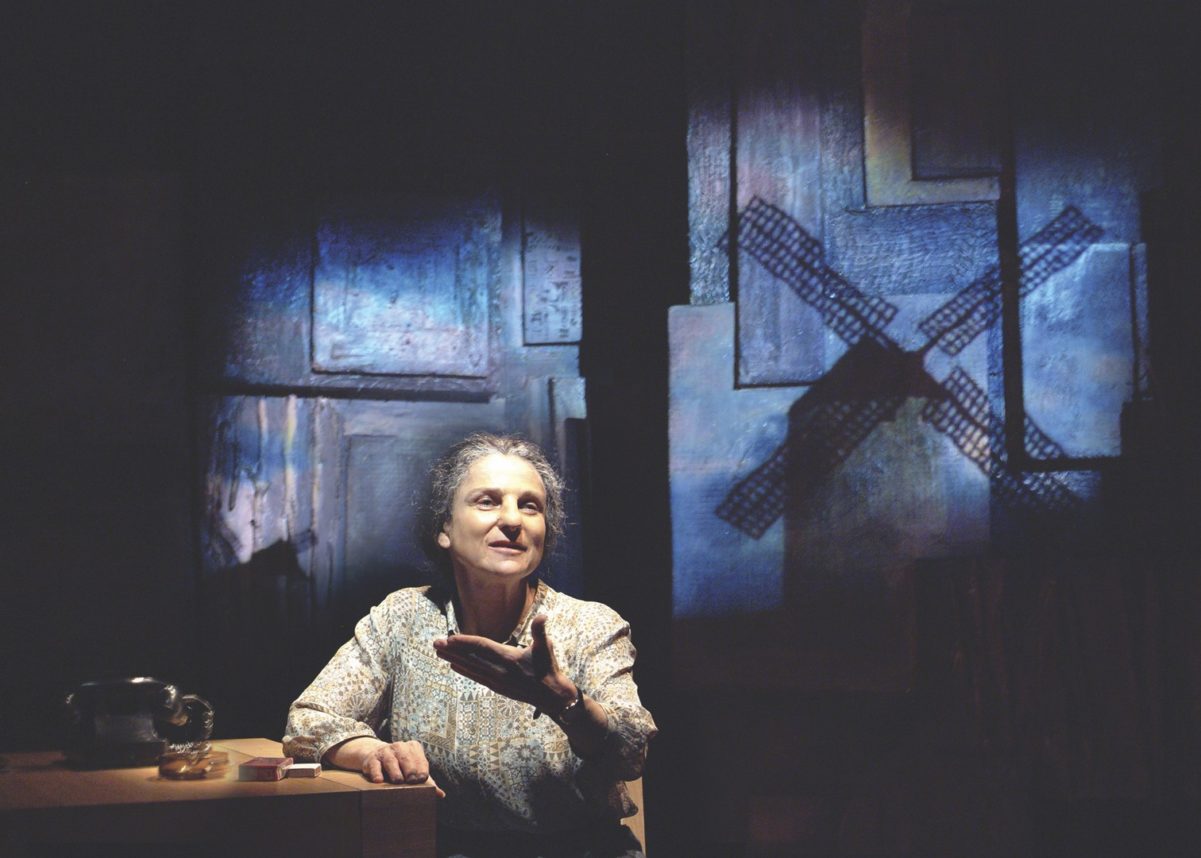
Tovah Feldshuh Returns to ‘Golda’s Balcony’ on Film

When Tovah Feldshuh accidentally called me instead of Los Angeles Jewish Film Festival Executive Director Hilary Helstein a couple of weeks ago, we had a good laugh. Just days before, when I was supposed to phone Feldshuh for this interview, I accidentally called Rabbi Joseph Telushkin.

“I’m so sorry I called you a little late,” I said and explained the mixup, “but Rabbi Telushkin sends his regards.”

“Oh!” Feldshush declared. “I hope he and his dear wife, Dvorah, are well. Dvorah was the assistant to Isaac Bashevis Singer when I did [the 1975 Broadway production of] ‘Yentl.’ It’s a very small world.”

It is indeed. Fifteen years after I interviewed Feldshush for this publication about her starring role as late Israeli Prime Minister Golda Meir in the one-woman hit Broadway show “Golda’s Balcony,” we found ourselves speaking again. This time, to discuss the full-length film version of “Golda’s Balcony,” produced by David Fishelson. The film is a live recording of the 2003 off-Broadway production of “Golda’s Balcony.”

The sold-out show eventually transferred to the Helen Hayes Theater, where it ran for 16 months, making it the longest-running one-woman show on Broadway. Feldshuh also enjoyed a stint with the production in Los Angeles. On May 9, the film “Golda’s Balcony” will close out the Los Angeles Jewish Film Festival, followed by a Q&A with Feldshuh.

Despite the fact it has been a decade and a half since she played Meir, Feldshuh still speaks about the role with conviction and passion. Written by William Gibson, the play explores much of the late prime minister’s life, but mostly focuses on the period surrounding the 1973 Yom Kippur War and the almost impossible decisions Meir had to make.  

The play opens with Meir at age 80. “I’m now 15 years closer to Golda’s age in the play,” Feldshuh said. What makes the film so powerful, she said, is that “it’s so up close and personal. This footage was taken in a 140-seat house. The cameras were on top [of me]. It marked every subtle feeling I had. It was also very early in the work. I had done the play for maybe three months.” The film, she continued, allowed her to be “in the palm of the audience’s hands and obviously in the center of their soul and heart. Here’s the sound bite,” she quipped. “ ‘Everybody has a front-row seat.’ ”

That recorded performance also captured Meir’s reserve, Feldshuh said. “It had her fighting never to cry. She was there for the State of Israel hook, line and sinker, and I was there for Golda Meir hook, line and sinker. The piece was better than I remember or expected. I’m very pleased, and [Fishelson] has been a huge supporter of the work. Then the [film] started to open in these festivals and four out of four festivals gave us first prize, so go figure.”


“[Golda] was there for the State of Israel hook, line and sinker, and I was there for Golda Meir hook, line and sinker.” — Tovah Feldshuh


Does she believe this newly released film will open up “Golda’s Balcony” to new audiences? “I think our dream is to get to every festival we can under the sun and get the imprimatur of the first prizes — as many as we can garner and then parlay that toward a bigger audience: maybe a Netflix, maybe an Amazon,” she said. “Hopefully, a place where [it] will be prized forever and anybody who wants to meet this aspect of Golda Meir will be able to do it.”

Feldshuh said she’d love to perform the show again. “I would love to do it live in Israel. The Jaffa Fest has invited me to come under the artistic direction of Noam Semel for just two performances next May. Obviously, I’d love to do a lot more. I’d love to be booked in Germany. I’d love to be booked in Austria. I’d love to be booked where anti-Semitism is lurking.”

While this interview was conducted before the attacks in Sri Lanka and at the Chabad of Poway, Feldshuh had a lot to say about anti-Semitism and the politics of divisiveness. When I interviewed her in 2004, she told me she used to post the list of names of all American soldiers killed in Iraq on the wall in the theater and read them every night before she went onstage to play Meir.

Today, she said, “We didn’t know then there were no weapons of mass destruction. We got rid of Saddam Hussein, but look what happened with Iran. I’ve never seen such divisiveness in my world.”

Her concern today, she said, “is for the massacre in Pittsburgh. My concern is for the massacre in New Zealand. My concern is for the bombing of 300 Australians in Bali years ago. The Israelis said to me in 1999 and 2000, ‘Stay alert. If you are easy on terrorists and you don’t come to Israel’s aid dealing with terrorism, you will be visited by the same nightmare.’ And sure enough, our world collapsed on Sept. 11, 2001.”

Violence, she said, takes many forms, “and it’s sadly present because it sits at the base of the spirit of man along with our goodness and decency and evolution as Homo sapiens.”

Stating that “we have a president who is an amoral guy and who didn’t come out fully against the Ku Klux Klan and we had that horrible incident in Charlottesville,” Feldshuh believes the time is ripe for America’s own Golda Meir — male or female.


“We really do need a moral compass in the White House,” she said, “and I know how complicated the presidency must be, but this can’t possibly be the answer. We have elected a media star. How can we expect him to be a proper president? I would love to see a brilliant, moral human being who is a clever internationalist and peacemaker.”

Paraphrasing a quote from “Golda’s Balcony,” Feldshuh said, “I have the most powerful army in the world, but when my boys come home from their military victories and shut their bedroom doors and mourn for the youth they have lost, we are not interested in victories, we are interested in sharing water and growing new kinds of strawberries.”

And it’s Meir’s famous quote, “There will be peace when the Arabs love their children more than they hate the Jews,” that Feldshuh said “is still true. The idea of having a two-state solution, which I absolutely believe in, is so that babies — Palestinians or Israelis — aren’t being killed in their cribs.”

“Golda’s Balcony” will screen at 7:30 p.m. May 9 at the Ahrya Fine Arts Theater, 8556 Wilshire Blvd., Beverly Hills. A Q&A will follow with Tovah Feldshuh and Jewish Journal Managing Editor Kelly Hartog.

Tovah Feldshuh Returns to ‘Golda’s Balcony’ on Film Read More »

JQ International Awards, Beit T’Shuvah Fundraiser

LGBTQ+ Jewish organization JQ International recently recognized five community leaders representing the best of the LGBTQ+ community and their allies.

“We take our job very seriously and select our honorees because they have made a difference in a positive way and we want to celebrate them and hold them up for all to see,” JQ International Executive Director Asher Gellis said after the 2019 JQ International Awards Brunch, which was held April 14 and honored Lorin and Linda Fife, Yoni Kollin, Rabbi Rachel “RBO” Bat-Or and Rabbi Zach Shapiro.

More than 250 people gathered at the Beverly Hills home of Neil and Kevin Goetz and helped raise more than $140,000 for JQ International, a West Hollywood-based organization that offers education, support and identity-enriching programs for LGBTQ+ Jews and their allies.

Lorin and Linda Fife received the Community Leadership Award for years of service to the community. Accepting the award, the two noted how far the community has come in its attitude toward gay and lesbian Jews since JQ’s founding 15 years ago.

Lorin credited “JQ activists and allies for having the vision to enrich our community, and for adding your contributions to make our Jewish world better, stronger and more inclusive.”

Kollin, a senior at Hamilton High School, came out as gender non-binary in 2017. Kollin — who goes by the gender pronoun they — did not feel seen until their mother, Deb Engel Kollin, treasurer of JQ International, joined the JQ team, Kollin said.

Accepting the Inspiration Award, Kollin also spoke about their drag alter ego, Krystal Guyzer, who ran for homecoming king in 2018.

“I didn’t win, but some games aren’t meant to be won. They’re meant to be started,” Kollin said. “And because of me, I have now paved the way.”

Bat-Or, a licensed marriage and family therapist and the director of JQ Helpline and Inclusion Services, received the Rabbi RBO (Rachel) Bat-Or Lifetime Achievement Award. Bat-Or — who goes by the gender pronoun per — takes daily calls and emails from therapists, teachers, parents and teens around the world that are seeking support related to LGBTQ+ issues. Per has been a spiritual leader, therapist and educator for almost 40 years.

“Through per work, RBO has completely shifted the landscape of LGBTQ inclusion in the Jewish community and has been a lifeline for community members in crisis,” Gellis said, presenting the award to Bat-Or.

Shapiro was awarded the Visibility Award for his leadership at Temple Akiba in Culver City, where he has served as rabbi since 2006, and for his contributions to the L.A. community.

“You are all lights.  You create legacy. And you bring goodness into the world,” Shapiro said, accepting the award.

In an email, L.A. City Controller Ron Galperin said he was thrilled about his husband, Shapiro, receiving the award.

“The JQ Visibility Awards are always a highlight for me, but this year’s was particularly special because my husband was an honoree,” Galperin said. “Zach is such a thoughtful spiritual leader and is so deeply committed to the betterment of the LGBTQ Jewish community and so many others in Los Angeles. I may be biased, but I can’t think of a more deserving recipient of this award.”

The gathering began with an outdoor buffet brunch in the backyard of the Goetz home. The award ceremony was held on the property’s tennis court, with rows of chairs arranged beneath a canopy.

Comedian Shawn Pelofsky entertained the crowd with lighthearted, self-deprecating humor about dating life, why Jews don’t do rock concerts and the college admissions scandal.

JQ International calls itself the “premier LGBTQ+ Jewish organization in Los Angeles.” Established in 2004, the organization has impacted more than 13,000 people in the past year with its Teen Jewish Queer Straight Alliance and programs serving the Persian community, young adults and others, the JQ website says.

The event celebrated this and more.

“Today, we honor five amazing individuals, all of whom were chosen for their trailblazing work,” Todd Shotz, chair emeritus at JQ International, said. “Each of them is a role model and sets an example for us of what it means to be so dedicated to strengthening and supporting a vibrant, dynamic and inclusive Jewish community.”

From left: Beit T’Shuvah honoree Judy Flesh, Holocaust survivor and philanthropist Hedy Orden and Harriet Rossetto, founder and clinical director of Beit T’Shuvah. Courtesy of Beit T’Shuvah

Nearly 200 women gathered on April 2 at the Four Seasons in Beverly Hills for the 12th annual Beit T’Shuvah Circle of Majesty luncheon.

The Circle of Majesty comprises of a group of women who have pledged to support Beit T’Shuvah’s work in preventing, educating and treating the disease of addiction for all those in need, regardless of the financial obstacles that are often in the way.

The event raised more than $250,000 and honored Judy Flesh with the Majesty Service Award for her exceptional volunteer work as an art therapist.

Flesh began facilitating an art psychotherapy group at Beit T’Shuvah 19 years ago and continues to donate her time anda expertise on a weekly basis so that residents can benefit from a discipline that combines psychotherapy and art into a powerful healing practice.

The money raised from this year’s Circle of Majesty will go toward the establishment of the Orden/Flesh Art Therapy Endowment Fund, which will ensure that the program remains a permanent part of Beit T’Shuvah’s clinical repertoire.

The integration of art and therapy can be healing for those who can’t find the right words to describe their feelings,” Flesh said.

“Art therapy allows residents to connect to their inner selves. They can draw what they are feeling and express themselves in a safe place,” Flesh said.

Shelley Zalis, CEO of the Female Quotient, was the afternoon event’s guest speaker. She delivered a speech on female empowerment, equality and living your life with passion and purpose.

The Circle of Majesty has raised close to $1.5 million for Beit T’Shuvah since its inception 12 years ago, according to Beit T’Shuvah.

Beit T’Shuvah is a 138-bed residential treatment center in Los Angeles. Since its launch in 1987, the center has helped more than 5,000 people recover from addiction. The facility also offers prevention services, as well as addiction education for clergy and medical professionals through the Elaine Breslow Institute.

From left: Maia Ferdman; Mark Rothman; Alisa Finsten; and Rabbi Ilana Grinblat celebrate Passover at an interfaith seder at City Hall. Courtesy of the Jewish Federation of Greater Los Angeles

The Jewish Federation of Greater Los Angeles held its 2019 interfaith seder with the city of Los Angeles Human Relations Commission on April 17.

More than 120 community members, leaders and elected officials came
together to celebrate Passover at L.A. City Hall.

“The seder explored the universal themes of Passover and gave every participant the opportunity to dialogue and find common ground during these challenging times,” Jay Sanderson, president and CEO of the Jewish Federation of Greater Los Angeles, said in an April 19 statement to the community. “These relationships will lead to even deeper partnerships in the future.”

Elected officials in attendance included State Sen. Henry Stern, Los Angeles City Controller Ron Galperin, L.A. City Councilmembers Bob Blumenfield and Paul Koretz, L.A. Community College District Board President Mike Fong, L.A. Community College District Board Vice President Andra Hoffman and L.A. Community College District Board Member Scott Svonkin.

Students picked up a pita on their way to class, mingled and listened to musical performances at Israelpalooza, USC’s largest Israeli cultural event of the year. Courtesy of Hillel at ‘SC

Israelpalooza, which describes itself as USC’s largest Israeli cultural event of the year, was held on April 2 and featured food, fun and festivities all in celebration of Israel.

The gathering held in advance of Israel’s Independence Day took place in the Los Angeles university’s McCarthy Quad from 11 a.m.-2 p.m.

Students picked up a pita on their way to class, mingled, listen to musical performances and opened their minds to all of the opportunities Israel has to offer.

“Israelpalooza was a huge success!” Hillel at ’SC, the organizer of the gathering, said on Facebook. “We cannot wait for next year!”

Want to be in Movers & Shakers? Send us your highlights, events, honors and simchas.
Email ryant@jewishjournal.com.

JQ International Awards, Beit T’Shuvah Fundraiser Read More »

Local Chabad Centers Respond to Poway Attack

The Chabad community is a close-knit one. In the wake of the April 27 shooting during the Passover service at Chabad of Poway, the Journal reached out to L.A.-area Chabad centers to speak with their leaders about their responses to an attack on one of their own.


Rabbi Amitai Yemini, Chabad Israel Center (Pico-Robertson)

[We] join the Jewish community worldwide in standing in solidarity with Chabad of Poway. We mourn the loss of Lori Gilbert-Kaye, a heroine who gave her life in defense of all that is right and good, and wish a speedy recovery to Rabbi Yisroel Goldstein, Noya Dahan and [Almog] Peretz.


“This is an attack on all of us as a whole. We are heartbroken.” — Rabbi Levi Begun


Hate, in any form, is ugly and the antithesis of Judaism and the tenets of Chabad Lubavitch. Anti-Semitism and intolerance must be rejected by people of all faiths. In its place, let us stand in unity with a commitment to increase goodness and kindness with fast and firm decisions to actualize that commitment in our daily lives.


Rabbi Avraham Zajac, Chabad South of La Cienega

Firstly, we express our deepest condolences to the entire Kaye family for the killing of Lori. We pray for the healing of all wounded, both for the wounds that are visible and for the wounds that are not. And we commend and are all very inspired by Rabbi Yisroel Goldstein and the entire Chabad of Poway community. We all must take concrete action to better secure our places of worship, schools [and] community centers; to increase our acts of mitzvahs — acts that express tolerance and respect to all mankind. We need to bring into this world more light — light that will banish all darkness. May we together usher in the Messianic era. Amen.


Rabbi Levi Begun, Chabad Culver City

 This is an attack on all of us as a whole. We are heartbroken. However, we have the power to rise above. Not allowing evil to prevail. It is only through adding in light that we push away darkness. Acts of random kindness that push away acts of random evil.


Rabbi Moshe Levin, Bais Bezalel Chabad (Pico-Robertson)


It’s understandable that the tragedy that struck the Jewish community in Poway resonated with each of us as something personal. We identify not only with the pain, but also with the trauma and fear that this kind of horrible hatred creates. Let’s identify with the incredible courage and strength the Poway community has displayed in the face of terror. Rabbi Yisroel Goldstein, an absolute hero who risked his life to protect his community, is asking us to stop a second and think. Be strong. Be united. They can’t break us.

Let’s ask ourselves: “What can we do to add in light?” A little bit of light pushes away a lot of darkness. We need light, friendship and warmth. You can see [Lori Gilbert-Kaye’s] gentle nature in her eyes, a soldier of light, who has built her community from Day One with a magnanimous and enthusiastic spirit. We don’t want her place empty in the synagogue this week. We want more soldiers of light and friendship and kindness to combat the darkness with goodness and kindness to bring Moshiach.


Rabbi Leibel Korf, Chabad of Los Feliz

Our reaction to such despicable, heinous acts of hatred is to overwhelm the world with light by increasing in our
acts of goodness and kindness. I will encourage the community not to allow
them to succeed in having us falter or bend in any way. We will continue to bring the message of the Lubavitcher Rebbe to always respond to negativity by doing acts of goodness and kindness. This Shabbat, we call on people to attend your
local Chabad.


Rabbi Levi Cunin, Chabad of Malibu

Lori Gilbert-Kaye was a bridge of love. This is a battle between light and darkness. As emissaries of the Lubavitcher Rebbe, we are united by our joint commitment to win this battle by continuing Lori’s bridge of love and light. We call out to our fellow brethren to join us by taking on a new mitzvah, an act of goodness and kindness. Together, we will illuminate
the world by transforming the darkness into light.

Local Chabad Centers Respond to Poway Attack Read More »

Emerging Leaders Learn to Fight Anti-Semitism at Poland Conference

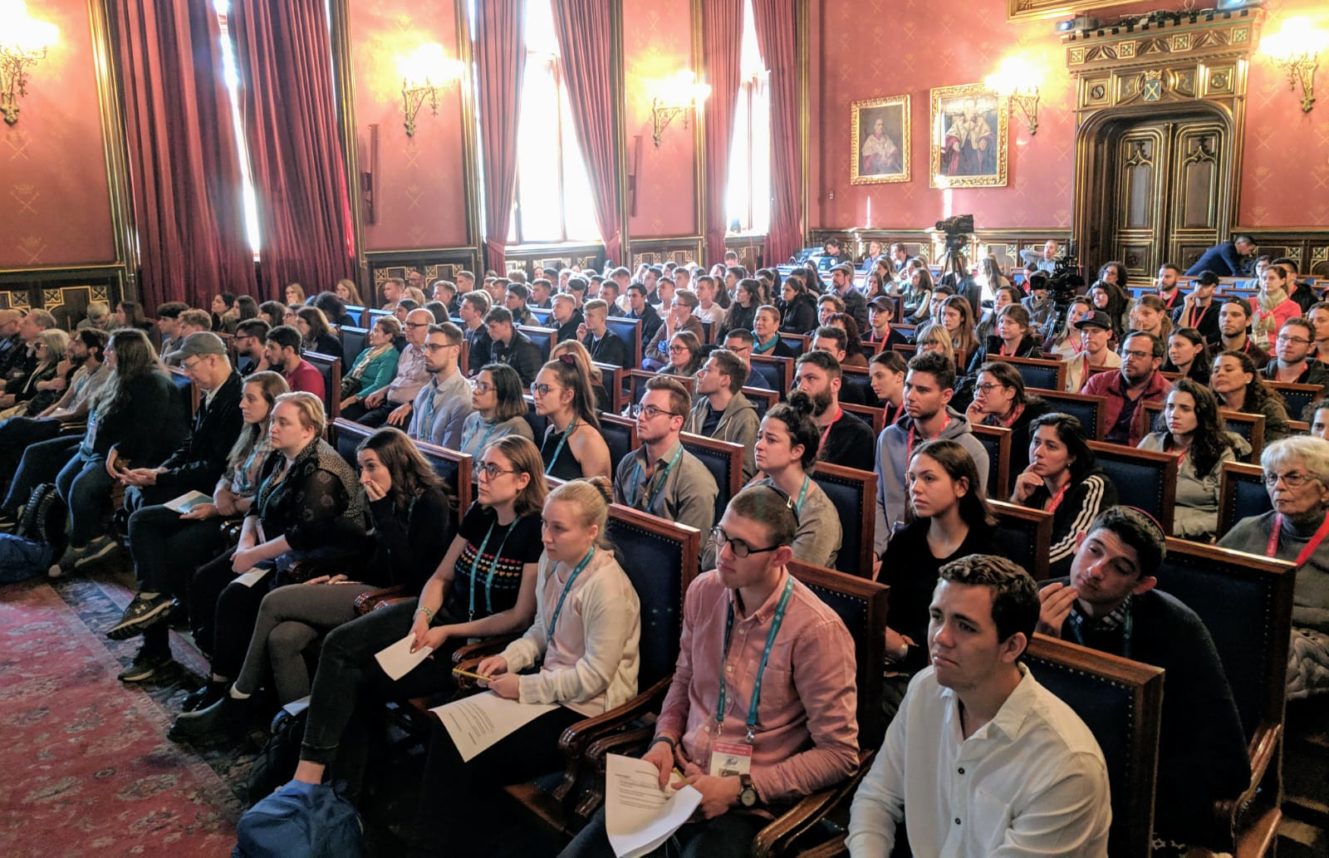
(Krakow, Poland)- March of the Living kicked off its first Emerging Leadership Conference May 1 discussing the Shoah and how to combat anti-Semitism and intolerance around the world.

Twenty one young leaders who have previously attended the March in Poland were selected from around the world to help educate and inspire more than 100 high school and college students from Canada, Panama, South Africa and the United States to take a stand against anti-Semitism, ahead of Holocaust Remembrance Day.

Rabbi Dr. Danny Schiff, foundation scholar at the Jewish Federation of Greater Pittsburgh, said in the wake of the April 27 attack on Chabad of Poway in Southern California and the Tree of Life shooting in Pittsburgh six months ago, “It is true – there is rising anti-Semitism. But it is also true that there are those who want to embrace us and support us, to hold us up and help us rebuild.”

He added, “The Jewish people do not dwell alone, we have friends who want to offer their support. So if we are serious about combatting anti-Semitism, let us choose our allies and work together. Let’s not pretend that we are by ourselves.”

March of the Living Emerging Leaders program director Michael Soberman; Dr. Zohar Raviv international VP of education for Taglit-Birthright Israel; and Alberto Levy also shared their experiences of first-hand exposure to anti-Semitism and how they will not let hatred and bigotry define them.

Twenty-five-year-old Izzy Lenga who is one of this year’s emerging leaders works with the UK Labour Party and the Jewish Labour Movement. Her activism came after experiencing direct anti-semitism during her first year at the University of Birmingham when she saw a “Hitler was right” sticker on campus among many other incidents.

“I’ve got complaints for a few years and I am seeing an absolute lack of action from the Labour Party,” Lenga told the Journal. “[Anti-Semitism] exists everywhere right to the top of the leader [referring to Labour Party leader Jeremy Corbyn] and who he surrounds himself… It’s words without action… What we need is action, not words.”

She added it’s been difficult to support the progressive British Labour Party because it attacks her faith by not calling out anti-Semitism in the UK. However, she said the best way to gain support for the Jewish people is with a shared dialogue.

“What I‘ve been saying to my progressive friends is [to] listen to Jewish people when they share about their experiences with anti-Semitism just like you would, just like you should, with all other minority groups when they talk about their oppression,” Lenga said. “Listen, understand, believe and take action with us. Stand with us. Help us lead this fight against anti-semitism.”

Emerging leader Ye’Ela Eilon-Heiber from Vancouver was excited to attend the conference and march this year to learn more about anti-Semitism in different countries. She said although there aren’t as many anti-semitic events occurring in Canada, it still exists.

“Having only a Canadian perspective sort of limits it [experiences with global anti-Semitism] but now that I’ve gotten to speak to people all over the world, it opens my mind about how anti-Semitism can show itself and how we can work against it,” Eilon-Heiber said. “I have actively chosen not to hide my Judaism and with the volunteer work I do I try to bring together the Jewish community and other communities I’m a part and try to create that dialogue where we can openly talk about why anti-semitism or racism are problems in other communities as well.”

The conference later divided the young adults into groups and asked them to draft a resolution that they would agree to follow when fighting future anti-Semitism. The final draft will be released at the 31st annual March of the Living event May 2.

The one message Schiff, Lenga and Eilon-Heiber emphasized is that they will continue to stand strong despite the hate towards Jews.

“We must acknowledge that the best response to anti-Semitism is to embrace our Judaism ever so fervently and deliberately. Embracing Jewish life is the best way to frustrate the well-laid plans of anti-Semites,” Schiff said. “Every one of you can undermine their plans by committing to become the finest Jews imaginable.”

Emerging Leaders Learn to Fight Anti-Semitism at Poland Conference Read More »

Cooking for All the Moms in Our Family

Every Mother’s Day, our family always gets together to plan and cook dinner for me. This year, I decided to surprise them and prepare my favorite dishes for everyone to enjoy.

The dishes I am making remind me of our wonderful Italian journeys. I remember one year in Tuscany, in the spring, when all the fresh-picked fava beans filled the market place and there was a mad dash by locals to fill their baskets.

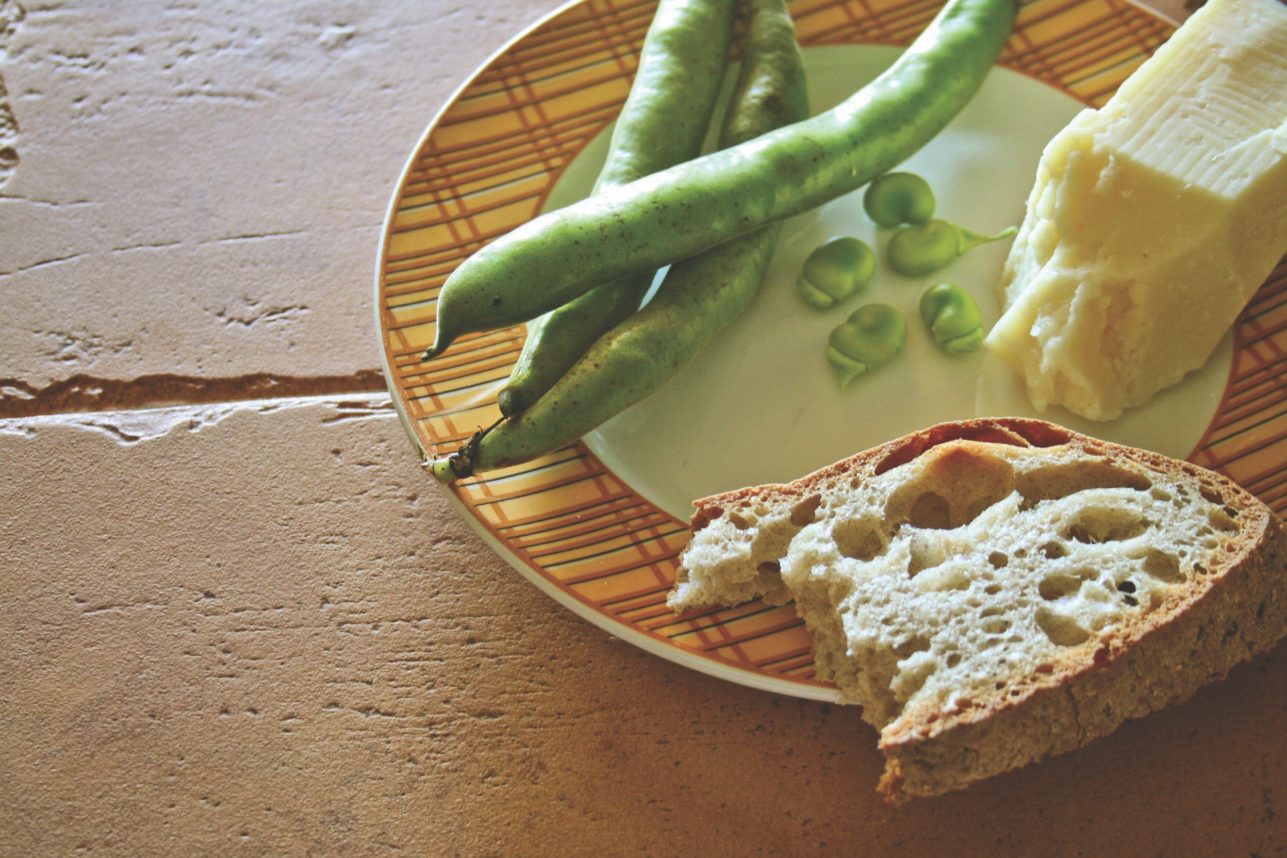
We have fava beans growing alongside our bocce court that are ready to harvest, and this is the best time to prepare Fava Beans With Pecorino Cheese. They are now available at the farmers markets. Cook them, add diced fresh pecorino cheese and olive oil for a special treat.

I love fresh asparagus in the spring. When we are in Italy during asparagus season, it is always a joy to see how many delightful ways Italians serve this vegetable. So perfect for a Mother’s Day menu.

The first time we had the amazing and simple dish Prinz Grill Asparagus and Fried Eggs was at the Prinz Grill, a restaurant in Biella, Italy, and we kept going back for more. As a matter of fact, you can find it in my cookbook “Italy Cooks.”

A trip to Barolo wine country, in the Piedmont region, was the first time we enjoyed a new way to prepare risotto. Try Barolo Wine Confetti Risotto, and you will love it as much as we do.

Homemade ricotta cheese is one of my favorite desserts. When I explain to friends that making fresh ricotta is as fast and simple as it takes to boil milk and cream, they can’t believe it. Just add lemon juice and, presto, you have fresh ricotta cheese to serve with olive oil, honey or fresh fruit.

I plan to have copies of the recipes available for my family, since so many of them love to cook.


FAVA BEANS WITH PECORINO CHEESE

This can be made with raw fava beans, as long as they are fresh. Blanching them quickly makes them much easier to peel.

3 cups shelled fresh fava beans (from about 3 pounds in the pods)
Kosher salt
1/4 cup olive oil
2 tablespoons fresh pecorino cheese, shaved or coarsely grated
Freshly ground black pepper

Using fresh fava beans, cook in a large saucepan of boiling salted water until just tender, about 2 minutes. Drain, transfer to a colander set in a bowl of ice water. Drain and peel off outer shell of the beans.

Toss beans, olive oil and cheese in a bowl, season with salt and pepper, and spoon into small bowls.

Serves 6 to 8.


“When we are in Italy during asparagus season, it is always a joy to see how many delightful ways Italians serve this vegetable.”


PRINZ GRILL ASPARAGUS AND FRIED EGGS
48 asparagus spears, trimmed and peeled
3 tablespoons unsalted butter or nondairy margarine
1 garlic clove, minced
8 eggs (or 16 quail eggs)
Salt to taste
Freshly ground black pepper
Shaved or grated Parmesan cheese

Tie the asparagus in a bundle with kitchen string and steam it standing up in a pot of simmering water. When it is tender-crisp, drain the asparagus, remove the string and place 6 spears each on 8 heated plates.

In a large skillet, melt half of the butter with half of the garlic over medium heat and fry 4 eggs sunny-side up, with the yolk slightly runny. With a metal spatula, carefully transfer the eggs and place on top of the asparagus. Repeat with the remaining eggs, and spoon the butter and garlic over all. Season with salt and pepper, and top with Parmesan cheese.

Serves 8.


BAROLO WINE CONFETTI RISOTTO
Sautéed Confetti Vegetables (recipe follows)
3 tablespoons unsalted butter (or nondairy margarine)
1 1/2 cups finely diced leeks, white and tender green parts, cleaned
2 1/2 cups Arborio rice (or short-grain pearl rice)
2 cups Barolo wine
6 to 8 cups vegetable stock
1/4 cup grated Parmesan cheese
1/4 cup cream
Salt and freshly ground black pepper to taste
1/4 cup chopped fresh parsley, for garnish 

Prepare the Sauteed Confetti Vegetables and keep warm.

In a large saucepan over medium heat, heat (melt) butter and add leeks. Cook until soft, about 5 minutes. Add the rice and stir for 1 minute to coat with butter. Add wine, 1/2 cup at a time, stirring well after each addition. When all the wine has been added and reduced, begin to add the stock, 1/2 cup at a time, stirring well after each addition. Wait until each addition of stock is almost completely absorbed before adding the next cup. Continue adding stock, 3/4 cup at a time, until all of it is absorbed  (total cooking time is 18-20 minutes). Taste the risotto frequently toward the end of the cooking process (rice should be tender). Just before the risotto is done, add the sautéed vegetables, Parmesan cheese and cream, and stir gently. Add salt and pepper. Spoon the risotto into warm bowls and sprinkle parsley on top.

Serves 8 to 10.


SAUTEED CONFETTI VEGETABLES
2 tablespoons unsalted butter or margarine
1 cup chopped carrots, cut into 1/8-inch dice
1 cup chopped zucchini, cut into 1/8-inch dice
1 cup chopped red bell pepper, cut into 1/8-inch dice

In a skillet, melt butter over medium heat and sauté the carrots, zucchini and bell pepper until tender but crisp, about 3-4 minutes. Keep warm.

Makes about 2 cups.


JUDY’S FRESH RICOTTA CHEESE

If you can’t travel to Panzano, Italy, to have the village cheesemaker, Signora Grazia’s ricotta, here is my simple and quick recipe that creates a smooth, velvety ricotta cheese. It is delicious with honey or olive oil for a breakfast, lunch or dinner treat.

1/2 gallon milk
1 cup cream
2 teaspoons salt
6 tablespoons lemon juice
Honey for garnish

Heat the milk, cream and salt over low heat until liquid is about to boil. Add lemon juice, stir a few times and when mixture begins to curdle, remove from the heat. Let curds rest for a couple of minutes. Using a slotted spoon, skim the ricotta curds from the whey and place them in a colander or wire sieve lined with cheesecloth. Drain for 15 minutes. Serve warm or at room temperature, with a drizzle of honey.

Makes about 1 pound. 


Judy Zeidler is a cooking teacher and cookbook author.

Cooking for All the Moms in Our Family Read More »

Remembering Lori Gilbert-Kaye: ‘She Was a Rainbow’

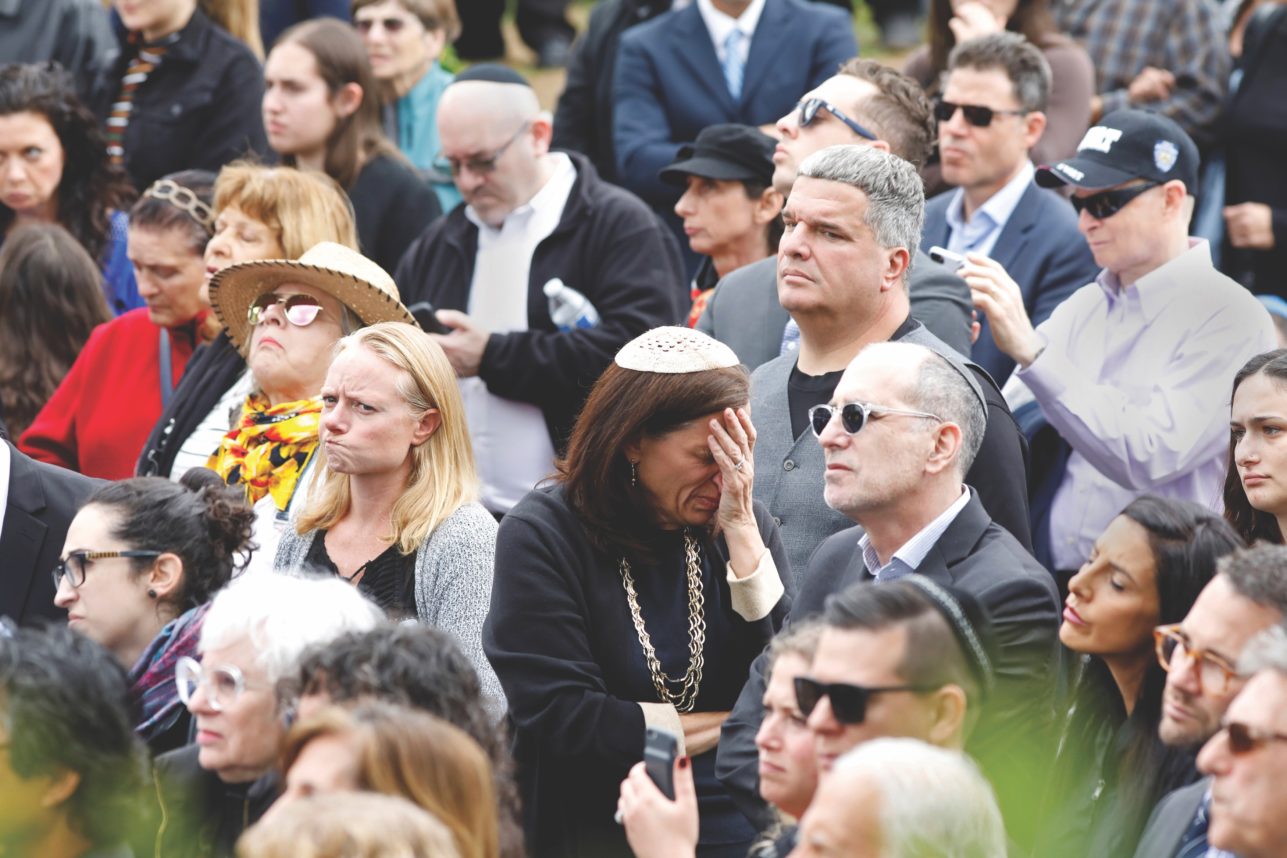
A blue-and-white sign inside the Chabad of Poway sanctuary indicates “Maximum Occupancy 696.” On the afternoon of April 29, with friends, family, community members, law enforcement representatives and elected officials gathered to honor Lori Gilbert-Kaye, the lone fatality in the April 27 attack, fire codes were no doubt violated.

All of the pews and dozens of rows of plastic folding chairs were filled with people who held onto the programs and boxes of Kleenex that had been placed on each seat. Attendees without seats stood in aisles and milled about in the lobby. A bank of news cameras on tripods lined the back of the room. An overflow crowd of thousands outside watched a livestream on a screen, courtesy of the Israel advocacy organization StandWithUs.

One man who had managed to find a seat tried to read Yuval Noah Harari’s book “21 Lessons for the 21st Century.” He couldn’t focus, his eyes red from crying. He gave up and shut the book, resting it on his lap. A woman filled in a crossword puzzle, sighing loudly in between scribbling down answers. Her friend, wailing, interrupted her. “Why? Just why?” she kept repeating. They hugged across their separate rows. Someone passed over tissues.

Chabadniks who traveled from all over to be at the memorial service sneaked in last-minute tefillin­ wrappings.

With a photo of Gilbert-Kaye smiling at the Western Wall in Jerusalem presiding over everyone from the bimah, a hush went over the crowd as the memorial service began. Steve Hoffman, Chabad of Poway’s president, stepped up to the podium. Rabbi Yisroel Goldstein, now with a sling holding up his injured hand, sat on the bimah looking on.

Hannah walked up to the bimah wearing one of her mother’s pink dresses. “I chose to wear pink because my mother was a colorful woman. She was a rainbow and she would’ve loved it.”

“It’s not lost on me or on any of us that we’re at ground zero, the very place where an anti-Semitic terrorist came to tear us down,” Hoffman said. “We’ve now come together to build our community back up by remembering and celebrating the life of our dear friend Lori Kaye and to show that we stand tall against the darkness of evil and anti-Semitism in the world.”

Elan Carr, the U.S. State Department’s Special Envoy to Monitor and Combat Anti-Semitism, spoke next. The former deputy district attorney for Los Angeles County and son of Iraqi Jewish refugees, Carr issued a rallying cry.

“Today, in Lori’s name, in the name of the 11 who were murdered six months and two days ago in Pittsburgh and in the name of every endangered Jew in the world and every endangered religious and ethnic minority in the world, today we pray for might and for strength,” he said. “So that we can vanquish this evil from our midst and build that better world that our children and our grandchildren so richly deserve. If that is what we do, and if that is to which we dedicate ourselves because of this ceremony and because of this, then Lori’s murder, as painful and heart-wrenching as it is, will not have been in vain.”

He added: “Yehi zichra baruch — “may her memory be a blessing” in Hebrew. The room erupted as he left the stage and took his seat.

Poway Mayor Steve Vaus, his usual cowboy hat replaced with a yarmulke, led a rendition of “God Bless America.” Before he began, he called up Oscar Stewart, the man who likely saved lives when he chased the suspect out of that synagogue 48 hours before. Vaus hugged him tightly and the crowd gave Stewart a standing ovation before swaying and singing together.

Close friends along with Gilbert-Kaye’s husband, Howard Kaye, and their daughter Hannah also spoke, painting an intimate portrait of the life lost.

A hush fell over the sanctuary when Hannah walked up to the bimah wearing one of her mother’s pink dresses. “I chose to wear pink because my mother was a colorful woman,” Hannah said. “She was a rainbow and she would’ve loved it.” Hannah unfolded her laptop on the podium, apologizing for not having time to print out her speech.

“She knew Judaism went beyond the text, beyond the guidance and beyond the synagogue,” Hannah said. “She also knew Judaism was about who you are as a person, how you treat others, how you respect and show love and kindness to all people. My mother lived her life this way. Everyone was her sister. Everyone was her trusted confidant. Everyone was her friend.”

After the memorial service, Gilbert-Kaye was laid to rest at El Camino Memorial Park in San Diego.

“We came here to heal as a community,” Audrey Jacobs said after the funeral. Jacobs, who lives in San Diego and works in private wealth management, was a close friend of Gilbert-Kaye’s. They met 14 years ago when their children attended Soille Hebrew Day School together. She has attended Chabad of Poway sporadically over the years.

“The most impactful moments were hearing her husband Howard and her daughter Hannah celebrate Lori’s life,” Jacobs said. “Listening to their intimate stories, everyone learned what a woman of valor Lori was and how her life was devoted to serving others.”

Being at the memorial was part of a whirlwind few days for Scott Silverman, 60, and his wife, Michelle, 65, close friends with the Kaye family. They spent April 27 at Palomar Medical Center comforting Howard, Hannah and other Kaye family members. Michelle had known Lori Gilbert-Kaye since they were youngsters in religious school together in the San Diego area. Scott and Michelle have known Hannah since she was born.

“Lori would’ve loved it all,” Michelle said. “We go back 50 years. She was such a news junkie. If there was something going on in the world, we’d text and talk until 1 in the morning. For her situation to be broadcast all over the world, with all the nice things being said about her, this would only bring her smiles. She’d be thriving in all this. It was just a very honorable tribute. It’s exactly how Lori would’ve loved to have been remembered.”

Silverman said he drew inspiration from the strength Hannah displayed in her speech about her mother. “It was spiritual for me personally,” he said. “[Hannah] is 22 and she articulated herself in a way that put just who Lori is together and she delivered it in such a way that was awe-inspiring. I can see the rise of her trajectory — just ultimately doing God’s work in a way we’ve probably never seen before.”  

Remembering Lori Gilbert-Kaye: ‘She Was a Rainbow’ Read More »

Poway Can No Longer Say ‘Nothing Happens Here’

Poway is a sleepy town of nearly 48,000 just northeast of San Diego about 15 miles from the Pacific Ocean. Tall palm trees line its wide streets. Driving through town, strip malls with chain restaurants blur past. Its residential neighborhoods have more palm trees, well-groomed lawns, American flags, and basketball hoops and SUVs in driveways. A sign welcomes you to “The City in the Country” — a nod to Poway’s rural roots.

As I traversed the town after the shooting on April 27 that killed 60-year-old Lori Gilbert-Kaye and wounded 57-year-old Rabbi Yisroel Goldstein, 34-year-old Almog Peretz and 8-year-old Noya Dahan, locals told me multiple times, “Nothing happens here.”

Chabad of Poway is in the heart of Poway’s Summerfield neighborhood. You can’t miss the huge, fenced-in concrete structure with stained glass windows on the corner of Espola Road and Chabad Way. Yes, it has its own street name. Jewish families from all over northern San Diego County send their kids to its renowned preschool. It provides programming for children with special needs and hosts popular youth summer camps. The sanctuary can fit close to 700 worshippers. Its Shabbat dinners are open and inclusive.

The locals — Jewish and non-Jewish —  know the Chabad House. It’s an institution; an integral part of the community. At a bagel shop in Scripps Ranch, a 10-minute drive away, a cashier said, “Everyone knows it.”

Less than 24 hours after the tragedy, Summerfield was waking up. Caution tape blocked street access directly in front of the synagogue. The facility was still considered a crime scene. Uniformed officers patrolled. The incessant hum of generators and running engines came from news vans lining the streets.

“It’s just normally so quiet here,” Summerfield resident Tad Nickolich said  while out walking his golden retriever with his wife, Christine, on their way to nearby church services. “It’s a little overwhelming,” Christine said, surveying the scene.

Another couple walked by pushing a stroller and walking a black Lab. The couples nodded to one another. “Everyone knows each other. It’s very family-oriented,” Christine said. “We all just walk our dogs, go to church.”

Nickolich sighed heavily. “You see these kinds of hate crimes, this kind of violence on television but it seems so far away,” he said. “It’s just so crazy that it’s in our backyard.”

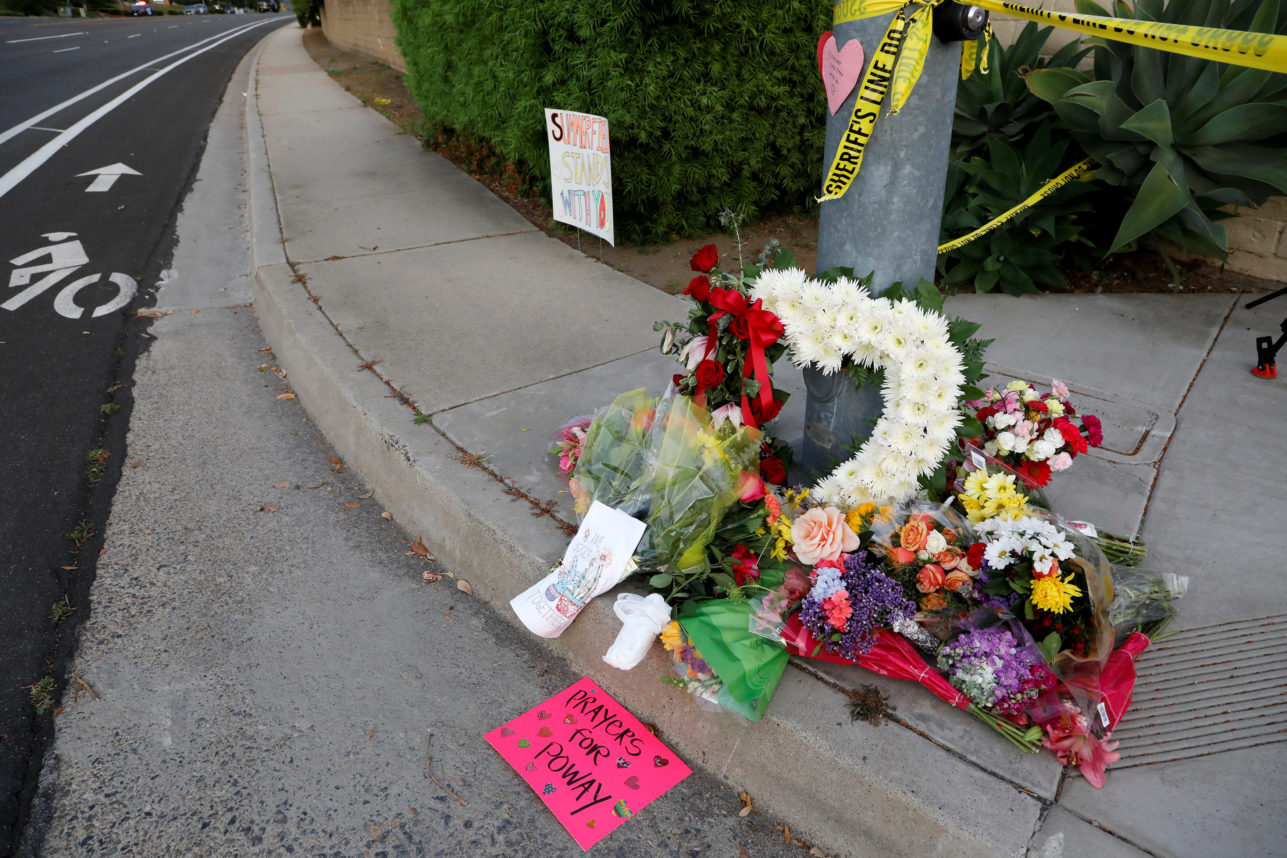
Throughout the morning, community members walked, drove and biked over to drop off flowers, candles, handwritten notes and posters at the Espola-Summerfield intersection. A memorial site took shape at the base of a traffic light pole. Heart-shaped notes with messages like “Poway stands with you” and “Poway strong” were taped onto the pole. Some messages were in Hebrew. Some quoted lines from Psalms.

“We will persevere. You can’t stop us from observing. You can’t stop us from doing what we need to do. Judaism will go on. We’re here to make sure it continues.” — Cantor Lori Frank

Dr. Mona Sobel, a retired pediatrician, drove from her home in Rancho Santa Fe to leave flowers. She has lived in the area since 1989 and her family attends services at Beth Am, a Conservative synagogue in San Diego.

“This is shattering, just horrible,” she said. “My grandson goes to preschool at our temple. We’re horrified but we’re not afraid. He’ll be going to school on Monday.”

Steve Vaus, the mayor of Poway, dressed in a sports jacket and a cowboy hat, was being interviewed nearby. “We’ve been through fires and other tragedies. We’re going to get through this,” he said.

A man in black sunglasses, a black-and-yellow Batman shirt and a black helmet affixed with pointy bat ears hopped off his motorcycle and left a bouquet of roses. More people came. Some teens walked over from the nearby Lutheran church and dropped off flowers. A tall, slender man in a long blue tunic and white turban stopped by, his grim face framed by a shapely black beard. His belt held a scimitar. He dropped off a note and left. One elderly man with patchy white facial hair, a blue baseball cap and a German shepherd by his side paced around the site for several minutes.

Some people, like 37-year-old Ryan Stout, came back to the neighborhood they grew up in. He was decked out in New Orleans Saints gear from head to toe. His chinstrap of facial hair glistened with sweat.

“My neighbor’s still right down there. She’s Jewish. I just walked over and gave her a hug,” he said. “She knew [Gilbert-Kaye] well. Her dad’s name is etched in that temple right there,” he said, pointing across the street. “Her kids go there. It’s personal. I’m from Poway. I went to Poway High School. I’ve driven by this I don’t how many thousands of times. To see that place, that was so much a part of my life, on the news for this just breaks your heart. I look at the temple and think who could do something like that to a place like that?”

Lauren Zimmerman, who isn’t Jewish, came from nearby Twin Peaks, where Indivisible San Diego, a coalition of grass-roots progressive groups from all over the county, held a rally in support of Chabad of Poway.

“We don’t have anything like this happen around here,” Zimmerman, a bus driver for Poway High School, said. “We put a kibosh on hate speech pretty quick. We don’t allow bullying in our schools. This is just incredible. Totally shocked.”

“Jewish brothers and sisters are my brothers and sisters. That’s why I’m here, to support the sister who passed away. We have to increase the love between all of us.” — Sulaiman Yonus

She then added that 17-year-old Chelsea King, a Poway High School student, was raped and murdered in the area in 2010. “We rallied then and we’ll rally now,”  she said.

A few minutes later, as I was walking to my car, Zimmerman bounded after me. “Chelsea King was on my bus every day,” she said. “I still have a blue ribbon on my bus for her. We don’t forget. And we won’t forget,” she said, hugging me.

A few streets over, a squad car idled in front of a “playa”-style home with an arched entranceway and a concrete front patio. About a dozen people stood in the driveway and on the lawn in the shade of a tree. Home to one of Chabad of Poway’s junior rabbis, it sits directly behind the synagogue.

The house is connected by a flight of steps in the backyard that lead up to a gate right in front of the synagogue’s downstairs parking lot.

Next to the house, a wooden fence lay flat on the ground. Shaina, a 15-year-old girl in a red sweatshirt, explained that the men, in such a panic fleeing down the steps out a back exit, ran through the downstairs parking lot, down the backyard steps and right through the fence. Shaina led a group of seven young children, including her little sister, down the steps and onto the street. A neighbor four houses down took in the children.

Shaina’s mother, Debra, had dark circles under her eyes. She spoke in a frantic staccato, staring straight ahead. “[Shaina] can’t sleep. She had nightmares. She can’t talk about it,” she said. She declined to have their last name in print. Debra arrived late to synagogue on the day of the attack.  There were already police cars on hand. “I knew. I just knew,” she said, fighting back tears. Then Shaina began to cry, too.

“We didn’t know where the kids were for almost an hour,” Debra said. “[Lori Gilbert-Kaye] was so brave. She’s a hero. It’s horrible what’s happened. He killed an amazing person, an incredible person. And for no reason. She gave everything to everyone. I have tulips sitting on my door because of her.” Apparently, Gilbert-Kaye enjoyed dropping off flowers on the doorstep of friends, just because.

By late morning, access to Espola Road was restored and hordes of people came to drop off flowers at the Chabad’s doorstep.

“We’re just in shock right now, just in shock,” Gary Abenaim said, standing in front of the blooming memorial. He and his wife, Negin Afari, live five minutes away in Rancho Bernardo. “You see this in the news elsewhere but this is personal. We’ve been here many times.”

Afari stared at the ground then shook her head in disbelief. “Our kids go to camp here.” She paused, before adding, “Jews need to get out and come to temples. Don’t stay home. Be proud that you’re Jewish. Stand in front of hate.”

At Temple Adat Shalom, a Reform synagogue about a mile away, Lon White, the temple’s senior adviser for security, walked me through the procedures his synagogue went through after hearing of the attack. Following initial concerns about a coordinated attack, Adat Shalom went into lockdown for three hours. Communications outreach went out to all congregants after the all clear was given.

“It’ll be unsettling for a time but this is a strong community of people,” he said. “We’ve been through these kinds of things for thousands of years and it’s going to take more than this to knock us down. My kids are in this building right now because I believe it’s a safe place to be. That’s a message I reinforce to other parents here.”

“You’re here to comfort us in this incredible tragedy. Because what happened to us happened to all of us. Your comfort, being here tonight, gives me incredible consolation.” — Rabbi Yisroel Goldstein

Inside the temple, cantor Lori Frank said, “There’s a strong interfaith community in the area we will lean on.” Hours after the April 27 shooting, she sang in front of hundreds at an interfaith vigil held at nearby Rancho Bernardo Community Presbyterian Church organized by POINT (Poway Interfaith Team).

“We just dropped everything and went to the vigil,” Frank said. “So many others did, too, on such short notice, including many of our Christian friends.”

After a brief interfaith service in English, Frank led songs in Hebrew in the courtyard. As the sun set, she and others realized they didn’t have everything they needed to make Havdalah.

“But we had candles,” she said. “So we gathered as people were leaving and did Havdalah. You could see in the faces of people there doing makeshift Havadalah that it was a powerful statement. We will persevere. You can’t stop us from observing. You can’t stop us from doing what we need to do. Judaism will go on. We’re here to make sure it continues.”

As the sun began to set on April 28, thousands descended on Valle Verde Park less than a mile from Chabad of Poway. Elected officials, law enforcement and faith leaders attended. Behind the outfield fence of a Little League Baseball field, where microphones, speakers and a pool of news cameras were set up, friends bumped into friends. Strangers shook hands. There were yarmulkes and the top hats of Chasidic Jews. Hijabs, too. Chasidim wrapped strangers in tefillin. A toddler in a Spider-Man jumpsuit observed from his father’s shoulders. Parents tried to keep their kids quiet. Some just let them roam off to the play structure.

Everyone helped one another light their candles, shielding their neighbors’ candles from the wind to prevent flames from going out. A car alarm blared. “Someone needs to turn that damn thing off,” someone said angrily.

It began to sprinkle. A man next to me tilted back his head, eyes aimed at the sky. “He’s crying,” he said. A woman held out her hands, cupping rain. “Yup. Definitely tears.”

Prayers were recited in Hebrew and English. Songs were sung. Mayor Vaus spoke. Others spoke, lauding the outpouring of support from around the globe and the GoFundMe drives for the victims.

Then, Rabbi Goldstein, America’s rabbi these past few days, stepped up to the microphone. The crowd become frenzied, elated at the sight of him.

By now, you probably know Goldstein or feel like you do. You probably know that he remained a voice of calm, a pillar of strength as bullets sprayed in the synagogue he and his family built when they moved from Brooklyn to the San Diego area in 1986. You’ve probably seen him interviewed on prominent media outlets, heard the shaking in his voice as he has retold his story and praised the heroes. You’ve probably seen the thick bandages on his hands and heard that he lost his right index finger after a four-hour surgery. A “scar I’ll carry with me forever,” he said.

When it was revealed Noya and Peretz, the other two who were wounded, were also at the vigil, the cheers grew louder.

You’ve probably heard their stories, too. How Peretz, visiting from the southern Israeli town of Sderot — a target of Hamas-launched rocket attacks from the Gaza Strip — sustained shrapnel wounds in the leg.

You’ve probably heard about his niece, Noya, who was injured by shrapnel in her leg and face; how her family moved from Sderot to San Diego County several years ago to escape violence.

And you’ve heard how Goldstein, Noya and Peretz are recovering, but that Gilbert-Kaye didn’t. That she was shot three times; that her husband, Howard, a doctor, tried to administer CPR and then fainted by her side. Many reports and eyewitness accounts assert she was protecting her friends and her rabbi.

As Goldstein stood in front of the vigil attendees with his bandaged hands, he declared: “We’re standing here right now in the heart of Poway surrounded by hundreds of wonderful people that I don’t know. You don’t know me, but you came out here because you have a heart. You have a soul. You’re here to comfort us in this incredible tragedy. Because what happened to us happened to all of us. Your comfort, being here tonight, gives me incredible consolation.”

Many people lingered on the grass after the vigil. Among them were Yusef Miller, 50, and Sulaiman Yonus, 33, two Islamic community activists affiliated with the Islamic Center of Escondido.

“They supported us when we had our fire at our mosque and we support them,” Miller said, referring to an arson attempt on the Islamic Center of Escondido a month before. A manifesto whose authenticity hasn’t been verified links the crime to the Chabad of Poway suspect. “Even before that,” he added, “we supported them when a swastika was painted on one of their houses. We have a back-and-forth relationship with the Jewish community.”

A man in a yarmulke interrupted us to shake hands with Miller and Yonus. “Thank you for supporting us,” he said. They nodded solemnly in reply.

Miller clasped his hands together and remained silent for a moment. “We want to show the people that think like this person that this cannot separate us,” he said. “We will band together and we will show love and solidarity, and we want everyone in the world to see this and do the same before tragedy happens.”

“For me,” Yonus said, “Jewish brothers and sisters are my brothers and sisters. That’s why I’m here, to support the sister who passed away. We have to increase the love between all of us.”

“We walk that walk here,” Miller added.

As vigil attendees walked back to their cars, many passed Chabad of Poway. They continued to drop off flowers and candles. The memorial site was still growing, the flames of lit candles beacons of hope in the darkness of night.

Poway Can No Longer Say ‘Nothing Happens Here’ Read More »

Weekly Parsha: Acharei Mot

One verse, five voices. Edited by Salvador Litvak, Accidental Talmudist

Acharei Mot.

The he-goat shall thus carry upon itself all their sins to a precipitous land, and he shall send off the he-goat into the desert.

Leviticus 16:22


Kylie Ora Lobell

Jewish Journal contributing writer

Today, it’s hard for us to understand the meaning of sacrifices. As an animal lover who has two dogs, five chickens and a tortoise, it would certainly be rough for me to participate in animal sacrifice. I’m sure when the third Temple comes, however, it’ll be a huge honor to participate in animal sacrifice and see it in all its beauty.

Because we’re still waiting for that time, this verse symbolizes something that we do have: teshuvah, repentance. The he-goat represents our sins, and when we send him into the desert, we are letting go of our past wrongdoings. There are some people who believe they have wronged so much in the past that they are “damaged.” They incorrectly think they can never fix themselves or improve.

HaShem offers us a chance, through teshuvah, to be forgiven of our sins and move on. We can step away from our pasts and only move forward into the future. We can let those sins wander off into the desert, and live our lives as brand-new, sin-free individuals. We don’t have to think of ourselves as bad people. We can pledge to do better, let go of the baggage and be free, which is an incredible gift from above.


Michelle Stone

Shalom Hartman Institute
of North America

Is it really possible for us to place our sins onto a living creature and send those sins into the wilderness, off our backs, forever? The biblical Yom Kippur ritual of expiating sin by sending the “scapegoat” to the wilderness seems to suggest so.

Maimonides explains that physical transfer is not actually possible, but the ritual is essential nonetheless. He writes, “There is no doubt that sins cannot be carried like a burden … these ceremonies are of a symbolic character, and serve to impress people with a certain idea, and to induce them to repent — as if to say, we have freed ourselves of our previous deeds, have cast them behind our backs, and removed them from us as far as possible.”

Maimonides identifies a concept inherent in our ritual-rich tradition: the role of ritual in inspiring behavioral change. Research shows that rituals can be beneficial in multiple ways, including improving attention, enhancing confidence or emotional stability or providing motivation. Maimonides suggests that we may need to connect ritual performance to our desire to repent in order to change our ways.

The grand spectacle of witnessing our sins leaving for the wilderness can convince us that they have actually left for good. While this particular ritual is no longer practiced, it is worthwhile to investigate the abundance of personal and communal rituals in the Jewish tradition (and there are plenty) to tease out what it is about these rituals that can help us be our best selves.


Rabbi Marc D. Angel

Institute for Jewish Ideas and Ideals

Elias Canetti, a Sephardic Jew who won the Nobel Prize for literature in 1981, describes the impact of a “sting.” We are hurt or insulted by someone. We are demeaned and without power to defend ourselves. Canetti states that these stings remain forever. They haunt us throughout our lives. If we are wise, we learn to control them. But if we are not so strong internally, we seek revenge. We look for other ways to relieve ourselves of the pain of the stings.

Many stings are self-inflicted. We make terrible mistakes. We sin against God, against ourselves, against others. We later feel remorse … but the stings don’t go away. We cannot undo the past errors; but allowing them to fester within us is painful and destructive.

The Torah describes a strange ritual involving the sending of a scapegoat to perdition. The goat symbolically carries the sins of Israel. Maimonides pointed out that “sins cannot be carried like a burden and taken off the shoulder of one being to be laid on that of another being. But these ceremonies are of a symbolic character … as if to say, we have freed ourselves of our previous deeds …” (“Guide of the Perplexed,” 3:46).

That ancient ceremony served to relieve people of their stings, freeing them from living in constant guilt and self-doubt. It was a vivid way of demonstrating to the Israelites: You can get past your sins and errors; you can overcome your stings. You can be cleansed.


Erica Rothblum

Head of School, Pressman Academy

We read here about the second of two goats. To understand the scapegoat, we must look at the two goats as a pair. The first goat was sacrificed to God. In modern Judaism, the sacrifice of this goat is replaced by prayer to God; in other words, instead of killing a goat, we pray fervently for forgiveness for the sins between us and God.

This second goat was sent into the wilderness with the sins of the people on its head. While we no longer send out a goat, so too must the scapegoat be replaced by the more modern act. The rabbis teach us it is our duty to take responsibility for all those sins we commit ben adam lechavero, the sins between man and his fellow human. There are those who, like Adam and Eve, sin and blame another. There are those who sin and respond with anger, like Cain. And there are those who take responsibility, who repent, who bravely look into their friends’ eyes and say, “I made a mistake and I am sorry.”

According to Maimonides, the truest form of repentance occurs when someone has not only publicly confessed his or her sin and sought atonement but has subsequently found himself or herself in a similar situation and has refrained from sinning. It is our responsibility to actively take responsibility when we have done wrong and to make it right again.


Rabbi Chaim Singer-Frankes

Interfaith Chaplain

It’s one thing to dispense with my wrongdoings, to splay the truths of my vice, blood and sinew, showering guilt in four directions until I am cleansed of them. Although I am taken aback by my ancestors’ brutish sacrifices, is there something grotesquely pleasing at the prospect of canceling my own badness through butchering naive animals? Oy.

The sacrifices surrounding our verse feel like hotheaded rage. Like a good scream or smacks to the punching bag. Savagery. And while I’m a person who’s compassionate and tender with animals, I still thank God that the Torah dictates animals, and not human beings, should be objects of purgation. Perhaps that’s the point.

Every time I stroke the head of an animal such as a cat or a dog — even a goat at the fair — I am passionately mindful that this is God’s creation. It will lift an innocent head, letting me run my fingers through its musky fur. It bays approvingly at the attention. I imagine being the Kohen, laying hands upon a trusting beast, intending to mark it with kavanah — with holy intent — transferring upon it all of Israel’s iniquities. But instead of the usual slaughter and splatter routine, I’m enjoined by Torah to let this one go. A reflection of me; alive, warm, coursing with dutiful blood. Confused and not altogether expectant. I am not unlike the wilderness that receives me. Spared, but banished in some nameless backcountry, I quietly face my creator with burdens. Truth. Mine. Not mine.

Weekly Parsha: Acharei Mot Read More »