fbpx

March 13, 2019

Author Christopher Noxon on Civil Rights, Conversion and Israel

Los Angeles native Christopher Noxon just came out with his third book. His first was “Rejuvenile,” about the blurring of lines between childhood and adulthood. Next came “Plus One,” a novel loosely based on his longtime marriage to television writer and producer Jenji Kohan. (The two recently separated.) His latest book is “Good Trouble: Lessons From the Civil Rights Playbook.” 

A convert to Judaism who belongs to both IKAR and Temple Israel of Hollywood, Noxon, 50, spoke with the Journal about his work, his passions and becoming a Member of the Tribe.

Jewish Journal: How did you come to write and illustrate a book on the civil rights movement?

Christopher Noxon: I was on a Jewish Book Council tour [for “Plus One”] and it was two days after the election of Donald Trump. I was in Memphis. I was talking about male house caretakers and female breadwinners and thinking that was very important, and then all of a sudden, this election happened and it seemed really not important. I ended up in a chance encounter with the [National] Civil Rights Museum, which is at the Lorraine Motel — which is where Martin Luther King was assassinated — and I sort of just had a breakdown, a reckoning. Just the very crushing and immediate sense of history going backward.

They had this big wall of mugshots at the museum of Freedom Riders and people who were at sit-ins and I started drawing [in my notebook]. There was something about those faces — in the moral clarity and in the resolve and in the defiance — that I just thought, “I need to connect with that spirit; that’s the spirit we all need right now.” I had actually written a book about conversion. At that point, I was supposed to go out to publishers with it. I talked to my agent about it. She’s the one who said, “You need to be doing this.”

JJ: I heard you are donating all the proceeds from “Good Trouble.”

CN: All the money that I am getting from the book is going to the Center for Popular Democracy, which is an activist group that does racial justice and health care. I knew that as a white guy writing about civil rights, it was important that people know, first of all, anything you like that I say is because of people like Fannie Lou Hamer and Ella Baker and Martin Luther King and [Rabbi] Sharon Brous and [Pastor] Otis Moss III and all these people who have put their selves on the line for many, many years. One of the guys in the book is a guy named Reverend R.K. [Smith]. He’s a man I met in an airport on my way down to Atlanta.

JJ: Just coincidentally?

CN: Yeah. He is a former preacher at Dexter Avenue Church, where Dr. King started the Montgomery bus boycott, and we have become really close. He says, “You’re late to the plate, but you’re swinging.” I don’t want anyone to get the impression that I’m trying to profit or benefit from the work of black folks who have been in this world for a long time.

“I knew that as a white guy writing about civil rights, it was important that people know anything you like that I say is because of people like Fannie Lou Hamer and Ella Baker and Martin Luther King and [Rabbi] Sharon Brous and [Pastor] Otis Moss III.” 

JJ: Who is the intended audience for “Good Trouble?”

CN: It grew out of this practice of sorting out my feelings and thoughts in pictures and words in a journal. I wanted the book to have that feeling, not to feel like a political treatise or a historical primer but a really personal reflection. A lot of people who see the book now think this is great for middle schoolers, for high school kids, because it’s graphic. I never thought of it as a book for young adults. But I totally see why that works.

JJ: Is there something Jewish about this project?

CN: For sure. Very basically, I talk about Abraham [Joshua] Heschel, who was close friends with Dr. King and who is quoted in the book as saying that when he marched in Selma, [Ala.], it was like praying with his feet. And he was a big presence in my conversion. I read a bunch of him when I was converting. To me, this idea of turning your faith into tangible action, about deeds and not creeds, is the essence of Judaism.

JJ: When and why did you convert?

CN: August 2015. I was bored with the constant explaining about acting Jewish but I’m not officially Jewish. I had that conversation so many times. I just needed to settle it.

JJ: That’s a big thing to go through to counter boredom.

CN: OK. That’s true. I felt settled. I felt resolved. And I felt like I had definitely found my people. There was no question in my mind. It had always been wrapped up in family but at a certain point, it was about the community. I wanted to be looking out from inside this camp and not standing on the outside of the crowd.

JJ: Do you think you’ll get back to the conversion book?

CN: I will. I just feel like right now is not the time. I basically use what’s called the hatafat dam brit, which is the ritualized bloodletting, as the hook, so to speak, to talk about larger issues of conversion and spirituality and Jewishness. But now is not the time to put my man hurt on display. There’s a lot more hurt that matters a lot more.

JJ: “Good Trouble” just came out so this may seem an unfair question, but what’s next for you?

CN: Actually I have a great answer. I signed a deal to illustrate a book about Israel. I’m doing it with this guy Daniel Sokatch. [Editor’s note: Sokatch runs the New Israel Fund.] He’s writing the words. I’m doing the pictures. The preliminary title is “Israel: WTF?” Basically we’re both like, we need “Israel for Dummies” for smart people.

Author Christopher Noxon on Civil Rights, Conversion and Israel Read More »

Hamantashen Sunglasses for Purim

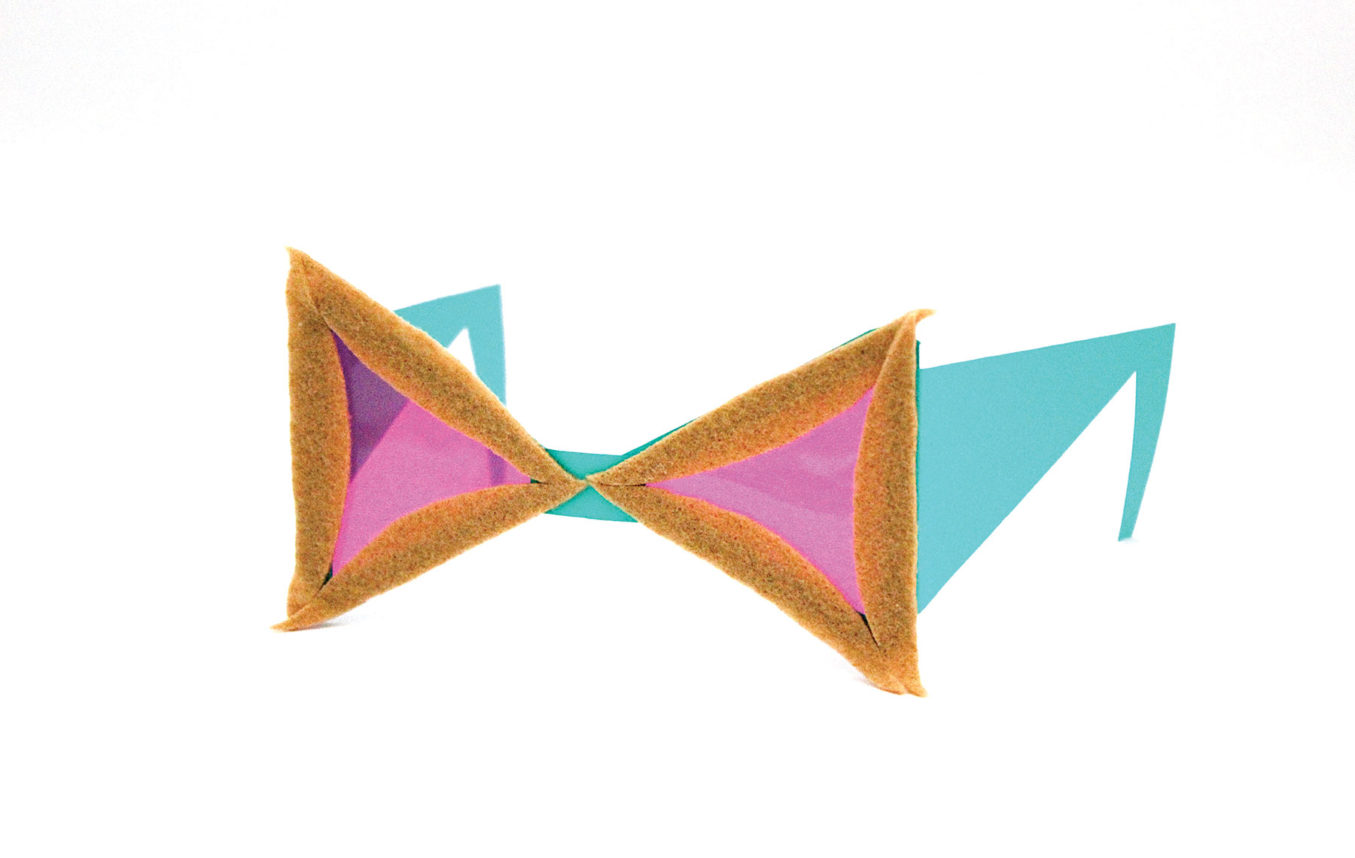
We’re a week from Purim. So what’s the best way to throw some shade at that evil Haman? These hamantashen sunglasses, of course. Wearing them will make you feel like a superhero — like Captain Hamantashen. And I find it’s also helpful to have some actual hamantashen cookies to snack on while making them. You know, for inspiration.

What you’ll need:
Card stock
Scissors
Glue
Tan felt
Transparent report dividers


1. Cut two strips of card stock to 8 inches by 1/4 inch.


2. Fold the strips to make a triangle. Glue the ends to secure them.


3. Cut two pieces of card stock that are 5 inches by 2 inches, and one piece that is 1/2 inch by 1 inch.


4. On the 5-by-2-inch pieces, cut out a long triangle to create the temple for the sunglasses. Cut this piece to fit your own ears.


5. Glue the temple pieces to the triangles as shown. Then glue the small 1/2-by-1-inch piece between the two triangles to make the bridge for your nose.


6. Cut wedge shapes out of tan-colored felt that will cover the sides of the triangle. Glue them in place with the curved part on the inside.


7. Cut triangles out of colored plastic sheets. Make them just larger than the triangular openings in the glasses. I used transparent report dividers I bought at Staples.


8. Glue the plastic triangles to the back of the sunglasses. Double-sided tape will also work. Finally, fold the temple pieces so they are perpendicular to the glasses.


Jonathan Fong is the author of “Flowers That Wow” and “Parties That Wow,” and host of “Style With a Smile” on YouTube. You can see more of his do-it-yourself projects at jonathanfongstyle.com.

Hamantashen Sunglasses for Purim Read More »

What’s Happening: Purim Festivities

SAT MARCH 16

Shushan Neighborhood
The Reform community’s annual temple-wide Purim celebration features a day of fun, costumes, music, food and laughter. 3-5 p.m. carnival opens; 3-4 p.m. mitzvah fair; 5 p.m. spiel; 5:45 p.m. carnival reopens; 7:30 p.m. raffle winner announcement. $25 per wristband. Temple Isaiah, 10345 Pico Blvd., Los Angeles. (310) 277-2772. .

SUN MAR 17

Pizza and Pints Purim
An evening of Purim debauchery and healing the world takes place during Open Temple’s “Pizza and Pints Purim.” Partygoers dance, move, wrestle, rap, read the Megillah and feed the homeless. Kombucha and beer for adults; pizza and soda for the kids. 4-7 p.m. Free. RSVP. Electric Lodge, 1416 Electric Ave., Venice. (310) 821-1414.

Purim in Santa Monica
Game booths, unique vendors, rides, food trucks, a raffle contest and other attractions highlight the Santa Monica Community Purim Carnival 2019. The Santa Monica Synagogue and Beth Shir Shalom co-sponsor. 11 a.m.-3 p.m. Free. 1448 18th St., between Broadway and Santa Monica Boulevard. (310) 453-4276.

Saddle Up for Wild Wise West
Little cowgirls and cowboys celebrate Purim at “Wild Wise West,” Stephen Wise Temple’s Purim carnival. 10:30 a.m.-3:30 p.m. $20 ages 2-4 years old, $40 for kids 5-18 years old, free for adults and kids younger than 2. Prices rise after noon March 15. Stephen Wise Temple, 15500 Stephen S. Wise Drive, Los Angeles. (310) 476-8561.

Wild Wild, West
Harkening to an earlier age, bull-riding highlights Harkham Hillel Hebrew Academy’s Wild Wild West Purim Carnival. Euro-bungee, pony rides, a giant slide, archery, a petting zoo, a dunk tank and photo booth await. Wristbands required for children 3-18 for rides and activities and for adults wishing to ride the bull or Euro-bungee. 11 a.m.-3 p.m. Wristbands $30 until March 14. $36 at the door.  Free for children younger than 3. Harkham Hillel Hebrew Academy, 9120 Olympic Blvd., Beverly Hills. (310) 276-6135. .

WED MAR 20

Purim Justice Carnival
Dress in costume, dance, drink, celebrate justice and partake in major noisemaking at IKAR’s Purim Justice Carnival. Bring your own grogger in the form of a pasta box, rice, cereal or whatever non-perishable food that makes noise. All donations will be brought to SOVA after the party. 6:30 p.m. Mini Megillah and costume parade for kids of all ages. Bar opens for adults. 7 p.m. Megillah reading and spiel. Free, but RSVP recommended. 8:15 p.m. party. $15 in advance, $20 at the door. Valet parking, $10. Candela La Brea, 831 S. La Brea Ave.  (323) 634-1870.

“Estheria”
The Pico-Union Project and its friends at Nefesh, East Side Jews and The Living Room collaborate on “Estheria,” an Israeli-style Purim celebration, featuring a costume contest with prizes, live music, line dancing led by Tina Michelle, snacks, a cash bar and the Purim story told from alternative points of view. 7 p.m. party starts. 7:30 p.m. Purim story. $20. Pico-Union Project, 1153 Valencia St., Los Angeles. (213) 915-0084.

Shushan Funk
During a Purim spiel just for adults, the strictly modern music of Bruno Mars blends with tradition. Temple Emanuel of Beverly Hills clergy perform in a spiel of the Esther and Mordechai story, while hamantashen, Hamantinis and appetizers are served and the Megillah is read. 7 p.m. Free admission to the spiel. Drink tickets: 2 for $10, 5 for $20. Temple Emanuel of Beverly Hills, 8844 Burton Way, Beverly Hills. (310) 288-3737.

Pasadena Purim
Purim at the Pasadena Jewish Temple & Center features a Purim spiel, a taste of schnapps and sangria and, of course, the Megillah reading. 7 p.m. Free. Pasadena Jewish Temple and Center, 1434 N. Altadena Drive, Pasadena. (626) 798-1161.

Costume, Humor and Movie
An evening of Purim merriment takes place at Hollywood Temple Beth El. Highlights include a Megillah reading; a screening of the classic film “Hester Street,” following Jewish immigrants who come to the Lower East Side; Russian folk dance and refreshments. Come dressed in costume and bring a dessert or a light liquor to share along with a canned or boxed food for charity. 7:30 p.m. Free. Hollywood Temple Beth El, 1317 N. Crescent Heights Blvd., West Hollywood. (323) 656-3150.

THU MARCH 21

“Purim in Candyland”
Candy canes, lollipops and gumballs galore, a sweet celebration is in store at the Friendship Circle of Los Angeles’ “Purim in Candyland” for children with special needs and their families. 5:30-8 p.m. Friendship Circle of Los Angeles, 1952 S. Robertson Blvd. RSVP to Chanie@fcla.org or call (310) 280-0955.

Sephardic Purim
Games, prizes and nosh highlight Sephardic Temple’s family-friendly Purim carnival. All children must be accompanied by an adult. 4-6:30 p.m. $35 for members (ages 5-15), $40 general and at the door. Sephardic Temple, 10500 Wilshire Blvd., Los Angeles. (310) 991-6032.

What’s Happening: Purim Festivities Read More »

Iran Gets Seat on U.N. Women’s Rights Committee

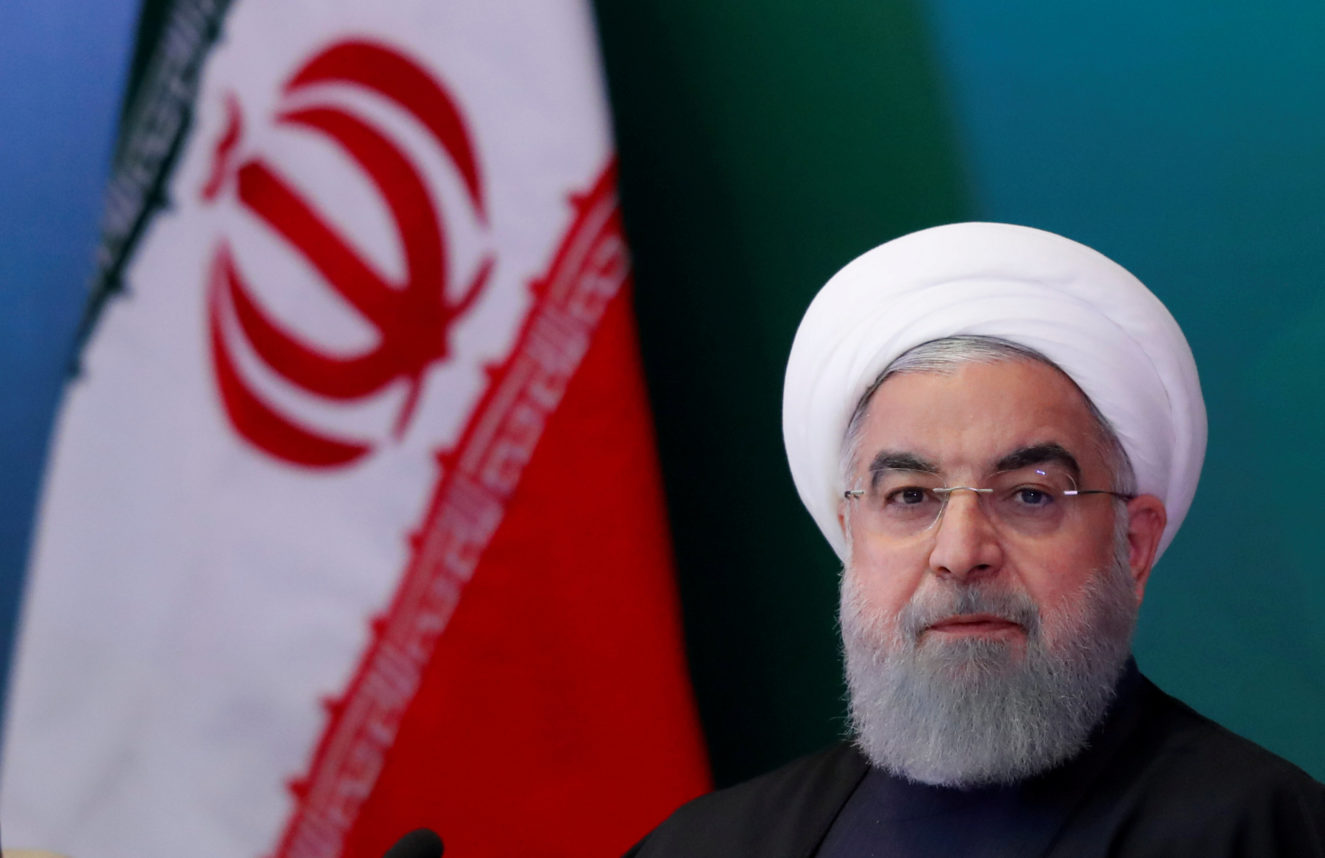
The United Nations announced on March 13 that Iran will get a seat on the U.N. Women’s Rights Committee.

U.N. Watch executive director Hillel Neuer shared the announcement on Twitter:

Neuer also pointed out that Iran adds to a growing number of anti-Israel countries on the committee:

According to Human Rights Watch (HRW), women face myriad restrictions on freedom in Iran, including that they “cannot pass on their nationality to their foreign-born spouses or their children like men.”

“A married woman may not obtain a passport or travel outside the country without the written permission of her husband Under the civil code,” the HRW report adds. “A husband is accorded the right to choose the place of living and can prevent his wife from having certain occupations if he deems them against ‘family values.’”

The report also notes that the Iranian regime has sentenced several women to prison for as long as 20 years because they removed their hijabs during anti-regime protests in December 2017 and January 2018. The regime forces Iranian women to wear hijabs in public.

H/T: Washington Free Beacon

Iran Gets Seat on U.N. Women’s Rights Committee Read More »

What’s Happening: Dance, Deli and Discussion

FRI MARCH 15

YJP Shabbat Dinner
Shabbat dinner with Young Jewish Professionals (YJP) draws career-minded women and men who are committed to Judaism. Network with ambitious 20- and 30-somethings while enjoying a four-course dinner and open bar. Ticket prices increase as the crowd size approaches capacity. 6:30 p.m., bar opens. $60-$90. Online purchases only. Pat’s Restaurant, 9233 Pico Blvd., Los Angeles. (310) 692-4190.

Mensch Awards
Hungarian Holocaust survivor Bill Harvey; renowned musical conductor Zubin Mehta; the late Leon Bass, a black American soldier who encountered the survivors of Buchenwald as a soldier in a segregated unit; and the refugee-aid organization HIAS are honored by the Mensch Foundation. The Temple of the Arts program is dedicated to Hungarian Jewry and the memory of Elie Wiesel, who the Nazis deported from Hungary in 1944. A Hungarian Shabbat dinner is served and Mensch Foundation Founder Steven
Geiger discusses the state of Hungarian Jewry. Rabbi David Baron leads Shabbat services featuring the 40-voice Spirit of David Black Gospel Choir. 6 p.m., dinner. 8 p.m., Shabbat services. $75 donation requested for dinner. RSVP at menschfoundation@yahoo.com. Temple of the Arts at the Saban Theater, 8440 Wilshire Blvd., Beverly Hills.

Batsheva Dance Company

“Venezuela”
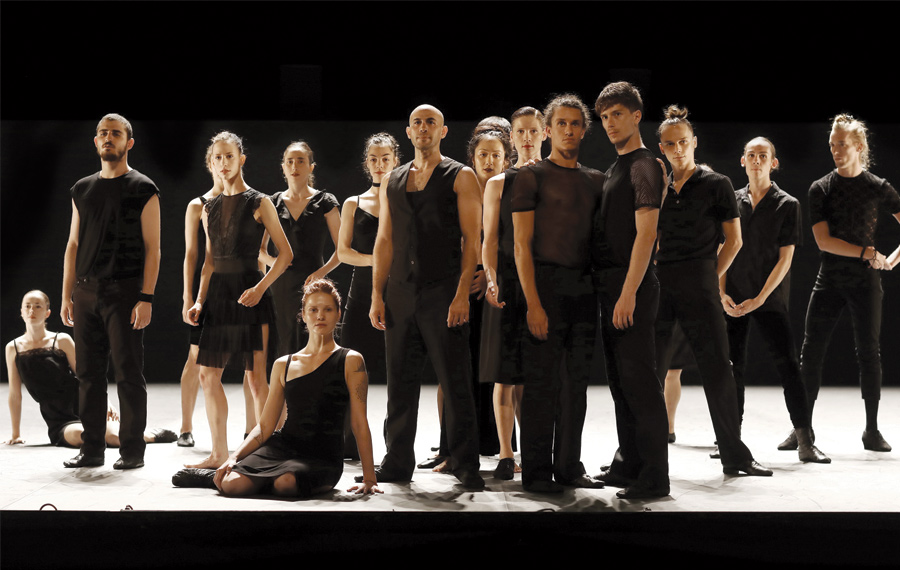
The Tel Aviv-based Batsheva Dance Company returns to UCLA’s Royce Hall to perform “Venezuela,” a new work by Ohad Naharin, the group’s choreographer for 28 years. He created the two 40-minute sections in juxtaposition where dances explore the dialogue and conflict between movement and the content it represents. 8 p.m. March 15, 8 p.m. March 16. $39-$99. UCLA Royce Hall, 10745 Dickson Court, Los Angeles. (310) 825-9646.

SAT MARCH 16

Adam Milstein

Discussing Anti-Semitism
While leaders in Washington debate anti-Semitism, Israeli-American community leader Adam Milstein discusses how anti-Semitism is anti-American during a Shabbat shiur at Valley Beth Shalom. Milstein, a Haifa, Israel, native, is a real estate investor and philanthropist who has been named among the world’s 50 most influential Jews. He is also the co-founder of the Israeli-American Council, which seeks to strengthen the State of Israel and serve as a bridge to the American-Jewish community. Noon-2 p.m. Free. Valley Beth Shalom, 15739 Ventura Blvd., Encino. (818) 788-6000.

SUN MARCH 17

“A Taste of Heaven: The New Jewish Deli”
“The Jewish Deli,” an episode of the PBS food documentary “Migrant Kitchen,” screens at Wilshire Boulevard Temple. The episode highlights Wexler’s Deli, which is putting a spin on traditional deli nosh. A Q-and-A session with Micah Wexler and Micah Kassar, the co-owners of Wexler’s, along with the documentary’s producers, Antonio Diaz and Lara Rabinovitch, follows the screening. Wexler and Kassar explain why they left the field of fine dining to enter the deli world. A Wexler’s Deli spread of its house-smoked, hand-sliced fish, bagels and nosh is served after the screening. 4 p.m. $18. Wilshire Boulevard Temple, Westside Campus, 11661 W. Olympic Blvd., Los Angeles. (213) 388-2401.

MON MAR 18 

“I Shall Not Be Silent”
Born into a Prussian family at the start of the 20th century, Joachim Prinz was one of the early Jewish models for civil rights activism for African-Americans, speaking before Rev. Martin Luther King Jr.’s “I Have a Dream” speech during the 1963 March on Washington, D.C. His life story of resistance is told in the documentary “I Shall Not Be Silent,” which screens tonight at Kehillat Ma’arav. A discussion follows the showing of the film. 7-9:30 p.m. $5, suggested donation. Kehillat Ma’arav, 1715 21st St., Santa Monica. (310) 829-0566.

WED MAR 20

“What Did American Faith Communities Stand For?”
A U.S. Holocaust Memorial Museum panel examines the question “What Did American Faith Communities Stand For?” during the rise of Nazism. Jewish Journal columnist Dan Schnur moderates a discussion featuring Suzanne Brown-Fleming, director of International Academic Programs at the U.S. Holocaust Memorial Museum; Stephen Haynes, a professor of religious studies at Rhodes College; and Jody Myers, a professor of religious studies and director of the Jewish Studies Interdisciplinary Program at Cal State Northridge. A reception follows. 7:30-10 p.m. Free. Registration required. Westwood United Methodist Church, 10497 Wilshire Blvd., Los Angeles. (310) 556-3222.


Have an event coming up? Send your information two weeks prior to the event to ryant@jewishjournal.com for consideration. For groups staging an event that requires an RSVP, please submit details about the event the week before the RSVP deadline.

What’s Happening: Dance, Deli and Discussion Read More »

Rabbi Named ‘Woman of Year,’ Bais Naftoli Farewell

From advocating for her community during the AIDS crisis to fighting for marriage equality; from protecting the environment to promoting Jewish sacred texts, Rabbi Lisa Edwards of Beth Chayim Chadashim (BCC) has long been a pillar of the Los Angeles progressive Jewish community.

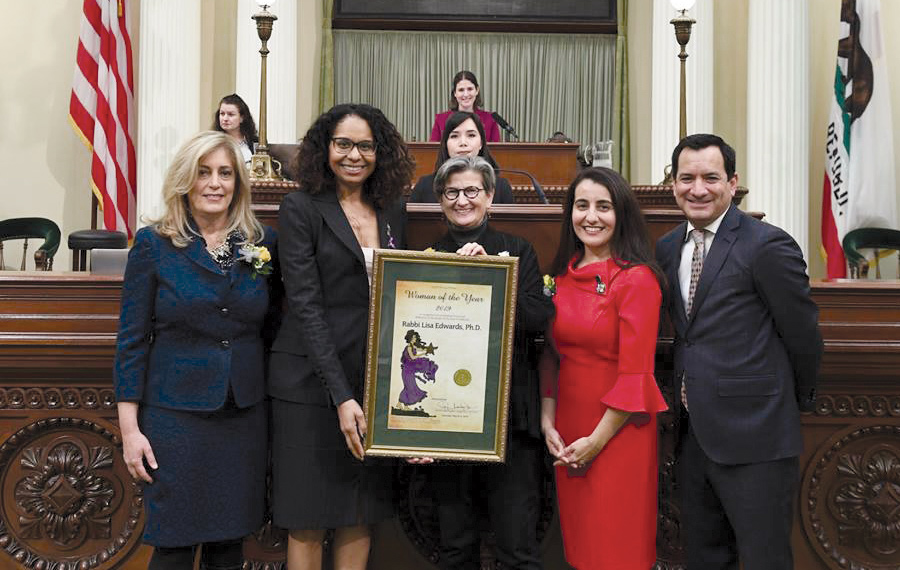
Her contributions to her community have not gone unnoticed. On March 4, Assemblywoman Sydney Kamlager-Dove (District 54) named Edwards a “Woman of the Year” during a formal ceremony on the Assembly floor in Sacramento. 

The “Woman of the Year” award was conceived in 1987 in celebration of March being Women’s History Month. The annual program, sponsored by the California Legislative Women’s Caucus, allows each state senator and assemblymember to invite a woman from their district to the Capitol to be honored for their accomplishments.

Edwards’ synagogue, the nation’s first LGBTQ synagogue, is located in Assembly District 54, which includes parts of the Westside. 

Since 1994, Edwards has served as the spiritual leader of BCC, which translates from Hebrew to “House of New Life.” 

“Rabbi Edwards has been a Jewish lesbian activist from the pulpit, on the page, on the web, in the classroom and in Los Angeles,” a BCC statement said. “She has witnessed — and works to counteract — the damage done to LGBTQ individuals when discrimination is preached by religious authorities and practiced by families and communities of faith.”

Edwards was one of several women from California recognized for their service to their communities.


From left: Gregory Martayan, Cindy Moore, LAPD Chief Michel Moore, L.A. City Councilman Paul Koretz, Chani and Andrew Friedman and LAFD Assistant Chief Jaime Moore attended the farewell Shabbat celebration for Congregation Bais Naftoli, which has operated for nearly 30 years and is being transferred to another synagogue. Photo courtesy of the Office of Councilmember Paul Koretz

Local Jewish and community leaders took part in the March 2 farewell Shabbat celebration of Congregation Bais Naftoli, including Los Angeles City Councilmember Paul Koretz, Los Angeles Police Department Chief Michel Moore, Los Angeles Fire Department Assistant Chief Jaime Moore and L.A. City Controller Ron Galperin.

The synagogue celebrated 27 years of service to the Jewish community.

Andrew Friedman, founding president of the synagogue, said the congregation has provided a free mikveh, daily morning and evening minyanim and daily lessons in English, Hebrew and Yiddish. Through its community outreach program, the congregation has been a strong advocate for Jewish causes with state, local and federal officials.

The shul, at 221 S. La Brea Ave., which was founded by a group of late Holocaust survivors, is being transferred to Congregation Ohr Hachaim, led by Rabbi Shlomo Klein, which also was founded by Holocaust survivors. 

Cantors Benzion Miller, Nati Baron and Yehuda Green led services at the farewell Shabbat. A Kiddush luncheon, sponsored by Friedman and his wife, Chanie, and Ira and Cohava Frankel, followed.


From left: United States Holocaust Memorial Museum National Leadership Award recipients Tony and Linda Rubin and Sylvie and Mark Deutsch with Dinner Co-Chairs Janet and Lenny Rosenblatt. Photo courtesy of tUnited States Holocaust Memorial Museum

The United States Holocaust Memorial Museum (USHMM) honored Sylvie and Mark Deutsch and Linda and Tony Rubin with its National Leadership Award for their contributions to preserving Holocaust history.

The Washington, D.C.-based museum honored the two couples during its 2019 Los Angeles dinner called “What You Do Matters,” which was held on March 6 at the Beverly Hilton Hotel in Beverly Hills.

The museum also presented its highest honor, the Elie Wiesel Award, to all Holocaust survivors for their courage and resilience and for inspiring the global movement for Holocaust remembrance and education. 

“Sylvie and Mark Deutsch and Linda and Tony Rubin are the epitome of generosity with their time to the museum and commitment to Holocaust history. We are pleased to be able to honor them with the museum’s National Leadership Award,” USHMM Regional Director Marla Abraham said in a statement. 

Named for the museum’s founding chairman, the Elie Wiesel Award recognizes prominent individuals and organizations whose actions have advanced the museum’s vision of a world where people confront hatred, prevent genocide and promote human dignity. In a pre-recorded video message, director Steven Spielberg paid tribute to the survivors. 

Nancy Mishkin, Janet and Lenny Rosenblatt and Carol and Jac Stulberg co-chaired the evening, which raised more than $1 million for the USHMM $1 billion campaign, “Never Again: What You Do Matters,” which enables the museum to invest in keeping Holocaust memory alive. 

More than 1,000 attendees turned out, including USHMM Director Sara Bloomfield; evening host and actress Lisa Edelstein; actor Mark Feuerstein; L.A. City Controller Ron Galperin; Remember Us: The Holocaust Bnai Mitzvah Project Director Samara Hutman and Scott Jacobs of JooTube.TV.

Bloomfield conducted a Q-and-A with Wendy Lower, the John K. Roth professor of history at Claremont McKenna College and author of “Hitler’s Furies: German Women in the Nazi Killing Fields.”

Edelstein discussed the importance of combating anti-Semitism today.

A living memorial to the Holocaust, the USHMM inspires citizens and leaders worldwide to confront hatred, prevent genocide and promote human dignity, according to a USHMM website. Since opening in 1991, the museum has to date welcomed 43 million visitors.


From left: Israeli model Esti Ginzburg hosted the inaugural Friends of United Hatzalah of Israel gala, which honored comedian Jay Leno (center) and drew Jon Voight (far right), among others. Photo by Mor Gaby

Friends of United Hatzalah of Israel held its inaugural Los Angeles gala on Feb. 28 at the Beverly Hilton, raising $5 million. United Hatzalah of Israel is an all-volunteer organization that provides 24-hour lifesaving emergency medical services to Israeli residents.

More than 1,000 people attended, including elected officials and community leaders.

Comedian Jay Leno, former host of “The Tonight Show,” accepted the Humanitarian Award for his work with United Hatzalah. Leno said he loves supporting Hatzalah because the organization is not political and saves lives regardless of a person’s religion, color, race or beliefs.

Israeli model Esti Ginzburg hosted the gala, which drew actor Jon Voight and “Fauda” star Rona Lee Shimon, among others.

Israeli singer Dudu Aharon entertained the crowd.

To improve services provided by the 5,000 volunteers of United Hatzalah, the event raised 100 “ambucycles,” or medically equipped motorcycles, thanks to a “match” donation from philanthropist Stewart Rahr. United Hatzalah Chairman Mark Gerson matched a donation of 100 defibrillators. Audience members underwrote 50 more “Day of Lifesaving” gifts, a program introduced by Board Member Amy Korenvaes. 

“The community in L.A. really came out to show their support for the lifesaving work that we do in Israel,” United Hatzalah of Israel President Eli Beer, who founded the nonprofit in 2006, said. “Raising $5 million at a first event is unlike anything I’ve ever seen.”

Citing United Hatzalah’s uniqueness, Ami Pomeranc, international gala chairperson of United Hatzalah, said he was honored to travel the world “and see so many new people come together from different paths to save lives in Israel.” 

United Hatzalah’s diverse volunteer roster in Israel includes 300 Muslims, Christians and Druze.

The gala was co-chaired by Dina Kadisha Aspen. Eitan Weiss, deputy chief of mission at the Consulate General of Israel in Los Angeles, participated in the evening.

— Ari L. Noonan, Contributing Writer


Want to be in Movers & Shakers? Send us your highlights, events, honors and simchas. Email ryant@jewishjournal.com.

Rabbi Named ‘Woman of Year,’ Bais Naftoli Farewell Read More »

Obituaries: March 15, 2019

Faye Amass died Feb. 9 at 85. Survived by daughters Stacey, Leslie; 1 grandchild. Hillside

Bernard Austin died Feb. 12 at 96. Survived by sister Lena Golenzer. Mount Sinai   

Todd Bird died Feb. 7 at 47. Survived by mother Nancy Robbins; sisters Cass, Robbin Reingold, Mindy Saichik. Mount Sinai

Joseph Codron died Feb. 9 at 84. Survived by son Art (Ann); 4 grandchildren; daughter-in-law Sherrie; brother Steve. Mount Sinai

Frances Flumenbaum died Feb. 9 at 95. Survived by son Bill (Patricia); 2 grandchildren. Mount Sinai

Harriet Frailich died Feb. 9 at 89. Survived by daughters Shari (Paul) Cohen, Linda (Jeff) Nerenberg; 5 grandchildren; 3 great-grandchildren; sister Roberta Sigel. Mount Sinai   

Robert Gemider died Jan. 27 at 83. Survived by daughters Mindy, Ellen; son Shia. Mount Sinai   

Michael Gerber died Feb. 8 at 61. Survived by wife Gail; daughter Jenica (Jason) Visenberg; son Adam (Abby Lane); 1 grandchild; sister Sharon Dellimagine; brother Howard. Mount Sinai

Gerald Granof died Feb. 20 at 92. Survived by wife Leah; daughters Victoria, Elisa, Judith (Larry), Deborah (Steven); sister Elaine; 7 grandchildren. Hillside

John Gruber died Jan. 25 at 76. Survived by wife Drina Fried; daughter Daniella Orihuela Gruber; sister Phyllis (Don Farkas) Kupferstein; brother Ron (Merri) Kupferstein. Mount Sinai

David Habif died Feb. 11 at 89. Survived by wife Linda; daughter Stephanie Sordini; stepsons Scott (Katie) Meyers, Jason Myers; 2 grandchildren; 4 stepgrandchildren. Mount Sinai   

Shirley Kahn died Feb. 20 at 93. Survived by niece Tanya; nephew Jason. Hillside

Stanley Kassap died Feb. 19 at 79. Survived by wife Suzanne; sons Scott, Todd; 1 grandchild; brother Marty. Hillside 

Michael Keston died Feb. 9 at 79. Survived by wife Linda; sons Daniel (Amanda), James (Lisa); 4 grandchildren; brother Stanley. Hillside

Cipora Kronen died Feb. 17 at 87. Survived by daughters Jordana, Leeora, Eva “Chava”; 3 grandchildren. Hillside 

Valerie Kronsburg died Jan. 26 at 49. Survived by husband Michael; son Noah; mother Marie Abijmil; father Raphael Abijmil; sisters Oryle (Mark) Stephansen, Joelle (Jay) Perlmutter, Sandra (Mark) Gamson; brother Simon (Laurence) Abijmil.  Mount Sinai 

Ester Leitman died Feb. 16 at 82. Survived by daughters Lena, Andrea; son Max (Jillian); 5 grandchildren; sister Ethyl. Hillside

Rene Levary died Jan. 22 at 74. Survived by daughter Amanda (Andrew) Miller; son Stefan Miller; 2 grandchildren; 2 sisters; 2 brothers. Mount Sinai 

Evelyn Lipka died Feb. 8 at 101. Survived by daughter Beverly (Stanley) Malamed; 7 grandchildren; 11 great-grandchildren. Mount Sinai   

June Rohrlick Miller died Feb. 11 at 94. Survived by daughters Karen (Dave) Lewis, Pam (Poochie) Bennish; son Richard (Bobbi) Rohrlick; 18 grandchildren; 15 great-grandchildren; 2 great-great-grandchildren. Hillside

Michael Orlikoff died Jan. 25 at 79. Survived by daughters Dana (Nelson) McCormick, Kimberly Salevin; 5 grandchildren. Mount Sinai   

Ruth Pollack Scott died Feb. 14 at 95.  Survived by daughters Carol, J.C. (Robert) Scott Klane; son Michael; 4 grandchildren. Mount Sinai  

Rhonda Purwin died Feb. 3 at 64. Survived by sister Janice Decker; brother Perry.

Robert Ross died Jan. 28 at 77. Survived by wife Joan; daughter Rochelle; sons Noah Franklyn, Randy; brother Oliver. Mount Sinai

Barbara Sacks died Feb. 7 at 90. Survived by sons Howard (Lee), Marc (Judith); 3 grandchildren; sister Myrna. Hillside

Don Shulman died Feb. 13 at 85. Survived by wife Tamar; daughter Debbie (Steve) Luce; son David; 4 grandchildren; brother Adley (Corinne). Mount Sinai   

Sidney Sturza died Jan. 29 at 94. Survived by wife Rhea; daughter Patricia (Kenneth) Boyd; son Mark (Rose). Mount Sinai

Doris E. Tabachnick died Feb. 9 at 91. Survived by sons Chuck (Judy), Robert; 5 grandchildren. Mount Sinai   

Michael Tabakov died Jan. 26 at 80. Survived by wife Celia Kach; son Alex; brother Alexander Bonder. Mount Sinai 

Harriet Trost died Feb. 5 at 83. Survived by husband David; daughters Michelle Dauphine, Renee Guenthner, Sheri (Bill) Hewes; son Lee (Stephanie); 13 grandchildren; 7 great-grandchildren. Mount Sinai

Samuel D. Wacht died Feb. 8 at 88. Survived by wife Jo Ann; daughters Julie (Jeff) Conway, Lisa (Rob) Szilagyi, Dori (Ed) Crofts; 8 grandchildren; 3 great-grandchildren; brother Richard (Kathy). Mount Sinai   

Katz Ramona Wasserman-Resnikoff died Jan. 25. Survived by mother Lizz; father Isaac; brother Eli; grandparents Louis (Caren Connolly) Wasserman; grandmother Denise Resnikoff. Mount Sinai 

Adam Marques Wohlstattar died Feb. 6 at 42. Survived by wife Brinden; son Greyson; mother Shari; sister Laurie (Cathy) Gelardi; father-in-law Don (Penny) Asher; sister-in-law Kerin (Scott) Asher. Mount Sinai   

Margot Wynn died Jan. 24 at 83. Survived by stepdaughters Samantha (Steve Leon) Anobile, Linda “Lindy” (James) Walsh; stepson Steve (Linda); 3 grandchildren; 4 great grandchildren. Mount Sinai

Obituaries: March 15, 2019 Read More »

Sidney Sheinberg, 84, Discovered Spielberg

As president of Universal/MCA, Sidney Sheinberg left his mark on American culture: green-lighting hit movies such as “Back to the Future,” “ET: The Extraterrestrial” and “Out of Africa,” producing long-running TV shows, including “Marcus Welby, M.D.,” “Kojak” and “Columbo” and opening movie-based theme parks around the world. But probably nothing Sheinberg, who died March 7 at the age of 84, did had as much impact as a single decision: discovering Steven Spielberg, and in 1974, tapping him to direct  “Jaws,” released the following year. 

He stuck with that choice throughout the troubled production, even as the movie’s budget ballooned. His faith was rewarded as “Jaws” went on to be a record-setting hit, grossing nearly $500 million. It also changed the way movies were marketed and distributed, becoming the template for the wide-release, tent-pole blockbuster releases of today. Perhaps even more profoundly, in 1982 he gave Spielberg a copy of Thomas Keneally’s “Schindler’s List.” More than a decade later, Spielberg adapted the book into the movie many consider his masterpiece; it won seven Oscars, including best picture and Spielberg’s first best director award. 

Sidney Jay Sheinberg was born on Jan. 14, 1935, in Corpus Christi, Texas. His parents, Harry and Tillie, emigrated from Poland and the Ukraine, respectively, and owned a general store. He graduated from  Columbia University and Columbia Law School. He married actress Lorraine Gary in 1956; the marriage lasted more than 60 years. She survives him, as do their two sons, Bill and Jon. 

In 1958, Sheinberg moved his family to Southern California. After a year teaching at UCLA, he started work at Revue, the television production arm of MCA, the talent agency that became Universal. Sheinberg’s drive and success brought him to the attention of Lew Wasserman, MCA’s powerful chairman, who named him head of television production in 1970. In 1973, Sheinberg was elected president and chief operating officer of Universal/ MCA.  

He was the tallest most stand-up guy I ever knew. … We were a team for 25 years and he was my dear friend for 50. … For the rest of my life, I will owe him more than I can express.”
— Steven Spielberg

Wasserman and Sheinberg expanded the reach of Universal. Under their watch, the studio moved into publishing and music, theme parks and developed the 420-acre tract known as Universal City, while producing a steady stream of movies hits (“American Graffiti,” “The Sting,” the “Jurassic Park” series) and TV (“McMillan & Wife,” “Miami Vice,” “Murder, She Wrote”). They were so successful that in 1990, they sold the company to Japan’s Matsushita Electric Industrial for $6.6 billion.

The relationship between Sheinberg and Wasserman and the new owners was rocky, and both left Universal in 1995, after Matsushita’s sale of the company to Seagrams. He started his own production company, The Bubble Factory, with his sons but had trouble duplicating his earlier success. 

A gruff but loyal man, Sheinberg also was active in the community. He served on the national board of the National Conference of Christians and Jews, the board of the American Jewish Committee, the board of Research to Prevent Blindness and the board of trustees of the Simon Wiesenthal Center. The Wiesenthal Center honored Sheinberg and his wife with its 1995 Humanitarian Award. He was the vice chairman of Human Rights Watch and the co-founder of the Children’s Action Network. 

Responding to Sheinberg’s death, Spielberg released a statement saying “(M)y heart is broken at this news. … He was the tallest most stand-up guy I ever knew. He gave birth to my career and made Universal my home. … We were a team for 25 years and he was my dear friend for 50. … For the rest of my life I will owe him more than I can express.”

Sidney Sheinberg, 84, Discovered Spielberg Read More »

Claremont Student Paper Banned from Attending Pitzer Israel Vote

An independent Claremont Colleges Consortium student newspaper has been banned from attending the March 14 Pitzer College Council Israel vote.

The Claremont Independent reported that Pitzer’s Media Office initially told the paper on March 13 that they could cover the March 14 Pitzer College Council vote on Pitzer’s study abroad program at the University Haifa in person; however, later in the day, the office told them that the paper was actually not allowed to attend the vote.

“[T]he Faculty Executive Committee (FEC) of [Pitzer] College has announced that it will restrict attendance at the March 14 College Council session to students, faculty, staff and student members of The Student Life (TSL) staff,” Pitzer spokesman Mark Bailey told the Independent in an email, adding that “no external media” was allowed to attend the vote.

The Independent notes that TSL “is funded by the student governments of the Claremont Colleges,” whereas the Independent is not. The Independent is registered as a student club.

Alec Sweet, editor-in-chief of the Independent, told the Journal in a statement via email, “I am appalled that Pitzer College is not allowing us to attend this event and is actively attempting to discourage us from reporting on it. I can wholeheartedly say that they won’t stop us. Not only is Pitzer voting on a measure that by any measure will restrict academic freedom, but they are also now trying to restrict the freedom of student press which has been critical toward the measure. I find it notable that the student run publication allowed to attend and report is funded from the Claremont Colleges student governments, one of which is the very same Pitzer student government which voted against a measure to condemn the initial faculty vote and whose members will be voting on the measure at the College Council.”

Sweet continued, “The issue at play here is extremely contentious; allowing only one viewpoint to cover the story is a significant blow to student press freedom on campus. This is a very important vote, both on campus and for the broader state of academic freedom especially as it relates toward the academic boycott against Israel. Attempting to suppress any student publication is wrong, but specifically targeting the campus publication which has been vocal in defending the Haifa study abroad program is reprehensible.”

Bailey forwarded the Journal a statement from FEC chair Claudia Strauss saying that the FEC wanted only “Pitzer faculty, staff, and current students, and that reporters be limited to the official 5C paper, TSL” due to “limited seating.”

The Independent criticized the efforts by Pitzer faculty to eliminate the college’s Israel study abroad program in a March 12 editorial as “a grave disservice to Pitzer students who will have to learn how to interact closely with those with opposing views on the Israel-Palestine conflict, especially those who wish to engage with political or diplomatic careers.”

“A boycott reduces a complex scenario to what would be remembered by students as a simple dichotomy of good and bad by denying students the ability to see the conflict first-hand and make judgements on their own,” the editorial argued. “In such a complex situation, it is childish to assume demonizing Israel and shifting total support to Palestine would do anything to resolve the situation; to expect the Jewish people—after thousands of years of persecution—to abandon their homeland is ludicrous.”

The Pitzer College Council also restricted the number of student senators allowed to vote on March 14.

This article has been updated.

Claremont Student Paper Banned from Attending Pitzer Israel Vote Read More »

Forgotten ‘Spies’ Finally Get Their Due

Israel is much admired, even among its enemies, for the valor and acuity of its storied secret service, Mossad. Before there was a Mossad, however, and even before there was a State of Israel, a few brave young men and women were already at work in conditions of the greatest danger to serve a Jewish state that was still in the making.

Among them were three young men who were all named Cohen but who were not related to one another — Gamliel, Yakuba and Havakuk — and a fourth man named Isaac Shoshan, whom author Matti Friedman befriended when Isaac was already a nonagenarian. Their exploits in advance of the War of Independence in 1948 are presented with the urgent episodic pacing of a spy novel in Friedman’s “Spies of No Country: Secret Lives at the Birth of Israel” (Algonquin Books of Chapel Hill). But the book is a work of history and biography, the untold tale of a unit of the Haganah known variously as “the Black Section,” “the Dawn Section,” “the Arab Section” or, more bluntly, “the Ones Who Become Like Arabs.” 

Indeed, the four young men were all Arab-speakers, only one of whom was born in what was soon to be Israel. Friedman likens them to contemporary Israelis whose families also came from Yemen, Syria and other Middle Eastern corners of the Diaspora: “These were Israelis, but not the kibbutz pioneers of the old Zionist imagination,” Friedman explains. “These were people from the Islamic world, in the Islamic world, their lives entwined with the fate of Islam.” Their command of the Arabic language and their ability to disguise themselves as native speakers were weapons of war. “If Arab spies were needed, the Jews wouldn’t pay them — they would be them,” Friedman writes.

The author, a veteran Associated Press foreign correspondent who has reported from Israel, Lebanon, Morocco and Moscow, among other places, was born in Toronto and now lives in Jerusalem. His first book, “The Aleppo Codex,” won the 2014 Sami Rohr Prize and the American Library Association’s Sophie Brody Medal. His 2016 book, “Pumpkinflowers,” was chosen as a notable book by The New York Times and other publications. “Spies of No Country” already has been honored with the Natan Book Award.

As it happens, we learn more about what a real-life espionage agent actually does in “Spies of No Country” than in any mere thriller. To be sure, the members of the Arab Section trained in the use of firearms and explosives, and “when they could round up a few bullets, they held target practice.” But they also “slipped in and out of Arab towns, practiced dialect, saw what fooled people and what didn’t.” Their tradecraft sometimes consisted only of “sitting at a cheap café or smoking on the steps of the post office, looking around, asking a question of a passerby as casually as possible.”

Now and then, we are able to witness the daring and dangerous missions that we hope to find in a book about espionage. When Jewish agents discovered an Arab plan to detonate a car bomb in a Jewish neighborhood, for example, the members of the Arab Section went to work on a car bomb of their own, placing it in a stolen car, parking it next to the Arab car, and then blowing up both vehicles in a pre-emptive strike. The bomb was assembled in a classroom at Technion, the scientific university in Haifa, and the detonator was fashioned out of a condom, an ampul of sulfuric acid, and quantities of sugar and potash. An Oldsmobile was stolen for use as a getaway car, and Isaac was assigned to be the driver even though he had never driven a car before. “This wasn’t allowed to slow things down,” Friedman reports. “Yakuba taught him to drive the Oldsmobile in the streets around [Technion], gears on the first day, steering on the second.” On the day of the operation, Isaac left the car in first gear all the way to the target because he had not yet mastered the manual transmission.

“Their mission didn’t culminate in a dramatic explosion that averted disaster, or in the solution of a devious puzzle. Their importance to history lies instead in what they turned out to be — the embryo of one of the world’s most formidable intelligence services.” — Matti Friedman

At least one of the secret missions revealed in “Spies of No Country” is so exotic that it sounds like something out of the imagination of Ian Fleming. The armored yacht that had been built for Hitler during World War II ended up at anchor in the harbor of Beirut. To deny use of the vessel by Arab forces, the Arab Section was assigned the task of detonating a bomb under its hull. “Evidence of Nazi fingerprints on the Arab side always drew special attention from the Jewish intelligence services,” writes Friedman. “If later on [the attack] was remembered by the Arab Section as ‘the jewel of our operations beyond the border,’” as Friedman reports, “the appraisal was less about the results than about seeing whether the Jews could pull

 off something like this at all.”

Friedman refuses to hype the heroes of his own book. “Their mission didn’t culminate in a dramatic explosion that averted disaster, or in the solution of a devious puzzle,” he writes. “Their importance to history lies instead in what they turned out to be — the embryo of one of the world’s most formidable intelligence services.” In fact, the author reveals a conversation between Havakuk and Isaac when they wondered aloud what would happen to them “if the Arabs really do capture Haifa, Tel Aviv and Jerusalem.” Havakuk jokingly told Isaac that “he wasn’t concerned, because he had a contingency plan for Jewish defeat: ‘We can always go back to Palestine as Arabs.’ ”

At the same time, Friedman’s book is animated by his conviction that respect must be paid to these overlooked heroes. “People trying to forge a Jewish state in the Middle East should have seen that Jews from the Middle East could be helpful,” he argues. “The newcomers might have been invited to serve as equal partners in the creation of this new society, but they weren’t. Instead they were condescended to, and pushed to the fringes; it was one of the state’s worst errors, one for which we are still paying.” Thus does Friedman rectify a moral and historical wrong when he calls our attention to the four young men whom we come to know so well and admire so much in the pages of “Spies of No Country.”


Jonathan Kirsch, attorney and author, is the book editor of the Jewish Journal.

Forgotten ‘Spies’ Finally Get Their Due Read More »