fbpx

February 27, 2019

Elderly Jewish Man Assaulted in London

A 69-year-old Jewish man was assaulted on the afternoon Feb. 26 in the London Borough of Islington, according to the Islington Gazette.

The man, who has not been publicly identified, was reportedly standing at the Highbury Corner roundabout when the assailant asked him if he was Jewish. The assailant then repeatedly punched him.

Eyewitness Marian Kennedy told the Gazette, “The old man wasn’t aggressive. He was just taking the blows. He kept going: ‘Please stop.’ Blood was pouring from the old man’s mouth and his body must have taken a lot of blows. The attacker ran off very fast. He was manic.”

The victim’s injuries are not believed to be life-threatening.

A 44-year-old man, who has not been publicly identified, was arrested on Feb. 27 in connection with the attack.

Anti-Defamation League CEO Jonathan Greenblatt tweeted, “#AntiSemitism overseas continues to rise & we cannot allow this to go on. We stand with the UK Jewish community & everyone fighting against this #hate.”

An organization called Stand Up to Racism is holding an anti-racist vigil and protest in London’s Highbury district on the evening of Feb. 27 in response to the attack.

Elderly Jewish Man Assaulted in London Read More »

Newsom’s Push Puts School Choice at Risk

California Gov. Gavin Newsom had a busy February. He sued the Trump administration over the president’s decision to declare a national emergency at the U.S.-Mexico border; he announced dramatic cutbacks to former Gov. Jerry Brown’s two biggest infrastructure projects — a high-speed rail line and proposed changes to the state’s water distribution system; and he promised broad overhauls of state housing, health care and immigration policies.

But Newsom has been much quieter about what could be his most significant upheaval — a fundamental shift in the state’s approach to public education. For more than a quarter century, California has been a national leader in the development and growth of charter schools — public schools that are given more autonomy and flexibility to attempt more innovative approaches to educating their students. That may be about to end.

The original 1992 legislation sponsored by Democratic state Sen. Gary Hart of Santa Barbara authorized the creation of 100 charter schools in the state.  Today, more than 1,300 charters educate 630,000 students, roughly one-tenth of California’s total public school population. 

Charter schools make up some of the state’s best and worst public schools. The original plan was for the most successful charters to be copied and for the worst to be closed. But over the years, two equally committed and equally well-financed groups of public school advocates — union-backed traditionalists on one side and a coalition of wealthy reformers and low-income minority communities on the other — have become embroiled in a scorched-earth battle.

The two sides have traded body blows, but nowhere more fiercely than in the Los Angeles Unified School District (LAUSD). Traditionalists and reformers have spent tens of millions of dollars on political campaigns to get their candidates elected to the LAUSD Board of Education, which controls the nation’s second-largest school district. Nearly 20 percent of LAUSD’s students, about 112,000, are enrolled in its 225 charters.

The competition for students is especially intense, mainly because each student represents a large amount of state funding. In an ultra-expensive housing market that makes housing increasingly unaffordable for families with children, the budgetary strain on LAUSD has become so intense that its teachers went on strike in January for the first time in decades. Some of their demands called for higher salaries and more support staff, but the most difficult part of the negotiations centered around charter schools.

When the strike was settled, the school board had agreed to a resolution asking Newsom to impose a moratorium on new charters in the district. A few days later, Newsom asked State Superintendent of Public Instruction Tony Thurmond to convene a panel that would examine the financial impact of charter schools. Thurmond already has called for a statewide moratorium on charter school expansion, so he likely will follow through on such a plan in the next few months.

In the past few weeks, Newsom began pushing for legislation that would increase transparency and oversight for charter schools. While such a law would create administrative headaches for smaller charters, it would provide an appropriate level of increased oversight to which all public schools should accede.

Holding charter schools accountable is one thing, but banning them is another. And that may be where California is headed.

Alex Caputo-Pearl, head of the teachers union, United Teachers Los Angeles, applauded Newsom’s action, arguing that “public school districts across the state, including Los Angeles Unified, are being financially strangled by the unmitigated growth of charter schools….”

Charter schools are not going to disappear tomorrow, but rhetoric like this from a strong Newsom ally suggests some very rough waters ahead for school-choice advocates.

Ironically, charter schools originally were intended as a compromise between public schools and private-school vouchers. Now, the options available to California parents within the public school system are likely to narrow considerably.


Dan Schnur is a professor at USC’s Annenberg School of Communication and Journalism, UC Berkeley’s Institute of Governmental Studies and Pepperdine University. He is the founder of the USC-L.A. Times statewide political survey and a board member of the Los Angeles Museum of the Holocaust.

Newsom’s Push Puts School Choice at Risk Read More »

Ancient Wisdom and Modern Medicine

Huddled over the hospital bed, the high-school students worked at placing a breathing tube down the throat of an elderly “patient” whose vital signs were crashing. The choices were stark and unfolding in real time: How would they revive this dying patient? Was there an ethical obligation to resuscitate someone on the brink of death without knowing the individual’s wishes?

It’s one thing to have this discussion in the abstract. It’s a far more complex experience when the crisis is literally playing out in your hands. And that is the point of the class I developed at Cedars-Sinai Medical Center for high-school students to wrestle with practical Jewish medical ethics.

Every week, students from YULA Girls, YULA Boys and Shalhevet high schools meet in the Women’s Guild Simulation Center for Advanced Clinical Skills. There, they work in simulated operating rooms on lifelike mannequins with the capability to “breathe” and “bleed.” 

Informed by ancient Jewish wisdom and contemporary science, I guide the students as they grapple with the ethical ramifications of organ donation, artificial nutrition, when — or if — to resuscitate dying patients, and more. Through this process of discovery and discussion, the students begin to develop a great appreciation for the nuances involved in decisions of life and death.

I often start the semester with the hypothetical case of the elderly patient who is rushed to the emergency room in critical condition after collapsing at home. The students must decide whether to place the patient on a respirator to keep her alive or to withhold this intervention, allowing death. Keeping the patient on the respirator, they learn, might prolong a life of agony and pain.

What should they do? I ask. What do they think Judaism requires them to do?

To explore these questions, we turn to the Shulchan Aruch, the code of Jewish law developed in the 16th century and the story of the woodchopper working outside the room of a dying individual. The story relates that the chop-chop-chop rhythm of the work prevents the dying person’s soul from leaving. Is it permissible, then, for the woodchopper to cease his work and thus risk ending the dying person’s life? The Shulchan Aruch rules that the woodchopper may stop, explaining that doing so indirectly allows — but does not cause — the soul to leave. 

Not surprisingly, the story provokes questions. “Does this rationale apply to contemporary technology, which has the ability to directly save or end life”? one student asks. “If we have a way to save a life, why wouldn’t we?” a second asks. A third worries about acting rashly: “Shouldn’t we step back and see if there is a compromise approach?” 

“It’s one thing to have this discussion in the abstract. It’s a far more complex experience when the crisis is literally playing out in your hands.”

My students have a real thirst for this type of discussion. They want to know how our tradition wrestles with the choices we confront every day, including, for example, the risks involved with organ donation.

For this subject, I introduce the responsa of Rabbi David ben Zimra, the Radbaz, a 16th-century Jewish scholar in Spain. The Radbaz tells of a thief who is caught stealing and faces the punishment of having his hand cut off. When the thief escapes, the authorities threaten to kill an innocent Jew if he fails to return to face justice. 

Is the thief required to come back and risk his life to save that of an innocent person? 

We apply this story to questions around organ donation. Here again, the students are divided in their opinions of how much risk any individual should be required to assume to help another. They ask: If saving one life means sacrificing another, what are the obligations involved? What if the cost involves sacrificing not a life but an organ and a lifetime of normal bodily functions?

It often takes time for students to realize that there are no simple answers to complex ethical questions, whether religious or medical. Still, they learn to appreciate the direct line between classical Jewish teachings and contemporary medical conundrums. 

With that understanding, my students develop an ability to engage with texts and argue their positions with authority and passion, the same way their ancestors have done for centuries. In the process, they learn that they can make informed decisions about some of the most complex and difficult issues they may ever face.


Rabbi Jason Weiner is senior rabbi and director of the Spiritual Care Department at Cedars-Sinai Medical Center. 

Ancient Wisdom and Modern Medicine Read More »

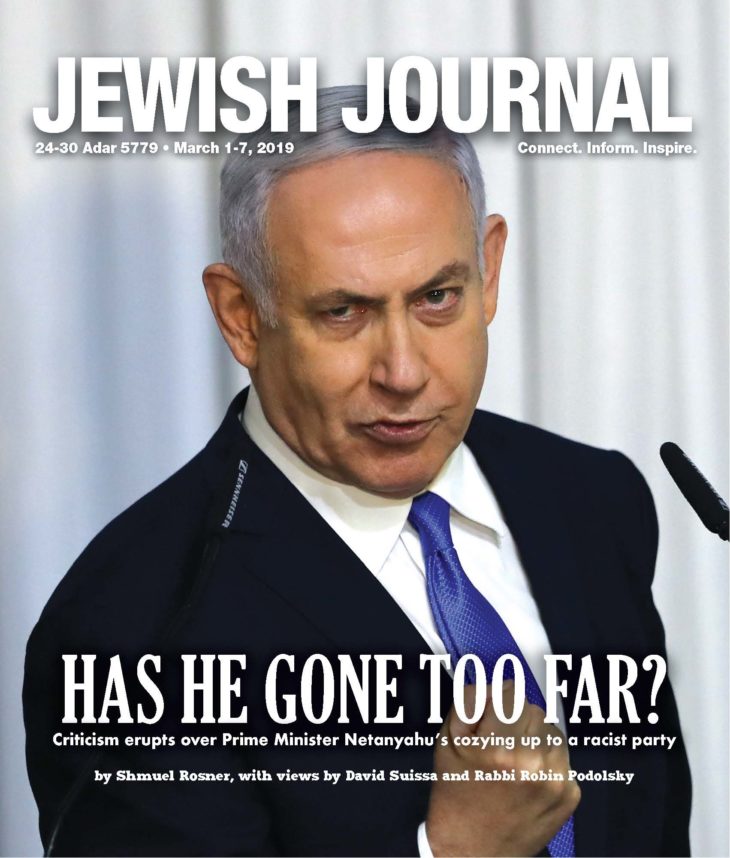
Bibi’s Disgraceful Act Tarnishes All Jews

I have a tip for Israeli prime ministers: When not even the American Israel Public Affairs Committee (AIPAC) and the American Jewish Committee (AJC) can stomach your shtus, you have gone well off the rails.

Prime Minister Benjamin Netanyahu, facing the possibility of political loss, has gambled — much like President Donald Trump — on currying the favor of the worst of his compatriots to help pull him through to victory. Netanyahu orchestrated the merger of a coalition partner, the pro-settlement Jewish Home party, with Otzma Yehudit, the racist, annexationist party of the Kahanist movement.

Netanyahu’s move to legitimize Otzma Yehudit was too much for AIPAC and the AJC, who tweeted their objections to the potential presence of what they called a “racist” and “reprehensible” party in the next Israeli government. This is an extraordinary development. Netanyahu has managed what J Street and other pro-peace groups could not do. He has extracted from AIPAC an unequivocal denunciation of an Israeli leader’s policies with regard to internal Israeli affairs and the government’s relationship with the Palestinian people.

Otzma Yehudit was formed in 2012 but has never won enough votes for a seat in the Knesset.  The party has been called Kahanist, due to its members’ adherence to the ideology of the late U.S.-born Rabbi Meir Kahane, who founded the Jewish Defense League in the U.S. in 1971 and served in the Israeli Knesset before being banned in 1988 on the grounds that he was a “racist” and “undemocratic.” Kahane was linked to violent attacks on Israeli Arabs and Palestinians before he was assassinated in a Manhattan hotel in 1990.

Otzma Yehudit leader Itamir Ben Gvir displays in his home a picture of Baruch Goldstein, the perpetrator of a mass murder of Palestinians at prayer in 1994; and his party advocates ethnic cleansing of Palestinians from Israel, which they consider to encompass not only the occupied territories of the West Bank but also the entire biblical territory from the Euphrates River (in Iraq and Syria) to the Mediterranean Sea. Their platform also calls for the denial of reproductive rights to women and, interestingly, “Jewish capitalism.”

By bringing a party that celebrates murder and ethnic cleansing into the political mainstream, Netanyahu has committed a disgrace. The state of Israel is linked with the Jewish people, so we have all been tarnished. Mishnah Sanhedrin 4:5 teaches a crucial meaning to be found in the story of God’s creation of the first human in the Divine image: “For peace among the created ones [human beings] so that a person will never say to their companion, “My father is greater than your father.” In other words, racism is not a Jewish value.

Surely, this development will finally exhaust the idea that American Jews may not criticize Israel for fear of accusations of internalized anti-Semitism. We don’t criticize President Trump because we hate the U.S. but because we love our country and object to its degradation. Why shouldn’t the same view apply to Israel? At this point, we have no choice, because failure to object to current events is to collude in an insult to the entire Jewish people.

Finally, it is long past time for American Jews to quit conflating their Jewish identity with the State of Israel and parking it overseas. Judaism is not an “identity,” it is a way of life that each of us needs to embody in ourselves, in community and in relationship with other Jews, HaShem and with all of creation. Perhaps this shanda, this outrage, will provoke a sense of insult in American Jews whose relationship with Judaism has been on the casual side. Perhaps this will impel more of us to find out more about this heritage that we have been assuming will take care of itself, to learn about our ethic of mutual interhuman obligation and take up our part in it.


Rabbi Robin Podolsky teaches at Cal State Long Beach, writes for Shondaland and blogs .

Bibi’s Disgraceful Act Tarnishes All Jews Read More »

Serious Semite: Brexit Blues

Britain is scheduled to leave the European Union (EU) on March 29 and could enter its worst period of economic turmoil in decades. As an English Jew, I’m very concerned. The Conservative government might be forced into a general election if Brexit plans fail; the opposition Labour Party, led by Jeremy Corbyn, could win power; and Britain could have its first prime minister who is regularly and openly accused of anti-Semitism. Seven members of Parliament (MP) made the bold move of leaving the parliamentary Labour Party, and one of those departing, Jewish MP Luciana Berger, said Labour has become “institutionally anti-Semitic.”

On March 29, Article 50 will be activated, allowing a member state to leave the EU. There will be severe implications if Britain fails to strike a deal and faces the “no -deal Brexit.” British voters, who approved the referendum to withdraw from the EU in June 2016, might have created the worst constitutional crisis in the U.K. for centuries.

Divorces are rarely easy. The EU has offered what it sees as the best terms, but some think that Europe is like a jilted lover, saying “Fine! You are leaving me. No, I won’t discuss who keeps the puppy, the vintage art we bought on vacation, or the Vitamix. Go on now, go! Walk out the door!”

Except we’re not discussing puppies, but borders, trade deals and workers.
What happens to the estimated 300,000 French people living in the U.K., or 153,000 Brits in France? How will Germany sell BMWs in Britain, or French winemakers get bottles to English markets? Today, I can get on a train from London to Paris on a visa-free U.K. passport, but what about tomorrow?

A no-deal Brexit would spark confusion. There would need to be some kind of customs border between Northern Ireland and the Republic of Ireland, after 100 years of peace processes that removed walls between the two countries. Yet Northern Ireland is part of Great Britain, and the Republic of Ireland is part of the EU, so if there is no border, then the EU has a back door entry to Britain. This threatens British sovereignty on its own land. 

If Britain stops Brexit or calls another referendum, it undermines the U.K. democratic process because the voters already approved Brexit. There is also the strange situation where the prime minister, who voted to remain in the EU, is now responsible for engineering Britain’s exit from the EU. 

“The EU has offered what it sees as the best terms, but some think that Europe is like a jilted lover.”

What if Scotland holds another referendum to leave Great Britain and rejoin the EU? Will Braveheart’s descendants build a wall?

Corbyn is the problem for British Jews.In the past, I was reluctant to call Corbyn a raging anti-Semite, reasoning that he is an old-school Marxist who dislikes Israel because it is a nation state, and Marxists don’t like nation states.

Corbyn is reminiscent of the “I am not anti-Semitic because some of my best friends are Jews” approach. He represents the new strain of anti-Semitism, typified by the boycott, divestment and sanctions movement that has spawned sickening “apartheid walls” on California college campuses.

There is a difference between legitimate criticism of Israel and disproportionate criticism. One is fair, the other is anti-Semitic. Why not talk more about Syria, South Sudan, Eritrea, North Korea, Turkmenistan, Equatorial Guinea, Saudi Arabia, Somalia, Uzbekistan, Sudan, the Central African Republic and Libya? I won’t play the “Jewish victim” card, but this is different. Enough is enough.

If May is ousted then Britain’s best new prime minister option might be Boris Johnson, a boisterous, says-what-he-thinks, womanizing politician with unkempt blond hair. Sound familiar? I look forward to the entertainment value of “The Trump and Johnson Variety Show.” Why not have a fun distraction while Rome burns?

It is possible that Anglo-Jewry will be safe from Corbyn. Brexit will take place a few weeks before Passover, and as Jews, we know that miracles can happen.


Marcus J Freed is a Los Angeles-based actor.

Serious Semite: Brexit Blues Read More »

Intersectionality: The New Caste System

Making sense of today’s oddities might be easier if one could put them in the context of 19th-century romantic novels, which depict that era’s social mores of class and caste, and the tragedies that befall those who take them all too seriously.

The rigid social classes of the 1800s have been replaced with an equally rigid system of “intersectionality,” whereby a person’s power and privilege are determined by the amount of melanin in their skin. Those on the lower rungs of the new caste system must adhere to intersectional ideology in order to compensate for being born with the “wrong” skin color. Strict adherence results in high-society acceptance and a scar-free reputation. A person with high melanin tones is encouraged to opine about any subject — unless their views fall outside accepted dogma.

Jussie Smollett, the “Empire” actor, is accused of taking these new rules too seriously by falsely reporting himself as the victim of a racially motivated attack. Apparently, no one told him there are still lines that can’t be crossed. And really, why would he think there would be? He only took intersectionality to its logical conclusion.

Meanwhile, this new era’s tragicomedies are hitting Jews who are desperate to fit in. Despite the melanin in our skin, we are constantly being told that we are white, white, WHITE! As such, we must take our place in the back of the room, at a separate table, in constant repentance. We are told we have no say in anything, even — especially! — if the subject is anti-Semitism. We are encouraged to malign one another as viciously as possible. Malign a fellow Jew, gain a status point. 

“The whole point of suddenly making Jews white, white, WHITE is that we are then incapable of being targets of racism.”

It’s not surprising that such attitudes have contributed to soaring increases in reports of anti-Semitism. Yes, it is illegal in the intersectional guidebook to make a connection between the new caste system and anti-Semitism. After all, the whole point of suddenly making Jews white, white, WHITE is that we are then incapable of being targets of racism.

I know I will be duly punished for this column, both by my fellow Jews (eager to score a week’s worth of status points) and non-Jews (eager to be, well, anti-Semites). But it’s hard to look at the anti-Semitic incidents in New York City alone — reaching almost 50 in less than two months — and not come to this conclusion. 

Perhaps the saddest part of this intersectional nightmare is how it threatens to take us back to a less-perfect time. My son and his friends are living Martin Luther King Jr.’s dream. They gather at school or in Central Park, unaffected by one another’s skin color or ethnicity. The other day, as I watched them playing football with two boys from Mexico, I kept thinking of the film “The Perfect Game,” about a group of Mexican boys in the 1950s who struggled against racism when they came to the United States to play baseball. 

We have come so far since the ’50s, and yet intersectionalists are desperate to take us back. Why? I can only guess. But perhaps they need to revisit what real racism was so they can understand the horrific damage they’re doing right now.

Regardless, as Jews — because we’re Jews — we need to end this intersectional farce. As New York Times columnist Bari Weiss said during a recent speaking engagement at a Manhattan synagogue, Jews on the left no longer have the luxury of staying silent. Just as important, we need to regain pride in our heritage and our values that have brought so much light into the world. “We are used to being powerless,” Weiss said. “We now need to learn how to use our power — to create a Judaism of affirmation. This will light a fire in every Jewish soul.”

And if it doesn’t, Weiss warned with a reference to anti-Semite Jeremy Corbyn, who has been gaining power as the leader of Britain’s Labor Party: “A slow, insidious Corbynism is coming to America.”


Karen Lehrman Bloch is an author and cultural critic living in New York City.

Intersectionality: The New Caste System Read More »

March 1, 2019

March 1, 2019 Read More »

UK Hezbollah Ban Passes House of Commons

Britain’s House of Commons approved a proposal from Prime Minister Theresa May’s administration on Feb. 26 to ban Hezbollah. This, despite skepticism from the Labour Party.

The proposal, which was announced by Home Secretary Sajid Javid on Feb. 25, stated that anyone who supports Hezbollah — be it their political or military wing —  will face a maximum sentence of 10 years in prison.

The Labour Party did not oppose the measure but did issue a statement saying that Javid needed to produce evidence that Hezbollah’s political and military wings are indistinguishable:

Labour Party Leader Jeremy Corbyn also told party members that they didn’t have to express support for the measure. At a 2009 parliamentary meeting,  Corbyn called Hamas and Hezbollah “friends.” In 2016, Corbyn said he regretted using the term.

The proposed ban will now head to the House of Lords. If passed, the ban will then become law.

UK Hezbollah Ban Passes House of Commons Read More »