fbpx

September 12, 2018

The David Suissa Podcast

DAVID SUISSA PODCAST: Jessie Kornberg from Bet Tzedek on How the Helpless Find Justice

[iframe style=”border:none” src=”//html5-player.libsyn.com/embed/episode/id/7040959/height/100/width/480/thumbnail/yes/render-playlist/no/theme/custom/tdest_id/689387/custom-color/dfdfdf” height=”100″ width=”480″ scrolling=”no” allowfullscreen webkitallowfullscreen mozallowfullscreen oallowfullscreen msallowfullscreen]

Jessie Kornberg, head of Bet Tzedek (“House of Justice”), tells us how she got high-powered attorneys in L.A. to volunteer and help those abused by the system, and how there’s no end to those in need.

Follow David Suissa on Facebook, Twitter and Instagram

Check out this episode!

DAVID SUISSA PODCAST: Jessie Kornberg from Bet Tzedek on How the Helpless Find Justice Read More »

Lev Landau: A Jewish Physicist and Nobel-Winning Genius from Azerbaijan

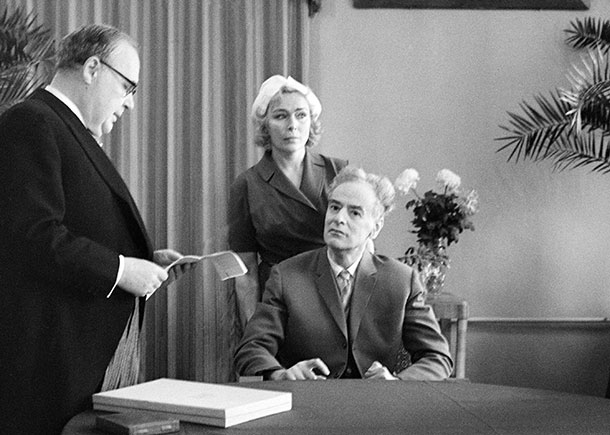
Swedish ambassador in the Soviet Union Rolf Sulman (L) on behalf of The Nobel Committee awards Lev Landau with the Nobel Prize in Physics in Moscow. 1962 car accident prevented him to travel to Stockholm to personally receive his Nobel Prize.


It is always interesting to follow the announcements of the Nobel Prize winners each year. This year the Nobel Prize winners are expected to be announced in October. Widely regarded as the most prestigious award in literature, physics, medicine, economics, chemistry and activism for peace, the Nobel Prize is annually awarded to extraordinary individuals for their outstanding contributions for humanity. I am proud to mention that one of those extraordinary individuals is a prominent Jewish physicist from majority-Muslim Azerbaijan – Lev Davidovich Landau, who was awarded the Nobel Prize in Physics in 1962 “for his pioneering theories for condensed matter, especially liquid helium.”

Landau was born on January 22, 1908, in Baku, the capital of Azerbaijan, into a Jewish family. His father was a prominent engineer working in the oil industry in Baku and her mother was a physicist and later taught at the Jewish High School as well as Baku State University. Both parents lived in Baku until the beginning of 1930s before moving to then Leningrad (now St. Petersburg).

He began his schooling in Baku, graduating from the Jewish High School. Recognized very early as a wunderkind in mathematics, he enrolled at the Baku State University (BSU) at the very young age of 14, studying in two programs at the same time: Mathematics and Physics, and Chemistry. He learned fundamentals of physics at the Baku State University, which is the oldest and largest university in Azerbaijan. Established in 1919, BSU is also one of the first secular universities in the Muslim world.

Landau benefitted from the open and embracing long-standing culture of tolerance in Azerbaijan, where a Jewish child can grow to become a well-known scientist, with the rights and freedoms to pursue his passions and goals, just the same as anyone else. We have seen this with many other examples too, including Azerbaijan’s current Supreme Court Justice Tatyana Goldman, Jewish Parliamentarian Yevda Abramov, Jewish doctor and scientist Gavriil Ilizarov and many other leaders and heroes.

In 1924, Landau moved to Leningrad to continue his study in physics at the Leningrad State University and in 1927, at the age of 19 he successfully graduated from that university and began his academic career at the Leningrad-Technical Institute.

In 1929, supported by a Rockefeller Foundation Fellowship, Landau embarked on an eighteen months-long scientific journey through Europe, conducting research and attending scientific conferences in Germany, Switzerland, the United Kingdom, the Netherlands, Belgium and Denmark. The research he conducted at various universities of Europe, especially in Copenhagen and learning from well-known physicists Wolfgang Pauli and Niels Bohr greatly influenced Landau’s views of physics.

After his return to the Soviet Union in 1932, Landau held various teaching positions, including the head of the Theory Department of the Ukrainian Technical Institute in Kharkov and the Head of the Theory Division of the Physical Institute of the USSR Academy of Sciences.

Landau worked on many branches of theoretical physics, including atomic collisions, astrophysics, low-temperature physics, atomic and nuclear physics, thermodynamics, quantum electrodynamics, kinetic theory of gases, quantum field theory, and plasma physics. He conducted thorough research on the basis of physician Kapista’s general thermodynamical theory of phase transitions of the second order and in 1938, he discovered the superfluidity of liquid helium. Even suffering from Stalin’s “Great Purge” and spending a year in prison in 1938 didn’t stop his enthusiasm for getting more outstanding achievements in physics. Between 1941 and 1947, Landau wrote many papers mainly focusing on the theory of quantum liquids. His comprehensive research on this theory was recognized with the 1962 Nobel Prize for Physics. In his award presentation speech Professor I. Waller, member of the Swedish Academy of Sciences, said: “Landau has by his original ideas and masterly investigations exercised far-reaching influence on the evolution of the atomic science of our time.”

In addition to Nobel Prize, Landau received many international honors for his contributions to the development of physics. He was a member of the Danish Royal Academy of Sciences (1951), the Netherlands Royal Academy of Sciences (1956), the London Physical Society (1959) and the Physical Society of France (1962). In 1960, he was elected to the National Academy of Sciences of the U.S. and the American Academy of Arts and Sciences. He received the Fritz London Prize and the Max Planck Medal. Moreover, he was elected to the USSR Academy of Sciences (1946), received the State Prize three times (1946, 1949, 1953), received the Lenin Prize in 1962 (shared with E.M. Lifshitz for the Course of Theoretical Physics), was granted the title Hero of Socialist Labour (1953) and awarded twice the Order of Lenin.

He died in 1968 – suffering from the implications of a serious car accident six years earlier. Sadly, this accident prevented him to travel to Stockholm in 1962 to personally receive his Nobel Prize.

Lev Landau has always been the source of pride for the people of Azerbaijan and the Jews living in this country, where people of different ethnic and religious backgrounds have been living for many centuries in peace and harmony. In Baku, a memorial plaque has been placed on his birth house. Also, one of the beautiful streets in downtown Baku is named after Landau.

Being one of the greatest theoretical physicists of the 20th century, Landau’s work, dedication to science and outstanding achievements have taught and inspired many scientists not only in Azerbaijan and in the former USSR, but in the entire world. As he mentioned repeatedly: “Everybody has a capacity for a happy life. All these talks about how difficult the times are we live in, that’s just a clever way to justify fear and laziness.”

Lev Landau: A Jewish Physicist and Nobel-Winning Genius from Azerbaijan Read More »

Troubled Rapper Mac Miller Dead at 26

Rapper Mac Miller, who died Sept. 7 of an apparent drug overdose at 26, will be laid to rest in his native Pittsburgh this week following a Jewish funeral service. Born Malcolm James McCormick, he is Jewish on his mother’s side and was raised Jewish.

“I always felt that Mac and I had a similar style, and I was happy that he embraced being Jewish, as there wasn’t really anyone at the time trying to make Judaism cool,” fellow Jewish rapper Rami Even-Esh, a.k.a. Kosha Dillz wrote in a letter to Variety.

A few years later, he headlined a festival called Paid Dues, where I was also on the bill…it was a massive moment for me, as I was finally feeling acceptance from the hip-hop community,” he continued. “[The] festival fell on the holiday of Passover, so I decided to make my merch tent an area for a traditional Passover seder. I even brought a bottle of Manischewitz grape juice just for Mac. He seemed to appreciate the gesture, and the importance of the holiday, and we filmed a video together to mark the moment.”

A resident of Studio City, Miller had a history of substance abuse, and it reportedly caused the end of his nearly two-year relationship with pop star Ariana Grande. They broke up in May, after he was charged with DUI following a car accident in the San Fernando Valley.

“I am not a babysitter or a mother and no woman should feel that they need to be,” Grande wrote on Twitter. “I have cared for him and tried to support his sobriety and prayed for his balance for years (and always will of course) but shaming/blaming women for a man’s inability to keep his s— together is a very major problem.”

Grande, now engaged to “Saturday Night Live” star Pete Davidson, got flak for her words, but Miller’s friend Shane Powers defended her on his “The Shane Show” podcast. “There was no one … more ready to go to the wall for him when it came to him being sober, and she was an unbelievably stabilizing force in his life,” Powers said of Grande. “She was deeply helpful and effective in keeping Mac sober and helping him get sober and she was all about him being healthy, period, in this area of this life.”

At the time of his death, Miller, who released his fifth studio album “Swimming” in August, was preparing for a U.S. national tour that was to launch Oct. 27.

Troubled Rapper Mac Miller Dead at 26 Read More »

Atonement

When I first learned how to recite
The confessional prayers —
Head bowed slightly, tight hand
In a fist against my heart
With each whispered word —
I was relieved.

Here, I thought,
Is my chance to let go the burden
Of all I’ve done wrong,
All my failures finally set free.

I whomped my fist against my chest
Enthusiastically, the sound
Hollow, dead, flesh on flesh-cavity.

This fallible flesh, I thought,
This self caring only for myself.

Whomp for the sin of deceit,
For unkindness, for gossip
And impatience and anger.

Afterward, I felt cleansed
And slightly proud of my self-hatred.

Now that, I thought, is atonement,
And then added a few more to atone
For my pride and self-satisfaction.

After services, a white-haired man
Approached me gently. You know,
He murmured, The mystics say we tap
To open our hearts, as if knocking
On a door, so the person within
Will open — first a sliver, then a foot,
Then if we are patient and kind,
Maybe they will open it fully
And invite us in.

He said, We practice
Kindness in the most difficult
Arena: our imperfect selves.
I never saw that man again. Perhaps
I never saw him at all.

But I Think of him on Yom Kippur
When I dress in white
And bow my head
And knock gently on the gate
Of my heart, whispering,
Open the door, I forgive you,
Self, my sweet fallible love.


Alicia Jo Rabins is a writer, musician and Torah teacher who lives in Portland, Ore.

Atonement Read More »

Emmy Winner Brian Kates: Editing ‘Mrs. Maisel’ Through a Jewish Lens

Beloved by critics and viewers since it premiered on Amazon in November 2017, “The Marvelous Mrs. Maisel,” a show about a 1950s housewife-turned-standup comic, exceeded expectations, garnering Emmy nods in 14 categories. Editor Brian Kates was honored for his work on the pilot episode, shot in late 2016. 

“I thought there was a good chance we would get something, but 14 was a wonderful surprise,” Kates told the Journal. “I love the show. Every episode is a gem. It’s a cotton candy fantasy that’s also realistic emotionally and important as a beacon of feminism. It’s hilarious
but incredibly moving at times.  How [creator] Amy Sherman-Palladino manages to keep all those balls in the air is an amazing feat,” he said. “There’s nothing like it on TV.”

Kates was sold on the show when he read the script. “The first page says ‘Jewish wedding,’ with references to the Holocaust and kosher food, the Borscht Belt and Philip Roth,” he said. “I saw that these were smart people who knew the history of Jewish representation and had a unique lens on the Ashkenazi Jewish experience and life in New York. It’s the Upper West Side but the downtown life as well. Midge goes from one milieu to another on the Jewish cultural spectrum.”

“[The show] is a cotton candy fantasy that’s also realistic emotionally and important as a beacon of feminism.” 

— Brian Kates

Kates added the show is also about Jewish femininity.  “It explodes stereotypes about marriage, appearance, the way a homemaker is supposed to look and act in 1958 and what it would take to be a female comedian at a time when it was rare.”  Additionally, he pointed out, “Midge’s mother is not a stereotypical Jewish mother. She’s really elegant and refined.”

Growing up in Teaneck, N.J., an “Ashkenazi mix” of Jewish ancestry from Ukraine, Poland and Russia, Kates was raised in a kosher home, attended Sunday school and synagogue and celebrated his bar mitzvah in Israel, where he’s returned several times since. “I feel very invested in Middle East politics and history, Israel specifically,” he said. 

A film major at New York University’s Tisch School of the Arts, Kates minored in Judaic studies, taking classes in comparative religion and the history of Jerusalem. He remains dedicated to keeping Jewish knowledge “alive and growing, which he says “makes me look for projects that have a Jewish point of view that is real, that isn’t a stereotype or a watered down version of what some people think a Jew is.”

Kates always wanted to make films, but unlike the majority of his NYU classmates, who aspired to be writers-directors, Kates is an introvert and felt better suited to shaping a film in post-production on his own. “What I didn’t know then was [editing] is a very communal job because it’s all about communication with the director,” he said. “I had to learn to collaborate.”

Recent 2018 Emmy winner Brian Kates. Photo by Impact 24 PR

Kates, whose other credits, including “Bessie,” “Lackawanna Blues” and “The Butler” and is now working on “Homunculus,” a ten-part musical podcast written and directed by John Cameron Mitchell, had a specific set of challenges on “Mrs. Maisel.” 

“A lot of the show is storyboarded and shot in a very specific way, with beautiful long takes. The standup scenes are not that and were the most challenging to edit,” he said. “There were many takes and many options, shot with multiple cameras from many angles. Rachel [Brosnahan who plays the title role] gave each one a different flavor.”

When the New York-based Kates is in Los Angeles working on a project, he attends services at Beth Chayim Chadashim, which has a primarily LBGTQ congregation. “I love the rabbi, Lisa Edwards. I really enjoyed the services there,” he said. “It’s nice to know I have a place to go in L.A.”

A previous Emmy winner for “Taking Chance” in 2009, he found the hoopla of the awards “incredibly nerve-wracking. Editors aren’t used to being in the spotlight. We do our work invisibly and quietly,” he said. “But it will be fun. Hollywood knows how to have a party.”

That first Emmy served as a hat rack for years, “But my husband said it was too important to cover up,” Kates said. He married in “a big, gay Jewish wedding” in which both grooms smashed the glass and circled each other seven times.

Kates took home his second Emmy at the Creative Arts ceremony on Sept. 8. “I was thrilled to reunite with our ‘Mrs. Maisel’ crew in LA and celebrate all of our hard work Saturday night,” he said afterward. “It’s sweet to feel so embraced here.”


The Creative Arts Emmy Awards will be broadcast 8 p.m. Sept. 15 on FXX.

Emmy Winner Brian Kates: Editing ‘Mrs. Maisel’ Through a Jewish Lens Read More »

Eric Trump Accuses Woodward of Trying to ‘Make Three Extra Shekels’

Eric Trump, President Trump’s second-oldest son, accused veteran journalist Bob Woodward of trying to “make three extra shekels” with his latest book.

In a Wednesday interview on Fox and Friends, Eric Trump was asked by co-host Steve Doocy about critics of the president who say that the Trump administration “is in chaos” based on the information presented in Woodward’s book and the anonymous New York Times op-ed.

Eric Trump dismissed the “chaos” perception presented by Woodward’s book and the op-ed.

“You can write a sensational nonsense book – CNN will definitely have you on there because they love to trash the president,” Eric Trump said. “It’ll mean you sell three extra books, make three extra shekels at the behest of the American people, at the behest of our country and a president that’s doing a phenomenal job by every quantifiable metric.”

Eric Trump’s remarks were condemned by various people on Twitter:

https://twitter.com/Yair_Rosenberg/status/1039915774654144513

https://twitter.com/KFILE/status/1039915551596978176

Jewish Telegraphic Agency noted:

The modern Israeli currency is named after currency referenced in the Bible. Shekels is also an American and Irish term slang for money, showing up in old potboilers like Mickey Spillane’s “I, The Jury”: “Generally a runner made plenty for himself, taking a chance that the dough he clipped wasn’t on the number that pulled in the shekels.”

But on some anti-Semitic corners of the web, like the anti-Semitic site The Daily Stormer, it is often used sarcastically to refer to Jewish greed or influence.

 Woodward’s book, titled “Fear: Trump in the White House,” claims that some Trump officials hide documents from Trump and that Trump frequently belittled members of his administration and vice versa. Trump and officials named in the book have pushed back on Woodward’s book as being inaccurate.

Eric Trump Accuses Woodward of Trying to ‘Make Three Extra Shekels’ Read More »

Holocaust Themes Add Historical Significance to ‘Romeo and Juliet’

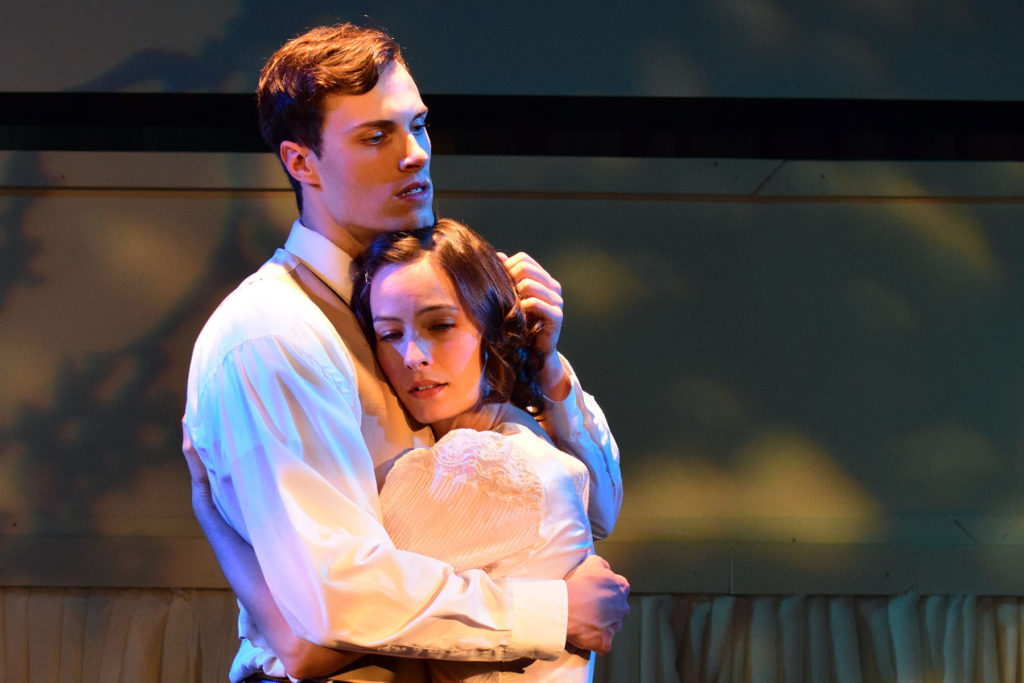
William Shakespeare’s classic tragedy “Romeo and Juliet” gains extra emotional and historical resonance in director Shira Dubrovner’s staging at The Group Rep at the Lonny Chapman Theatre in North Hollywood. 

The star-crossed lovers are now a German boy and a Jewish girl in Berlin in the 1930s, their feuding families divided by much more than a personal vendetta. 

Black-and-white words and images chronicling the rise of anti-Semitism, Kristallnacht and the Nuremberg Laws are shown on a screen above the stage, while Nazi brownshirts and armbands and Stars of David emblazoned with the word Jude unmistakably separate the Montagues and the Capulets.

“It’s about what happened and not letting history repeat itself, but it’s also a commentary on what’s happening today and about standing up to terror and injustice,” Dubrovner told the Journal. “People think of the Holocaust as 1938 on, but there were warning signs five, 10 years before. It touches on all of that.”

“The star-crossed lovers are now a German boy and a Jewish girl in Berlin in the 1930s, their feuding families divided by much more than a personal vendetta.”

Inspired by the unconventional versions of Shakespeare’s work at the Oregon Shakespeare Festival that featured time period changes and color- and gender-blind casting, Dubrovner made some clever casting choices. The Nurse became a yenta called Bubby, Benvolio is lesbian and Friar Lawrence is now Gypsy Lawrence. “I wanted to represent other persecuted people in that time period,” Dubrovner said, noting that she developed the play two years ago at the Mammoth Lakes Repertory Theatre, where she is the artistic director.

As for other ingenious twists, the light seen from Juliet’s window is from Shabbat candles and Rosaline, a character talked about but never present, physically exists in this version. She’s a chanteuse who opens the show singing Marlene Dietrich’s “Falling in Love Again” a la “Cabaret,” and later, “Bei Mir Bist du Schon.” There’s also a visual reference to the dance in “West Side Story” and the music includes the “Schindler’s List” theme. 

Dubrovner, who was raised in an Orthodox home in Los Angeles, has had her own brushes with anti-Semitism. “We’d walk to synagogue on a Saturday and people yelled, ‘Dirty Jews’ out their car windows. One time I was with a friend and a guy said, ‘I wish Hitler succeeded,’ ” she recalled. “The main purpose of doing this play is to remember what happened and not let history repeat itself.”

Lead actors Mike Bingaman and Savannah Schoenecker are not Jewish, but the Holocaust milieu resonated personally with both of them. Bingaman, who arrived in Los Angeles five years ago from Australia to attend the American Academy of Dramatic Arts (AADA), grew up with a mother whose master’s thesis was about the Holocaust. “I was very interested in it and always wanted to do a project based in Berlin in the ’30s,” he said, adding that playing Romeo was another dream. “I got to knock two things off my list.”

“I grew up watching films about the Holocaust, like ‘The Pianist,’ and I watched ‘Schindler’s List’ before starting this,” Schoenecker said, adding that she was “moved by the gravity of it, and the pain and suffering.” A San Jose native, she also studied at AADA but didn’t know Bingaman there.

Schoenecker said she thinks “Romeo and Juliet” takes on extra weight and resonance in this new context. “It personalizes the Holocaust. The personal, human aspect of the innocence of love, something that is beautiful, is destroyed because everything is destroyed.”

Bingaman believes that this version “adds a dynamic to the story that everyone knows. This setting brings another dimension to it that adds something to every scene.”

“The beauty of ‘Romeo and Juliet’ is it can be set in any place where there is separation,” Schoenecker said, “whether it’s [because of] ideology, religion, politics, personal vendettas, and it can be so incredibly powerful. Shira’s vision really brought it all together.”


“Romeo and Juliet” runs at the Lonny Chapman Theatre in North Hollywood through Oct. 14.

Holocaust Themes Add Historical Significance to ‘Romeo and Juliet’ Read More »

The Yom Kippur Amidah Prayer Guide

For many Jews, the Days of Awe are the one time of year to experience prayer services. An essential part of those services is the weekday Amidah, a prayer said standing, punctuated by silence and meditation — key elements of Yom Kippur. To help guide your spiritual reflections and to enhance this holiest of days, I offer you kavanot (meditations) for the respective paragraphs of the Amidah. Use them as you see fit. My blessing is that we will each dance with Jewish prayer long after this round of holy days is over.

The Kavanot


United in Relationship

Adonai Sfatai — Prayer happens in relationship. We ask God to create the possibility of connection, then pledge that we will respond to the opening God facilitates. Meeting God in relationship, then reciprocity, then words. There is no speech without two participants. There is no relationship without another. And there is no prayer unless we stand in our own readiness before the One.

Our Parents’ Dreams, Dreaming Our Children

Avot — We are who we are because of those who came before us. We are who we are for the sake of those who will follow. Every human being is someone’s child and grandchild. As Jews, it is our privilege to know who those founding forebears are. And it is our destiny to advance their project into the future. So, we begin our prayers as the children of Abraham and Sarah, Isaac and Rebekah, Jacob, Rachel and Leah. And we pledge to them that our children, in turn, will connect their journeys to the ancient ones through us.

Life the Greatest Miracle

Gevurot — There are miracles only God can achieve — causing the rains to fall, reviving the dead. And then there are miracles that God can achieve only through us — lifting the fallen, healing those who suffer, liberating the bound. It is with God’s greatness, and ours, that we can channel God’s power and goodness and birth it into the world. We pray to expand to this Godly potential.

Joining the Cosmic Chorus

Kedushah — Human arrogance once perceived our species as separate from the living web of creation, but no longer. We are the upwelling of a life process billions of years in the making and the expression of consciousness within creation, turning to sing praises on behalf of creation. The kedushah makes this explicit: The angels sing when we do, and we join their chorus in praising the creator of all. Holy, holy, holy is an affirmation of belonging and a celebration of the unity and diversity of this astonishing cosmos.

Aiming for Wisdom

Da’at — Knowledge is mere cataloging if not enlisted in the service of wisdom. Discerning what is significant from what is trivial, what is lasting from what is ephemeral and what is worthy from what is distracting is at the core of humanity’s greatest potential. We thank God who has gifted us with this possibility, the attainment of true wisdom.

Returning Anew

Teshuvah — Repentance is always a circling back — to our original beginnings, to our truest core, to our bedrock values. We whirl a dance of return, and amid the spinning, smooth away our sharp edges and unpolished exterior. The ancients saw the sphere as a symbol of perfection; we see it — like the blur of the atom — as the dynamic birth of all becoming. From our turning, we emerge better and more alive.

Forget What We Remember, Remember What We Forge

Slichah — A God who forgets nothing might be logically supreme, but such a God would be an impossible companion. The greatness of the God of Israel lies in God’s forgetting what we recall and recalling what we forget. We regret our misbehavior and bad choices in the past, and God responds by erasing them. When we minimize and ignore the harm we have done, it continues to do us damage. The greatness of our God lies in the power of selective forgetting, which we would do well to extend to each other’s perceived slights.

Healing Embrace

Refuah — What are we requesting when we ask God for healing? Clearly not for the end of all sickness, for a stagnant immortality in which there is no death, but also no birth and renewal. God’s healing comes in the inner peace of knowing we are never alone, always loved, always embraced. On that journey from birth to death and beyond, we continue as part of the people of Israel, we continue as God’s partners in covenant. Love is stronger than death, and in knowing that, we are healed.

We Have What We Need

Mvareckh Ha-Shanim — Satisfy us with your goodness. When we are content with what we have, we harvest a richness that blossoms from within. It is our attitude of sufficiency, the awareness of having what we need (but not necessarily all we want), that engenders fullness of soul, a flow of gratitude and generosity. Bless us, Holy One, to know that we have enough — enough to thrive, enough to relax, enough to share. 

All Are Called

Teka Be-Shofar — We are not whole if everyone is not included in our ingathering. When our community includes us all — with no exceptions — then we fulfill the answer to our ancient prayer, kabtzeinu yachad, gathered together as one.

On That Day, Love and Mercy

Ohev Tzedakah u’Mishpat — At present, humans dispense a justice of rules, limits and consequences. Only God merges lovingkindness and mercy with justice. We pray that one day soon we will join with God in that divine fusion, so that the justice we apportion will simultaneously fuse the mercy that makes reconciliation possible with the lovingkindness that makes wholeness real. Only then can we have hope to remove sorrow and anguish from our communities and our lives.

Fight the Enemy Within

Ve-le-malshinim — Who are we addressing in this prayer? Is this directed toward our enemies, implacable in their blind hatred of Jews, Judaism and Jewish sovereignty? Or are we speaking of ourselves, arrogant in our blindness to how our sense of victimhood can blind us to those we might victimize, to the ways our sense of being hated might rationalize the marginalization and denigration of others? Help us, God, to resist the arrogance in others even as we strive to rise above it in ourselves.

Blessed by the Wise, the Old, the Wounded

Al Ha-Tzadikim — It is easy to be faithful before experiencing pain or loss. But to have traversed history through millennia of sovereignty and dispersion and still affirm hope; to have lived through illness, disappointment and loss and still rise in the morning to praise the God of possibilities; such a faithfulness is cause for praise and remains a source of marvel. Thank you, God, for still blessing us with such people, wizened with travail yet capable of a nurturing smile and a sustaining caress.

Jerusalem, Our Mother

Ve-lirushalayim — It is impossible to claim to love the Earth without loving actual earth. We turn to Jerusalem as our Metropolis, our Mother City, in whose winding alleys and golden stones we first learned to discern God’s presence. On all of our journeys, we are always on the way home, always seeking the presence. Because we cultivate deep roots in Jerusalem, we retain the capacity to find home and presence wherever we dwell.

Redemption, Just Beyond Our Grasp

Et-Tzemach — Redemption is a vision always advancing and never realized. It remains, in the words of the prayer, a hope, an aspiration, a glimmering possibility of what might yet be ours. God holds open the possibility of a future that outstrips the past, of a self-surpassing in which we may truly nestle. We are made in God’s image, and our choices help determine the path we claim from the future.

May We Hear as God Hears

Shma Koleinu — In a world where everyone is speaking yet none listen, God’s unique gift is to truly hear. God hears the outcry of Israel and descends to save. God hears the cry of the orphan and widow and takes on their cause. And God hears our prayer. We invite God’s compassionate listening when we cry out; we extend God’s glory when we make the effort to listen to the other.

Accept our Prayers

Retzei — What does it mean for God to accept our prayers? The prayer itself contains the answer: Your merciful return … the Divine Presence. Intimacy with God, a sense of God’s closeness and embrace, an existential realization that we are never alone, these are the answers to our prayers, not the specific fulfillment of a verbal request. When we feel valued and welcome, then indeed our prayers have been accepted.

Gratitude Blossoms

Modim — Our gratitude is expressed in grand, universal human language, without reference to particular Jewish observances. God’s wonders are found in the cycles of the planets, the rhythm of the seasons, the resurgence of life and love and experience. Gratitude is a self-creating blessing; the more we cultivate gratitude, the more we are aware of all that we get to be grateful for, the more we blossom as human becomings.

God’s Dream of Shalom

Sim Shalom — The capstone prayer of the Amidah reflects God’s great dream — all humanity uniting in service; the inauguration of an age of justice and peace; using our minds to heal the sick and comfort the bereaved, feed the hungry and shelter the homeless. God’s great dream of a humanity that reflects God’s image not merely in potential but in actuality is within our grasp, if we but dare to dream.


Rabbi Bradley Shavit Artson holds the Abner and Roslyn Goldstine Dean’s Chair of the Ziegler School of Rabbinic Studies and is vice president of American Jewish University in Los Angeles. 

The Yom Kippur Amidah Prayer Guide Read More »

Bagels and Lox and September 11

As an American chef in a foreign service post, I feel that part of my job description is to make fellow expats feel as if, albeit briefly, they are at home. I do this by paying special attention to the times of the year people might feel nostalgic for a food they miss when they’re not in the United States, such as Halloween or Thanksgiving, Hanukkah or Valentine’s Day. I even pretend it’s fall by whipping out the pumpkin spice lattes and honeyed apple cakes, even though in East Africa, the seasons alternate only between wet and dry.

In spite of this, somehow, September always manages to sneak up on me. I suspect it sneaks up on many people for various reasons — the beginning of the school year, cooking for the Jewish holidays and, for me, I can’t help but think about what I was doing in New York City, on an infamous Sept. 11.

Truth be told, I never much liked New York’s twin skyscrapers. I would jog past them in the mornings a few times a week and they were always my cue to turn around and go home, shower, go to work. But not that morning. That morning I had overslept.

I was cursing my laziness and lamenting my dried-up tube of mascara when a sonic boom-like noise shook my 11th-floor apartment. Whoa! I turned on Howard Stern and made coffee. “What was that?” Stern asked. “We are getting reports that a small prop plane flew into one of the towers,” said his sidekick Robin Givens. 

As an only child, my ingrained responsibility kicks in. My parents — they’re vacationing in Italy. They will flip out if they see something happened here. Dial the number, calm as can be. It’s only a prop plane, no big deal, but that was a really loud boom. Do I smell smoke? Dial the phone, wait for the Italian ringtone. Smile. Think of Italy. “Mom?” “Hi, baby, you won’t believe where we are. We are in Ravello. Here talk to your aunt; we are in the most beautiful place. …”

“Mom! Listen to me!” I’m yelling. “Something has happened here. I don’t know what it is, and they say it was a small prop plane but my whole building shook. I think something bad is happening. Anyway, I’m fine. Just don’t worry. I’m OK.”

I’m babbling. Phone goes dead. Uh oh. Good thing I called. Call my friends, one after another. Phone dies again. Forgot about my cellphone. Dial out, no tone, nothing but a dead phone line. Breathe, don’t panic.

Stern and Givens are still chatting calmly. Wait, another report has come in: a plane hijacked in Pennsylvania? Biochemical weapons a possibility?

Warrior mode kicks in. Go, go, go, get out of the building. See what is happening. Is this a joke? The building shook. Something must have happened.

Go downstairs, out onto Fifth Avenue. It’s such a beautiful day. The sky is so blue. The Washington Square Arch looms over me. Ask the doormen, “Do you know what happened? Where is everyone? Do you smell smoke?” No reply, just panic-stricken looks on shell-shocked faces. 

“Warrior mode kicks in. Go, go, go, get out of the building. See what is happening. Is this a joke? The building shook. Something must have happened.”

Don’t have time for this. Need information. Run back to the elevator, press the “Penthouse” button. There are windows in the hallways on that floor. Meet some neighbors. “Do you guys know what happened? Wow, this view is something from up here.” They are silent. Watching the towers through the big windows. Smoke is coming out of one of the towers.

“Hey, don’t you work at The New York Times?” a guy asks. “Yes, I do,” I tell him as I remember I’m supposed to be at work right now. I borrow a cellphone and dial one of my co-workers. “What is going on?” I hear frantic newsroom activity on the other end, then the call drops. “The call dropped.” I dial again and the phone rings and rings. “May I use your phone to call a friend?” I ask.

Before I can make the call, I see a plane on the horizon. It looks like a jet. “Isn’t that plane flying too low?” I ask my neighbors. “It’s so close, why is it flying so low?” Silence. More neighbors gather. “Why is that plane flying so low?” No panic, just wondering. The plane looks like a little toy plane.

Gasps come from shocked mouths including mine. Plane flies into the second tower in a burst of flames. Clouds of flames. Gasps. It’s like a disaster film. “Ohmigod, ohmigod, ohmigod, ohmigod!” I hear my neighbors say. “This can’t be happening. This isn’t happening. Tower crumbles like a set of dominoes.

Now I smell smoke. It’s so close. Tears start flowing from neighbors. I’m calm. “I think we should all figure out what to do and stop watching this,” I say finally. Silence, tears, gasps, curses. I say, “Goodbye and be safe” to my neighbors, and run down ro my apartment, which is foggy with smoke. 

Involuntary trembling as I grab my cellphone, I call my friend. I get through on the first try. “Come down here. I don’t want you to be alone.” “But why?” she asks, “You are right there.” It’s illogical but I want her to come downtown, perhaps to confirm that what I am seeing is real. “Please come. Come fast, take a taxi and just come, OK?” “OK,” she says finally. “I’ll come down.”

Run down the 11 flights of stairs to the lobby. Wait outside. Smoke, ashes, people running. So much smoke. I’m choking. Where are the towers? They are usually right there. You watched one fall remember? 

“So, how do I mark Sept. 11 for my fellow ex-pats? What else — the quintessential New York homage: a bagel with lox and a schmear. It reminds me of that beautiful morning right before our city changed forever.”

Finally, through the smoke and thick snowy ash, I see my friend. It’s her birthday, I remember. She looks like an athletic soldier running in a war film. “Happy birthday,” I say to her, feeling her heart pound in her chest against mine. “Are you OK? You picked some day to be born.” Her heart is beating so fast I think she may faint and take me down into the ashes with her.

I often think that perhaps if more people had seen what I saw that day, and the days and the months and year that followed, that there would be not a shred of a doubt in anyone’s mind what this country is made of — because in spite of the fact that our nation was attacked in an unforeseeable, unprecedented and unimaginable way, what is most permanently etched onto my consciousness from that time is the caring, the generosity, the pulling together and the sacrifices that were made by so many Americans. 

So, how do I mark Sept. 11 for my fellow ex-pats?

What else — the quintessential New York homage: a bagel with lox and a schmear. It reminds me of that beautiful morning right before our city changed forever, when the sky was crystal blue, sharp and clean. I didn’t much like those buildings back then — not until I watched them collapse out of the clear sky and then watched the city somehow regroup and our nation rebuild.

That’s New York and that’s America. Let’s not forget it for a moment.


Yamit Behar Wood, an Israeli-American food and travel writer, is the executive chef at the U.S. Embassy in Kampala, Uganda. 

Bagels and Lox and September 11 Read More »

Reclaiming Dignity

As I prepare for this Yom Kippur, when we stand before the Judge of Truth, open the ledger of our deeds and recite our confessions both personal and communal, one transgression rises to the top in my mind: humiliation. We live in a culture of humiliation.

In all we read and hear on the news, on social media and in public discourse, it is apparent our society has lost touch with centuries of stories and traditions that emphasize how deeply destructive humiliation can be to one of the most precious qualities of life — human dignity.

During a congregational journey to Israel, as our group visited a Bedouin camp, our host told us of their elaborate rituals around coffee, an essential part of the hospitality dance. “We even use the coffee cup to indicate to a guest that it is time for them to go,” he said. “How do you think we do this?”

All of our guesses were of actions aggressive and humiliating: “Throw the coffee cup at the guest?” “Spill the coffee on his caftan?” 

The Bedouin frowned.

“No, we fill the cup to the top,” he said. “It is a quiet signal, and the guest can leave with dignity.”

“Dignity in Hebrew is kavod, and its root means weightiness. If you take up space, you have worth. By your virtue you earn respect. Your dignity comes by virtue of your birth.”

His words reflected a cultural trope in the Muslim world: Humiliation is worse than death.

We have our Jewish stories too. There is the story of Rebbe Akiva Eiger, who had guests at his Shabbos table, one of whom accidentally knocked over a glass of wine. The other guests were horrified as wine spread across the tablecloth. The Rebbe, seeing the embarrassment on the man’s face, swiftly knocked over his own glass, declaring, “The table must be crooked!”

Donna Hicks, author of “Dignity: The Essential Role It Plays in Resolving Conflict,” and the newly released “Leading With Dignity: How to Create a Culture That Brings Out the Best in People,” has worked extensively on the Israeli-Palestinian conflict as well as conflicts in Sri Lanka, Northern Ireland, Colombia and Cuba. She is currently involved in dignity restoration projects in Syria and Libya. In her work on conflict resolution, Hicks discovered that what is of utmost importance to us human beings is how we feel about who we are. Her research shows that we are just as programmed to sense a threat to our dignity as we are to a physical threat.

“When we sense our worth is being threatened, we are flooded with dread and shame … our self-preservation instincts are very strong, inciting feelings of rage, and self-righteous revenge,” she wrote. “Our desire for dignity is even stronger than our desire for survival. People risk their lives to protect their honor and that of people in their social group: wars are fought over dignity threats. This paradoxical reaction, putting one’s life on the line to protect one’s dignity, puts dignity ahead of survival.”

If people are programmed to protect their honor at all costs, how do we navigate our way out of the current hailstorm of humiliations?

Supporters of Donald Trump in the 2016 presidential election still take issue with Hillary Clinton calling them “deplorables.” Liberals bristle when they are labeled as “snowflakes.” And the leader of the free world is not averse to calling detractors stupid, dogs, retards, losers and sad.

As we are increasingly overwhelmed with information, it becomes more and more difficult to capture our attention. Humiliation gets our attention.

How do we come together when we have no respect for one another?

Hicks makes an important distinction between respect and dignity: respect is earned, while dignity is a birthright. Respect is about a person’s actions. Dignity is about a person, period.

Dignity in Hebrew is kavod, and its root means weightiness. If you take up space, you have worth. By your virtue you earn respect. Your dignity comes by virtue of your birth. 

Dignity is the inherent nobility and worth of every living being. Innocent or guilty, right or wrong, conservative or liberal, sick or strong, capable or incompetent, hero or villain — if you are here, then you have substance; if you have substance, then you matter; and if you matter, you have worth. 

According to Hicks, we don’t have to respect each other’s opinions to achieve conflict resolution; what we have to do is protect each other’s dignity. 

At the heart of every conflict, she teaches, is a “dignity violator.” 

The catastrophic power of a dignity violator is explored in the talmudic story we tell on Tisha b’Av:

A Jewish man who had a friend named Kamtza and an enemy named Bar Kamtza prepared a feast. The man sent his servant to invite Kamtza to his party, but the servant invited Bar Kamtza by mistake.

Bar Kamtza took the invitation as a sign of forgiveness, dressed in his finest clothes and went to the party.

When the host spotted Bar Kamtza among his guests, he said, “What are you doing here? You are not welcome!”

Bar Kamtza replied, “Please, don’t embarrass me in front of all these guests. If you allow me to stay, I will pay for what I eat and drink.”

“No!” the host replied.

“Please,” begged Bar Kamtza, “I will pay for half the cost of the feast.” He could see the rabbis and sages at the party were watching but doing nothing.

“No!” repeated the host.

“I will pay for the entire cost of the feast, only don’t shame me!”

“No!” said the host again, and he had Bar Kamtza dragged out and thrown into the street.

“Since none of the guests protested, they obviously had no objection to my humiliation,” Bar Kamtza said to himself.

In anger, Bar Kamtza went to Caesar and incited him to begin the war that would destroy the temple.

Humiliation led to the ruin of the House of God.

How different would the ending have been had the host handed Bar Kamtza a brimming cup of coffee?

I am reminded of the 2011 White House Correspondents Association dinner when President Barack Obama and comedian Seth Myers roasted Donald Trump.

Some of Myers’ one-liners included: “Donald Trump has been saying he will run for president as a Republican — which is surprising, since I just assumed he was running as a joke.” “Trump owns the Miss USA Pageant, which is great for Republicans because it will streamline their search for a vice president.” And, “Donald Trump said recently he’s got a great relationship with ‘the Blacks.’ Unless the Blacks are a family of white people, I bet he’s mistaken.”

“A person, to have their dignity restored, needs to be heard, seen, recognized and understood, and to have their suffering and experience acknowledged.”

Some political commentators wrote afterward that the humiliation Trump experienced from the remarks triggered deep feelings of revenge (although Trump later said that was untrue and he enjoyed the evening).

We live in an “attention economy” in which human attention is the most valuable commodity. As Matthew Crawford wrote, “Attention is a resource — a person has only so much of it.” As we are increasingly overwhelmed with information, it becomes more and more difficult to capture our attention.

Humiliation gets our attention. As Saul Alinsky said, “Ridicule is man’s most potent weapon.”

It’s not always easy to identify a precise dignity violation as in the story of Bar Kamtza. But Hicks reminds us that “nameless and unvoiced indignities are the missing link in our understanding of what keeps conflicts alive,” and that when we react to our being humiliated, we must remember that “our opponents are often reacting to a violation of their dignity as well, a violation we, perhaps, perpetrated.”

Humiliation was part of the warfare used against the Jews.

When visiting Yad Vashem, my son and I paused over some long auburn braids in a glass case, cut off a little girl by Nazi soldiers before she was gassed at Auschwitz-Birkenau. 

We know about humiliation, and we are uniquely positioned as a people to offer the world a theology of dignity. 

The preamble of the United Nations’ Universal Declaration of Human Rights reads: “Whereas recognition of the inherent dignity and of the equal and inalienable rights of all members of the human family is the foundation of freedom, justice and peace in the world…”

The preamble of the story of the Jewish people is the creation of the first human beings, of which Torah teaches: Human beings are made in God’s image, B’tzelem Elohim, and to shame a person is to affront the Creator.

The victim and the perpetrator, as hard as it is for us to accept, are both made in God’s image. It is not something one can forfeit. 

Rabbi Jonathan Sacks wrote in “Dignity of Difference: How to Avoid the Clash of Civilizations”: “For almost 2000 years, scattered throughout the world, we continued to see ourselves and be seen by others as a single people…. That experience forced us to reflect on many problems that are now the shared experience of mankind, how to maintain identity as a minority, how to cope with insecurity, how to sustain human dignity in a world that seems often to deny it.”

A person, to have their dignity restored, needs to be heard, seen, recognized and understood, and to have their suffering and experience acknowledged.

Talmud (Tractate Sanhedrin) tells us:

It once happened that while Rabbi Judah was delivering a lecture, he noticed a smell of garlic. He said: “Let him who has eaten garlic go out.” Rabbi Hiyya arose and left; Then all the other disciples rose in turn and went out with him, protesting the teacher’s humiliating words.

There is also the Chasidic story of the visiting rabbi who is given the first serving of a family’s kugel. The rabbi quickly eats the entire tray before anyone can take a bite. The townspeople are so upset that they run the glutton out of town. Many years later they discover that someone had mistaken salt for sugar in the kugel and it tasted horrible. To save the cook from humiliation, the rabbi had eaten it all himself. 

In his book “Improvisational Negotiation: A Mediator’s Stories of Conflict About Love, Money, Anger, and the Strategies that Resolved Them,” Jeffrey Krivis shares the case of a couple whose two sons had been killed while riding their bikes in a park. The excruciating legal negotiations dragged on for years with no end in sight. 

After one particularly grueling meeting, just as the parents were about to storm out of the conference room, the lawyer shouted, “Wait! Look, I think we’ve been approaching this in completely the wrong way … I’m so sorry. Your kids deserved to be remembered. We’ve had our eye on the money for so long, planning our court case, that we lost sight of Johnny and Scott and their value — as human beings.”

Immediately the mother began sobbing and the father started sharing memories. By the end of that session, they came up with a new idea. The new bike trail would be named after the children and a scholarship fund endowed by the state was created for children in need. 

We must remember these stories as we process the pain of victims of sexual assault. We must address the dignity violators on both sides when we approach flashpoint issues such as immigration, gun legislation and healthcare. We must identify the dignity violators that continue to fuel our feuds.

We are not to say that they who do not share my faith, my race or my ideology do not share my humanity. Rather, this Yom Kippur, let us begin the work to recognize the inherent dignity of others, and to restore it, for the sake of us all.


Rabbi Zoë Klein Miles is the senior rabbi at Temple Isaiah in Los Angeles.

Reclaiming Dignity Read More »