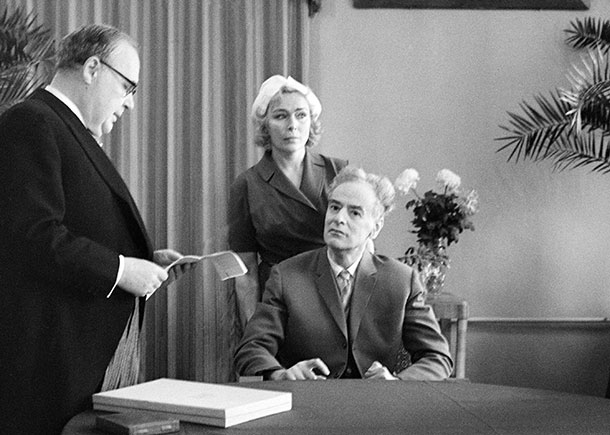
It is always interesting to follow the announcements of the Nobel Prize winners each year. This year the Nobel Prize winners are expected to be announced in October. Widely regarded as the most prestigious award in literature, physics, medicine, economics, chemistry and activism for peace, the Nobel Prize is annually awarded to extraordinary individuals for their outstanding contributions for humanity. I am proud to mention that one of those extraordinary individuals is a prominent Jewish physicist from majority-Muslim Azerbaijan – Lev Davidovich Landau, who was awarded the Nobel Prize in Physics in 1962 “for his pioneering theories for condensed matter, especially liquid helium.”
Landau was born on January 22, 1908, in Baku, the capital of Azerbaijan, into a Jewish family. His father was a prominent engineer working in the oil industry in Baku and her mother was a physicist and later taught at the Jewish High School as well as Baku State University. Both parents lived in Baku until the beginning of 1930s before moving to then Leningrad (now St. Petersburg).
He began his schooling in Baku, graduating from the Jewish High School. Recognized very early as a wunderkind in mathematics, he enrolled at the Baku State University (BSU) at the very young age of 14, studying in two programs at the same time: Mathematics and Physics, and Chemistry. He learned fundamentals of physics at the Baku State University, which is the oldest and largest university in Azerbaijan. Established in 1919, BSU is also one of the first secular universities in the Muslim world.
Landau benefitted from the open and embracing long-standing culture of tolerance in Azerbaijan, where a Jewish child can grow to become a well-known scientist, with the rights and freedoms to pursue his passions and goals, just the same as anyone else. We have seen this with many other examples too, including Azerbaijan’s current Supreme Court Justice Tatyana Goldman, Jewish Parliamentarian Yevda Abramov, Jewish doctor and scientist Gavriil Ilizarov and many other leaders and heroes.
In 1924, Landau moved to Leningrad to continue his study in physics at the Leningrad State University and in 1927, at the age of 19 he successfully graduated from that university and began his academic career at the Leningrad-Technical Institute.
In 1929, supported by a Rockefeller Foundation Fellowship, Landau embarked on an eighteen months-long scientific journey through Europe, conducting research and attending scientific conferences in Germany, Switzerland, the United Kingdom, the Netherlands, Belgium and Denmark. The research he conducted at various universities of Europe, especially in Copenhagen and learning from well-known physicists Wolfgang Pauli and Niels Bohr greatly influenced Landau’s views of physics.
After his return to the Soviet Union in 1932, Landau held various teaching positions, including the head of the Theory Department of the Ukrainian Technical Institute in Kharkov and the Head of the Theory Division of the Physical Institute of the USSR Academy of Sciences.
Landau worked on many branches of theoretical physics, including atomic collisions, astrophysics, low-temperature physics, atomic and nuclear physics, thermodynamics, quantum electrodynamics, kinetic theory of gases, quantum field theory, and plasma physics. He conducted thorough research on the basis of physician Kapista’s general thermodynamical theory of phase transitions of the second order and in 1938, he discovered the superfluidity of liquid helium. Even suffering from Stalin’s “Great Purge” and spending a year in prison in 1938 didn’t stop his enthusiasm for getting more outstanding achievements in physics. Between 1941 and 1947, Landau wrote many papers mainly focusing on the theory of quantum liquids. His comprehensive research on this theory was recognized with the 1962 Nobel Prize for Physics. In his award presentation speech Professor I. Waller, member of the Swedish Academy of Sciences, said: “Landau has by his original ideas and masterly investigations exercised far-reaching influence on the evolution of the atomic science of our time.”
In addition to Nobel Prize, Landau received many international honors for his contributions to the development of physics. He was a member of the Danish Royal Academy of Sciences (1951), the Netherlands Royal Academy of Sciences (1956), the London Physical Society (1959) and the Physical Society of France (1962). In 1960, he was elected to the National Academy of Sciences of the U.S. and the American Academy of Arts and Sciences. He received the Fritz London Prize and the Max Planck Medal. Moreover, he was elected to the USSR Academy of Sciences (1946), received the State Prize three times (1946, 1949, 1953), received the Lenin Prize in 1962 (shared with E.M. Lifshitz for the Course of Theoretical Physics), was granted the title Hero of Socialist Labour (1953) and awarded twice the Order of Lenin.
He died in 1968 – suffering from the implications of a serious car accident six years earlier. Sadly, this accident prevented him to travel to Stockholm in 1962 to personally receive his Nobel Prize.
Lev Landau has always been the source of pride for the people of Azerbaijan and the Jews living in this country, where people of different ethnic and religious backgrounds have been living for many centuries in peace and harmony. In Baku, a memorial plaque has been placed on his birth house. Also, one of the beautiful streets in downtown Baku is named after Landau.
Being one of the greatest theoretical physicists of the 20th century, Landau’s work, dedication to science and outstanding achievements have taught and inspired many scientists not only in Azerbaijan and in the former USSR, but in the entire world. As he mentioned repeatedly: “Everybody has a capacity for a happy life. All these talks about how difficult the times are we live in, that’s just a clever way to justify fear and laziness.”