fbpx

August 16, 2018

Aretha Franklin – The Malkah of Soul

In a 1970 interview Aretha Franklin, the “Queen of Soul” who died this morning at the age of 76, told Jet Magazine “You don’t have to be Black to have soul.” She certainly lived by that maxim; it’s hard to imagine her career without the collaboration of Jewish label heads, songwriters, musicians and producers.

Born March 25, 1942, in Memphis, Tenn., Franklin got her start singing in Detroit’s New Bethel Baptist Church under the direction of her father, the minister and singer C.L. Franklin. By her teens she had already famous as a gospel singer, and had appeared with the Soul Stirrers (featuring Sam Cooke), and the Rev. Martin Luther King Jr. By the time she turned 18, she decided to move into secular music. Courted by multiple labels, including Berry Gordy’s fledging Motown, she signed with Columbia Records in 1960. Columbia marketed her more as a jazz singer in the mold of Dinah Washington, with limited success. It took a move to Atlantic Records in 1967 to turn her into a superstar.

At Atlantic, she was teamed with the producer Jerry Wexler, known as “the funky Jewish King of Black music.” He immediately recognized the unbridled emotion of her gospel singing was a major part of her appeal, and put her in the studio with the mixed-race Muscle Shoals Rhythm Section, and recorded her early hits “I Never Loved A Man (The Way I Love You),” and “Respect.” The latter song, which reworked Otis Redding’s call for male privilege into a call for liberation, was Franklin’s first No. 1 single.

Wexler (who explained his affinity for soul music to Stephen Whitfield that “as a Jew, I didn’t think I identified with the underclass, I was the underclass”) also brought the songs of Jewish composers to her attention, and together they had hits with songs composed by Jewish songwriters such as Carole King and Gerry Goffin’s “(You Make Me Feel Like) A Natural Woman),” Burt Bacharach’s “I Say A Little Prayer,” and Jerry Leiber and Mike Stoller’s “Spanish Harlem” and Paul Simon’s “Bridge Over Troubled Water.”

Wexler left Atlantic in 1976, and although Franklin remained at the label, the hits were not coming with the same frequency. She left Atlantic and, in 1980, signed with Artista Records, the label founded by Clive Davis. Like Wexler, Davis was a Brooklyn-born Jew, and he helped to revive her career, starting with a command performance at the Royal Albert Hall in London and a well-received cameo in the hit movie “The Blues Brothers.”

Davis freshened Franklin’s sound while retaining her deep gospel roots, and the result was a late-career run of hits. He connected Franklin with the songwriter Jeffrey Cohen, who co-write the chart-topping “Freeway of Love,” and “Jimmy Lee.” While health (and Franklin’s life-long fear of flying) cut down on her touring and recording in her later years. She performed the National Anthem at the 2006 Super Bowl, “My Country Tis Of Thee” at President Barack Obama’s 2009 inauguration, and in 2015 gave a show-stopping performance of “Natural Woman” at the Kennedy Center Honors for Carole King. A 2012 review in the Orange County Register said “she can still bring it, her voice barely diminished, still bristling with power and authority.”

With the announcement of Franklin’s death from pancreatic cancer, many of her collaborators paid tribute. Davis called her “truly one of a kind. She was more than the Queen of Soul. She was a national treasure to be cherished by every generation throughout the world.” On Twitter, King wrote of Franklin “What a life. What a legacy! So much love, respect and gratitude. R.I.P.”


Aretha Franklin – The Malkah of Soul Read More »
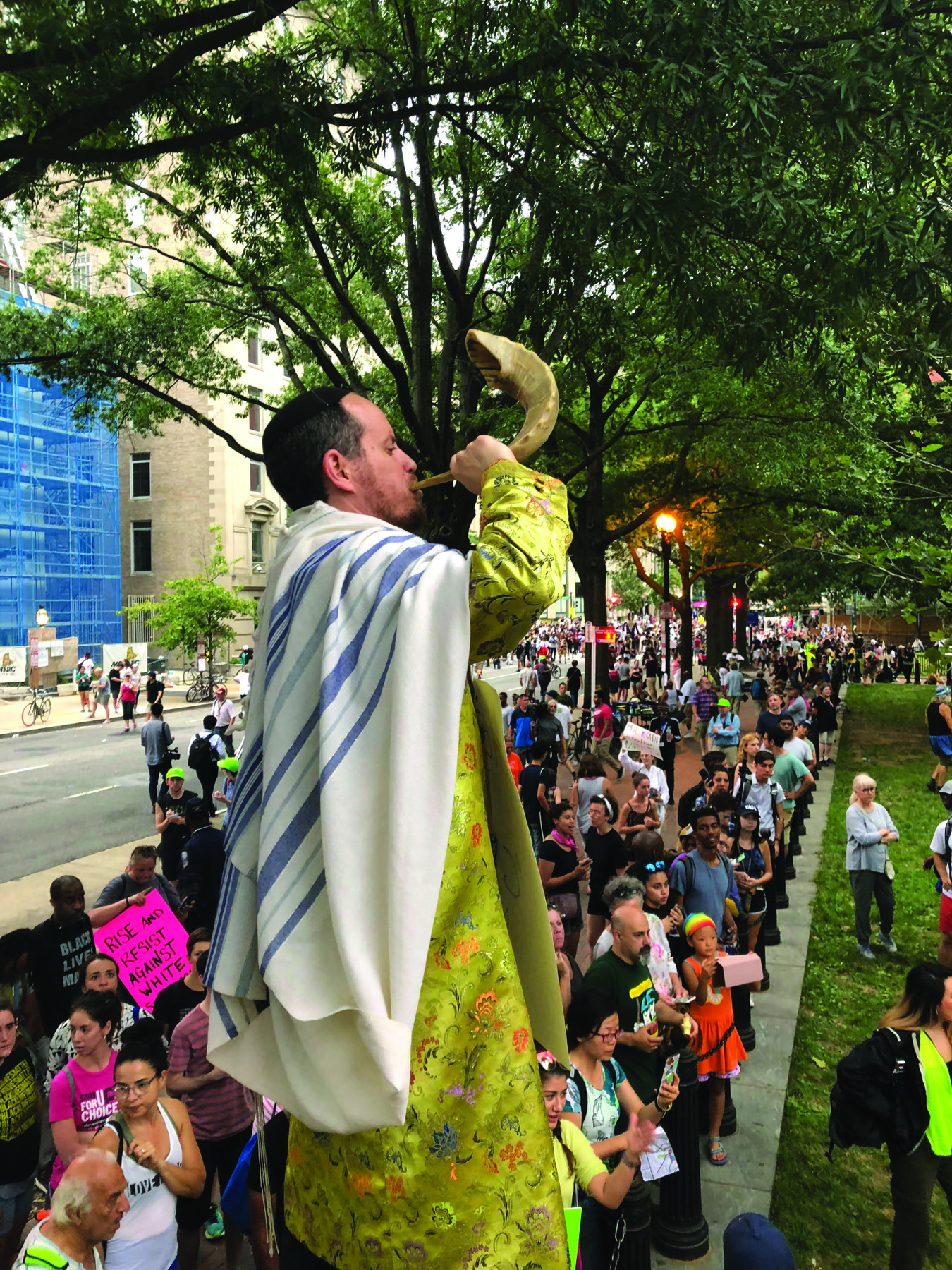
Image of the Week: A Shofar Blast at ‘the Nazis’

Photo courtesy of Rabbi Shmuel Herzfeld

Rabbi Shmuel Herzfeld, leader of Ohev Sholom — The National Synagogue in Washington, D.C., blows the shofar “to drown the evil shrieks of the Nazis” during a counterprotest against white nationalists’ “Unite the Right 2” rally in the nation’s capital on Aug. 12. Thousands of counterprotesters heavily outnumbered the approximately two dozen white nationalists who turned out to demonstrate on the one-year anniversary of the “Unite the Right” rally in Charlottesville, Va., which turned violent and led to the death of 32-year-old counterprotester Heather Heyer.

Image of the Week: A Shofar Blast at ‘the Nazis’ Read More »

Table for Five: Shoftim

Weekly Parsha: One Verse, Five Voices
Edited by Salvador Litvak, the Accidental Talmudist

Is there anyone afraid and disheartened? Let him go back to his home, lest the courage of his comrades flag like his. (Deuteronomy 20:8)

Rabbi Michael Berenbaum
Writer, Lecturer, Professor, American Jewish University
On the eve of battle, most soldiers are afraid, fearful of death or injury, fearful also that they will run, uncertain that they are prepared to kill. Rabbi Akiva, who is usually the most fanciful of rabbis — the one so given to interpretation that he meditates on the crowns of letters — understands this verse quite simply: It says what it means. The man is afraid that he cannot withstand the rigors of war, a sword hanging over his head.

The Hebrew is intriguing — “soft of heart” is the way that Everett Fox translates it; Robert Alter interprets it as “faint of heart.”

The Torah understands that fear is contagious and demoralizing for an army. And from time immemorial, military commanders have understood that military recruits must be toughened by training, by the harshness of their conditions. 

The soft-hearted can be dangerous in battle, perhaps even more dangerous on the eve of battle when fears permeate the air. The characteristics so important and so admired in civilian life may endanger a military mission. 

One must not give in to that softness and flee, and yet we dare not have a hard-hearted military. 

For everything there is a time; there is a time for softness and a time for toughness. Perhaps also a time for both.

Cantor Michelle Stone
Shalom Hartman Institute of North America
Is it undignified to be afraid? Fear is often treated as a sign of weakness. As a result, some commentators sought alternative ways to interpret “afraid and disheartened.” But Rabbi Akiva explains that the verse means what it says: This person is afraid to fight in battle and should therefore go home. But this doesn’t absolve him of his responsibility. Chizkuni, the 13th century French commentator, adds that he still must provide supplies to the front. 

The message is clear: We must take the time to really know ourselves. Not everyone is cut out for combat, but every person who supports the front line is an essential component of its success. We all strive to be positive contributors to our communities and our society. We are most successful when we choose roles that best suit our strengths and minimize our deficiencies. 

We are about to enter the month of Elul, the time of year when we engage in heshbon hanefesh, an accounting of our soul. This is a good time not only to take stock of our actions over the past year, but also to get to know ourselves better; to ask ourselves critical questions: What do I do best? What do I have to offer? What am I not well-suited for? So, no, it is not undignified to be afraid. We bring dignity to ourselves and others when we take the time to figure out where and how we can be most beneficial to the greater good.

Rabbi Ilana Grinblat
Vice President of Community Engagement, Board of Rabbis of Southern California
Recently, Avraham Perlmutter came to The Jewish Federation of Greater Los Angeles and shared his story of how he survived the Holocaust, chronicled in his new memoir, “Determined.” He was asked: What gave you the courage to keep going, after hiding in a hole in the ground, dodging bullets and skirting death time and time again? 

He explained that he had been a “wild child” who tended to sneak out and run away from his teacher and baby sitter. This instinct to flee served him well when he was captured by the Nazis and always managed to escape. He also noted that since he was raised religious, he believed God was watching over him and that he would survive. 

The verses from this week’s Torah portion show the danger of becoming disheartened. One soldier’s anxiety can spread to others and cause despair. During war, losing hope can lead to losing one’s life. 

Surely, fear is a contagious disease. Anxiety about the unknown can spread from one person to another and build over time. 

Yet, as terror is contagious, so too is hope. Perhaps by listening to the stories of those far braver than ourselves, we can catch a smidgen of their courage and their faith. To hear survivors’ stories, visit jewishla.org/save-our-survivors-resource.

Rabbi Chaim Singer-Frankes
Interfaith Hospice Chaplain
Breishit to Devarim: growth. In Genesis, God asks Adam, “Aayeka,” (“Where are you?”) What was the actual question? “Adam, [what] were you thinking?” or “Whom, my beloved creation, have you become?”

By Shoftim, God knows what we might, or might not, be capable of. Considering would-be soldiers, She reveals deep know-ledge of us: the need for dispensation. Our ancestors stand on the threshold of a holy war, and suddenly an exemption: “If your heart isn’t in it, please stay home.” 

Rashi cites Rabbi Akiva describing soldiers who “can’t even stomach the sight of an unsheathed sword.” God no longer asks where we are; She knows and meets us there. By Shoftim, God knows that the Law is not only black fire and white fire; with us, there is going to be gray. This holy wisdom mandates “cities of refuge.” We are going to err. It’s going to get messy. There are consequences, but also safety, for those whose fate would otherwise be spiraling toward reprisal or payback. 

In Parashat Noach, God’s solution is extreme, almost instantly regretted. By Shoftim, we and God have learned that mutual vulnerability and acknowledgment of limitations is essential for trust and safe love. 

The partnership will fray at times. In Lamentations, “ayeka” morphs into “eicha.” We do the asking of God: “How?” How can this be happening? At times, it will exceed our fantasies; hear the delighted Omniscient One in Bava Metzia 59b: “My children have surpassed me, my children have surpassed me!”

Rabbi Mendel Schwartz
The Chai Center
When I was 17 years old, my father, Schwartzie, pulled me aside and said, “Mendel, you’ll be graduating high school at the end of this year, and I want you to leave Los Angeles, away from home, and study in a yeshiva.” He suggested the yeshiva in Paris. The truth is, I was playing hooky throughout my high school years, dodging Talmud classes for matinees at the theaters. 

So I enrolled in the yeshiva. This place was a monastery. High gates, electricity that went off at 9:30 p.m., water valves that were closed at 10 p.m. (no more showers at this hour, no lights). All I was able to think of for the first eight weeks in this yeshiva is when can I get back to Venice Beach? Eventually, I adapted, and I spent two years there. My father was pleased. I am the person I am today — married with six kids, leading a congregation of 3,000 people — as a result of that critical move when I was 17. 

Now it is my son turning 17. He leaves this week to a Mechina IDF program in the Golan Heights to prepare for the Israel Defense Forces (IDF). If Ari was fearful or fainthearted, the Bible forbids him to fight (Deuteronomy 20:8). The IDF needs strong and brave men and women. The boys and girls who want to study in a yeshiva or seminary, let them be “lest they melt the heart of others.” They serve in other ways. 

Israel, her army and the Torah continue to be the beacon of light, hope and driving force for the Jewish people. 

Table for Five: Shoftim Read More »

Tova Leibovic-Douglas: The Reluctant Rabbi

Rabbi Tova Leibovic-Douglas was ordained this past May at the Ziegler School of Rabbinic Studies at American Jewish University, but she’s not yet comfortable with being called rabbi. 

The 32-year-old native Angeleno will have to get used to it because she’ll be leading High Holy Days services this year at the Sanctuary @ Pico Union, an alternative congregation housed at the multicultural arts and interfaith Pico Union Project in downtown Los Angeles.

She was happy to talk with the Journal, though, about her Jewish journey, developing High Holy Days traditions with her two young children, her time working as a spiritual counselor at Beit T’Shuvah — the Jewish addiction-treatment facility — and how she’s reluctantly learning to embrace the moniker “Rabbi Tova.”

Jewish Journal: How did growing up with a father who was raised ultra-Orthodox and a mother who was raised Methodist influence your Jewish journey?
Tova Leibovic-Douglas: In a certain way, both of my parents chose Judaism. My mom, who grew up in the South, converted to Judaism and my dad, who left the ultra-Orthodox world in his late teens, chose to live a Jewish life he did not grow up with. So, although I didn’t grow up in those worlds, per se, I was exposed to them and they certainly influenced me as a human being and also as a rabbi. It allowed me to step in and out of different worlds I would otherwise not be exposed to. 

JJ: What traditions for the High Holy Days are you developing for your family?
TLD: Our 3 ½-year-old is at the stage of really understanding the High Holy Days in a way she can communicate. We were just talking about how it is Elul and what it means to blow the shofar. I’m thinking of asking her a question, maybe before bed, maybe in the morning, like, “What are you thinking about in terms of your life today?” Generating these conversations as a family is something we can do as our kids continue to grow up. And, obviously, singing fun songs like “Apples Dipped in Honey.” 

JJ: Why did you decide to become a rabbi?
TLD: When I was cleaning out old notebooks, I found an essay I wrote at Milken [Community Schools] on my Jewish theology and what I hope for from my Judaism. I wrote that maybe one day I would be a Jewish leader or a rabbi. I wrote in parentheses “hahaha,” which is funny to me. I didn’t know women rabbis existed until I was 13, and it wasn’t a goal of mine. 

JJ: What was your goal at the time?
TLD: To be a teacher, for the most part. And a mom. I just never could see myself being a rabbi. Something about the title.

“At Beit T’shuvah they insisted I call myself Rabbi Tova, so I do it, but it’s not exactly the most natural thing. I also think rabbis are human just like anybody else. They are just people doing their best in the world.”

JJ: Are you now getting used to the title?
TLD: Slowly. At Beit T’Shuvah they insisted I call myself Rabbi Tova, so I do it, but it’s not exactly the most natural thing. I also think rabbis are human just like anybody else. They are just people doing their best in the world. There is something about having a title when talking to a human being that feels sort of strange.

JJ: In a letter on the Pico Union Project’s website, you wrote about being skeptical of the “What if?” theme of the congregation’s High Holy Days services. Why is that?
TLD: I think sometimes there’s a piece of me that says “What if,” and inserts whatever “what if” is, and then I want to say, “So what? Who cares about the ‘what if’? Let’s be here. Let’s be now. Let’s be present.” But there’s a lot of emotion and spiritual depth when we do explore ourselves in multifaceted ways, so I think the [what if] question could be perfect for what we are trying to do on the High Holy Days, which is to reflect deeply about ourselves. 

JJ: What’s next for you?
TLD: I’m not sure where my rabbinate is going to go, but I’m really excited about that. I feel like I’m in a place where I am really blessed to live in Los Angeles. There are amazing communities and a lot of opportunities to reach many different people, and I think all of the experiences I’ve had thus far in rabbinical school have been eye-opening. Casting a wide net is sort of my vision for my rabbinate.

Tova Leibovic-Douglas: The Reluctant Rabbi Read More »

Life-Threatening Moments Inspired Her Art

A bike accident, a traumatic brain injury and coronary artery disease don’t typically invoke images of lilies. However, a pink lily — symbolizing love, devotion and purity — is exactly what came into Jamie Lee Hoffer’s mind after she overcame all three of these obstacles.

Hoffer, 62, an artist and preschool teacher, created a pale pink lily in the center of one of her paintings a year after she fell while riding her bike on May 30, 2017. When she fell, she fractured her skull and experienced a traumatic brain injury (more specifically, a subdural hematoma), which she says required her to remain on bed rest for three months. She also lost her sense of smell. 

After being released from the hospital last September, the Beverlywood resident returned to teaching preschool at Temple Isaiah in West Los Angeles. However, she said she had no desire to go back to her art studio. 

“I was very scared that something that means so much to me — my creative energy — might have been taken away,” Hoffer said. “There was no mojo, no muse.” 

At the time, she blamed her exhaustion and depression on early aging. However, when she sought medical attention for severe chest pains this past May, she discovered she had a 90 percent blockage in one of her main arteries. She received a stent and immediately felt better. 

“I questioned my reasons for showing my art. I never felt that I was ready or good enough or deserved it. Sometimes you need a big hit on the head to realize that you have something that is beautiful to share.” 

The image of the lily, she said, came to her the night after the stent was implanted. It was only then, she said, that she stopped having a recurring nightmare of drowning in murky water. Instead, she dreamed of wading in paradise. 

“I’m in this crystal-blue beautiful water,” Hoffer said during an interview with the Journal at the National Council of Jewish Women (NCJW) building in the Fairfax District, where she is set to hold an art exhibition later this month. “I see the sparkles of the sun, and I come out of the water and there’s water lilies and lily pads everywhere. And I just went, ‘Oh my God, water lilies.’ ” 

It was then that she determined the lily would become the symbol of both her accident and her upcoming exhibition, which opens Aug. 19. 

Titled “After the Fall,” the exhibition will showcase 30 of Hoffer’s works, created from 2013 onward. 

“I don’t know why I have not had a solo show ever, and I’m 62,” Hoffer said. “I just know that everything became very precious to me — not my work — my life, my family, this Earth.” 

Hoffer’s work mixes damar crystals and beeswax to make her own encaustic medium — a technique she discovered 10 years ago when she visited the Los Angeles County Museum of Art (LACMA) and found that some of her favorite paintings, including Jasper Johns’ flags, were labeled “encaustic” instead of “wax.” 

After seeing Johns’ work at LACMA, Hoffer said, “All of a sudden, a light went off in me and it completely changed my life. I looked up everything I could in encaustic. I started experimenting. I’m still experimenting.”

In her work, Hoffer paints with light colors and portrays nature and abstract shapes. She hopes to calm people with her art and provide them with an escape from their busy lives. 

“I really believe that art that is very political and has a statement and is really in your face all the time, that there is a place for that art,” she said. “The way the world is right now, there is so much hate and anger and opposition that I just want to give people a break. And if they look at my art and find themselves lost in it for a couple minutes, seconds, whatever, and they get something of acceptance and love and gratitude and forgiveness, then that’s all I want my art to do.” 

Hoffer said she believes she’s now producing the best art of her life. She feels like herself again and has stopped letting any fear of criticism get in her way.  

“You know, your doctor tells you that you’re a walking time bomb, and you realize that you could have died and you didn’t,” Hoffer said. “I questioned my reasons for showing my art. I never felt that I was ready or good enough or deserved it. Sometimes you need a big hit on the head to realize that you have something that is beautiful to share.” 

She added that in the wake of the accident she feels a “higher sense of urgency to be my true self. I truly feel that I have an obligation to spread love, kindness, compassion and forgiveness. Being a preschool teacher gives me that opportunity. 

“This is what being a Jew means to me.”


The opening reception for “After the Fall” is Aug. 19 at the NCJW, 543 N. Fairfax Ave., 90063. The exhibition runs through Nov. 15. For information, visit ncjwla.org.

Evita Thadhani is a high school junior at Milton Academy in Massachusetts, and a Jewish Journal summer intern.

Life-Threatening Moments Inspired Her Art Read More »

Novelist in Jail Finds Herself in 22 Books

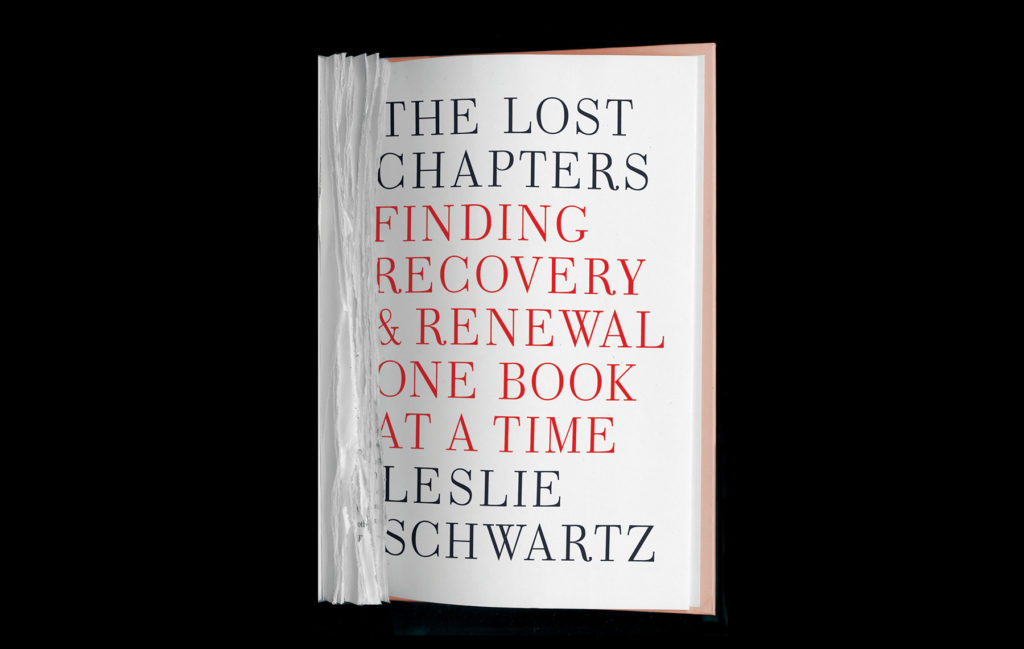
Leslie Schwartz is a Los Angeles-based novelist (“Angels Crest,” produced as a motion picture in 2011, and “Jumping the Green”) and a revered teacher of writing. But her latest book, “The Lost Chapters: Finding Recovery & Renewal One Book At a Time” (Blue Rider Press/Penguin Random House), is a memoir, harrowing but ultimately redemptive, that begins with her arrest for drunk driving in 2014 and ends with a victory over alcoholism achieved through the healing power of words on the printed page.  

“I’d committed my offenses while in a 414-day relapse from double-digit years of sobriety,” she explains. “I had fallen so profoundly into the mental illness that accompanies alcoholism that I was no longer able to work. … My family eventually moved away. My friends, no longer able to help me, left. Even the dog was scared of me.”

Schwartz would only serve 37 days of her 90-day jail sentence, but each day was a step toward self-liberation. “Living through this experience exposed me to new levels of human cruelty,” she writes of what she saw behind bars. But she also was afforded the privilege of receiving three books a week from friends and family. Those books saved her life, and changed it. “As much as anything else, I credit stories for that; for making me feel whole in a place where the carcasses of addiction were so evident, and the temptation to otherwise return to the old life of an addict was suspended each day, one word at a time.”

The subtext of Schwartz’s intimate and affecting memoir — and I use the word “subtext” literally — is a reading list of 22 books that were her companions while in jail, ranging from “The Big Book of Alcoholics Anonymous” to “One Hundred Years of Solitude” by Gabriel García Márquez, from Maya Angelou’s “I Know Why the Caged Bird Sings” to “The Woman Warrior” by Maxine Hong Kingston. So, in a sense, the story that Schwartz tells so powerfully in her memoir is only the first step in the immersive reading experience that she invites us to explore for ourselves. Indeed, I can readily envision a variant on the classic recovery program that includes not only the famous 12 steps but also Schwartz’s 22 recommended reads.

Schwartz demonstrates her gift as a storyteller as she shows us what it looks and feels like to be behind bars. A rabbi who counseled her before she surrendered to the Century Regional Detention Facility  in Lynwood told her, “They can take your clothing, but they can’t take your dignity.”  Schwartz confides to her readers, “He was wrong.” She may have recovered from alcoholism while in jail, but she now carries a new affliction that began with the beam of a flashlight aimed at her genitals: “Even in the years to come, I cannot release the memory of such indignity, the exposure of my most private body, under threat of gun and billy club, to people who collect a paycheck for probing me there.” 

But Schwartz’s memoir can also be sublime and even exalting. On her first night in a jail, a fellow inmate named Melissa asks if she can get under the covers with Schwartz — not for sex but for the comfort of human touch at a moment of fear and loneliness. They never see each other again. “Yet, for that brief moment when Melissa was asleep beside me, I understood what ‘holy’ meant,” Schwartz writes. “I didn’t really comprehend, until a long time later and far removed from that place, that the God who I believe had abandoned me was still there and was not only answering my prayers but saying them for me, too.”

Although Schwartz is frank about the dangers and afflictions of imprisonment … “The Lost Chapters” may be the most upbeat prison memoir ever written.

Not every fellow inmate was so angelic. Schwartz was assigned to a cell with “a butch lesbian who played Hitler in a [jail] play about Fascism, an ironic note since it would appear I was the only Jew in jail.” She was not happy to be bunking with Hitler, as Schwartz calls her cellmate, and yet Schwartz still offers to carry a message to Hitler’s girlfriend in another part of the jail. Hitler is thankful, and Schwartz finds herself touched by Hitler’s gratitude.

“[M]y heart opened to Hitler and her place in the world,” Schwartz recalls, and she finds validation in a passage from one of the books on her jail reading list, “When Things Fall Apart” by Pema Chödrön: “The only reason that we don’t open our hearts and minds to other people is that they trigger confusion in us that we don’t feel brave enough or sane enough to deal with.”

The momentous event in “The Lost Chapters,” of course, was the day she discovered the prison “library.” She puts the word between quotation marks because the library consists almost exclusively of a two-tiered metal cart of “Bibles, study guides for Bibles, Bible excerpts, Bible journals, Bibles in español, and AA books.” But a fellow inmate hands her a book called “Ester and Ruzya,” a story about two Jewish grandmothers who survive both Hitler and Stalin. “You might like this,” the young African-American woman says. Again, it is a revelatory experience for Schwartz, an example of “the wizardry of books.”

“The spooky thing about jail, I will find, are these small incidents that arise, as if out of smoke,” she recalls. “Like a magic trick. She must have figured I was Jewish. I don’t know how, though I suppose most people’s Jewdar goes up when they look at me. Regardless, I chose to view her gift as the olive branch it was for the words she couldn’t say to me.”

Although Schwartz is frank about the dangers and afflictions of imprisonment, ranging from the putrid smell of the cells to the prevalence of staph infection to the brutal treatment at the hands of the guards, “The Lost Chapters” may be the most upbeat prison memoir ever written. “I saw a pattern in jail, of being utterly and completely cared for,” Schwartz writes. “It happened over and over again — the people I encountered showing me only love, kindness, and respect — as long as they were inmates.”  Even Amazon, the Evil Empire in the eyes of many authors and publishers, is a benign presence in Schwartz’s eyes because an Amazon package in the mail represented a new book to read.


Jonathan Kirsch, attorney and author, is the book editor of the Jewish Journal.

Novelist in Jail Finds Herself in 22 Books Read More »

From Lace to the Art of Steel

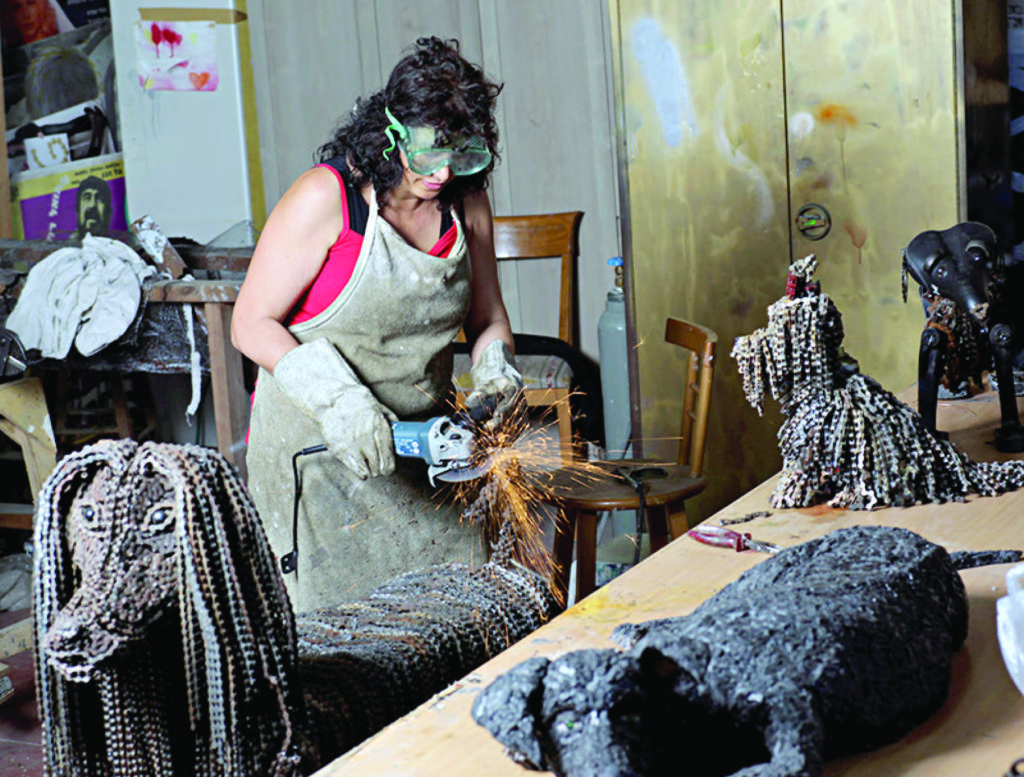
It might be the strangest career shift ever: A woman who was a successful wedding dress designer left it all to sculpt dogs out of discarded bicycle parts. 

But Nirit Levav Packer has never been happier. For the 55-year-old Tel Aviv native, happiness is inexorably linked with the ever-changing process of creativity. Despite owning a thriving bridal-wear business with multiple stores throughout Israel, Levav Packer felt her creativity was going stale.

“It just no longer felt good. Most of the day-to-day [routine] had very little to do with creativity,” she said in her newly minted gallery in Jaffa’s flea market. “It was more [about] running a business, dealing with seamstresses, customers and that sort of thing.”

So, in 2013, Levav Packer shuttered her business and embarked on a journey of self-discovery. She took courses in everything from ceramics to silversmithing. She built a greenhouse in her backyard in lieu of a workshop and started creating, using little more than her intuition and bits of scrap. 

“I just started collecting stuff: silicone, mattress springs — anything I could get my hands on — and played with it until something emerged,” she said. 

Pretty soon, Levav Packer had become an obsessive collector of junk. When she had enough of any one item—keys, matches, stones or candles — she’d start to create. But while people loved her work, they weren’t “getting” it, she said. “I knew I had to focus, to narrow it down to one subject and one material.” 

And so, “Unchained,” a series of sculpted dogs made out of bicycle parts, was born. Like real dogs, every one of Levav Packer’s canine avatars is unique: from “Sit the Dachshund,” made with a bike seat for the head, pedals for paws and a bicycle chain for the body, to Tuzy the pooping mutt. Despite their cold, steely elements, the one thing these creatures have in common is a startling warmth and lifelikeness.  

I just started collecting stuff: silicone, mattress springs — anything I could get my hands on — and played with it until something emerged. — Nirit Levav Packer

Another series, “From Within,” documents Levav Packer’s fascination with pregnant women. Crude materials typically associated with masculinity, such as engine valves, are juxtaposed with the soft lines of the female body. But for Levav Packer, their coupling is seamless and represents the power of women, which, according to her, is felt most during pregnancy and childbirth.  

Her unconventional use of materials was influenced by her parents: Her mother is an arts and crafts teacher who told Levav Packer it was a pity to throw things out, and her father is a well-known set designer for both theater and film. He fashioned the planes for the 1976 movie “Raid on Entebbe.” 

The nature of her father’s job meant that he was often under deadline pressure. During those times, Levav Packer was instructed to skip school and come and help him in his workshop, which is where she learned to weld. 

The opening of her first gallery in Jaffa this month represents a reconciliation of sorts surrounding a central conceit in Levav Packer’s creative process. While on the one hand her instinct is to close herself in her studio and enter into her work as a kind of solitary meditation, she is acutely aware that her creations have far more exhibitionist tendencies than their creator. 

“Everyone who encounters them is moved in some way,” she said. 

Because her creations beg to be seen—and in some cases even touched—Levav Packer only charges a token entrance fee of a couple of dollars. The idea, she said, was to make sure that even those without pockets deep enough to buy art feel comfortable enough to come in and enjoy it. 

Her gallery — converted from stables that once belonged to the historic Khan hotel — has exposed brick walls and yawning arches, and is just as raw as the materials she uses in her art. Her rags-to-riches sculptures look as if they had always been there.

From Lace to the Art of Steel Read More »

Why Cooks Prefer Farmers Markets

When I first started working at the American Embassy in Uganda, I had just come off of eight years of owning and cooking in two popular restaurants. I’m a bit challenged when it comes to change and working within structured environments, so I was nervous about not being able to cook what I wanted in the embassy kitchen. Of course, when you fear something, that’s when it’s sure that a form of your fear will make its way toward you.  

Sure enough, within the first weeks of working in my new digs, I got a disconcerting email from someone in management who wanted me to print out an advance list of our daily specials. Suddenly, my trepidation about the difference I would have to endure between having my own restaurants and the institutional cooking I felt was being required of me in the embassy seemed justified.  

After thinking about it, I realized that it wasn’t abnormal for me to feel boxed into a corner by being told to write out specials in advance; rather, it was a completely normal reaction of a cook. Aside from the fact that chefs don’t like to be told what to do in the kitchen, unless it’s by a much more experienced chef, the very cornerstone of any creative endeavor is spontaneity and playfulness. The artist Marc Chagall said, “If I create from the heart, nearly everything works, if from the head, almost nothing.” But there is a heavy practical element to cooking, both at home and in a professional kitchen. While creative expression can benefit from dreaming and playing, cooks need to balance out the “heart” and “head” elements of their day. If all I ever did at work was my own cooking experiments, I think I would have been thrown out of the embassy kitchen long ago.  

Like any other task, kitchen work is a juggling act made up of creativity but also of practicality. To make something happen in a kitchen, you must select and refine your ideas in order to make them real. This is where farmers markets come into play as a tool that any cook can employ to become better. When you walk around a market and allow yourself to take in the beauty of the myriad produce on display, you can’t help but gain passion and appreciation for what it takes for a meal to get onto your plate.  

Few places will tell you more about a culture than a market. The driving force in a market is, after all, its patrons’ buying habits, so if you are in a major metropolitan area, you will find that the farmers grow and sell for a combination of home cooks and professionals. Chefs develop relationships with farmers and vendors, and this is the key to getting the best produce as well as great deals on slightly bruised (not pretty to the eye) overstock. In the summer, when you can get a bargain on tomatoes, you could, for example, become inspired to make gazpacho or sauce for pasta that you can preserve and keep for the winter months.

Also, it’s quite rewarding talking to farmers and vendors, and even asking them for recipes. People who grow food for a living often have great tips and tricks up their sleeves. My favorite salad recipe was given to me by a farmer, and I’ve learned a lot about pickling and spices from others. Farmers are quite literally “experts in their fields” who are usually more than happy to share their favorite preparation methods with you. I often ask sellers in markets to pick the best produce for me and because they are motivated to make you a return customer, you will often get the best quality goods this way.

Learning about what’s in season and trying to stick to locally grown produce makes a difference. It’s no coincidence that food eaten in its growing season is tastier and better for you. Of course, you will find some vendors in farmers markets who are resellers of merchandise that comes from warehouses, but this is generally the exception and it’s easy to spot. You simply can’t get the same flavor and texture out of produce when it’s been grown on the other side of the country and then shipped or frozen. I find it best to buy produce from sellers who have only one or two of the same type of items for sale — tomatoes and peppers for example, or apples and pears.

Although it’s more convenient to do a big shop, your cooking will improve if you try to buy less but more often. If you make yourself a regular at a farmers market and buy only what you need for one or two days, you will notice that you are avoiding waste. Sometimes, if I see good-looking peppers at the market, I’ll think about roasting or stuffing them, but that doesn’t mean I have to buy 10 pounds when I know I have a busy week ahead of me. Be realistic about your time constraints when shopping and be more conscious in your approach to shopping or you may end up with a whole counter full of rotting produce and a Big Mac in your hand. Great produce that’s in season is usually perfect when you prepare it simply and you have the ability to mix and match flavors with herbs and seasonings. If you buy too much and end up throwing away a good portion of it, you are less likely to go back to the market for more. Having less to work with also forces you to be more mindful in your approach to cooking. It’s one thing to experiment with one meal’s worth of produce and quite another to potentially ruin a huge batch of something. While you always have to take risks to experiment with a new dish, psychologically you are more likely to continue to take chances if your last disaster didn’t involve a huge loss.

Going to the market without a list is like a mini vacation. I know this sounds crazy and you may think it’s an invitation to overspend and get overwhelmed, but with some practice you may find this will unleash your creative cooking side. Allow yourself the luxury of looking to see what appeals to your eye when you go to a market. Often, it will remind you of something you ate on a trip or at a restaurant. This is how I come up with my specials most of the time. Looking at a pile of papaya can make me remember the markets in Thailand and remind me that I have a hankering for a Thai green papaya salad. It’s hard to get that kind of motivation from a grocery store, no matter how beautifully presented the fruit and vegetable section is.

While I’m not suggesting that you add to your already busy lives by centering your whole routine around shopping for produce, if you are a cook who needs regular doses of inspiration, there is no place better to find it than in the colorful, dizzying bounty of your local farmers market.

This is what I told the woman who emailed me at the embassy, when I was new and fearful and feeling worried that I’d just made a huge mistake by accepting the job there. After explaining that I would prefer to offer the freshest possible food that would revolve around what’s in season with my local farmers, rather than a set menu that I’d have to write in advance, I received a reply by email in under a minute. It just said, “Of course! That’s why we picked you for the job!”  

As it turns out — she was a cook.


Yamit Behar Wood, an Israeli-American food and travel writer, is the executive chef at the U.S. Embassy in Kampala, Uganda, and founder of the New York Kitchen Catering Co.

Why Cooks Prefer Farmers Markets Read More »

Elul Week Two: Working on Our Brokenness

This is the second of six weekly columns by Rabbi Zimmerman leading up to Yom Kippur.

Last week, we talked about how essential it is for each of us to do our own soulwork during the month of Elul, preceding Rosh Hashanah. Now let’s look at the overarching theme of the High Holy Days — acknowledging our brokenness and seeking wholeness.

Several core stories in the Torah provide a metaphor for the journey we are challenged to make at this time of year. Prominent among them, the story of the Jewish people at Mount Sinai. 

When God proclaims the Ten Commandments, all the people (kol ha’am) experience a connection with the Divine at the deepest level. The text depicts the encounter as a mystical union. Our sages likened it to a marriage ceremony in which the Jewish people say yes to a binding, intimate relationship with an invisible God that is all that is, ever was and will be. 

But this radical notion of God as partner is too difficult for the people to maintain, and when Moses goes up on the mountain to receive the stone tablets and the entire Torah, the people lose connection with the unseen God. They fall back into old patterns. They build a golden calf.

Moses hears about the golden calf from God. After descending the mountain with the tablets and seeing the people’s worship of the idol, he throws the tablets to the ground, smashing them to pieces. The relationship is shattered. 

In the forthcoming days until Rosh Hashanah, we have the opportunity to acknowledge what is broken in our lives.

To the rabbis, the golden calf represents a profound betrayal of the marriage vows the people made with God.

Moses decides he wants to repair the relationship and heads back up the mountain to plead with God to forgive the people. The beginning of his petitions happens on Rosh Chodesh Elul.

Let’s take this story forward into our own lives. The golden calf story is about us and the way we have become estranged from holiness and unity. It’s about losing connection and forgetting what our commitments are. We forget, we veer off, we pray at the altar of the quick and easy. We abandon the vows we have made to our own selves or to the people we care about. We forget what is truly important.

In the forthcoming days until Rosh Hashanah, we have the opportunity to acknowledge what is broken in our lives. In this month of Elul, the shofar blows each day and beckons us to search our past year (or lifetime) for what needs to be healed. We bear witness to the ruptures we have experienced and committed in our relationships, with our own selves, in our communities and with God. 

Moses is successful in persuading God to forgive the people for their transgression with the golden calf. We hope that we, too, will be forgiven for how we have strayed. 

And then a second set of tablets is given. When? On Yom Kippur! In the liturgy of Kol Nidre, we read these words that God spoke to us: salachti ki’devareicha (I forgive you, as you have asked). 

You might think that after receiving a second set of tablets, the first, shattered set would be discarded. Who wants to retain the memory of betrayal?

But no, the rabbis tell us the broken tablets were kept in the same traveling ark (Mishkan) with the new, whole ones.

This is a profound teaching.

We carry our brokenness with us — not as a reminder of where we went wrong or what has befallen us, but with the knowledge that this, too, has shaped us. Also, not everything that is broken can be fixed. Some relationships are unhealthy, and it is a betrayal to our best selves to stay in them.

So, with that as preamble, here are the Elul journal questions for this week: 

  • Where have there been betrayals this year (even self-betrayals)?
  • What basic commitments have we forgotten?
  • In what ways have we veered off the path? 
  • What has been shattered this year?
  • How have we been complicit?
  • What needs healing?
  • Next week, we will continue our journey toward healing and wholeness.

Rabbi Jill Berkson Zimmerman is a rabbi-at-large. She can be found online at ravjill.com

Elul Week Two: Working on Our Brokenness Read More »

Let Me Tell You What’s Cool About Shul

As a child, I was told that I have to go to shul to pray. And like a lot of kids, my experience was neither fun nor interesting. And for a lot of people, because of that experience as a child, that’s where it all ended.  Imagine making a decision at twelve or thirteen and riding that out for the rest of your life. But that’s what people do.

For me now, going to shul covers so many things. It’s serious, fun and interesting. Now when I go not only do I get to pray, but I also get to watch other people pray. Praying is one of the few very private events that people do publicly. Watching someone commune with God is amazing. I also get to see people not praying, but rather sitting very relaxed, reading a newspaper like they’re at a bus stop. In some ways that’s more amazing than watching them pray. I’m guilty of that one.

I get to see people celebrating or mourning giant milestones in their lives. Bar Mitzvahs, upcoming marriages, anniversary’s, passing of loved ones. I get to see people hugging each other in very loving ways. I get to hear the Rabbi or the guest speaker give a talk that they hope will change our lives for the better. I get to ask people how they’re are doing after an operation or how their new baby is or how they’re holding up after a major loss.

I get to laugh at a new joke and I get to tell them one they’ve never heard. I get to have a bite to eat with friends and get to watch people put food in their pockets to take home for later. I get to watch boys and girls giving their Bar and Bat Mitzvah speeches and talking about how much they love their families. I get to watch the proud faces of crying parents and grandparents, aunts, uncles, brothers and sisters as these kids move on to the next stage of their lives.

I get to watch six-year-olds leading part of the service. I get to find out about worthy causes to donate to. I get to take a nap when the Rabbi’s speaking. I get to watch people stop at people’s homes and wheel them to shul and I get to watch them bring them back home 4 hours later.

When someone tells you religion does more harm than good, take him or her to shul on a Saturday and point out all the good that is taking place.

But the thing that moves me the most is when I get to watch the tremendous loving care people give to some of their older friends and relatives when their lives have taken a turn for the worst. I get to watch them help put a Tallis on their father in-law and turn the pages of his siddur while pointing him to where we are. That one makes me cry every time. I get to see people that are sick praying for miracles and people well praying for the same. I get to see people thanking God non-stop for what they have. I get to go to people’s homes for meals and say hi to an elderly parent that now lives with them since the loss of a spouse. I get to see people opening their hearts.

There are a million more things I get to see by just showing up at shul. But most of all, I believe I get to be a better person by going and seeing all these things. Now when someone tells you religion does more harm than good, take him/her to shul on a Saturday and point out to him/her all the good that is taking place.

Best of all, I get to see goodness and hope up close.


Mark Schiff is a comedian, actor and writer.

Let Me Tell You What’s Cool About Shul Read More »