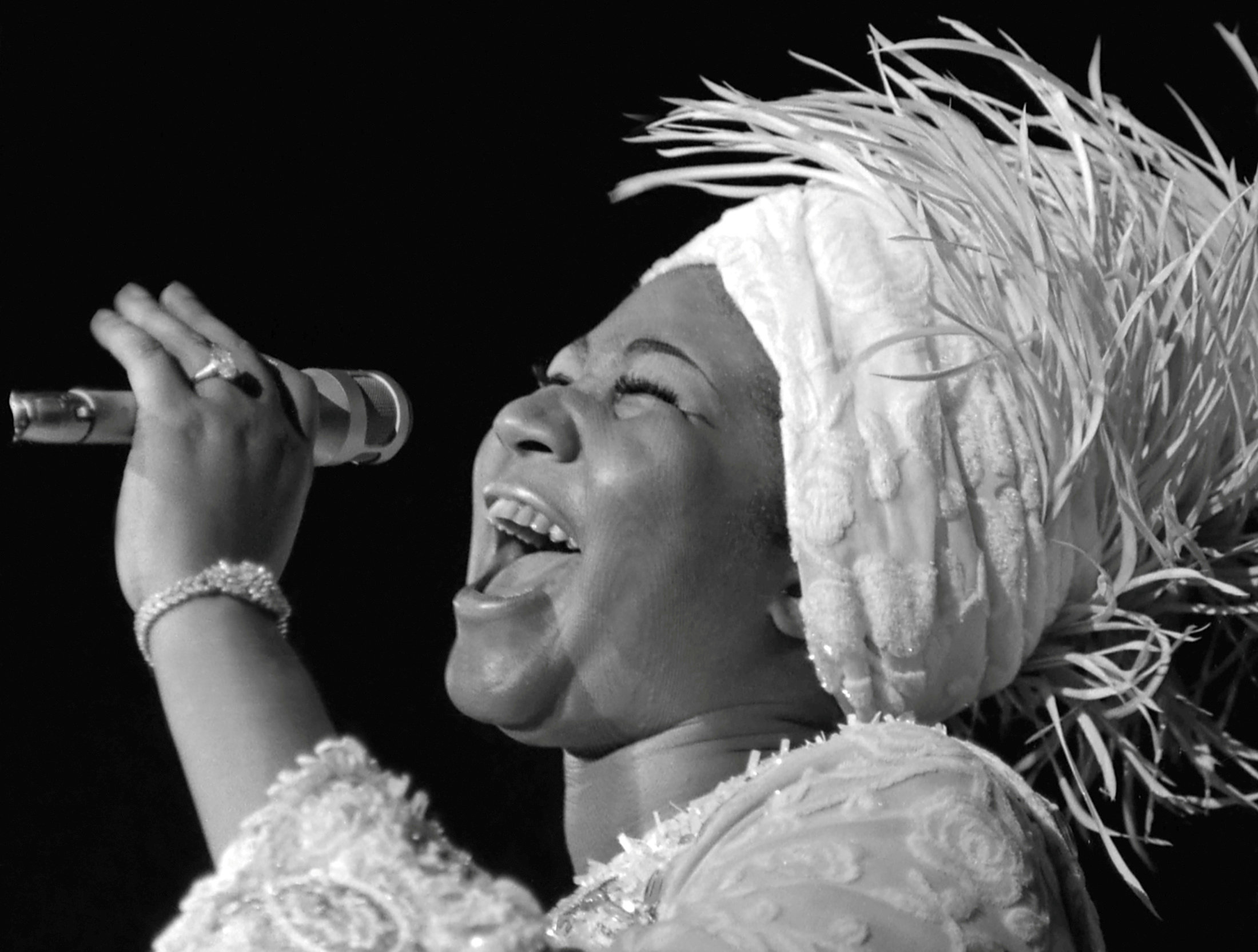
In a 1970 interview Aretha Franklin, the “Queen of Soul” who died this morning at the age of 76, told Jet Magazine “You don’t have to be Black to have soul.” She certainly lived by that maxim; it’s hard to imagine her career without the collaboration of Jewish label heads, songwriters, musicians and producers.
Born March 25, 1942, in Memphis, Tenn., Franklin got her start singing in Detroit’s New Bethel Baptist Church under the direction of her father, the minister and singer C.L. Franklin. By her teens she had already famous as a gospel singer, and had appeared with the Soul Stirrers (featuring Sam Cooke), and the Rev. Martin Luther King Jr. By the time she turned 18, she decided to move into secular music. Courted by multiple labels, including Berry Gordy’s fledging Motown, she signed with Columbia Records in 1960. Columbia marketed her more as a jazz singer in the mold of Dinah Washington, with limited success. It took a move to Atlantic Records in 1967 to turn her into a superstar.
At Atlantic, she was teamed with the producer Jerry Wexler, known as “the funky Jewish King of Black music.” He immediately recognized the unbridled emotion of her gospel singing was a major part of her appeal, and put her in the studio with the mixed-race Muscle Shoals Rhythm Section, and recorded her early hits “I Never Loved A Man (The Way I Love You),” and “Respect.” The latter song, which reworked Otis Redding’s call for male privilege into a call for liberation, was Franklin’s first No. 1 single.
Wexler (who explained his affinity for soul music to Stephen Whitfield that “as a Jew, I didn’t think I identified with the underclass, I was the underclass”) also brought the songs of Jewish composers to her attention, and together they had hits with songs composed by Jewish songwriters such as Carole King and Gerry Goffin’s “(You Make Me Feel Like) A Natural Woman),” Burt Bacharach’s “I Say A Little Prayer,” and Jerry Leiber and Mike Stoller’s “Spanish Harlem” and Paul Simon’s “Bridge Over Troubled Water.”
Wexler left Atlantic in 1976, and although Franklin remained at the label, the hits were not coming with the same frequency. She left Atlantic and, in 1980, signed with Artista Records, the label founded by Clive Davis. Like Wexler, Davis was a Brooklyn-born Jew, and he helped to revive her career, starting with a command performance at the Royal Albert Hall in London and a well-received cameo in the hit movie “The Blues Brothers.”
Davis freshened Franklin’s sound while retaining her deep gospel roots, and the result was a late-career run of hits. He connected Franklin with the songwriter Jeffrey Cohen, who co-write the chart-topping “Freeway of Love,” and “Jimmy Lee.” While health (and Franklin’s life-long fear of flying) cut down on her touring and recording in her later years. She performed the National Anthem at the 2006 Super Bowl, “My Country Tis Of Thee” at President Barack Obama’s 2009 inauguration, and in 2015 gave a show-stopping performance of “Natural Woman” at the Kennedy Center Honors for Carole King. A 2012 review in the Orange County Register said “she can still bring it, her voice barely diminished, still bristling with power and authority.”
With the announcement of Franklin’s death from pancreatic cancer, many of her collaborators paid tribute. Davis called her “truly one of a kind. She was more than the Queen of Soul. She was a national treasure to be cherished by every generation throughout the world.” On Twitter, King wrote of Franklin “What a life. What a legacy! So much love, respect and gratitude. R.I.P.”