fbpx

June 7, 2018

German Jewish Girl Allegedly Raped, Murdered By Iraqi Refugee

A 14-year-old Jewish girl was allegedly raped and murdered by an Iraqi refugee in Germany, according to German media reports.

The girl, identified as Susanna F., went missing on May 22. Her body was discovered near a railroad line in Wiesbaden on June 7, a city in the western part of Germany. According to media reports, it appears as if she had been raped and strangled to death. The suspect, 20-year-old Ali Bashar, is believed to have been her boyfriend.

Rabbi Aharon Ran Vernikovsky, who leads the Mainz Jewish community, where Susanna was from, told Juedische Allgemeine, “I am as shocked, sad and aghast about the violent death of Susanna as one can be.”

The Central Council of Jews in Germany issued a statement that read, “With deep concern, the Central Council of Jews in Germany heard the news of violent crime on 14-Year-old Susanna from Mainz. A young life has been put in a cruel way. Our deep compassion applies to relatives and friends.”

The suspect seems to have fled Germany, with one German outlet reporting that Bashar headed to Iraq. He is also wanted for robbery at knifepoint, among other alleged crimes.

A second suspect, a 35-year-old Turkish national applying for asylum status, was also detained on the matter but was later released.

More to come.

German Jewish Girl Allegedly Raped, Murdered By Iraqi Refugee Read More »

Hamas to Incite Gazans to Dress As Concentration Camp Victims for Border Riots

With another batch of riots set to occur at the Israel-Gaza border on June 8, Hamas plans on inciting Gazans to dress up as concentration camp victims.

Israel’s Channel 2 news is reporting that the protesters will be dressed in black-and-white striped uniforms in order to replicate what Jewish prisoners in the Nazi concentration camps were forced to wear:

The Simon Wiesenthal Center’s Rabbis Marvin Hier and Abraham Cooper condemned the “macabre ploy” in a statement.

“By dressing up kids as Nazi victims, proves the only god this terrorist organization [Hamas] worships is Moloch, the pagan god of child sacrifice, for whom children’s lives are worthless,” Hier and Cooper said. “When will NGOs and U.N. agencies devoted to protecting children finally raise their voices in protests against Hamas’ barbaric tactics, including the use of civilians, children nonetheless, as human shields and cannon fodder for their endless terrorist campaigns? When will the nations like Japan, who supplied beautiful kites for Palestinian children, protest the use of these kites to set fires in Israeli nature preserves and fields?”

The June 8 riots are expected to be particularly violent, as at least 1,500 flaming kites are reportedly being prepared and Hamas is inciting Gazans to breach the border fence. The Israel Defense Forces (IDF) have already begun warning Gazans to stay away from the border fence and is preparing to strike Hamas targets in Gaza.

Hamas to Incite Gazans to Dress As Concentration Camp Victims for Border Riots Read More »

Inside Scoop From ‘Fauda’s’ Creators

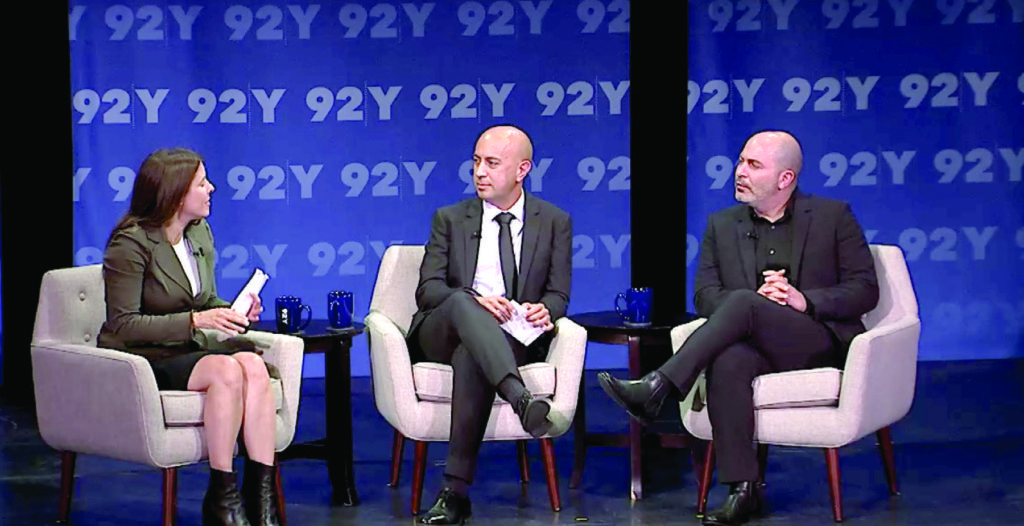
Not everyone who filled the auditorium at New York’s 92nd Street Y one recent evening had yet watched the second season of “Fauda,” the hit Israeli series available on Netflix. So the men the crowd had come to see—”Fauda”‘s creators Avi Issacharoff and Lior Raz—avoided spoilers in conversation with The Hollywood Reporter’s Tatiana Siegel.

But in the discussion, which followed a screening of the second-season premiere, Issacharoff and Raz (who also stars in the series) shared a number of fascinating tidbits for “Fauda” fans.

On selling the show
It may be a hit today, but “Fauda” wasn’t easy to sell, Issacharoff said. Raz added that “nobody wanted” this show, which depicts an undercover Israeli unit (to which Raz’s character Doron Kavillio belongs); Palestinian terrorists the unit seeks to stymie; and families on both sides.

Even some at YES, the Israeli satellite company that eventually signed on, had reservations that the high-action thriller would appeal only to male viewers. But after the first season, polling revealed a majority of women among the viewership. (“Because of me,” quipped Raz, before adding, “I’m joking!” Issacharoff suggested that if the show boasts a primary sex symbol in Israel at the moment, that honor likely belongs to Firas Nassar, the 20-something Arab-Israeli actor who plays terrorist Nidal “Al Makdasi” Awadalla).

On where acting matters more
Bad acting on screen may be punished with a bad review; bad acting in the real life situations that Raz faced in the undercover work that informs “Fauda” can be literally lethal. Raz turned serious as he explained.

“If you’re not a good actor, you can die. And your friends can die. And a terrorist that you’ve run after for a long time can run away, just because of your bad acting, if you don’t have the right accent, if you are a little bit scared, if you don’t know how to move….You have to be an amazing actor.”

On “Fauda”‘s chief message
“Fauda” is a fictional television series—not, Issacharoff emphasized, a political manifest. Ultimately, he said, it’s about the awful price of war—on every side—rippling beyond individual combatants through families and beyond.

“We wanted people to understand that war is bad,” Raz added. “That’s it.”

But Issacharoff noted another aim: showing some of the complexity that characterizes the Israeli-Palestinian conflict. “Sometimes the bad guy is a good guy, and sometimes the good guy is a bad guy. And this is war, and war is not simple.”

“‘Fauda’ is a fictional television series — not a political manifest. Ultimately, it’s about the awful price of war.  – Avi Issacharoff

On filming under fire
Filming of “Fauda”‘s first season coincided with the 2014 Gaza war known as Operation Protective Edge. Raz recalled canceling the first day on location in an Arab-Israeli village “because we were afraid.” But after a village leader reminded them about the emphasis they’d placed on coexistence when they’d sought permission to film there in the first place, the “Fauda” team of more than 150 proceeded, remaining on site for weeks. The work unfolded, according to Raz, “in a bubble of creativity and love and care and honor.” Despite missiles and sirens.

When sirens wailed, everyone gathered: Arabs, Jews, the young, the old. “We went together, to the shelter, to hide, and it was [an] amazing experience,” one that Raz suspects no one who was present will forget.

On criticisms
At multiple points, “Fauda”‘s creators stressed their commitment to “authenticity” in the show: casting, costumes and everything else. They suggested that for the most part, negative criticisms of the show have stemmed from political disagreements, not from artistic issues.

“We are Israelis. We are writing an Israeli show. The narrative is Israeli. Me and Avi—Zionists….If Palestinians want to write a show, they should write a show.”

Regarding efforts by Boycott Divestment and Sanctions (BDS) activists to have Netflix drop the series, Issacharoff said, “This is wrong, this is a mistake.”

“It’s ridiculous,” added Raz.

On what’s next for them
Issacharoff and Roz are writing two new shows for Netflix. Raz will play lead roles in those shows as well. They’re also at work on a third season of “Fauda” and writing a movie (“not about ‘Fauda'”).

Additionally, fans will find Raz on screen later this year in “Operation Finale,” a film about the capture of Adolf Eichmann. Starring Ben Kingsley as Eichmann, the movie is slated for September release. Raz plays the role of Isser Harel, the Mossad director who oversaw Eichmann’s capture in South America and transfer to Israel for trial.

And Issacharoff, whose reportorial experiences have also infused “Fauda” alongside Raz’s undercover operations, continues work as a journalist.

Erika Dreifus is a New York-based writer and book publicist. 


Watch “Fauda” on Netflix and the full 92nd Street Y discussion at 92yondemand.org.

Inside Scoop From ‘Fauda’s’ Creators Read More »

A Modern Journey to ‘Heart of Torah’

We live in “the golden age of the parashat ha-shavua,” according to Rabbi Yitz Greenberg, who is referring to the formal study of the weekly Torah portion, a practice that may take place in the synagogue, around a dining room table, on the internet, or by reference to published essays. For some Jews, observes Rabbi Ruth Adar, parashat ha-shavua is “their primary form of worship.”

A lustrous example of the genre can be found in “The Heart of Torah: Essays on the Weekly Torah Portion” by Rabbi Shai Held (Jewish Publication Society), a two-volume collection of short essays on readings from all five books of the Torah. “When the history of rabbinic literature of this era is written, R. Held’s contributions will be acknowledged as the brightest stars in this new galaxy of Torah teaching,” Greenberg affirms in the foreword that he contributed to “The Heart of Torah.” 

Held is the president, dean and chair in Jewish Thought at Mechon Hadar, a center for study, practice and community-building in egalitarian Judaism in New York City, and director of its Center for Jewish Leadership and Ideas. His previous book was a celebration of the theology of Abraham Joshua Heschel, and it is on Heschel’s path — from “self-centeredness to God-centeredness” — Held himself walks in “The Heart of Torah.”

Held is not concerned with the question of divine authorship of the Bible. He affirms Heschel’s admonition that “more decisive than the origin of the Bible in God is the presence of God in the Bible,” and Held’s stated aspiration is that his readers “may now and again catch a glimpse of heaven as they read, as I was blessed to catch them as I wrote.”

At the same time, Held insists on confronting his readers with the hard edges and the dark corners of the biblical text. “From its very beginning, the Torah subtly warns us against Pollyannish notions of moral progress,” he writes in reference to the story of Cain in the Book of Genesis. “The same man who invented cities, we learn, also invented murder.” And Lemekh, the descendant of Cain, is even more bloodthirsty than his notorious ancestor: “If Cain is avenged sevenfold, then Lemekh seventy-sevenfold” (Genesis 4:24).

Each entry in “The Heart of Torah” is rooted in a specific weekly Torah portion, and that’s why it is best read with an open Bible at hand. Indeed, the real glory of Held’s book is that he shines a bright light on the ancient text, and he brings out the nuances, interconnections and interpretations that make the Bible come fully alive for the modern reader. Held may want us to glimpse heaven in the Torah, but what we also glimpse in “The Heart of Torah” is a rich and provocative human mind at work.

A good example is Held’s entry on the second parsha in Genesis, which focuses on the mind-bending proposition that human beings are made in the image of an imageless God. Held’s sources include such revered medieval figures as Maimonides and Saadia Gaon, but also more recent rabbinical authorities like Rabbi Meir Simha of Dvinsk and Rabbi Eliyahu Dessler, both born in the 19th century, and even a contemporary German Protestant theologian, Michael Welker. Held points out the “ancient Near Eastern context” of the original text, but he also ponders how modern environmentalists have criticized the “arrogance toward nature” that they detect in the biblical notion that human stewardship over creation is mandated by God.

Held may want us to glimpse heaven in the Torah, but we also glimpse a rich and provocative human mind at work.

“In modern times, amid an almost manic need to produce and consume more and more, we have all too often lost sight of what has been entrusted to us,” Held concludes. “What we need is not to abandon Genesis 1 but to return to it and to rediscover there what we have forgotten or failed to see altogether.” So, he rejects the “anthrocentrism” that can be seen at the surface of the text and looks instead for deeper meanings: “This is another way to understand the democratization of the image of God: Every human being, each and every one of us, is responsible for his or her actions.” If God has given us power over creation, we are called upon to exercise that power as God would.

When his eye falls on parashat Ki Tetse’ in the Book of Deuteronomy, as another example, Held’s first thought is to remind us that slavery is not merely a dusty historical relic. “[S]hocking as it is, more than twenty million people around the world are enslaved to this day,” he writes.  And he argues that “a stunningly revolutionary passage” from Deuteronomy “can help us formulate a response to this appalling phenomenon.” Contrary to the prevailing laws of the ancient Near East, the Torah commands, “You shall not hand over to his master a slave who seeks refuge with you from his master” (Deuteronomy 23:16). And, quoting Bible scholar Christopher Wright, Held points out that the duty to shelter a runaway slave is only one clause of the “social legislation on behalf of the poor and the weak” that fills the pages of Deuteronomy.

“The Heart of Torah,” then, is a spirited call to moral action and social justice. “In any age when Jews have access to political and economic power in ways our ancestors could scarcely have dreamed of, surely we ought to be at the forefront of contemporary movements for abolition and liberation,” Held writes. “Where slavery was concerned, Deuteronomy was enormously radical in its time; to take its message seriously is to be enormously radical in our own.”

Exactly here is the notion that makes Held’s commentaries so compelling. Relatively few Jews study the Torah at all, and those who do are not likely to penetrate to the remarkable inner meanings that he discerns in the text. But Held is not content with learning Torah. He insists that we must not only study the word of God; rather, we must both “hear and do.” n

Jonathan Kirsch, author and publishing attorney, is the book editor of the Jewish Journal. 

A Modern Journey to ‘Heart of Torah’ Read More »

Flashback: Roseanne Barr in 2006

Editor’s Note: In the wake of the recent controversy over Roseanne Barr’s racist tweets and the cancellation of her T.V. show, the Journal is reprinting an edited excerpt from an interview with the comedian that ran in 2006, when, among other things, she said her ambition was to become prime minister of Israel and that she would never act in a sitcom again.

Roseanne Barr says she has two secret ambitions. One is to celebrate the bat mitzvah she never had growing up in Salt Lake City. The other is to become prime minister of Israel, a sort of Golda Meir II.

“My family won’t listen to me, but otherwise I know every solution to every problem,” she said.

The one-time “Domestic Goddess,” whose popularity exploded as a lower-middle-class Lucy in Middle America during nine stormy seasons of “Roseanne,” said she will never act in sitcoms again. She hosted a talk show, “The Roseanne Show,” for two years before it was canceled in 2000, and followed up with a reality television show and a cooking show, both of which met with premature ends when she fell ill in 2003.

In 2005, she returned to her first love, stand-up comedy, toured much of the world and recently did a two-night stint in England, where she wowed the natives.

In her new stand-up routines, Roseanne frequently predicts that “unless people wake up,” the whole world is going to blow up, and she means it. But even so, there is a silver lining. When Armageddon arrives, she predicts, thin people will die first and fat people will walk over their bones.

In this interview she was also less frenetic, more in control and, at times, pensive, although with frequent flashes of her trademark bawdy wisecracks.

The star, who was booed in 1990 for mangling “The Star-Spangled Banner” for laughs before a Padres baseball game in San Diego, remains Hollywood’s anti-celebrity. Her storefront office is on Main Street in El Segundo, and she mostly dresses in jeans, flowered shirts and glasses. She, and her closely knit clan, all raised Jewish, live in the South Bay area, far from the ritzy digs of Beverly Hills and Bel-Air (“too many Jews there”).

“I need to be in a quiet place. I need to know all the neighbors, to walk down the street and talk to people,” she said. “I love the outdoors, the beaches and to go hiking and camping.”

Roseanne’s Jewishness, heightened by her well-publicized association with the Los Angeles Kabbalah Centre, is as much a part of her persona as her loud stage voice and fat-lady jokes.

“It’s nice to be important, but it’s more important to be nice.” — Roseanne Barr

Like many American Jews, Roseanne defines her ethnic and religious identity by her own personal standards, which in her case often leads into uncharted territory.

Asked about the basis of her Jewishness, she cracked, “An overwhelming desire for carbohydrates.”

Turning more serious, and mystical, she added, “It’s part of my genetic memory. When I hear stories from the Bible or about Judaism, I think that they are about me, that I am part of them, like, I was personally at Mount Sinai with Moses.”

Then the comedian resurfaces. “Of course, this may be some kind of mental illness,” she pondered. “Sometimes, I wonder if there isn’t a fine line between being Jewish and being crazy.”

Her rather eclectic views on religion may have their roots in her childhood years in Salt Lake City, surrounded by Mormons, during the 1950s and early ’60s. There were only 50 Jewish families in the city and there was a lot of anti-Semitism, which sometimes expressed itself violently, she recalled.

Her grandfather, descended from a long line of rabbis, had changed his name from Borisofsky to Barr when he arrived from Russia, while her father was a door-to-door salesman of sundry household goods, including a ready supply of crucifixes.

To protect her children, Roseanne’s mother kept their Jewishness secret from the neighbors and took the family to Sunday services at a Mormon temple.

There, 6-year-old Roseanne discovered her first public stage, lecturing on the faith to Mormon congregations throughout Utah and becoming “like a little preaching rock star.” She was even elected president of a Mormon youth group.

Meanwhile, Roseanne’s devoutly Orthodox grandmother, who knew nothing about her granddaughter’s Mormon escapades, took her to synagogue for Shabbat services. There the little girl was unable to duplicate her stage success, although when she reached 13, the resident cantor introduced her to the mysteries of the kabbalah.

Roseanne never had a bat mitzvah, but is now giving serious thought to catching up.

“I was recently at my niece’s bat mitzvah, and she talked about helping other people in the world,” Roseanne said. “I love to be involved, and that really turned me on. Yes, I would like to have a bat mitzvah; that would be cool.”

She thinks her 72-year-old mother might join her as a fellow bat mitzvah girl.

When she was 16, Roseanne was hit by a car, and the accident left her with a “traumatic brain injury,” whose after-effects she still feels occasionally.

At 17, she became pregnant, gave up the baby girl for adoption, but has since reclaimed her as part of the family. She now counts three ex-husbands, three daughters and two sons, ranging in age from 10 to 35, and two grandsons, named Ethan Zion and Cosmo Dexter.

Roseanne revels in the role of family matriarch and excused herself during the interview to pick up her 10-year-old son, Buck, at a nearby school.

 “I love being a nosy neighbor, an interfering mother-in-law and all those wonderful things,” she said. “I started doing everything wrong with my children, but have spent the last 15 years trying to make up for it.”

In recent years, Roseanne’s name has been closely linked to the Kabbalah Centre, which is frequently criticized for its alleged high-pressure tactics to extract money from its followers and the sale of “blessed” bottled water as a cancer cure.

Roseanne said she is not a member of the center, hasn’t given any money, is not “a joiner or follower of anything” and visits mainly to check out its library books.

Although she left home before finishing high school, Roseanne reads widely.

“I like all kinds of esoteric reading and thinking,” she said. Among her favorite subjects are mysticism, philosophy, comparative religion, science and current events.

She also supports liberal politics, traveled with iconoclastic filmmaker Michael Moore during the last presidential election, and as part of a recent show she diagnosed President George W. Bush as having attention deficit disorder.

Besides supplying books, she credits the Kabbalah Centre with showing her the power of meditation, which has given her greater control over her emotions and made her “a lot nicer than I used to be.”

Asked for some parting words of wisdom, Roseanne said,  “It’s nice to be important, but it’s more important to be nice.”

Flashback: Roseanne Barr in 2006 Read More »

IDF: Killed Palestinian Medic Threw a Smoke Grenade, Declared Herself As a ‘Human Shield’

Much attention has been given to Razan Najjar, the 21-year-old Palestinian medic who was killed by Israeli gunfire on June 1. Israel’s critics have claimed that her death was a war crime. However, the Israel Defense Forces (IDF) are claiming that she was not the “angel” that her defenders make her out to be.

According to a June 7 video released by the IDF, Najjar can be seen throwing a smoke grenade during a riot at the Israel-Gaza border and proclaiming herself as a “human shield.”

“The fact we see her in front of the cameras protecting demonstrators with her body proves how Hamas exploits all classes of Gazan society to its ends and to Iran’s ends,” IDF Arabic Language Spokesperson Avichai Adraee tweeted. “Do medical personnel around the world throw grenades and participate in riots and call themselves human shields?”

Joe Dyke, the Palestinian correspondent for Agence-France Presse (AFP), argued that the IDF took the video out of context, stating that the full quote was her saying that she’s “a human shield and rescuer for the injured on the front lines.”

Regardless, in their examination of the incident the IDF concluded that Najjar’s death was not intentional, claiming that “a small number of bullets were fired during the incident, and that no shots were deliberately or directly aimed toward her.”

The violence at the Israel-Gaza border has been ongoing since March as part of Hamas’ plan to breach the border fence and terrorize Israelis. Protesters have been documented as flying fiery kites into Israeli territory, burning tires and throwing rocks at IDF soldiers. Despite the criticism the IDF has faced, most of the Palestinians killed by Israeli gunfire have been Hamas and Islamic Jihad terrorists.

IDF: Killed Palestinian Medic Threw a Smoke Grenade, Declared Herself As a ‘Human Shield’ Read More »

Hadassah Stories Come to Life Onstage

To most, condensing over 100 years of history into a one-hour theatrical performance would seem impossible. To Sharon Krischer, the prospect sounded like an opportunity. 

Krischer, who lives in Beverly Hills, served as Southern California regional president for Hadassah, the Women’s Zionist Organization of America, from 2001 until 2003. The volunteer organization was founded over a century ago with more than 300,000 members nationwide in chapters across major American cities. 

Five years ago, Krischer picked up a copy of “Thin Threads,” a published compilation of personal stories written by Hadassah members over the years. “I was endlessly fascinated by what I was reading,” she said. “I felt that dramatizing the stories would make even more of an impact and make the content that much more relevant.”

A frequent patron of Jewish Women’s Theatre (JWT), a Santa Monica-based theater company dedicated to giving Jewish women a voice onstage, Krischer approached its founder and artistic director, Ronda Spinak, a longtime Hadassah member, with a proposal: Staging a performance of selected “Thin Threads” stories. She explained to Spinak that she saw it as a marketing and fundraising tool for the organization that could engage and educate both existing and prospective members in a new, innovative way. 

“Luckily, [Spinak] was enthusiastic from the beginning,” Krischer said. 

Krischer, along with Sandi Sadikoff, another former Hadassah Southern California regional president, worked closely with Spinak to search for, select and edit stories from “Thin Threads,” developing them for the stage. However, with many of the stories being quite short, Spinak suggested expanding the search to include pieces from Hadassah Magazine, the organization’s bimonthly publication. 

“We hope this exposes a younger generation of women to the breadth of experiences of the amazing women who came before them and inspires them to follow in their footsteps.” — Hazel Gordon

During a trip to New York, Spinak received permission from the magazine’s editorial staff to cull through its archives. After spending the better part of two full days dusting off decades-old stories, she left with sets of photocopies and a deep appreciation for the stories she came across. 

“You could do 10 shows with the treasure trove that is the archive,” she said. “The thing that struck me most is the commitment of tzedakah, the commitment to doing good in the world, and how that is a 100-year history and legacy that Hadassah has created. To be able to unearth some of those little-known stories and to share them has been a joy.” 

One of the stories she found, “Keeping a Promise,” tells the tale of Henrietta Szold, the founder of Hadassah, picking out her grave on the Mount of Olives in Jerusalem and the young Muslim undertaker sworn to protect it after it fell to ruins during the War of Independence of 1948. 

“Many Hadassah stories are intertwined with Israel’s story,” Spinak said. 

Other stories Spinak and company settled on cover ground like the work of “medical clowns” that entertain hospitalized children at Hadassah Medical Center in Jerusalem, and discovering pride in Zionism through Hadassah membership after fleeing persecution in Muslim countries like Iran. 

Soon after Krischer, Sadikoff and Spinak finished collecting and editing stories, the estate of Lily Rosman, a lifelong Hadassah member, and the Ladies of Finesse, a group of Hadassah donors, graciously agreed to underwrite “Hadassah on Stage.” It has already been performed four times with JWT casts. Last year, JWT staged performances at a Hadassah conference in Arizona and at a synagogue in Santa Ana for Southern California regional members. This year, shows took place at the Luxe Sunset Boulevard Hotel in Brentwood in April and at JWT’s home, The Braid, in Santa Monica on May 31. 

“There’s a lot of recognition for audiences when they’re seeing this,” Spinak said. “People recognize themselves and their own Hadassah work and experiences in these stories.”

One of the main goals of staging the show, according to Hazel Gordon, the Los Angeles Metro area manager for Hadassah, is to foster a new generation of Hadassah members. 

“We hope this exposes a younger generation of women to the breadth of experiences of the amazing women who came before them and inspires them to follow in their footsteps,” Gordon said. 

Another key part of the initiative, Gordon said, is to put Zionism, which she said has become a “loaded word” for many young people, front and center in hopes of encouraging young prospective members to “not shy away from their Zionism” in public spaces. 

The creative team behind “Hadassah on Stage” has written guidelines instructing how to stage different iterations of the show with varying lengths and content. 

“Essentially, any chapter can design their own show based on their needs with different stories,” Spinak said. “They can design one that speaks to a younger audience, an older audience or a Sephardic audience.” 

But Krischer insisted it’s the elusive younger audience, the millennials, that chapters in and around Southern California and beyond will continue to try to lure. 

“Like every organization out there, we’re hoping this type of venture can keep us relevant and bring in millennials in a way that speaks to them,” she said. “We’re trying something different.”

Hadassah Stories Come to Life Onstage Read More »

Home Invasion Comes to Life in ‘Tea Time’

In 1998, two robbers burst into the home of a Jewish family in Uruguay. They tied up the mother, daughter and a live-in maid, and the father was injured. The mother conversed with the robbers for 40 minutes, telling them that her expensive belongings were in a safe at the bank. The robbers left empty-handed. 

The couple’s son, Marcos Cohen, was more than 6,000 miles away, settling into his new home in Los Angeles at the time of the incident. “My family and friends wanted to hide the news from me,” Cohen told the Journal. “I started to panic. I called my family. They had to tell me the truth. It was very emotional for me.”

Now, 20 years later, Cohen has brought an adaption of his family’s experience to the stage at the Hollywood Fringe Festival, in a new play called “Trapped at Tea Time.” 

The play tells the story of an 80-year-old Holocaust survivor whose building is held hostage by two brothers. One of the brothers, Omar, is tasked with robbing the survivor, Yolanda. At first, he yells at her, ordering her around while he attempts to find her valuables. The action then takes a turn as the characters begin talking about their backgrounds and finding common ground. 

Throughout the show, the audience learns about Omar’s and Yolanda’s personal stories. Omar grew up in a group home, had no relationship with his mother and became addicted to drugs. Yolanda was persecuted during the Holocaust and tries to hide her Jewish identity. 

“We take disenfranchised people and make them main characters and make their stories stand out.” — Linda Alznauer

There are no Holocaust survivors in Cohen’s real family. However, he said he wanted to give his family’s story more of a Jewish focus and message, so he chose to create the character of Yolanda. “There are some insights about this lady who is trying to deny her Jewish identity because of the Holocaust. A lot of things happen in the play that help her regain that pride and her identity.”

When Yolanda and Omar come together, they couldn’t be more different on the outside, but deep down, they both face the same battles. 

“When they were trapped in this situation together and communicating about their own lives, they were able to find similarities and compassion for each other,” said Baila Romm, the producer of the play. “Yolanda believes in Omar and sees that he has a good heart. He tells her that that war is over, and [she’s] hiding [her] Jewish identity for no reason. [He tells her she] needs to be proud that [God] made her and that she can live proudly as a Jew.”

Director Linda Alznauer said the play shows characters that typically are not given a fair chance. “We take disenfranchised people and make them main characters and make their stories stand out. The interesting thing about Yolanda is she sees things in this
young man. Omar sees her as a clichéd old lady, and he is the clichéd robber. But Yolanda has so much to share. And these are people whose childhoods were taken away.”

In a time when there is so much division in the United States, and race and identity are hot topics, Romm said the play is “really right for this day and age to bring the message of unity. We’re all the same. We’re all people. And we all have our struggles.”

“Trapped at Tea Time” is playing at the Actor’s Company Let Live Theater in West Hollywood, June 10 at 3:30 p.m., June 17 at 6 p.m. and June 21 at 7 p.m.

Home Invasion Comes to Life in ‘Tea Time’ Read More »

(Re)Visioning Jewish Prayer, Ritual and Inclusivity

What is the role of a rabbi in serving a community? 

“I think it’s the job of every teacher or leader to take Torah and translate it to our time and place. Connect heaven and earth — that’s it. It’s not an easy job but that’s our job. We have to know who we’re translating for.” 

These words from Rabbi Noa Kushner, founder of San Francisco-based religious startup The Kitchen, came during a discussion on “Post-Tribal Judaism: From Birth to Death and In Between,” at (Re)Vision: Experiments & Dreams from Emerging Jewish Communities, a conference co-hosted by the organizations of the Jewish Emergent Network from June 1–3. The gathering was attended by 150 rabbis, synagogue board members and lay leaders, funders and other Jews from across the country.

The three days of activities included interactive sessions, panels, guest speakers and opportunities for networking, davening, singing and creating community. Sessions were held at The Mark and Morry’s Fireplace, and Shabbat was hosted by IKAR, the L.A. member of the network, at Shalhevet High School. In addition to IKAR and The Kitchen, the network includes Kavana in Seattle, Mishkan in Chicago, Sixth & I in Washington, D.C., and Lab/Shul and Romemu in New York City. 

“These organizations came together out of a longing for camaraderie and then realized they could deepen impact and raise each other up,” said the network’s program manager, Jessica Emerson McCormick. At the conference, she said, “I heard conversations ranging from sharing best practices to ‘Let’s get on the phone before the chagim and connect in a spiritual way; let’s be there for each other.’ The networking that happened was very rich and very satisfying; we can only raise each other up, all of us.” 

The Jewish Emergent Network was founded in 2016. Its first program, a rabbinic fellowship, aims to create the next generation of entrepreneurial, risk-taking, change-making rabbis. (Re)Vision marked the conclusion of the fellowship’s first cohort and the beginning of its second. The network’s first four years were funded through a grant from the Jim Joseph Foundation. The Crown Family, the Charles H. Revson Foundation, the William Davidson Foundation, Lippman Kanfer Foundation for Living Torah, Natan, and Maimonides Fund have also provided support. 

The program included sessions with titles such as “This, Too, Is Torah: The Spirituality of Branding & Marketing” and “Ritual 360: A Ritual Prayground Masterclass,” and “Dear Rabbi, %@$& You,” in which rabbis shared negative feedback they’ve received.

During the “Post-Tribal” discussion, Rabbi Shira Stutman, from Sixth & I, said the definition of “tribal” has changed, noting people also feel strongly connected to political perspectives, sports teams or even tattoos. “Judaism is not our only tribe. … Judaism has to look different.” 

Kushner added that she wanted to “start a movement of serious Jews. If you are for real, then I will stay up late and get up early to work with you,” she said, acknowledging that relational work “takes time and energy and there are no shortcuts.”

“Many people we serve are seekers who have been disconnected and are looking for ways to tap in,” Rabbi Amichai Lau-Lavie of Lab/Shul said during the session titled “Navigating the Minefield of the Great Jewish Taboo: Let’s Talk About Israel and Palestine.” “Israel used to be the connective tissue,” Lau-Lavie said, “now it’s the most divisive issue. Israel needs to be part of the recipe. We have to figure out how to do ‘both-and,’ giving people the connection of spirit so they can understand Israel in a nuanced and deep way.” 

Introducing “Pastor or Prophet,” a session on rabbinic roles, Rabbi Michael Adam Latz from Congregation Shir Tikvah in Minneapolis said, “All justice work is pastoral; it’s just done in public.” 

In this session, IKAR Senior Rabbi Sharon Brous referred to the Torah as a “fundamentally political document” and later noted that although people are “capable of hearing complex and nuanced ideas” they have to prioritize human dignity, and “there is no room in the tent” for those who do not.

Kavana’s founder, Rabbi Rachel Nussbaum, said, “All justice work begins deeply with self-work, being able to examine our privilege but implicate ourselves morally in the causing of traumas against other people.” 

“We need to deliver challenging information in doses and language that helps people take the next step,” added Mishkan founder Rabbi Lizzi Heydemann, who previously served as an IKAR rabbinic fellow.

Rabbi Chai Levy said she attended the conference looking for inspiration during a period of transition in her career. She is moving from Congregation Kol Shofar in Tiburon, Calif., to Congregation Netivot Shalom in Berkeley. 

“I was impressed and inspired by how clearly the leaders were able to articulate their unique vision for each of their communities,” Levy said. “Each one has a driving question that their community seeks to answer. … Traditional institutions can learn from their attention to ‘user experience.’ ”

Naomi Less, Lab/Shul’s associate director and founding ritual leader, said she appreciated “the myriad ways each community approaches spiritual practice. My soul is refueled when I pray with these cherished colleagues. The musical moments of spirit are beyond description.”

The core of the conference experience was the Shabbat hosted by IKAR, which included services, a multifaith program on Friday night, and on Saturday, a conversation with Congressman Ted Lieu (D-Torrance) on “What Does Moral Leadership Look Like in a Time of Crisis?” Lieu shared his frustrations with what he considered the lack of progress on gun reform, and he denounced the Trump administration’s immigration policies.

In other moments, the conference enabled participants to create their own havdalah spice jars or rituals for important life transitions. And Lab/Shul’s SoulSpa multimedia afternoon prayer program featured “Storahtelling,” a reading of verses from the upcoming Torah portion, with Lau-Lavie and Less guiding a dramatic, audience-engaging re-enactment of each verse after it was read. 

“I was really moved by how energized we all felt about what is possible in the Jewish community,” said IKAR executive director and Jewish Emergent Network chair Melissa Balaban following the conference. “Everyone left with a list of dozens of ideas to implement in their own communities, including me. It really felt like a gift to learn from and with such an extraordinary gathering of people doing creative and impactful work all over the country.”

Staff Writer Ryan Torok contributed to this report.

(Re)Visioning Jewish Prayer, Ritual and Inclusivity Read More »

Finding God in Silent Jewish Meditation

“You mean, no talking, like not at all?” my sister asked by phone during the two-hour drive to the Royal Way Spiritual Retreat Center in Lucerne Valley. “That’s intense.”

It was June 2016, three years after my mother had died prematurely of a brain hemorrhage. Grief was supposed to be over. I had completed my year of Kaddish, settled all her estate business and had ensured some kind of familial stability for my younger siblings. 

But I was lost. 

I had been so busy taking care of others, I’d neglected my own well-being. I felt as if I was moving through life on cruise control, advancing one simple step at a time, but not going anywhere. Yea, though I walk through the valley of the shadow of death … only, I feared everything. I felt stalked by a crippling restlessness and the terror of unrealized dreams. Death has a way of reminding you that time is always running out. 

Determined to do something about the condition of my stasis, I decided to embark on a spiritual experiment: a one-week Jewish silent meditation retreat. 

Held by the Israel-based Or HaLev Center for Jewish Spirituality and Meditation, the program was conducted in “social silence,” meaning verbal communication was assur — forbidden. So was reading, writing, gesturing, eye contact and touching. For seven days, I was forced to live in desert isolation, sequestered in a sprawling 840-acre plot in the San Bernardino Mountains where there was nothing else to do but transform myself into a Jewish monk. (Or HaLev will return to Los Angeles this summer to conduct its third annual “Opening the Heart” retreat on July 1.)

When I arrived at quarter to 6, just before the opening meditation or “sit,” as it was called, I was greeted by Ariel, the program manager. “You have 15 minutes of technology left,” he said, handing me a large Ziploc bag and a Sharpie. “Write your name on it, put your phone inside and I’ll return it to you on Sunday.” 

I felt my grip on my device tighten. “Is this optional?” I asked. 

“It’s recommended,” he said.

So much for the honor system. I took the Sharpie in stride and bade farewell to my connection with the world. It was the first time in my life I would be completely cut off from everything I knew: no phone calls, no texts, no photos, no internet, no news. I figured that by the end of the week I’d either achieve total enlightenment or go stark raving mad.  

“This is not a vacation,” Rabbi Nancy Flam declared the first night in the meditation hall. “This is hard work. It requires dedication, attention, focus.”

It was the first time in my life I would be completely cut off from everything I knew. I figured that by the end of the week I’d either achieve total enlightenment or go stark raving mad.

With the exception of one or two familiar faces, I knew none of the other 50 or so seekers. Our instructors were both rabbis from out of town. Or HaLev’s founder and director, Rabbi James Jacobson-Maisels, is a Pennsylvania-born observant Jew who lives on Kibbutz Hanaton in Israel. And Flam, senior program director for the Institute for Jewish Spirituality, is based in New York. Though none of us would socialize or even learn one another’s names until the retreat ended, the presence of community was fortifying. During sits when I looked at my watch every five minutes, I didn’t feel embarrassed — someone else was doing it, too. And when I needed inspiration to focus, I didn’t have to look far before finding some intimidating angelic creature wrapped in a tallit and virtually floating in her meditative trance.    

Even in silence, there was solidarity. No one was alone in their suffering. We were all sorts of naked before our own private struggles.

“This is a yetziat mitzrayim,” Rabbi Flam said. “A leaving Egypt … 

“And what was enslaved in Egypt?”
she asked. “The rabbis tell us, ‘Da’at — awareness.’ ”

Although mindfulness meditation is deeply rooted in Eastern religious practice, most closely associated with Buddhism and Hinduism, Jewish mystical tradition has long incorporated meditation and mindfulness teachings. Rebbe Nachman of Bratslav popularized a practice some 200 years ago called hitbodedut — “self-seclusion,” in which a person speaks aloud to God. But the relationship between Judaism and mindfulness expanded exponentially when a group of American Jewish practitioners including Jon Kabat-Zinn, Sharon Salzberg, Joseph Goldstein, Daniel Goleman and Ram Dass (aka Jewish Harvard professor Richard Alpert) each helped pioneer and popularize the mindfulness movement in the United States.

Or HaLev founder Jacobson-Maisels is a devotee of the Buddhist mindfulness practice Vipassana, but he also considers himself a student of the Piaseczno Rebbe, Rabbi Kalonymus Kalman Shapira, best known as “the rabbi of the Warsaw ghetto.” Reb Kalonymus, as he was known, ran a secret synagogue in the ghetto, performing Jewish life cycle events even as death neared. After he was murdered by the Nazis, a student recorded a mystical practice he invented known as the Quieting Technique, or hashkatah. 

On retreat, Or HaLev integrates both Eastern and Jewish practice in its teachings, and maintains conditions for traditional Jewish observance. There is Shacharit chanting every morning and Torah study every evening. The retreat culminates with Shabbat, a religious experience designed to accommodate all participants, from totally secular to deeply observant. All meals are kosher vegetarian. 

It took me a few days to adjust, not just to the rules but to the environment and to the “practice” itself. The first few days were really long and I had more than one fantasy of fleeing to my car, racing through the desert like in “Thelma and Louise” and never looking back. But then something happened. Something really happened.

“You were having an experience that we like to call rapture,” Rabbi Flam told me when I met with her in a private session.

It’s true. All that talk I’d heard all my Jewish life about ecstatic prayer, connecting with the divine, feeling God move through me as if I were a vessel? It was no longer legend. It was real.

On the last full day of retreat, near the end of Shabbat, it was time to practice Rebbe Nachman’s hitbodedut. I found a quiet spot on the mountain with a view of the valley and watched the sky stream rainbow colors as the sun prepared to set. When I opened my lips to speak, all that came was tears. My voice was raspy from disuse. But I told God about the things I had learned, and God listened. And then I asked God to excuse me, so I could speak to my mother.

Finding God in Silent Jewish Meditation Read More »