fbpx

January 31, 2018

The Jewish Geography of — and in — Auschwitz

After two nights in Krakow, we were returning to Warsaw to finish our study trip to Jewish Poland. I packed, pulling out clothes for Sunday’s site visit: comfortable shoes, pants instead of a dress, black clothing to convey an appropriate somberness for Auschwitz.

My deliberations seemed like unintentional mockery — disrespectful in the
light of history that we all know well. When Jews packed before “resettlement,” they had no idea where they were going, and many may have suspected that packing was just an exercise. I knew how the story ended, that later that day, I would see those suitcases and the belongings that filled them.

In conversation, a trip participant mentioned that his parents had been deported from Hungary around June 21 or 22 in 1945. Transports took about 10 days for the journey to Auschwitz, so they would have arrived on or around July 2. Our visit to Auschwitz was on July 2, 2017.

Seeing on social media where I was, one of my friends messaged me, “Look for my daughter — she is also at Auschwitz.” Although it’s an informational statement (and in 2017, 2.1 million people visited), adding “at Auschwitz” to any sentence brings a flush of nausea. This contemporary game of Jewish geography had a troubling, alternate reality echo: Had inmates been desperate to see familiar faces, or did not seeing familiar faces mean maintaining hope that some had survived?

We’re here. They never would have dreamed we would be. But we are.

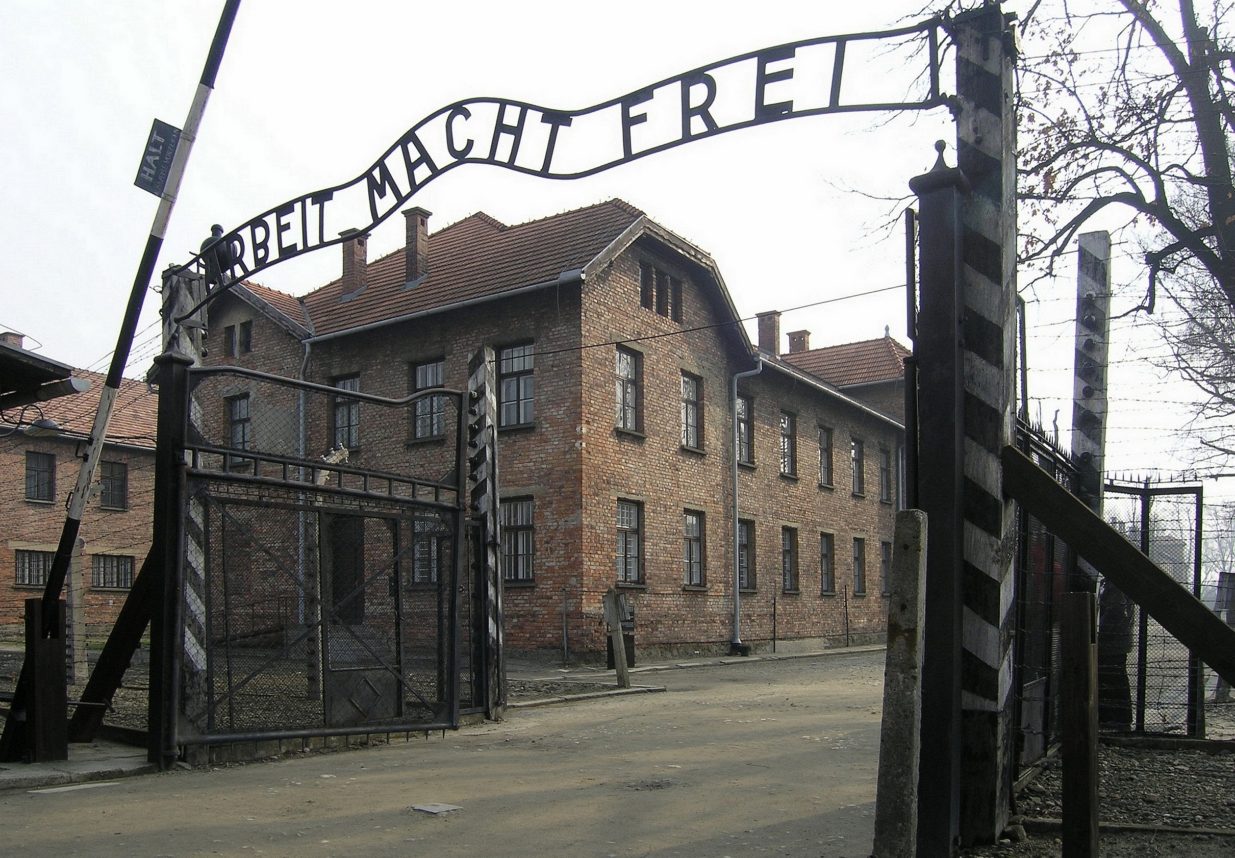
I had a solid Jewish education and already understood my responsibility to never forget. I’d read Anne Frank, Elie Wiesel, Simon Wiesenthal and Yaffa Eliach. I wrote a book about the Hidden Children of the Holocaust. I’d been to Yad Vashem, the Museum of Jewish Heritage, the United States Holocaust Memorial Museum, and half a dozen other Jewish museums in various cities. I don’t remember a time when I didn’t know about Auschwitz, about the people who passed under that famous gate, the “Arbeit Macht Frei,” that sets an ache into the Jewish heart. Now that we were there, our guide explained that it was a replica; the real sign had been stolen in 2009 and cut into pieces to fit into the getaway car. The original is in storage, he said. I imagined it in a government warehouse with endless rows of identically sized boxes, while its understudy played its part.

I had been prepared to feel every aspect of sadness in this space, but as I went from room to room, looking at the artifacts — shoes, hairbrushes, suitcases, uniforms — I felt the mildest version of sadness. Where were my tears? What was wrong with me? Was I too prepared? Or was it the damned replica gate, the fact that some of this experience had been constructed for tourists, that made me disconnect?

Then I saw the hair. Cut from the heads of the victims, the hair was horror, and the human loss it represented snapped me back into humanity. From that point on, I was emotionally tuned in.

One of the men on our trip wore his tallit throughout the visit, and I understood it was his way of proclaiming triumph: We, the Jews, are still here. I needed to find my own way to do that.

I pointed my phone’s camera toward the ground and walked; filming my feet, black sneakers on gravelly earth; not speaking, listening to the mostly quiet air, the sound of my feet as they hit the ground; feeling my breath as I walked and being both grateful and horrified.

I walked in their footsteps, in their memory, in an attempt to feel, understand and experience a new kind of Jewish geography — the mobius strip of communal memory, where location binds past to the present, and we all march into our unknown future.

Connecting with others who are here. Seeing the place. Feeling the gravity of the location beneath our feet. Inhaling the trauma of our history with every breath. Trying to process their loss and the triumph of our return. We’re here. They never would have dreamed we would be. But we are. I am.


Esther D. Kustanowitz, a 10-year veteran of Twitter, is a contributing writer at the Jewish Journal and an editor at GrokNation.com.

The Jewish Geography of — and in — Auschwitz Read More »

The Meaning of Cool

“That’s cool,” I said somewhat offhandedly to my son after he showed me something, well, cool.

It’s not a word I use very often. In fact, I probably hadn’t used it for at least a decade. But he had said it a couple of times, so I thought that maybe it’s made a comeback among the ninja turtle set.

“What does that mean?” he responded.

I paused. I frowned. I think I even looked around to see who else was listening.

“Well,” I began promisingly. “Cool means …”

How to begin? How to sum it up? Why was it so much easier to define coolness 10 or 20 years ago, before everything changed? Before I began to feel completely out of sync with the group of people and ideas that I had associated with coolness?

My introduction to coolness didn’t come till high school. Like most teens in suburban America, I was fairly rebellious. At 14, I believed that meant: Do what other teens who seem rebellious are doing. I let my hair grow long and wild, wore the most bohemian clothes my mother would allow, and spouted the “benefits” of socialism.

At 16, my first real boyfriend introduced me to the works of Ayn Rand, and my entire world was turned upside down. After devouring every word the Jewish-Russian author wrote, I stopped copying what everyone else was doing and began to look within, to look for me.

It was liberating and inspiring. I stopped caring whether the other girls thought I was pretty enough to be part of their clique: I didn’t want to be part of anyone’s clique. I began to seek out the most interesting, thoughtful friends, and we had endless discussions about literature, philosophy and art.

This nonconformist rebellion continued throughout college, shaping and cementing my classical — now called universal — liberal views.

This has not always led to happiness. One of the flaws of capitalism is that it often rewards people who know how to “work a room” over developing innovative ideas. But it has led to a sense of inner peace. If I wasn’t always as successful as I would have liked, at least I knew that I had never sold my soul to the highest bidder.

The illiberal leftism that high school and college students are devouring today makes my initial conformity look almost cool. Students are taught not how to think, but what to think — about politics, film, art, even fashion. Nothing is left to individual choice. In fact, nonconformity is frowned upon. The closer one adheres to the leftist agenda, the higher one’s status.

What would I tell teens who have been brainwashed by their Marxist professors into thinking that following leftist orders is the definition of cool?

We are the artists of our lives. Resist fashions, both political and aesthetic. Listen to Maajid Nawaz, the Muslim reformer fighting against radical Islam; to  Ayaan Hirsi Ali, the ex-Muslim feminist activist fighting against genital mutilation and other forms of female oppression. Listen to Ben Shapiro even if you disagree with him.

The rebels today are rebuilding liberalism, after a quarter century of identity politics, intersectionality and victimhood. As Bob Marley put it: “None but ourselves can free our minds.”

It’s a little harder to talk about this with my son, now 8. He’s already dealing with peer pressure to wear a certain type of clothes and talk in a certain manner. He has learned that being bad equals cool. In fact, he’s already moved on from cool to sick, monster, beast. But he still wants to know what it means.

Students are taught not how to think, but what to think. … The closer one adheres to the leftist agenda, the higher one’s status.

“There’s a difference between questioning things and being bad,” I’ve told him. “You should question things all the time. But being bad is actually uncool. It means you’re trying to get the approval of your friends, instead of following your heart.”

He looked at me as if he was going to cry; he didn’t understand.

I tried again. “Do you know what’s really cool? Creating something incredible. Becoming an awesome artist or athlete or scientist.”

The cry face went away. I continued. “But do you know what’s the coolest thing of all?”

I whispered in his ear: “Just being yourself.”


Karen Lehrman Bloch is a cultural critic and author living in New York.

The Meaning of Cool Read More »

The Last of Doly’s Barberries

I’ve often viewed birthdays as a time to challenge myself to do the scary and uncomfortable. I promise myself to try at least one new thing by my next birthday. Silly things such as hot air ballooning or learning how to ride a horse featured prominently on my lists until one year when my birthday goal was to have a child. But by the time the next year dawned, my biological clock had stopped ticking prematurely, rendering pregnancy impossible. After that, my only goal was to get through the next few birthdays without letting childlessness define me, because I’d previously viewed myself as a woman destined for motherhood. Instead of setting my priorities, I focused on building my businesses until they became my children.

Then three years ago, during a surprise birthday trip to Europe, I finally got the message loud and clear. My jaw dropped upon opening my Facebook page. Instead of the usual birthday wishes, my eyes darkened as they fell on condolences for a close friend named Doly who died that day after a brief but painful battle with cancer.

One of the worst things about this realization was that I hadn’t seen Doly in a long time and she hadn’t told me of her illness. Her sister told me Doly didn’t want to burden anyone with the sad news of her diagnosis just six months before. Doly and I had been in touch in the years since my husband’s job had taken us to Uganda, but in the meantime, I had opened two restaurants and was too busy juggling the demands of my businesses to talk to her nearly as much as I’d wanted to. We had discussed her visiting me in Uganda many times, and I realized I’d again put off something that I could never go back to fix. Another year had passed, and this time Doly was gone.

Doly was a Persian Jew whose father immigrated to Israel from Shiraz, Iran. After Israel’s victory in the Arab-Israeli war in 1948, anti-Semitism swept Iran. Up to a third of Iran’s Jewish population fled to avoid increasing violence and harassment. Because Doly’s family name was Yehudiha, there was little doubt that the sons of the wealthy and successful family needed to leave the Iran of their childhood, one of privilege and grandeur. Eventually, one of those sons — her father — married and had four daughters, the oldest a spitfire named Dalia, who got the nickname Doly while serving in the Israeli military.

She would glue you back together with food from her father’s homeland.

If you didn’t mind being the subject of a thorough interrogation, you could visit Doly’s tiny corner apartment in the heart of Tel Aviv, assured that no matter your problem, you’d always leave well fed and in a much better mood. If your expression was slightly off-kilter, she’d notice immediately. She’d poke and pry until you spilled the beans. When she was satisfied she couldn’t extract more information, she would get up, open the refrigerator door, stare as if she was looking in a mirror and ask what you wanted to eat. It was as if, content in the knowledge that she had pulled you apart and dissected you to the best of her ability, she would then try to glue you back together again with food.

The food of her father’s homeland always featured prominently in her household for the Shabbat meal. Since I had many Persian friends while growing up in the Washington, D.C., area, I was exposed to Persian food prepared by my friends’ mothers. I even badgered one of these incredible home cooks into teaching me how to make zereshk polo — my favorite dish.

Zereshk polo is a rice dish with chicken, saffron and barberries — tart and sweet dried berries with a flavor similar to pomegranates. I must have impressed Doly with my knowledge of Persian cuisine when we first met because I remember that one of the first gifts she gave me was dried barberries her mother had acquired from an aunt in Iran.

Doly cooked for me many times in her tiny kitchen, pulling from precariously hung cabinets mismatched hand-me-down pots that never seemed to have lids that fit. While she cooked, she would smoke, drink coffee and continue the interrogation, stopping only to look at me with squinting eyes if her finely honed bull— detector noticed any discrepancies in my statements. Every few minutes she would get a phone call, swing back her long black curls and continue chatting and laughing with the caller while cooking. Phone on her shoulder, knife in hand, she would squeal in hilarity, her bright eyes sparkling and shining like stars.

Finally, five hours or so after you had “just stopped by for a coffee,” Doly presented you with an insanely amazing plate of food — simple, fresh and perfectly cooked. Something as no-nonsense as roast chicken with rice and salad prepared with a little pinch of this and that, exactly what you felt like eating and with so much love oozing out of it that it felt as though you were in your mother’s kitchen. At least 10 times during the meal, Doly would bounce out of her chair and pull another delicacy out of the fridge — a condiment, a lemon slice, a chili pepper, a dusting of sour and earthy sumac. “Try this, try that, eat this with that,” she’d say.

This birthday, I will cherish this zereshk polo, using the last of Doly’s barberries. I was so utterly miserly with them that they have darkened and soured, their remains still buried in my freezer three years after her death. They don’t taste so good anymore, but that’s part of the lesson. Hopefully, eating them will be a bittersweet reminder not to put off events and people that are important. Instead, this birthday my goal will be to remember to eat the barberries now before it’s too late.


Yamit Behar Wood, an Israeli-American food and travel writer, is the executive chef at the U.S. Embassy in Kampala, Uganda, and founder of the New York Kitchen Catering Co.

The Last of Doly’s Barberries Read More »

Feeling

Ah, to be human.
How fearlessly we feel;
and at our core, we know
the truth: that it’s but a moment
here. But alas, we get swept up
in the winds of this world
and our heart can feel
the tugs and the whirls.
These feelings they span
from the north to the south;
storms whipping from coast to coast —
at what cost? you might ask.

What is a chest of gold
if guarded not by booby traps?
A simple find is not rich,
there’s no fun in that.
Ah, the value,
of struggle and strife,
the way they exalt heavenly delights.
All the richer we are for our moods
and our minds.
Fearless though blind,
we feel out our way,
growing closer to Love all the time.

Feeling Read More »

Jewish Background Helps Comedian Rise to Roastmaster General

Jeff Ross is a comedian, writer and producer also known as the Roastmaster General. His comedy roast “victims” have included Rob Lowe, Justin Bieber, James Franco, Charlie Sheen, James Carville and Donald Trump. Jeff’s most recent comedy special is “Jeff Ross Roasts the Border: Live From Brownsville, Texas,” which is available on Comedy Central and iTunes.

His latest TV series is “Jeff Ross Presents Roast Battle,” a comedy competition show about to start its third season on Comedy Central. He will be appearing live at Caroline’s Comedy Club in New York City, February 8-11.

Jewish Journal: What motivated you to become a comedian?

Jeff Ross: I was struggling, living in New Jersey with my grandfather, trying to start a video production business. A buddy said, “Why don’t you try taking this stand-up comedy class? I think you’d be good at it.” He said it would be a good way to meet a girlfriend, have a social life and a creative outlet. The class was near the bus station where I was going home every night, anyway. So, I tried it on a whim, really enjoyed it right away and was the best one in the class, so I stuck with it.

JJ: How has your Jewish upbringing and heritage influenced your work and your life?

JR: Being Jewish makes you funny. It’s almost in our DNA. Although my Judaism isn’t the main focus of my act, it’s a big part of my personality. I love families, food, fun, parties and busting chops. Love of life. L’chaim.

“Being Jewish makes you funny. It’s almost in our DNA.”

JJ: What qualities make a perfect roast joke?

JR: The best roast jokes are backhanded compliments, where the recipient not only laughs along with the audience but goes home and tells their family about it; jokes that they’re proud of. That’s the heart of the artichoke for me, that’s what makes me feel good, when the joke lives longer than the show.

JJ: Your process for creating roast material?

JR: I do research. I’m all in. I go to battle to prepare. I get in shape. I go to the gym. I hang up pictures all over the house of the target I’m roasting. I buy their books, watch their movies, listen to their music. It’s war — take no prisoners.

JJ: Any charities close to your heart?

JR: The USO and what they do for our troops stationed overseas. You can’t play that up enough because it’s so important. And Meals on Wheels. When I was a beginning comedian and my grandfather was dying of cancer, Meals on Wheels delivered kosher meals to him, checked on him to make sure he was OK and helped him and me get through the day.

JJ: Tell us about your new special, “Jeff Ross Roasts the Border: Live From Brownsville Texas.”

JR: I went down to the Mexican border and did a show in front of the border fence for the immigrant community down there. I worked a year on it. It’s a very complicated subject and the jokes as well as my emotions are deep and sometimes confusing. I learned a lot, including how lucky I am that I was born in America. One point I make in the show is that Jewish people tried to come to America at the beginning of World War II and we sent them away. Now, we’re saying the same thing to these other refugees from other countries. Maybe we should take a look at all that.

JJ: Have you retained your dancing skills from your appearances on “Dancing With the Stars”?

JR: Oh, I had those skills way before “Dancing With the Stars.” I won a dance class in summer camp when I was about 8 and never looked back since. Don’t even tell me I’m not great. [Laughs] My family was in the kosher catering business; I know every dance you can think of from the “Hustle” to the horah.

JJ: What kinds of hobbies and interests do you have outside of comedy?

JR: Dancing, eating and looking for a wife.


Mark Miller is a humorist who has performed stand-up comedy in nightclubs and on TV, and has written on numerous sitcom staffs.

Jewish Background Helps Comedian Rise to Roastmaster General Read More »

Senior Settler Leader Talks Trump

For the first time in American history, a senior settler leader from Israel was formally invited to the inauguration of the president of the United States. This inauguration was, of course, that of Donald Trump, and the guest was Oded Revivi.

The affable Revivi, 49, serves as both chief foreign envoy of the Yesha Council (the official body representing more than 406,000 Israeli residents of Judea and Samaria) and mayor of Efrat, a modern Orthodox settlement town south of Jerusalem. He sat near the front to witness the swearing-in ceremony and now enjoys close ties with U.S. Ambassador to Israel David Friedman and Trump adviser on Israel Jason Greenblatt.

And while this is the first time an American administration has actively engaged settler leaders, Revivi is not sure Trump’s showering of goodwill on Israel, particularly with his announcement on moving the U.S. embassy to Jerusalem, will necessarily translate into rapid settlement expansion any time soon.

“The right wing in Israel, in my view, was too quick to celebrate the victory of President Trump,” Revivi told the Journal, speaking from his office in Efrat just hours before attending Vice President Mike Pence’s speech at the Knesset on Jan. 22. “They were right in celebrating the victory because the other option would be much worse, but the assumption that President Trump is Santa Claus who’ll be able to deliver everything we dream about was not grounded in reality.”

“The assumption that President Trump is Santa Claus who’ll be able to deliver everything we dream about was not grounded in reality.” — Oded Revivi

So far under the Trump administration, no new building permits have been granted for Efrat, although two new neighborhoods have been in construction in the past two years that will allow Efrat to grow from 10,000 residents to 16,000.

“In my understanding — and I’ve had quite a few meetings with the prime minister [Benjamin Netanyahu], and I try to understand what are American guidelines for building in Judea and Samaria — it seems to me President Trump said to the prime minister something along the lines of parents wanting a child to play nicely, when the parent says: ‘I know you know how to behave.’ The reaction of the child is to freeze in his place because he doesn’t know what his boundaries are.”

Revivi was elected in 2008 (and re-elected in 2013) by a constituency eager for Efrat’s expansion, but upon stepping into this new role after a decadeslong career as a lawyer, Revivi’s main task was to ensure Efrat was well-managed. Efrat is among the more socio-economically successful settlements.

The nature of Revivi’s role as mayor, as well as his fluent English, made him the natural successor to Dani Dayan, currently Consul General of Israel in New York. Revivi lived in the U.S. and England as a child while his parents served as Jewish Agency emissaries, and his wife is British.

Revivi takes nongovernmental organizations, congressmen, AIPAC representatives and other decision-makers throughout Efrat in part to dispel settler stereotypes.

“The vast majority of people living in Judea and Samaria move here for financial reasons, social reasons, not because of ideological reasons,” he said.

Himself included. He moved with his family in 1993 in large part for affordable housing, although that has changed in Efrat. Demand is high and real estate prices in Efrat now exceed those in many Jerusalem neighborhoods. Revivi believes quality of life for all, Jews and Arabs alike, should be the main factor in any discussion about peace in the region.

“That’s why we have to find a new approach, a new solution, which isn’t on the table in the moment,” Revivi said.

Senior Settler Leader Talks Trump Read More »

German CEOs Embrace Holocaust Remembrance

Flipping World War II history on its anti-Semitic head, the evidently brave chief executives of three German corporations that collaborated with the Nazis have extended something more substantive than a symbolic hand to the Jewish community.

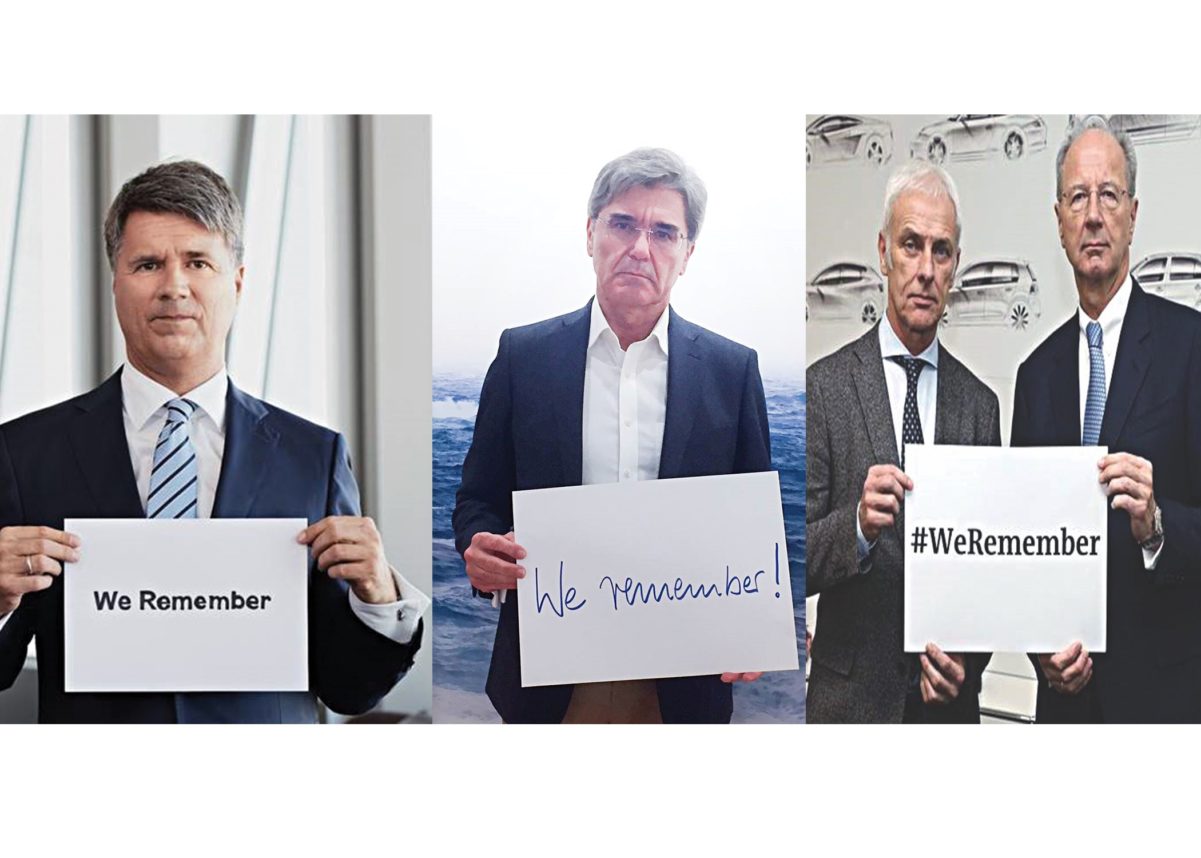
In honor of International Holocaust Remembrance Day last week, these men have signed onto the World Jewish Congress’ second annual “We Remember” campaign, which means: Beyond a nod of endorsement that hardly anyone would notice or care about, they indelibly went on the record.

Each agreed to have his picture taken, individually, while holding the World Jewish Congress’ “We Remember” sign.

And their photos are circling the globe faster and more frequently than  celebrity gossip on the internet.

This is neck-straightening news, especially because of the latest cultural anti-Semitic mudstorm that again is splattering into the vulnerable faces of Germany’s 120,000 Jews.

Remember the names of the corporate chiefs:

• BMW CEO Harald Krüger

• Siemens CEO Joe Kaeser

• Volkswagen CEO Matthias Müller and VW Board Chairman Hans Dieter Pötsch

Although 1.2 million people worldwide have participated in the social media campaign — posting individual photos — what these men have done appears to border on the heroic.

Will they pay a price?

Will they or their organizations be marked?

Germany’s ugliest past of Hitler’s regime 80 years ago is sneaking back into prominence.

Not so quietly, either.

This does not appear to be merely a hiccup.

Jew-haters are marching again, boldly and fearlessly.

“It is particularly meaningful to us that the CEOs of German companies that employed slave laborers during the Nazi era are taking their historic responsibility seriously.” — Ronald Lauder

German Chancellor Angela Merkel not only admitted to a worrisome expansion of German anti-Semitism in her International Holocaust Remembrance Day address on Jan. 27, she sternly warned about its perils and urged muscular vigilance.

Can there be any doubt that the most intriguing dimension of this story would be to know what is so far the unknowable:

What are the motivations of these industrial powerhouses?

Clues abound.

Here is the one statement that was made available by the World Jewish Congress. Below it, some possibilities will be explored.

Müller, CEO of the Volkswagen Group, said:

“Remembering the crimes of World War II and the Holocaust is an established part of Volkswagen’s corporate culture.

“Given our company’s history, we have a very special responsibility for society.

“We have been fulfilling this responsibility for the last 30 years through a vibrant culture of remembrance and special education projects.

“We are committed to speaking out against intolerance, anti-Semitism and racism, and for international understanding, tolerance and humanity.

“More than 630,000 people work for the Volkswagen Group — all over the world.

“Diversity is in our DNA. It has shaped us and made us successful.”

A fair-minded critic would judge that Müller deserves to be taken at his word.

A partisan critic, if he is to be seen seriously, should reach a matching conclusion.

That is precisely the reading of Ronald Lauder, president of the World Jewish Congress:

“A powerful statement,” he said.

“We are deeply grateful for the time and effort people around the world have taken to commemorate the memory of the 6 million Jews who were murdered in the Holocaust.

“We have been overwhelmed by the response, and by the desire of so many to share in spreading this critical message against hate.

“It is particularly meaningful to us that the CEOs of German companies that employed slave laborers during the Nazi era are taking their historic responsibility seriously. They are acknowledging the crimes of their predecessors.”

After examining more closely Müller’s words, here is a curious fact to place on the board and study for a moment:

• Müller was born in 1953

• Pötsch was born in 1951

• Kaeser was born in 1957

It gets better.

Krüger, the youngest of the crowd by far, was born in 1965, 20 years after despondent Hitler’s suicide, long after the worst monsters had been put away and the German government machine presumably had been tamed for the foreseeable future.

So all of them were born an apparent safe interval after the war.

While cerebrally the courageous men are not to be minimized, neither is the timing of the births of all of them.

Ranging in age from 52 to 66, they have reached admirable executive conclusions at the epitome of their careers, displaying the kind of brave public thinking by influential people that German watchers have been hoping for.

While it is not known what kinds of homes and family lives influenced them on their way to wing-spreading success, this much is indisputable:

The four of them have planted their feet, impressively folded their arms across their chests and declared to the world they are the Good Germans.

They are the Good Germans whom Holocaust survivors, Jews and other moral people have been hoping would emerge from the blood- and memory-soaked German fatherland for the past 73 years.

German CEOs Embrace Holocaust Remembrance Read More »

The 1940 Campaign for a Jewish Army to Fight Hitler

In the opening months of World War II, more than a year before the attack on Pearl Harbor propelled the United States into the war, the three most prominent Zionist figures in the world — David Ben-Gurion, Vladimir Jabotinsky and Chaim Weizmann; leaders of the left, right and center of Zionism, respectively — undertook missions to America to energize the American Jewish community in support of raising a Jewish army to fight Hitler. Each of the leaders crossed an Atlantic patrolled by German submarines.

What follows is a little-known story about the Jewish people, as they began to face their darkest hour at the beginning of the most horrific decade in modern Jewish history.

* * *

The Germans did not embark on their “Final Solution” until late 1941 or early 1942, and reliable word about it did not reach America until 1943. But in 1940, readers of The New York Times — the most important source of information in the age before television — knew the existential crisis the Jews faced not only in Germany but also throughout Eastern Europe.

On Feb. 7, 1937 — 2 1/2 years before World War II began — one of the Times’ most experienced correspondents, Otto D. Tolischus, described the wave of anti-Semitism sweeping Eastern Europe in an article covering five columns in the first section of the Sunday edition. Tolischus’ article began with a prescient sentence:

“Anti-Semitism, raised by Adolf Hitler in Germany to the status of a political religion, is rapidly spreading throughout Eastern Europe and is thereby turning the recurrent Jewish tragedy in that biggest Jewish center in the world into a final disaster of truly historic magnitude.”

Tolischus reported that the “disaster is now taking place in Latvia, Lithuania, Hungary and Rumania and is approaching a high-water mark in Poland, the country with the largest Jewish population outside the United States.” Tolischus wrote that “5,000,000 souls” were “facing the prospect of either repeating the Exodus on a bigger scale than that chronicled in the bible … or spending the rest of their lives in an atmosphere of creeping hostility and dying a slow death from economic strangulation.”

After the Nazis and Soviets invaded Poland in September 1939, the two totalitarian powers held 3 million more Jews captive, with plans to destroy them or their religion, or both. The October 1939 issue of the Brooklyn Jewish Center Review, published by one of the leading American Conservative synagogues, featured an article by Rabbi Elias N. Rabinowitz, titled “How Will the Conquest of Poland Affect Its Jews?” Rabinowitz wrote that “the tragedy of Poland has, probably, never been equaled in the recorded annals of history”:

“The plight of the Polish Jew beggars description. He has been uprooted, he has been destroyed. … The Polish Republic contained the second-largest Jewish community in the present Diaspora, approximately 4,000,000 souls. … As reports reach us from various sources, starvation is rampant. The number of suicides is reported to be overwhelming.”

The crisis was thus well known in America, but the three Zionist leaders found an American Jewish community that faced a complicated situation. Virtually the entire country was against any involvement in the new European war, and there was significant anti-Semitism openly espoused by such public figures as Charles Lindbergh, Henry Ford, Father Charles Coughlin and syndicated columnist Westbrook Pegler, among others. American Jews worried that Zionism might bring accusations of dual loyalty, and that arguing for supporting Britain might bring charges of “warmongering.”

But thousands of people came out to hear Ben-Gurion, Jabotinsky and Weizmann in their appearances in America during 1940, and the effort to build a Jewish army that year came closer to reality than most people now realize.

* * *

The three leaders knew that the Jews could form a fighting force, because all three leaders had been involved in the Jewish Legion in World War I — the 15,000 soldiers who fought alongside the British to defeat the Ottoman Empire in Palestine. Jabotinsky had been the guiding force behind the Jewish Legion and became one of its officers; Weizmann had given it critical support with his contacts in the British government; and Ben-Gurion had served in it as a private. In World War II, with the Jews themselves the expressed target of Nazi Germany, the three leaders thought they could mobilize a far larger Jewish force to meet the existential threat.

At the time of World War I, the proposal for a Jewish military force was a radical idea for a people with no modern military experience and an ingrained moral resistance to “militarism.” For nearly 2,000 years, there had never been a Jewish army. But the formation of the Jewish Legion was a landmark in Jewish history, and Jabotinsky would later describe the 1st Battalion, consisting of Jews previously denigrated as mere “tailors,” marching through the streets of London before deployment to Palestine, as tens of thousands of Jewish onlookers stood in the streets or watched from the roofs:

“Blue-white flags were over every shop door; women crying with joy, old Jews with fluttering beards murmuring, ‘shehecheyanu’ … and the boys, those ‘tailors,’ shoulder to shoulder, their bayonets dead level, each step like a single clap of thunder, clean, proud … with the sense of a holy mission, unexampled since the day of Bar-Kochba ….”

Two decades later, as World War II began, the idea of forming a Jewish military force was no longer a theoretical or fanciful one. It had been done before. Two days after the Nazi invasion of Poland, Jabotinsky called Lt. Col. John Patterson, the British officer who commanded the Jewish Legion in 1917, to request a meeting as soon as possible. They met that afternoon and agreed to work together to form not a Jewish Legion but a Jewish army.

Within days of the beginning of World War II, Weizmann and Jabotinsky each wrote directly to Prime Minister Neville Chamberlain, offering to provide a Jewish military force and other wartime assistance. In his letter to Chamberlain, Weizmann wrote: “In this hour of supreme crisis, the consciousness that the Jews have a contribution to make to the defense of sacred values impels me to write this letter.” He told Chamberlain that the Jewish Agency was “ready to enter into immediate arrangements for utilizing Jewish manpower, technical ability, resources, etc.” Jabotinsky, in his own letter to Chamberlain, recounted how the Jewish Legion had done it before.

Chamberlain declined both offers.

Chaim Weizmann (left) and David Ben-Gurion meeting during World War II.

In 1940, Jabotinsky wrote to Rabbi Louis I. Newman, a prominent Reform rabbi in the United States, that the “mission now is to stir American Jews into some such effort of an unprecedented magnitude and daring.” Weizmann wrote to an American friend that “3,000 miles of water will not save American Jewry, or America itself, if they refuse to take the right decisions now.” Ben-Gurion wrote to the Zionist Organization of America that there was “no time to lose.”

That same year, Weizmann traveled to America in January and stayed until March, Jabotinsky was in America from March until August, and Ben-Gurion left London for America in September and remained until January 1941. All three leaders gave remarkable speeches in America, held meetings with key groups, and prepared practical plans for building a Jewish military force to join the war. The most extraordinary of the public addresses, however, was the one Jabotinsky gave on June 19, 1940, before an overflow crowd of 5,000 people at the Manhattan Center.

The day before, new British Prime Minister Winston Churchill had addressed the House of Commons, urging members to forego recriminations about the humiliating Dunkirk evacuation, urging them to “so bear ourselves that, if the British Empire and its Commonwealth last for a thousand years, men will still say, ‘This was their finest hour.’ ” On the same day, Charles de Gaulle spoke from a BBC radio studio as the French government prepared to surrender to Hitler. De Gaulle argued for fighting on: “Must we abandon all hope? Is our defeat final and irremediable? To those questions I answer: No!”

The next morning’s Times reported on the “complete military and political collapse” of France. The war communiqué of the German High Command, published in the Times, stated that “Yesterday alone far more than 100,000 prisoners were taken,” with “booty” comprising “the complete equipment of numerous French divisions.” The Times article was accompanied by a photograph of Hitler and Mussolini standing before a cheering crowd in Germany, with the Times headline reading: “Munich is Gay as Dictators Meet.” The Times reported that “all Munich [is] riding on the crest of an exhilarating wave,” bathed in the “bright sunlight of the thought that this war may now be almost ended.”

That evening, Jabotinsky addressed the Manhattan Center on “The Second World War and a Jewish Army.” He told reporters before the speech that, just as he had felt in 1916 that Jews must participate in World War I, he felt even more strongly that they must join the new war, since they were the explicit targets of the Nazi barbarism. And he thought that Jewish participation in the war would have an important moral and psychological effect:

“The example of Jews, long known as a most peaceful of peoples, volunteering in large numbers to fight for truth and sacrifice their lives, will inspire humanity to ever greater sacrifices at the present critical hour. … In the first World War, where the very idea of Jewish military units was unfamiliar and strange … 15,000 fighting Jews were easily got together from Palestine, England, the United States, Canada and Argentine. This time, where the stakes are greater and the responsibility heavier, I am hopeful that progress will be both speedier and greater.”

In his speech, Jabotinsky reiterated that what was required was not a Jewish Legion but a Jewish army, with a status like the Polish army-in-exile, to “signify that the Jewish people choose a cloudy day to renew its demand for recognition as a belligerent on the side of a good cause.” He wanted not only to see the “giant rattlesnake destroyed,” but destroyed “with our help.” He told the audience “there is stuff for well over 100,000 Jewish soldiers even without counting American Jews,” given the number of stateless Jews in the world and prospective volunteers from neutral countries:

“[H]ad our request for a Jewish Army been granted early in the war when we first submitted it to the Allies, that source alone would have yielded three to four divisions. Even now it can yield two at least.”

The following morning, the Times quoted from Jabotinsky’s Manhattan Center speech:

“This is the time for blunt speaking. I challenge the Jews, wherever they are still free, to demand the right of fighting the giant rattlesnake … as a Jewish Army. Some shout that we only want others to fight, some whisper that a Jew only makes a good soldier when squeezed in between Gentile comrades. I challenge the Jewish youth to give them the lie.”

In the end, for various reasons, the Jewish army was not formed in 1940 — but not because of the absence of a huge and heroic effort by the three Zionist leaders, and not because of a lack of a significant response within the American Jewish community. The story is important to remember not only to honor those who crossed an ocean and those who responded to them, but to correct the misimpression that Jews stood by passively as their existential crisis unfolded.

The effort to form a Jewish army in 1940 is an inspiring story, as well as a cautionary tale about divisions within the Jewish community at a time of existential threat. The story also bears on the world situation today: as Russia and Iran seek to re-establish their previous empires, American isolationism is not something to be repeated, and American Jews should never take Israel’s existence for granted.


Rick Richman is the author of the recently published “Racing Against History: The 1940 Campaign for a Jewish Army to Fight Hitler,” from which this article has been adapted.

The 1940 Campaign for a Jewish Army to Fight Hitler Read More »

SHARING SOME LIGHT: Amid the Sundance Festival’s Glitter, Jews Find Connection and Respite

eEvery January, Harris Tulchin, a Los Angeles entertainment lawyer and producer, travels to Park City, Utah, to attend the annual Sundance Film Festival. Usually, he spends his days there busily networking with potential clients, promoting his film projects and enjoying the ski slopes.

This year was different. Tulchin spent much of his festival time at the Sundance Shabbat Lounge, an unofficial Sundance site whose organizers sought to provide a welcoming Jewish space in the midst of the festival, which transforms Park City, population 7,800, into a bustling culture center of 50,000 independent filmmakers, entertainment professionals and other dreamers. Over 11 days, Sundance features more than 200 screenings, scores of panel discussions and countless industry parties.

And then there’s the Shabbat Lounge. On Friday before sundown, as a photographer snapped images of Shabbat Lounge attendees in front of a backdrop imprinted with the words “Shabbat Tent,” Tulchin, a member of the Santa Monica congregation Beth Shir Shalom, said he was grateful to find a Jewish home at Sundance.

“Having a Shabbat at a festival and taking some time away from the hustle and bustle of the festival is good,” Tulchin said. “Coming to a place like this where you meet the rabbi and other Jewish people, you not only have film in common but spirituality.”

During the opening weekend of the festival — which ran from Jan. 18-28 — the Shabbat Lounge occupied the second floor of Wasatch Brew Pub, a centrally located establishment on Park City’s Main Street, a postcard-worthy stretch of stores, cafes and restaurants that serves as the main artery of the festival.

People of all backgrounds — Jewish and non-Jewish — showed up to celebrate Shabbat and Havdalah.

People of all backgrounds — Jewish and non-Jewish — showed up to celebrate Shabbat and Havdalah, enjoy free food and an open bar, dance to Jewish music and find temporary respite from the intensity of the festival.

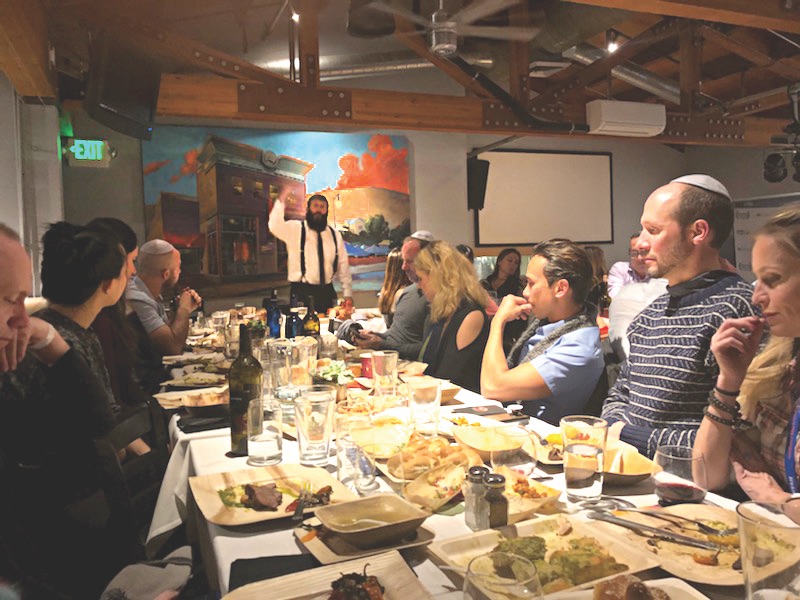
Rabbi Yonah Bookstein served as the welcoming face of the operation. Bookstein is the spiritual leader of L.A.’s Pico Shul and the organizer of Shabbat Tent, a program that holds Shabbat gatherings at music festivals and other events. On Friday evening, he led a Shabbat dinner for 85 attendees, with a kosher menu that included pesto salmon, beef ribs, challah, hummus, Israeli salad, Moscato wine and more.

“Sundance sameach,” Bookstein said, greeting the eclectic array of people seated at two long tables in the brewery. He had to shout to be heard over the cacophony of chatter from patrons on the bar’s first floor. “Enjoy yourselves. Make friends. Mingle. Go to the bar. Have a beer.”

The dinner kicked off a weekend that attracted more than 1,000 people to the Shabbat Lounge, including Los Angeles rapper Kosha Dillz, who attends Sundance every year in the hope of increasing his exposure among well-connected entertainment professionals. In an interview, Dillz praised Sundance attendees for their openness to one another’s ideas and ambitions.

“Sundance is like the gem of all gems, for anybody. It’s magical to me, because it’s the most money per capita, per square mile for anyone trying to hustle,” he said. “Imagine Los Angeles, every person crowding into one street actually being open to sharing ideas and being excited in a winter wonderland, versus a guarded Los Angeles.”

Rapper Kosha Dillz performs for the crowd at the Sundance Shabbat Lounge. Photo by Yehuda Prero

“Sundance is like the gem of all gems, for anybody. It’s magical.” —Kosha Dillz

That openness is part of what brings people to the Shabbat Lounge, which Bookstein was hosting for the second consecutive year. Bookstein began his work in the Los Angeles Jewish community at college campuses. He previously ran Jewlicious, the annual Jewish arts and music festival that drew college students and young professionals to locations including the Queen Mary in Long Beach. His most recent venture, Pico Shul, a storefront congregation in the Pico-Robertson neighborhood, draws young Jews, many of whom are just discovering observant Judaism.

Though Bookstein’s efforts at Sundance were under the auspices of another organization, Shabbat Tent, in a way he was bringing Pico Shul to Sundance. As with his synagogue back home, everyone was welcome.

“We provide this because the whole notion of the Shabbat Tent is it provides a low-barrier entry to everyone,” he said. “We don’t judge people for how they live their life — there are no prerequisites.”

Shabbat Tent began in 1999 when attendees of a Phish concert turned their campsite into a space for Shabbat services. With no funding, the group of live-music devotees began holding Shabbat gatherings at other music festivals to provide a respite for like-minded festivalgoers.

A turning point for the scrappy organization came in 2007, when Matisyahu, the Jewish reggae singer who at the time was observant, contacted Shabbat Tent about organizing a large-scale Shabbat celebration at his performance at the Langerado Music Festival in South Florida.

In 2009, Bookstein and Jewish professional Josh Kaplan took over the organization. They have expanded its reach, bringing Shabbat Tent to the Coachella Music and Arts Festival, High Sierra Music Festival and other events, and attracting financial supporters including the Alevy Family Foundation, Emanuel J. Friedman Philanthropies, the Avi Chai Foundation and San Francisco-based philanthropist Suzanne Felson. Chabad of Park City was a partner on the Sundance Shabbat Lounge.

Bookstein said Shabbat Tent works because the universal message of Shabbat appeals to people of all backgrounds.

“The message of Shabbat is we need to take time during the week to focus on something higher than ourselves,” he said in an interview. “In the fast and furious world we live in, Shabbat resonates with people.”

Rabbi Yonah Bookstein holds court at the Shabbat Sundance Lounge. By the end of the weekend, attendees were approaching him with their pitches for movie ideas. Photo by Yehuda Prero

“In the fast and furious world we live in, Shabbat resonates with people.” —Rabbi Yonah Bookstein

Kaplan, president of JConnect, the parent organization of Shabbat Tent, said the organization engages young Jews where they are.

“It’s very easy to say, ‘Come to our place, and we’ll take care of you.’ We go to where you are — film festivals, music festivals, college campuses — and it’s meaningful,” Kaplan said. “A lot of these people don’t want to walk into a synagogue, and we don’t know what kind of spark we’ll create by going to them.”

The Chai Center, a Los Angeles-based Jewish outreach organization, is among the partners of Shabbat Tent at Sundance. The Chai Center’s Rabbi Mendel Schwartz conceived of the idea after leading Shabbat events at the Cannes Film Festival for many years.

He decided to expand his activities from Cannes to Sundance to reach a different kind of audience, and reached out to Bookstein, whom he saw as a natural partner for the venture. Bookstein seized the opportunity to connect with more Jews outside of his synagogue.

“It was a combination of Jews who wanted to go to festivals but didn’t have a way to make Shabbat and realizing all these Jews are going and don’t have Shabbat,” Bookstein said. “We put it all together.”

Schwartz, who estimates about half of the Sundance festival’s attendees are Jewish, said the Shabbat Lounge attracts people with a wide range of Jewish identities and levels of observance. (About 20 percent of those at the Shabbat dinner weren’t Jewish, he said.)

“Some people are looking for community; some people are just looking for business networking; and for some people it’s just the reverse — they are uncomfortable being Jewish in L.A.,” he said. “I find some people — because it’s fun, sexy and cool to be at a film festival and do Shabbat there — they’re willing to go for that, especially with people in their own industry. It’s a different type of Shabbat.”

Schwartz wasn’t able to attend this year’s festival because the weekend coincided with the first yahrzeit of his father, Rabbi Shlomo Schwartz, widely known in the Los Angeles Jewish community as Schwartzie.

Accompanying Bookstein were his wife, Rebbetzin Rachel Bookstein, three of their children and several members of Pico Shul.

Fabian Lijtmaer, a visual artist, Pico Shul congregant and a supervisor at a residential treatment center, drove from Los Angeles to Utah to take part in the Sundance Shabbat Lounge. He and Yehuda Prero, the chazzan at Pico Shul, left L.A. at 11:26 a.m. on Jan. 18 — in gematria, the Hebrew characters for the name of God add up to 26 — and the two arrived at exactly midnight, Lijtmaer said.

Wearing a fedora splattered, Jackson Pollock-style, with white paint, Lijtmaer recounted the drive in an interview after Shabbat dinner. He said he and Prero had sung nigunim — wordless melodies — every 26 minutes along the way, stopping occasionally to pray and buy beef jerky.

While many at the festival were seeking to make connections to one another, Lijtmaer was hoping to facilitate artists’ connections to God.

“I love film very deeply, and film is a very spiritual thing. For some reason there’s been a separation between the spirituality of film and the filmmaking part, so I feel like, to bring the spirituality, the light of Shabbos, is an opportunity to elevate Jews and elevate all people, give them a connection to God and re-empower them to connect to God through their creative endeavors,” he said. “It is beautiful to be able to come together in an open platform and share that light, share the love and share that inspiration above all.”

During Havdalah, Rachel Bookstein, the rabbi’s wife, was smelling the Havdalah spices when a young man approached to inquire about what she was doing.

“That’s what we are here for,” she said later. “It’s a big team effort. But when people come in and have a place to be together, and have a little taste of Shabbat, and we watch them smile and have Jewish conversations in the middle of all their industry conversation, it’s amazing.”

Attendees of the Sundance Shabbat Lounge mix and mingle before a Friday night dinner. Photo courtesy of Tamar Simon, Mean Streets Management

So was the flurry of Sundance activity beyond the Shabbat Lounge, which ranged from panels on virtual reality to a star-studded women’s march in solidarity with the #metoo movement, to a concert showcase featuring singer Joan Jett.

On the morning of Jan. 21, Supreme Court Justice Ruth Bader Ginsburg fielded questions from NPR correspondent Nina Totenberg hours before the premiere of “RBG,” a documentary about Ginsburg’s life. The crowd included Robert Redford, president and founder of the Sundance Institute; “Democracy Now!” host Amy Goodman; and CNN President Jeff Zucker.

Totenberg asked how long Ginsburg, 84, planned to serve. “My answer and the answer that will continue to be my answer is: As long as I can do the job full-steam, I will be here,” Ginsburg said to loud applause.

Founded by Redford in 1981, the Sundance Institute, which organizes the festival, has grown exponentially. The festival nurtures talented and emerging independent filmmakers who submit their features, documentaries and shorts to the festival in hopes of generating interest in their films. Winning an award at Sundance can dramatically improve a film’s chances of making its way to larger audiences in theaters.

The good-natured party at the Sundance Shabbat Lounge drew attendees of all backgrounds to the Wasatch Brew Pub in Park City. Photo by Yehuda Prero

This year’s films included many with Jewish themes, among them: “The Kindergarten Teacher,” a remake of a 2014 Israeli film of the same name; “Three Identical Strangers,” a documentary about Jewish triplets separated at birth; “Eve,” a 22-minute meditation on widowhood directed, written and produced by and starring Susan Bay Nimoy, the widow of actor Leonard Nimoy and cousin of Temple Israel of Hollywood Rabbi John Rosove; “The Oslo Diaries,” a documentary featuring Shimon Peres’ final interview about the Oslo Accords; and “The Catcher Was a Spy,” about a Jewish baseball player who was recruited by the U.S. government to assassinate a German-Nazi scientist.

“If you’re a film junkie, Sundance is amazing,” said Dan Adler, founder of Media Eagles, an L.A.-based media consultancy firm. “It is the one thing I do as a treat to myself. It’s a great experience.”

This year, Adler arrived at the festival after the opening weekend to avoid the large crowds. In just a few days, he saw 21 films, mostly documentaries.

Adler is both a supporter of Bookstein’s work — including Shabbat Tent —and a member of Temple Har Shalom, a Reform congregation in Park City. The synagogue community serves as an official screening site dubbed the Temple Theatre.

“Sundance completely takes over the temple — it’s part of our operating budget,” Har Shalom Rabbi David Levinsky said. “It’s a chance, essentially, to let Jewish visitors to the Sundance festival know there is a thriving Jewish community here in Park City.”

The Jewish side of Sundance attracted plenty of non-Jews as well. Olga Goister, an independent filmmaker who recently relocated from L.A. to New York, found herself at the Shabbat dinner. The Ukrainian native, whose favorite film growing up was Steven Spielberg’s “E.T.,” started chatting with a music composer seated across from her. When she mentioned that she might need his music for a film one day, he gave her a business card with a built-in USB drive holding his music.

But Goister may have been seeking something deeper than industry networking. Later, she approached Bookstein and asked the bearded rabbi to say a prayer for her success. Surrounded by people from all over the world — from Denmark, India, Mexico, the U.S. and Israel, enjoying beer, cocktails and one another’s company — Bookstein read to Goister a passage from his prayer book that said the key to happiness is improving one’s character.

As the rabbi spoke, Goister said later, she realized she had found what she was looking for — “a combo of good-hearted spiritual people and amazing filmmakers, who,” she said, “are ready to help each other.”

This article was corrected to reflect that Rabbi Yonah Bookstein’s background is not in the Chabad movement. 

SHARING SOME LIGHT: Amid the Sundance Festival’s Glitter, Jews Find Connection and Respite Read More »

Pew, Pew, Pew

Jews have trouble with good news. That’s why Jewish grandmothers taught us the spitting sounds “poo, poo, poo” to ward off the evil eye anytime something good happens.

So much good stuff has happened to Jews in America that we might as well say poo, poo, poo all day long. This is the modern Jewish paradox: We suffered for centuries with really bad news, but now that we have really good news, we’re afraid to embrace it too tightly, lest we lose it.

The poo-poo-poo mindset expresses itself in different ways, sometimes by minimizing good news (“Joey got into Harvard — poo, poo, poo”), other times by maximizing bad news (“Is it true a neo-Nazi was stalking our shul?”).

There’s something endearing about a people who are always watching their backs. Jews can never trust too much, get too comfortable or too happy. That’s what 2,000 years of persecution buys you: We never know when some evil force will come and take all this good stuff away.

This mindset also keeps us sharp. Let’s face it, when you see threats around every corner, you’re less likely to get ambushed by reality.

The Jewish community is especially good at seeing threats around every corner. Surveys from the Pew Center have become the evidence par excellence. If you want bad news about “the new generation,” Pew will deliver. No doubt this is helpful for fundraising: If Pew says young Jews are assimilating at an alarming rate, what better set-up for philanthropists worried about the future of their people?

In short, bad news is good for the Jews. It keeps away the evil eye, keeps nonprofits in business and enlivens conversations. Poo, poo, poo.

So much good stuff has happened to Jews in America that we might as well say poo, poo, poo all day long.

This is even more true in journalism. Bad news is our lifeblood. I will confess: I was electrified when I heard last week that a man with neo-Nazi connections was suspected in the Orange County slaying of a gay Jew, Blaze Bernstein. I thought of finding an enterprising reporter to infiltrate and expose the neo-Nazi group and create a national story. I had no time for sadness. I was just thinking of the story.

I go out of my way to include some bad news in every issue of the Journal. Last week, we were able to provide two good pieces of bad news: a mezuzah that was removed from the doorpost of an office at UCLA, and a binational, Jewish same-sex couple who were suing the U.S. over parental rights. This week, all we have is the neo-Nazi story.

I imagine that the simplest way to provide bad news every week would be to have regular columns quoting Pew studies. One of the more fascinating Pew findings is the growing divide between American Jews and Israeli Jews. In surveying Jewish adults in both places, Pew found sharp differences. For example, while 39 percent of Israeli Jews quoted “economic problems” as the most important long-term problem facing Israel, only 1 percent of American Jews did. This may help explain the greater obsession with the peace process among American Jews — it’s the luxury of not living in Israel and facing everyday problems.

In terms of Jewish identity, there’s more bad news: 53 percent of American Jews identify as Reform or Conservative, compared with only 5 percent of Israeli Jews. No wonder so many divisive religious issues have flared up in recent years, among them the egalitarian prayer space at the Western Wall. The two camps are living in different realities.

The Jewish community is especially good at seeing threats around every corner. Surveys from the Pew Center have become the evidence par excellence.

If you bring a bad-news mentality to such findings, you will use them to nourish the crisis narrative of Jewish communal life. We’re all familiar with this narrative. It’s a lot more energizing to talk about a crisis than to do a calm analysis that will help us better understand the issues.

This, then, is the dilemma: How do we handle bad news without letting it drown us and define us? If bad news is the surest way to raise funds or get media attention, how do we keep it in its proper place?

It’s clear that bad news gives us a sense of purpose, a direction to improve the world. But if we focus so much on the bad that we lose our sense of joy, what good is living? If we become so good at complaining that we lose the ability to create and imagine, what kind of future is that?

This past Saturday night, I bumped into a group of French Sephardic Jews at Shiloh’s restaurant. I knew many of them. They all spoke French. I could tell they were having a really good time. They had come out of a Torah class given by a rabbi from Paris. It seemed as if all they talked about was good news, as if they were looking for good news, or at least things to laugh about.

I should have said poo, poo, poo.

Pew, Pew, Pew Read More »