fbpx

January 31, 2018

Joseph and Paddington

It is unanimous.

Movie review site Rotten Tomatoes aggregated all 176 critic reviews of “Paddington 2” and every single one has been glowing with adulation — making it the best reviewed movie of all time. The children’s story of an immigrant CGI bear living in real-world London has captured the hearts of even the most hardened film critics.

It is fitting that a mean word cannot be said about a movie without a single mean-spirited or cynical moment. “Paddington 2” manages to entertain, enlighten, enchant and inspire without an ounce of negativity. The world of “Paddington 2” is exactly what we wish for our world: a community of decent people with curiosity, mutual respect and so much joy. Visiting this world, even through a children’s film, is so powerful that everyone who sees “Paddington 2” leaves the theater with the same exact thought: How do we make our world into that world?

This question led me to consider the story of the most likely Biblical inspiration for “Paddington 2”: Joseph.

The superficial parallels are striking. Both Paddington and Joseph are dreamers who get into trouble by oversharing their aspirations. Both are outsiders falsely accused of a crime and imprisoned. Both manage to keep their morals and good spirits in prison by being super helpful to other inmates. Both are rescued because of their helpfulness and both experience a yearning to be reunited with their family — despite feeling like foreigners in their own families.

With role models like Paddington emerging from the juggernaut of Hollywood, we can change the world.

There is something deeper in the Joseph story that explains the simple beauty and joy in “Paddington 2.”

How did Joseph see an interpretation of Pharaoh’s dreams that no one else saw? He has no superpower or special wisdom other than his ability to see things in a novel way, without the same biases as his Egyptian overlords.

Ancient Egyptians worshipped the sun god and lived by the predictable rhythm of the Nile overflowing into its irrigation canals. It was a world with very firm cycles. Measuring time with the sun gives you the same 24 hours in a day, every day, and 365 days in a year. It’s pretty regular. Joseph comes from a family that lives by the moon and worships a conversational, relationship-based God. The moon seems unpredictable because it grows and shrinks throughout its lunar phase. The lunar month has irregular cycles of 29½ days. The God of Joseph and the Bible is unpredictable and changes plans or ideas in reaction to human intervention.

Pharaoh’s dreams appear to be so contrary to the fixed order of nature. Lean cattle swallowing bigger, fatter cattle and small ears of grain swallowing larger ears of grain make no sense in a world of strict order. Pharaoh’s dream interpreters were completely stumped. But in Joseph’s moon-based culture, anything is possible. Hope springs eternal, cynicism and despair are the enemy, and there is always hope for a better tomorrow. He saw years of plenty followed by overwhelming years of famine in Pharaoh’s troubling dream — and he was right. But Joseph also saw reasons for optimism and believed in Egyptians’ ability to roll up their sleeves,  work hard and endure.

Paddington embodies this idea. He unabashedly believes in the power of unconditional kindness and the strength in optimism. When confronted by life’s struggles, Paddington “keeps calm and carries on” with British aplomb and a contagious sincerity. Everyone who comes into contact with Paddington is better for the experience because cynicism is poison and Paddington is the antidote.

The most compelling message of “Paddington 2” is that the world thrives when we follow Paddington’s golden rule: If we live with hope and kindness, reject cynicism and negativity, we can change people. Thankfully, the world is watching “Paddington 2” and loving it. Society is responding to Paddington’s modest proposal with a resounding and reassuring, “Yes, more please.”

Indeed, with role models like Paddington emerging from the juggernaut of Hollywood, we can change the world. As Paddington fondly quotes from his Aunt Lucy throughout the film: “If we’re kind and polite, the world will be right.” Amen.


Eli Fink is a rabbi, writer and managing supervisor at the Jewish Journal.

Joseph and Paddington Read More »

Flags on the Bimah – Do they belong?

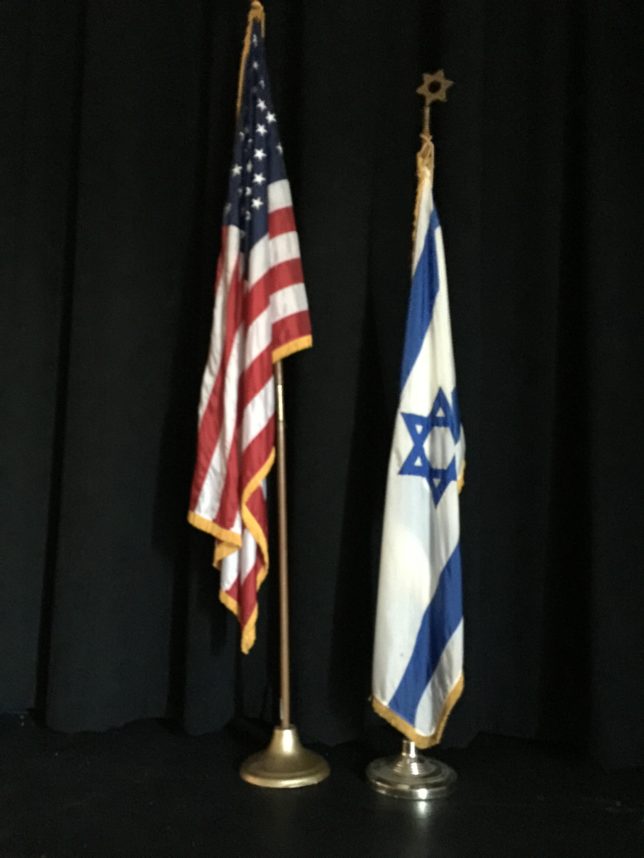
I was sitting in front of the ark this past Shabbat and ruminating during a few moments of quiet prayer about the two flags that have framed my synagogue’s ark for as long as I can remember – the American flag on one side and the Israeli flag on the other. I love them both, but I asked myself, ‘Do they belong here in our Sanctuary, in our house of prayer?’ After all, they are national symbols and not religious ones.



I took a look at what has been written in Reform Responsa literature over the past 50 years since the question first was asked of the Central Conference of American Rabbis Responsa Committee about the appropriateness of placing flags in the sanctuary of our synagogues.

Essentially, the following is what I gleaned from a number of Responsa (links below):

“Though the flags are not religious symbols, they are symbols of our spiritual and emotional attachment to our country and to the State of Israel.”

“As citizens of the United States, the American flag represents some of our most sacred American ideals, our acceptance of the responsibilities and privileges of citizenship, and our devotion to the prophetic ideals of social justice and freedom.”

“The State of Israel is the political embodiment of the age-old Jewish dream of national redemption, a dream that Jews have expressed in our prayers for two millennia, and the Israeli flag represents the prayers of the Jewish people for a return to the land of Israel and the re-establishment there of our Jewish national life.”

So, yes! They do belong, in my opinion, and as a consequence of my ruminations last week, I feel that these flags in fact add something to the iconography of symbols that characterize our holy spaces.

Sources – Central Conference of American Rabbis Responsa

Hatikvah and The Star-Spangled Banner – https://web.archive.org/web/20170824182820/http://ccarnet.org/responsa/rr21-no-5758-10/

Israeli flag on a synagogue pulpit – https://web.archive.org/web/20170824183123/http://ccarnet.org/responsa/arr-66-68/

National flags at religious services LXIV(1954) 79-80 – https://web.archive.org/web/20170824183218/http://ccarnet.org/responsa/arr-64-66/

Flags on the bimah – https://web.archive.org/web/20170824182928/http://ccarnet.org/responsa/tfn-no-5753-8-29-32/


Flags on the Bimah – Do they belong? Read More »

How to Make Chocolate Roses

Some people like receiving flowers. Some people like receiving chocolate. Well, how about both at the same time? Believe it or not, you can make gorgeous roses out of Tootsie Rolls. They’re perfect to give as gifts, and they even make great alternative centerpieces.

Best of all, Tootsie Rolls are kosher-certified. What’s not to love?

What you’ll need:
Tootsie Roll Midgees  |  6-inch treat sticks

1.

1. You’ll need about 10 Tootsie Roll Midgees to make one rose. (You can always use fewer for a smaller rose.) Tootsie Roll Midgees are the small 1-inch version. Place the unwrapped Tootsie Rolls on a plate and microwave them for five seconds to soften them.

2.

2. Roll the softened Tootsie Rolls into balls. I like to use food-safe gloves when handling them to keep them sanitary.

3.

3. Squeezing the Tootsie Roll balls between your fingers, flatten them into thin oval shapes. The shape doesn’t have to be perfect — in fact, the more irregular the better. They should be just slightly smaller than a business card.

4.

4. Get some treat sticks at the crafts store. (They’re in the baking aisle.) With the flattened Tootsie Roll oriented horizontally, wrap it around the top of a treat stick. Pinch the bottom tightly to make sure the Tootsie Roll doesn’t fall off.

5.

5. Continue wrapping the Tootsie Roll petals around the center, overlapping them as you go. Press down on the lower portion of the petals to help them stay secured to the rest of the rose. The rose looks really full after eight to 10 petals.

6.

6. To add some realism to the roses, pinch the tips of the petals and curl some of the edges. The natural look makes the chocolate roses even more beautiful. Display them in a short glass or vase, and try not to eat them all at the same time.


Jonathan Fong is the author of “Walls That Wow,” “Flowers That Wow” and “Parties That Wow,” and host of “Style With a Smile” on YouTube. You can see more of his do-it-yourself projects at jonathanfongstyle.com.

How to Make Chocolate Roses Read More »

What’s Happening in Jewish L.A. Feb. 2-7: Intriguing Talks and Super Sunday Events

FRI FEB 2
“SHOAH: HOW WAS IT HUMANLY POSSIBLE?”

An art exhibition presented by the American Society for Yad Vashem and Sinai Temple, making its debut on the West Coast, offers a comprehensive history of the Holocaust from 1933-1945. Several sections of this exhibition recount major historical aspects of the Holocaust, including pre-Holocaust Europe, European anti-Semitism and Nazi policy before the outbreak of World War II, Jewish life under German occupation, industrialized exterminations and deportations, and the liberation of the concentration camps in 1945. The exhibition, introduced at the United Nations in 2015 for International Holocaust Remembrance Day, features text, images and video clips. 10 a.m.-3 p.m. Free, RSVP required at stcommunications@sinaitemple.org. Sinai Temple, 10400 Wilshire Blvd., Los Angeles. (424) 273-4460.

INCLUSION SHABBAT

Congregation Or Ami in Calabasas marks February, which is Jewish Disability Awareness and Inclusion Month, with an inclusion Shabbat service open to those with disabilities and those without a place to worship or a community to call their own. Or Ami Rabbi Paul Kipnes, Cantor Doug Cotler and rabbinic intern Julie Bressler lead the service. 7:30-9 p.m. Free. Congregation Or Ami, 26115 Mureau Road, Suite B, Calabasas. (818) 880-4880. The service will be livestreamed at oramilive.org.

SAT FEB 3
RESTORATIVE SHABBAT YOGA

Yogis interested in infusing their practice with Jewish spirituality are encouraged to come to Adat Ari El for a Saturday morning restorative Shabbat yoga service. Bring your yoga mat. 9:30 a.m. Free. Adat Ari El, Adler Fabe Meeting Room, 12020 Burbank Blvd., Valley Village. (818) 766-9426. adatariel.org.

CIVIL RIGHTS ADVOCACY AND LITIGATION FOR JEWS

Brooke Goldstein, executive director of the Lawfare Project, the self-described “legal arm of the pro-Israel community,” discusses “Civil Rights Advocacy and Litigation for the Jewish People.” She appears after Shabbat services at the Beverly Hills Jewish Community. Limited seating, RSVP at info@beverlyhillsjc.org. 11:30 a.m.-12:30 p.m. Free. Beverly Hills Hotel, 9641 Sunset Blvd., Beverly Hills. (310) 276-4246. beverlyhillsjc.org.

L.A. CITY ATTORNEY MIKE FEUER

Mike Feuer

Los Angeles City Attorney Mike Feuer discusses public safety, criminal justice reform, gun safety and immigrants’ rights during lunch after IKAR’s Saturday Shabbat service as part of the egalitarian congregation’s “Know Your Reps” campaign. Noon-1:30 p.m. Free. IKAR, 910 S. Fairfax Ave., Los Angeles. (323) 634-1870. ikar-la.org.

“GOOD VIBRATIONS”

Have a groovy time with Cantors Ken Cohen of Temple Ahavat Shalom and Daniel Friedman of Temple Ramat Zion, both in Northridge, cantorial soloist Jackie Rafii of Shomrei Torah Synagogue in West Hills and musical theater vocalist Jennifer Bennett as they perform songs of courage, hope and love. Proceeds benefit Temple Ahavat Shalom programs and services. All tickets will-call, starting at $40. Will-call opens at 6:30 p.m., doors open at 7:10 p.m., concert starts at 7:30 p.m. Temple Ahavat Shalom, 18200 Rinaldi Place, Northridge. (818) 360-2258. tasnorthridge.org/concert.

SUN FEB 4
WORLD WIDE WRAP XVIII

On Super Bowl Sunday, more than 100 men’s clubs and congregations around the world teach the mitzvah of wrapping tefillin. Participating congregations include Sinai Temple, which hosts a breakfast in conjunction with the event; Temple Aliyah, which serves bagels and holds a drash after the wrap; and Temple Ramat Zion, which serves light refreshments afterward. Organized by the Federation of Jewish Men’s Clubs, an initiative of the Conservative/Masorti movement, the World Wide Wrap unites men, women and children in prayer. Free at all locations. 8:45 a.m., Sinai Temple, 10400 Wilshire Blvd., Los Angeles. (310) 474-1518, ext. 3340, member.sinaitemple.org/events; 9 a.m.-noon, Temple Aliyah, 6025 Valley Circle Blvd., Woodland Hills. (818) 346-3545, templealiyah.org; and 9:30 a.m., Temple Ramat Zion, 17655 Devonshire St., Northridge. (818) 360-1881, trz.org.

KIDS CHALLAH BAKE

The second, nearly annual LA Kids Challah Bake comes to downtown Los Angeles. Boys and girls ages 2-13 will be provided with braiding tips and sufficient ingredients to make two challahs, one to take home and one to be donated to Jewish Family Service of Los Angeles. Co-hosted by Sarah Klegman, a writer and co-founder of Challah Hub, a local artisan challah delivery company, and Whitney Fisch, director of counseling at Milken Community School’s upper school campus and creator of the Jewhungry blog. 11 a.m.-1 p.m. $23 general admission; $50 VIP ticket includes valet parking, early access and check-in, swag bag and reserved seating. The Majestic Downtown, 650 S. Spring St., Los Angeles. lakidschallahbake@gmail.com. lakidschallahbake.com.

SUPER SOUL PARTY

Temple Beth Am, Accidental Talmudist’s Sal Litvak and motivational speaker Meir Kay throw a Super Bowl party for the homeless. Attendees watch the game together, eat and shmooze, and the organizers distribute dignity kits to the homeless. Volunteers are needed to arrange and help with the event, which will be filmed and shared on social media. Contact Lia Mandelbaum with questions at lmandelbaum@tbala.org. 1:30 p.m. Free. Temple Beth Am, 1039 S. La Cienega Blvd., Los Angeles. (310) 652-2384. tbala.org.

“TO LOOK A NAZI IN THE EYE”

Kathy Kacer

Prolific children’s author Kathy Kacer, the daughter of survivors who writes about the Holocaust for children, collaborated with 19-year-old Jordana Lebowitz, the granddaughter of Holocaust survivors, to tell the fascinating, true story of Lebowitz’s experience attending the 2015 trial of Oskar Groening, known as the bookkeeper of Auschwitz. Their work, “To Look a Nazi in the Eye: A Teen’s Account of a War Criminal Trial,” was published in 2017. Kacer and Lebowitz take part in a discussion and book signing co-presented by the Consulate General of Canada and the Los Angeles Museum of the Holocaust. 3 p.m. Free. Los Angeles Museum of the Holocaust, 100 The Grove Drive, Los Angeles. (323) 651-3704. lamoth.org. Kacer and Lebowitz also appear on Feb. 6 at the Museum of Tolerance, for school groups in ninth grade through college. 12:30 p.m. Free. Advance registration required. Museum of Tolerance, 9786 W. Pico Blvd., Los Angeles. (310) 772-2505. museumoftolerance.com.

MON FEB 5
THIS IS HUNGER

Barbara Grover

Photojournalist Barbara Grover provides an intimate and surprising portrait of hunger in the United States in a multimedia touring exhibition, “MAZON: A Jewish Response to Hunger.” Featuring portraits and first-person narratives of individuals suffering from food insecurity, including people serving in the military and their families, the exhibition is displayed inside a specially designed trailer of a semi-trailer truck. Through Feb. 6. Various times. Free. Wallis Annenberg Center for the Performing Arts, Eva and Marc Stern Arrival Court, 9390 N. Santa Monica Blvd., Beverly Hills. (310) 442-0020. thisishunger.org/the-tour.

TUE FEB 6
“REACHING ACROSS THE POLITICAL DIVIDE”

Rick Richman

Jewish Journal Publisher and Editor-in-Chief David Suissa leads a “nonpolitical” discussion of the nation’s political divide, emphasizing the goals and aspirations shared by Jews and citizens, regardless of party affiliations, along with ways people can come together to bridge the divide. Author Rick Richman moderates. 6:30-8:30 p.m. $10, includes dinner. Sinai Temple, 10400 Wilshire Blvd., Los Angeles. (310) 474-1518. sinaitemple.org.

“CARING FOR YOUR AGING PARENTS”

Community Shul president and elder care expert Justin Levi leads a discussion on navigating key issues involved in caring for one’s aging parents. Issues addressed include advanced planning, selecting the right care and housing options, the future of elder care and what it means for children taking care of their parents, and Jewish/halachic issues relevant to aging. A Q-and-A will be held and light refreshments served. 7 p.m. Free. Community Shul, 9100 W. Pico Blvd., Los Angeles. RSVP to justin@clarendonsl.com.

WED FEB 7
“CATCH ’67”

Micah Goodman

Micah Goodman, research fellow at the Shalom Hartman Institute in Jerusalem, discusses “Catch ’67: 50 Years Since the Six-Day War.” He explores the tension between right-wing and left-wing ideological visions of what Israel and Zionism are meant to be, discusses where both sides have gone wrong, and questions what possibilities there would be if Israelis were to focus on common-sense wisdom rather than ideological commitments. 7:30 p.m. $10. American Jewish University, 15600 Mulholland Drive, Los Angeles. (310) 476-9777. aju.edu.

WAS ALEXANDER HAMILTON JEWISH?

A discussion of Alexander Hamilton’s roots features Rabbi Meir Soloveichik, director of the Zahava and Moshael Straus Center for Torah and Western Thought, and Alexander Porwancher, Straus visiting scholar. 7:30 p.m. Free. Beth Jacob Congregation, 9030 W. Olympic Blvd., Beverly Hills. (212) 960-5400, ext. 6902. bethjacob.org.

What’s Happening in Jewish L.A. Feb. 2-7: Intriguing Talks and Super Sunday Events Read More »

A Moment in Time: Putting a Cherry on Top


Dear all,

I ordered an ice cream Sundae this week. (Yes – I had it as my main course. But that’s another subject).

When it came, my smile revealed the little boy in me. As yummy as the ice cream and fudge and whipped cream looked, it was the cherry on top that made me really
happy. What a difference that small extra something can do.

Judaism has a concept of that extra something.  It’s called kavanah.

Kavanah is our intention to deepen an experience with a unique twist. Kavanah is putting a mint on the pillow when a guest stays in our home. Kavanah is not just a hot towel –
but a spritz of eucalyptus or lavender on that towel. Kavanah is making our Shabbat table look just a little nicer than it does the rest of the week.
Kavanah allows us to imbue a moment in time with that cherry on top, transforming
good into special. Our personal soul-print, our little extra something, is what can make life really matter.

What will your touch be? And more important – have you given thanks to those who went out of their way to add kavanah to your day?

With love and shalom,
Rabbi Zach Shapiro


A change in perspective can shift the focus of our day – and even our lives. We have an opportunity to harness “a moment in time,” allowing our souls to be both grounded and lifted. This blog shows how the simplest of daily experiences can become the most meaningful of life’s blessings. All it takes is a moment in time.

Rabbi Zach Shapiro is the Spiritual Leader of Temple Akiba, a Reform Jewish Congregation in Culver City, CA. He earned his B.A. in Spanish from Colby College in 1992, and his M.A.H.L. from HUC-JIR in 1996. He was ordained from HUC-JIR – Cincinnati, in 1997.


A Moment in Time: Putting a Cherry on Top Read More »

Memorial Days

It is sometimes quite amazing to see how the Holocaust, 70 years later, is still a daily subject of discussion in Israel. Not a day goes by without it being mentioned in the public sphere. Not a week goes by without it becoming a point of contention. If you think the Jewish people will ever begin to get over this tragedy, think again.

Or just listen to how Israelis discuss their daily affairs. It won’t be too long before you also realize that this trauma is far from being healed. It is constantly on our minds.

Some things force this constancy on us. For example, the fact that from January to May, Israel marks not one but three Holocaust Memorial days. There was International Holocaust Remembrance Day, marked this week, and there is the religious Memorial Day, marked, along with other Jewish tragedies, on the Asarah be-Tevet fast, and then there is the actual, official Memorial Day, a week after Passover.

Yet in most cases, the Holocaust occupies us not because of special duty — a day that calls for a pause. In most cases it is us, busying ourselves with it because nothing has more power to grab our attention. We do not pause to remember the Holocaust; we remember it while on the move.

We do not pause to remember the Holocaust; we remember it while on the move.

Consider the past two weeks. The fierce public debate over a government plan to expel thousands of illegal migrants from Africa (opponents to their expulsion insist on calling them asylum-seekers and presenting them as people whom Israel must absorb) quickly descended into Holocaust-themed arguments. The ultimate weapon was pulled out when Holocaust survivors began voicing their views on this matter — implying a moral authority that trumps government considerations in such matters of conscience.

And as this debate rages, a famous Israeli writer and artist, who wrote lyrics for Israeli classics, compared a Palestinian attacker of soldiers to Anne Frank — prompting a harsh response from Israel’s defense minister. The minister demanded that the Israel Defense Forces radio station cease from playing all songs written by this author, and was then reminded by the attorney general that he has no legal authority to enforce such a demand.

The artist, Yehonatan Geffen, later apologized for his foolishness, as did another, less prominent Israeli writer who was even more vulgar in his use of Holocaust imagery. This artist said — you need to pause before you read this — that he would gladly sit on the roof of a death camp to see the smoke coming out of its chimney, provided it is novelist Amos Oz who is put to death below him. He is so angry with Oz for using “Nazi” to describe the action of right-wing radicals that he felt an irresistible urge to make his point clear, before apologizing to whatever followers he might still have.

Then there is Poland. If the memory of the Holocaust divides Israelis when they have an internal political debate, it often unites them against external forces. Such is the case with the Polish Parliament, which now plots to pass legislation that makes reference to Polish involvement in executing the Holocaust unlawful.

Of course, the story of Poland and the Holocaust is complicated. The Poles were victims of the Nazis. The Poles were not the initiators of the mass murder of Jews, nor invited the construction of death camps in their midst. Still, evidence of Polish participation in the execution of Jews is vast and irrefutable. The attempt by Poland to silence the voices demanding acknowledgment of such participation, or the scholars who dig for more evidence of how, where and why it was done, was met with unified Israeli condemnation.

The Israeli government was adamant not to let this Polish law pass without response. Israeli opposition was sometimes even more robust in its demand for retribution (while also needling the government for having ties with right-wing European parties). In a heartbeat, the Holocaust ceased to be a tool of nasty division and has become a tool of guarded unification.

Lessons are few: It would be better for Israelis to count to 10 before they use the Holocaust to score cheap points in a conventional, if fierce, political debate. It would be better for them to ignore artists who cannot properly think before they speak. It would be better for Poland to come to grips with its past and stop trying to mask it.

Most of all, it would be better for us all to realize that we are still a traumatized people. The evidence is all around us — at times in the form of cynicism or stupidity, at times in the form of serious discussion. The only remedy is time. A very long time.

Memorial Days Read More »

Moving & Shaking: Beit T’Shuvah Celebrates, Aliyah Hosts MLK Prayer

Jewish rehabilitation organization Beit T’Shuvah held its 26th annual gala on Jan. 28 at the Beverly Hilton.

The event drew about 900 people and raised $2.2 million for the organization, making it the top-grossing event in the organization’s 31-year history, said Janet Rosenblum, Beit T’Shuvah’s director of advancement.

The cocktail-attire event honored “Rebel Rabbi” Mark Borovitz, the senior rabbi at Beit T’Shuvah, and “Mogul Mensch” Sam Delug, a Beit T’Shuvah board of directors member.

Lynn Bider and Heidi Praw, who have been involved with Beit T’Shuvah for over a decade, co-chaired the event.

Valley Beth Shalom Senior Rabbi Ed Feinstein served as emcee of the event, which also featured a silent auction, dinner and an awards program.

Attendees included Stanley Black, Rev. Mark Whitlock, Annette and Leonard Shapiro, Joyce Brandman, Charlotte Kamenir and members of the Kamenir-Reznik family, Nancy Mishkin, Ruth Ziegler and representatives of The Jewish Federation of Greater Los Angeles, a partner of Beit T’Shuvah.

Beit T’Shuvah serves people recovering from substance abuse and other addictions, including gambling, eating disorders and compulsive behaviors. Every year, Beit T’Shuvah reaches more than 500 residential clients and an additional 2,500 community members through its congregation and prevention programs.

“With the opioid epidemic now considered a national emergency, Beit T’Shuvah is one of the few places dealing with addiction regardless of someone’s ability to pay for treatment,” Rosenblum said. “We are truly unique that way, and we don’t throw you out when your insurance runs out. Many of our 145 residents stay six months to a year. This dinner makes this possible.”

Honorary chairs were Joyce Brandman, Warren Breslow and Gail Buchalter, Asher Delug, Jeff Frasco and Beverly Frank, and Annette and Leonard Shapiro. Laura Kinsman and Stefanie Post Pollard were the auction chairs.

Elana Wien, vice president of the Jewish Community Foundation of Los Angeles, has been selected as a Wexner Field Fellow. Photo courtesy of the Jewish Community Foundation of Los Angeles
Bailey London, executive director at USC Hillel, has been selected as a Wexner Field Fellow. Photo courtesy of Bailey London

Los Angeles Jewish community leaders Elana Wien, vice president of the Jewish Community Foundation of Los Angeles, and Bailey London, executive director of USC Hillel, have been selected for the latest cohort of the Wexner Field Fellowship, a three-year leadership development program for the Jewish community.

The fellowship is awarded by the Wexner Foundation in partnership with the Jim Joseph Foundation.

“We are very proud of Elana Wien for her many contributions in the community, including this significant honor,” Jewish Community Foundation President and CEO Marvin Schotland said in a statement. “Having worked with Elana for over six years, I’ve watched her develop into the outstanding Jewish leader she is today. We congratulate Elana, and all of the Wexner Field fellows, and look forward to her continued growth through this fellowship and beyond.”

Wien and London are among 15 fellows selected for the 2018 Wexner Field cohort, from cities that include Los Angeles, San Francisco, New York, Chicago and Washington, D.C.

“I’m beyond honored to have been selected to be a part of the second class of the Wexner Field Fellowship,” London said. “Throughout the early stages of my career, I have had the privilege of participating in high-level professional development, and this opportunity is, by far, the most comprehensive way I can imagine continuing the process of growing and learning. I’m most excited to be a part of a network around the world of professional and volunteer leadership that has not only been invested in their own development but in strengthening the Jewish community for generations to come.”

From left: Vance Serchuk, director of KKR Global Institute; former IDF Chief of Staff Gabi Ashkenazi; and retired Gen. David Petraeus were the keynote panel at the recent AIPAC L.A. gala. Photo by Timothy J. Carr Photography

The American Israel Public Affairs Committee (AIPAC) held its annual Los Angeles gala on Jan. 21 at the Ace Hotel in downtown Los Angeles. About 1,000 people attended the event, the theme of which was a celebration of 70 years of friendship between the United States and Israel.

The program featured AIPAC Regional Director Wayne Klifosky; Houston City Councilwoman Amanda Edwards; AIPAC UCLA student activist Amir Kashfi; and a keynote panel with retired Army Gen. David Petraeus, former Israel Defense Forces Chief of Staff Gabi Ashkenazi, and Vance Serchuk, director of the investment firm KKR Global Institute.

The panelists discussed the U.S.-Israel relationship and challenges and opportunities in the Middle East.

AIPAC is a bipartisan pro-Israel lobby seeking to promote and strengthen the U.S-Israel relationship.

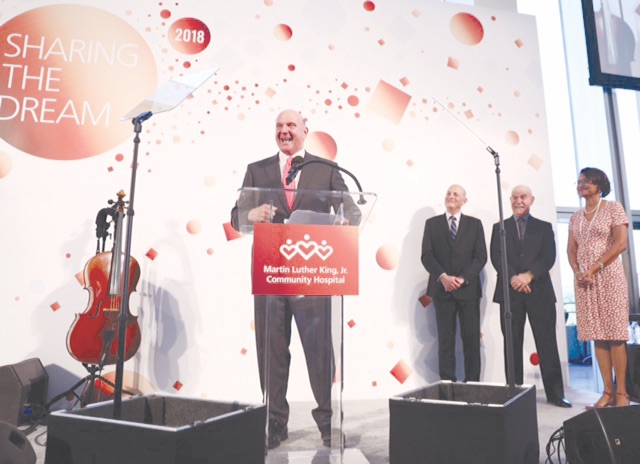
L.A. Clippers owner Steve Ballmer, who has pledged $7.5 million over five years to Martin Luther King, Jr. Community Hospital, appeared at a ceremony for the pledge. Photo courtesy of Martin Luther King, Jr. Community Hospital

Los Angeles Clippers owner Steve Ballmer, through his philanthropic organization the Ballmer Group, which supports economic mobility, has pledged $7.5 million over five years to Martin Luther King, Jr. Community Hospital.

The Ballmer Group, which Ballmer co-founded with his wife, Connie, and the Weingart Foundation, a grant-making foundation founded by the late Ben Weingart and his late wife, Stella, together pledged $15 million to the nonprofit hospital serving South Los Angeles.

“Both Weingart and the Ballmers identified the hospital as an agent for change in South Los Angeles,” said a Jan. 12 Martin Luther King, Jr. Community Hospital press release.

The organizations’ goal is to bring more doctors to South Los Angeles and thus close the physician gap, the
release said.

Ballmer attended a Jan. 12 ceremony at the Los Angeles Music Center’s Dorothy Chandler Pavilion that celebrated the pledges.

The Temple Aliyah Martin Luther King Jr. Day interfaith service featured Jewish and Christian children’s choirs. Photo courtesy of Temple Aliyah

Jews, Christians and Muslims gathered together on Jan. 19 at Temple Aliyah in Woodland Hills for the 19th annual Voices of Unity interfaith prayer service in observance of Martin Luther King Jr. Day.

An estimated 800 people attended the Shabbat service, including Pastor Najuma Smith Pollard of Word of Encouragement Church in Pico-Union, Pastor Michael J. Fisher of Greater Zion Church Family in Compton, Father Michael Evans of St. Bernardine of Siena Church in Woodland Hills, and Shaykh Suhail Hasan Mulla of the Council of Islamic Scholars.

The service included performances by Christian and Jewish children’s choirs and Algerian actor-activist Ben Youcef, who is also a muezzin, the man who calls Muslims to prayer from the minaret of a mosque. Youcef sang the Abrahamic prayer “We Are All Children of Abraham,” which Temple Aliyah Cantor Mike Stein had translated into English so the choirs could accompany him. They created a fusion of voices, singing in harmony in English and Arabic and sending a message of peace and friendship.

Over the years, Stein said, Temple Aliyah’s collaborations with Christian churches and the Ezzi Masjid Mosque in Woodland Hills have gone beyond the annual prayer service.

“Five years ago, while [the Ezzi Masjid Mosque] was going through renovations, they used our synagogue on Saturdays for their classes,” Stein said. “And when we found some swastikas on our walls about 2½ months ago, the Shaykh Mulla came with a bouquet of flowers to show support.”

The prayer service concluded with the participants singing “Oseh Shalom Bimromav” and “We Shall Overcome.”

“We have been doing this for 19 years, and each year people leave feeling a wellspring of hope that no one will be treated differently because of their race, religion, ethnicity or sexual preference,” Stein said. “We are created b’tzelem Elohim, in the image of God. This event started and continues to be inspired by the words of Dr. Martin Luther King’s dream — that people will not be judged by the color of their skin, only by the content of their character and their souls.”

Ayala Or-El, Contributing Writer

Moving & Shaking: Beit T’Shuvah Celebrates, Aliyah Hosts MLK Prayer Read More »

Letters to the Editor: Trump, Marriage, Partisan Divide on Israel and Women’s March

Trump and the Cycle of Violence in Israel

In the Jan. 19 cover story, “The Trump Gap,” Shmuel Rosner asserts that a “Trump-friendly” Israel “becomes an outlier” in the view of Israel and the Europeans — as evidenced in the U.N. actions of late. Is Rosner not aware that Israel’s existence has been as an outlier in the U.N. and Europe since long before the Oslo Accord? Or the U.N. Security Council’s continuous focus on destroying Israel? All of this predates the latest U.S. election by far.

Worse, in “Jerusalem, What Comes Next?” (Jan. 19), Joel Braunold argues that asserting Israel’s sovereignty over Jerusalem has surrendered the United States’ ability to broker peace, and that building grass-roots peace movements is the answer. What deluded bubble must one occupy to think that building communities “of collective humanity” will magically create an atmosphere of peace while our purported peace partners teach their children to become martyrs for the “holy” cause of killing Jewish women and children, and Arab supporters of peace are executed as collaborators?

David Zuckerman, Phoenix


Alternative Secrets to a Happy Marriage

Rabbi Benjamin Blech’s story was great, but I have my own three secrets to a happy and long-lasting relationship/marriage (“Three Secrets to a Long and Happy Marriage,” Jan. 19).

They are: 1) Always hold hands when walking; 2) Sit next to each other in a restaurant, not across; 3) Never watch TV after a date or after an evening out.

Robert Geminder, Palos Verdes


Nature and God

I read with interest “Why I Don’t Worship Trees” by David Suissa (Jan. 26).

He says that there is a difference between loving nature and worshipping God. This is interesting to me because, according to Spinoza, God and Nature are one and the same.

So, it depends on which philosopher you are reading, as to what is “true and correct” — or rather, “an adequate idea” in the words of Spinoza. I love and worship Nature, which to me is synonymous with God.

Debora Gillman, Los Angeles

I have great respect for, though not agreement with, David Suissa’s argument that Jewish tradition calls for transcending Nature and aiming for a higher place. It was such an argument that propelled the Amsterdam Jewish community to excommunicate Spinoza, who saw divinity in all of Nature, thereby incurring the anathema of being a “polytheist.”

The relevancy in our world today is that such a separation must now become anathema in order to preserve the only place in the universe we have to live. We must see nature and divinity as indivisible or risk continuing on the path that in an accelerating manner threatens to leave us as the “masters of nothing.”

Sheldon H. Kardener via email


Republicans, Too, Must Widen Their Views

Ben Shapiro, in his column “Partisan Divide Over Israel” (Jan. 26), only exacerbates that divide by insisting that only the Democratic Party has to “re-evaluate its moral worldview in the Middle East.” In fact, there are many Democrats, myself included, who strive to enhance the long-term security and prosperity of Israel by desperately working (sometimes it’s more like “hoping”) to leave the door open for a workable two-state solution. Additionally, we struggle to encourage Israel’s democratic institutions and pluralism, to reverse the increasing rejection felt by liberal Jews. Conservatives talk a good game when it comes to supporting Israel, but in reality their strategies have done more harm than good — none more so than President George W. Bush’s removal of Saddam Hussein’s counterbalance to Iranian expansion followed by his encouragement of an independent entity and “free” elections in Gaza, which led to the ascendancy of Hamas and the ensuing conflicts. It’s time for the Republicans to take off their blinders and widen their views of what will and won’t work in the Middle East.

John F. Beckmann, Sherman Oaks


The Women’s March

Thanks to Karen Lehrman Bloch for her brave piece “Why I Didn’t March” (Jan. 26). I hope her writing will open the eyes of many women who do not recognize the manipulative, anti-Zionist agenda behind the progressive movement. We can fight for human rights without allowing ourselves to become robotic pawns in a crowd led by the likes of the hateful Linda Sarsour. Let’s march for acceptance of thought and speech and let’s celebrate individual choice.

Alice Greenfield via email

I think mostly everyone can agree that our country is extremely polarized on issues concerning Israel, immigration, education, taxes, trade policies, health care, the environment, women’s rights and abortion. Very often, it’s only one issue that is paramount to the individual and it is so powerful that they will overlook positions on all the other important issues facing us. That’s why the Women’s March is so important. To assert that women were following the leaders of this march and were told what to think is absurd and demeaning. I never heard of Linda Sarsour before reading Karen Lehrman Bloch’s column and learned that she is anti-Israel and an anti-Semite. I marched with the hundreds of thousands of men, women and children in Los Angeles who are concerned about a multiplicity of issues and, like me, have no knowledge of Linda Sarsour’s political views.

Frima Telerant, Westwood


Parties Split Over Support of Israel

Danielle Berrin, who appears to be left-leaning, and Ben Shapiro, who is right-leaning, seem to agree on something: There is a lot of partisan division in politics in the United States and in Israel which affects support for Israel. According to recent Pew research data, 79 percent of Republicans say they sympathize with Israel and just 27 percent of Democrats say they identify with Israel. That should not be surprising given the fact that at the 2012 Democratic National Convention there was booing when the platform was amended to identify Jerusalem as the capital of Israel. Now the No. 2 person in the DNC, Keith Ellison, is an avowed Israel-hating Jew hater.

Marshall Lerner via email


Tablets Belong in Our Schools

It was sad to read the uninformed opinion of Abigail Shrier on getting iPads out of our schools (“Smash the Tablets: Get iPads Out of Our Schools,” Jan 19). Hardly any student goes to college without a laptop or iPad these days. Not too long ago, the Yale School of Medicine gave each of its students an Apple iPad 2 for use in the classroom and their clinical responsibilities.

Litigators create their deposition outlines on iPads, and during depositions they typically have a separate iPad that’s linked to the court reporter. The use of this technology simply makes sense unless Shrier also thinks that attorneys’ brains are being compromised because of these technology tools.

The correlations she cites are just that — correlations — unproven statistical comparisons that may turn out to be false. The explicit intention of using iPads in the schools was to reach a rainbow of learners, which it accomplished, with or without the agreement of Shrier.

Joel Greenman, Woodland Hills


CORRECTIONS

The founder of Netiya was misidentified in a Jan. 26 story (“A Tu B’Shevat Question”). Rabbi Noah Farkas founded Netiya, a Los Angeles-based food justice organization; Devorah Brous was hired as its founding executive director in 2011.

The former name of de Toledo High School was misreported in the Jan. 26 edition (“De Toledo Goes Green”). It formerly was called New Community Jewish High School.

Letters to the Editor: Trump, Marriage, Partisan Divide on Israel and Women’s March Read More »

Sonja Rosenwald: Parents Took Steps to Preserve Her Safety

Fifteen-year-old Sonja Zyskind, dressed as a boy in pants and a shirt, her braids concealed under a cap, walked with Mrs. Novak, a former customer of her father’s textile store, toward the center of Piotrkow, Poland. As they reached the Hortensja Glassworks factory, they saw the men lining up, Jewish slave laborers, preparing to return to the ghetto. “Go,” Mrs. Novak said, pushing Sonja into the line.

Sonja had been living with Mrs. Novak, posing as a blue-eyed, blond-haired relative. And although Mrs. Novak treated her kindly, and was well paid by her parents, Sonja feared she would be caught. She planned to sneak into the ghetto, where her mother and sister were confined.

The men halted at the gate while a guard counted them, something Sonja hadn’t anticipated. “One too many,” he reported. He recounted several times, repeating, “One too many,” over and over. Sonja’s stomach hurt, but she remained silent. Finally, another guard urged, “Let them go already.”

As a young girl, Sonja had been, in her words, “a bit of a spoiled child,” beloved by her parents, grandparents and two uncles. But now she felt alone. “You got unspoiled,” Sonja said. “You had to do a lot of things.”

Sonja was born in Piotrkow Tribunalski, in central Poland, on Oct. 11, 1927, to Rachela and Shlomo Zyskind. Her sister, Itka, was born in 1930. The well-off and traditionally religious family lived in a spacious three-bedroom apartment above Shlomo’s store.

At age 7, Sonja attended public school, living mostly with her maternal grandparents, whose maid walked her to school each morning. After school, Sonja often treated friends at a candy shop, where her grandfather had arranged charging privileges.

But on Sept. 5, 1939, that life ended as Sonja watched German soldiers marching into town. “Don’t worry,” her parents said, trying to reassure her. But Sonja learned later they were already making arrangements to hide her.

Once inside the ghetto, after leaving Mrs. Novak, Sonja shed the boys clothes. Underneath was her school uniform, a black satin dress with a white detachable collar, which she wore for the duration of the war, washing the collar whenever possible.

In October 1942, before Sonja’s arrival, a great aktion had taken place in the ghetto, in which 18,000 to 22,000 Jews, including Sonja’s father, were shipped to Treblinka and murdered. About 2,500 workers remained, with special permits. This included Sonja’s mother, Rachela, who worked in the Judenrat (Jewish Council) kitchen, keeping Itka with her. Sonja, who lacked a permit, couldn’t see her. Instead, she stayed with those who had emerged from hiding, moving from place to place to avoid capture. “The less I showed my face, I was better off,” Sonja said.

“I knew I am not going to live,” she said.

But eventually the Gestapo found her — she believes she was betrayed— and she was taken to the Great Synagogue, where about 300 people were being held. “I knew I’m not going to live,” Sonja recalled. She bit her tongue, hoping it wouldn’t happen, and prayed to God to save her or take her as soon as possible.

Then one day she heard a Gestapo officer call her Yiddish name, “Sura Zyskind.” She was certain she would be the first to be killed. Instead, she was taken to the Judenrat building, where she briefly saw her mother. (Sonja later learned that Rachela had bribed someone to secure her release and that the others in the synagogue were trucked to the Rakow forest and massacred.)

Weeks later, Sonja and 29 other girls, selected for their excellent eyesight, were transported to Skarzysko-Kamienna, a labor camp about 65 miles southeast of Piotrkow.

The girls spent 12 hours a day at an ammunition factory, sitting in front of machines, three to a machine, inspecting bullets. Sonja’s job was to check each bullet through the machine’s magnifying glass as it passed on a conveyor belt, removing the defective ones. If she missed one or if she fell asleep — which sometimes happened — the female Gestapo officer, Mrs. Hirsch, or the Jewish forewoman, Lola, slapped her.

Lola, whom Sonja described as beautiful, hunchbacked and “worse than the Gestapo,” resented Sonja, and decided to have her hair cut off as punishment. Sonja was dragged to the barber and undressed. But she escaped, running through the camp naked. “Kill me,” she shouted, “but you’re not going to cut my hair.” She prevailed.

In August 1944, as the Soviet army approached, the Skarzysko prisoners were transported to a labor camp in Czestochowa, about 95 miles west. Sonja worked with the same girls on the same machines, but without Lola.

The Soviets continued their advance until one day in mid-January 1945, amid the sounds of falling bombs, the girls noticed the Germans had disappeared. “I’m going home,” Sonja announced, running out of the factory with a group of girls, joined by several young men.

The group walked and hitched rides on horse-drawn wagons whenever possible, scavenging for food in empty houses. After a month, Sonja and about six others reached her grandparents’ house, now occupied by several families. “You still alive?” one person asked her. After waiting, they were reluctantly let in.

Several days later, as the group sat in the dining room, shots were fired through the window, with one nearly grazing Sonja’s head. She fled.

At the Jewish Committee office in Piotrkow, Sonja met Bluma Rosenwald, a family acquaintance, who invited her home. Sonja became friendly with her son, Waldek (also called Israel). Together, they traveled to Prague, where they learned Rachela and Itka had survived, and then to Bergen-Belsen, where they reunited with them at the displaced persons camp. “Everybody cried,” Sonja recalled.

Sonja and Waldek married on April 2, 1946, in Bergen-Belsen. Their daughter, Jeanie, was born there in June 1948, and their son, Sam, in December 1953, in Los Angeles, where they had immigrated to two years earlier. Waldek died in 2009 and Sam in 2011. Sonja now has four grandchildren and two great-grandchildren.

In California, Sonja and Waldek ran a chicken farm for six years in what is now Winnetka before moving to Los Angeles and buying two liquor stores, which they sold in the 1990s. The couple then managed office and apartment buildings. After Waldek’s death, Sonja continued, retiring in 2016.

Sonja previously had told her story publicly only once, to the Bay Area Holocaust Oral History Project in 1999.

“I didn’t want to tell it. What for? There were so many stories — mine was not missing,” she said. But at her daughter’s urging, she agreed to be interviewed by the Journal.

“I’m glad that I did it,” Sonja said. “I’m old. I’m 90 years old.”

Sonja Rosenwald: Parents Took Steps to Preserve Her Safety Read More »

Torah Heroes Had Special Needs

Before we begin to explore specific ways we can fully welcome people with disabilities into our Jewish communities, let us take a brief look at how our tradition has viewed people with disabilities in the Tanakh, in Jewish law and in Midrashic literature.

Many of our great leaders had various disabilities.

Isaac became blind in his later years — “When Isaac was old and his eyes were too dim to see ….” Jacob had difficulty walking and became blind. Our matriarchs also were not portrayed as perfect; Sarah, Rebekah and Rachel were barren, and Leah is described as having had weak eyes.

Even Moses, the leader of the Jewish people, is portrayed as having some type of speech disability: “Please, O Lord, I have never been a man of words, either in times past or now that you have spoken to Your servant; I am slow of speech and slow of tongue.” In the next verse God answers him:

“Who gives man speech? Who makes him unable to speak or deaf, seeing or blind? Is it not I, The Holy One? Now go, and I will be with your mouth and will instruct you what to say.”

In the Babylonian Talmud … [t]hese texts speak to the value of respecting, accepting and empowering people with disabilities.

God encourages Moses to be successful in leading the people of Israel, even with his disability, providing a powerful example of how individuals with disabilities can not only be included but can make significant contributions to our community.

A great leader does not need to be physically perfect.

There are also textual examples guiding the community of Israel to treat people with disabilities in a respectful way. “You shall not insult the deaf, or place a stumbling block before the blind. You shall fear your God: I am The Holy One.” This example provides textual support for the critical importance of making our schools, congregations and Jewish communal institutions physically accessible to those with disabilities.

Modifying our physical environments with ramps, and making accommodations for those with visual and hearing impairments are important paths to take when approaching the inclusion of people with disabilities in Jewish life. A further verse in Leviticus states, “You shall love your neighbor as yourself.”

In the Babylonian Talmud, the rabbis emphasize that all Jews are responsible for one another. These texts speak to the value of respecting, accepting and empowering people with disabilities.

Many of the examples about the status of people with disabilities in rabbinic legal literature portray the conflict that the rabbis might have had between strictly interpreting certain aspects of Jewish law and taking into consideration the possibility of being more lenient in other instances.

Finally, in Midrashic literature we find that, as today, the rabbis had differing opinions and attitudes about people with disabilities. Some offered interpretations pointing to the fact that disabilities were part of God’s overall plan, focusing on the ultimate justice of God. It was also believed that certain righteous individuals could intercede and change the plight of people with disabilities. We can see that the rabbis of the time struggled to understand the causes of various disabilities and to find meaning in what they interpreted as the suffering of people with disabilities.

Excerpted from a presentation by Lenore Layman, “Opening the Gates of Torah: Including People with Disabilities in the Jewish Community,” which originated at the Religious Action Center of Reform Judaism.

Torah Heroes Had Special Needs Read More »