fbpx

November 1, 2017

Change? Not So Fast

There is great excitement among feminists in America that our culture finally is heeding the voices of women.

Over the last several weeks, hundreds of women — millions, if you count Twitter — have come forward with their tales of alleged sexual harassment, assault and rape, mostly against men who have wielded their power to extort sexual acts. Throughout the media, this was heralded as a watershed moment, and we have since been inundated with grandiose declarations that a “sea change” has occurred in the way we understand and acknowledge sexual predation in the workplace and elsewhere.

The only sea change I detected at this gathering was the fish of the day.

A handful of accused men even faced consequences, albeit not legal ones: Harvey Weinstein was fired from his own company, expelled from the motion picture academy and abandoned by his wife. Journalist Mark Halperin was dismissed by NBC News. Leon Wieseltier, weeks from launching a new publication, was dumped by his financial backer, Laurene Powell Jobs. All this after Roger Ailes and Bill O’Reilly already had been fired from Fox News, though not without multimillion-dollar compensation packages.

“Our consciousness has been raised,” declared journalist Rebecca Traister.

But I say: Not so fast.

Last week, I had dinner with two high-level film producers, both male, and two women who worked for one of them. The only thing we discussed for three hours was Harvey Weinstein and the sexual politics of the entertainment industry.

And let me tell you something: The only sea change I detected at this gathering was the fish of the day.

Both male producers agreed that Harvey Weinstein is an “ugly, pock-marked, smelly bully.” But a rapist? Not so much.

“Most of the women accusing Harvey made a deal with the devil,” one of them said. “If you go to a man’s room at 11 at night, you know what you’re in for. And believe me, I stayed down the hall from him at the Hotel du Cap in Cannes, so I saw the processional of actresses who knocked on his door at all hours.”

So, I guess sexual assault is permissible if it occurs after 11 p.m.?

Next, I was told “the vast majority” of women accusing Weinstein of sexual impropriety really were trading sex for career advancement.

If that’s true, I asked, shouldn’t more of his accusers be movie stars?

When I puzzled over the fact that so many women would claim abuse if they had made “deals” with Weinstein, I was told their confessionals were born of shame for having prostituted themselves early on.

I brought up the actress Annabella Sciorra, who told The New Yorker that Weinstein violently raped her in the early 1990s.

“I’ve known Annabella Sciorra for many years,” one of the producers said, going on to offer a preposterous claim intended to disparage her.

“If you don’t want sex,” the other admonished, “why would you open the door to a man in the middle of the night?”

Actually, “It wasn’t that late,” Sciorra told The New Yorker. “Like, it wasn’t the middle of the night, so I opened the door a crack to see who it was. And [Weinstein] pushed the door open.”

I also asked about Rose McGowan, who suggested Weinstein raped her in 1997. She, too, was callously dismissed.

And when the subject turned to other infamous Hollywood abusers, I was lectured on how “each year, 2,000 young actresses come to L.A. and they will do anything — anything — to be famous.”

I got the feeling these producers feel like victims themselves, since so many young women must use them for parts.

“It’s called ambition,” one of them said.

“Decades ago, I was desperate to sell a TV show and I slept with the female executive who could give it the green light. So I closed my eyes during the act and fantasized about someone else. We do what we must.”

Consensual sex is the sort of ordeal that afflicts men in power.

But when it comes to women, any objections I made about gender inequity, discrimination, intimidation, subjugation, threats, lawyers and hush money were batted away. Even the women at the table referred to one known Hollywood predator as “sweet.” When I suggested he, too, soon would be outed, one producer got so “sad” he skipped his appetizer.

“It’s a witch hunt,” one of them declared.

And he is scared. Because, just like Weinstein, these two are old guard “dinosaurs” whose era serving as gatekeepers to the entertainment industry, with its attendant sexual perks, will soon become extinct.


Danielle Berrin is a senior writer and columnist at the Jewish Journal.

Change? Not So Fast Read More »
A Second, Quieter Festival Explores the Sephardic Journey

It’s hard to describe the pull of nostalgia. I left Casablanca, Morocco, when I was 8, and grew up in Canada and the United States. I’m a proud U.S. citizen and I love my country. When I travel overseas, I skip over Morocco and usually go right to the Jewish homeland of Israel, which I also love.

So, how do I explain my nostalgia for Morocco, an Arab-Muslim country? How can I be attached to a country that feels so foreign, so distant?

It’s true that with the passage of time there’s a tendency to romanticize our past. The very idea of romanticizing feels Moroccan to me. The mystical deserts where Jewish holy men are buried; the souks of Marrakesh; the drama of Tangiers; the French flavors of Casablanca; the Arabic music I still love; the Arab expressions my mother still uses — all of those things dance in my mind as I try to make sense of my attachment to the country of my ancestors.

But there’s something else — the “Moroccan Judaism” I grew up with. This is a Judaism that elevates celebration, aesthetics, holiness, neighborliness and tolerance. I didn’t grow up with the trauma of the Holocaust. I grew up dreaming in the deserts and beaches around Casablanca. What I most recall about our Jewish neighborhood was cozying up with family and neighbors during Shabbat and Jewish holidays.

It was an intimate and happy Judaism — one you could touch, feel and smell. We were Jews in a non-Jewish land, and we had to hug our Jewish rituals and each other to feel alive and whole.

Are my memories idealized? Probably. But here’s the thing: They feel real to me. The pull of my Moroccan past feels genuine.

This pull of nostalgia is one of the areas explored in the Los Angeles Sephardic Film Festival, which runs Nov. 5–12. While the buzz in the city will be around the larger and more established Israel Film Festival — which we feature in this week’s cover story — it’s worth paying attention to this other festival, especially if you enjoy the story of wandering Jews.

In a way, it makes sense that both festivals are happening simultaneously, because there’s one place where they clearly intersect: Israel. The Jewish state has played a major, even transformational, role in the recent history of Sephardic Jewry. In fact, the film premiering at the Sephardic festival, “Back to Casablanca,” could well have been featured at the Israel Film Festival.

The film tells the story of Ze’ev Revach, an Israeli actor and director born and raised in Morocco. As described on the festival’s website, “He sets out on a journey back to Casablanca, in search of a Moroccan actor to star alongside him in his next film, which he dreams that he’ll be able to distribute around the Arab world. He connects with his mother tongue, discovers the commonalities between the two cultures, but his mission is not a simple one.”

Another film, “Journey from Tunisia,” deals with “the upheaval of centuries of roots for Jews and their Arab neighbors in North Africa, and the forming of new roots in Israel, soon after its rebirth as a nation.”

And then there’s “Why Do They Hate Us?” — a must-see from French-Jewish filmmaker Alexandre Amiel, who hails from Morocco. Shortly after the Charlie Hebdo and kosher market attacks, Amiel was shaken by his 11-year-old son, who asked, “Why do they hate us Jews?” His response was to produce a series on racism and anti-Semitism in France. It aired on French television and will be presented at the festival.

While the film festival is sure to attract Sephardic Jews, it’s also an opportunity for Ashkenazi Jews to learn more about their Sephardic brethren. This learning can’t happen as easily in religious institutions like synagogues, because most of us are attached to our religious customs, our style of prayer, our denominations and so on. Having said that, I know several Ashkenazi synagogues that now offer Sephardic services to their members. A great example is at Valley Beth Shalom, which you can read about in this week’s Journal, where Sephardic musician Asher Levy leads Middle Eastern-style services based on his Syrian roots.

A cultural event like a film festival is an ideal way to learn about different Jewish stories. Culture doesn’t ask us to change our ways, it just invites us to open our eyes and ears and hearts and experience a moment.

Although I’m deeply attached to my Sephardic roots, I have spent a good part of my adult life exploring Ashkenazi traditions, religiously and culturally, for the simple reason that I’m fascinated by the story of my people.

As with the story at Valley Beth Shalom, I’m noticing a similar interest among many of my Ashkenazi friends. Last Friday night, for example, after we sang the Ashkenazi version of “Shalom Aleichem,” one Ashkenazi guest asked, “What’s the Sephardic melody for that song?”

Singing that melody pulled me back to my childhood in Morocco. It’s ironic that an Ashkenazi Jew made me sing it, but that’s emblematic of our generation. We’re pulled by the nostalgia of our own past, but we’re fascinated by the past of other Jews we meet. After centuries of living apart, we’re discovering new Jewish stories, new Jewish melodies, new Jewish traditions, right here in Los Angeles. That’s something I could never taste in my Casablanca neighborhood, as much as I miss it.

A Second, Quieter Festival Explores the Sephardic Journey Read More »

What to do When We Don’t Believe all the Words of our Prayers?

Perhaps you really don’t wish that sinners be struck down by God? Perhaps you don’t believe that God is male (and that even when this language reduction isn’t interpreted literally it is harmful today) since reinforcing patriarchal structures so deeply is dangerous? Perhaps you don’t wish to turn back the clock to previous eras? Perhaps you don’t wish that God limits human free will and intervenes with nature consistently when you pray for daily Divine interventions? Perhaps you think it is wrong that healing prayers be reserved just for Jews or that prayers for peace be Judeo-centric? Perhaps you feel that the grand universalistic visions and utopic ideals of Jewish tradition have not been fully realized in the more limited pre-modern articulation that we’ve inherited? Perhaps you believe in evolution and modern science? Perhaps you don’t believe that abandoning democracy and returning to a political monarchy, transitioning back from a rabbinic intellectual tradition to a priestly tradition, and building a Third Temple with mass animal sacrifices is God’s highest aspiration for the future? Perhaps you look at Jerusalem today and don’t see desolate destruction? Perhaps you feel the most ideal prayers (which often seem absent from the liturgy) should be about eradicating injustice, hate, and oppression and replete with expanding love, respect, and tolerance? Perhaps the words of prayer themselves feel so strained that they alienate you from God more than draw you closer (even after the reading the most compelling commentaries on them)? Perhaps they don’t deepen your deepest moral intuitions and expand your spiritual imagination? 

Too often, I’ve heard that there are some parts of the traditional liturgy that many do not believe adequately reflect the highest moral truth – that these words don’t seem to be fully in accord with the highest Jewish values as generally understood. They pray that they are yearning for something that they do not actually crave. Yet they still feel committed to reciting these traditional words of prayer, albeit with a new, uniquely relevant, holy, and moral intention at times or at times just in confusion but guarding the tradition and yearning for God’s higher intention. It seems as though reciting false, or expired, words with the highest intentions, rooted in the spirituality of our ancestors, may reach higher heavens than erasing them in favor of new words that feel right in the moment. But here I will argue that we should acknowledge the imperfection of our prayers to God.

For those who are very comfortable changing the traditional liturgy whenever desired, my argument here will likely sound absurd. After all, if I don’t fully believe a prayer then I either shouldn’t say it or I should just change it, right? My argument here will also likely sound absurd to those who fully submit (intellectually, spiritually, & emotionally) to the literal interpretation of the traditional liturgy the Jewish people have inherited as being flawless and perfect for all eras and contexts. Isn’t it arrogant to think we know better? But if you are like me and feel committed to traditional prayer but also feel that merely shifting your intention to reinterpret prayers is no longer enough, then please read on.

I’m suggesting that we might declare to God, with full humility, integrity, & courage, that we don’t actually want certain things that we ask for on a daily basis even though we honor the holy tradition of our revered ancestors and the halakhic process by continuing to say them.

Perhaps, it is not enough to merely shift our intention, but we must actually acknowledge verbally that there are some flaws in what we’re saying. So below, I propose a tefillah that I recommend we recite before prayer. I share this with trepidation. Yet I have even more trepidation about not exploring this and not acknowledging the truth of our hearts before our Creator, Who holds infinite wisdom & endless compassion, Who indeed already knows our every thought and feeling. We wish to acknowledge and embrace the fragmentation of broken lower earthly truths in order to except the harmonious wholeness of the highest heavenly truths. As Rav Kook taught: “In relation to the highest Divine truth, there is no difference between formulated religion and heresy. Neither of them yields the truth, for every positive human assertion is lacking before the divine Truth,” (Arpelei Torah 45). The religious person must acknowledge the imperfection of our articulations, the limitations of our language (even holy language!). The depths of our hearts and souls , on the other hand, reveal something much deeper: “If we encounter thoughts which seem to us defective or empty, their defect or emptiness is only in their outer expression,” (Orot HaKodesh I, 17-18). In Rav Kook’s poem “Expanses, Expanses,” he concludes: תנה לי שפה וניב שפתים  אספר במקהלות אמתי אמתך ,אלהי “I shall declare before the multitudes my fragments of Your truth, O my God.” We are love sick to connect with God, clinging to the holy Torah, and yearning for the most cherished religious ethics and the most sublime truths. Because of this love for God, we only seek words and actions that will bring us closer.

The Prophets were more radical and they changed traditional liturgy so that they would not feel they were lying to God by calling God “awesome” and “mighty” when God did not appear awesome & mighty to them (Yoma 69b):

אתא ירמיה ואמר נכרים מקרקרין בהיכלו איה נוראותיו לא אמר נורא אתא דניאל אמר נכרים משתעבדים בבניו איה גבורותיו לא אמר גבור

But we are not prophets! Yet in the spirit of the prophets who took the integrity of their words of prayer very seriously, we too must hold ourselves responsible to the truth of our prayers. There is a holiness to embracing the religious skepticism that prevents us from falling into absolutist binary thinking (either that the prayers are perfectly good/true or that they are completely bad/false). To me, being religious means to be full of wonder, amazement, questioning, and doubt, not, God forbid, bracketing our Divine gift of our Conscience to submit to the arrogance of certainty. Might God laugh at the one who prays with certainty that they know the will of God? That they are certain that it is their exact words that are the key to unlocking the gates of heaven? That they silence the voice emanating from their inner Godliness in favor of social conformity? That we blindly submit to truths of the past while silencing newly revealed truths? Rather, we yearn for God, we cleave to the Torah, we seek the truth. We hold on to the tradition but acknowledge that we are limited & our prayers are insufficient. We recite the traditional liturgy while also seeking to spiritually transcend the words invoked to reach new heights.

For those like me that are fully committed to halakhah & feel spiritually connected to the holy yearning of our ancestors yet also are committed to pursuing their own unique spiritual integrity, let me know how adding this tefillah goes for you if you try it. Or if you write your own tefillah, I’d love to learn from it. I don’t believe this prayer addition removes our responsibility to work to affirm the words that literally represent the highest Torah ideals we know to be true and beautiful (and to work to understand metaphors and hints with hidden meaning more deeply) nor does this prayer addition exempt us from working hard to re-interpret those words that beg for higher understanding and interpretation, but this does express a humility (or perhaps a גאוה דקדושה) before God that we ourselves do not know the truth and our humble insecurity that our words are fully adequate to be accepted as they stand.

Here is the new tefillah addition (followed by a translation):


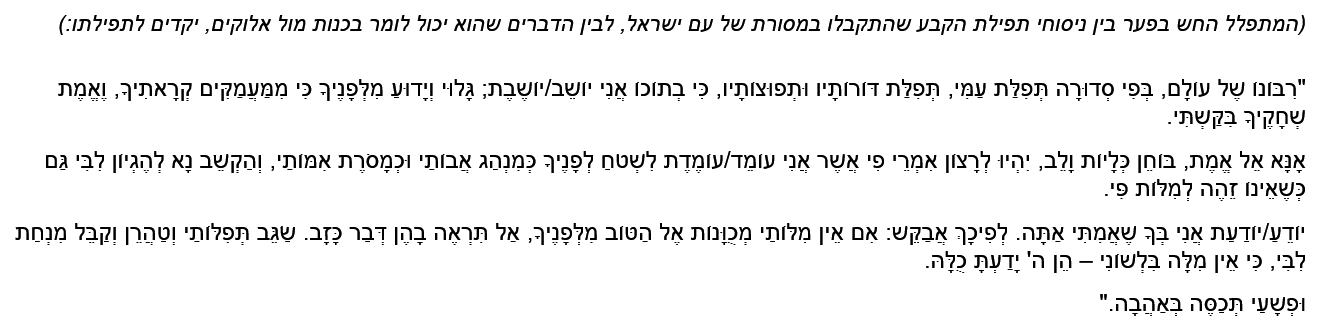
(The worshipper who perceives a gap between the wording of the official prayers that have been accepted as Jewish tradition, and what he/she can sincerely utter before God, should prefix this prayer:)

Master of the Universe, I approach You with the prayers of my nation prepared in my mouth, for I dwell among my people; You know well, that while I call out to You from earthly depths, it is in fact the truth of the Heavens that I pursue.

Please, Lord of Truth, Who intimately fathoms our inner world, may the utterances of my mouth which I pour before You, in conformity with the custom of my forefathers and the tradition of my foremothers, be agreeable to You, but please also heed the meditations of my heart, when they are not identical to the words of my mouth.

I know that You are authentic, and consequently I appeal: If my words are not coordinated with Your absolute goodness, don’t consider them as deceitfulness. Exalt my prayers and purify them, and accept the offering of my heart, for “Even before a word is on my tongue, You, Lord, know it completely,” and conceal my failings with love.

What to do When We Don’t Believe all the Words of our Prayers? Read More »

IDF Won’t Apologize for Killing Terrorists in Hamas Tunnel Blast

The Israel Defense Forces (IDF) will not apologize for killing terrorists while blowing up a Hamas tunnel on Monday.

IDF Spokesman Brig. Gen. Ronen Manelis said that the explosion, which killed seven terrorists, wounded 12 others and left five terrorists missing wasn’t meant to harm any Palestinian. Education Minister Naftali Bennett used Manelis’ statement to claim that the IDF was apologizing for killing terrorists.

“These were terrorists involved in digging an attack tunnel inside Israeli territory with which they intended to kill Israeli women and children,” Bennett tweeted.

Defense Minister Avigdor Liberman fired back on Twitter, writing that “comments like this seriously damage the security of Israel and the IDF.” Yesh Atid MK Elaza Stern, a former IDF general, issued a statement denouncing Bennett’s comments and stating that the IDF in no way apologized for the killing of terrorists.

“It is a shame that government ministers, instead of backing the IDF after an incident like this, chose once again to use it to score political points at the army’s expense,” said Stern.

Two of the terrorists killed in the tunnel explosion were senior commanders for the terrorist organization Islamic Jihad.

The Palestinian Authority (PA) has responded to the tunnel explosion by accusing Israel of using poison gas to kill the terrorist, who they referred to as “martyrs.”

“We call on all of the international organizations to stop these materials that the Israeli occupation is using against our unarmed people,” PA Health Ministry Spokesman Ashraf Al-Qudra said to the PA’s news outlet.

Hamas has called the explosion “a dangerous escalation against our people” and Iran referred to Israel as the “blood-sucking Zionist regime” in response to the explosion.

IDF Won’t Apologize for Killing Terrorists in Hamas Tunnel Blast Read More »

We will decide, we will steer Rabin’s legacy

A man’s legacy, especially when it’s a famous figure — a leader, a philosopher, a great rabbi, a statesman — is a kind of illusion. The man leaves behind some of the things he did in his life — writings, speeches, verdicts, works of art, notes, the results of daring acts — but his legacy is only what people choose to do with all these things after he’s gone. The legacy does not belong to the deceased, it belongs to the living. In the context of recent Israeli affairs, the legacy is not Rehavam Ze’evi’s or Itzhak Rabin’s, it is ours.

If we so choose, we may decide that the legacy has no value at all and simply dismiss the deceased person and what he left behind. If we so choose, we may decide that it has a negative value. That’s what several Tel Aviv high-school principals decided when they chose not to devote any time and resources to what is known as “the Gandhi legacy,” named after Rehavam “Gandhi” Ze’evi, the minister who was murdered by assassins during the second intifada. They did not claim that there is no legacy to discuss; rather, they claimed that this legacy — which includes, among other things, support for the transfer of Arabs from Israel — is of negative value and should, therefore, be discarded. By the way, their choice is a testament to the futility of the state’s attempt to force upon the public customs it is not interested in. The state can decide to mark this or that legacy, to hold ceremonies, have meetings, give speeches. But it is the public that will ultimately decide if these decisions have any actual societal validity. In Ze’evi’s case, it seems that the decision has been made.

Perhaps the decision has been made in Rabin’s case too. At least at this stage, 22 years after that horrible night, the public does not ignore, does not avoid and does not deny the powerful memory of the Rabin murder. The public wants this day, each for his or her own reason.

Certain groups see it as the last remnant of the glorious forgotten days, the days of peace, which have taken on, with the years, a mythological character which they never had at the time: the veiled character of utopia. Other groups see it as a warning sign against extremism, hate speech and deterioration into political violence. The legacies sometimes clash with each other. Those who want to spend Rabin Remembrance Day sharpening positions, heating up disputes and engaging in political ambushes cannot live in peace with those who wish to spend it blurring the divides, toning down the disputes and taking a break from politics.

There are also those who try to talk on Rabin’s behalf, but that’s just hot air. Rabin said many different and contradictory things throughout his life, and each political camp chooses what it finds most convenient to focus on. There are those who choose words of peace, and there are those who choose wartime achievements; there are those who choose speeches about difficult compromises that must be made, and there are those who choose speeches about Jerusalem being united for all eternity. With his death, Itzhak Rabin went silent. He cannot determine how the general public will view his legacy. In one of his most famous speeches, when he was elected prime minister for the second time, he reminded us that “there is no responsibility without authority” and forcefully stated that “I will steer…I will decide.” Here, there’s something that’s easy to agree on: There is no responsibility without authority, so we — the living — will steer and we — the living — will decide. We will argue and, at some point, decide, in whatever way, what legacy this sad day will have, based on the epic life and miserable death of Itzhak Rabin.

Those of us who study the Daf Yomi (the daily Talmud page) are now at the Sanhedrin tractate, which focuses on issues relating to the afterlife. In tomorrow’s page (Sanhedrin,108), there is a discussion about a verse from Parashat Noach: “It came about after the seven days, that the water of the flood came upon the earth.” The Talmud wonders about the nature of these “seven days” and provides an answer: These were seven days of mourning. At that very moment, Methuselah died and the world was asked to mourn him. This demand was so important that even the flood was delayed. “To teach you that eulogies for the righteous prevent calamities from ensuing.”


We will decide, we will steer Rabin’s legacy Read More »