Movie and television producer Brett Ratner, known for films such as The Revenant and the Rush Hour franchise, is one of the latest Hollywood players to be accused of decades of serious sexual harassment and assault. Six actresses, including Natasha Henstridge and Olivia Munn, have come forward to the Los Angeles Times with disturbing allegations. The Jewish Journal’s own Danielle Berrin wrote a series of accounts of her uncomfortable interactions with Ratner over many years. Ratner’s attorney has categorically denied the allegations, calling some of them “absurd”.
“I've made specific, conscientious choices not to work with Brett Ratner,” Munn said. “It feels as if I keep going up against the same bully at school who just won't quit."
Olivia Munn has been saying this for years and he has been disgusting about the allegations and to her for years. He is a garbage human. https://t.co/TvMkhScZoP
Jewish celebrities dressed up for Halloween and some of them crushed it with amazing costumes.
Matt Lauer made a pretty spectacular Dolly Parton, and even got a singing tutorial from the star herself. His fellow anchors also transformed into country stars, including Kenny Rogers, Billy Ray and Miley Cyrus, Willie Nelson, Shania Twain, and Blake Shelton.
Two days after the Jan. 22, 1973, Roe v. Wade decision was handed down by the Supreme Court, the editorial page of The New York Times — pro-abortion then, even more pro-abortion now — announced the 7-2 decision “could bring to an end the emotional and divisive public argument” and “will end the argument if those who are now inveighing against the decision as a threat to civilization’s survival will pause long enough to recognize the limits of what the Court has done.”
That gross misstatement established the template that still exists in large measure: Pretend that Justice Harry Blackmun’s decision hadn’t gutted the abortion laws of all 50 states, some very protective, others virtually allowing abortion on-demand well into the second trimester. And because the abortion regime established nearly 45 years ago was — and is — so wildly out of sync with public opinion, its foundations remain inherently unstable.
The irony is that even “pro-choice” scholars knew how slipshod Blackmun’s opinion was. In 2005, for example, Benjamin Wittes wrote, “In the years since the decision an enormous body of academic literature has tried to put the right to an abortion on firmer legal ground. But thousands of pages of scholarship notwithstanding, the right to abortion remains constitutionally shaky. … [Roe] is a lousy opinion that disenfranchised millions of conservatives on an issue about which they care deeply.”
Irony Number 2: In its earliest years the pro-life movement was filled with liberal Democrats. A commitment to protecting the vulnerable and the powerless was the reason I once was up to my elbows in Democratic Party politics. Alas, when adherence to abortion on-demand became a litmus test, virtually all liberal Democrats chose party over principle.
But the movement’s diversity is richer than ever — everything from nonsectarian organizations such as the National Right to Life Committee (NRLC) to Feminists for Life to Secular Pro-Life. That is the genius of the pro-life cause: You can oppose killing unborn babies — including those capable of experiencing horrific pain as they are torn limb from limb — for a host of reasons. Pigeonholing the pro-life movement as “right-wing” or Christian-only will never end; it will just be even more foolish.
In its earliest years the pro-life movement was filled with liberal Democrats.
Science and technology, and even television commercials, have made the job of persuasion infinitely easier. When my wife was pregnant, I had to pretend I could make out what I saw on the ultrasound. Nowadays, like hundreds of millions of grandparents, when we went to the obstetrician, we could see our grandkids in four-color “real time,” meaning you could see them running all over the place. The facial features were distinct, not blurs, and no one had to help me figure out (literally) heads from tails.
The debate in the 1990s over partial-birth abortions changed the trajectory of the abortion debate. Pro-lifers are convinced the oncoming debate over banning the abortions of pain-capable children will have no less an impact. There already is overwhelming public support for just such a law.
NRLC believes this will help reveal a truth buried for decades: A majority of Americans oppose — and always have — the reasons 90-95 percent of all abortions are performed.
All this support when the mainstream media is so hostile to our cause that they didn’t have to even feign indifference to the trial of an abortionist convicted of three counts of first-degree murder for aborting late-term babies alive and then murdering them by slicing their spinal cords. Where would public opinion be if people understood that West Philadelphia abortionist Kermit Gosnell is no outlier? That he is the real face of the abortion industry that fights any and all attempts to have their facilities inspected without prior notice? (Wonder why?)
Pulitzer Prize-winning editorial writer Paul Greenberg once wrote, “The right to life must come first or all the others can never take root, much less flourish. As in the Declaration of Independence’s order of certain unalienable rights, among them ‘life, liberty and the pursuit of happiness.’ Note which one is mentioned first. And for good, logical reason.”
The movement toward life and away from death is inexorable. Remember that the next time someone pretends it is pro-lifers who are the outliers.
For the other side of the debate, read Sandra Fluke’s column here.
Dave Andrusko is the editor of National Right to Life News and National Right to Life News Today.
As Tolstoy might have observed, every secular Jewish family is secular in its own way.
When I was a baby, my parents chose to settle far from the neighborhood where the synagogues were. “Why,” my father asked, “would we choose to live in the Jewish ghetto?”
On the other hand, each spring my father led a brief seder from the Maxwell House haggadah. Each fall I asked for a Christmas tree and was refused. And, I had a bat mitzvah.
I always will be grateful for my loving, supportive, open-minded, secular Jewish parents. They didn’t flinch when I announced my career choice: poet, with a backup plan of musician. And they had no issue with my dating non-Jews, or women for that matter.
But it was a different story when, in my early 20s, I found myself falling in love with the most unlikely partner of all: God.
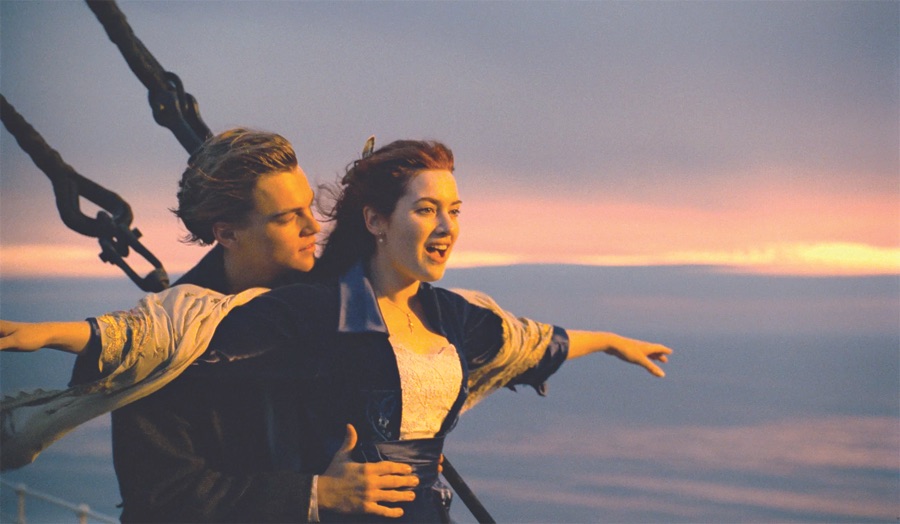
How did this happen? I blame it on a combination of two things — a semester-abroad program and the movie “Titanic.”
It happened in my senior year of college in New York City. I recently had returned from a semester “abroad” on a schooner in the middle of the ocean. This was a surprising turn of events. I had never been on a sailboat before and, in fact, I was frightened by deep water. But I had always been drawn to what frightened me, so when a friend casually mentioned a semester-abroad program on a tall ship, I signed up.
Those six weeks at sea were full of wonder. We learned celestial navigation — aiming sextants at the moon — and took turns cooking dinner for our shipmates in the tiny galley. Some nights, dolphins trailed the boat, braiding their green bioluminescent streams through the water. Recorded music was not allowed, and when I played my violin on the deck beneath the stars, my shipmates gathered around me in silence.
I returned to New York for my senior year with arms like Popeye’s and a new perspective on the miracle that is our planet. It was from this place that I took the subway to 72nd Street and bought a ticket to the newly released “Titanic” movie. With sea air still clinging to my clothes, the story may have felt more real to me than to some of my fellow New Yorkers.
So when the Titanic hit the iceberg, splitting her hull like a banana, and when half of the ship began to sink rapidly, pulling the other half after it, I was beyond terrified. It was all too easy to imagine myself on that deck, knowing the freezing water awaited.
I watched, unable to move. On the part of the deck that had not yet sunk, a string quartet played. Beside them, a preacher cried out: “Save us, God!” Shaking, shivering, screaming, holding his arms to the sky: “Dear God, save us!”
I knew with utter clarity that in the moment of my greatest fear I would have put down my violin and gone to that preacher and prayed with him.
When I left the theater, I walked back uptown on Broadway, that river of taxis trailing red lights behind them. A light, cold rain fell.
I was full of questions.
I wouldn’t be seeking a miraculous rescue.
Who was this God I would be calling out to? I wouldn’t be seeking a miraculous rescue. It was about something larger than myself. My impulse to call out had to do with accepting the power of the sea, the vast sky we had sailed beneath, night after night. And it had something to do with relinquishing my own sense of self, joining something beyond me.
But if my instinct was to orient myself to this mystery in the most heightened circumstances, I thought, why wait for a disaster? Why not call out to God in joy? And for that matter, why not think about God in even the most casual moments, like walking home from a movie?
And so it was that I began to fall in love with God. I did not know what that meant. All I knew was that I was at the beginning of a new voyage.
Twenty years after that rainy night on Broadway, I’m still on that voyage.
And I’m still in love.
Alicia Jo Rabins is a writer, musician and Torah teacher who lives in Portland, Ore.
Since news broke in October of Harvey Weinstein’s decades of alleged rampant sexual violence and assault, women have come out in force to tell their stories of being on the receiving end of unwanted sexual behavior.
As the Weinstein effect has taken down journalist Mark Halperin, former Amazon executive Roy Price, Oscar-nominated writer-director James Toback, and public intellectual Leon Wieseltier, social media has become the site of confessionals.
Nearly 2 million posts have appeared with the hashtag #MeToo in response to a tweet from actress Alyssa Milano asking those who had been “harassed or assaulted” to speak out.
The five-letter hashtag collapsed everything — from rape to crude humor to being stared at on a train — into a single, powerful catch-all category. Any stripe of sexual misdeed was recognized as part of a mass culture of violence by men against women.
Then an Australian journalist named Benjamin Law launched another campaign, #HowIWillChange, with men confessing their deeds and promising to change their ways.
“Facebook’s algorithm are not the way to combat the plague of abuse.” – Sivan Rahav Meir
Law wrote in a series of tweets that men need to recognize they “don’t need to be a perpetrator to be a bad guy.” Questioning allegations, Law wrote, is the equivalent of being a quiet bystander while watching an offense take place.
Men’s #HowIWillChange vows included promising to not interrupt a woman speaking or ask at a job interview how many female executives are with the company, and to shut down catcalls.
Perceived improprieties are now immediately taken up by Twitter. Recently, appearing on a British talk show, actor Adam Sandler touched English actress Claire Foy’s knee.
In the social media whirl that followed, some called Sandler’s act inappropriate and asked whether he would have touched the knee of a man in the same setting. (He had, in a recent interview with Dustin Hoffman). Sandler’s spokesperson said it was a “friendly gesture” that was “blown out of proportion.” A representative for Foy said the actress took no offense.
Sivan Rahav Meir, an Israeli journalist and popular Torah lecturer, characterized the social media approach to addressing sexual assault as dangerously unhealthy.
“Facebook’s algorithms are not the way to combat the plague of abuse sweeping through society, and they may possibly be harmful,” she wrote on her blog.
Rahav Meir cautioned that the indiscriminate outpouring of personal anecdotes may unintentionally normalize sexual assault, giving the mistaken impression that all women have been or will at some point be abused.
“The nonstop flood of heartbreaking stories with the accompanying violence is exaggerated and too intimate,” continued Rahav Meir. “There is a total mishmash of posts between the serious cases of abuse and those of mild harassment as if they are all equally offensive. However, the story of a woman who once had an unpleasant or unwelcome comment directed at her is not in any way connected to a woman who is the victim of a violent assault who requires professional therapy.”
While online indictments of nameless alleged perpetrators may raise awareness, they hold no guilty parties to account and contribute to a “sensationalis[t] and gossipy” exercise, she wrote.
Instead, Rahav Meir encouraged women to work the legal system to crush sexual violence.
Trading sober assessment, exacting definitions and legal action for frenzied narrative and confused terminology can have disturbing consequences. It’s a trend that has been playing out on America’s college campuses.
Shortly before the media were consumed with Weinstein and company, the country’s institutions of higher learning released campus security reports containing three years’ worth of data, as universities that participate in federal financial aid programs are required to do annually under a policy known as the Clery Act.
The reports lack clarity. “Consent,” a word that sits at the core of the conversation about sexual violence, especially on campuses, has no uniform definition in Clery Act reporting. An offense classified as “dating violence” must have occurred while the victim and alleged offender were in a relationship, yet there are no clear parameters for what constitutes a “relationship” — and college students often aren’t engaged in relationships in any traditional sense. “Stalking” is defined as causing “substantial emotional distress” on at least two occasions, but the report offers no specific measure of what that looks like.
Federal reporting that most people don’t look at may not have direct impact on this national conversation but may signal the rabbit hole we have headed down: victims left to navigate a confusing landscape, alleged offenders robbed of their legal right to know what they have been accused of and adjudicators who are unqualified to handle the psychological or legal elements of sexual offenses.
Campuses again offer a useful corollary when considering the numbers. The hundreds of thousands of posts in recent weeks suggest that every woman is the victim of a sexual offense and every man an offender.
As Law, the journalist, wrote, he had to “acknowledge that if all women I know has [sic] been sexually harassed, abused or assaulted, then I know perpetrators. Or am one.”
On campus, an oft-cited claim is that 1 in 5 women will be sexually assaulted during her time in a U.S. college. The statistic originated in a widely disputed 10-year-old survey, but its results have been replicated in surveys by individual universities and in a larger report published by The Washington Post.
Critics cite overly broad definitions and concerns with the reports’ methodologies when disputing the horrifying statistic.
A similar argument already has begun to take hold over #MeToo.
Washington Post writer Lisa Bonos asked those who might be shocked at the number of posts to “consider this: There are far more stories of #MeToos than the number of posts on Facebook.”
Women may be holding back because they don’t think their stories rise to the level of #MeToo, or they may not be ready to share them on such a public forum, Bonos posited. But many more stories are out there, she assured her readers.
Meanwhile, an anonymous writer at the free speech-promoting site Quillette offered a hypothetical breakdown in which he attempted to demonstrate that the internet “can cause an awareness campaign to go viral with millions of posts even if it is raising awareness of something that affects only a small percentage of the population.” In his experiment, 812,500 #MeToo posts were quickly generated if 5 percent of Milano’s 3.25 million Twitter followers participated, and then each of those followers in turn had five friends who posted.
“Of course, this analysis does not prove that abuse is rare; it only shows that the success of #MeToo does not prove the contrary,” according to the author, a software engineer.
Each day, women continue to reveal painful stories of personal and professional lives derailed by influential men who systematically violated them. We easily can be transfixed in disgust and communal shame. But for the national conversation to move forward and force away the lies and grime that have hid sexual assault, it cannot stay boxed into hashtags and tweets.
Rachel Frommer is a reporter with the Washington Free Beacon.
November 9, 2017 will mark the 79th anniversary of Kristallnacht, when Jews were subjected to pogroms throughout Nazi Germany, which turned out to be the beginning of the “Final Solution” and Holocaust.
When one remembers this terrible genocide against the Jewish people, we should also be mindful of all nations that made tremendous contributions and sacrifices to achieve a victory over the evil Nazi regime and its Führer. Azerbaijan was one of these nations.
As the Third Reich attempted to conquer Eurasia, the German General Staff was faced with a massive problem: the Blitzkrieg required mechanized equipment. Unlike previous wars where horsepower was triumphant, the Wehrmacht needed oil to fuel its tanks and planes in this new kind of warfare. Germany had no oil wells of their own, and so Adolf Hitler decided to seize the oil fields of Azerbaijan. This could first provide Wehrmacht with much needed oil, but also starve out the Soviet Union as Azerbaijan’s oil was essential for the Soviet army. Indeed, as Hitler celebrated his birthday in 1942 with a cake showing the Eurasian landmass, he carved out a large piece marked as Baku, capital city of Azerbaijan, for himself. Hitler’s plans were not to be. Over an eight-month period in 1942-43, on their way to Azerbaijan through the North Caucasus, the German war machine ground to a halt at Stalingrad ending in a disastrous defeat for Nazis and stopping their march to Baku. They began a retreat from the Eastern Front that would not finish until the collapse of Nazi tyranny in 1945. It was a costly victory in a deadly war lasting over 6 years with 70 million people killed. The Soviet Union suffered the most, with an estimated 26 million fatalities. Hitler’s ultimate goal, Azerbaijan, shared in the suffering. 700,000 Azerbaijani soldiers, including 100,000 women, fought on the front line with 400,000 making the ultimate sacrifice. Thousands of Azerbaijani Jews sacrificed their lives fighting against the Nazis on the front lines.
Azerbaijan’s contribution to the war effort also included delivering 23.5 million tons of oil a year to the Soviet Army. Baku oilmen accounted for more than 70% of the total oil production and more than 80% of the total fuel production in the Soviet Union in 1941-1945. Georgy Zhukov, Marshal of the Soviet Union, acknowledged that this uninterrupted supply of petroleum products to the front lines was essential to the ultimate victory over the Nazis. Azerbaijani Mountain Jews are also proud of the fact that one of the key figures in Azerbaijan’s oil industry during those difficult years was Yakov Mikhailovich Agarunov – a proud member of our community.
To better understand Hitler’s war for Baku oil, I would highly recommend to watch a great documentary “Objective Baku” that was filmed with the support of Azerbaijan’s Heydar Aliyev Foundation and produced by Mrs. Arzu Aliyeva. The film successfully premiered on National Geographic TV in May 2015.
World War II was a milestone for Azerbaijan’s oil production, one of many. In 1848, engineers drilled the world’s first oil well in Baku to usher in the modern petroleum age. This preceded the first American oil well in Pennsylvania by 11 years. Over the next several decades, Azerbaijan produced the first oil pipeline, the first oil tanker, the first oil refinery, etc. In the beginning of the 20th Century, Baku produced 50% of the world’s oil. A newly-independent Azerbaijan achieved another milestone in 1994, when the government signed the “Contract of the Century” with Western oil companies to jointly develop and produce the Azeri, Chirag and Guneshli oil fields in the Azerbaijani sector of the Caspian Sea. Thanks to the smart use of revenues generated by this contract Azerbaijan has become the largest economy and richest and the most developed country of the South Caucasus region. It has also allowed Azerbaijan to reduce poverty from 50 percent then to under 5 percent now. This contract was renewed on September 14, 2017, and will be effective until the end of 2049. The revenues generated by this new deal will allow Azerbaijan to continue social and economic reforms aimed at modernizing the country and improving the wellbeing of the population – as well as further strengthening a free and independent nation. It also allows its customers, such as the state of Israel, to do the same. From fighting Nazis to fighting poverty, the oilmen of Azerbaijan continue to make contributions to their country and to the world.
“When you grow up in America, the DMV and all the red tape involved is the absolute worst. Then you make aliyah and you realize that [Israel’s Ministry of Interior] is definitely the worst. But then you get to the army and you know, without a shadow of a doubt, that there can be nothing worse than this.”
So muses Sariba Feinstein — and she should know. At 25, Sariba was seven years past Israel’s conscription age when she knocked down the doors of the recruitment office in Tel HaShomer and demanded to be drafted. But like the requisite rejection from rabbis to a potential convert, they turned her away — multiple times. Unflinching, Sariba insisted she wasn’t moving until she could speak to a higher-up.
“I’m stubborn like that,” she said.
Her tenacity about getting into the army ultimately prevailed. Getting into a combat unit, however, was out of the question — until it wasn’t.
“It was a fight to get into the army and a fight to get into a combat unit,” she said.
Sariba ended up being drafted into Caracal, the first co-ed combat battalion of the Israel Defense Forces (IDF), named for the eponymous cat with sexes that appear the same. That didn’t stop the catcalls she and her army buds received from Egyptian soldiers stationed a stone’s throw away across the border, though.
Her two-year service, which now has concluded, consisted of intense training, even more intense tête-à-têtes with commanders several years her junior, and plenty of struggles with the language. During idle times, Sariba took to social media using the hashtag #WatchMeCrackle to recount tales of her service and aggregate lists of things she loved about serving in the IDF, such as the dining hall PSAs announcing when the food is spicy — for the benefit of the Ashkenazi soldiers — or the fact that she doesn’t actually remember the last time she saluted anyone.
This proved to be a rather different experience compared with that of two of Sariba’s brothers back home who chose to serve in the U.S. Army, one in the 10th Mountain Division and the other in the 101st Airborne Division. That half of the Feinstein children chose to serve in the military at all is a curious fact given their upbringing in a Chasidic home.
The recent Netflix documentary “One of Us,” which follows the lives of three individuals who chose to leave their insular Chasidic sects, encouraged Sariba to share her own experiences as an OTD — the somewhat dubious slang given to people who are “off the derech (path)” and who abandon religious observance.
She’s quick to point out that the Chasidic sects portrayed in the documentary have vast differences from the Chabad lifestyle that Sariba’s parents espoused, which, among other things, encourages interaction with nonobservant Jews while other sects reject any dealings with people outside of their communities.
Sariba ended up being drafted into Caracal, the first co-ed combat battalion of the IDF.
Until the age of 11, Sariba lived in Brooklyn’s Crown Heights in New York, the Chabad movement’s epicenter. Her family then moved to Postville, Iowa, where her father took a job as a registered nurse in a hospital. The small town’s Jewish community was largely religious but not exclusively Chabad, with most people affiliated with the town’s kosher slaughterhouse.
When asked if there was any pivotal experience that turned her off religious observance, Sariba demurred, chalking it up to a general feeling of disconnect that just intensified over the years.
“I just stopped feeling like it was my place, like it was mine,” she said without a trace of bitterness in her voice.
After several years in New York and halfway through an online degree, Sariba made plans to move to Southern California. But an impromptu trip to Israel — her first — with Birthright in January 2013 threw a wrench in her plans for the next half-decade, and counting.
“I kept making excuses to stay longer,” Sariba said of her choice to extend her trip.
Ironically, it was on July 4 when Sariba, who now is studying at Bar-Ilan University, finally made the decision to make aliyah.
“I could explore life and live life as I wanted,” she said. “And I just felt that I was at home here.”
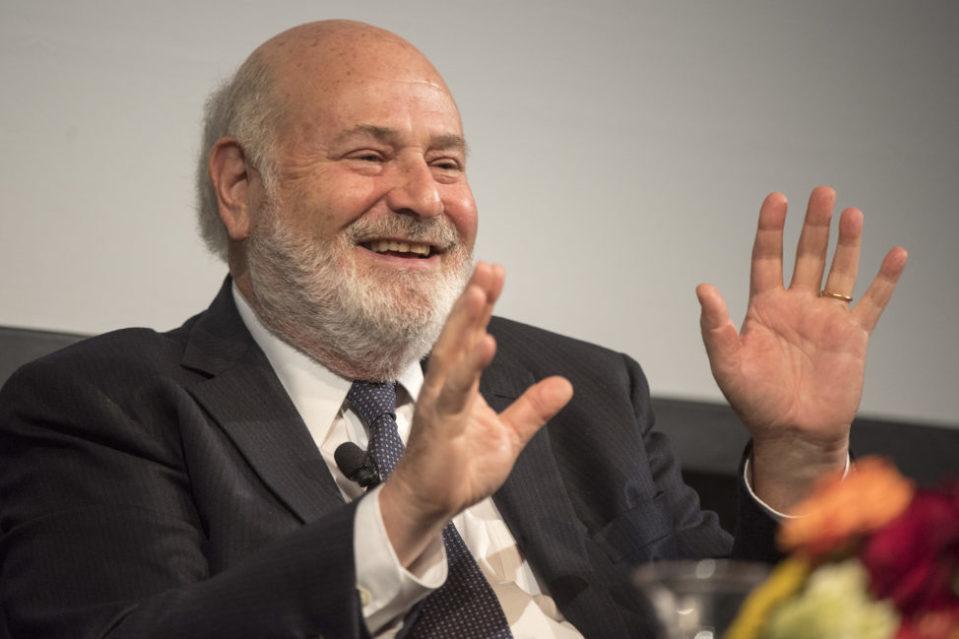
Director and political activist Rob Reiner, 70, is perhaps best known for his iconic films “When Harry Met Sally” and “The Princess Bride.” Before he made a name for himself as a director, he won an Emmy for his role as Archie Bunker’s liberal son-in-law, Michael (aka “Meathead”), on the classic 1970s sitcom “All in the Family.”
While Meathead raged against the Vietnam War, Reiner’s new film, “LBJ” — which opens Nov. 3 — spotlights the president who escalated that conflict in Southeast Asia. But the drama doesn’t cover Lyndon B. Johnson’s war efforts; rather, it focuses on the period when the then vice president was thrust into the highest office in the land after the assassination of President John F. Kennedy.
Jewish Journal: Your father is renowned actor-director-writer Carl Reiner. Did you ever feel competitive with him?
Rob Reiner: I did. As a teenager, I would go with him every day during the summer to where they were shooting “The Dick Van Dyke Show.” One day, I looked at a script he was working on. And I was going, “I can’t do this.” I felt so inadequate. But then when I was 19, I directed a production of Jean-Paul Sartre’s “No Exit,” starring Richard Dreyfuss, at a small theater in Beverly Hills. My dad came backstage after the show and said, “That was good. No bulls—.” That was the first time he had ever basically approved of what I was doing.
JJ: What did you think of LBJ back in the day?
RR: I hated him. I was of draft age during the Vietnam War, which I thought was immoral and illegal. Johnson was my enemy, because he could send me to my death. He was a bully and a browbeat; he cussed and held meetings while going to the bathroom. But later I realized that if it weren’t for Vietnam, he’d be considered one of the greatest presidents of all time. He pushed through the Civil Rights Act, the Voting Rights Act, Medicaid, Medicare and more. But people generally don’t know that.
JJ: What else did you find compelling about LBJ?
RR: He could be rough and tough, but in reading about him, I realized he was also tremendously insecure. He felt like he wasn’t loved because his own mother had been withholding of her love. And he felt that he was ugly compared to the Kennedys, who were handsome, witty, charming and had sex appeal.
JJ: Speaking of controversial presidents, what would the character of Archie Bunker have thought of Donald Trump?
RR: He’d be saying, “Trump is for guys like me.” They’re both from Queens, and they’re both racist and anti-Semitic. As for Meathead, his head would have exploded by now.
JJ: You’ve said that Jared Kushner has turned his back on Judaism.
RR: How do you not speak out when people with swastikas and Nazi signs are walking around and saying, “Jews will not replace us?” How do you stand by and call yourself an Orthodox Jew? He’s like the Jewish police in the Warsaw ghetto.
JJ: Would you ever consider making a movie about Trump?
RR: I couldn’t do it. I’d have to take a shower every other minute.
JJ: You originally had a different ending for “When Harry Met Sally,” when the characters, played by Meg Ryan and Billy Crystal, didn’t end up getting together.
RR: I had been single for 10 years and I just couldn’t figure out how do you ever get with a woman again? I had questions I bring up in the film, like can you be friends with a woman or does sex always get in the way? But then I met Michele, my [wife-to-be], and I changed the ending.
JJ: There’s that famous scene where Sally fakes an orgasm for Harry in a deli. Your own mother plays the deli customer who hilariously says to a waiter, “I’ll have what she’s having.”
RR: When we shot the scene, Meg didn’t do the orgasm full out in the first few takes. So, I said, “Meg, if this is going to work, you’re going to have to really go for it.” But she was embarrassed. So, I sat down across from Billy and I showed her what I wanted her to do. It was, “Oh, yes! Yes!” I’m pounding on the table, and I realized I was having an orgasm in front of my mother. And that was so mortifying.
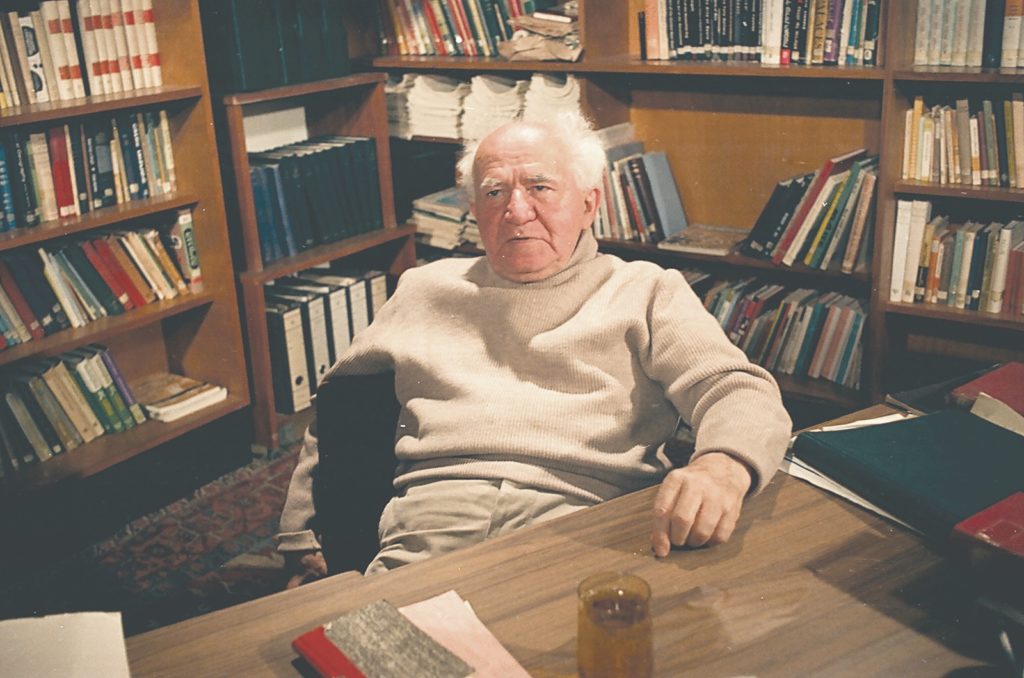
One year after Israel’s lightning victory in the Six-Day War, David Ben-Gurion was asked what he now thought of the country whose independence he had declared in 1948 and which he served as its first prime minister.
“We are not a state yet,” he replied. “We are only at the beginning.”
His somewhat cryptic response is but a blip in six hours of interviews, compressed into the 70-minute film “Ben-Gurion, Epilogue.” The documentary — an eye-opener, even to those who knew Ben-Gurion — will be screened Nov. 5 at the opening gala for the 31st Israel Film Festival at the Saban Theatre in Beverly Hills.
The film — derived from a recently rediscovered, six-hour interview conducted in 1968 — reveals the deeply introspective man behind the legend, who died in 1973 and who was given to politically incorrect statements, which often startled friend and foe alike.
One would hardly label as “peacenik” a man who led his 1-day-old nation into battle facing five Arab nations in 1948. In doing so, he defied every foreign military expert who predicted the poorly equipped, untested Israelis would be wiped out by their heavily armed foes in a matter of weeks, if not days.
Yet later, with Israel’s jubilation over its miraculous 1967 victory still ringing in his ears, Ben-Gurion somberly counseled his countrymen that if the choice were between peace and retaining all the conquered territories, he would choose peace. He amended his position later, saying Israel should retain all of Jerusalem and the Golan Heights.
For a man often described as brusque and at times labeled a dictator by his political foes, the aging Ben-Gurion of “Ben-Gurion, Epilogue” comes across as a modest individual, although eager to continue the filmed interview.
Among his memorable observations:
Alone I couldn’t have done anything. Once, when I spoke to Albert Einstein, he said that even his famous Theory of Relativity depended on experiments conducted by other scientists.
Big cities are not good for humanity. Why does everybody want to go to Tel Aviv? We should have a large number of small towns, each with no more than 15,000 residents.
I am a Jew, not just an Israeli. … I am not a Zionist, I am not a socialist. I am a Jew who lives in Israel, who wants to live in peace with the rest of the world and for people to honor each other and not exploit each other.
Turning to God is thinking deeply about something.
On the day Israel declared its independence, everybody celebrated, but my heart was heavy.
You can’t be afraid of making mistakes. You do something because you think it’s right.
Is there a danger of the military taking over the government? No, not in our state.
Can Israel survive as a democracy? I hope so.
The six hours of interviews — the longest in Ben-Gurion’s life — were filmed at Sde Boker, and then the videotapes mysteriously disappeared.
Three years ago, filmmakers Yariv Mozer and Yael Perlov visited the Steven Spielberg Jewish Film Archives in Jerusalem in search of a feature film labeled “42:6” about the life of Ben-Gurion as interpreted by a group of actors. The film came out in 1970 and was quickly forgotten.
Moser and Perlov found “42:6” and next to it noticed some 35mm reels labeled “raw material” containing the videotape from the Sde Boker shoot. The filmmakers’ joy at the discovery turned to dismay when they discovered that the tapes’ soundtracks were missing. Doggedly, Mozer embarked on a six-month global search and finally found the soundtracks — at the Ben-Gurion Archives in Sde Boker.
Mozer, 39, the film’s director and co-producer, wasn’t even born when Ben-Gurion died. “For me, growing up in Israel, Ben-Gurion was no more than a picture on the wall,” he said in an email exchange.
The interview and film offer members of younger generations a chance to discover the person behind the Israeli icon.
“I am not a Zionist, I am not a socialist. I am a Jew who lives in Israel.” – David Ben-Gurion.
“He becomes a human being with emotions and the full complexity of his personality,” Mozer said. “So, almost everything in this film was for me a new discovery. I came to understand that deeply in his vision and ideology was the connection to the higher moral values of the Bible and the prophets.”
Conducting the interview in the film is Clinton Bailey, now 80, who as a young Jew from Buffalo, N.Y., made aliyah to Israel in 1958. He became one of the foremost authorities on the lives and customs of Bedouin tribes living in the Negev and Sinai Peninsula, and met Ben-Gurion through the most unusual of circumstances.
Shortly after his arrival in the country, Bailey was walking along Keren Kayemet Street in Tel Aviv, heading for a job interview. He passed a modest house and was hailed by a woman standing outside, who instantly recognized him as an American, since he wore a necktie. Learning that the young man wanted to live in Israel and was looking for a job, she invited the stranger in for a cup of tea. Before her guest left, the woman told him that her husband was out of town but would return the next morning, and she would introduce the two at that time.
The hospitable lady was Paula Ben-Gurion, whose husband was then in his second term as prime minister. The two men hit it off, and when the documentary film project materialized, Ben-Gurion requested that Bailey be the interviewer.
Bailey, in an interview with the Journal, called Ben-Gurion “a visionary who guided his vision by pragmatism. He was totally dedicated to this vision and what had to be done to realize it. He wanted political power to realize the vision, and not for the perks of power. A modest lifestyle, without the frills of power, was sufficient for him. He was a thinking person and an avid reader.”
The description is apt, but if the film has a weakness, it is that it omits the criticisms leveled against Ben-Gurion during his public life. Many of the attacks were political hardball, which Israelis play more enthusiastically than anyone else, but some of the criticism was valid and worth examining.
Toward the end of his interview, the then 82-year-old Ben-Gurion mused about his own mortality.
“I don’t fear death,” he said. “Why should I? It won’t change anything.” Then he added, “At my funeral, I want no eulogies and no gun salutes.”
Five years later, the government carried out his wishes faithfully.
The impact of Israeli programs on American television has taken an almost biblical route: In the beginning, there was “BeTipul,” which begat HBO’s “In Treatment”; “Hatufim” begat Showtime’s “Homeland”; and Keshet Studios begat NBC’s “The Brave” and CBS’ “Wisdom of the Crowd,” both based on television shows born in Israel.
And now, through the proliferation of online streaming services such as Hulu, Amazon Prime and Netflix, Israeli concepts are dispersed throughout the world, being translated for international audiences.
“Israel’s influence on the global TV marketplace is remarkably disproportionate to the size of the country,” said Andrew Wallenstein, co-editor-in-chief of Variety. “It’s hard to believe a nation so small can have such a big impact.”
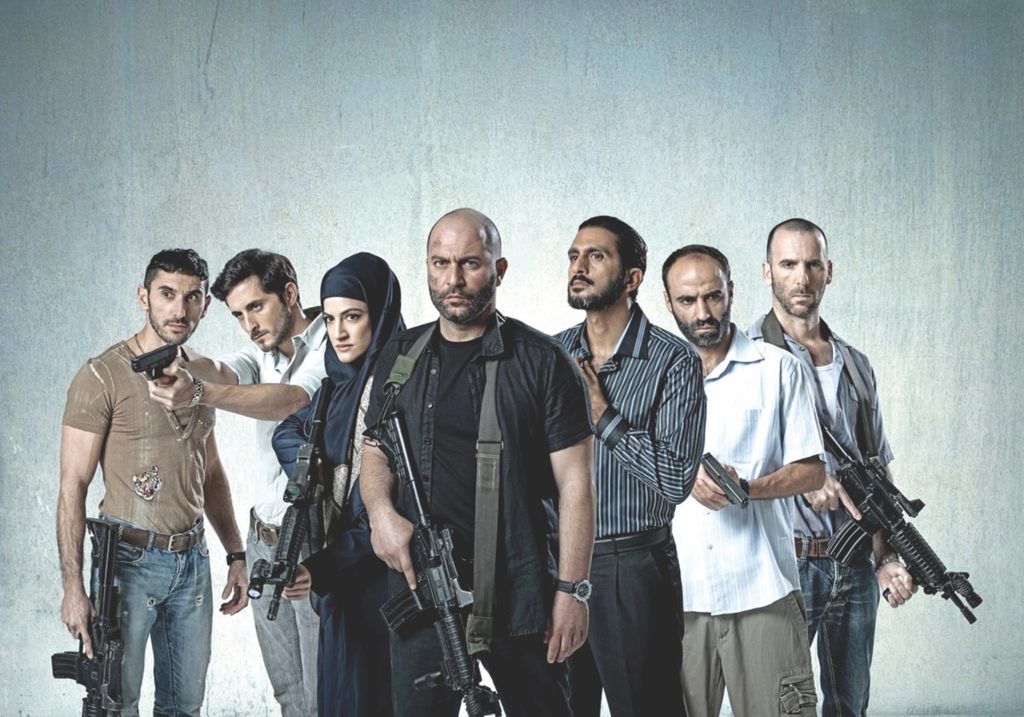
The vehicle for much of Israel’s entertainment impact on the world is Netflix, which isn’t just the home of “Stranger Things” and stand-up comedy specials. It’s also where subscribers access television shows and films from across the globe, including the two most recent straight-from-Israel TV success stories, “Fauda” and “Mossad 101.”
Both programs related to Israel’s intelligence agency are being spotlighted on the streaming service and at the upcoming Israel Film Festival, which runs Nov. 5-21. New episodes of both dramas will screen as part of the festivities — “Mossad 101” on Nov. 15 and “Fauda” on Nov. 16 — before most audiences have a chance to see them elsewhere. A conversation about the state of the television market, with a panel of Israeli and American executives, will take place following the “Mossad 101” screening.
Netflix, boasting 109 million members in more than 190 countries, is a major distributor of both original Israeli content and repurposed Israeli formats, like the teen drama “The Greenhouse Academy,” the BBC drama “The A Word,” and the forthcoming original “The Good Cop,” a dramedy featuring Tony Danza. But in addition to exporting formats, the Israeli TV shows themselves are having a moment. KCET has been broadcasting “Hatufim” (“Prisoners of War”), and Hulu has announced distribution for the Israeli thriller series “False Flag.” Amazon Prime has “Srugim,” a show about Orthodox singles living in Jerusalem. Netflix also has “Mossad 101” airing in Hebrew with English subtitles, and the Arabic-and-Hebrew “Fauda.”
“It’s a credit to Netflix that it was willing to see if an American audience could take to a show that is part Hebrew, part Arabic,” Wallenstein said.
Netflix’s wide reach also means that “Fauda” and other Israeli TV shows are being seen in more countries than their creators ever could have imagined.
“It’s shown in 200 countries!” said Israel Film Festival director Meir Fenigstein, rounding up from Netflix’s official number of 190 countries. “There has never been an Israeli film shown in 200 countries.”
In addition to “Mossad 101” and “Fauda,” the festival is screening two other television shows, “Your Honor,” a thriller about a judge’s involvement with a notorious crime family, and “Harem,” a fictional tale about the phenomenon of cults and their destructive consequences. With so much Israeli material being sold to the United States, and with last year’s festivals in Cannes, Berlin and Toronto featuring TV programming, it was time for the Los Angeles festival to get in on the conversation, Fenigstein said.
For Netflix, things really got hot with “Fauda” (“chaos” in Arabic). The series lives up to its name, with chaotic relationships and situations that are ready to explode, sometimes literally, as a retired Mossad agent is reactivated into service to try to eliminate a terrorist who had been presumed dead. Episodes are laden with tension, violence and ethical justifications for deception.
When the show started airing in Israel in 2015, Larry Tanz, vice president of acquisition at Netflix, said he spent two late nights bingeing the series.
“It became clear to me that we should invest in a meaningful way to premiere the show globally, outside of Israel,” he said. “It’s brilliantly executed and also quite topical and relevant.”
Wallenstein said it’s no surprise that the foreign-language program has managed to find an audience in America — and beyond.
“Though it captures the story of just one region of the world, that drama taps into more universal themes that resonate even with those who don’t necessarily know what’s going on in the Middle East,” he said.
Netflix worked with Yes, the Israeli satellite channel that produced the show, on a multiseason partnership and the rest, as they say, is history. Local festival audiences will be treated to the world premiere, but Season Two will not be available on Netflix until March 2018.
“For many people watching, it’s very likely that it’s the first time they have ever seen an Israeli TV show,” Tanz said.
“It’s a credit to Netflix that it was willing to see if an American audience could take to a show that is part Hebrew, Arabic.” – Andrew Wallenstein
To Fenigstein, “Fauda” resonates because of its truth — specifically that of Lior Raz, the retired Israeli special forces soldier who co-created and stars in the show.
“He knows [that world] inside out,” he said. “He doesn’t even have to act. He’s playing himself.”
The show also portrays Palestinians in a very human way, Fenigstein added. “Even the Arab populations in other countries watching it, it looks real to them.”
Afghan-American actress Azita Ghanizada got hooked on “Fauda” after it was recommended by novelist Stephen King, she told the Journal.
“‘Fauda’ presented a balanced and nuanced perspective of the Israeli-Palestinian conflict, the fight against terrorism and the complication of geopolitics,” she said. “The humanity of the characters dove into a place that isn’t shared in most narratives surrounding the conflict, and the Muslim characters were deeply human, not the caricatures you often see in Hollywood films and TV.”
Ghanizada, founder of MENA (Middle Eastern North African) Arts Advocacy Coalition, added that “Fauda” “shared how complicated both sides of the conflict are, allowing me as the viewer to go on the journey with each character regardless of religion or national identity.”
“Mossad 101” (“Hamidrasha,” meaning “The Academy” in Hebrew) takes a different perspective — and tone. A scripted dramedy, it focuses on a training course for Mossad cadets.
“The series was used from the beginning as a platform through which we could show different Israelis from different perspectives getting to another Israeli melting pot, but this time, a very elite one: the Mossad training course,” said Daniel Syrkin, the show’s co-creator and director, in a Hebrew email interview.
“Mossad 101”
The first season featured diverse characters, including a Persian Israeli, a Russian Israeli, a genius psychologist, a startup millionaire and American-Israeli brothers from Los Angeles. The course is guided by a Mossad officer whose motives are suspect and whose work relationships are complicated. An essential question throughout the series: What would these cadets do to protect their country?
“We dealt less with the famous operations of the Mossad and more with the human aspect and allowed ourselves to do this with a wink — there was a lot of humor and lightness in the first season,” Syrkin wrote.
Several critics indicated that it was, perhaps, too light-hearted, focusing more on the competitive spirit and relationships between trainees than on the serious fact that they were training to seduce, kidnap and even assassinate targets. Syrkin said the second season — the first episode of which will have its U.S. premiere at the Los Angeles screening — had to be more serious and “more respectful of the legend of the Mossad.” This season, they’re still asking the question about love of country, he reports, but “the plot is bloodier, more suspenseful and has less humor,” and the shared enemy this season is “international Islamic terror — that’s not a group that any Israeli is ready to
joke about.”
Now that the show has a global audience, Syrkin said, “it excited me to think that the scenes we were shooting at that moment in Hebrew for an Israeli audience, that deal with Israeli dilemmas, will get to the wider world and interest also viewers that know very little about Israel.”
This could happen more often in the future, Netflix’s Tanz said, noting that the streaming service already has announced plans for more original series with “Fauda” creators Avi Issacharoff and Raz.
“Maybe we have increased the demand for Israeli TV by showcasing some of the best of it,” he said. “Israel, in particular, is a strong source of compelling content, so we expect to find more opportunities there.”