As Tolstoy might have observed, every secular Jewish family is secular in its own way.
When I was a baby, my parents chose to settle far from the neighborhood where the synagogues were. “Why,” my father asked, “would we choose to live in the Jewish ghetto?”
On the other hand, each spring my father led a brief seder from the Maxwell House haggadah. Each fall I asked for a Christmas tree and was refused. And, I had a bat mitzvah.
I always will be grateful for my loving, supportive, open-minded, secular Jewish parents. They didn’t flinch when I announced my career choice: poet, with a backup plan of musician. And they had no issue with my dating non-Jews, or women for that matter.
But it was a different story when, in my early 20s, I found myself falling in love with the most unlikely partner of all: God.
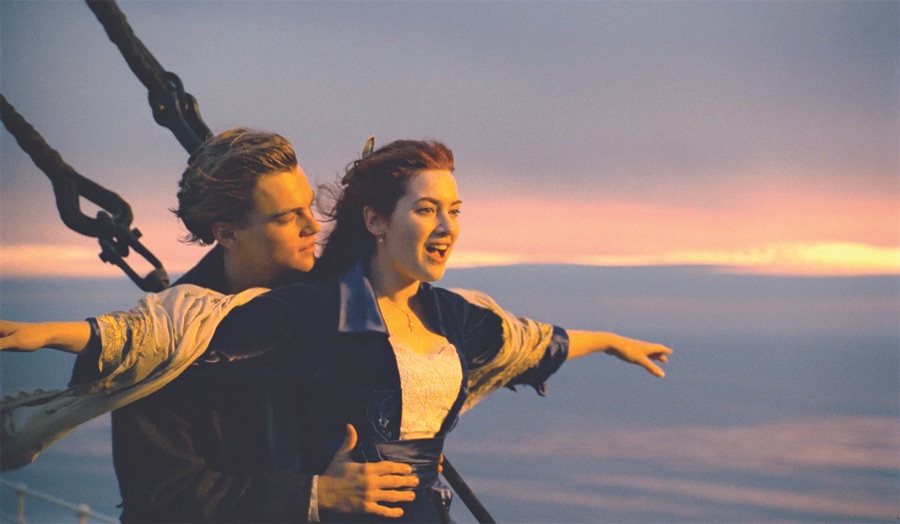
How did this happen? I blame it on a combination of two things — a semester-abroad program and the movie “Titanic.”
It happened in my senior year of college in New York City. I recently had returned from a semester “abroad” on a schooner in the middle of the ocean. This was a surprising turn of events. I had never been on a sailboat before and, in fact, I was frightened by deep water. But I had always been drawn to what frightened me, so when a friend casually mentioned a semester-abroad program on a tall ship, I signed up.
Those six weeks at sea were full of wonder. We learned celestial navigation — aiming sextants at the moon — and took turns cooking dinner for our shipmates in the tiny galley. Some nights, dolphins trailed the boat, braiding their green bioluminescent streams through the water. Recorded music was not allowed, and when I played my violin on the deck beneath the stars, my shipmates gathered around me in silence.
I returned to New York for my senior year with arms like Popeye’s and a new perspective on the miracle that is our planet. It was from this place that I took the subway to 72nd Street and bought a ticket to the newly released “Titanic” movie. With sea air still clinging to my clothes, the story may have felt more real to me than to some of my fellow New Yorkers.
So when the Titanic hit the iceberg, splitting her hull like a banana, and when half of the ship began to sink rapidly, pulling the other half after it, I was beyond terrified. It was all too easy to imagine myself on that deck, knowing the freezing water awaited.
I watched, unable to move. On the part of the deck that had not yet sunk, a string quartet played. Beside them, a preacher cried out: “Save us, God!” Shaking, shivering, screaming, holding his arms to the sky: “Dear God, save us!”
I knew with utter clarity that in the moment of my greatest fear I would have put down my violin and gone to that preacher and prayed with him.
When I left the theater, I walked back uptown on Broadway, that river of taxis trailing red lights behind them. A light, cold rain fell.
I was full of questions.
I wouldn’t be seeking a miraculous rescue.
Who was this God I would be calling out to? I wouldn’t be seeking a miraculous rescue. It was about something larger than myself. My impulse to call out had to do with accepting the power of the sea, the vast sky we had sailed beneath, night after night. And it had something to do with relinquishing my own sense of self, joining something beyond me.
But if my instinct was to orient myself to this mystery in the most heightened circumstances, I thought, why wait for a disaster? Why not call out to God in joy? And for that matter, why not think about God in even the most casual moments, like walking home from a movie?
And so it was that I began to fall in love with God. I did not know what that meant. All I knew was that I was at the beginning of a new voyage.
Twenty years after that rainy night on Broadway, I’m still on that voyage.
And I’m still in love.
Alicia Jo Rabins is a writer, musician and Torah teacher who lives in Portland, Ore.