fbpx

October 26, 2017

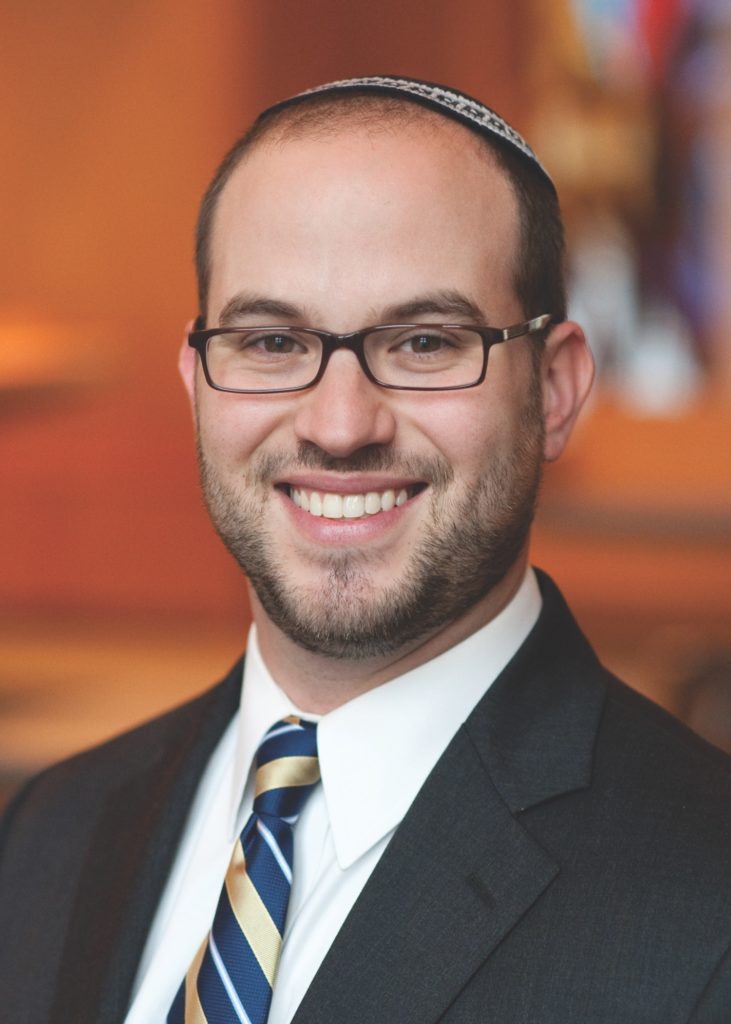
Rosner’s Torah Talk: Parashat Lech Lecha with Rabbanit Alissa Thomas-Newborn

Our guest this week is Rabbanit Alissa Thomas-Newborn of the B’nai David-Judea community in L.A. Rabbanit Thomas-Newborn is a graduate of Yeshivat Maharat and of Brandeis University. Rabbanit Alissa is also a Board Certified Chaplain (BCC) through Neshama: the Association of Jewish Chaplains. She has specialities in Palliative Care, End of Life Care, and Psychiatric Care. She has worked as a chaplain at Cedars-Sinai Medical Center, New York-Presbyterian Columbia University Medical Center, and Bellevue Hospital. She was also a writer for the Center for Jewish End of Life Care at Metropolitan Jewish Health System. Rabbanit Thomas-Newborn was a fellow both at Clal: The National Center for Jewish Learning and Leadership and at the UJA-Federation of New York Wiener Educational Center. She has been a Scholar-in-Residence at various universities and shuls around the country.

This week’s Torah portion — Parashat Lech Lecha (Genesis 12:1–17:27) — features Abram’s Journey to the land of Canaan, his forced departure to Egypt, his covenant with God, the birth of Ishmael, Abram’s circumcision, and the changing of his name to Abraham. Our discussion focuses on the difficult beginning of Abraham’s journey and on how flaws and mistakes can actually be essential to a holy journey.


Our past discussions of Parashat Lech Lecha:

Rabbi Avram Mlotek on the idea of being “on the other side”

Rabbi Michelle Dardashti on why Abraham is sent forth by God and why he’s responsive to God’s call

Rabbi Hyim Schafner on the character of Abraham, why he was chosen, and the importance of his journey to Israel

Danya Ruttenberg on the symbolic nature of the uncertainty facing Abraham and the problematic father-son relationships in the stories of the patriarchs

Rosner’s Torah Talk: Parashat Lech Lecha with Rabbanit Alissa Thomas-Newborn Read More »

Israeli judo champion sings Israeli anthem to himself since Abu Dhabi wouldn’t play it

An Israeli won the gold medal in the Abu Dhabi Judo Grand Slam competition on Thursday, but the United Arab Emirates (UAE) refused to play Israel’s national anthem. The Israeli decided to sing it himself instead.

Tal Flicker, 25, won the under-66 kilogram Judo gold and came to the top podium underneath the International Judo Federation (IJF) flag, as the UAE doesn’t allow the Israeli flag to be publicly displayed. The IJF also blared their own anthem.

Flicker sang the Israeli anthem to himself anyway:

https://twitter.com/GuidoGma/status/923689885373956096

Flicker later told Channel 2, “The anthem that they played of the world federation was just background noise.”

He expressed pride in his country.

“The whole world knows that we’re from Israel, knows who we represent,” Flicker said. “The fact that they hid our flag, it’s just a patch on our flag.”

Additionally, Israeli Gili Cohen won the bronze medal in the women’s judo competition in the tournament. The IJF unfurled their own flag instead of the Israeli flag.

Israeli symbols of any kind are banned in the UAE, so Flicker, Cohen and other Israelis competing in the tournament had to compete as members of the IJF instead of as members of Israel.

There have been other instances of Israelis facing disparaging treatment at sporting events. In 2016, an Israeli Judoka defeated an Egyptian Judoka in the Rio Olympics, but the Egyptian refused to shake the Israeli’s hand. Participants from Lebanon also wouldn’t let Israelis onto a bus they were slated to ride together. In 2013, the Tunisian tennis federation forbade its star athlete from squaring off against an Israeli opponent.

Israeli judo champion sings Israeli anthem to himself since Abu Dhabi wouldn’t play it Read More »

My Story with Leon Wieseltier

“Are you waiting for Shmuel?”

“I’ve been waiting all my life for Shmuel,” I said.

He laughed. “You’re funny.”

We’re at the fax machine; it was my first interaction with Leon Wieseltier. I was in my twenties; he was roughly 10 years older. A bit shy, I couldn’t believe I actually said that, but out it came and so began a literary friendship that lasted for the nearly four years that I was at The New Republic.

We talked a lot. About everything. He loved to talk. He found intelligence sexy before it was cool to find intelligence sexy. He also encouraged me a great deal. With Leon’s guidance, I wrote three major essays on feminism for The New Republic, one a major cover story that led to a book contract. As an editor and a writer, he brought a fierce, distinctive intelligence to his work and never shied from an intellectual fight.

Were our conversations tinged with sexual innuendo? Sometimes. But for me they fell into the realm of flirtation. Other men in the office flirted, too. Only once did something “happen.” He asked me if I wanted to watch a movie in his apartment. I said yes. He tried to kiss me; I said no. He stopped immediately. That moment never came up again, and never affected our relationship.

We talked a lot about Judaism. I told him that right before my Bat Mitzvah, my family had moved to a big, sterile synagogue, which I hated. I hated it so much that I literally didn’t set foot in a synagogue again for a decade. When he heard this story, he said, “We’re going to synagogue this Shabbat.” And we did. At one point during the services, I cried. Tears of sadness, joy, reconnection. Leon said nothing, just offered quiet support by sitting next to me. He let me reconnect privately and never took credit for it.

Because of an email chain that I was not a part of, Wieseltier has now been Weinsteined. Shamed and disgraced. As far as I can tell, the worst he is being accused of is trying to plant an unwanted kiss and boorish behavior; perhaps there is more that we don’t know.

I respect—in fact, insist on—a woman’s right to speak up. If someone finds something offensive, it’s not for me to judge. But speaking out works both ways. I also have a story to tell, and part of that story is that I did experience harassment in the offices of TNR, but it didn’t come from Leon, and it wasn’t sexual.

It was verbal bullying. One editor in particular would look for reasons to scream at me and at the other young women. His bullying was well known. We put up with it, but it wasn’t pleasant.

With Leon, there was a lot of laughter. No matter what was going on in the world, we laughed. And he listened. He listened to my ideas, to my thoughts about men, women, sex, anything and everything. There was no quid pro quo; there was no manipulation. Wieseltier was nothing like Weinstein.

My purpose here is not to defend Wieseltier against the charges of other women. I have no special interest in defending him. We haven’t worked together in years. I bumped into him last year; it was the first time I had seen or spoken to him in ages.

I’m writing not to negate anyone else’s story, but simply to tell my own. I want to say that this particular man inspired me to be my best self, made me into a thinker, and helped me reconnect to my Judaism.

I’m telling my story also because we’ve reached a very sensitive point. I’m tremendously grateful that Harvey Weinstein’s monstrous behavior has come out—it should have come out decades ago. And the #MeToo campaign has enabled women, and men, to talk about inappropriate behavior from many others.

At the same time, we have to resist the temptation to turn every incident into a Harvey Weinstein scandal. Not all stories are similar. Not all sexual innuendo in the office is harassment. Not all women are victims.

Some, like me, have been empowered by men who came into our lives at a particular moment, took no for an answer, and then raised us up and let us go.

My Story with Leon Wieseltier Read More »

SOUL BITES: Highlights from Shabbat Sermons

Rabbi Ari Lucas, Temple Beth Am
In the wake of the Harvey Weinstein revelations that the Hollywood mogul had serially abused women sexually, and repeatedly created situations where women saw themselves as having to choose between submitting to his unwanted advances or give up any hopes of a career in Hollywood; in the wake of all the publicity his actions were getting, many women have taken to social media and posted: “MeToo”. And the floodgates opened.

In Parshat Noah, God opens the floodgates of the heavens in response to the corruption He witnesses on Earth. The text tells us vatimalei ha-aretz hamas – the land was filled with hamas. We’re not certain what the word hamas means in the Bible. In other contexts, it appears to mean corruption or injustice. Ibn Ezra, a medieval commentator on the Bible claims that hamas refers to stealing and “taking women by force.” According to his interpretation, some kind of sexual violence leads God to regret at having created the world such that God chooses to start over with one family.

The way we speak and behave are reflections of the choices we make. The earth may continue to be filled with hamas – way too many stories of sexual violence. But God has promised never again to purify the land with floodwaters, so the responsibility falls to us – the rainbow after the storm – to do the work of pursuing justice and uprooting evil from our land. Let’s continue that work together.

Rabbi Mordecai Finley, Ohr HaTorah
This week’s Torah portion, Noah, has a verse that has become a foundation for the spiritual and mystical approach to prayer. In Genesis 6:16, we find God saying to Noah, “Make a tzohar (light) for the teivah(ark).” The Hebrew word “tzohar” has two basic interpretations in the Talmud: “radiant gemstone” and “skylight”, but they both mean “a source of light.”

Jewish commentators have creatively mistranslated the word “teivah” in Genesis 6:16, that refers to Noah’s “teivah” (ark), as “word”, so that we can read this verse “put a light in the ark” as “make a light for the word.”

The Baal Shem Tov teaches that when one places the radiant light of consciousness into a word of the prayer book (or any sacred text, for that matter) one perceives “worlds, souls and divinity.”  The letters, the pronunciation of a word of the prayer book or the Bible, are a vessel that holds an inner depth.

I think that one must first have some experience in a contemplative practice so that one can reach deep within. We have to be able to create that skylight of consciousness to illuminate the hidden chambers of holy words.

And we must take the time to enter into the holy books like a spelunker. It is dark in there, and the journey inward is tough, and maybe boring, but then you detect that the atmosphere has changed. You find yourself in this cavern, thick with souls, words and divinity.

Rabbi Gabriel Botnick, Mishkon Tephilo

Most people forget it’s there, but at the end of Parshat Noach is the story of the Tower of Babel.  The Torah states that for many generations after the flood, the people of the world were unified in both language and matters – namely, building a tower to challenge the heavens.  God – worried there’d be no end to human achievement if this trajectory continued uninterrupted – decides to confuse the people, “so that no one would understand the language of their fellow” and thus cease being so productive.

However, the Hebrew word for “language” is “Safah”, which can relate to a culture’s unique language or the collection of words a person speaks. And the word for “understand” here is “Shama”, which is more often translated as “listen.”  With this in mind, one could translate this line so that it reads “no one would listen to the words of their fellow.”  In other words, God knew the best way to keep us from achieving greatness would be by having us not listen to one another.

We often get so caught up in our own narratives that we fail to listen to the narratives of others.  As Jews, our tradition teaches us that no one should go to bed hungry, sleep without a roof over their head, or suffer without medical care.  However, as humans, we may differ in how we prefer to achieve these goals. Imagine how much more we could achieve if we saw the Tower of Babel not as a punishment, but as an invitation:  if we actively listen to one another, nothing can stop us from achieving whatever we desire.

Helena Lipstadt (Guestspeaker), Beth Chayim Chadashim

A rainbow always comes as a surprise. Usually after rain and when the sun comes out. What do you say when you see a rainbow? “Wow,” “it’s unexpected,” “magical,” “beautiful.”

Ten days ago I was in Poland. It rained nearly the whole time I was there. My friends and I were walking around in the drizzle and suddenly we turned around and saw a rainbow in the sky behind us. Wow! The rainbow made us feel happy and hopeful.

This was my sixth trip to Poland in six years. It is the place my family comes from. In the middle of the 20th century, Poland was the site of an enormous flood of anti-Semitism. The Polish Jewish community was almost completely destroyed in this flood, including my grandparents, aunts and uncles and cousins. There was no ark to hold this community.

I never expected to find rainbows in Poland but I did. The rainbow – an ineffable combination of fire and water – is shocking in its possibilities. It is once again a sign of change, of hope, of beauty. A surprise, when it appears. Everything depends on our being able to see it. See it and remember our time of floating together above the flood in one, life-saving ark.

Rabbi David Wolpe, Sinai Temple

I’m going to talk about Harvey Weinstein.

We read this morning the story of Noah, which by the way, if you read the verse carefully, is in part about sexual immorality. But we don’t know the name of Noah’s wife. It isn’t until Abraham comes along that [Sarah], the female partner is named. Just as the female partner is named in the original intention of creation with Adam and Eve and then somehow falls out of the picture. And that is a lesson, both in how easy it is to erase and how important it is to restore. About how often through history women didn’t have names and voices and position and power, and what that can mean.

When you sexually violate someone, you are taking part of the core constituent of their identity, part of their soul and saying it’s yours and not theirs. Remember the biblical word for sex is yada – to know – to know someone. So what are you saying when you violate them? “I know you. And you’re worthless.”

When you have monsters of ego and desire, it is our responsibility as Jews, as human beings, not to just laugh over stories like this or have a prurient interest or to read about them because after all it’s interesting, but to be outraged and to speak up and to say how wrong it is.

It is a long way from Noah’s wife to Sarah. We are the children of Sarah. It is our job to teach that to the world.

Rabbi Sharon Brous, IKAR

It strikes me this year is maybe what’s happening is that the story of the tower of Babel is coming to drive home the lesson of Noah, that there’s power in community but the real danger comes from uniformity. It comes from when we’re all so busy working for some greater goal that we’re silent when we see things happening along the way that are cruel, that are indecent, that are simply wrong.

The world sometimes finds itself upside down. Sometimes what’s normative is what’s wrong. And what’s right is to stand up and to speak out against whatever that pervasive culture is. Whether that culture is in the White House or whether that culture is in the studio offices.

This is incredibly hard to do because these challenges sometimes lose us friends, and they sometimes lose us our jobs. They sometimes lose us opportunities and deals. But resistance is built into the Jewish ethical and moral and religious system.

We’ve seen over the last few weeks exactly what’s at stake when everybody knows what’s happening but few, too few, are willing to speak about it. We’ve seen the dangers of silent complicity. The Torah of Noah is that it’s not enough to just stay decent and to not join in to the evil.

It’s not enough to just be good in times like these. We also have to find the courage to defy God, to defy colleagues, to defy authorities, to defy anyone who’s willing to contribute to the normative practices that are so toxic in our current climate.


SOUL BITES: Highlights from Shabbat Sermons Read More »

McGill University Jewish Student Kicked Off Student Government Board for ‘Conflicts of Interest’

A Jewish student at McGill University has been kicked off the student government board for having “conflicts of interest” due to his pro-Israel activism.

Third-year student Noah Lew was one of 12 board members up for general assembly ratification on Monday evening following his victory as vice-president finance of the Arts Undergraduate Society. The ratification vote is typically a mere formality, but Monday’s was different due to Democratize Student Society of McGill University (SSMU), an organization that was established to resist the university’s ban of the Boycott, Divestment and Sanctions (BDS) movement on campus.

Democratize SSMU was able to pass a motion that required each board member to be voted upon separately under the grounds that they weren’t a fan of the names. When it was Lew’s turn, he was voted down, 105 to 73 with 12 abstaining, with applause following the vote. Two other students who had criticized BDS, Alexander Scheffel and Josephine Wright O’Manique, were also voted down.

Democratize SSMU had targeted Lew and the other two students on the board because they had connections to the Canadian Jewish Political Affairs Committee (CJPAC) and were involved in getting the BDS ban passed, which Democratize SSMU claimed were “conflicts of interests.”

Lew shared the experience on Facebook.

“I have no doubt from the information circulated about me and campaign run against me prior to this vote that this was about my Jewish identity, and nothing more,” wrote Lew. “I was blocked from being able to participate in my student government because I am Jewish, because I have been affiliated with Jewish organizations, and because I believe in the right to Jewish self-determination.”

Lew added that the experience shows the inherent anti-Semitism in the BDS movement.

“If BDS is not anti-Semitic, why did a BDS-led campaign name and shame me for my affiliation with a Jewish organization, and call on students to remove me from student government for this reason?” wrote Lew. “If BDS is not anti-Semitic, why was I barred from participating in student government because of my Jewish identity?”

SSMU President Muna Tojiboeva wrote on Facebook that Lew being voted down was “a blatant expression of anti-semitism.”

“To vote against the candidacy of a Director simply because he is Jewish and involved in his community is unacceptable,” wrote Tojiboeva. “No matter what your place of origin, your religious or political beliefs are, you should feel welcome to get involved in your own Student Society.”

McGill Principal and Vice Chancellor Suzanne Fortier sent out an email declaring that the university would be investigating the matter.

Democratize SSMU defended their actions on Facebook, claiming that the students were voted off the board for their role in passing the BDS ban.

“It is not surprising that students refused to ratify these Directors,” the organization wrote. In their voting, they were fulfilling their role of making a political decision about who will represent them. This is how democracy works.”

They added that they “apologize for any harm that has been done” in response to accusations of “being divisive and discriminatory.”

McGill University Jewish Student Kicked Off Student Government Board for ‘Conflicts of Interest’ Read More »

How I Discovered My Cousin, the Dodger

A couple years ago, after center fielder Joc Pederson spectacularly debuted with the Los Angeles Dodgers, I decided to look into his family tree.

What a tree it is. Pederson’s mom, Shelly Cahn, has a remarkable Jewish background. Shelly’s paternal great-grandfather, Leopold Cahn, was born March 13, 1864, in San Francisco. Leopold’s grandparents came from Bouxwiller in Alsace, France, and have typical Jewish surnames from that region: Cahn, Loeb, Weyl and Bamberger. And on and on.

Some people like to do crossword puzzles. I like to do genealogy.

I got started in third grade with a family tree assignment. You know how it is when you’re a kid and you find out you’re good at something? I wish it had been baseball, but it turned out to be genealogy.

After consulting with my maternal grandmother and a new biography on my paternal grandfather, Austrian composer Arnold Schoenberg, I came back to school with an enormous, deep family tree, stretching back to the 1700s.

From then on, genealogy was my passion.

Amazingly, after 40-plus years, I keep finding new things. As resources become available online and get indexed, searching for new clues is just too much fun.

But in between discoveries of my own, I like to keep busy by working on other people’s trees. That’s how you really learn to be a genealogist.

A while back, I started a project on Geni.com, my favorite genealogy platform, to explore the family trees of famous Jews throughout history. It’s called the Jewish Celebrity Birthday Project, and it lists all of the famous Jews I can find, with links to their family trees.

We’ve got all the Nobel Prize winners, the musicians, actors, politicians, even the baseball players. You can click on a name, and Geni’s World Family Tree will tell you how you’re connected to them — if not directly, then cousin to cousin to cousin.

For Jews, a connection is pretty much automatic. It turns out we’re all pretty closely related.

As for Joc Pederson of the Dodgers, let’s keep following his branches.

His Cahn ancestors came first to New Orleans in the 1840s. Leopold’s father, Israel, was a wool merchant. He and his brothers moved on to Monterey, Calif., and ended up in San Francisco, where they were charter members of Temple Emanuel. Shelly’s paternal grandmother, Zelda Sugarman, was born in 1907 in San Francisco, one year after the great earthquake, to parents who had emigrated from Russia around 1889. Her father, Michael, owned an iron and metal business.

The family of Shelly’s mother, Suzanne Heyman, is even more fascinating. Suzanne’s paternal grandfather, Samuel Heyman, was born Feb. 20, 1869, in New York to a family of German immigrants from Glückstadt in Schleswig-Holstein, while her grandmother, Fannie Morris, was born Oct. 4, 1873, in San Francisco. Fannie’s father was from Poland, but her mother, Bessie Adler, was born in New York in 1857 to parents from Poland and Germany.

Is that close enough to ask for tickets to the World Series?

Suzanne’s maternal grandfather, Charles Weil, was born Dec. 12 , 1871, in Hornersville, Mo., before his family moved to Modesto, Calif. His father was from Germany, but his mother, Fannie Parara, was born Sept. 2, 1852, in Providence, R.I. Fannie’s father was Salomon Abraham Rodrigues Pereira, born Nov. 9, 1809, in Amsterdam, descended on his father’s side from that city’s large Sephardic community, with ancestors also named Querido, d’Aguilar, Barzilay, Quiros, Provencal, Belmonte, Tartas, Abendana and Baruch. Salomon’s mother, Meintje Levie de Goede Stodel, was not Sephardic, but also descends from a large Dutch-Jewish family, as did Salomon’s wife, Mietje Halberstadt.

Finally, Suzanne’s maternal grandmother, Ancie Weil, was born January 20, 1878 in Shasta, Calif., to parents from Germany. Ancie’s father, Joseph Anschel Weil, was born Aug. 30, 1841, in Steinsfurth and was an early pioneer in Shasta. In a book on Old Shasta, you can see an old photo of Joseph and his brother David, early vintners in the area.

Joseph Weil


Using the genealogical resources we have available online today, I could come up with this tree for Joc Pederson’s maternal ancestors in a matter of hours, while watching him play a game. It turns out we’re not that distantly related. The niece of Joc’s great-great-great-grandmother Fannie Weil (Parara) married Joseph Stampfer, my second cousin three times removed.

Is that close enough to ask for tickets to the World Series?


E. Randol Schoenberg is an attorney and a law lecturer at USC.

How I Discovered My Cousin, the Dodger Read More »

Wise Temple to Open New Pavilion and Garden

Stephen Wise Temple and School on Nov. 5 will unveil a new event space its leaders hope will become a premier venue for sports, cultural happenings and lifecycle events.

The $9.2 million Katz Family Pavilion and Shalom Gardens are in the first phase in the temple’s campus improvement project, launched five years ago.

Working with Lehrer Architects, the temple transformed the historic Hershenson Hall at the center of its Bel Air campus into the new pavilion. It also transformed a parking area into a park with trees and grass.

The pavilion is named for the Katz family — Ronald Katz, Dana and Todd Katz, and Kathy and Randall Katz—who have been active in the temple for decades.

“Ron is an extraordinary philanthropist, and the whole family has been generous to our community and the greater Los Angeles community,” said Rabbi Yoshi Zweiback. “We couldn’t be prouder to have their name attached to the project.”

Among the new pavilion’s striking features are its 9,500-square-foot gymnasium and multipurpose room, 1,000 square feet of athletic program offices, and a 1,000-square-foot yoga and Pilates studio. The surrounding 7,000-square-foot Shalom Gardens — created in honor of Senior Rabbi Emeritus Eli Herscher, who retired in 2015 after 40 years of service to the temple — is lined with olive trees and has arc-shaped benches and dedication pavers made of Jerusalem-stone.

“To have a facility of this size to host weddings or bar mitzvahs, with a place to park and a glatt kosher [catering] option that’s right in the heart of the city is really amazing,” Zweiback said. “The park makes you feel like you’re really out in nature on this mountaintop, with beautiful views and an olive orchard.”

Among the project’s striking architectural features are the 28-foot-tall glass doors that open onto an outdoor patio.

Among the project’s striking architectural features are the 28-foot-tall glass doors that open onto an outdoor patio.

“This is really taking advantage of the wonderful Southern California indoor-outdoor living,” Zweiback said.

Stephen Wise members Alvaro and Paola Gancman were the first family to book a private event at the pavilion — the party for their daughter Sabrina’s bat mitzvah on Dec. 9.

“Our kids grew up here at Stephen S. Wise,” Paola said. “When we saw the plans [for the pavilion], it looked so beautiful.”

Sabrina is a ballerina and the theme of the party will be “Swan Lake.”

“With those beautiful glass doors and the trees outside, it fits so well with the atmosphere that we’re trying to create,” her mother said. “I think it’s going to be beautiful.”

With a capacity of 500 people, the new pavilion easily will accommodate the Gancmans’ 300 guests. The outdoor area also can be tented to accommodate an additional 300-400 people.

Gancman said initially she was concerned because the space is a multipurpose room that can be used as a gym. “But they built it in such a way that the acoustics are wonderful,” she said. “It’s really an honor to be the first family to celebrate in this space. It’s very special in a lot of ways.”

Wise Temple to Open New Pavilion and Garden Read More »

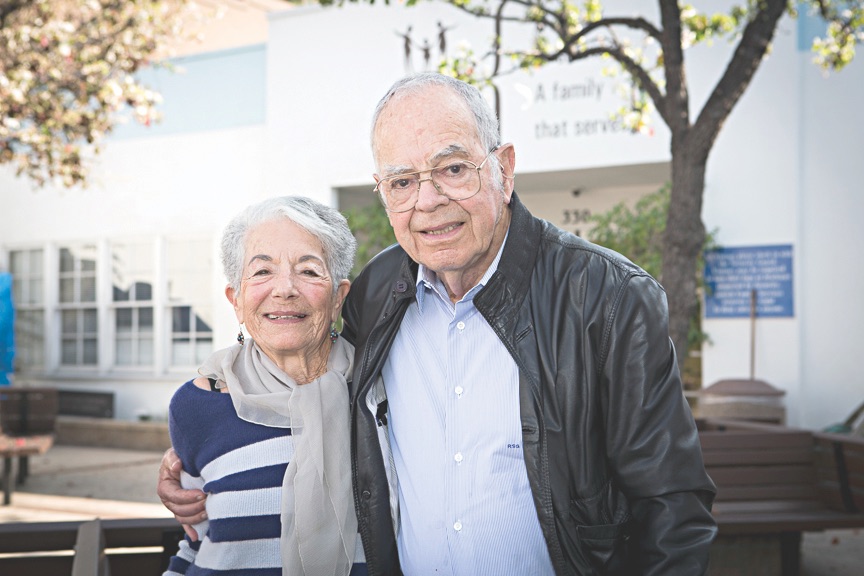
An Attitude of Gratitude

I lived my younger years with three anchors: to live in service, in adventure and in love.

My service consisted of 60-plus years participating in many fulfilling community and political projects in the United States and Israel. There were thrilling adventures, too, with long treks, mountain climbs and bicycle tours in exotic countries. And then there was love — rooted in my dearest Lois, our three sons, their wives, our grandchildren and ever-widening circles of friends.

But now I am 92. My service and adventures are only wonderful memories. Today, there are new experiences — like arthritic aches and a few strange pains in my back.

Still, my aging days are filled with much love, gratitude and joy. My wife of 69-plus years remains my true love; I will never understand how I was so smart at age 22 as to grab her for life. I can look back on a life filled with excitement and a reasonable level of success. And in my efforts to promote tikkun olam, I continue to support social justice causes as in the past, only today this support is more financial than physical.

One gift of my senior years has been a contentment level I never felt when younger.

One gift of my senior years has been a contentment level I never felt when younger. I was always too busy, always on to the next activity, never stopping to meditate and appreciate the life I created. Now, age and perhaps a little wisdom have directed this change in how I live. I have time to read for pleasure and not just for data. Time to see beauty that in the past I ignored. Time to move slowly and open my eyes to so much of what I’d been missing.

For me, this contentment has re-birthed the dominant emotion at this time in my life — gratitude, a deeply felt satisfying joy for all the blessings in my life.

But why did I not learn about the joys of gratitude until my later years? Did I miss a valuable lesson along the way? Could an enlightened elder have showed me a path that could have brought to me the joys of gratitude in my youth? Could I be that elder for others?

Years ago when traveling with our children, we saw incredible poverty in many places around the world. Now I wonder: In talking with our sons, did we reflect enough on life in one of those villages compared with our lives in Beverly Hills? Did we consider their food, their clothes and toys, their dwellings and schools? Did we ever talk about how lucky we were to be born in the United States?

One path to learning gratitude is comparing our life with what might have been, but it doesn’t take foreign travel to accomplish this. There are examples everywhere, such as the inspiration offered by the heroic people in our lives.

Consider my grandmother, who left her tiny shtetl in Ukraine at age 17. She came alone to this country to live in freedom and escape the rampant anti-Semitism of the czar. What if she had lost her courage and didn’t complete that trip? Or if the odds were too great and she failed? Would we ever have left that part of the world?

How different my life would be. What a debt I owe that courageous 17-year-old. I never told my grandmother how grateful I was for her daring, and how she determined the future of our whole family.

As I grew older, gratitude came more naturally. I learned to be more thankful for having such a full life — call it a heightened awareness of the vitality and beauty of my everyday surroundings. There grew a joy in living beyond myself, as I continued to be active in community service and the world around me.

This might be tough to teach, but through the conversations we initiate and our own actions, we all can model this lifestyle for the next generation.


Richard Gunther has lived the life of a social entrepreneur.

An Attitude of Gratitude Read More »

Being Almost 100 Calls for 99 Cents Only Bash

When Cecile Petrak and her family planned her birthday party a few months ago, they thought about organizing a themed party around her age.

Naturally, there was only one place to hold it for the woman who was born in 1918.

“We thought, ‘Let’s celebrate her birthday at the 99 Cents Only store,’ ” Cindy Petrak, Cecile’s daughter-in-law, said. “That worked out really well.”

On the afternoon of Oct. 22, the Petrak family blew up purple, blue and white balloons — matching the store’s logo — and welcomed a few dozen guests outside the 99 Cents Only Store in Northridge to celebrate the 99th birthday of the family matriarch.

Cecile sat at a table with her friends, most of them in their 80s and 90s. Some guests came leaning on their walkers and, one by one, went to her table to say hello and chat.

Visitors signed birthday wishes on a poster that featured the store’s logo and a photo of Cecile in a graduation cap and gown, a picture she had recently found and liked. Someone joked about celebrating Cecile’s next birthday at a $1.00 store.

“I love the party,” Cecile said. “I am seeing people who I care about and that makes me really happy.”

When Cecile prepared to cut her white birthday cake, her guests sang “Happy Birthday” and many captured the moment with their cameras and cellphones.

Raised in Brooklyn, Cecile grew up in a family of Russian Jews who moved from what is now Ukraine, looking for “better opportunities.” Her father, who had a degree in engineering, owned a store and sold real estate. Like many families during The Great Depression, Cecile’s was far from wealthy —she remembered once asking her parents to buy something at a market, which made her mother cry because their family couldn’t afford it.

She recalled only one time when she experienced anti-Semitism. It was when she went to a Macy’s store in New York looking for a job and the store manager told her she had already met her quota for hiring Jews.

“You didn’t go to a place looking for a job outside the Jewish neighborhood,” Cecile said.

Someone joked about celebrating Cecile’s next birthday at a $1.00 store.

A good student, Cecile graduated high school when she was 15. She married in 1947, moved to Los Angeles with her husband, Hyman, and began working as a kindergarten and first-grade teacher. Soon, she and Hyman adopted their daughter, Marisa, and son, Jonathan.

“It was the best thing I have ever done,” Cecile said as she stood next to Jonathan at her birthday party. “They are the best kids in the world, and it was very easy to raise them.”

Cecile and Hyman ended up divorcing, and she raised the children alone.

Being a single mother, however, didn’t stop her from joining the Los Angeles Unified School District teacher strike in 1970.

“She went on strike because it was about women’s issues,” Jonathan said. “She has always believed in fighting for civil rights.”

Despite Cecile’s advanced age, her family and friends say she is a young-at-heart woman who enjoys traveling to Las Vegas and using social media. She has four grandchildren.

“She is pretty remarkable,” Cindy said. “She wishes her grandchildren happy birthday on Facebook, several days in advance, making sure it gets there on time as if it is going in the mail.”

The only drawback of being 99 years old, Cecile said, is feeling young but not being able to go wherever she wants.

“It doesn’t feel like 99,” the Valley Glen resident said. “As long as I can read and talk to people, I am good.”

Cecile said she knows only two people her age but she rarely feels lonely.

“She loves to read, tell stories and laugh,” Jonathan said. “She loves being Jewish.”

Cecile said longevity runs in her family. Her mother lived until she was almost 100 years old and her father passed away when he was 87.

“I’ve had a good life,” Cecile said as she stood next to her grandson Andrew, Jonathan and Cindy. “I feel blessed.”

Being Almost 100 Calls for 99 Cents Only Bash Read More »

Jewish Republican Group Looks to Grow

Louis Averbach, who is in his mid-60s, once considered himself a middle-of-the-road, conservative Democrat. However, “I don’t like what is happening today with rioting in the street,” he said. “Right now, I would consider myself Republican.”

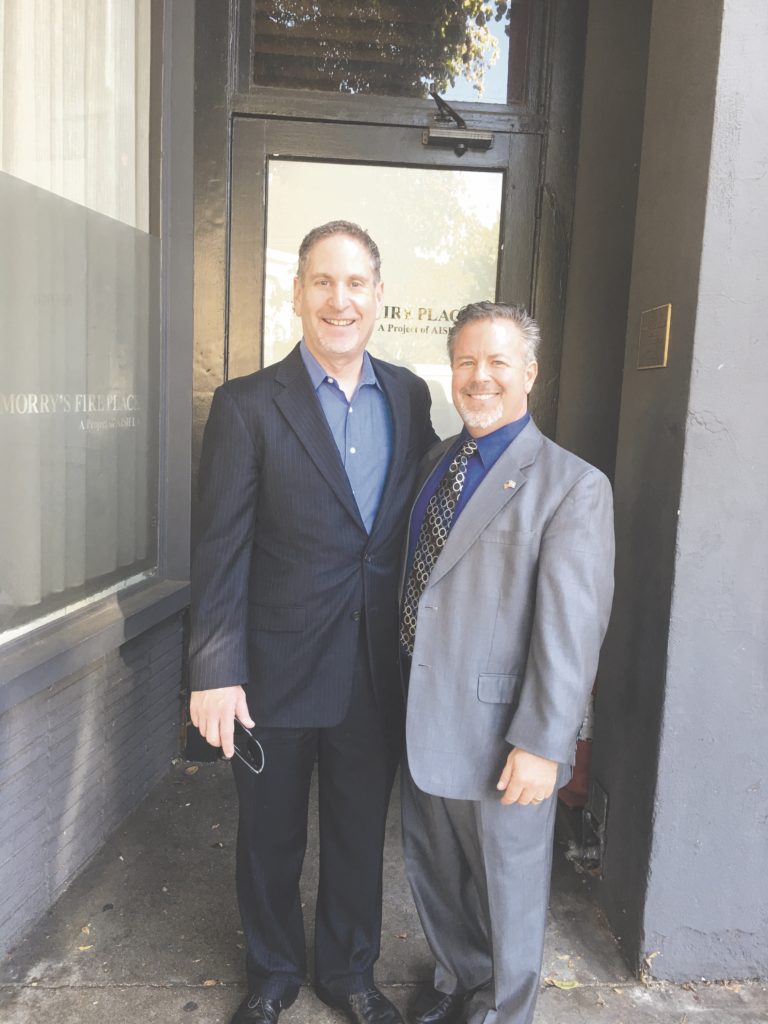
Averbach was one of about 30 people who gathered at Morry’s Fireplace restaurant in Pico-Robertson on Oct. 20 for a lunch event organized by the Jewish Republican Alliance, a fledgling organization aiming to support Jewish Republicans in heavily Democratic California.

Republican Townhall.com columnist Bruce Bialosky spoke at the event, delivering a speech defending President Donald Trump and criticizing leftists. Bialosky said Trump did nothing wrong when he said “both sides” were to blame for the violence in Charlottesville, Va., over the summer. He called Charlottesville the “holy grail” for those seeking to delegitimize the president.

Real estate broker Bruce Karasik and financial adviser Mitch Silberman, both of the Conejo Valley, co-founded the group last year. It has three chapters — in the Conejo Valley, the San Fernando Valley and West Los Angeles.

They hope to expand into a national group with 100 chapters.

They hope to expand the Alliance into a national organization with 100 chapters, and so far the group has nearly 1,000 people on its email list, they said.

The Alliance’s mission statement asserts that “Growing Republican Jewish communities and supporting Israel is key.”

People interviewed at the event said support for Israel was a top priority for them. “A lot of the Jewish community is more about supporting a Democratic candidate whether he is pro-Israel or not,” Averbach said. “[Former President Barack] Obama was not a pro-Israel guy. How could a Jew support the Iran deal?”

The group currently is in the process of applying for nonprofit status and is trying to distinguish itself from the more established Republican Jewish Coalition (RJC).

Karasik said in a phone interview that he and many Alliance members are former RJC members, but he felt the RJC had become “less of a grass-roots organization and more centrally based.”

In a phone interview from Washington, D.C., Alex Siegel, the RJC deputy director, said he is pleased to have an additional organization working to engage Republican Jews.

“There are opportunities for both organizations to succeed in the Jewish community,”
he said.

Metuka Benjamin, president of Milken Community Schools, accompanied a friend, Georgette Joffe, to the event. Benjamin said Israel was the only issue that mattered to her, so she wanted to learn what the Alliance was about. “I want a leader who will be very supportive of Israel at a very difficult time,” she said.

The lunch event began with the ha-Motzi blessing, with attendees breaking off pieces of challah and passing them.

Later, Trump supporter Joffe could barely hold down her chicken when Bialosky mentioned New York Times columnist Bret Stephens, who wrote in July that Trump’s presidency was the “most morally grotesque administration in American history.”

“He’s a ‘never-Trumper,’ ” Joffe said of Stephens. She supports Trump in part because of her concern about Islamic fundamentalism.

“How many more unvetted Muslim refugees are there than neo-Nazis?” she asked.

One 59-year-old man who spoke with the Journal asked that his name not be used because he worried his support for Trump could threaten his livelihood.

“I am one of the 84 people in my precinct who voted for Donald Trump,” he said, mentioning a newspaper report that some 90 percent of Santa Monica voters cast ballots for Hillary Clinton.

The event attracted both insiders and outsiders in the Republican Party. Before taking his seat, Gary Aminoff, treasurer of the Republican Party in Los Angeles County, said Los Angeles Jews have many incorrect assumptions about Republicans.

“The misconceptions are that we’re racist, that we don’t care about poor people who have financial problems — none of that is true,” he said. “We need Jews on both sides of the [aisle] but Democrats are not really behind Israel.”

An earlier version of this article referred to Bialosky as a conservative columnist.

Jewish Republican Group Looks to Grow Read More »