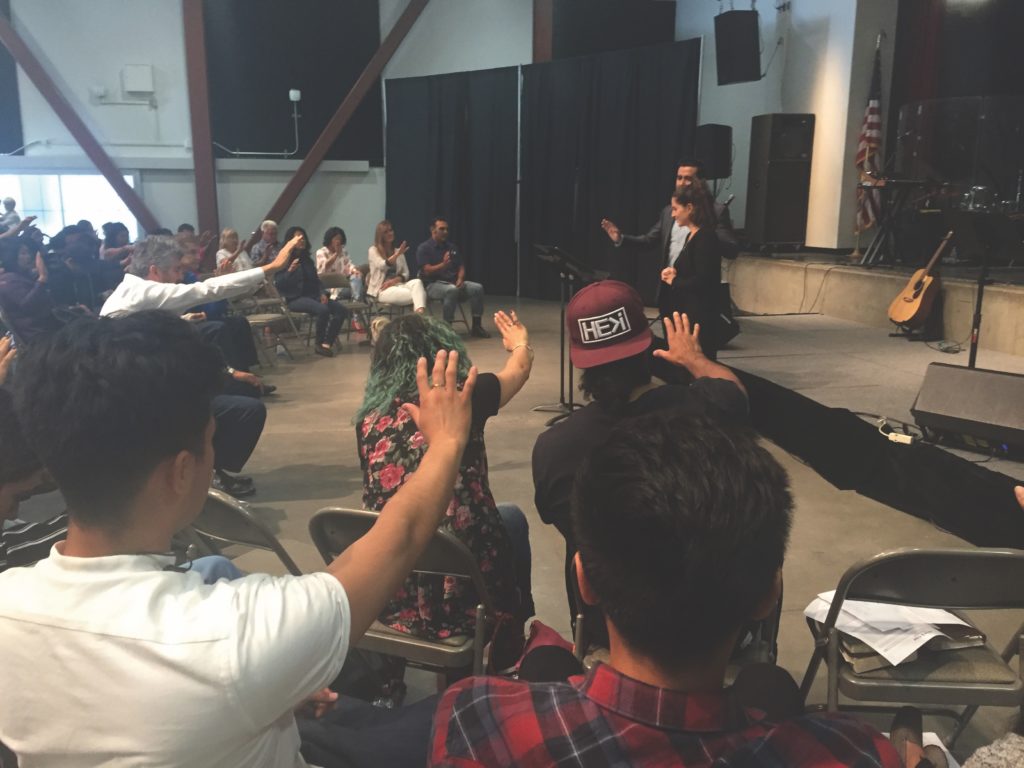
While the rest of the crowd raised its hands toward the ceiling of the middle school auditorium, an olive-skinned woman in a knee-length black dress shifted on her feet in the front row, her hands folded in front of her.
Iyyar Schwartz, 28, visited the bilingual congregation El Camino Metro in Sun Valley on Oct. 22 as part of a United States tour by former Israeli soldiers, organized by the pro-Israel education organization StandWithUs. She and her traveling companion, Ilan Lopez, make up one of six teams touring the country until Nov. 5. On this morning, Schwartz addressed the English-language service of the nondenominational Christian congregation while Lopez spoke at a larger Spanish-language service at a high school.
Schwartz shared her experience as an artillery officer in the Israel Defense Forces (IDF), including the time when a rocket went off as she was patrolling the border of the Gaza Strip during Operation Pillar of Defense in 2012. Dropping to the ground, she lay prone in a muddy field. “I won’t forget that,” she said. “I had mud in my nose and my mouth, and I was thinking, ‘Would I rather lose my arms or my legs?’ ”
Before the rocket landed, it was intercepted by Israel’s Iron Dome missile defense system — but the incident served as a touchstone for her to talk about the Israeli-Palestinian conflict and the need for dialogue.
“We need to put ego, money, politics — we need to put that aside, and we need to listen to each other,” she said.
After Schwartz’s remarks, Pastor Cruz Navarro called on the approximately 100 people in attendance to raise their hands and bless Schwartz and all of Israel. “Today, we bless through Iyyar not just her, but the entire nation,” he said.
“They love Israel but they still need connections to what’s going on today.” – Ilan Lopez
The visit to El Camino Metro marked the beginning of the nationwide tour that will bring former IDF soldiers to more than 150 audiences in churches, synagogues, high schools and other venues. Schwartz traveled to California from Israel with Lopez, the director of StandWithUs Latin America. The pair also will travel to Colorado, Nevada and Arizona.
The visits are meant to expand Americans’ understanding of Israel, and to counter negative attention Israel receives in the media.
“There’s a divine mandate in the Bible to bless Israel,” said Pastor Josh Tolle, as he introduced Schwartz.
Nonetheless, Lopez said it was important to introduce Spanish-speaking congregations like El Camino Metro to a “human face to relate to” that was connected with Israel. In downtown Los Angeles on Nov. 5, Lopez is scheduled to visit Tabernaculo Biblico Bautista Amigos de Los Israel, a Hispanic church.
“They love Israel,” Lopez said in an interview, “but they still need tools [to support it] and connections to what’s going on today.”
After Schwartz’s appearance, Lopez took the stage across the street at El Camino Metro’s Spanish service with about 1,000 people, mostly immigrants from Mexico and Central America.
Lopez spoke in Spanish about his upbringing as the child of a Jewish mother and Christian father in Venezuela, where, in 2009, a mob overpowered security guards at a Sephardic synagogue, then tossed the Torah scrolls across the room and spray-painted anti-Semitic graffiti. A year later, Lopez moved to Israel and enlisted in the IDF.
He spoke about his humanitarian work as an IDF soldier, relating a tale about how he helped move a boy from a Palestinian hospital to Hadassah Medical Center in Jerusalem, where Israeli doctors treated the boy for burns suffered after an accident at his home.
After Lopez spoke, the Salvadoran-born Navarro reminded the congregation about an upcoming church trip to Israel in February.
“If there are pupuserias in Israel,” Navarro said, referring to Salvadoran stuffed tortillas, “I’m moving there right away.”
The bad news is that my grandson’s upcoming bar mitzvah will not be a royal affair. Queen Elizabeth has declined his personalized invitation.
However, Her Majesty did respond to the young Anglophile with a lovely letter, writing in part — via her Lady-in-Waiting — “Although unable to attend your Bar Mitzvah celebration, The Queen greatly appreciated your kind invitation.”
Born and bred in Southern California, my grandson Zachary (Zach) Austgen, now 12, became a believer in the British Isle when he was 7. That’s when he visited England on a family vacation that included his two older siblings. His loyalty to the crown was sealed during a second visit last year, highlighted by views of Buckingham Palace and the Changing of the Guard and attendance at the musical “Billy Elliot.”
Two weeks later, it was the parents’ turn to gasp as the mailman brought an envelope embossed with a crown.
His letter to Her Majesty was handwritten — and without any parental input. It included a photo of himself and a drawing he made of the queen and himself at his bar mitzvah party.
“Dear Queen Elizabeth,” Zach wrote, “I am writing to you today from La Jolla in California to invite you to my Bar Mitzvah. I would have emailed you the electronic ‘Save the Date’ notification, but we didn’t have your email. My Bar Mitzvah is on the 6th of January of 2018 and I would love you to come.
“You are my role model, I am a huge fan of you and England, I have visited London twice already and I am going again after my Bar Mitzvah. My after-party to my Bar Mitzvah will have an English theme, with a huge British flag at the entrance.
“Thank you for reading this and I hope to hear from you soon! — Zach”
Zach’s father, Tim, and his mother (my daughter), Ronit, have over time adjusted to their son’s fertile imagination and unusual projects.
“In first grade, when he was barely 6, a class assignment was to represent the Great Wall of China in some way,” his mother said. “Almost everyone entered a drawing, but Zach insisted he wanted to make a cake representing part of the Great Wall. He somehow befriended a pastry chef and together they made the cake wall.”
But the bar mitzvah invitation to Queen Elizabeth seemed so far out that the parents tried to prepare Zach for the inevitable letdown, figuring there was no chance he would receive a reply. Two weeks later, it was the parents’ turn to gasp as the mailman brought an envelope embossed with a crown and the letters E II R (Elizabeth the Second Regina [Queen]).
Zach’s fondness for the sceptered isle and its ruler took some time to ripen.
“The first time our family visited England, I was 10 years old,” he said. “I thought then that the way the British spoke, they were putting on airs. But I now know that everybody talks that way — and I can now understand what they’re saying most of the time.”
However, it wasn’t until his second visit to London, in the summer of 2015, that Zach learned to fully appreciate his hosts.
“I think the reason I fell in love with England was because of how the British act — they are very formal and orderly. They give off a certain vibe that makes you feel like you are part of a big, organized group. As I crossed the streets of England with everyone else in their fancy suits, carrying their fancy briefcases, I had this great feeling. I felt special.”
This from a youngster who was raised in an environment where a T-shirt, shorts and flip-flops are considered dressy.
The Austgen parents have a tradition that whenever one of their three children formally joins the Jewish peoplehood, she or he can choose the destination for their next summer vacation. There was never any doubt that Zach would opt for England, but this time he also wants to visit the countryside and, at his father’s request, take a side trip to Wales.
To show that he bears no grudges toward the queen for skipping his bar mitzvah, Zach said he is considering doing the right thing by dropping in on Her Majesty at Buckingham Palace during next summer’s family visit.
Prime Minister Benjamin Netanyahu’s most memorable phrase of the past week — the phrase for which his speech at the opening of the winter session of the Knesset will be remembered — is untranslatable.
Yes, you can call it the “pickles speech,” but this makes no sense. In Hebrew, “pickles” is “chamutzim.” In Hebrew, “chamutzim” is also “sourpuss.” So, the “pickles speech” (in Hebrew, “Ne’um HaChamutzim”) is truly the “sourness speech.”
Netanyahu mocked his rivals by calling them “pickles,” as he blamed them for being irreparably sour and dissatisfied. “You are constantly grousing,” Netanyahu said about them, “attacking and nitpicking. … You deal with nonsense, but you know deep down that in democratic elections, we will win.”
Yet the chief pickle of the day was not the usual opposition leader or some party hack. It was Israel’s president, a Likud Party veteran, Reuven Rivlin. Without mentioning Netanyahu or his party by name, Rivlin harshly criticized the attitude of the ruling majority and its tendency to treat all criticism as politically motivated and hence illegitimate. “The media is political, the democratic institutions — everything from the [civil service] professionals to the state comptroller — political,” Rivlin said. “The Supreme Court is political, the security forces are political. And is even the IDF, our Israel Defense Forces, political? The entire country and its institutions are filled with politics.”
The debate between these two leaders was as profound as it was personal.
The debate between these two leaders was as profound as it was personal. They clearly dislike each other, but that’s beside the point. What they say is what’s important, and what they say it what’s disturbing.
Rivlin, rightly, feels that his party and former friends lost their way, and lost their sense of stately responsibility. He did not say this in such words, but what he meant was: You all have become party hacks, no longer caring for the country and its people, only caring for maintaining your government.
Netanyahu, rightly, feels that no matter what he does, his critics grumble. If the economy is doing well, he does not get credit. If Israel is strong, he does not get credit. If terrorism is contained, war is avoided, relations with the United States are solid and Israel’s position in the world improves, he does not get credit.
Both of these leaders lost their trust in the good faith of important institutions — a disease of our time (see this week’s number on the right side of the page). Rivlin, for example, does not believe that the government is acting in good faith to better Israel when it attempts to rein in the Supreme Court’s activists. Netanyahu does not believe that police are acting in good faith to better Israel when they investigate his deeds and misdeeds.
This is a disturbing sentiment, because trust is all a government has in a democratic society. Without the general trust of the public, it cannot properly function. If citizens do not trust the police, they will not complain, nor tell it the truth. If citizens do not trust the courts, they will not accept their verdicts. If citizens do not trust the government, they will search for ways to circumvent the government — to change the rules or ignore them.
Lack of trust is a dangerous disease because it is very hard to heal. Netanyahu is unlikely to heal it, because of his belief that every attempt to mend the differences will be a sign of weakness and used against him. Rivlin is unlikely to heal it because the minute he steps into this minefield, he becomes a suspect in the eyes of those who see conspiracies and enemies around them. The opposition is unlikely to heal it, because it has political motivations that it rarely resists — namely, when opportunity to politicize an issue presents itself, the opposition usually jumps on it and thus reveals its un-stately motivations.
Maybe the next leader, after Netanyahu, can do something to mend this sense of mistrust. Maybe, but Netanyahu is not going away without a fight. Why would he, when all he sees around him are blunt attempts to dethrone him by means other than winning an election — investigations, insinuations, allegations, exaggerations and the pickiness of pickles? n
Shmuel Rosner is senior political editor. For more analysis of Israeli and international politics, visit Rosner’s Domain at jewishjournal.com/rosnersdomain.
Many Jewish kids experience their first kiss at summer camp. But the participants in a recent four-day retreat in Simi Valley, billed as a Jewish summer camp for young adults, came looking for something more lasting.
One of them, Molly Oberndorf, sat on the sidelines of a grassy field watching a spirited game of Ultimate Frisbee. “I would be lying if I told you I wasn’t always somehow looking for a companion, a partner,” she said. “Like, my person.”
On Oct. 6, Oberndorf, 26, traveled from Seattle to Camp Alonim on the Brandeis-Bardin Campus of American Jewish University to take part in the summer-camp weekend.
Campers came from as far as Boston and Baltimore, looking for community, romantic connection or campfire hits accompanied by acoustic guitar — and, in some cases, all three.
Trybal Gatherings, the nonprofit organization that hosted the retreat, hopes to offer a solution to a nagging concern for organized Jewry: how to capture the attention and buy-in of young Jews whose busy professional lives and tight budgets often keep them out of synagogues and Jewish Community Centers.
Michael Steinberg, 41, drove from Santa Barbara to participate in the gathering. He said he has lacked Jewish companionship since he moved to the West Coast from New York City’s East Village.
“I like to be in diverse environments, but it’s nice to be with a group of people who share certain Jewish values and traditions and understandings,” he said.
An ombudsman at UC Santa Barbara, Steinberg said he had difficulty meeting other Jews as a busy professional, particularly because he doesn’t live in a Jewish epicenter like New York or Los Angeles.
That predicament is at the heart of the challenge Trybal Gatherings is taking on. A 2013 Pew Research Center study on Jewish affiliation, often cited as a demographic alarm bell, indicated that millennial Jews were less likely than their predecessors to affiliate with synagogues and marry within the faith.
Trybal hopes to bridge the Jewish-professional gap with singalongs, arts and crafts, and designated bonding time. If summer camp can help inculcate Judaism in kids, the thinking goes, then why not in young adults?
Participants arrived on a Friday afternoon to Camp Alonim’s rustic slice of chaparral canyon swept by warm winds. The counselors — a team of Jewish camp professionals from around the country assembled by Trybal’s founder, 32-year-old Carine Warsawski — greeted the campers with beaming smiles and hugs as if they were meeting long-lost friends.
If summer camp can help inculcate Judaism in kids, the thinking goes, then why not in young adults?
The next three mornings, campers had the option of waking for “early riser” yoga at 8:30 a.m. or sleeping in until the 9:30 a.m. breakfast.
Warsawski, a former Israel travel guide and Reform summer camp counselor, is far from the first person or group to address the challenge of alienation among young Jews. As a graduate fellow in Jewish leadership at Boston University who has worked for Jewish travel businesses, she developed relationships with many of the myriad groups trying to reach out to young, predominantly non-Orthodox Jews, including the Union for Reform Judaism, the
Schusterman Family Foundation and Hillel International.
Since at least the 1990s, Jewish organizations in the United States have been spending millions of dollars every year to engage young Jewish adults with their faith and culture, whether with trips to Israel or through fellowships and conferences.
“Everybody’s sort of trying to tap into this group where the main focus of the group is primarily professional — you’re just getting started in your career, you’ve just graduated college, you’re trying to go ahead and make money,” said Mark Rosen, a professor of Jewish organizational behavior at Brandeis University.
When Jay Sanderson took over as president and CEO of The Jewish Federation of Greater Los Angeles eight years ago, he insisted that engaging young people would be the No. 1 priority for Federation. (For the Camp Alonim weekend, Federation provided campers with a $100 reduction in the cost, which ranged from $625 to $1,050, depending on a participant’s choice of accommodations.)
Jeremy Hollander strums a guitar during the Havdallah service at the Simi Valley retreat. Photo by Sara Knobel.
Campers pose before a game of gaga, a dodgeball variant typically played at Jewish summer camps. Photo by Sara Knobel.
Campers form a circle and sing during Havdallah. Photo by Sara Knobel.
“The greatest challenge facing the Jewish people is that young Jews are not engaging and connecting in meaningful ways, and the community needs to address this,” Sanderson told the Journal. “Because if we don’t, 25 years from now the Jewish community is going to look radically different and radically smaller.”
For Sanderson, addressing that challenge has meant creating programs that aim to meet young Jews where they are — in activities and spaces they already attend — including through Federation initiatives such as Young Adults of Los Angeles and NuRoots.
“More young Jews these days are taking yoga classes or SoulCycle classes than are going to synagogue,” Sanderson said. “How do we connect those experiences to the Jewish community?”
In studies by researchers such as Steven M. Cohen of Hebrew Union College-Jewish Institute of Religion in New York, Jewish summer camp has been shown statistically to be successful in inspiring Jewish participation among kids and teens. Whether Trybal Gatherings or other programs like it can crack the nut of Jewish engagement for adults in their 20s and 30s is unclear, but Cohen is optimistic.
“It has all the markings of a successful intervention, in that it brings people from a similar demographic together for an extended period,” said Cohen, a research professor of Jewish social policy. “As my bubbe would say, ‘What’s not to like?’ ”
The only thing resembling a bubbe at Camp Alonim was a 3-foot-tall doodle of a Jewish grandmother on the sign for Bubbe’s Beer Garden, a plastic kiddie pool in the shape of a flamingo filled with ice and stocked with beer and hard cider.
Between camp activities such as horseback riding, archery and tie-dying, participants sipped beers at picnic tables or reclined in the nearby sukkah — camp coincided with the ancient Festival of Booths, and the spacious hut served as a venue for intention-setting exercises and a discussion of the seven ritual species of Sukkot.
Jeremy Hollander sat on a pile of cushions in the sukkah, practicing a song he wrote on the guitar, his long, red hair falling in a ponytail down his back.
“Let these moments drip by like honey down a jar,” he sang. “Breathe the air, make time to care — take life slow.”
Camp was going well so far, said Hollander, 33, an aerospace engineer who lives in Hermosa Beach and plays in a bluegrass band in the South Bay. About 24 hours in, he already felt he was beginning to bond with fellow participants.
“It’s not just that it’s a cool vacation that’s easy and fun,” Hollander said. “What I want to do is connect with people in a really meaningful way.”
Later that night, he played the musical accompaniment for an outdoor Havdalah service along with another camper and Rabbi Adam Allenberg, the camp’s freelance rabbi, as other participants lit braided candles they had made earlier. After they put out the candles, the group stood swaying in a circle in the pavilion that the night before had served as an impromptu dance hall, with Israeli music and popular b’nai mitzvah songs from the 1990s.
Warsawski designed the experience after analyzing survey data from 37,000 Birthright alumni on what they would like to see in a follow-up program. “Overwhelmingly, people wanted three- to five-day, all-inclusive experiences within a three-hour driving radius of home,” she said.
The Simi Valley retreat was within a two-hour drive of most of the Los Angeles metropolitan area. Trybal’s previous retreat, its inaugural session in The Berkshires region of Massachusetts in August, was a 2 1/2-hour drive from New York City.
“It’s not just that it’s a cool vacation. What I want to do is connect with people in a really meaningful way.” – Jeremy Hollander
For this West Coast retreat, Warsawski brought in local Jewish professionals such as Morris Panitz, a rabbinical student at American Jewish University and director of the Brandeis Collegiate Institute, a three-week immersive summer program at Camp Alonim in which Jews between the ages of 20 and 29 explore their Judaism through art and community activities.
At the Trybal camp, he taught small groups how to turn cucumbers into pickles with just water, salt, garlic and pickling spices. As his session wound down, he explained his “Pickle Torah.”
“Like preserving cucumbers requires changing them to pickles, so too preserving Judaism requires changing the culture to speak to our times and to our challenges and our present-day identity,” he said.
Similarly, Warsawski said her goal is to “reimagine the way that young adults gather and plug into community.”
“People are here searching for all sorts of different things,” she said. “And I think that, above all, they’re looking for their people.”
One of the first games children learn in grade school is called telephone or grapevine. All the students in the class form a line, and the teacher whispers a sentence into the ear of the first child, who then whispers the sentence into the ear of the child next to him or her. On and on it goes until the last child in the row reveals a sentence that is usually much different in meaning than the original.
It’s a fun, silly game but also one that offers a few deeper lessons: The game often is used to show how quickly rumors become gossip, which tends to be factually incorrect.
But another takeaway is far more intriguing, and that is the unreliability of human recollection. Some children genuinely mishear the sentence whispered to them; some change a word here and there according to their understanding; others deliberately change the sentence to make it more humorous or interesting.
As a child, I was extremely anxious about getting the sentence wrong and not making a mistake. To make matters worse, instead of standing at the beginning of the line, where no one could blame me for getting it wrong, somehow fate always had me standing in the middle. Try as I might to repeat the sentence exactly as I’d heard it, my anxiety over making a mistake would render me unable to hear the whispers in my ear. It took a while, but once I realized that the last one in line got rewarded with all the laughs, I always tried my best to be that kid.
Since I first tasted this salad in Israel 12 years ago, everyone I’ve fed it to falls in love with it.
Belting out that punch line might inadvertently have made me realize I was good at improvising and led to a lifetime of learning to build on other people’s ideas. It’s certainly served me well in the kitchen.
I was reminded of this recently while talking to my cousin Tali about a salad. This incredible herb salad is so unusual that it has appeared on every one of my restaurant menus and is a regular staple on my table at home, particularly when I’m entertaining.
In my restaurants, it’s called Tali’s Garden Herb Salad-Four Tastes. The four tastes are salty, sweet, sour and spicy. It features feta and caramelized pecans on top of cilantro, parsley and mint, dressed simply with olive oil, balsamic vinegar, garlic and chili flakes.
Since I first tasted this salad in Israel 12 years ago, everyone I’ve fed it to falls in love with it.
I phoned my cousin the other night to tell her about my intention to write about her famous salad, and the conversation went something like this:
“Tali, I want to write about that herb salad you make. Can you remind me how you came up with the idea?”
“I didn’t come up with that salad.”
“What do you mean? I thought you used to make it when pecans came into season on Uncle Leon’s farm, and Aunt Viola would caramelize them in big batches.”
“That’s so romantic, but we never used our farm’s pecans for the salad! My mom used to make salted pecans on the farm, not sugared ones. I buy the ones for the salad at the store.”
“Really? I must have misunderstood. Other than the cilantro, parsley and mint, do you ever use any other herbs in the salad? Like basil?”
“No, you’re the one that added parsley and mint. I use only cilantro, and I got the recipe from the owner of the bakery on a nearby farm. I was annoyed because I had to wait for my order to finish baking and he made me this salad to distract me. You make caramelized pecans yourself?”
“Wow! I wonder why I started adding parsley and mint to it.”
“Remember Aunt Dora hated cilantro, so you probably added parsley for her and then Aviva suggested mint may be good in it.”
“And did the baker come up with the dressing of olive oil and balsamic vinegar
or was that your idea?”
“I hate to tell you this, but there is no vinegar in the salad, Yamit. Only olive oil and garlic.”
“But what makes the sour fourth taste?”
“You made it by adding vinegar! Now, get over it already and teach me how to caramelize pecans.”
As I hung up the phone, I smiled, remembering that life is a little like a game of telephone. Although it’s human nature to want to avoid making mistakes, sometimes it pays to be at the end of the line.
YAMIT’S GARDEN HERB SALAD-FOUR TASTES
Better double or triple this recipe for a gathering. No matter how much I make for a party, the bowl is always empty in 10 minutes.
1/2 cup Caramelized Pecans, coarsely chopped (recipe follows)
2 large bunches (about 4 cups) fresh cilantro,
leaves only
1 bunch (about 2 cups) fresh flat-leaf parsley,
leaves only
1 handful (about 1 cup) fresh mint,
leaves only
1/4 cup extra-virgin olive oil
1/2 teaspoon red pepper flakes
1 clove crushed garlic
1 tablespoon balsamic vinegar
3 grinds freshly ground black pepper
1 cup crumbled feta cheese, preferably
Bulgarian
1/4 teaspoon salt (or to taste)
Make Caramelized Pecans; set aside.
Use sharp kitchen scissors to cut the leaves of the herbs from their stems. Wash herbs thoroughly and dry using a salad spinner or paper towels. Chop the leaves, leaving some whole leaves, and chopping others medium to fine. I use a mezzaluna for this, but kitchen scissors work great as well.
In a bowl, whisk together olive oil, red pepper flakes, garlic, vinegar and pepper, and toss with herbs an hour before you want to eat. Store salad in the fridge to chill.
Right before serving, crumble in the creamy feta and the chopped pecans. Give it a final mix and taste to adjust salt.
Makes 4 servings.
CARAMELIZED PECANS
1 tablespoon butter
1 cup pecans
1/4 cup sugar
1/2 teaspoon coarse sea salt
Over medium heat, melt butter in a pan. Add pecans and sugar and let cook slowly, frequently stirring with a wooden spoon. The butter/sugar mixture will become syrupy and then evaporate and glaze the pecans. Keep stirring until the pecans turn a dark, shellac brown, about 10 minutes. They are easy to burn, so keep an eye on them.
Carefully, pour the glazed pecans onto a plate covered with a sheet of baking paper, sprinkle on salt, and let cool to harden thoroughly for about 30 minutes. Nothing hurts more than caramel sugar burns, so consider wearing gloves.
“Now it came to pass when he drew near to come to Egypt, that he said to Sarai his wife, ‘Behold now I know that you are a woman of fair appearance. And it will come to pass when the Egyptians see you, that they will say, ‘This is his wife,’ and they will slay me and let you live. Please say [that] you are my sister, in order that it go well with me because of you, and that my soul may live because of you.’”
Rabbi David Woznica, Stephen Wise Temple
Abram (whose name later became Abraham) understood that while Egyptians
respected the bond of marriage, they did not value human life. Therefore, he believed, if an Egyptian “wanted” a married woman, he would first murder her husband, thereby rendering her unmarried and available.
The Torah entered a world in which murders such as this were deemed acceptable and where widows were routinely abused. It sought to change both. The sixth of the Ten Commandments, “Do not murder,” prohibited all murder (although, of course, not morally justified killing). And there are countless Torah commandments to protect the widow, the woman left with no husband to protect her.
When Abram heard God tell him, Lech lecha (“Go forth”), those words meant far more than “Leave your father’s home.” They meant, “Leave the moral world in which you lived” — and become the father of a nation that will lead humanity to a new moral plane.
Those words changed history. And just as God promised, through Abram and his descendants, “all the families of the Earth will be blessed.”
Rabbi Arielle Hanien, Rabbinic adviser, International Trauma-Healing Institute
This script pokes out from the unfolding story of Avram and Sarai in uncomfortable ways. Was Avram, who inspires us with his faith, so unsure of God’s providence that he would flee to Egypt during a famine? Was our courageous ancestor so afraid of Egyptians even without encountering them? Was our righteous forefather willing to lie about his marriage — and was he callous to the implications this would have for his wife?
This year, in this story, the detail that cries out loudest to me is silence.
Sarai’s voice is absent. Her feelings — even her presumed consent to Avram’s plan — are masked from us.
“Please pretend we are not married,” says Avram, “to spare my life and make things go well for me.” Indeed, the Torah affirms, every word he says is fulfilled.
Meanwhile, we can only imagine Sarai’s wordless feelings, if not her protests.
This year, we read this story as #MeToo reveals to our society how often this script plays out even today. Your body is a problem. My needs come before yours.
It strikes me as fitting that the stories of our foremother, Sarai, are all read in the month of Cheshvan, the barren month. The one whose very name sits at a nexus of yearning and silence — the beginning of desire (cheshek) and the end of whisper (lachash). It is a month to dwell with Sarai in her silence until she dies of pain, say the rabbis, a month to hear what is suffered in silence — to pause to listen.
Rabbi Shlomo Einhorn, Rav and Dean at Yeshivet Yavneh
The Torah is a perfect Divine document — no word is superfluous. Our verse could easily have said, “Behold, now I know you are beautiful.” Why is the word “woman” added? Each of the patriarchs and matriarchs goes through an evolution, from simplicity to sophistication.
Jacob, for example, initially is called “a simple man who dwelled in tents.” Yet, in a short matter of time, he becomes a cunning warrior. Joseph is an innocent child, oversharing his dreams. Kidnapping, accusations and dungeons quickly mold him into a far different individual.
The same is true of Abraham. Up until this point, he recognized Sarah’s beauty, but in his innocence, he didn’t understand the ramifications of her appearance in a world that can objectify a woman. At this particular moment, as he was traveling through unfriendly soil with his beautiful wife, he noticed the hooting, catcalling and gazes. For the first time, he understood the type of cruel world that women are often born into. With this in mind, he advises his wife, “Say you are my sister.” In the spirit of fraternity, perhaps they will see Sarah as somebody’s sister — not somebody’s object, waiting to be taken.
Salvador Litvak, Founder of the Accidental Talmudist
Our Sages generally extend themselves to justify the actions of our Patriarchs. Jacob lied to Isaac, for example, and David sent Uriah to the front lines. The commentator Ramban, however, calls Abraham’s ruse a “great sin” because it put Sarah in danger. I agreed, until I thought about Sarah’s role in the subterfuge. She never did anything she didn’t want to do.
Sarah joined the plan because she and Abraham were partners in a Divine awareness project. They weren’t going to halt that work for anything, including famine or forced relocation to the most depraved nation on Earth.
In fact, they viewed their descent into Egypt as a chance to reach those who were most in need of their message. Accordingly, they devised a structure that would enable them to interact with as many people as possible. Rather than hide Sarah in a box, as one midrash suggests, they shielded her with common parlance, calling her Abraham’s sister — a truth, since she was his niece as well as his wife, according to a midrash. They might even have called her Abraham’s “sister in faith.”
Their plan was wildly successful. Not only did they gain followers and financial support for their outreach organization, they also brought awareness of the One God to Pharaoh, who thought he was God until HaShem afflicted him and his household for encroaching on the Jewish priestess’ honor.
In a time when popular culture blazes with immodest and immoral behavior, people of faith would do well to emulate Sarah and Abraham’s commitment to spreading Divine awareness.
Rabbi Miriyam Glazer, Professor of Literature Emerita at American Jewish University
With not us, but me. Not “our souls,” “my soul.”
How Abram’s words troubled our commentators. How incisively they noticed that Abram says “now I know” that Sarai is lovely. Had he not known before? Before leaving Haran; while, as midrash says, busy converting others, had either gazed upon the other in appreciation? Passion? Love? Before trudging from Haran to Canaan, through the searing/freezing desert to Egypt, had Abram ever pleasured in his wife’s beauty?
Had there been any intimacy between our ancestral parents?
Or is that very lack of intimacy, that failure to see one’s partner, the price one pays for focusing on one’s own life’s vision, one’s own mission? Does one have to choose, as the poet Yeats said, “perfection of the life or of the work”?
The cost of Abram’s choice is dear. “Sarai” disappears. Like the enslaved women of the American South, the Yazidi women under ISIS. Like any woman viewed as an object, Sarai is erased. The Egyptians saw the woman … the woman was taken into Pharaoh’s house (Genesis 12: 14, 15). Only God’s intervention — afflicting Pharaoh — restores her identity, and then with bitter irony, she is again “Sarai, Abram’s wife.” (Genesis 12:17)
But just as Isaac will disappear after the Akedah, Sarai now disappears from the text. When she returns, it is to offer “Hagar her handmaid the Egyptian” to Abraham. I wonder, when she did so, whether she looked her husband straight in the eye.
In their side-by-side pieces on gun policy (“Debating the Issues,” Oct. 13), Ben Shapiro and Karen Kaskey emphasize their differences. But beneath the surface, there is significant agreement. We need to focus on such areas of agreement to try to wring some of the crazy out of our politics.
Shapiro argues against “banning all guns,” while Kaskey condemns the idea that “the Second Amendment guarantees everyone the right own weapons — in any number, of any type, and at any time.” But these are fringe positions that the majority of Democrats and Republicans reject.
More important is that Shapiro allows that there are limitations on the Second Amendment. Kaskey admits that the Second Amendment does not restrict the right to defend yourself in your home or to go hunting. In short, both sides agree that gun ownership is legal, and that guns may be regulated. Recognizing that agreement, Congress and the states should disavow extremists and figure out what sort of regulatory compromise can be achieved.
Paul Kujawsky, Valley Village
Poland’s Role in Holocaust Misrepresented
In “Polish Citizenship for This Jewish Boy? Not So Fast” (Oct. 20), reporter Eitan Arom ruminates about identity, nationality and shared — or divided — history. Although becoming a Polish citizen may be emotionally difficult for Arom because of his family members’ experiences on Polish soil during World War II, his reflections are based on an incorrect foundation — that Poland was responsible for his family’s fate, that Poland is to blame, and that Poland needs absolution. Poland under Nazi occupation was where most of the Holocaust took place, but Poland — the state, its leaders or institutions — did not orchestrate or participate in the genocide.
Yes, there were Polish Christians, sometimes groups or even villages of them, who, deplorably, did kill Jews during and after the Holocaust, and contemporary Poland needs to confront this horrific reality. But the extermination of the Jewish people was not organized, planned, or meticulously executed by the Poles. It was Nazi Germany, not Poland, that carried out the Holocaust.
As a Polish Jew who lives and breathes the very questions that Arom’s story raises, I believe it is through dialogue, education and openness to present-day Polish people that we can try to move on and explore our shared, fascinating, and sometimes painful history.
Gosia Szymanska, Weiss Senior Associate, Polish-Jewish Affairs American Jewish Committee
Moved by Writer’s Brush With Death
Kay Wilson’s column (“We Are Dying of Overexposure to Death, Oct. 20”) is horrifically intriguing, in form and content. The piece is so well written about an event traumatically telling her (and us), “Death reminds us that we are here for a limited … amount of time during which we must act for the good of our … communities.” Wilson’s writing is of such high quality that I would like to read more by her, about that event and other interests of this gifted journalist.
Rick Edelstein via email
Stopping the Weinsteins of the World
Danielle Berrin makes a powerful point in her story about how Harvey Weinstein was able to get away with his alleged misbehavior for so long. It is a fitting irony that in an industry where everyone tries so hard to look good, so few had the guts to do good. It seems more unseemly that an industry associated with championing causes and giving to charity would abet systemic corruption and then play dumb.
Rabbi David Wolpe of Sinai Temple delivered a powerful sermon on the topic on Shabbat (Oct. 21). He said this problem is prevalent regardless of whether the perpetrator is liberal, conservative, centrist or nonpolitical. He pointed out that it cuts across the spectrum — Bill Clinton, Harvey Weinstein, Bill Cosby and Donald Trump. Wherever it appears, it should be addressed and not tolerated.
It is ironic that in California, a state known for labor laws that protect employees, there is very little legislation that addresses this form of labor abuse prevalent in the movie industry for decades. Perhaps the Hollywood elites who make a business of the fantasy of good triumphing over evil have been so powerful with the ruling party in California that they have prevented any such legislation. It’s time to do something to prevent its recurrence.
Marshall Lerner, Beverly Hills
Myers Qualified to Lead Jewish Center
We in Los Angeles should be proud that one of our intellectual leaders, David Myers, has been chosen to lead the Center for Jewish History in New York. That pride has been offset somewhat by the reaction of some leaders of the Center who fear Myers’ approach to the complex issues of Israel’s present, and his understanding of Israel’s past.
Judaism has been strengthened over the centuries by its independent thinkers, and through a tradition of commentary, disputation and self-criticism.
Can’t the modern Jewish mind find comfort in that richness of thought and experience, and shed the fears that intellectual exchange enlivens our community, not threatens it?
Myers is a lover of Israel, a profound thinker and a person who has demonstrated a willingness to take on a role that can only broaden our horizons and his.
William Cutter, Professor Emeritus of Hebrew Union College-Jewish Institute of Religion
Kudos, and a Suggestion
I am heartened at the increased visibility given to Torah portions in the Jewish Journal. Dialogues among various rabbis on the parshiyot are a much more interesting format. I previously suggested that the “religious pages” expand to include discussions about the haftarah portion. There are so many rich religious topics that most L.A. Jews don’t even consider, it would seem providing this portal into an unknown aspect of Judaism would prove mutually beneficial.
Bill Kabaker via email
Iran Nuclear Deal Details
In the Letters to the Editor in the Oct. 13 edition, a reader wrote, “The election is over and the agreement was signed. Neither can be changed.” He’s right about the first and wrong about the second. An agreement signed by one president can be voided by another, unless Congress passes legislation forbidding it, which this one hasn’t and won’t. The Iran nuclear deal was never submitted to the Senate for ratification as a treaty, which indeed could not be subsequently changed unilaterally by a president.
Stephen J. Meyers via email
Politics in the Pulpit
We clearly have lost our Jewish historical roots when those protesting the taking of political positions in “temples,” “sanctuaries” and “houses of worship” neglected using the most common Jewish term “synagogue” or beit knesset in the one-sided point-of-view letters that ran in the Oct. 13 edition.
Why is the most important political and politicized forum of the State of Israel called the Knesset? It comes from the Jewish communal tradition in hearty political discussion in the “houses of gathering/congress,” the batei knesset. Praying and studying also were routinely going on in the synagogue, but ironing out communal political issues and decisions was always happening.
Even the term temple has its Latin root in templum, a place set aside, not only for officials who solicited the Roman gods for answers to political actions, but also an alternative meeting place for the Roman Senate, where men rather than gods argued politics.
So, a rabbi who avoids taking positions and actions can’t take “sanctuary” in a “house of worship” or even a temple because that’s what the non-Jews have, and even the non-Jews have a long historical tradition of engaging in politics in those places.
Pini Herman, Beverly Grove
What Is Tikkun Olam?
The normative Jewish approach to ethical action inside and outside of the Jewish community has been embodied in the commandment, “Veaseetah hayahor vehatov” (Do the straight and good) and the observation, “Eizehoo Chaham, Haroaeh et hanoalad” (Who is wise? The one who sees the consequences).
Rabbi Laura Geller’s memory of “straw buyers” of real estate being an example of tikkun olam was well meaning but failed the test of seeing the consequences (“What Is the Meaning of Tikkun Olam?” Oct. 20). The blockbusting of communities in the 1960s by well-meaning people fueled the flight to the suburbs in many American cities, drained the tax bases of municipalities, destroyed property values and left charred inner cities with crime and drugs after insurance fires. The South Bronx and Brownsville in Brooklyn are examples of the outcome of tikkun olam that Geller cites.
Unfortunately, the Reform movement has taken these two words from the Aleinu prayer: “b’emalchut shadai,” in the kingship of the Lord.
Tikkun olam is a call to spread monotheism and was never intended as a call to social action.
TNT’s top rated drama “Major Crimes” debuts in less than a week on Halloween night.
In honor of the show’s premiere, series stars Tony Denison (Lt. Andy Flynn) and Phillip P. Keene (Buzz Watson) allowed our cameras inside their private star trailers for an exclusive tour. Every actor has his or her own trailer in which to dress and unwind when they’re not on set, a sanctuary away from the bustle of life on a popular television show.
Denison and Keene invited our cameras inside to put their decorating on display. Take a look below for a “Major Crimes” exclusive:
Part One – Phillip P. Keene:
Part Two – Tony Denison:
–>Keep in touch with the author on Twitter and Instagram @realZoeHewitt. Looking for the direct link to the videos? Click here for Tony Denison’s trailer tour and here for Phillip Keene’s.
The recent German national elections that saw the nationalistic AfD (Alternative for Germany) Party gain nearly 13 percent of the vote — placing it third with 94 seats in the Bundestag, up from none in the last elections — stunned many in the establishment, not least the Jewish community.
A non-Jewish German friend of mine shocked me by suggesting that Germany got the government it deserved, and that German Jews should consider leaving.
The Shoah was supposed to be the “never again” watershed tragedy heralding a genuine enlightenment that included contrition and remorse. Yet, this new post-unification Germany that held the promise of a modern dynamic and diverse society based on liberal values has stumbled with growing populism and xenophobia.
Former British Prime Minister Margaret Thatcher was bitterly opposed to German reunification, fearing a resurgence of unbridled nationalism. At the time, Chancellor Helmut Kohl (current German Chancellor Angela Merkel’s mentor) assured Thatcher that a united Germany was now “a good Germany,” though acknowledging that it had a longer history of dictatorships than democracy.
Despite misgivings about a future new pan-Germanism from other European leaders, such as Italy’s Giulio Andreotti — who joked that he “loved Germany so much, he preferred to see two of them” — German reunification formally occurred in 1990. The year before, Jewish-American conductor Leonard Bernstein led a passionate performance at Berlin’s Gendarmenmarkt of “Ode to Joy” from Beethoven’s Ninth Symphony, which he renamed “Ode to Freedom” for that occasion.
Twenty-seven years later, the joy has turned to anger, angst and divisiveness.
From the right, there are neo-Nazi sentiments expressing vulgar hatred of “outsiders,” and from the left, there is support for groups that endorse Israel’s demise in different ways through the Boycott, Divestment and Sanctions (BDS) movement, nongovernmental organizations (NGOs), misleading anti-Israel propaganda in the media, Holocaust distortion and inversion, and annual Al-Quds marches. According to a German federal government study, modern anti-Semitism rose sharply between 2014 and 2016.
And so Germany’s Jews are uneasy. They no longer enjoy the confidence and optimism they had in the early 1990s.
Indeed, Bjorn Hoecke, a top AfD leader, questioned how Germany could shame itself by having a Holocaust memorial in the center of its capital, something that no other self-respecting country would do.
Germany’s mirror seems cracked.
On the one hand, a Nazi salute is against the law, yet on the other hand, the annual Iranian-sponsored Al-Quds marches calling for Israel’s annihilation are permitted.
On the one hand, the government says that Israel’s existence is linked to modern Germany’s raison d’etre (questioned by AfD co-founder Alexander Gauland), but on the other, Germany funds radical NGOs such as B’Tselem, Zochrot and Al-Haq that promote the demise of Israel as a Jewish state through BDS, lawfare and violence.
On the one hand, Germany guarantees the security of its Jews, but on the other hand, the Wuppertal Court of Appeals ruled that the firebombing of a synagogue was a form of protest against Israel’s policies.
On the one hand, Germany strongly rejects anti-Semitism, yet Martin Schulz, the leader of Germany’s second largest party, the Social Democratic Party (SPD), not only accused Israel of stealing Palestinian water but also applauded Palestinian Authority President Mahmoud Abbas’ European Union (EU) parliament speech accusing Israeli rabbis of plotting to poison Arab water, reminiscent of medieval canards.
Martin Schulz, the leader of the Social Democratic Party.
Sigmar Gabriel, Germany’s foreign minister, condemns anti-Semitism but embraces an Iran that sponsors a Holocaust cartoon contest and forgoes diplomatic norms by choosing to meet with a radical anti-Israel NGO rather than the Israeli prime minister. He also told the Hamburger Abendblatt newspaper in April that “the current government is not Israel,” and he previously called Israel an “apartheid regime.”
Sigmar Gabriel, Germany’s foreign minister.
Germany’s Jews have fallen into the cracks between right and left, preferring not to observe the observable.
Jewish life has become largely security-centered, fighting anti-Semitism as an end itself, to the point where German authorities advised the Jewish community to send official mail in plain envelopes without logos. Most German Jews do not put up a mezuzah, and those who do place them concealed inside their front doors.
Jewish leadership needs to ask itself whether Jewish cultural life in the broadest sense has been reduced to armed police at synagogues, the Holocaust and combatting BDS. Several times when looking for a particular synagogue, smiling pedestrians directed me to “where you see a group of police guards.”
German Jews still are arguing yesterday’s issues. Not too long ago, I heard a sermon in which the rabbi asked, “Are we Germans of the Mosaic [Jewish] faith or Jews living in Germany?”
German Jews debate whether the stolpersteine (small brass memorials to murdered Jews inlaid on the pavements outside their former homes) are disrespectful or not, given that people and dogs walk on them.
Are post-war German Jews today equipped to sustain Jewish life?
A community program called Rent-a-Jew was started in Berlin whereby people “could engage with Jews, rather than about Jews.” Spokeswoman Mascha Schmerling told German broadcaster Deutsche Welle that “we want them to see that we’re completely normal people.”
Some 70 years after the Shoah? Really?
A few years ago, a German politician told me that Germany could not indefinitely commit to a foreign policy that considered Israel’s interests. With Holocaust survivors and perpetrators dying out, Germany would align more with the EU. This is clear already.
Germany was the first EU country to recommend the labelling of Israeli products over the Green Line in addition to voting with such countries as Saudi Arabia, Qatar and China against Israel at the United Nations Human Rights Council.
On the other hand, some cities such as Munich and Berlin finally are making an effort to block BDS activities.
While German Jews focus on anti-Semitism, Holocaust memorials and adequate security, Germany is drifting from the United States and Israel, and embracing a guilt-free nationalism. If the British and French can honor their soldiers, “we Germans should also honor our soldiers from both world wars,” according to Gauland, ignoring the fact that thousands of these “soldiers” were savage murderers of men, women and children, as happened at Babi Yar.
As Germans break taboos and return to populist nationalism and speak with forked tongues about Jews and Israel — increasingly discarding historical guilt — German Jews need to adapt to reality and focus on strengthening Jewish youth, particularly with education and identity. I have come across young Jews who confused Passover and Purim and had no idea who Chaim Weizmann was. Assimilation rates are high.
Germany’s challenge is to rethink the direction in which it is going.
The challenge for the Jewish community is not only to know what it is fighting against, but to understand what it is actually fighting for.
Ron Jontof-Hutter is a fellow at the Berlin International Center for the Study of Antisemitism and author of the satire “The Trombone Man: Tales of a Misogynist.”
Judge Royce Lamberth, a federal judge of the District of Columbia, will request Israel for their assistance in a dispute with Russia over religious texts.
The dispute involves the Chabad-Lubavitch movement demanding that Russia relinquish a collection of texts that are invaluable to the movement. So far, Russia has refused to hand them over.
According to The National Law Journal, Chabad told Judge Lamberth on Tuesday that Kedem Auction House in Israel was able to a get hold of one of the texts, so they requested that Lamber ask an Israeli court to mandate Kedem to explain how they obtained the book. Lamberth approved their request and issued a legal letter to an Israeli court.
“Chabad has brought to this court’s attention the apparent intention of the Witness, Kedem Auction House Limited of Jerusalem, Israel, to auction a volume that has been identified as part of the Chabad library in Russia’s possession,” the letter reads. “Based on information presented to this Court and found to be credible, the volume is subject to this Court’s previous judgment and order.”
Lamberth also reportedly ruled that the book obtained Kedem shouldn’t be sold.
The texts in question involve a collection of 12,000 books and 25,000 handwritten documents that were stored by Rabbi Sholom Dovber Schneersohn during World War I, which is why they are known as “the Schneerson collection.” Rabbi Chaim Cunin told Deseret News that these documents feature “notes from rabbis” and “personal thoughts and teachings.”
“The documents include the stories and struggles of people who, in some cases, only exist on these pages,” said Cunin.
The Russians seized half of the Schneerson collection in 1918; the rest were seized years later by the Nazis. In the aftermath of World War II, the Soviet Union got their hands on them.
Chabad first filed a lawsuit against Russia to return the texts in 2004. Russia withdrew from the case in 2009 and has refused to hand them over, claiming that Chabad has no legal claim to it. However, Tablet’s Avital Chizik has written that the Russians are simply afraid of “setting a legal precedent for returning nationalized Soviet property at large.”
Russia’s refusal to hand over texts prompted Lamberth to sanction them $50,000 per day in 2013, which has accumulated to $83.5 million. Chabad argued on Tuesday that the sanctions should be increased to $100,000 per day.
All 100 U.S. senators have called for Russia to release the texts. The Department of Justice has also sided with Chabad, although they are wary of further sanctions that may result in Russia taking retaliatory measures.