fbpx

October 11, 2017

Riding on the Right Side of the Law

On the road to the hard-knock Israeli town of Ramla, between the small town of Kfar Chabad and the smaller moshav of Beit Dagan, there’s a bar where bikers come and park their hogs.

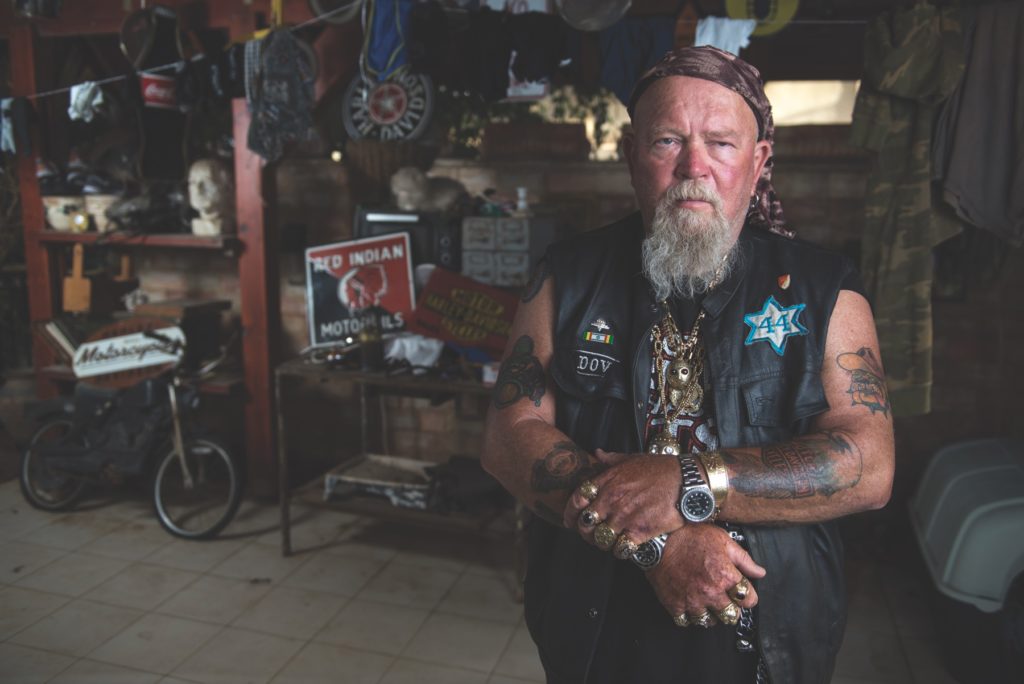
It’s called Bonnie Design, and it’s equal parts watering hole, social club and shrine to all things Harley-Davidson. It’s here that Barak “Doveleh” Moskowitz, a hardcore member of the Israeli motorcycle gang Zion Riders, parks his custom bike each day. (A friend gave Moskowitz the nickname “Doveleh,” Hebrew for “Little Bear,” and it stuck.)

He doesn’t come to drink, although he’s always happy to join his friends at the bar. Moskowitz says he has been sober since 1991, when at the age of 26, he joined Narcotics Anonymous, embraced its 12-step program and gave up the drugs, booze and petty theft that had marked his previous decade.

He doesn’t really come to chat, either, although Moskowitz is laid back and generally loves to talk.

For Moskowitz, the real reason to come to Bonnie Design is the dog that lives along the way.

“I have one dog and two cats at home,” Moskowitz said, “but I also have a dog near Ramla. He’s been tied up his whole life. He’s a big dog — very nasty. He’s chained up in a field. So every day I bring him food.”

Moskowitz is a study in contradictions: a tatted-up, road-hardened biker who greets friends with a grin and double kisses on the cheek; an ex-con who cuddles up at night with a rescue pup and who spends hours each day at a trendy vegetarian cafe in the heart of posh Tel Aviv.

Moskowitz has a name for the dog in the field: “Gingy,” because of his reddish fur. He would love to take home the animal, he said, but unlike Moskowitz, Gingy can’t be tamed.

“He’s a murderer,” he said. “He would kill anyone. He would kill my dog and my cats, but with me, and only me, he is OK. I understand him and he understands me, too.”

Moskowitz was born not far from Gingy’s field, in the Israeli town of Ness Ziona. He first tasted crime as a teenager, stealing cars and motorcycles with packs of friends who would hang out and cause trouble along Dizengoff Street in Tel Aviv.

A few years later, while completing his mandatory three years in the Israel Defense Forces, he was stationed in a jeep with three other men at the Quneitra crossing between Israel and Syria. It was Oct. 6, 1973, and his commander wanted to make an omelet on the jeep’s hot plate. He ordered Moskowitz — the youngest and lowest ranking among the quartet — to head over to the unit’s makeshift kitchen tent to grab some olive oil.

A few seconds after Moskowitz scrambled out of the vehicle, a Syrian strike took out the jeep. Moskowitz survived, but the guilt shattered him.

“Three people died in one place, but I didn’t. For sure it was luck,” he said. “And that’s where it all started. I started taking opium, and then I started to live on the street.”

For years, Moskowitz was caught up in a cycle of crime and punishment. He served multiple stints in prison for theft. He lived illegally as a squatter.

He had a son while in prison, and before Moskowitz got out, his wife took the child and left. He says he held the baby once, when the boy was 8 months old. He says he hasn’t seen the child since.

The suffering, he said, “got too much,” and in 1991 he bade crime, drugs and alcohol goodbye. He started to earn a legal living by buying and reselling vintage items and antiques. Today, his closest and most genuine family, he said, is the Zion Riders, Israel’s answer to the Hell’s Angels.

He is a fixture at Cafe Xoho, the vegetarian Tel Aviv cafe popular among olim, Anglos and the gluten-free, raw-food and vegan set. He loves it there, he said, and this past summer he rode his Harley down to the Negev desert to attend the wedding of the cafe’s owner.

Last year, knowing he could never bring Gingy home with him, Moskowitz  rescued a black Labrador puppy named Sunny. He can’t bring Sunny on his bike with him, but in a few months, he said, he is going to purchase a motor home to drive around the country. Sunny will travel with him, wherever he goes.

These days, Moskowitz is recovering from gastric bypass surgery, which he had because of developing diabetes, and he is meeting weekly with his 12-step group to offer support and to help him stay clean.

“We sit and we talk about everything,” he said. “People like me, we are many thousands in Israel.” 


Debra Kamin, an American journalist living in Tel Aviv, is a regular contributor to The New York Times Travel section, and her work has appeared in The Atlantic, Foreign Policy, Time magazine, Town & Country and Variety.

Riding on the Right Side of the Law Read More »

Q & A with Daniel Radcliffe

In the “Harry Potter” films, actor Daniel Radcliffe battled the evil Lord Voldemort with his wand and fortitude. Since the eighth Potter film premiered in 2010, the English actor has tried to diversify his career with films such as the supernatural thriller “Horns,” the gay, Jewish beat poet saga “Kill Your Darlings” about Allen Ginsberg, and the horror film “The Woman in Black.”  Now he’s back with a new movie, “Jungle” — which hits theaters on Oct. 20 — based on the book of the same name by Israeli adventurer Yossi Ghinsberg. The memoir tells of Ghinsberg’s misadventures during three weeks stranded in the Amazon jungle in Bolivia in the early 1980s. The Journal recently caught up with Radcliffe, whose mother is Jewish, to talk about his new film.

Jewish Journal: Why were you drawn to the story and to the character of Yossi Ghinsberg?

Daniel Radcliffe: I pursued the part passionately. Sometimes when a story is true and incredibly powerful and communicates something that’s useful about the human survival instinct, I just wanted to become a part of further disseminating that story into the world.

JJ: Did you identify with the story’s themes of survival, especially as an actor after Harry Potter?

DR: You can be worried that people will typecast you, but I’ve been lucky because for every director who saw me out there as just Harry Potter, there was another one who was excited by the prospect of reinventing that image.  You just sort of grab those opportunities when they come around as much as you can. And also I’m very lucky that I’m in a position where I don’t have to work, so I don’t have to accept roles that I’m not passionate about.  

JJ: You spent many hours speaking to Yossi about his experiences. What kinds of questions did you ask him?

DR: Just talking to him about his inner monologue; how he kept himself going.  He said an interesting and also very sad thing about hope. I asked whether the hope of getting home is what kept him alive, and he said actually the opposite was true. Most of the time, he was just surviving from one moment to the next. He said that the moment when a plane flew overhead, he thought he was going to be saved. But the second when that plane flew away was the most demoralizing, deepest despair he had ever felt. He said as useful as hope can be, it can also break your heart.

JJ: Did you learn anything interesting from Yossi about Israelis?

DR: It was this idea that for the generation of kids who grew up as the sons and daughters of Holocaust survivors, like Yossi, what is your responsibility?  What do you have to live up to? I think that because Yossi wanted to go off backpacking, that was a disappointment to his father, a Holocaust survivor, and so I think his journey was tinged with a bit of guilt.

JJ: You went on an extreme diet for a month to lose weight for the final scenes of the film.

DR: I was generally having a fillet of fish or chicken and a protein bar every day, as well as vast amounts of coffee and cigarettes. It just makes you feel a tiredness that seeps into your whole being.

JJ: What was it like to film the scene in which your character removes parasitic worms from his forehead with a pair of tweezers?

DR: When you look up and you see the crew looking beyond grossed out, you go, OK, clearly it’s gone all right.

JJ: What was your most difficult moment on the shoot?

DR: One moment that was particularly heartbreaking was when the final scene was postponed for a week because the river had risen 7 or 8 feet and washed away our set. In my hotel room, I had a massive bar of chocolate and I had asked the kitchen to give me a steak for that night; I was going to eat finally. I was so close that I could practically taste it, and then it got rescheduled a week. 

Q & A with Daniel Radcliffe Read More »

Sukkah At Kansas State Vandalized

A sukkah that was residing on the Kansas State University (KSU) campus was vandalized on Friday evening.

The sukkah was built on October 3 and was intended for Jewish students to gather and eat during Sukkot, but on Friday graduate student Glen Buickerood, a Hillel liaison, noticed that the “the Sukkah was gone.”

“The chairs and tables stood where the Sukkah had been,” Buickerood wrote in an email to campus leaders. “The stakes were still in the ground. Stakes that had been tied to the Sukkah had been pulled out.”

The Sukkah ended up being wrapped around Buickerood’s car, which damaged the vehicle. Buickerood added in his email that he believes that the sukkah was an act of anti-Semitic vandalism.

“This was a direct response to what the Sukkah stands for and represents,” Buickerood wrote.

KSU President Richard Myers issued a statement condemning the incident.

There is no place in our community for hateful, criminal reactions to religious expression,” said Myers “Many who live or work on our campuses, particularly those of the Jewish community, are experiencing significant pain and fear as a result of this act. Our hearts go out to those in the K-State family who have been negatively affected.”

The sukkah has since been rebuilt and on Wednesday the campus will be hosting a Sukkot Solidarity Dinner as a response to the vandalism.

According to an Anti-Defamation League (ADL) study in April, anti-Semitic incidents on college campuses increased by 86% by that point in 2017. ADL CEO Jonathan Greenblatt is quoted on the site as saying, “Clearly, we have work to do and need to bring more urgency to the fight. At ADL, we will use every resource available to put a stop to anti-Semitism. But we also need more leaders to speak out against this cancer of hate and more action at all levels to counter anti-Semitism.”

Sukkah At Kansas State Vandalized Read More »

Growing From the Depths of Pain

The physician who came to see me happened to be a Persian Jew. After listening to my story and examining me, he diagnosed a rare, genetic, progressively debilitating neuromuscular disease found among Persian Jews called Hereditary Inclusion Body Myopathy (HIBM). This is a muscle-wasting disease that manifests in the prime of one’s life and can lead to severe incapacitation within 10 to 15 years from diagnosis. He then informed me that there was no known treatment or cure.

That was 11 years ago.

At that moment, everything I thought I knew about who I was and where my life was headed collapsed. Among a flood of racing thoughts, my mind kept returning to one: I guess I am not as lucky as I thought I was.

I will never believe this disease was “meant to be,” but I do believe I can find meaning in it. I have learned that if you don’t grieve for your losses, you won’t have gratitude for what you do have.

Life had always been comfortable for me. I actually used to wonder if maybe my family was immune to tragedy. How did I get so lucky? I even got to fall in love with my now husband during medical school. Everything was going according to plan. But this news? This diagnosis? This moment? This was not part of the plan. This was not the way my life was supposed to go.

It was during the intern year of my psychiatry residency when people started asking me why I was limping. I didn’t know to what they were referring. I was 29 years old and a model of good health. I’d been working out for as long as I could remember, climbed mountains from the Grand Tetons to Mount Kenya, ran the Jerusalem half-marathon and even cycled from San Francisco to Los Angeles for the AIDS Ride. I shrugged them off.

But over time, I noticed something was off. I started tripping more often. I chalked it up to clumsiness. After all, I was always rushing around, multitasking. Or maybe it was the exhaustion from 30-hour hospital shifts. Regardless, I didn’t make much of it. A year into it, however, I started having trouble running. And then trouble jogging. And eventually, I couldn’t do either.

It wasn’t until my third year of residency that I decided to investigate. My husband and I wanted to have a child. By then, even walking required effort. I bounced from sports medicine doctor to podiatrist to physical therapist to neurologist to, finally, the Persian specialist who told me I had HIBM (now known as GNE Myopathy).

Today, though I am not dying — the disease is not fatal — my muscles slowly are. Over the past 11 years, I have gone from walking with a slight limp, to wearing leg braces, to holding a cane, to using an electric scooter for long distances. I have gone from experiencing only lower-body weakness to losing a significant portion of my upper-body strength. I have had to tolerate physical and emotional discomfort in ways I never believed I could.

And yet, right alongside this journey, I also have had two kids, maintained a successful private practice and become a patient advocate — educating others about HIBM and raising awareness around what it’s like to live with a disability.

“Resilient” is not how I would have ever described myself pre-disease. I was the opposite — sentimental, sensitive, always in touch with my emotions and never good at compartmentalizing. After my diagnosis, I cried all the time. I was raw and vulnerable.

Then I realized that my perceived weakness was actually my greatest strength. I understood that strength was not about being able to “look on the bright side” or push past the pain. True strength is having a non-distorted perception of how bad it is and accepting it; locking eyes with the beast of loss and pain without turning away. Strength is being able to let in the sadness, fully and wholly, and still keep moving.

I will never believe this disease was “meant to be,” but I do believe I can find meaning in it. I have learned that if you don’t grieve for your losses, you won’t have gratitude for what you do have. If you can’t have compassion for yourself and make room for all of your feelings, you won’t be able to show up and make room for anyone else’s.

If you don’t make room to feel the depths of your pain, you won’t have room to experience the height of your joy.


Dr. Jennifer Yashari is a board-certified psychiatrist in private practice in Los Angeles.

Growing From the Depths of Pain Read More »

Faith in the Ruins

In the middle of a Sukkot dinner last week, a guest’s wandering dog got a little lost.

When my host, Elon Gold, squeezed through a sukkah side exit to retrieve the dog from a narrow alley, the whole structure quivered around us.

“Elon, the sukkah’s gonna collapse!” his wife, Sacha, cried, urging him to be more gentle.

I looked up as the Moroccan lamps dangled over the couscous and a prime collection of single-malt scotch. It’ll be a shame if those bottles are shattered, I thought.

Fortunately, the disturbance this caused was very minor. But the metaphor was big, echoing the core message of Sukkot: What shelters us is fragile. How easily things can fall apart.

It’s ironic that this is supposed to be a season of joy — our z’man simchateinu — a celebration of earthly bounty and heavenly blessing at a time so many are being inundated with pain, trauma and tragedy.

This isn’t a revelation for Jews. Sukkahs are supposed to be delicate, temporary dwellings, recalling the protective “cloud of glory” that God provided the Israelites during the Exodus from Egypt as well as the booths they build for shelter. We build these booths to withstand a normal wind, but not a strong one. Only God is permanent, we’re told; our buildings and our bodies are ephemeral. 

I did not need reminding of this three days after a Las Vegas shooting massacre in which 58 people were murdered and more than 500 injured. I didn’t need reminding after Texans, Puerto Ricans and Barbudans saw their entire lives upended, their permanent homes decimated by the wrath of a storm. It’s no secret how vulnerable humans are to the forces of nature and the evils of our own darkest impulses — not to mention our terrible and chronic complacency in the face of horror.

Wall Street Journal columnist Peggy Noonan observed that with every additional gun massacre we become less stunned, less shattered than we were from the previous massacre. The tragedy is no longer the tragedy; the tragedy is how inured we’ve become to “a culture of death” that grips us tighter with each new violent event. 

It’s ironic that this is supposed to be a season of joy — our z’man simchateinu — a celebration of earthly bounty and heavenly blessing at a time so many are being inundated with pain, trauma and tragedy. For God’s sake, why do so many Americans buy so many guns?

“I think a lot of Americans have guns because they’re fearful,” Noonan wrote. “They fear a coming chaos. … They think it’s all collapsing — our society, our culture, the baseline competence of our leadership class.”

For some of us, everything seems fragile while others appear well protected. But we survivors of history know that it could have been any of us in that concert crowd, and that all God’s creatures live in the path of a potential destructive natural event, whether by flood, fire or earthquake.

Do we really need a reminder of impermanence, or do we need an assurance of God’s presence? Where are you, Permanent God? How can we reach you?

Two years ago, I wrote a column declaring Sukkot “the most romantic of Jewish holidays.” Rabbi Amy Bernstein, leader of Kehillat Israel in the Pacific Palisades, told me, “Sukkot is all about pleasure.”

After the intensity of Yom Kippur, repenting the ways we’ve failed our creator, king and judge, “Sukkot is celebrating that we’ve come back,” Bernstein said. “It’s all about when we dwelled in the desert with God, when we depended only on God — it’s this kind of wonderful, gorgeous honeymoon imagery.” 

But this year, it’s the honeymoon from hell.

Days after Hurricane Harvey hit Texas, I was on the treadmill watching a news report of a woman standing in floodwater up to her knees, with her destroyed home behind her, crying, “God is great! Oh my God, y’all. God is great!” She was sobbing, wailing, hysterical, but she kept repeating: “God is great!”

I thought, is she nuts?

In times like these, when life feels more tragic than romantic, we all have a choice: We can turn toward God, hang out like lovers in the Sukkah, or we can turn away. 

A rabbinic interpretation holds that when we are told to “blot out the memory” of Amalek, an archetypal villain of the Bible, what we’re really blotting out is doubt. The curse Amalek brings is confusion and despair.

But that is part of faith, too. Like the guest’s wandering dog, we get a little lost sometimes. Our shelter may collapse. But God is always there, trying to find us.


Danielle Berrin is a senior writer and columnist at the Jewish Journal.

Faith in the Ruins Read More »

The Truth That Blinds

Waking up to the news of the Las Vegas shooting, I saw headlines touting “the five things to know about the shooter.” As if that was all there was to know. And there I was, along with everyone else, gorging myself on quick sound bites of information that gave me the illusion that I knew the story.

It happens this way every time there is a shooting, a terrorist attack, a tragedy: We become submerged in facts, in the hope that it will help us cope, bring us understanding.

I’m not saying facts aren’t important. I love facts and data. I have an arguably unhealthy obsession with data of all kinds — historical, political, personal. But the more data I collect, the more I am convinced that I understand something — that I have conquered it. And then there’s nothing left to say about it.

Yes, facts are a necessary framework. But they can also obscure our vision.

The rabbis and sages knew this as they compiled the midrashim. They worked to reveal not the facts of the Torah but its silences and omissions — the places where story breaks down. Midrash brings those silences to the forefront.

Consider Genesis 22: God says to Isaac, “Take your son, your only one, whom you love, Isaac … and offer him up there.” Abraham says nothing in response to this horrifying request to murder his son. Those who know a bit about Abraham know this is out of character. He argues with God consistently; he is not afraid to push back. But here, Abraham is silent.

Rashi responds to this challenging moment. Perhaps when God asked Abraham to take his son, Abraham said, “But I have two sons,” to which God said, “Your only one.” Abraham’s clever response may have been to suggest that each son (Isaac and Ishmael) is the only son of his mother, to which God may have said, the one “whom you love,” with Abraham insisting, “But, God, I love them both,” with God finally confirming that Isaac is the one.

Rashi reads Abraham’s silence midrashically. He’s less concerned with the facts of the story than with what is absent. He suggests that the silences must not be ignored, and that there is more than one story residing within them. They are opportunities for meaningful dialogue.

Rashi is not resolving the silence of Abraham; nor is he answering the question of why Abraham took Isaac up the mountain without pushing back. Rather, Rashi is presenting one possibility, pointing us toward what is missing in the text rather than what appears readily. Focus on what you don’t see, he suggests. He is moving us to dialogue. A midrashic response is never a final answer or revelation of fact. Each response implies the existence of another. It’s what keeps the text alive.

But what about the most compelling absences of our day — the ones brought about by violence and suffering? What about recent tragedies?

After catastrophes, we struggle with unanswerable questions. We do so with fervor and intensity, but the impulse quickly becomes negative as we impose story and speculation onto absence.

My inclination, upon hearing about Las Vegas, was to scan the available data and categorize it. It’s a convenient practice, but also dangerous: Once we do this, we stop listening and talking. After a mass shooting, we rush to identify a perpetrator’s gender, ethnicity, religion, mental health — perhaps at the expense of things less obvious. We lose story when we do this, and losing story means losing our way forward, toward a time when such events are no more.

It happens this way every time there is a shooting, a terrorist attack, a tragedy: We become submerged in facts, in the hope that it will help us cope, bring us understanding.

“I did not witness the most important events of my life,” says the character Jakob in Anne Michaels’ novel “Fugitive Pieces.” “My deepest story must be told by a blind man.”

It’s a line from a book to which I return continually. Jakob, years after witnessing the extermination of his family, is writing his memoirs. But he finds that it is precisely what he saw that is most impossible to articulate.

He has no words. He knows nothing — although he saw everything — and he won’t pretend that he does. He acknowledges, instead, the dangers of claiming to know the complete story.

In a world where we imagine we are blind to nothing given the pervasiveness of visual images, we privilege quick data over silent reflection and humility. We strive desperately to put together the pieces of each puzzle, leaving no gaps. We recoil from the idea of blindness.

Until we can acknowledge what we don’t know, we will be blinded by what we do know. 


MONICA OSBORNE is a writer and scholar of Jewish literature and culture. Her book, “The Midrashic Impulse and the Contemporary Literary Response to Trauma,” will be published later this year.

The Truth That Blinds Read More »

Episode 59 – The Arab Zionist from Umm al-Fahm

Palestinian Arabs are 20% of Israel’s population. They have the same rights and obligations like every Israeli: they vote, pay taxes, they get social support and medical insurance, and their children go to public schools funded by the state.

But what do Israeli arabs really think about Israel? If you ask the Arab members of parliament, the answer will be contempt: contempt from the discrimination which they claim goes way back to the beginning of the state, from the fact that Israel is occupying territories in Judea and Sameria, and from many other reasons. Those Members of Knesset serve in the Israeli parliament, but they refuse to recognize the legitimacy of the State of Israel as home to the Jewish people.

But do those members of parliament represent all Israeli Arabs?

In recent years, more and more Israeli Palestinians promote another voice, a voice that says – I’m an Arab, and I’m zionist. But how could those two statements coexist?

Yayha Mahamid was born in Umm Al-Fahm, one of the largest arab cities in Israel. A city which is not well known for it’s sympathy towards the country of which it’s a part of. Nothing in Yahya’s path led him to be like any other Umm al-Fahm-born kid, and his direction towards hatred was a clear one. But at a young age something happened which has led him to see everything differently, and to become, as he defines himself, an Israeli-Arab-Zionist.

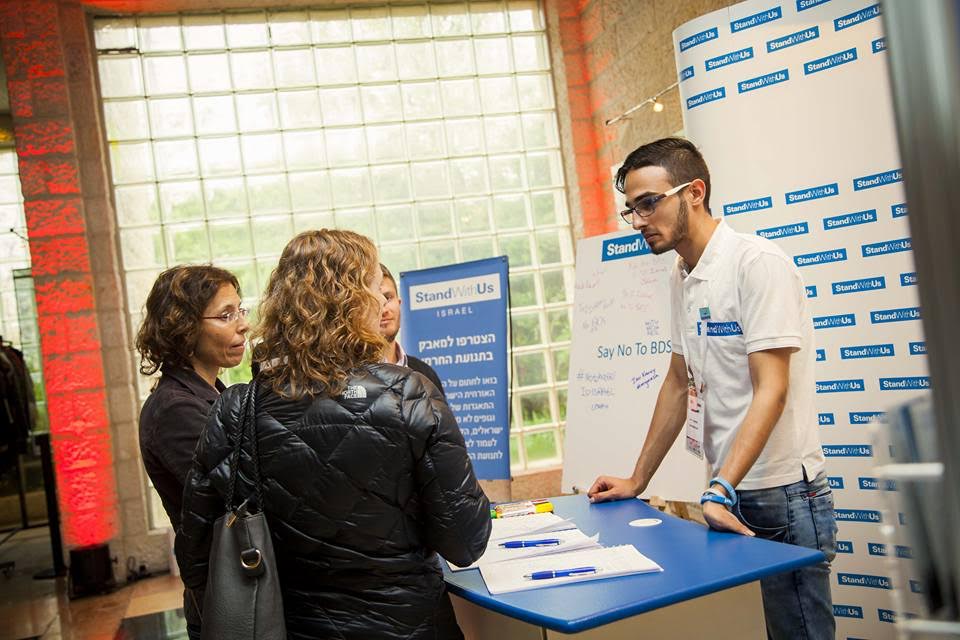
Since then Yahya has devoted his life to fight the BDS movement around the world, as part of the StandWithUs organisation. He joins 2NJB to talk about his view on life in Israel.

A little about StandWithUs: StandWithUs (SWU) is a sixteen year-old, international, non-profit Israel education organization.  Through fellowships, conferences, materials, social media, educational films and missions to Israel, StandWithUs supports people around the world who want to educate their campuses and communities about Israel.

We also played awesome music by Folly Tree! Their Facebook and Bandcamp

RSS Subscribe

Direct Download

Episode 59 – The Arab Zionist from Umm al-Fahm Read More »

The God of CSI: Las Vegas

Means, motive, opportunity.

For detectives, nailing down those is the perp trifecta.

In Las Vegas, the forensic postmortem on the deadliest mass shooting in modern American history stands at two out of three. Means? Check. Opportunity? Check. But unless new evidence turns up, the killer’s motive is a black box.

A missing motive is worse than frustrating. It disrupts the moral order.
When humans act, in Coleridge’s phrase, with “motiveless malignity,” our wisdom traditions, the stories we typically soothe ourselves with, are disturbingly ineffectual. Not knowing why the cipher on the 32nd floor did what he did, not knowing why God did what God did, upends our beliefs about luck, meaning, evil, justice — the stuff of life and death.

“What the detective story is about,” said P.D. James, the queen of crime fiction, “is not murder but the restoration of order.”

Las Vegas was, devastatingly, not fiction, but it was and is a detective story. It came to us labeled as news, but we experienced it as narrative. It was visual, visceral, violent and shamefully riveting. It also illustrated James’ aphorism: The murderer may be dead, but absent a motive, we’re stuck in a random cosmos, where horrors like this can happen to anyone.

Why did he do it?

Was he a psychopath, driven by demons, severed from reality? No one who knew him saw it coming. If he could snap like that, who’s next?

Was it for fame? Revenge? Was he abused? Or was it political? Did he hate us for our freedom? He left no note, no manifesto, no trail of terror — no reason, until his blaze of barbarity, for us to call him Other instead of Brother.

Or did he do it, like a madman out of Dostoevsky, to demonstrate that God is dead?

“I was agnostic going into that concert,” Taylor Benge, 21, told CNN, his and his sister’s clothes covered in other people’s blood, “and I’m a firm believer in God now, ’cause there’s no way that all of that happened, and that I made it, and I was blessed enough to still be here alive talking to you today.”

The terror of that night is unimaginable. Like all Americans, I mourn its victims. Its survivors’ courage and generosity take my breath away. Yet — with respect —  I wrestle with the idea of a God who blessed Taylor Benge enough, but who also made the monster of the Mandalay Bay. If the Benges’ survival is attributable to God’s benevolence, could the 58 killed, the more than 500 injured and the shooter who rained grief and death on them be chalked up to God’s negligence, perversity or impotence?

Any restoration of order is tentative, because our human hands have enough free will to fail us. But to inhabit a world where arbitrary carnage is considered inevitable: that’s a lousy story to have to tell our tribe about the nature of existence.

It limits God’s love. It imagines that God has abandoned us. It prompts some of us to attribute evil to an origin beyond God’s reach, to a Satan or an evil eye. It moves others to conflate mysticism with wishful thinking. It’s what led Gloucester, in “King Lear,” to drag our deities down to earth: “As flies to wanton boys are we to th’ gods. They kill us for their sport.”

Was he a psychopath, driven by demons, severed from reality? No one who knew him saw it coming. If he could snap like that, who’s next?

Taylor Benge experienced his survival as God’s grace. To interpret it, instead, as luck would be living life on the volcano’s edge. I’ve been there. It’s intolerable.

The cover of The Wall Street Journal on Oct. 6 had a three-column image of a page from the 1970 Francis Polytechnic High School yearbook, above the headline, “The Life of a Mass Shooter.” To protect student privacy, all pictures but one were pixelated. The exception was a photo of the murderer as a junior — pleasant face, healthy head of hair, nice kid.

In hindsight, uncanny and haunting. But no warning — no horns. The Wall Street Journal’s reporters found nothing in his life that fits a mass killer’s profile. His final act might as well have fallen from the sky.

The mass murder case is closed. The murderer of order, though, remains at large. Our life stories now include his story. Like it or not, his motiveless malignity points a bullet at our dreams of an unconditionally lovable God. 


Marty Kaplan is the Norman Lear professor at the USC Annenberg School for
Communication and Journalism. Reach him at martyk@jewishjournal.com

The God of CSI: Las Vegas Read More »

Where Were the Liberals When Weinstein Betrayed Them?

When I first heard about the Harvey Weinstein scandal, my initial reflex was to see it through a Jewish lens: Oh no, I thought, not another Jewish scandal. As anti-Semitism reaches a tipping point, this is the last thing we need.

And then I read The New York Times story detailing three decades of sexual misconduct, and the stories that have come out since then. Sickening stories that, as a woman and as a mother, make my blood boil. Stories that would make me sever ties with a man who was capable of just one of them, let alone dozens. Stories that have apparently been an “open secret” in Hollywood for years.

As an outsider looking in, I am dumbfounded that the women of Hollywood, the women of the Democratic Party, would keep silent about these transgressions. For what? His money? His glamorous parties? His ability to “make your career”? After a certain point, you don’t get to claim that you’re a feminist, that you support women’s rights, if you know that there is a very powerful man destroying the emotional fortitude of young women on a daily basis.

As an independent, I have no dog in the Democrat versus Republican hyper-partisan mega-fight. Both sides play up the scandals of the other side, and play down the scandals on their own side.

But as a liberal, as a feminist, I care about women subjected to repeated abuse — verbal, physical, psychological, sexual. And so I ask the liberal women of Hollywood: How could you let this happen for three decades? I ask Hillary Clinton: How could you take money from this man?

I ask the liberal establishment: How could you allow your hatred of the GOP — and we’re talking pre-Trump here — to undermine your ability to honor your own principles? To stop you from stopping Weinstein from scarring yet another young woman’s life?

We have come to over-politicize nearly everything. If it’s bad for the other side, we go hysterical. If it’s bad for our side, we stay quiet. If the abuser is a right-winger like Bill O’Reilly, the left goes ballistic. If it’s a Democratic lion like Harvey Weinstein, it goes silent.

Perhaps the ugliest episode of the Weinstein saga is that, according to a report by Sharon Waxman at The Wrap, the Times gutted a story on Weinstein’s sexual misconduct in 2004, after coming under pressure from Weinstein and his liberal Hollywood pals. How many women would have been spared the scars of sexual abuse had this predator been called out earlier?

While the Times’ explosive piece on Weinstein should be applauded, the “paper of record” was one of his enablers. “So pardon me,” Waxman writes, “for having a deeply ambivalent response about the current heroism of the Times.”

There’s nothing ambivalent or partisan about the moral depravity of using power to abuse women. To its credit, the Times published an op-ed by Bari Weiss that nails this point: “Will Liberals Give Weinstein the O’Reilly Treatment?” In her piece, Weiss notes that “prominent feminists like Gloria Steinem didn’t waste any time discarding sexual harassment guidelines when it came to Bill Clinton’s sexual predations as president. Principle rapidly gave way to partisanship and political opportunism.”

The one good that can come from all this is a deep self-reflection on the part of everyone who knew what was going on but chose to remain silent. Some liberals, like Meryl Streep and Lena Dunham, have begun to speak up. Of course, now that Weinstein’s star has dimmed, it’s a lot easier to show outrage.

Streep, who has worked with Weinstein for years, says she didn’t know anything about the overt daily harassment — he was known for throwing tables at employees when he was angry — and huge financial settlements. Perhaps she didn’t. But with her statement of outrage, Streep now can go back to attacking the right for its moral failings.

To redeem politics and scale back the cynicism that is corroding our discourse, both sides must choose moral principles over politics. We can’t hate “the other party” more than we hate sexual predators or Islamic terrorists. Every time we put politics ahead of what’s obviously right, we put another nail in the political coffin.

We’re running out of nails.  


Karen Lehrman Bloch is a cultural critic and curator. Author of “The Lipstick Proviso: Women, Sex & Power in the Real World” (Doubleday), her writings have appeared in The New York Times, The New Republic, The Wall Street Journal and Metropolis, among others.

Where Were the Liberals When Weinstein Betrayed Them? Read More »

Taking a Stand for His Newsstand

The owner and operator of a popular Brentwood newsstand, which he has run for nearly three decades, is in danger of losing the business despite a months-long campaign to keep it open.

Marck Sarfati, the 66-year-old owner, learned earlier this year that his landlord, the adjacent Whole Foods, did not intend to extend his lease, which expired on Sept. 30. Whole Foods has since granted him a one-month extension and his lawyer is attempting to continue negotiations with Amazon, which bought Whole Foods in June.

Sarfati still shows up at the newsstand daily, as he has for 28 years, but he fears his days of selling newspapers, magazines and cigarettes may be coming to an end.

“[Whole Foods] knows they can file an unlawful detainer against me and win,” Sarfati said. “But I think what is in their minds is how this is going to play out in court and how much media I can get with the headlines ‘Amazon and Whole Foods Throwing Out a Newsstand.’ ”

With his moonbeam smile and jovial disposition, Sarfati is a fixture in Brentwood, boasting, “We’re the largest and most famous newsstand in the city.”

The business, along with the much smaller stand he owns on Robertson Boulevard in front of a Walgreens, is Sarfati’s only source of income, which he said he needs to care for his 96-year-old father, Nic, a Holocaust survivor who has dementia. For 30 years, Nic owned the Beach House Market in Venice Beach.

Sarfati has circulated — in person and online — a petition to save the newsstand, with more than 5,000 people signing, including such celebrities as Dustin Hoffman, Owen Wilson and Henry Winkler. He has organized protests and printed T-shirts that proclaim, “Save Brentwood Newsstand.” He also has created bright yellow-and-black placards stating, “Being Evicted by Whole Foods” and “28 Years Here.”

Los Angeles Councilman Mike Bonin, whose District 11 includes Brentwood, signed the petition and issued a statement that said, “The Brentwood Newsstand is a community treasure and the Sarfatis’ story exemplifies the American dream. I’m joining the thousands of neighbors in Brentwood and other nearby neighborhoods to urge Whole Foods’ management to reconsider their decision and allow the Brentwood Newsstand to stay at its current location.”

Sarfati and his attorney sent Whole Food and Amazon the petition signatures along with their repeated requests to have the newsstand’s lease renewed.

Bonin also encouraged Sarfati to file a request with the city to have the stand designated a historical landmark. Sarfati has done so but said consideration for the designation is a slow process with no guarantees.

Meanwhile, his resistance has generated coverage from the Los Angeles Times and local TV stations. But after Sarfati’s attorney spoke with the head of global litigation at Whole Foods in mid-September, Sarfati agreed to halt his protests while the two parties attempted to negotiate a settlement.

Sarfati has requested an additional 18 months on the lease. As of the Journal’s press time, Whole Foods has responded with an offer of just one more month.

Whole Foods did not return messages from the Journal seeking comment on the status of the negotiations.

Sarfati was back at his newsstand on Oct. 1, and said he had mailed his October rent check well in advance.

“I’ll be honest,” he told the Journal by telephone several days later, “we’re experiencing an almost 30 percent loss in revenue. I think some people just assumed we wouldn’t be here after Sept. 30.”

For now, he is waiting and hoping the attorneys can hammer out a favorable settlement.

He said he hoped to hear good news by Oct. 13.

If not, he said, “We aim to hold our own as long as we can.”

Taking a Stand for His Newsstand Read More »