fbpx

October 2, 2017

Jewish and Israeli communities respond to Las Vegas attack with aid, call for action

UPDATE 10:21 A.M. OCT. 4: The five missing Israelis mentioned below in the story “are safe and accounted for,” Anna Rubin, director of media affairs at the Consulate General of Israel in Los Angeles, told the Journal.

The Oct. 1 mass shooting at a country music festival in Las Vegas, which left at least 59 people dead and 527 wounded, was “obviously not just about the Jewish community,” Jewish Federation of Las Vegas President and CEO Todd Polikoff said hours after the attack.

The Federation, nevertheless, was committed to assisting those affected by what many are calling the deadliest shooting in modern American history, he said.

“I don’t think there is any part of this community that is not feeling the impact of these events. We’re constantly looking at how we can help the whole community, Jewish and non-Jewish, and deal with what transpired,” Polikoff said in a phone interview the day after the shooting.

Those efforts have been multi-faceted.

“Right now it’s information-gathering. We’re trying to reach out to members of the community, various synagogues and anyone in our base to let us know that everyone is safe that they know of and if they’re not, what’s the situation.”

He added that as of that morning he did not know if anyone in the Jewish community had been injured or killed, but there were 22,000 people at the concert, “and we know members of the Jewish community go to these festivals,” he said.

Rabbi Levi Harlig of Chabad of Southern Nevada said he had spent time with the family of one Jewish victim at Sunrise Hospital and Medical Center, where 14 patients had died as late Oct. 2. The Route 91 Harvest music festival began Sept. 29 and concluded on Oct. 1.

He said he visited the hospital after hearing about a Jewish woman from Orange County whose husband had dropped her off at the concert, where she was shot in the neck.

“Thank God [her injury] does not seem to be life threatening,” Harlig told the Journal.

There are an estimated 70,000 Jewish people living in Nevada, with the majority residing in Las Vegas, according to Polikoff.

The Federation leader said the organization has been in contact with the Las Vegas Metropolitan Police Department.

“We’re trying to work with Metro as best as we can,” Polikoff said. “They have a hotline for people who are looking for family members; we’re trying to drive people to the blood services in town because blood services are greatly needed and we’re trying to be a community partner the best we can.”

The authorities said the gunman, Stephen Paddock, fired his weapon from a room on the 32nd floor of the Mandalay Bay hotel, overlooking the concert, during the performance of headliner Jason Aldean. Paddock began firing at the crowd gathered at the Las Vegas Village and Festival Grounds at 10:08 p.m., the authorities said.

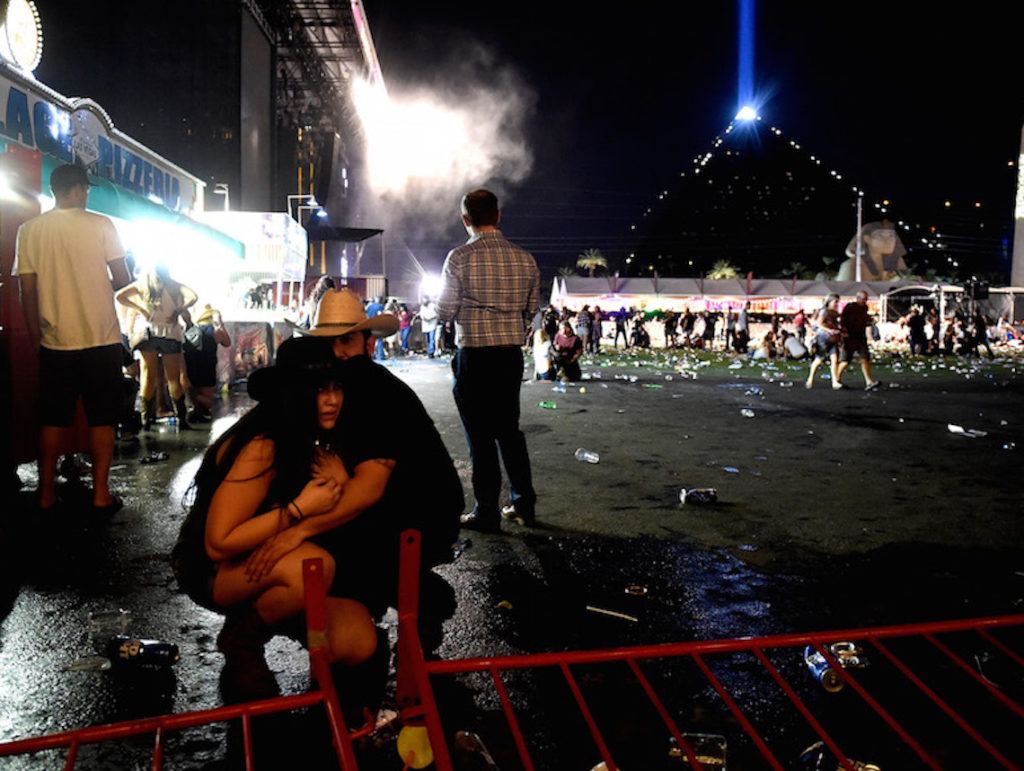
The rapid gunfire sent concertgoers running for their lives while others crouched on the ground and held each other.

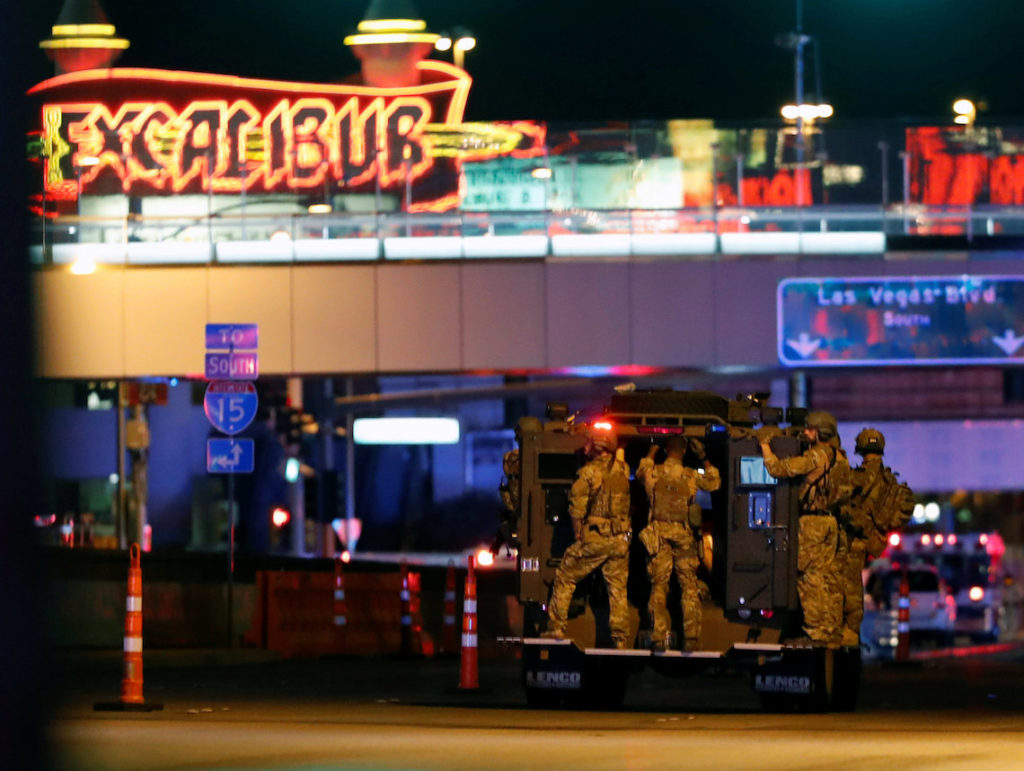
As the shooting continued for several minutes, a SWAT team closed in on the shooter’s location. The Clark County Sheriff Joseph Lombardo of the police department, said Paddock committed suicide after SWAT pinned him down. ISIS – or Islamic State – claimed responsibility for the attack. Law enforcement, however, said the shooter acted alone.

Polikoff said he was asleep when his Apple Watch buzzed at 1 a.m. with a news notification about the incident. He thought it was his watch alerting him to wake up, as it does every morning at 5 a.m. for the gym. The news – that 20 people had been killed – stunned him. By the time he got in his car to drive to work, the number had risen to more than 50.

Various members of the Federation staff left the office to donate blood and found long lines, “100 people deep,” he said.

Noa Peri-Jensch, regional director of the Israeli American Council in Las Vegas, said her organization was encouraging people to assist those donating blood.

“The blood centers are packed with donors, so we have decided that instead of blood, we should assist those who are standing in lines to donate blood,” she said. “Members of the Israeli community went out in a big truck to hand out water and food to those in line at the blood centers.”

Anna Rubin, director of media affairs at the Consulate General of Israel in Los Angeles, which serves the entire region of the southwest United States, including Nevada, told the Journal on Oct. 2 that five Israelis were unaccounted for in the wake of the attack.

“We are monitoring the situation,” Rubin said, explaining that the consulate was notified by the missing individuals’ families. Additional information on the missing Israelis, whose parents are in Israel, was not immediately available. 

Julie Martinez, a mother of two girls, has lived in Las Vegas for eight years. The daughter of an Israeli mother and an American father, Martinez was supposed to go to the concert with a friend but changed her mind at the last minute. Her friend, however, attended.

“My friend went there with her four-year-old daughter. She called me crying and in shock after she ran from the concert area to the Tropicana hotel,” Martinez said. “That’s how I found out what had happened. They stayed there for five hours until the police let them go back home. The streets were completely empty. No one was allowed to leave. Many people who attended the concert ran as well to the Tropicana. People gave them drinks and helped them out. Every body was so helpful, she told me.”

In the aftermath of the shooting, Jewish organizations including the Union of Reform Judaism, the Anti-Defamation League (ADL) and Los Angeles social justice-oriented congregation IKAR renewed a call for the enactment of tighter gun control legislation.

“There is so much we don’t know yet about this shooting. What does seem clear is that the gunman used at least one fully automatic assault weapon among the 17 other weapons, including rifles with scopes, that police found in his hotel room. These are weapons of war, easily accessible in America,” IKAR Rabbi Sharon Brous said on Oct. 2 in a statement titled “Enough With Your Thoughts and Prayers. People are Dying.”

ADL CEO Jonathan Greenblatt echoed Brous’ call for gun control.

“We firmly believe that one way to limit the power of extremists and reduce violence in our communities is to enact tough, effective gun violence prevention measures,” Greenblatt said.

Polikoff, meanwhile, said at this early juncture, he did not want to focus on the politics of the situation.

“One thing I’m not listening to is anyone who wants to turn this into any sort of political commentary. I don’t think this is the time or place [to say] ‘This wouldn’t have happened if so and so were in office.’ “ he said. “We have to worry about the people who were hurt and the families who lost loved ones at this time. I will let everyone else discuss the politics of what they want to discuss. I will focus on people who need help.”

Harlig, the Chabad rabbi, said the shooting shook him up.

“You hear stories about New York, Florida, overseas, and all of a sudden this is our hometown, so it is frightening, but I think the holiday of our rejoicing is coming up, Sukkot, so we will have a double amount of strength to counter the darkness,” he said.   

Harlig expressed confidence that life in Vegas will soon – perhaps too quickly – return to normal.

“Unfortunately people get caught up with the excitement and the glamour here and are quick to forget. It might take a day or two but I think it will go back to normal,” he said. “Let’s wait for the dust to settle.”

Ayala Or-El, contributing writer, contributed to this report

Jewish and Israeli communities respond to Las Vegas attack with aid, call for action Read More »

Rabbi Yoshi Zweiback’s Rosh Hashanah sermon: We Need Each Other

Maybe it’s because she grew up in a very small Jewish community – El Dorado, Kansas was home to about ten Jewish families. Maybe it was because of her deep love for Jewish values, traditions and teachings. Whatever inspired it, my mother absolutely delighted in discovering that the perfect stranger with whom she was sitting on the airplane or whom she happened to begin speaking with in the museum or concert hall at intermission was, like her, a Jew.

If one of her kids was nearby, she’d shoot us a knowing look and stage-whisper, “He’s JEWISH.” Sometimes it was obvious. A star of David around the neck. A hamsa. Maybe it was the name – David Shapiro was an easy one. Rochel Leah Rabinowitz – a no brainer. Shmuel Cohen – a gimmee. But mom could also find the Jewish Maureen O’Malley, too.

Then it was time for some Jewish geography. Before you knew it, mom had found a connection. Maybe through an acquaintance, a distant cousin – some Rabbi we knew in common.

When I entered Rabbinical school, it got worse. Here’s how it played out:

  • Step one: Identify the Jew.
  • Step two: Chat up the Jew.
  • Step three: Discover some type of personal connection to the Jew.
  • Step four: Seize the opportunity to announce proudly to her new best friend that her son is studying to be a rabbi.

Once on a family vacation, as we sat down for our first dinner, a member of the staff approached me and said, “I hear you’re a rabbi – would you be willing to help us light the Chanukah candles tomorrow night in the lobby? Your mom said you’d love to!”

I don’t want you to think that her ability to identify and connect with Jews was flawless – sometimes her “Jew-dar” was off. Once, on a phone call with mom when I was in college, I mentioned that I was going to a Bruce Springsteen concert with some friends. “You know he’s a self hating Jew, don’t you?” She said. “I mean, he never talks about his Jewish identity, he’s not raising his kids as Jews – he hasn’t ever performed in Israel.”

“Mom,” I noted. “We’ve talked about this before. Bruce Springsteen is not, I repeat, NOT a self hating Jew. Do you know why that is, mom? It’s ‘cuz he’s NOT A JEW AT ALL. Yes, his name ends in ‘Steen’ and he’s from Jersey but HE’S NOT A JEW.”

There was a pause.

“Still,” she said, “he could be more supportive.”

My parents taught us that we were part of a community, a People – Members of a Tribe. They were devoted to our synagogue. Mom was president of the Temple sisterhood, an active lifelong learner, forever volunteering for things like the outreach committee, the book drive, and taskforces of all types. Dad was honored to be named the volunteer of the decade at our local Jewish Community Center.

For us kids, attending religious school through Confirmation was a requirement. Mom insisted that we all try Jewish summer camp and youth group. We loved it so much that we went back year after year.

And my parents walked the walk with their tzedakah dollars as well supporting the Temple, our local Federation, and a host of Israel related activities.

Their example, the way they modeled the importance of being part of Jewish community, shaped me in the most profound ways, leading me ultimately to the rabbinate, to devoting my professional life to Jewish community, education, and values. It’s what inspired me to move to Israel to study and that’s there I met my wife, the mother of our three daughters – by far the best outcome of all.

My life has meaning and purpose because of these experiences. I have a deeper sense of my small role in the cosmos because of it. Being part of this tribe, this people Israel, has helped me to feel a sense of connection in a time of increasing alienation and division. And – most importantly – it is through my community that the values of our People have been transmitted to me: a way of life that points us towards justice and righteousness and inspires us to make ourselves and the world better.

This sense of connection to a people with a shared history, destiny and set of values provides us with what the great sociologist, Peter Berger, calls a “plausibility structure.” A system of meaning which helps us to make sense of our world and understand our place in it.

But for so many people today, not just Jews, the “plausibility structure” of community itself is being undermined in profound ways.

Marc Dunkelman, a professor at Brown University, writes about this in his recent book, “The Vanishing Neighbor: The Transformation of American Community.”

Dunkelman describes what he calls “middle-ring” relationships. These involve people who are not family or close friends but not as distant as mere acquaintances. Over the past few decades, these middle-ring relationships have all but disappeared in America and as a result, people feel less and less connected to their neighbors, their towns, and, even more broadly, their country. An additional consequence of this alienation is a narrowing of our world-views.

Dunkelman notes that middle-ring relationships are best “suited to pierce our much-bemoaned filter bubbles” – the increasingly precise way we get our news and are exposed to the ideas of others through the various feeds, tightly controlled by ever-monetized algorithms, that limit the ideas, people and – ultimately – experiences to which we are exposed.

Before the deterioration of these “middle-ring” relationships, “a left-wing academic might talk with a conservative banker while in line at Blockbuster — if that’s how we still rented movies. An activist could explain the benefits of paid leave to a skeptical businesswoman on the sidelines of the P.T.A. meeting — if that were how we spent our Tuesday nights. Experiments that compel ordinary people to discuss a fraught topic face-to-face have illustrated that those conversations quite frequently lead participants to think differently. But without middle-ring relationships, those sorts of thoughtful, substantive interactions have become all too rare.”

And, sadly, tragically even, our ability to connect deeply with what was once not a “middle-ring” relationship but rather a kin/familial relationship, namely, to Jewish community, has also been compromised.

Locally, nationally, and internationally, our Jewish community has become more fragmented and divided politically, ethnically, and religiously. Right versus Left. Ashkenazi versus Sephardi. Orthodox versus Reform.

And, more globally, there has been a most unfortunate distancing between the two major centers of Jewish life today: Israel and America. This past summer, divisions between Israel and the Diaspora surfaced in deeply troubling ways. The Kotel controversy and the debate over a new conversion bill in the Knesset, inspired headlines in Jewish newspapers including this one that should send chills down our spines: “Netanyahu to Millions of Jews – we don’t really want you.” The author of that piece, David Horovitz, the editor of the Times of Israel, argued that the Prime Minister’s decision to freeze the Western Wall compromise plan that had been labored over for more than three years was a “blow to the heart and soul of world Jewry.”

And just a few weeks ago, in the middle of the month of Elul – our countdown to repentance – the chief Sephardic Rabbi of Jerusalem said publicly that Reform Jews are worse than Holocaust deniers.

Perhaps you’re thinking, “Rabbi, don’t be so naive! Isn’t this how it has always been?”

Indeed, my own grandfather used to tell me about how the German Jews in Omaha used to look down on the Shtetl Jews – my family – who had immigrated more recently from Poland.

And what about the old adage, “two Jews, three opinions”? This one is beautifully illustrated by the joke about the Jew who is shipwrecked on a desert island. The crew of a passing ship notices his campfire and comes to his aid. When the captain of the ship comes ashore, the Jew thanks him profusely and offers him a tour of his little island. He shows him the fire pit where he cooks his food, the hammock where he sleeps, and the little synagogue he built so he could offer his prayers to God. On the way back to the ship, the captain notices a second synagogue. The captain is confused. “I don’t understand,” the captain asks, “why on earth did you go to the trouble to build two synagogues!?!? You are the only Jew on this island!” “Vell,” replies the Jew, “da first shul, dat’s where I go to daven! Dis shul? I would never set foot in dis shul!”

It’s funny. And it’s awful. And it’s a rather apt metaphor for human life on this planet today – or where we might be headed.

Each of us all alone on our own little islands. Like the two couples I saw the other night out for the dinner – all four of them on their smartphones, not talking to one another, not even looking at each other.

All alone on our islands – one Jew with two synagogues, or, even worse, one Jew actively choosing to absent himself from every synagogue, from the community itself. Each one of us an island – experiencing the world, filtering our news and our friends and the values we embrace, all on our own.

And here is why this conversation is so urgent, why it matters so much, right now: Communities transmit values and a sense that, whatever the challenge, we can confront it more successfully together.

Think about the extraordinary images we’ve seen over the past few weeks of the devastation caused by hurricanes and earthquakes. Neighbors rescuing neighbors right along side professionally trained first-responders.

Friends – now, as ever, we need each other. Whatever our differences, the challenges we’re facing confront us all. Climate change, North Korean nukes, stagnant wages, social disruptions, a worldwide refugee crisis – no one is immune. Gay, straight, transgender – whether we were born in this country, immigrated here with all the proper papers, or came as an infant in the arms of a parent dreaming of a better life – we are all in this together. Only through a shared commitment to our best values will we be able to survive, to thrive, to hope for and realize a brighter tomorrow for ourselves, our children, and our world.

So the challenge is bigger and the sense of urgency is more pronounced but here’s the good news: the solution hasn’t really changed at all. It’s ultimately a matter of choice. We have a simple decision to make: Are the privileges and benefits of communal membership generally and, more particularly for us as Jews as members of this tribe, this People, worth the efforts required? If we conclude that they are, then it’s all about commitment.

And, make no mistake, it’s always been a matter of choice. In Talmudic times, there was a robust competition amongst the Jewish, Christian, and Pagan communities for the hearts and minds of the masses. The rabbis – two thousand years ago – had to make a case for Jewish community.

First, they laid out the obligations the community has toward the People. In short, the community had to provide for the physical, intellectual, and spiritual needs of everyone – no small task. Soup-kitchens for the poor; funding, and matchmakers, to make sure that orphans could marry; assistance for widows; burial societies and cemeteries for life’s end. Schools for learning. Synagogues for worship. Emissaries to represent the interests of the community to the Gentile authorities. The community would provide everything. (Sanhedrin 17b)

But the relationship must be reciprocal. The individual has obligations to the community as well.

Here’s how the Midrash puts it: “The person who asks, ‘Why should I trouble myself for the community? What’s in it for me to involve myself in their problems? Why should I care about what they say? I’m fine all by myself!” This person, says the Midrash, “מַחֲרִיב אֶת הָעוֹלָם – destroys the world. (Midrash Tanchuma, Mishpatim 2:2)

An example of Rabbinic exaggeration? Perhaps. Destroying the world might be putting it a bit too strongly.

And yet, and yet. The one who thinks, “I’ll just worry about myself and my needs alone,” doesn’t this way of thinking, ultimately, lead not merely to the disintegration of one’s local community but to the disintegration of society, of civilization itself?

And here’s what makes affiliation in Jewish community in particular and the energy we expend to strengthen it more than a provincial, self-centered act. Communal affiliation is generative. The act of connecting more deeply to our particular community, leads us to a deeper sense of obligation to and concern for the broader community. Our affiliation with and affection for members of our tribe does not have to lead us to being “tribal” in a parochial, narrow, xenophobic fashion. In fact, our tribal tradition wants our particular, personal experience to be a doorway to a more expansive sense of connection and responsibility for others who, while not MOTs, are part of our broader, human family.

As the great theologian and scholar, Rabbi Eugene Borowitz, argues, “our particular religious vision is also profoundly and inseparably universal.” Our People’s master narrative of our slave ancestors being redeemed at the Shores of the Red Sea, leads us to understand in a personal and profound way, the universal value of liberation and national dignity for all people.

In a time when our nation is so deeply divided and so much in need of healing, our commitment to Jewish community and the values it upholds can help us to be better Americans for, as Jews, we have always cared for more than just “our own.” As the great sage Hillel put it 2000 years ago:

״וּכְשֶׁאֲנִי לְעַצְמִי, מָה אֲנִי?״

״If we are only for ourselves, what are we?”

For our Rabbis, the “case” for community is existential: without it, the whole world is destroyed. We depend upon community for our very survival – physical and spiritual as well for communities transmit values.

And our spirits, our souls, need the core values of our tradition especially right now.

In the face of hatred and violence, neo-Nazis and klansmen marching in our streets, our tradition reminds us (Lev 19:17):

לֹֽא־תִשְׂנָ֥א אֶת־אָחִ֖יךָ בִּלְבָבֶ֑ךָ

Hatred is a sin.

In the face of racism, homophobia, and xenophobia – our tradition reminds us that God created humanity through a common ancestor for the sake of peace –

מִפְּנֵי שְׁלוֹם הַבְּרִיּוֹת

so that no man or woman could ever say: אַבָּא גָּדוֹל מֵאָבִיךָ! My father is better than yours! (Sanhedrin 37a)

We are all children of the same loving God. We are all connected.

In a time of “alternative facts” – our tradition reminds us that there is such a thing as truth and that, indeed, the integrity of the world depends on it.

In a time in our country when disagreements about our deeply held beliefs increasingly move from what should be vigorous, healthy debates to scenes of chaos and violence, our tradition reminds us that, no matter how hard, our job is to “seek peace and pursue it.” (Psalm 34:15)

בַּקֵּ֖שׁ שָׁל֣וֹם וְרָדְפֵֽהוּ

I could go on all day – but I won’t.

But do indulge me just one more: In a time of fear, uncertainty, and anxiety, our tradition teaches us that “the whole world is a very narrow bridge. The most important thing is not to be afraid!” In the face of the very real and frightening challenges of our lives, our tradition reminds us never to lose hope, never to give in to our fears. And being part of a community helps us to cross the bridge despite those fears.

In my own experience, the gifts I receive from being part of this community, this People Israel, far outweigh what is required of me. I get so much more than I give.

And I know this is true for so many of you here today. You’ve told me story after story about how – right here, maybe in our parenting center – you met the closest friends who have supported you throughout your life. You’ve told me about how, right here – maybe at Torah study or as a regular in Shabbat services – you’ve found meaning and strength through life’s most challenging times. You’ve told me about how our clergy have been there for your family through simchas as well as through life’s tsuris. You’ve shared how you’ve found a deeper sense of purpose as a volunteer in one of our Tikkun Olam programs.

You’ve told me – again and again – that you have received more than you’ve given.

We’re lucky – so lucky – to be part of a vibrant, established Jewish community. My mom and her family had to drive to Wichita from El Dorado to attend Shabbat services. Now, truth be told, it’s only 40 miles which took them less time than it does to get to Stephen Wise from Santa Monica on a Friday evening but still, still – it took some effort. She could hardly imagine, as a young woman, a Jewish community like ours numbering in the hundreds of thousands, boasting synagogues and day-schools and Jewish institutions of all shapes and sizes. She couldn’t imagine a shul with a pool.

My mom grew up in a town that didn’t have any Jewish institutions and barely enough Jews to make a minyan. It’s probably why she was always searching, always on the look-out for other MOTs, Members of the Tribe.

It’s part of what inspired her to give so much time and energy to her community. But I know that – ultimately – she received as much or more as she contributed.

When she died, much too young, hundreds and hundreds of members of our community were there to honor her and to support us, to carry us in our grief.

This is the commitment, this is the support, this is the sense of belonging and meaning and purpose that we all need. And it’s what our our nation and our world needs right now, too.

To get there – we’ll all need to step up. It’s hard, I know. We’re busy – pulled in a thousand directions. But it’s important. So in this New Year of 5778, let’s all commit to doing more for each other.

I’m not going to ask you to devote yourself 24 X 6 to the Temple – although you’re welcome to do so. But what if we could each commit to doing one additional act of kindness every month for our community? It might be attending a shiva minyan or showing up to pack lunches for homeless folks in our city. Maybe it’s reaching out and bringing a friend to a class or a service. Maybe it’s helping to raise funds for a special project that will bring more meaning and hope into our world. Maybe it’s volunteering to serve on a committee or help with a program. Whatever it is, let’s commit ourselves to doing more to strengthening our tribe, our community and in so doing, we’ll strengthen our city, our nation, and our world.

Friends – we need each other. Desperately. Joyfully. Eternally.

 

Rabbi Yoshi Zweiback’s Rosh Hashanah sermon: We Need Each Other Read More »

Amazon expanding in Israel

Amazon is expanding in Israel, setting up Alexa Shopping teams in two cities.

The company will open research and development groups in Haifa and Tel Aviv with a total of 100 employees at the start, the Israeli business daily Globes reported. Alexa is a digital personal assistant developed by Amazon that allows users to shop online using voice commands.

Amazon said in an announcement that it is seeking to hire scientists, software engineers and product managers for the two offices.

The company recently hired Eyal Itah, former Microsoft Israel development director, as general manager of the Alexa Shopping engineering team, and Yoelle Maarek, who was the former research director at Yahoo! and ran its Haifa development center, as vice president of worldwide research.

Amazon has been active in Israel for the past several years. In early 2015 it purchased the Israeli cloud computing company Annapurna Labs.

Amazon expanding in Israel Read More »

Swedish Jews celebrate Yom Kippur under heavy security as neo-Nazis march in major city

Jews in the Swedish city of Gothenburg expressed relief on Monday after a neo-Nazi march on Yom Kippur bypassed the city’s main synagogue and the community received hundreds of messages of support from groups and individuals.

On Saturday, 30 members of the far-right nationalist Nordic Resistance Movement, or NRM, were arrested when they did not follow their assigned route, clashed with counterprotesters and tried to walk toward the Scandinavia Book Fair, the largest literary festival in Scandinavia. Among those arrested was the group’s leader, Simon Lindberg.

Jews had worried about harassment and vandalism during the march, which was rerouted after appeals by the Jewish community that it not pass the synagogue on Judaism’s holiest day. Police presence around the synagogue was heavy, with cars patrolling the area as well as a helicopter and a boat in a nearby canal. The synagogue also provided additional security.

Despite this, Yom Kippur services went on as usual and had a large turnout, community chairman Allan Stutzinsky told JTA.

The Gothenburg community, which is typically under tight security and has approximately 1,000 official members, feared not only the neo-Nazi marchers but potential left-wing counterprotesters, Stutzinsky told JTA earlier this month. People affiliated with the NRM were responsible for anti-Semitic threats that led to the shuttering in April of the Jewish community center in Umea, a city in northeastern Sweden, according to Stutzinsky.

Jews in Gothenburg had worried that the synagogue would be vandalized with swastikas over the weekend, Stutzinsky said. Instead they woke up on Sunday to find that people had drawn hearts with chalk around the building in support.

Amid wide media coverage of the march, the community received hundreds of messages of support from groups and individuals. Stutzinsky, who earlier this month compared present-day anti-Semitism to that in pre-World War II Europe, praised the response.

“The threats exist, but they don’t dominate society. Civil society in Sweden stood up for us in a way that the civil society in Germany didn’t do in the ’30s. We have received a lot of support,” he told JTA.

Last month, the Jewish community appealed a police decision to allow the NRM to march along a route that would have taken them only about 200 yards from the city’s main synagogue on the Jewish holiday. The neo-Nazis had originally wanted to march on the main streets of Gothenburg, but the police offered the alternate route near the synagogue.

After appeals by the Jewish community, as well as several other groups in Sweden, an administrative court in Gothenburg rerouted the protest. The Anti-Defamation League and the World Jewish Congress also urged the Swedish government to ensure the Jewish community’s safety.

Still, the fact that the march took place was worrying, Stutzinsky said.

“We have people who openly follow Nazism and who publicly show that they are Nazis and that they have that agenda,” he said of the marchers.

Aron Verstandig, chairman of The Official Council of Swedish Jewish Communities, said Monday that the incident represented a larger trend of the rise of the far right, citing recent demonstrations across Sweden. On Thursday, Verstandig spoke with Swedish Prime Minister Stefan Lofven about the march. Lofven denouncedthe rise of neo-Nazi groups and said the government needed take action to combat such organizations.

Though the far right is worrying, the largest threat to the community comes from Islamist terrorism, said Verstandig, who also serves as chairman of the Jewish community in Stockholm. He cited recent terror attacks against Jewish institutions across Europe, including in 2015 on a synagogue in nearby Copenhagen that left one dead.

The community isn’t going anywhere, but the various security threats take a toll, he told JTA. The synagogue in Stockholm uses more than a fifth of the money it raises from membership dues to pay for security, in addition to members volunteering to patrol the synagogue.

“There is always something you need to consider,” Verstandig said. “If you go to the kosher grocery store in Stockholm and want to buy some ground meat, that meat is more expensive because there has to be security. It affects everything. If you want to go to a Shabbat dinner, we have to spend money on security. It makes it harder.”

Swedish Jews celebrate Yom Kippur under heavy security as neo-Nazis march in major city Read More »

After Las Vegas shooting, rabbi uses High Holy Days poem to protest gun violence

In the wake of the shooting Sunday night in Las Vegas that left at least 58 people dead, a New Jersey rabbi has used a Jewish poem as a vehicle to argue against gun violence.

Those who attended synagogue during the recent High Holy Days likely chanted or read the “Unetanah Tokef,” which describes how God decides at the beginning of each Jewish New Year who will live and who will die.

“On Rosh Hashanah it is inscribed/ And on Yom Kippur it is sealed/ How many shall pass away and how many shall be born/ Who shall live and who shall die/ Who shall reach the end of his days and who shall not/ Who shall perish by water and who by fire,” reads the most recognizable part of the poem, which goes on to list different ways people can die.

The version by Rabbi Douglas Sagal of Temple Emanu-El, in the central New Jersey town of Westfield, substitutes gun models and makes for the causes of death: “who by full automatic fire, and who by semi auto; who by AR, and who by AK; who by pistol and who by revolver.”

But unlike the “Unetanah Tokef,” in which the reader is comforted to know that “repentance, prayer and righteousness avert the severe decree,” Sagal ends by saying that those actions “will do absolutely nothing to avert the decree, nothing, for our politicians are too frightened.”

Read Sagal’s poem here:

https://www.facebook.com/douglas.sagal/posts/10155840043477878

After Las Vegas shooting, rabbi uses High Holy Days poem to protest gun violence Read More »

Enough with your thoughts and prayers. People are dying.

As of the most recent count, 58 people were senselessly murdered in Las Vegas last night, and more than 500 wounded. Another horrific mass shooting tragedy on American soil. This is a sad day for our country—and I am heartbroken for the many families whose lives have been irrevocably upended by this act of terror. But for all of those thinking and praying for the souls of the dead and their bereaved families, think and pray on this: we, as a nation, have once again failed to protect our citizens from preventable tragedy.

There is so much we don’t yet know about this shooting. What does seem clear is that the gunman used at least one fully automatic assault weapon and had ten rifles in his hotel room. These are weapons of war, easily accessible in America. There have been 1,400 mass shootings since Sandy Hook, and yet we have failed to think or pray up a way to pass legislation that would change this reality. And even worse, after highly publicized mass shootings, there tends to be a loosening of gun laws. Right now, Congress is considering legislation that would make it easier to obtain silencers. Just imagine the increased scope of the carnage last night had the shooter possessed a silencer. It is criminal that Congress has failed to act in the face of the epidemic of mass shootings over the past many years; it is obscene that they are considering legislation that will exacerbate the problem.

This is not rocket science. A ban on weapons designed for battlefield use and a ban on high capacity magazines. Universal background checks for all gun buyers. Expanded mental health treatment. Restricted gun sales to anyone with a history of violence—especially a history of domestic violence—or mental illness. The overwhelming majority of Americans support these measures. So what exactly are we waiting for? Maybe we should pray on it?

Charles Clymer wrote this morning: “Being in this country, right now, is living in a terrible lottery. At anytime, at any place—a church, a school, a concert, at work, on a random street—we are at risk of being in a massacre. And our Congress continues to do nothing. They have failed us.”

One of these days, our nation will hit a tipping point. I dread the calamity that finally awakens us to the need to extricate our political system from the craven grip of the NRA and take real action to protect people from weapons of war. In the meantime, shame on us for not mustering the political will and the moral outrage to effectively address this crisis. Shame on us for letting our elected officials off the hook.

The news cycle will move on from this in a couple of days. It always does. And the only ones left to dwell in the tragedy will be those who lost loved ones or whose lives are forever altered by injury and trauma.

I am a person of faith, someone with a real prayer life. But I also know the limits of prayer: we cannot pray our way out of this endless loop of devastation and distraction. The only way out is collective spiritual and political action. That means saying NO to the diversionary tactics, NO to the empty excuses, NO to the bald-faced lies that will inevitably follow on the heels of this tragedy, as they always do. We have to use our voices, our resources, our connections, whatever public platform and political capital we have to call out the insanity of easy access to deadly weapons. This will not end until we end it.


Enough with your thoughts and prayers. TAKE ACTION: Call your members of congress.
Tell your House Member to oppose the Sportsmen Heritage and Recreational Enhancement Act (SHARE Act) which would deregulate gun silencers.
Tell your Senators to oppose Senate Bill 446, the concealed carry reciprocity bill.
Learn more here: https://everytown.org/act/
Find your rep here: https://www.house.gov/htbin/findrep


Sharon Brous is senior rabbi and founder of IKAR.

Enough with your thoughts and prayers. People are dying. Read More »

Temple Israel Rabbis’ High Holiday Sermons – 2017/5778

Temple Israel Rabbis’ High Holiday Sermons – 2017/5778 Read More »

An Israeli trauma expert predicted a Las Vegas attack three years ago

When Dr. Avi Rivkind landed in Las Vegas three years ago to lecture as a trauma care expert, he saw something that troubled him.

The airport, McCarran International, felt too open, almost exposed.

He felt no less comfortable on the city’s Strip while watching crowds flow from hotels to casinos to shops to the street — with little security in sight.

“I felt there was a lack of presence, from the ease of getting around there, from the casinos, from how easy it is to enter all the malls,” he told JTA on Monday. “I felt very uncomfortable.”

Rivkind, who heads the Shock Trauma Unit at Hadassah Medical Center in Jerusalem, is a pioneer in treating victims of mass-casualty terror attacks. He gained his experience treating terror victims in Israel, and his techniques were used in 2013 to save the lives of some of the injured in the Boston Marathon bombing.

He came to Las Vegas in the summer of 2014 to speak at a Hadassah conference, but cut his trip short when Israel’s most recent war with Hamas broke out.

Before he left, however, Rivkind delivered a warning to a local TV channel: Get ready for a potential terror attack.

“With all the casinos and people are coming here from all over the world, I think you should take a huge situation,” Rivkind told Channel 8, the local CBS affiliate. “I don’t want to give anybody any ideas. However, you should be well prepared. In my mind, it’s a question of time.”

Rivkind’s words feel ominous today after a gunman rained bullets from a Las Vegas hotel room window, killing at least 58 people and injuring more than 500 at a concert Sunday in the worst mass shooting in American history. Police said the gunman, Stephen Paddock, 64, of Mesquite, Nevada — killed himself and appears to have acted alone.

Rivkind had spent stints living in Los Angeles and Baltimore, so he was familiar with the scale of an American metropolis. But he hadn’t felt scared in those cities.

Although he can’t remember details now, Rivkind said something felt more dangerous about the public spaces in Las Vegas. He noted that some of the 9/11 hijackers met in the city before carrying out their 2001 attack.

The doctor said he offered to advise local government officials on emergency preparedness but never heard back.

“It was clear, I don’t know why, that it was destined for calamity,” he told JTA.

His specialty is blast trauma, or how to care for victims of a bombing attack, honed during the bloody years of the second intifada at the beginning of the century. Rivkind has taught at hospitals around the world how to save victims from massive blood loss and injuries to vital organs. In one instance he revived a soldier who had been shot in the heart and was pronounced dead in the field.

Rivkind also invented the “accordion method” of efficiently moving patients through stages of assessment in a crowded emergency room. He was the personal physician for the late Israeli President Ezer Weizman, and helped care for Ariel Sharon when the former prime minister fell into a coma in 2006 following a stroke.

But Rivkind cautioned that medical care after a mass shooting like Sunday’s is different from treatment following a bombing. Besides, he said, “this is a time to turn inside yourself and feel the pain. This is not a time to give suggestions.”

But after a career saving the lives of terror victims, Rivkind said the news of the Las Vegas attack hit especially hard.

“On one hand, you do exceptional things to save a human life,” he said. “Then one crazy piece of shit comes to kill without blinking an eye.”

An Israeli trauma expert predicted a Las Vegas attack three years ago Read More »

ISIS reportedly threatens Jewish NY museum for hosting Kurdish event

Police increased security at a Jewish museum here after the Islamic State reportedly suggested it as a target for attack for hosting an event about Kurds fighting the terrorist group.

The threats against the Museum of Jewish Heritage-A Living Memorial to the Holocaust are unsubstantiated, but security was increased Sunday and Monday as a precautionary measure, NBC reported.

NBC said the recordings had suggested targeting the museum because of a “Kurdish exhibit opening Monday.”

The museum is not hosting a Kurdish-themed exhibition, Lisa Safier, the museum’s communications director, told JTA. It is, however, screening a movie Monday evening about Kurdish fighters battling the Islamic State. Safier declined to comment on the report of the threats.

The film’s director, Bernard-Henri Levy, a prominent French-Jewish public intellectual, will be present at the screening of “Peshmerga,” for which he traveled to Iraq to meet with the fighters.

ISIS reportedly threatens Jewish NY museum for hosting Kurdish event Read More »

[WATCH] That time Tom Petty hung out with an Orthodox rock band in Israel

Musician Tom Petty died at UCLA Santa Monica Hospital last night, October 3, after suffering cardiac arrest. The rock star just wrapped up a big tour, which ended on September 25 at the Hollywood Bowl, marking the 30th anniversary since he visited Israel for a “Temple in Flames Tour.”

From the vaults: September 1987, Tom Petty and the Heartbreakers toured Israel with Bob Dylan, performing in Tel Aviv and Jerusalem. A film crew followed Petty around and chronicled the experience for MTV‘s Musical Passport series, Rock Israel.

“We’re really just whirl-winding through here, so it would be hard to say I have any impression of the people,” he said during a private interview, probably backstage between shows.

On the tourbus, Petty pointed out the window. “What’s that?” he asked as they passed an ancient site. “Well, it ain’t Mulholland Drive,” one of his bandmates responded.

“I haven’t heard any Israeli Rock and Roll, though it must exist,” he confessed. And he soon found out, it does a la Orthodox rock band, Diaspora Yeshiva Band. “I think anyone should be able to pick up an instrument and jump around,” Petty said smiling.

While sightseeing in Jerusalem, Diaspora Yeshiva Band’s frontman Avraham Rosenblum, points out the Mosque of Umar. “That’s considered the holiest place to Jews because there’s a rock directly underneath that and that rock is considered the foundations to the universe. Some of our famous rabbis said the process of music also began here,” Rosenblum said.

To which Petty responded, “That’s pretty wild, right?”

[WATCH] That time Tom Petty hung out with an Orthodox rock band in Israel Read More »