fbpx

September 8, 2017

Right-wing activists target David Myers

Historian David Myers’ honeymoon period as president and CEO of the Center for Jewish History (CJH) has not lasted long.

Three months after his appointment, several right-wing Jewish activists are now publicly demanding his removal from the New York-based institution over his ties to organizations critical of Israel.

[Rob Eshman: The David Myers Debacle]

But amid the right-wing criticism, a growing number of supporters have come to Myers’ defense. Among the supporters is former Los Angeles County Supervisor Zev Yaroslavsky, who collected 100 signatures on a letter to CJH, calling the attacks against Myers, a professor of Jewish history at UCLA, “scurrilous.”

Leading the campaign against Myers are two New York public relations specialists, Ronn Torossian and Hank Sheinkopf, and political campaign consultant George Birnbaum. They penned a blistering opinion piece calling for Myers  to be fired that was posted on like-minded, right-leaning Jewish websites, including The Jewish Press, The Algemeiner and the Israeli network Arutz Sheva.

Torossian has an eclectic list of clients that includes rapper Lil’ Kim and former mayors of Tel Aviv and Jerusalem. Sheinkopf does PR for companies such as Home Depot and runs political campaigns. Birnbaum is a former chief of staff for Israeli Prime Minister Benjamin Netanyahu and served as an adviser for Ben Carson’s presidential campaign.

The opinion piece contends that CJH, a coalition of five partnership organizations that houses the largest archive of the modern Jewish experience outside of Israel, “has made an unfit choice” in Myers, due to his being on the board of the New Israel Fund (NIF), a U.S.-based organization dedicated to advancing liberal democracy in Israel; his fundraising efforts on behalf of If Not Now, an organization that vehemently opposes Israel’s occupation of the West Bank; and his adviser role with J Street, an organization proposing a two-state solution in the Israel-Palestinian conflict.

The opinion piece also condemns Myers for being a “fierce critic” of Netanyahu and his policies.

“Individuals who hold views such as Myers’ should not hold positions of leadership in the Jewish community,” the piece concludes.

The opinion piece has won support from right-wing figures in Israeli politics such as the Knesset’s Bezezel Smotrich, a member of the Orthodox far-right Tkuma party. Smotrich reposted a link to the piece on his Facebook page, adding in his own words, “Naming him as CEO of the Center for Jewish History is gross malfeasance.”

The piece also refers to Myers’ support for “some forms” of boycotts against Israel but doesn’t give specifics. It links to an essay written by Myers in 2014 titled “Why I Oppose a Boycott Mostly.” Myers wrote, “I can’t support a global boycott against Israel,” and also chided Israeli academic boycotts. Later in that article, Myers wrote that, if necessary steps weren’t taken toward Palestinian sovereignty by the end of 2015, “then a boycott of Israel’s settlements and commercial activity in the West Bank may have to be the necessary next step.”

In an email to the Journal, Torossian said, “The purpose of our op-eds was to ensure that his viewpoints are widely exposed and known. … We do not disqualify his academic credentials in the least.”

Myers has contributed to various academic journals and is a Jewish Journal columnist. He has written numerous well-reviewed books on Israel and Jewish history.

Myers is no longer involved with J Street but does remain on the NIF board.

In an email to the Journal regarding the controversy, he wrote, “I’m deeply gratified by the breadth and depth of support demonstrated so far from colleagues, students, and friends in the United States and Israel, especially the Historical Society of Israel.”

Yaroslavsky’s letter includes the signatures of UCLA administrators, heads of Jewish organizations, academics, current and former elected officials, and numerous local rabbis, including David Wolpe of Sinai Temple, Sharon Brous of IKAR and Ken Chasen of Leo Baeck Temple.

The letter calls the attack on Myers “scurrilous,” and compares it to “the worst kind of McCarthyism” and a bullying campaign.

“This is a test for the CJH and the Jewish community,” Yaroslavsky said in an email to the Journal. “Can a small, fringe group of right-wing extremists succeed in intimidating a communal institution into firing a respected and more-than-qualified scholar based on ad hominem and fundamentally false attacks? This is not only about Professor Myers, a lover of Zion and the Jewish people. If this fringe succeeds in its insidious effort, it will undermine the independence of every institution in our community. We must put a stop to this here and now.”

Many others have come forward in Myers’ defense. Some 500 Jewish historians signed a letter of support, and other similar letters have circulated among academics, rabbis and Jewish leaders.

The board of the Historical Society of Israel, the profressional organization of historians teaching history in Israel, issued a statement saying it plans to publish a defense of Myers on various media, with renowned Israeli scholars signing it.

“The Board of the Historical Society of Israel thus calls for an immediate end to the defamation campaign, which presents all critical opinion as ‘anti-Zionist’ and as ‘treason,’ ” it said.

Jonathan Sarna, perhaps the pre-eminent American Jewish historian and a professor at Brandeis University, wrote a letter of support to CJH, now posted on the American Jewish Historical Society’s Facebook page. While Sarna acknowledged that he sometimes strongly disagreed with Myers’ political views on Israel, he said those views should have no bearing on whether Myers is fit to lead CJH.

“It is unthinkable that the Center’s president should be obligated to espouse a particular view, or that there should be any ideological litmus test whatsoever beyond an ability to articulate and celebrate the ideals of the Center itself,” Sarna wrote.

The CJH also released a statement, reiterating its support for Myers: “The Board of the Center for Jewish History has full confidence in his ability to lead the Center in the fulfillment of its mission.”

Right-wing activists target David Myers Read More »

Stephen Colbert gives Trump Nazi salute

Stephen Colbert returned to The Late Show this week after a two-week vacation, and, given the constant chaos of the Trump administration, there was quite a bit he missed.

The comedian didn’t waste any time, ripping President Trump’s bizarre Hurricane Harvey response—wherein the commander in chief hawked a new line of USA hats, marveled at the size of the crowd he received, and failed to meet with a single victim of the devastating natural disaster during his first go-around—and the president’s creepy story about his 35-year-old daughter Ivanka, who he has a history of sexually objectifying, addressing him as “Daddy.”

Read more at thedailybeast.com.

Stephen Colbert gives Trump Nazi salute Read More »

Jews fleeing Hurricane Irma are taking refuge in Atlanta’s synagogues

Rabbi Adam Starr was returning from an emergency trip to Houston, where he had helped a colleague clean up his synagogue after Harvey swept through that city, when his phone began to buzz. Jews from Florida had begun contacting Starr’s Atlanta synagogue seeking a safe haven from Hurricane Irma.

So on Tuesday, right after Starr got back from pulling out drywall and moving holy books in Texas, he began organizing his own relief effort back home. By Thursday night, he and a team of local volunteers were sitting around folding tables in Beth Jacob, a suburban Atlanta Orthodox synagogue, each working on laptops to coordinate shelter for Florida Jews.

“We were starting to get inquiries about Irma – two, three, four people asking about coming for Shabbat,” said Starr, rabbi of the Young Israel of Toco Hills, near Beth Jacob. “We realized this is going to be a real need, and instead of dealing with a one-off, let’s open our community.”

Irma, a Category 4 storm, has been called one of the worst hurricanes in decades. It ravaged the Caribbean this week and is expected to make landfall in Florida late Saturday.

The number of families seeking refuge in Atlanta’s Orthodox community is up to 250 — and growing. The community has turned into a landing spot for religious Jews from Florida seeking home hospitality, a local synagogue and meals for Shabbat funded by the Orthodox Union. Starr estimates that about 600 Orthodox families live in the area; many of them will be hosting impromptu guests on Friday night.

“What’s been going on for the past 36 hours is making shidduchim,” Starr said, using a Hebrew word for matches. “We’re the largest [nearby] Orthodox community that’s not directly in the path of the hurricane. We can do a tremendous kindness in assisting these people who want to get out of harm’s way.”

The Orthodox synagogues are two of nearly a dozen Atlanta Jewish institutions that have pitched in to help Irma evacuees from Florida, which has one of the country’s largest Jewish populations. Members of B’nai Torah, a Conservative synagogue, are hosting about 150 people, including some non-Jews. On Saturday morning, a few dozen members of the Conservative Aventura Turnberry Jewish Center, on Florida’s coast, will attend services and lunch at B’nai Torah.

A few other synagogues have opened their doors, as have three nearby Jewish camps that are hosting evacuees. The campus Chabad at Georgia Tech is welcoming students from out of state, and the local Jewish community center is offering free passes to evacuees. Jewish Family and Career Services has a hotline where evacuees experiencing trauma can talk to clinicians.

The rabbis aren’t sure how long they will have to host the Floridians, though Heller estimates they will be in Atlanta at least until Wednesday. And though Atlanta is inland, there is a chance that Irma could bring damage there, too. Savannah, Georgia, and Charleston, South Carolina, are also in its path.

“All of Florida is trying to come to Atlanta at the moment, and Savannah and Charleston are close behind,” said B’nai Torah Rabbi Joshua Heller, who was up at 1:30 a.m. Friday inflating air mattresses in his basement for evacuees.

This isn’t the first time Atlanta’s Jews have mobilized to help out-of-state hurricane victims.

Melissa Miller, public relations manager for the Jewish Federation of Greater Atlanta, recalls the community making a similar effort in 2005 to shelter Jewish victims of Hurricane Katrina as it swept through New Orleans. Some of those evacuees never left Atlanta.

“We had whole families in the middle of the night who came to Atlanta, left all their belongings,” Miller said. “There’s a tradition of loving kindness and Southern hospitality that all goes hand in hand. We’ve just always mobilized.”

Jews fleeing Hurricane Irma are taking refuge in Atlanta’s synagogues Read More »

This factory makes thousands of shofars each year

Shimon Keinan has a business to run. He doesn’t have time to teach you how to blow the shofar.

But if you come all the way to his Kol Shofar factory here, Keinan is going to make sure you walk away with the horn that’s right for you.

“What should I do?” he explained to JTA. “If someone is going to blow one of my shofars on Rosh Hashanah, I have to make sure he doesn’t fail.”

Even now, in the busy weeks ahead of the Jewish New Year, Keinan spends much of his day helping customers pick a shofar — and how to make it sound just right. It may not help his financial bottom line, but it keeps him attuned to a higher calling.

On a recent weekday morning, Keinan, 70, was reviewing shofar orders when a family of seven showed up. The husband, Dror Yoggev, took the day off from work and made the several-hour drive from central Israel to buy his first shofar.

“My father-in-law said not to go anywhere else,” he said.

Sorry, Keinan said, but he could not possibly find the time to help at the moment. Why didn’t Yoggev call ahead?

Yet minutes later Keinan, whose work uniform consists of a denim apron and a black leather cap, was rummaging through boxes of shofars in the back of the factory.

“According to your skin color, you probably want a Yemenite shofar,” Keinan said, offering Yoggev a spiraling, unpolished kudu horn, the type traditionally used by the Yemenite Jewish community. (A kudu is a type of African antelope.)

Yoggev explained that while his parents are from Yemen, he would be blowing the shofar at the Ashkenazi synagogue of his wife’s family and thus was looking for the kind of shiny ram’s horn preferred by European Jews.

“So yalla,” Keinan grunted, heaving a box of dozens of ram horn shofars onto the table in the storage room. “If it takes more than 15 minutes to pick one, you’re doing something wrong.”

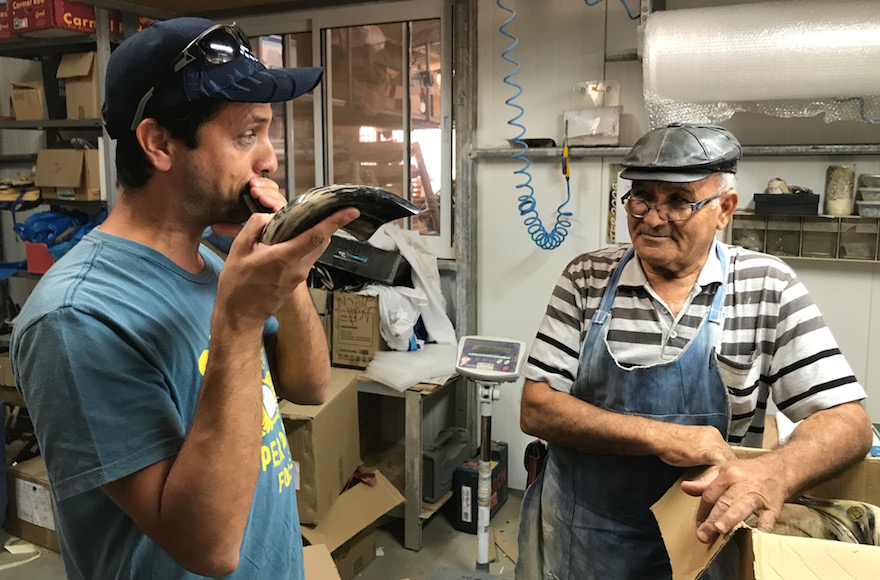
Over the next couple of hours, Yoggev blew shofars while Keinan offered guidance and criticism: “Chin up. Chest out. Blow from the center of your mouth, not the side.”

In the end, Yoggev settled on a medium-sized ram horn with a small mouthpiece.

“It suits that strange game you play with your lips,” Keinan said. “Now I have to get back to work.”

For Keinan, running Kol Shofar is the fulfillment of a lifelong obsession. He likes to say he was born with a shofar in his hand. But in reality, his parents, who immigrated to Israel from Morocco in 1949, when Keinan was a baby, never had enough money to buy him one. He learned to blow the shofar as a child at his Orthodox synagogue in Tiberias, a small, working-class city on the Sea of Galilee, and he built his own out of a funnel and tubing.

Shimon Keinan watches as a customer, Dror Yoggev, blows a shofar at his Kol Shofar factory, Sept. 6, 2017. (Andrew Tobin)

Dropping out of school at 16, Keinan worked as a welder and was finally able to save enough money to buy a real shofar, which he blew every Rosh Hashanah at his synagogue as well as at the nearby Ashkenazi one. After marrying, he moved to Givat Yoav in the 1970s, where he built a metal workshop that doubled as a turkey farm and raised four children.

In the 1990s, Keinan got a chance to turn his passion into a profession when his rabbi introduced him to an elderly shofar maker in Jaffa who wanted to retire. For two years, Keinan drove to the man’s factory twice a week, more than two hours each way, to learn his techniques. In 1998, he turned the turkey farm into a shofar factory.

Today, Kol Shofar, which still looks a bit like a farm, with thin metal walls and concrete and dirt floors, is one of just two in Israel — the other being the much older Bareshet-Ribak Shofarot Israel, which has locations in Haifa and Tel Aviv.

Keinan said he sells about 7,000 shofars a year, at least 90 percent of them mail orders. Half are sold to Israelis, he said, while most of the rest go to Jews in the United States and Europe. Among his clients are famous Israeli rabbis, he said, including current Sephardi Chief Rabbi Yitzhak Yosef. The  months between Tisha b’Av and Sukkot are his busiest time of year.

According to Keinan, the hardest part of producing shofars is obtaining the raw materials. Every two or three years he travels to Africa to buy ram and ibex horns. He gets the ram horns — by far the most popular shofar material because of their recommendation by the Jewish sages – from his native Morocco, where millions of the animals are ritually slaughtered every year for the Muslim festival of Eid.

Shimon Keinan and son Hanan posing for a photo at their Givat Yoav factory, Sept. 6, 2017. (Andrew Tobin)

At the moment, the shofar factory is packed with thousands of horns. They fill boxes, shelves and shopping carts; some are heaped in huge piles on the floor. Keinan estimated that he has 20,000 ram horns, 2,000 kudu horns and a few ibex horns on hand. The ibex horns are rare because they come from Israel, where the wild goat is protected. An ibex horn shofar costs about $1,000, compared to about $100 for a ram horn.

Some 15 years ago, Keinan’s son, Hanan, 42, started accompanying his father on his Africa trips. Soon thereafter, he returned to Givat Yoav with his wife and children to join the family business full time. Along with his father, he handcrafts every shofar the factory produces. Three other employees help run the factory and the office.

While the younger Keinan acknowledged that he cannot match his father’s passion for shofars — and he’s also not religious, he added — Hanan has helped upgrade Kol Shofar’s production process with new techniques and machines.

Kol Shofar’s first two steps for producing shofars are family secrets, but they involve treating the horns to remove the gamey smell and applying heat to straighten them. After that, the narrow end of the horn is sawed off, a hole is drilled in the end and a special tool is used to expand the hole into a mouthpiece. The last step is buffing and shining the exterior.

Hanan Keinan has also pushed to expand the factory’s tourist business —  in recent years, he and his father paved the driveway and built a visitors center, parking area and restrooms. Some 7,000 people took tours of the factory last year, which at about $9 per person is a significant new revenue stream.

But while his son may have a head for business, Shimon remains the heart of the factory.

“He’s not afraid to give visitors a hard time, but when it comes to shofars, he has a serious desire to deliver knowledge and perfection,” Hanan Keinan said. “I think that is a big part of the reason our shofars are really the best.”

This factory makes thousands of shofars each year Read More »

Sara Netanyahu to be indicted for fraud

The wife of Israeli Prime Minister Benjamin Netanyahu will be indicted on four counts of fraud for allegedly diverting some $100,000 in public funds for her family’s personal use, Attorney General Avichai Mandelblit said.

Mandelblit gave Sara Netanyahu the news on Friday, according to Army Radio.

“The attorney general examined the case evidence and reached the decision [to indict Sara Netanyahu] after consulting relevant sources, including the state prosecution and the Jerusalem District Prosecutor’s Office,” read a statement from the attorney general’s office Friday.

Benjamin Netanyahu’s office dismissed the indictment as “absurd and unfounded.”

“Sara Netanyahu is a brave and honest woman,” read a statement posted on his Facebook page, adding that any financial discrepancy at the prime minister’s residence came from former housekeeper Menny Naftali, who was described as “problematic.”

The indictment also names Ezra Saidoff, a former deputy director general of the Prime Minister’s Office, according to The Times of Israel. The Jerusalem District Prosecutor’s Office notified Saidoff on Friday as well.

The indictments are pending hearings for both Netanyahu and Saidoff.

The Netanyahus ended their statement Thursday by alleging that they were the target of an “obsessive” smear campaign.

The most serious of the four charges being brought against Sara Netanyahu involves the hiring of electrician Avi Fahima, a Likud Central Committee member. A committee charged with overseeing residence expenditures — and which included the legal adviser in the Prime Minister’s Office — had ruled against the hiring of Fahima.

Further suspicions relate to the use of state funds for purchasing furniture that purportedly was bought for the official residence in Jerusalem and then moved to the Netanyahus’ private residence in Caesarea. Older furniture was taken back from Caesarea to the residence in Jerusalem.

The decision to launch the investigation came in light of the state prosecutor’s recommendation after allegations were raised in a 2015 report by State Comptroller Yosef Shapira that detailed lavish spending at the official residence in Jerusalem, as well as at the Caesarea home.

Sara Netanyahu to be indicted for fraud Read More »

After amendment, Booker now supports Taylor Force Act

With a significant change in the latest version of the Taylor Force Act, Sen. Cory Booker (D-NJ) will now support the effort after an amendment was agreed to on Thursday by the Appropriations Committee, a Booker aide told Jewish Insider. The New Jersey lawmaker was one of four Democratic Senators to vote against the Taylor Force Act in the Senate Foreign Relations Committee last month.

[This story originally appeared on jewishinsider.com]

According to section five of last month’s bill, all U.S. funding to programs in the West Bank and Gaza would end unless the Secretary of State could certify every 180 days that the Palestinian Authority is taking credible steps to stop violence against Israelis, in addition to ending all payments to terrorists and their families.

However, in an updated version advanced out of the Appropriations Committee on Thursday, and sponsored by Sen. Lindsey Graham (R-SC), the text clarifies that the U.S. funding to the West Bank and Gaza would only be severed for assistance that “directly benefits the P.A.” Therefore, U.S. funding towards humanitarian projects assisting Palestinians would now be permitted, a key demand by Booker who was concerned about the impact of cutting off U.S. aid to Palestinians not involved with committing acts of terrorism.

Programs that will now be exempted include “Kids4peace” which connects Israeli and Palestinian children from West and East Jerusalem to celebrate religious diversity. Additionally, the “Olive Oil without Borders” project that builds economic cooperation between Palestinians, Israelis and Jordanians and encourages women-led businesses.

Earlier this week, the hawkish Committee for Israel launched an attack ad against Booker accusing him of “throwing Israel under the bus” for his vote in the Senate Foreign Relations Committee. Booker is considered a possible 2020 Presidential candidate.

Originally introduced in February, the legislation would cut off U.S. aid to the Palestinian Authority until they cease payments to families of terrorists. Graham included the provision into the Fiscal Year 2018 State and Foreign Operations Appropriations Bill on Thursday. The bill is named after a former U.S. Army officer who was stabbed to death while participating in a study abroad program in Tel Aviv last year.

In a statement released last month, Booker explained his committee vote, “As recently as the day before the vote there was confusion among State Department officials over provisions in the bill and exactly what impact they would have on Israel’s security and the stability of the region.”

However, even the revised version of the bill faces other considerations. As Jewish Insider first reported, the U.S. will likely be unable to participate in the water agreement trumpeted by the Trump administration due to cooperation with the Palestinian Authority.

Given the scarcity of floor time in the Senate, it appears that the Taylor Force Act will go to the floor through the annual appropriations bill rather than in a standalone bill.

After amendment, Booker now supports Taylor Force Act Read More »

donald-trump

Apologies and non-apologies in the year of our Trump 5777

There are apologies, there are non-apologies and there are apologies that never were.

Rosh Hashanah and Yom Kippur are approaching: We are in the season of repentance and its most apt expression, apologizing to our fellow women and men.

The Trump presidency presents special challenges to apology trackers: Donald just doesn’t do them, but he loves them when he gets them. And sometimes he insists he got them when he didn’t.

To be fair to Trump, his ambivalence, if not hostility, toward self-reproach is not unique, and certainly not among presidents. It took Bill Clinton months — until just days before Rosh Hashanah of 1998 — to fully apologize for embarking on, and lying about, his affair with Monica Lewinsky. George W. Bush still blames the Iraq War on bad intelligence. Barack Obama took his time before eventually apologizing to Americans who lost their health insurance despite his repeated promises that they wouldn’t.

Clinton’s apology, at least, included a direct apology to Lewinsky for having called her a liar, and thus met the conditions for “teshuvah,” or genuine repentance, laid out by the Jewish sage Maimonides 900 years ago in his Mishnah Torah: One must seek forgiveness for sins against one’s fellows not from God, and directly from the wounded party. Beg forgiveness directly, Maimonides prescribed, resolve to not repeat your transgression and do what you can to make it up to the victim. Anything less is not a real apology.

In that regard, 5777 wasn’t a great year for Maimonidean apologies. Take a look:

The failing, if not sorry, New York Times

The New York Times

The Midtown Manhattan building that houses what Trump calls “the failing @nytimes,” July 2017. (Spencer Platt/Getty Images)

Trump very much wants to believe The New York Times apologized for its coverage of the election last year. But the Times insists it never apologized.

Trump’s hopes for an apology lie buried in a letter the newspaper posted five days after the election.

“After such an erratic and unpredictable election,” the editors wrote to readers, “there are inevitable questions: Did Donald Trump’s sheer unconventionality lead us and other news outlets to underestimate his support among American voters?”

Trump read that sentence as a mea culpa.

“The failing @nytimes, which has made every wrong prediction about me including my big election win (apologized), is totally inept!” Trump tweeted as recently as Aug. 7.

The Times has responded by tweeting, “We stand by our coverage,” and pointing to the language of the original letter, “We believe we reported on both candidates fairly during the presidential campaign. You can rely on The New York Times to bring the same level of fairness, the same level of scrutiny, the same independence to our coverage of the new president and his team.”

In a fiery speech in Phoenix last month, Trump still hoped to shake out the nugget of an apology in the Times letter.

“How about this?” Trump said. “The New York Times essentially apologized after I won the election because their coverage was so bad, and it was so wrong, and they were losing so many subscribers that they practically apologized. I would say they did.”

A sorry state of affairs

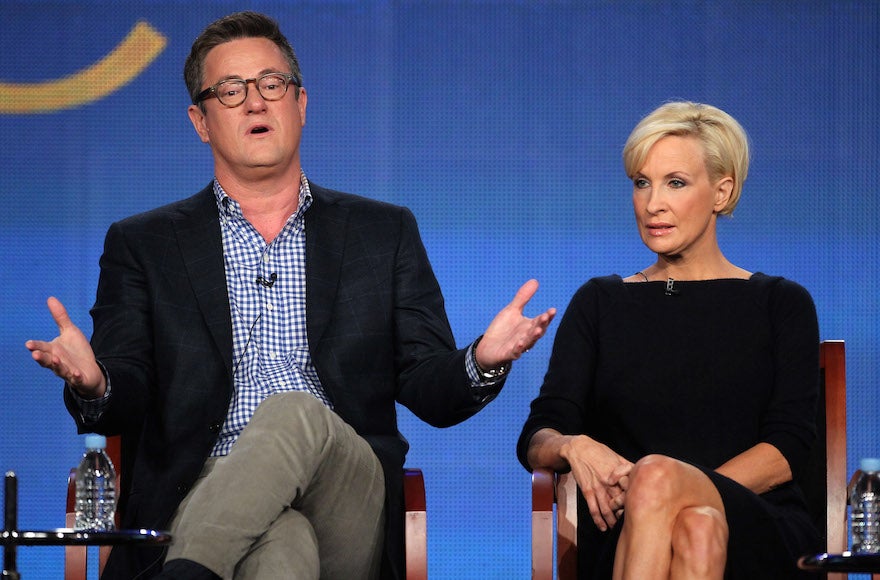
Joe Scarborough and Mika Brzezinski speaking in Pasadena, Calif., Jan. 7, 2012. (Frederick M. Brown/Getty Images)

Becoming the most powerful man on earth has barely slaked Trump’s thirst for deference.

“Fake News is at an all time high,” he said on Twitter in June. “Where is their apology to me for all of the incorrect stories???

Michelle Cottle, writing in the Atlantic in February, compiled a partial list of the people from whom Trump and his surrogates had demanded apologies during and since the campaign. They included Sen. John McCain, the cast of “Hamilton,” CNN’s Jim Acosta, Justice Ruth Bader Ginsburg, Megyn Kelly and Hillary Clinton.

“If anything, a grudging, coerced apology seems to delight him even more than a wholly voluntary one,” Cottle wrote.

Failing to extract an apology, by contrast, seems to enrage Trump. In June, New York magazine reported that Trump son-in-law Jared Kushner failed in his bid to get MSNBC’s Joe Scarborough to apologize to Trump for his show’s critical coverage of the president. The exchange culminated with the president’s attack on Scarborough’s fiancé and co-host, Mika Brzezinski, as “bleeding from the face” from a facelift.

Sorry, not sorry

Donald Trump, then a presidential candidate, giving an apology message about remarks made in a released “Access Hollywood” tape, Oct. 7, 2016. (Screenshot from Facebook)

Trump’s best-known apology, delivered Oct. 8 between Rosh Hashanah and Yom Kippur, was a classic of the sorry, not sorry genre.

It came after the “Access Hollywood” tape showed Trump boasting about sexual assault in 2005.

“I’ve said and done things I regret, and the words released today on this more-than-a-decade-old video are one of them,” Trump, then a candidate, said in his videotaped apology.

Translation: It was over a decade old, when I was a mere child of 59. Why bother with it now?

“Anyone who knows me knows these words don’t reflect who I am. I said it, I was wrong and I apologize,” he said.

Better; even Maimonides might approve. But Trump wasn’t done.

“Let’s be honest: We are living in the real world. This is nothing more than a distraction from the important issues we are facing today,” he said.

Uh-oh. Sounds like he is diminishing the significance of the thing he just apologized for. But at least Trump didn’t say that others have done things that are far worse.

Wait, there’s this:

“Hillary Clinton and her kind have run our country into the ground. I’ve said some foolish things, but there’s a big difference between the words and actions of other people,” he said. “Bill Clinton has actually abused women, and Hillary has bullied, attacked, shamed and intimidated his victims.”

Trump, moreover, did not apologize to his direct targets: the actress he was lusting over in the audio or the married friend he claimed he had hoped to seduce. Melania Trump, who was already married to Trump at the time the tape was made, said her husband apologized to her. Trump has said he did not.

His daughter Ivanka Trump, the evening the tape emerged, reportedly pleaded for him to make a real apology. He refused. She left the room in tears, according to The New York Times.

Trump recorded his apology on Oct. 8. He won election on Nov. 8.

Atonement for the Day of Atonement

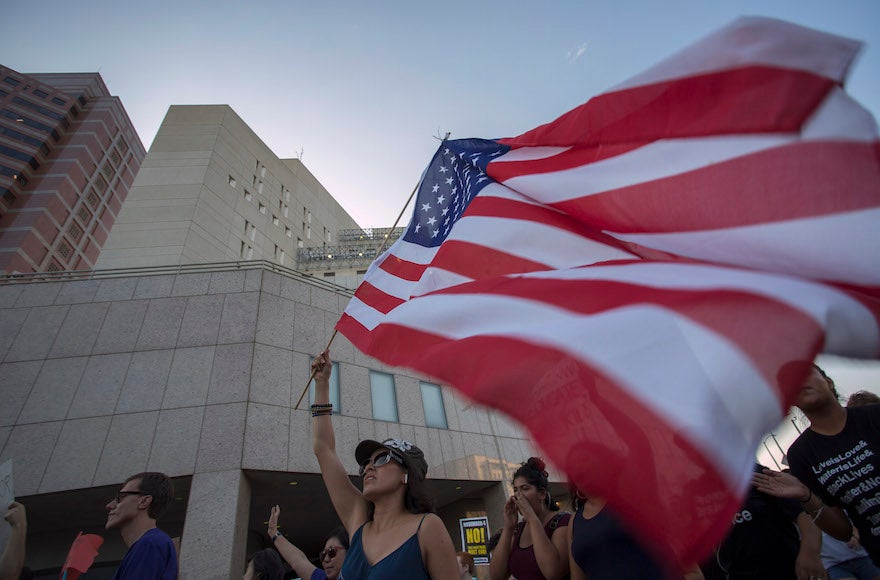
Marchers in Los Angeles protesting President Trump’s order to end the DACA immigrant program, Sept. 5, 2017. (David McNew/Getty Images)

There have been plenty of other apologies in the Trump era.

Jewish social justice activists were miffed when they learned that the March for Racial Justice in Washington, D.C., was scheduled for Sept. 30, which happens to be Yom Kippur. The organizers dithered for a bit, but on Aug. 16 issued a statement saying the scheduling “was a grave and hurtful oversight on our part. It was unintentional and we are sorry for this pain as well as for the time it has taken for us to respond. Our mistake highlights the need for our communities to form stronger relationships.”

The date of the march will not be changed, but related events may be held on that Saturday night or the next day.

Rabbi Jill Jacobs, the executive director of T’ruah: The Rabbinic Call for Human Rights, welcomed the apology, saying the organizers “have modeled teshuvah in the past few days.”

Swiss miss

A photo of the pool at the Paradies Arosa hotel in Switzerland. (Screenshot from Paradies Arosa)

A Swiss hotel owner made all the wrong kinds of headlines when she posted signs at her place urging Jews to shower before entering the pool and telling them they could only access a hotel refrigerator at set times. Even Israel’s deputy foreign minister, Tzipi Hotovely, chimed in, saying the incident reflected the prevalence of anti-Semitism in Europe.

But the story was somewhat more complicated. Ruth Thomann, who runs the hotel, tearfully told JTA that she meant no offense to Jews and that she merely sought to convey information relevant only to the Jewish guests (who, she said, store their kosher food in the hotel fridge and tend to swim wearing T-shirts and other outerwear, presumably out of modesty).

“I may have selected the wrong words; the signs should have been addressed to all the guests instead of Jewish ones,” she said, adding, “My God, if I had something against Jews, I wouldn’t take them as guests!”

On Target

A Target store in Novato, Calif. (Getty Images)

Target apologized to Israelis when it couldn’t make good on orders after a shipping company offered a brief free-shipping promotion. The U.S. retail giant said it was overwhelmed by the orders from Aug. 18 to 20.

“Due to the much higher than anticipated response to the Borderfree Free Shipping promotion, we are unable to deliver order [number] and had to cancel it. We apologize for this inconvenience,” read the letter sent to  Israeli customers.

‘It’s over for me’

Kevin Myers (Screenshot from YouTube)

An Irish journalist, fired for writing what critics called an anti-Semitic newspaper column, apologized to those he offended — although he insisted his intentions were good.

“I am very very sorry to them, I really mean it, I’m not rescuing anything as far as I can see, it’s over for me,” Kevin Myers said, referring to the two Jewish female BBC broadcasters who were described in his column as hard-bargainers. “I am issuing an apology for no other reason than contrition of the hurt I have caused them.”

Jews, he had written in July, “are not generally noted for their insistence on selling their talent for the lowest possible price.”

Said Myers: “I said those words out of respect for their religion.”

Um, thank you?

Flag politics

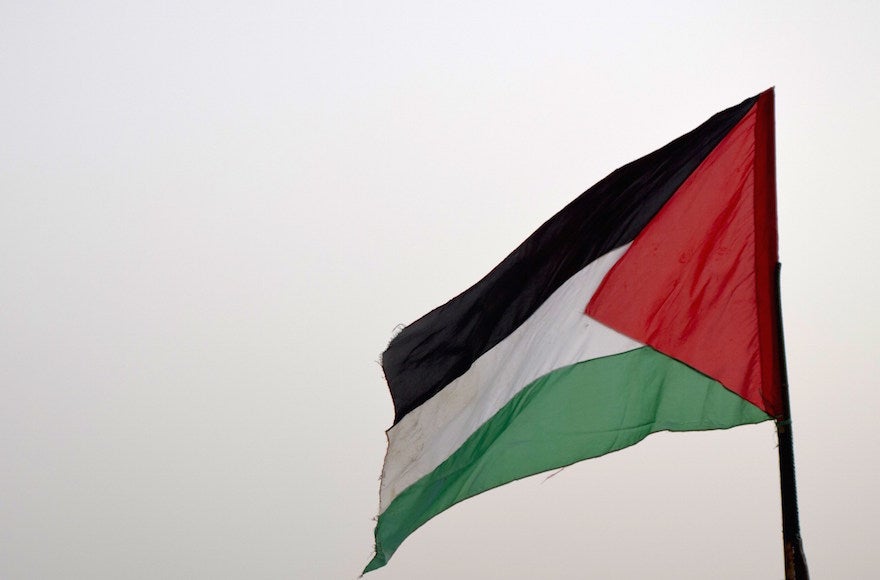
A Palestinian flag flying in Gaza City in 2015. (Mohammed Abed/AFP/Getty Images)

Also in July, a Jewish camp in Washington state apologized after flying a Palestinian flag “as a sign of friendship and acceptance” to visiting Palestinian Muslim and Christian students. Critics of the flag said it was offensive and represented a regime that still incites violence against Jews. Supporters said welcoming Palestinian students on a peace mission was the menschy thing to do.

The critics won the debate.

“We sincerely apologize that we upset some in our CSS and larger Jewish community by introducing the Palestinian flag into our educational program,” Camp Solomon Schechter wrote in a letter to parents and supports. “Camp Solomon Schechter reiterates our unwavering support for the State of Israel as the Jewish homeland.”

The camp’s executive director and co-board president also issued a statement.

“Camp Solomon Schechter regrets raising the Palestinian flag alongside US, Canadian and Israeli flags on Thursday and Friday mornings …,” the statement said. “We neglected to foresee in such actions the serious political implications and for that lapse in judgment, we are deeply sorry.”

Apologies and non-apologies in the year of our Trump 5777 Read More »

French ex-principal reveals he advised Jews not to attend his school for their safety

A former principal at a preparatory school for teenagers in Marseille said he regularly advised Jews not to attend his institution for fear of harassment by other students.

The revelation, which has grabbed front-page headlines in the mainstream media in France, came in a newly published book co-authored by the retired principal, Bernard Ravet, and Emmanuel Davindenkoff, a Le Monde journalist.

In an interview for the L’Express newspaper, Ravet recalled one case in which he as the principal of a public school asked a counterpart from a private Jewish school in Marseille to accept an Israeli boy whose mother wanted to enroll him at Ravet’s school.

Ravet said he “knew the boy would get beat to a pulp” as soon as the other students realized he was an Israeli Jew.

“Hiding my embarrassment, I asked the mother whether she had considered enrolling her boy at Yavneh,” a Jewish school in Marseille, said Ravet, who used to head the Versaille prep school in the same city. After the mother said Yavneh was full, Ravet intervened to have the boy accepted there anyway, he told L’Express.

Ravet first realized his school was not the place for Jews when a radio journalist, Edouard Zambeaux, asked some of his students during interviews whether there were any Jews studying in their institution.

“If there are, then they have to hide it,” one student said, sending “a chill down my back,” Ravet recalled.

Davindenkoff told JTA on Thursday that he considers it a “failure” for the public education system when one of its principals feels they need to refer Jews to private schools for their own safety or well-being.

Ravet also found Islamist verses about killing homosexuals and mutilating thieves circulating among the student population.

Whereas 30 years ago the majority of French Jews enrolled their children in public schools, now only a third do. The remaining two-thirds are divided equally between Jewish schools and private schools that are not Jewish, including Catholic and Protestant institutions, according to Francis Kalifat, the president of the CRIF Jewish umbrella group in France.

“In the Paris region, there are virtually no more Jewish pupils attending public schools,” Kalifat told JTA last year, attributing their absence to “a bad atmosphere of harassment, insults and assaults” against Jews because of their ethnicity, and to the simultaneous growth of the Jewish education system.

French ex-principal reveals he advised Jews not to attend his school for their safety Read More »

Jews may travel on Shabbat to escape Hurricane Irma, Charedi rabbi says

An influential Ashkenazi rabbi in Israel said Jews may travel on Shabbat to escape Hurricane Irma, a Category 4 storm that is expected to hit Florida over the weekend.

But some Jews in flood-prone areas are determined to ride out the storm, another rabbi said.

Rabbi Chaim Kanievsky, who receives thousands of followers annually at his home in Bnei Brak from Charedi Orthodox communities around the world, issued the call in an interview with a follower. One of his aides filmed and posted his response online Wednesday.

Kanievsky’s ruling came as people in parts of three Florida counties faced mandatory evacuation orders Thursday and officials in two other counties issued voluntary orders to leave in advance of Irma.

The storm could create one of the largest mass exoduses in U.S. history as additional evacuations are announced. Orthodox Jewish law permits the violation of Shabbat, the Jewish day of rest, only in life-threatening or otherwise severe emergencies.

Late Thursday, the National Weather Service issued a hurricane warning for South Florida and a storm surge warning as Irma makes its expected way to the U.S.

Tens of thousands of people had left the area voluntarily even before mandatory evacuations took place in the Florida Keys and began Thursday in some parts of the Miami area.

But many Jews in Miami will stay, according to Rabbi Chaim Lipskar, co-director with his wife, Deenie, of Miami’s Shul of Downtown.

Lipskar, who has five young children at home, told the Chabad.org website that half of his community is determined to remain in town. He said his family plans on riding out the storm in the 20,000-square-foot, 3-year-old Chabad House, which “is made of solid steel and concrete, and can handle hurricane-force winds.”

“We have gas generators, food and water; we are all set up,” the rabbi said. “We are going to hunker down and hope for the best.”

Evacuation orders led to the closure on Wednesday afternoon of the Lubavitch Educational Center, where some 1,500 students from preschool through high school are enrolled. The school, which has several campuses in the greater Miami area, will remain closed for the next few days.

An Orthodox community in Toco Hills, an Atlanta neighborhood, is offering hospitality to Jews evacuating Florida. Congregation Beth Jacob is planning to host approximately 400 people for meals on Shabbat, a publicist said, and more than 210 local  families have signed up to host.

The governors of Georgia and South Carolina ordered mandatory evacuations of low-lying coastal areas around Savannah and Charleston as rescue forces brace for the arrival this weekend of the storm, whose 165 mph winds have already devastated whole islands in the Caribbean, resulting in several deaths.

The path the storm will take as it rolls up Florida remains unclear, USA Today reported. The Florida Keys are poised to get hit. Some models show the storm’s eye bending a bit, just to the east of the Florida coast, while other models take the storm directly over Miami Beach.

Jews may travel on Shabbat to escape Hurricane Irma, Charedi rabbi says Read More »

Ki Tavo, Torah, Poetry, Haiku, Rick Lupert, Ki Tavo, Parsha Ki Tavo, poem

7 Haiku for Parsha Ki Tavo (in which God and the Jewish people ‘make it official’) by Rick Lupert

I
Wheat, barley, dates, figs
grapes, pomegranates, olives –
The first ones are God’s

II
Tithes is a word that
makes me feel like I should go
and see a dentist

III
God and the Jewish
people make it official
like sweet Valentines

IV
All that we have done
and all we’ll do – carved on stones
pulled from a river

V
We shout blessings and
curses to two mountains – What
did they ever do?

VI
For the love of God
please don’t curse my kneading bowl
I’ll follow the rules

VII
Gifts – A heart to know,
eyes to see, and ears to hear
Creation goes on


God Wrestler: a poem for every Torah Portion by Rick LupertLos Angeles poet Rick Lupert created the Poetry Super Highway (an online publication and resource for poets), and hosted the Cobalt Cafe weekly poetry reading for almost 21 years. He’s authored 21 collections of poetry, including “God Wrestler: A Poem for Every Torah Portion“, “I’m a Jew, Are You” (Jewish themed poems) and “Feeding Holy Cats” (Poetry written while a staff member on the first Birthright Israel trip), and most recently “Donut Famine” (Rothco Press, December 2016) and edited the anthologies “Ekphrastia Gone Wild”, “A Poet’s Haggadah”, and “The Night Goes on All Night.” He writes the daily web comic “Cat and Banana” with fellow Los Angeles poet Brendan Constantine. He’s widely published and reads his poetry wherever they let him.

7 Haiku for Parsha Ki Tavo (in which God and the Jewish people ‘make it official’) by Rick Lupert Read More »