fbpx

August 14, 2017

The peace process merry-go-round

U.S. President Trump to send top envoys to region in bid to re-launch Israel-Palestinian negotiations

“Fool me once, shame on you; fool me for twenty-five years, I’ll try the same thing over again…”

This play on words of an age-old adage may aptly describe the U.S. approach to the Israeli-Palestinian peace process, defined by a quarter century of perpetual failure to implement the “two-state solution,” which envisions the creation of an independent Palestinian country in exchange for an end-of-all-claims agreement with Israel.

Most observers concede that the sides today remain as far apart as ever on the so-called “core issues,” including the delineation of borders, dividing Jerusalem, the fate of Palestinian refugees, etc.; in addition to which, they contend that Palestinian Authority President Mahmoud Abbas is too weak to deliver an accord to a population that has not been conditioned to accept the permanency of a Jewish state. Where Israeli Prime Minister Binyamin Netanyahu is concerned, the consensus is that he either opposes the formation of any Palestinian entity outright or could likewise never push an agreement through his right-wing coalition.

There is also the Gaza conundrum and what to do about Hamas, the Palestinian Islamist movement which rules the Strip and which despises Abbas only slightly less than it longs for Israel’s destruction. Catch-word elements such as “settlements,” “territorial contiguity,” “bi-national,” among many others, serve to entrench the notion that there is no rational justification for the belief that any peace, let alone an enduring one, may be in the offing.

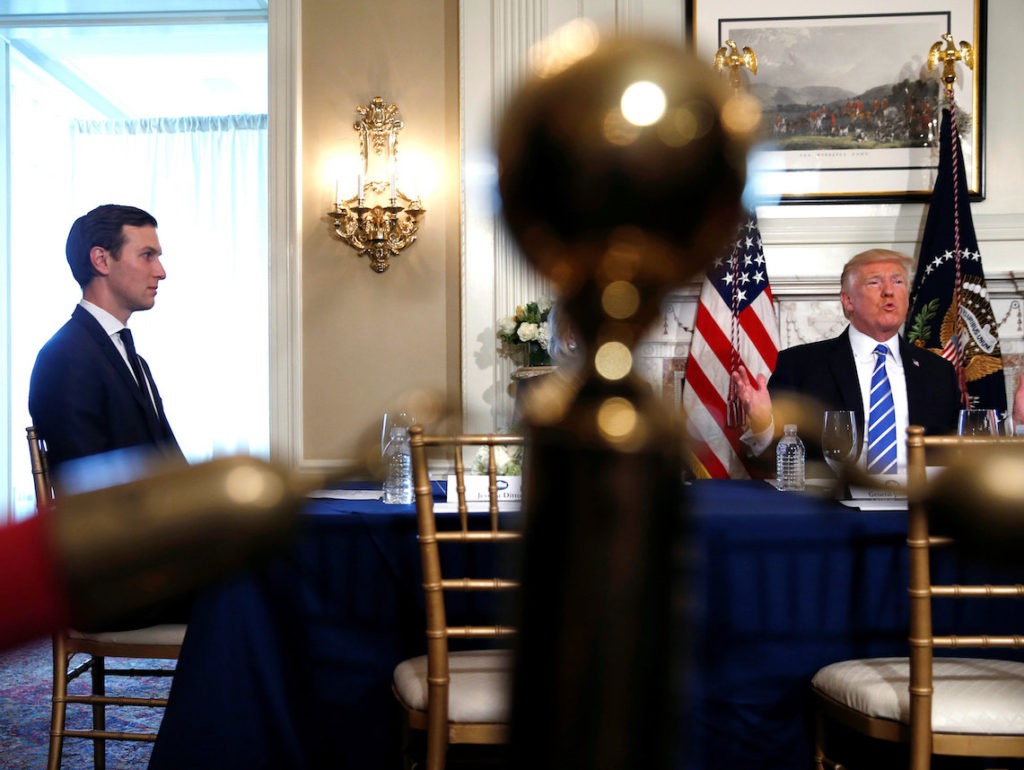
In the result, why, then, is U.S. President Donald Trump dispatching three top envoys to the region later this month, with the aim of jump-starting renewed peace talks? Without the White House having signaled any fresh approach or original ideas, and without any indication that the conditions on the ground are ripe for a breakthrough (rather, the recent crisis over the Temple Mount/Al-Aqsa Mosque suggests quite the opposite), what purpose can possibly be served by the upcoming visit of Jared Kushner and Jason Greenblatt—Trump’s point men on the conflict—as well as Deputy National Security Adviser Dina Powell?

One theory is that Trump is trying to “internationalize” a potential solution, evidenced by the fact that his diplomats are slated to meet with, in addition to the Israelis and Palestinians, leaders of Jordan, Egypt, Saudi Arabia, the United Arab Emirates and Qatar. But this approach is not new; rather, the Arab Peace Initiative has been on the table since 2002 and was just re-endorsed earlier this year at the Arab League summit. And while there has indeed been a quiet rapprochement between Sunni regional countries and Israel, it is based foremost on the converging interest of countering Shiite Iran’s expansionist ambitions.

A peace deal with the Palestinians would no doubt enhance these bourgeoning relations, but it seems unrealistic to expect Netanyahu to make the far-reaching concessions stipulated by the Arab proposal, even as an initial framework for future talks. From his point of view, Riyadh, for example, currently needs Israel more than it needs the Palestinians. Conversely, to expect the Saudis to modify their longstanding positions in order to bring relations with a Netanyahu government “above the table,” so to speak, likewise defies strategic sense.

Meanwhile, a White House official last week reiterated that, “peace between Israelis and Palestinians can only be negotiated directly between the two parties;” thereby throwing cold water on the so-called “outside-in” tactic of devising the parameters to be dictated to the parties.

These issues are compounded by the problems Trump has directly encountered during his peacemaking efforts, which reportedly included a March blow-up with Abbas in Bethlehem over the Palestinians’ refusal to stop paying stipends to prisoners convicted of security offenses in Israel. Both Kushner and Greenblatt have purportedly similarly sparred with Palestinian officials, with allegations of bias having recently been levelled against the former after he was caught on an open mic ostensibly siding with Israel’s decision to install security measures at the Temple Mount following last month’s deadly attack there.

Coupled with the fact that Trump’s Ambassador to Israel, David Friedman, has essentially been declared persona non grata in Ramallah due to his past support for the settlement enterprise, along with increasing criticism directed by Palestinian leaders at Trump’s actions thus far, major doubts arise regarding the practicality of renewing any process, never mind forging a broad accord. Accordingly, many have started promoting a method that relies on intermediary deals to sufficiently narrow the gaps between the two sides to enable an eventual final agreement.

Gilead Sher, a Senior Fellow at Israel’s Institute for National Security Studies, believes that a “more moderate setting of the bar is required that encourages a process towards a two-state reality, which, in turn, would lead to a two-state solution.” To this end, the former chief of staff to Ehud Barak and lead Israeli peace negotiator laid out for The Media Line a multi-dimensional approach in which bilateral Israeli-Palestinian negotiations are revisited “in order to replace the formula of ‘nothing is agreed to until everything is agreed to’ with ‘whatever is agreed to should be implemented.'”

This, Sher contended, “would entail a mutual understanding of the necessity for a gradual and transitional process rather than a one-off, stand-alone comprehensive deal.” Moreover, he elaborated, “independent, constructive steps could also be taken by either party in order to reverse the trend towards the materialization of one state, which would be a disaster for Israel and the Palestinians.”

To this end, Sher does not rule out the possibility of “Israel unilaterally delineating a border—even a provisional one—as such will ultimately ensure the country remains both Jewish and democratic.”

While acknowledging that the Palestinians might not approve of such measures, Sher stressed that “their all-or-nothing approach, combined with an international campaign [to delegitimize] Israel has not yielded any results.” As such, in his view, “the international community should encourage this type of gradual process,” which can prevent “extremists on both sides from forging a reality that is unsustainable.”

In fact, this was the initial approach taken in 1993 with the signing of the Oslo Accords, which did not call for the immediate creation of a Palestinian state. Rather, the deal was officially named the Declaration of Principles on Interim (emphasis added) Self-Government Arrangements, clearly indicating that an all-encompassing pact was to be achieved over time.

Oslo II, as it is known, was signed two years later, dividing the West Bank into areas A and B, over which the Palestinians were granted a measure of autonomy, as well as area C, which remains under total Israeli control and which is home to the vast majority of Jewish communities across the 1967 borders. Thereafter, the Hebron and Wye Agreements, formalized during Netanyahu’s first premiership (1996-1999), stipulated further Israeli military redeployments from the West Bank, thereby increasing Palestinian self-rule. Overall, then, the first seven years of the peace process, leading up to then-U.S. president Bill Clinton’s Camp David summit in 2000, were based on the premise of “interim” agreements.

The problem, however, is that Yasser Arafat ended up rejecting then-Israeli prime minister Ehud Barak’s proposal for full-blown statehood and instead launched the Second Intifada. Given this catastrophe, as well as the futility of subsequent intermediary proposals—notably George W. Bush’s “Roadmap For Peace” in 2003 and, most recently, Barack Obama’s 2014 “Document Of Principles—questions arise as to the validity of repeating these, or any analogous, approaches while both sides remain so deeply at odds.

According to Dr. Gershon Baskin, Co-chairman and Founder of Israel-Palestine: Creative Regional Initiatives, “if Trump’s people are listening carefully to what both sides are saying, they are probably hearing that it is impossible at this point with Netanyahu and Abbas to reach a permanent status agreement.” Furthermore, he explained to The Media Line, “while the majority of both the Palestinian and Israeli publics want peace, most do not believe it is presently possible because neither side thinks they have a legitimate partner in the other.”

In Dr. Baskin’s estimation, “the only possibility for a breakthrough is for a change of leadership, either on one side or both. This way, some new kind of dynamic could open up a possibility for a real negotiation, which would most likely take the form of a direct back-channel and not a very public process.” Nevertheless, he concluded, it is “potentially dangerous” to forgo a process altogether and to say “there is nothing left on the table.” On the flip side, past failed attempts at peacemaking served only to sow additional frustrations, which then boiled over into violence.

As if to tackle history head-on, Trump remains “personally committed” to renewing some form of Israeli-Palestinian negotiations as an end in and of itself. For now, then, “around and around the peace process will go, where she’ll stop no one knows.”

One thing, however, seems eminently clear—the unlikelihood that the final station on this circular diplomatic track will be named “Palestine.” Therefore, it may be high time to drop all pretense and simply resort to baby steps, with the modest aim of improving the lives of both peoples even while they remain at conflict with each other; in essence, replacing “peace” with “honest” in a process that fewer and fewer people believe in.

The peace process merry-go-round Read More »
Jerusalem-Amman diplomatic row continues over embassy attack

Jordan refuses to allow Israel’s ambassador to return to country unless security guard who shot dead two Jordanians is investigated and tried

Jordan remains steadfast in its refusal to allow Israel to return its ambassador to Amman unless an Israeli security guard involved in a shooting at the embassy last month is brought to trial.

Speaking to The Media Line, Yahya Al-Saud, head of the Palestine Committee in Jordan’s parliament and who is responsible for the Jerusalem file, confirmed that “an order was issued [Monday] banning the Israeli ambassador in the absence of an initial investigation in Israel over the actions of the security guard.

“And Jordan must be involved and kept aware of the proceedings,” he stressed.

Al-Saud’s statements comes after Jordanian government officials were quoted by local media as saying that they had sent a letter to Jerusalem reiterating that Einat Schlein could not return to her post without “guarantees of a serious and thorough investigation of the embassy guard and the bringing of him to trial.”

The guard, Ziv Moyal, was allegedly stabbed by teenager Mohammed Jawawdeh on July 23, after which he opened fire, killing the attacker along with a Jordanian bystander. The incident sparked a diplomatic crisis, which intensified when Prime Minister Binyamin Netanyahu gave Moyal a hero’s welcome upon his return to Israel—a move described by Jordanian King Abdullah II as “unacceptable and provocative.”

In this respect, a Jordanian source told The Associated Press over the weekend that Netanyahu’s action had “damag[ed] bilateral relations and the regional acceptance Israel is seeking.”

Israel has since launched a probe into the incident, which the Jordanian parliament speaker called a “step in the right direction,” before adding that “justice must be served.” While Israel’s attorney general said the inquiry was routine, Moyal will likely be investigated on suspicion of manslaughter, according to media reports. As a signatory to the Vienna Convention, Israel is required to probe suspects upon their return from a country that provided them with diplomatic immunity against potential charges.

Hassan Ka’bia, a spokesman for the Israeli Ministry of Foreign Affairs, confirmed to The Media Line that “the investigation is ongoing but that once it is done, a report will be transmitted to Jordanian authorities, in accordance with the law.” He said that no conclusions have yet been drawn.

Ka’bia further asserted that the incident should have led to such a blowup, and explained that the decision to bring home the Israeli diplomats was made by the Netanyahu government and that Amman had not expelled them. Lastly, he contended that “there are no issues between Israel and the Jordanian side, and, in fact, there is a meeting scheduled next week which will also be attended by the Palestinian Authority to discuss the borders.”

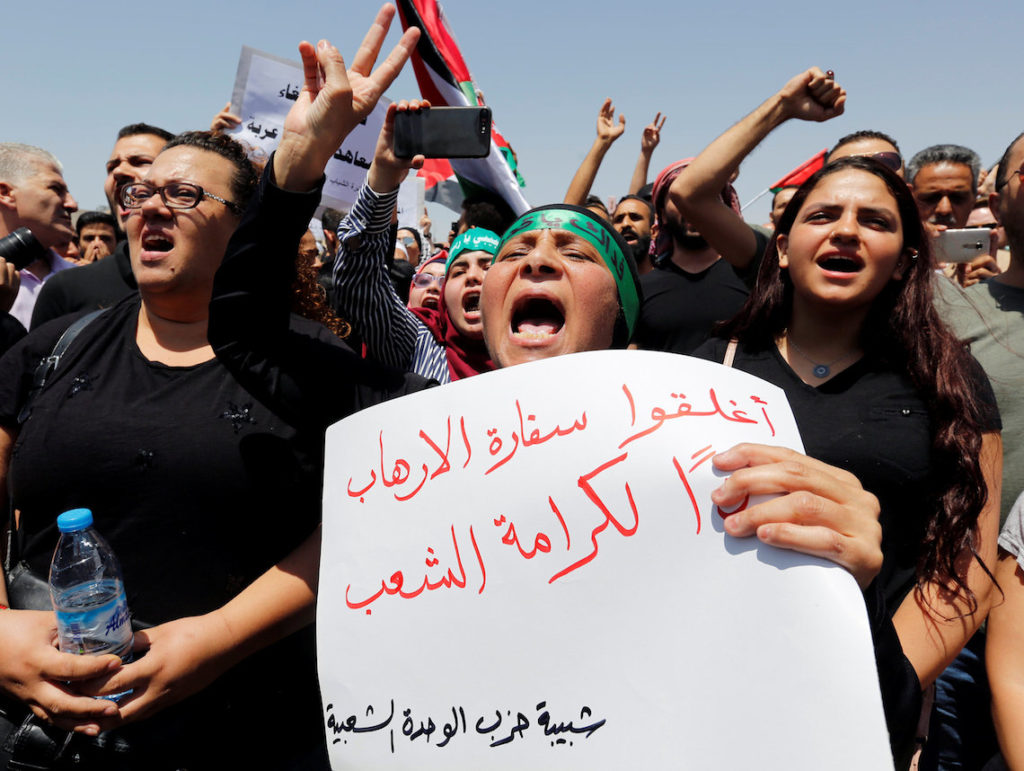
Nevertheless, the incident prompted widespread condemnations from Jordanian citizens, who held mass demonstrations including outside the Israeli embassy where protesters chanted “Death to Israel.” At Jawawdah’s funeral, thousands of people gathered to urge Abdullah to cancel the 1994 peace treaty between the countries.

“I prefer to cut all relations with Israel,” Yahya Al-Saud affirmed to The Media Line. “It is not about the latest incident. I don’t think it is important for us to have ties with Israel, period. Our relationship is like a five-star hotel—it only benefits the heads of the country and not the average person.”

The embassy incident occurred against the backdrop of recent tensions centered on the Temple Mount/Al-Aqsa Mosque complex. Following the killing of two police officers at the compound on July 14, Israel installed metal detectors at the holy site, a move vehemently rejected by Muslims worldwide. Two weeks of upheaval ensued, leading Netanyahu to backtrack and remove the security measures.

Thus far, Moyal has rejected all claims that the incident at the embassy in Jordan was sparked by an argument over furniture, instead insisting he was attacked for “nationalistic” reasons, an Israeli term used to designate acts of terror.

Jerusalem-Amman diplomatic row continues over embassy attack Read More »

Neo-Nazi website supposedly hacked by Anonymous after Charlottesville

Was America’s most vicious alt-right website hacked this morning? The verdict is unclear.

Here’s what we know:

On August 13, internet server Neo-Nazi website Daily Stormer was supposedly hacked by Anonymous, a collective of worldwide hackers who gained national attention in 2008 when they hacked the Church of Scientology website. The Daily Stormer hacking job was made public with a post, which read:

HACKERS OF THE WORLD HAVE UNITED IN DEFENSE OF THE JEWISH PEOPLE
YOU SHOULD HAVE EXPECTED US

A few hours later, Daily Stormer founder Andrew Anglin posted a follow-up:

Anglin Here. I’ve Retaken Control of the Site. The Daily Stormer Never Dies.

Since the fiasco, Anonymous has taken to Twitter to rebuke the claims of an alleged hack. “Seriously, suck less,” they tweeted to Daily Stormer in response.


The Independent was the first to note that the “hacking job” came after the neo-Nazi website was notified by its server GoDaddy that it would be shut down in 24 hours after violating their terms of service.

On August 13, Daily Stormer posted a hateful article about Heather Heyer, a victim of the white supremacist rally in Charlottesville, titled: Heather Heyer: Woman Killed in Road Rage Incident was a Fat, Childless 32-Year-Old Slut.


A few hours later, the Anonymous hack was posted, driving traffic to the website. A desperate cry for attention before being shut down?

Neo-Nazi website supposedly hacked by Anonymous after Charlottesville Read More »

Trump names KKK, white supremacists, neo-Nazis in condemnation

Two days after the death of a 32-year-old woman during a white supremacists’ rally in Charlottesville, Va., and amidst a furor over his delay in condemning the rally in specific terms, President Donald Trump condemned the “racist violence” and declared that “racism is evil.”

“Racism is evil and those who cause violence in its name are criminals and thugs, including the KKK, neo-Nazis and white supremacists, and other hate groups who are repugnant to everything we hold dear as Americans,” Trump said Monday in a statement he delivered at the White House.

“We condemn in the strongest possible terms this egregious display of hatred and violence. It has no place in America,” Trump said. He also said the Department of Justice had opened up a civil rights investigation into the attack, and honored by name Heather Heyer, who was killed Saturday after a car driven by a 20-year-old who has espoused neo-Nazi views plowed into counterprotesters.

Trump had been under pressure since Saturday to forcefully condemn the white supremacists who descended on Charlottesville to protest the planned removal of a statue of Confederate Gen. Robert E. Lee. His initial statement, condemning “hatred, bigotry and violence, on many sides, on many sides” angered Democrats and Republicans alike for seeming to draw a moral  equivalence between the white supremacists and the counterprotesters. In a subsequent tweet he had expressed condolences to “the family of the young woman killed today” but did not name Heyer.

Jewish leaders also noted the widespread expressions of anti-Semitism of the rally, which included demonstrators carrying signs reading “Jews are Satan’s children,” Nazi flags and chants of “Jews will not replace us.”

In a statement Saturday, Jonathan Greenblatt, CEO of the Anti-Defamation League, said: “This is a moment that demands moral leadership. President Trump should acknowledge that this is not a matter of equivalence between two sides with similar gripes. There is no rationalizing white supremacy and no room for this vile bigotry. It is un-American and it needs to be condemned without hesitation.”

On Sunday the White House put out a statement, attributed to an unnamed  spokesperson, saying, “The president said very strongly in his statement yesterday that he condemns all forms of violence, bigotry and hatred. Of course that includes white supremacists, K.K.K., neo-Nazi and all extremist groups. He called for national unity and bringing all Americans together.”

That statement still failed to satisfy many critics who noted that some white supremacist groups who were encouraged that  Trump had not himself singled them out. On Monday, David Harris, CEO of the American Jewish Committee, called on Trump to “make clear that our nation does not countenance the warped views of bigots, as was on display in Charlottesville.” He also urged the president “to send a strong message to these extremist groups that their endorsement is not welcome.”

Trump names KKK, white supremacists, neo-Nazis in condemnation Read More »

Pink and Regina Spektor write moving messages about the Charlottesville violence: ‘They will not win’

Jewish celebrities are responding to the “Unite the Right” protests that turned violent in Charlottesville, Virginia, over the weekend.

Singers Pink and Regina Spektor both happened to be on tour in Berlin in the aftermath of the Saturday protests, in which hundreds of white supremacists gathered to protest the removal of a Robert E. Lee statue, and one counterprotester was killed in a car ramming attack.

In their responses on social media, both drew comparisons to the dark history of Berlin. Pink, born Alecia Beth Moore and whose mother is Jewish, directly noted her Jewish identity. “It’s incredible to watch neo-nazis march in 2017, while I, a Jewish woman, headline a show in Berlin where these tunnels were built by him,” writes Pink, referring to the tunnels built by Hitler leading to the Waldbühne, the amphitheater where she performed Friday. “I walked through this tunnel to get to [the] stage while people just like him marched in Charlottesville. My heart aches for the amount of hatred in this world.”

It's incredible to watch neo-nazis march in 2017, while I, a Jewish woman, headline a show in Berlin where these tunnels were built by him, built curvy so he couldn't be shot in the back. I walked through this tunnel to get to stage while people just like him marched in Charlottesville. My heart aches for the amount of hatred in this world. But in this place, where so many awful things happened once upon a time, here we are together in Berlin. People of all walks of life celebrating together. He didn't win. Hate didn't win here and this show, all of us on stage and in the audience together, we are a living testament to that. This city of Berlin is full of beautiful, loving people who accept me for who I am. The world is still full of beautiful people. Hate will not win if we don't let it. It's up to each of us to choose love and acceptance. This is an old war that's already been lost. They will not win. RIP Heather Heyer 🙏

A post shared by P!NK (@pink) on

Regina Spektor referred to her childhood as a  Jewish refugee from the then-Soviet Union in a Facebook post on Monday.

“I am in Berlin where after a dark history, it is illegal to be a Nazi or say hate speech,” she said. “As a refugee, I have promised to protect and fight for my country when I was sworn in as a citizen. I was a teenager then. As I held up my right hand, I never dreamed of the hate speeches and the normalizing of institutionalized prejudice that would be falling over the land in such a short time. The haters coming out of the shadows, and being empowered.”

Heather Heyer, 32, mentioned in Pink’s post, was killed Saturday after being hit by a car driven by James Alex Fields, a 20-year-old said to harbor neo-Nazi beliefs. Another 19 people were injured; Fields, 20, is being held on second-degree murder charges.

Pink and Regina Spektor write moving messages about the Charlottesville violence: ‘They will not win’ Read More »

PATTI CAKE$ *Director/Writer/Star Interviews and Movie Review*

Danielle Macdonald nearly turned down the lead role in Patti Cake$: she’d never rapped before.  She accepted the challenge, and watching her performance it’s hard to believe she’s not a veteran of the genre.  Macdonald practiced rapping in her closet (acoustics were better) and after hearing her Jersey accent on screen, learning she’s Australian only further emphasizes her skill.

Patti Cake$ is an underdog story about Patricia (Macdonald), a rapper who doesn’t look the part but perseveres anyway.  While there’s a unifying theme of loss among the leads, the overarching message is one of finding strength within.

Writer/director Geremy Jasper spent years on this ode to rap.  He utilizes a combination of shooting styles that complement each other well, further emphasizing the more magical elements of the story.

Patti Cake$ also stars Cathy Moriarty, Bridget EverettSiddharth Dhananjay and Mamoudou Athie.

For more about the movie, including exclusive interviews with writer/director Geremy Jasper and stars Danielle Macdonald and Cathy Moriarty, take a look below:


—>Keep in touch with the author on Twitter and Instagram @realZoeHewitt.  Looking for the direct link to the video?  Click here.

All photos and video are courtesy of Fox / Fox Searchlight.

PATTI CAKE$ *Director/Writer/Star Interviews and Movie Review* Read More »

Charlottesville and the Jews: The peril of cognitive dissonance

What did we learn from Charlottesville that we did not know?

That there are Nazis in America? We knew that.

That Nazis, and their white supremacist bedfellows, are bad people? We knew that, too.

That when such people have grievances they always find reasons to implicate the Jews in some twisted way? No news there.

That most of America neither identifies with nor supports these bigots, their views and their actions? We hope this is still true – there are many signs it is.

There are many explanations for Jew-hatred, and a hefty number of them focus on its psychological roots. I deal with these in a chapter of my latest book (in Hebrew), “The Jews: 7 Frequently Asked Questions.” The chapter begins with a story from about a thousand years ago and goes on to remind readers that due to the Nazi persecution Sigmund Freud was forced to leave his home in Vienna and move to London, where he died a year later.

In Freud’s book “Moses and Monotheism,” this great Jewish revolutionary offers an interpretation of Jew-hatred, claiming that Christians have an Oedipal relationship with Jews. Judaism is the father religion, and Christianity is the rebellious son. Since then, many non-Freudian explanations have also viewed the psyche and human consciousness as key to understanding the hatred of Jews. Many of them highlight how Jews have always played into the hands of people who have a hard time deciphering the meaning of a puzzling and erratic world, especially in times of crisis.

Anti-Semitism becomes deadly “when a culture, nation or faith suffers from a cognitive dissonance so profound that it becomes unbearable,” wrote Rabbi Lord Jonathan Sacks in “The Return of Anti-Semitism,” his January 2015 essay in The Wall Street Journal. He was referring to societies that cannot quite figure out the changing world around them.

When you ask what happened in Charlottesville, why they “go after Jews” (as Yair Rosenberg puts it) or why the Jews were targeted in Virginia, there is your answer. Not necessarily a new or surprising answer, but an answer nonetheless.

“A cognitive dissonance that becomes unbearable” is a fair description of how more than a few Americans feel today. This cognitive dissonance led to the election victory of Donald Trump, a perplexing yet tolerable political outcome. This cognitive dissonance, when it gets more severe, can lead to much more dangerous outcomes.

So, what did we learn that is new?

We learned — yet again — that President Trump was unable to condemn such bad people in the harshest terms possible (and not because of his tendency for politeness) — at least until the firestorm in reaction to his initial remarks became so strong that he had to issue a second, more-reasoned statement. Erick-Woods Erickson, the conservative blogger, made this point succinctly in his call for moral clarity: “This is the same president who routinely mocked and attacked Barack Obama and Hillary Clinton for failing to call Islamic radicalism by its name. In Charlottesville, evil has a name, and it is white supremacy.”

This is not the first time I write such a thing, and I have the feeling it will not be the last. It is not wise for Jewish institutions, organizations and leaders to paint President Trump as an ally of anti-Semitism because it is very unlikely he is anti-Semitic and such accusations, when repeatedly hurled at people, tend to become self-fulfilling prophecies.

A few months ago, when Trump erupted after he was asked a question about anti-Semitism, I wrote: “In Trump’s view, a lot of the growing level of talk about anti-Semitism is no more than a political strategy to destroy his credibility.” When college campuses in several states (anyone here from California?) became an intimidating setting for Jewish students because of attacks from the left, the Jewish establishment did not unite to blame President Obama and his confrontational approach toward Israel. But now, when vile attacks on Jews come from the right, many Jewish leaders are ready to point a finger at the White House.

Trump is a divisive figure in a divided and confused world. He has many deficiencies as a leader, some of which were in display when he meekly condemned the violence in Charlottesville. Jews will gain nothing from portraying him as their foe.

My first visit to Charlottesville was about eight years ago, to meet Prof. Vanessa Ochs and learn about the invention of new Jewish rituals. Ochs has studied and written about this issue, and in one of her books she explained that “two forces have influenced the abundance of ritual innovation. The first is the spiritual stance shaped by democracy and open access, and the second is the dramatic change brought by Jewish feminism.”

The story I wrote about Ochs focused more on the feminist aspect. But thinking about recent events in Charlottesville has made me ponder the “democracy and open access” aspect of her theory and how far we have come from the old to the new: From anti-Semitism to inventing Jewish ritual; from hatred of Jews to America’s love of Jews; and from Jewish fears (read Ron Kampeas’ “The Day the Nazi Called Me Shlomo”) to Jews having the confidence to protest and respond without mincing words.

Charlottesville and the Jews: The peril of cognitive dissonance Read More »

Jewish leaders condemn Charlottesville violence and Trump’s reaction

Jewish groups and Jewish leaders condemned the violence at a white supremacist event in Charlottesville, Virginia, and criticized President Donald Trump for saying that the hatred and violence came from “many sides.”

“The vile presence and rhetoric of the neo-Nazis who marched this weekend in Charlottesville is a reminder of the ever-present need for people of good will to stand strong, to speak loudly against hate, and act both to delegitimize those who spread such messages and to mitigate the harm done to the commonweal of our nation and to those that are the targets of hate messages,” Rabbi Rick Jacobs, president of the Union for Reform Judaism, said in statement issued on Saturday evening, adding that “once again, hate has killed.

Three people were killed as a result of the weekend neo-Nazi event. One woman was killed and 19 injured, some seriously, after a car driven by an Ohio man slammed into a crowd of counterprotesters. The driver, identified as James Alex Fields Jr., 20, of Maumee, Ohio, was taken into police custody and the incident is under investigation.

Two Virginia state troopers were killed when their police helicopter crashed and caught on fire while responding to clashes between white supremacist protestors and counterprotesters.

“We commend the opening of President Trump’s statement condemning the “egregious display of hatred, bigotry and violence” but are deeply troubled by the moral equivalence evident in President Trump’s statement today. White supremacists wielding Nazi flags and spewing racist vitriol need to be specifically condemned, not only violence and hate ‘on many sides.’ If our leaders can’t call out this virulent strand of hate we will surely fail to stop it,” Jacobs also said in his statement.

Trump held a news conference from his summer vacation in Bedminster, New Jersey after posting tweets criticizing the violence in Charlottesville, including one which read: “We ALL must be united & condemn all that hate stands for. There is no place for this kind of violence in America. Lets come together as one!”

“What is vital now is a swift restoration of law and order and the protection of innocent lives. No citizen should ever fear for their safety and security in our society,” he also tweeted.

Ronald Lauder, president of the World Jewish Congress, condemned the “inconceivable violence” on display in Charlottesville.

““It is utterly distressing and repugnant that such hatred and bigotry still run rampant in parts of this country. There is no place in our democratic society for such violence and intolerance. We must be vigilant and united in our opposition to such abhorrence,” he said in a statement.

Anti-Defamation League CEO Jonathan Greenblatt condemned the violence in Charlottesville in a tweet posted Saturday afternoon. “Mayhem in #charlottesville. We pray for victims of #violence & condemn those who marched thru streets chanting #hate,” he tweeted.

He also praised Trump for condemning the violence but criticized him for not specifically condemning the white supremacist movement. “Glad @POTUS blasted violence but long overdue for moral ldrshp that condemns the agents of #hate: #WhiteSupremacists, #NeoNazis, #AltRight,” he tweeted.


In a statement later issued by ADL, Greenberg said: “This is a moment that demands moral leadership. President Trump should acknowledge that this is not a matter of equivalence between two sides with similar gripes. There is no rationalizing white supremacy and no room for this vile bigotry. It is un-American and it needs to be condemned without hesitation.”

“We call on the White House to terminate all staff with any ties to these extremists. There is no rationale for employing people who excuse hateful rhetoric and ugly incitement. They do not serve the values embodied in our Constitution nor the interests of the American people,” he also said.

The American Jewish Committee tweeted: “Appalled by white supremacists & neo-Nazis in #Charlottesville preaching #racism, spewing #antiSemitism & #homophobia & glorifying violence.”

The organization also called on Trump to find “moral clarity.”

“@POTUS Time for moral clarity. Condemning ‘hatred, bigotry & violence on many sides’ blurs truth & gives pass to neo-Nazi perpetrators,” AJC tweeted.

Israel’s Minister of Diaspora Affairs, and Security Cabinet member Naftali Bennett, who is head of the right-wing Jewish Home party, condemned the rally and called on U.S. leaders to denounce the anti-Semitism connected to it.

“The unhindered waving of Nazi flags and symbols in the U.S. is not only offensive towards the Jewish community and other minorities, it also disrespects the millions of American soldiers who sacrificed their lives in order to protect the U.S. and entire world from the Nazis,” he said in a statement, adding: “The leaders of the U.S. must condemn and denounce the displays of anti-Semitism seen over the past few days.”

Sen. Bernie Sanders, I-Vermont, who was a former candidate for president, in a tweet slammed Trump for his handling of Charlottesville. “No, Mr. President. This is a provocative effort by Neo-Nazis to foment racism and hatred and create violence. Call it out for what it is.”

Former Ku Klux Klan leader David Duke, who ran for and lost his bid for a Senate seat in Louisiana, and was an early and vocal supporter of Trump’s presidential run, tweeted in response to Trump’s call for all Americans to unite against hate.

“I would recommend you take a good look in the mirror & remember it was White Americans who put you in the presidency, not radical leftists,” Duke tweeted.

https://twitter.com/DrDavidDuke/status/896431991821926401

Jewish leaders condemn Charlottesville violence and Trump’s reaction Read More »

Charlottesville Jewish community hires security

The Jewish community of Charlottesville, Virginia, hired security guards for the first time in its history ahead of a far-right event that ended with a deadly attack on protesters against racism.

Rabbi Tom Gutherz of Congregation Beth Israel told Haaretz on Sunday that the move was deemed necessary ahead of the “alt-right” rally planned for the city the day before. On Saturday, a 20-year-old white supremacist drove a car into a crowd of counterprotesters, killing a 32-year-old woman, Heather Heyer, and wounding 20 others.

“We had to hire the service of security guards because of the events,” Gutherz told Haaretz. “We’re sad but we had no choice.”

The synagogue held its scheduled activities on Saturday, Gutherz said.

“It was clear we wouldn’t let this intimidate us, these people can’t keep us away from our synagogue,” he said of the far-right activists.

On Sunday, Charlottesville Mayor Michael Signer, who is Jewish, blamed President Donald Trump for some of the hatred on display in his city, where thousands of marchers chanted racist slogans, including about Jews and blacks.

“Look at the campaign he ran,” Signer told CNN about Trump. “Look at the intentional courting, on one hand, of all these white supremacists, white nationalists … and look on the other hand at the repeated failure to step up, condemn, denounce, silence, put to bed all of these different efforts, just like we saw yesterday. This isn’t hard.”

On Saturday, Trump condemned hatred and violence “on many sides” in his remarks, but did not directly single out the white supremacists, whose rally in Charlottesville resulted in the governor, Terry McAuliffe, a Democrat, calling a state of emergency.

Trump has come under bipartisan criticism for failing to explicitly condemn white nationalists, neo-Nazis and other hate groups in brief remarks he gave Saturday from his golf club in New Jersey.

Vice President Mike Pence did issue such a condemnation while speaking to reporters in Cartagena, Colombia.

“We have no tolerance for hate and violence, white supremacists or neo-Nazis or the KKK,” he said.

Charlottesville Jewish community hires security Read More »

Next-Gen Photo Editing App, The Fall of Teva, Groundbreaking Research and More – This Week from the Startup Nation

Here are this week’s top tech/health/business news coming straight from the Startup Nation:


IDF Soldiers Take Part in a Unique Collaboration to Help Children with Autism

Soldiers, parents of autistic children, high school students and random volunteers joined forces in Tel Aviv to make life easier for people with autism and their caregivers. Some 85 people took part in a 24-hour hackathon last month organized by OFEK, the computing unit of the IAF. Held jointly with ALUT, the Israel Society for Autistic Children, people worked in groups to put innovation in the service of disability by creating an app or computer program for the benefit of the children.

Read more here. 


Jerusalem Startup Unveils Next Generation of iOS Photo Editing App

Lightricks, a Jerusalem start-up operating out of the Hebrew University of Givat Ram, launched its newest breakthrough product last month: Enlight Photofox, the next generation of the lauded iOS photo editing app Enlight. Photofox, the latest app from Lightricks, introduces a new layers system that pushes the boundaries of artistic photo manipulation and redefines expectations from mobile creativity tools, bringing a layer-centric flow that gives immense power to aspiring artists on the go. Photofox has been tailored to captivate today’s growing mobile creative community, empowering them with the tools to generate impressive visual art.

Lightricks, leading developers of premium image processing software for mobile, was founded in 2013 by five entrepreneurs from the Hebrew University of Jerusalem (four CS PhD students and one Supreme Court clerk) and is now paving the way as the innovative maker of creativity tools on mobile.

Read more here. 


10 of the Hottest Autonomous Driving Technologies from Israel

How did Israel, a country that has no domestic car manufacturing industry, become a worldwide powerhouse for autonomous-driving technology (also known as self-driving cars)?

“We get that question a lot,” says Yaniv Sulkes, VP of business development and marketing for Autotalks, a leading Israeli startup in the autonomous driving space. “We’ll meet with a manufacturer and they’ll say, ‘You’re the 30th company we’ve seen from Israel!’”

Read more here.


Drip Irrigation Pioneer Netafim Sells for $1.5 Billion

Mexican plastic pipes producer Mexichem announced Monday that it has reached an agreement to acquire an 80 percent stake in Israel’s iconic drip irrigation company, Netafim, from the private equity fund Permira Funds and other minority shareholders.  Kibbutz Hatzerim, Netafim’s founder, will retain the remaining 20% stake of the company’s share capital. The deal values Netafim at $1.895 billion.

Read more here. 


Renault-Nissan to Open Smart Car Incubator in Israel

Renault-Nissan is jumping onto the Israeli smart car bandwagon. The company announced last week that it was opening a smart car incubator in Tel Aviv.

According to the company, startups selected for the program will be able to plug into a worldwide technology network that is associated with Renault-Nissan, currently the world’s largest automaker. Startups will be able to draw on the experience and resources of other Renault-Nissan research and development centers, and will be able to test their technologies on vehicles in real-world conditions at test tracks belonging to the company.

The incubator, which will be operated in cooperation with the Israel Innovation Authority, will receive up to a million shekels in funding, based on how advanced the startups’ technology is.

Read more here. 


Oracle Selects 5 Israeli Startups for Accelerator Program

Aiming to advance Oracle’s next-generation cloud capabilities, the California-based corporation has selected five Israeli companies to participate in its inaugural Start-up Cloud Accelerator Program in Tel Aviv.

The start-ups, which include experts in fields such as predictive maintenance and cloud native networking, will be joining a six-month program facilitated by technical and business experts from Oracle and the industry. Oracle will be hosting the companies in a co-working space, where they will have access to Oracle customers, partners and investors, as well as free Oracle Cloud credits, to test and develop their technologies across a wide user base.

Read more here. 


Simple Drug Cocktail Reduces Post-Surgery Cancer Relapse

The researchers found that, rather than do nothing around cancer surgery, if they applied a specific drug regimen consisting of a beta blocker and an anti-inflammatory, they could reduce the risk of cancer recurrence. The recommended inexpensive drug cocktail is considered safe and consists of Deralin (used to reduce blood pressure and anxiety) and Etopan (which reduces inflammation).

Prof. Shamgar Ben-Eliyahu of Tel Aviv University’s School of Psychological Sciences and the Sagol School of Neuroscience says that his colleagues were shocked by the results.

Read more here. 


Israeli Scientists Discover A Rare Children’s Disease That Has Puzzled Doctors For Years

The disease, which is characterized by a sudden onset of neurological deterioration in children, has now been identified as a new genetic disease caused by a single mutation. A previously healthy child, between the ages of three and seven, begins to experience a small motor problem. Suddenly, the child experiences rapid motor and cognitive decline. By the time the child is a teenager, he or she usually needs a caregiver around-the-clock.

Discovered by Israeli scientist Dr. Orly Elpeleg, the disease is still unnamed. According to Hadassah, it is the result of a mutation in a single gene in the ribosomal RNA, which is essential for protein synthesis in all living organisms. Its malfunction results in an excess of ribosomal RNA, so that the child’s cells are flooded with and poisoned by it.

Read more here. 


Two Israeli Natural Gas Fields to Start Pumping in 2020

The Energy Ministry officially presented its plan Tuesday for developing the Karish and Tanin natural gas fields, which sit alongside the larger Tamar and Leviathan deposits in Israel’s economic waters in the Mediterranean.

The plan calls for Karish, or “shark,” to be developed first, followed by Tanin, or “crocodile,” if there is sufficient demand in the Israeli market. The two fields are believed to contain some 55 billion cubic meters of gas, which the development plan says will flow to Israel’s shores by 2020.

Read more here. 


Pharma Giant Teva’s Troubles Were Predicted. The Path to Recovery Could Be Rocky

The world’s biggest maker of generic medicines on Aug. 3 triggered a selloff in its debt and equity by paring a profit forecast and warning investors that it may have to renegotiate some debt covenants if cash flow worsens. The Petach Tikva, Israel-based company slashed its dividend by 75 percent, and said it plans to cut jobs and sell off non-core assets to shed some of its $35 billion debt load. Moody’s dropped its credit rating to one step above junk. (S&P reaffirmed the drugmaker’s rating a level higher.)

What’s more, Teva is facing this crisis without a leadership team — it has been without chief executive and chief financial officers for months.

Read more here. 


Next-Gen Photo Editing App, The Fall of Teva, Groundbreaking Research and More – This Week from the Startup Nation Read More »