fbpx

August 14, 2017

How to Stop ‘Neo-Nazi’ from Turning ‘Nazi’

After 20-year-old James Alex Fields Jr. drove his car into a crowd of peaceful protestors in Charlottesville, Virginia, over the weekend, his former high school teacher Derek Weimer reported that his student had been fascinated by the Nazis at school. Weimer’s classroom was not where Fields’ fascination began, but where he was able to express himself openly and publicly with pride. The Second World War and the entire period of Nazi power was indeed fascinating, but Weimer realized that Fields’ interests lay in a deeper and darker place.

Weimer touchingly confessed that once he knew of Fields’ leaning towards white supremacy, and did not manage to dissuade him from his unhealthy interest in the Nazis, that he “failed” as a teacher. In fact, we failed Weimer.

Our society has had such a focus on the threat from extreme Islamist terrorism, that white supremacy has been portrayed like some tribute band, reprising dated covers with no contemporary threat and little relevancy.  So much so, the leadership of its ideological cousin, the so-called alt-right, festers in the White House, veering policy down a dangerous path, enabling the far right to believe they can unite.  Unite the Right, the alt-right, and James Fields share the same ideological DNA.  It is an ideology that is always exclusive and ultimately violent.  The labels we use for the various strands of far right groups mislead us. White supremacy, alt-right, neo-fascist, neo-Nazis: There is nothing alternative or new about them. They are self-declared fascists drawing directly from the well of a genocidal past.  To term current-day Nazis as “neo-Nazis,” when in fact they themselves want to emulate the actions of Hitler and consider themselves to be Nazis, is to delude ourselves about their intent and the threat they pose.

Currently, eight states have laws on the books that mandate the teaching of the Holocaust and genocide.  Of those, only five have a state commission or task force to keep genocide education comprehensive and up to date. No states mandate the provision of resources to support teacher education in this subject or the kind of mentorship that would have benefitted Fields’ high school teacher.

To prevent more students treading this dangerous path requires a concerted effort among the U.S. Department of Education, state education boards, school districts, and the many private sector organizations that teach about the Holocaust and the prevention of racism and discrimination. There needs to be support for intervention when a teacher notices a student in a dangerous situation.

The reason we teach about the Holocaust is because hatred as expressed by Nazi ideology is not abstract history. It has real, ongoing power that can rapidly manifest in violence at any time. We do not teach it to engage students in morbid fascination, but to alert them, to prepare them, and to provide them with tools to resist this kind of evil.

A high school recently called USC Shoah Foundation because its football team greeted members of the opposing team who were Jewish with the “Heil Hitler” salute. The school leaders could have ignored it, but in seeking help, they were able to work with a well-equipped organization. The students were brought together and the issue was worked through.  With a safe context and expert support, the gap was closed, and students got to know each other as people, not as stereotypes.  It took some time and was a difficult process, but hate was taken out of the situation and replaced with respect.

We need to worry about what we have seen in Charlottesville.  This is not the last we will see of the far right.  But if we really want to prevent such violence, we need to invest in our classrooms. Otherwise, there will be many more James Fields in the future.

Stephen D. Smith is Finci-Viterbi Executive Director of USC Shoah Foundation.

How to Stop ‘Neo-Nazi’ from Turning ‘Nazi’ Read More »
Netanyahu plans to become first sitting Israeli prime minister to visit Latin America

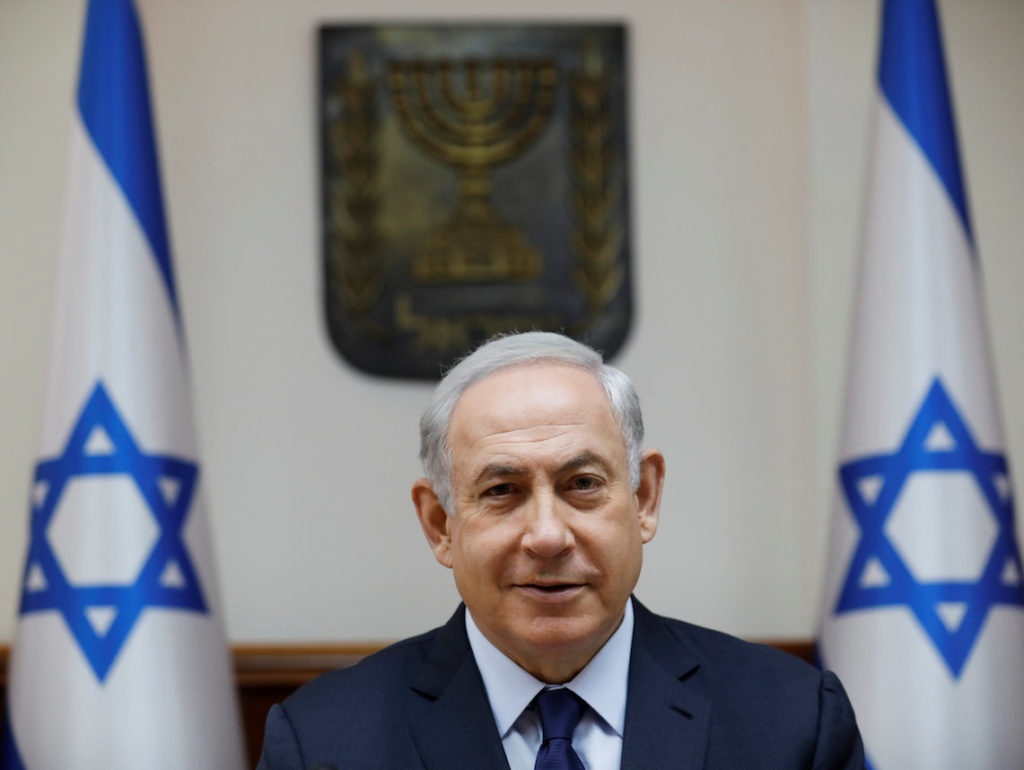
Benjamin Netanyahu is planning trips to Argentina and Mexico in September that would make him the first sitting Israeli prime minister to visit Latin America.

Netanyahu is scheduled to visit the region before flying directly to New York to address the United Nations General Assembly on Sept. 19, according to The Jerusalem Post. He would return to Israel for Rosh Hashanah on Sept. 20.

“Latin America has always been friendly to Israel, but I think we’re at a position where these relationships can be far, far, far advanced,” Netanyahu told President Jimmy Morales of Guatemala last fall.

The Jerusalem Post noted the trip would coincide with the 70th anniversary of the U.N. partition plan vote, when 13 Latin American and Caribbean countries were among 33 states that cast ballots in its favor, paving the way for Israel’s independence.

Israeli ties with Argentina have improved considerably since Mauricio Macri won the presidency in 2015.

The trip to Mexico also sends the signal that its abstention in anti-Israel UNESCO votes last year, as well as friction over a tweet Netanyahu posted regarding the efficacy of a U.S.-Mexico border wall advocated by President Donald Trump, are not hindering ties between the countries.

Brazil, Latin America’s largest nation and home to some 120,000 Jews, was left off the Netanyahu itinerary. Israel and Brazil tussled for a year over the former’s envoy choices.

“Political issues are internal problems, but if an Israeli prime minister comes to Brazil, he prefers that the government be stable because no delegation wants to present a project that after a month will change,” Yossi Sheli, Israel’s ambassador in Brasilia, told the Folha de S. Paulo newspaper on Sunday.

Brazil is experiencing high levels of unemployment and social instability.

Shell added that he believed the past two Brazilian presidents, Lula da Silva and Dilma Rousseff, “were against the State of Israel.”

Netanyahu plans to become first sitting Israeli prime minister to visit Latin America Read More »

A guide to the far-right groups that protested in Charlottesville

They believe the “white race” is in danger. They believe the United States was built by and for white people and must now embrace fascism. They believe minorities are taking over the country. And they believe an international Jewish conspiracy is behind the threat.

These are the people who were rallying in Charlottesville.

The “Unite the Right” rally Saturday saw hundreds of people on America’s racist fringe converge in defense of a statue of Confederate General Robert E. Lee and brawl with counterprotesters. The rally ended after a white supremacist, James Fields, rammed his car into a crowd of counterprotesters, killing one woman and injuring at least 19. Two police officers also died when their helicopter crashed while monitoring the rally.

The rally was the largest white supremacist gathering in a decade, according to the Anti-Defamation League, but it wasn’t the work of one extremist group or coalition. Spearheaded by a local far-right activist named Jason Kessler, the rally saw several racist, anti-Semitic and fascist groups, new and old, come together.

According to the Southern Poverty Law Center, which tracks hate groups, the rally included “a broad spectrum of far-right extremist groups – from immigration foes to anti-Semitic bigots, neo-Confederates, Proud Boys, Patriot and militia types, outlaw bikers, swastika-wearing neo-Nazis, white nationalists and Ku Klux Klan members.”

Many of the attendees, says the ADL’s Oren Segal, were young men who became radicalized on the internet and were not affiliated with any particular group. While some protesters belonged to the “alt-right,” a loose movement of racists, anti-Semites and nativists, others were part of older white supremacist groups like the Ku Klux Klan.

At the rally, protesters were seen carrying Nazi and Confederate flags, as well as signs with racist and anti-Semitic slogans. They chanted “Sieg heil,” gave Nazi salutes and shouted the N-word at passers-by.

“They really believe they have to save the white race, and to do that, they have to achieve some sort of white ethno-state,” Segal said. “They tend to be young, more frenetic in terms of their use of social media, while older more traditional groups like the Klan are in decline. Regardless of differences, it’s all the same hate.”

Here’s a guide to a few of the most prominent hate groups who showed up in Charlottesville.

Vanguard America

James Fields joined this relatively new fascist white supremacist group at the rally. On the homepage of its website, Vanguard America declares that “Our people are subjugated while an endless tide of incompatible foreigners floods this nation.”

The group trumpets the concept of “blood and soil,” an idea championed by the Nazis claiming that the inherent features of a people are the land it lives on and its “blood,” or race. In addition to opposing multiculturalism and feminism, Vanguard America’s manifesto calls for a country “free from the influence of international corporations, led by a rootless group of international Jews, which place profit beyond the interests of our people, or any people.”

According to the ADL, the group has posted dozens of fliers on campuses in at least 10 states. Its posters bear slogans like “Beware the International Jew” and “Fascism: The next step for America.” This year, the group defaced a New Jersey Holocaust memorial with a banner reading “(((Heebs will not divide us))).” Its signs at Saturday’s rally bore the fasces, a traditional fascist symbol depicting a bundle of sticks with a protruding axe blade.

Ku Klux Klan

One of the country’s oldest and most infamous hate groups, the Klan has primarily targeted black people, along with Jews, Catholics and other minorities. The KKK throughout its history has been responsible for lynchings, bombings, beatings and other racist acts of murder and abuse.

Group members have historically worn white hoods, to hide their identities and to mimic ghosts. Its leaders, including white supremacist activist David Duke, take on bizarre titles such as grand wizard and exalted cyclops.

The KKK was founded by Confederate veterans following the Civil War to harass black people, and at its height in the 1920s it had some 4 million members, according to the SPLC. An ADL report this year said the Klan has shrunk to about 3,000 total members spread across 40 groups in 33 states, mostly in the South and East.

“This represents a turning point for the people of this country. We are determined to take our country back,” Duke said in a video at the rally Saturday. “We’re going to fulfill the promises of Donald Trump. That’s what we believed in. That’s why we voted for Donald Trump, because he said he’s going to take our country back, and that’s what we got to do.”

Identity Evropa

A new group that affiliates with the alt-right, Identity Evropa seeks to promote “white American culture,” and also has posted fliers on college campuses. The group, which works with white supremacist pseudo-intellectual Richard Spencer, claims there are inherent differences among races and that white people are more intelligent than others. Identity Evropa sees itself as “identitarian,” a far-right European ideology seeking to reassert white identity.

The group supports a policy of “remigration” of immigrants out of the United States. Some of its posters bear the slogan “You will not replace us,” a chant that Charlottesville protesters paired with “Jews will not replace us.” Identity Evropa does not allow Jews as members.

League of the South

If the rally’s proximate goal was to preserve the statue of Lee in Charlottesville, the most obvious participants were the League of the South, a neo-Confederate group. The organization supports southern secession from the United States and “believes that Southern culture is distinct from, and in opposition to, the corrupt mainstream American culture.”

The group envisions a Christian theocratic government that enforces strict gender norms. It opposes immigration as well as Islam. League of the South defines the “Southern people” as being of “European descent,” calls itself “pro-white” and states that it “has neither been the will of God Almighty nor within the power of human legislation to make any two men mechanically equal.” Duke gave the keynote address at one of the organization’s gatherings this year.

According to the SPLC, the group founded a paramilitary unit in 2014.

National Socialist Movement

This one is pretty self-explanatory — America’s version of the Nazi Party. It is a white supremacist organization that would either deport “non-whites” — including Jews — or strip them of citizenship and subject them to a discriminatory regime (the group’s manifesto proposes both). The group is also anti-feminist and homophobic.

The National Socialist Movement idolizes Adolf Hitler, whom it says “loved and cared deeply for the average person.” Until about a decade ago, the group would protest in full Nazi regalia, which it has swapped out for black uniforms. Its crest features a swastika superimposed on an altered version of the Stars and Stripes.

A guide to the far-right groups that protested in Charlottesville Read More »

Alex Jones says Jewish actors posed as KKK followers in Charlottesville

Radio host, conspiracy theorist and Donald Trump supporter Alex Jones — who earlier this year ranted about a “Jewish mafia” run by billionaire George Soros — was at it again Sunday with a theory that “leftist Jews” may have impersonated Nazis to discredit white supremacist protesters in Charlottesville, Virginia.

Speaking on “The Alex Jones Show,” Jones recalled his own experience, he said, protesting the Ku Klux Klan:

I mean, quite frankly, I’ve been to these events, a lot of the KKK guys with their hats off look like they’re from the cast of “Seinfeld.” Literally they’re just Jewish actors. Nothing against Jews in general, but they are leftists Jews that want to create this clash and they go dress up as Nazis. I have footage in Austin — we’re going to find it somewhere here at the office — where it literally looks like cast of “Seinfeld” or like Howard Stern in a Nazi outfit. They all look like Howard Stern. They almost got like little curly hair down, and they’re just up there heiling Hitler. You can tell they are totally uncomfortable, they are totally scared, and it’s all just meant to create the clash.

As Jones explained in a video of his remarks video posted Saturday titled “ Virginia Riots Staged To Bring In Martial Law, Ban Conservative Gatherings.”

Media Matters first reported Jones’ comments about the rally goers.

White nationalists gathered Saturday for a “Unite the Right” march in Charlottesville, ostensibly to protest a plan by local officials to remove a statue of Robert E. Lee. There were clashes between the white nationalists and counterprotesters, and a 32-year-old woman was killed when a car driven by a man who espoused neo-Nazi views plowed into a group of counterprotesters.

In the past, Jones has denied that he is anti-Semitic, saying he reserves his attacks for Jewish liberals. In March, Jones said that “the Jewish mafia” was supporting efforts by moderate Republicans to “derail the Trump presidency.”

“Well there is undoubtedly a Jewish mafia and the [Anti-Defamation League] will say you’re anti-Semitic,” Jones said on his program. “No, there’s an Italian mafia, Irish mafia, Jewish mafia, Jamaican mafia, and there’s mafias, there’s Dixie mafia. And absolutely, the Jewish mafia, then, if you criticize it says you’re anti-Semitic, but the Jewish mafia is a very powerful mafia.”

In December 2015, Trump appeared on “The Alex Jones Show,” where the then-candidate for the Republican presidential nomination told the host that “your reputation is amazing” and promised he would “not let you down.”

Jones has been called out for spreading other conspiracy theories, including one claiming that FEMA wanted to put Americans in concentration camps, Vox noted. Southern Poverty Law Center fellow Mark Potok told Vox that Jones is the “primary producer of conspiracy theories in America today.”

Media Matters video from Alex Jones show

Alex Jones says Jewish actors posed as KKK followers in Charlottesville Read More »

Zen and the art of nuclear war

In the contest between crisis and calm, oy has an edge over om. Case in point: Just as I was giving meditation another try to take my mind off Donald Trump, the North Korea fire-and-fury horror show broke out, and Trump’s itchy finger on the locked and loaded nuclear trigger made my strategy for sanity look awfully iffy.

Even so, I’d rather be triggered to think about the risks of nuclear weapons, which don’t distract me nearly as much as they should, than be trolled by whatever random trash talk Trump tweeted 10 minutes ago.

Meditation is all about letting go of your thoughts. That’s hard enough to do for any of us whose attention is the plaything of stress about work and money, love and sex, sickness and sadness, not to mention unwanted desires, unbidden memories, undone to-do lists and other anxieties ad infinitum. Which is to say, just trying to kiss your ordinary, everyday thoughts goodbye is hard enough for all of us.

Now add all-Trump-all-the-time media to the mix, and the stress makes my head want to explode. Within hours of his nuclear saber-rattling, not only did he refuse to call out white supremacists, neo-Nazis and the Ku Klux Klan by name, he located them among “many sides,” setting up a moral equivalence between those thugs and the peaceful marchers
protesting those hate groups in Charlottesville, Va. His fake moral leadership 48 hours late only underscored how morally shrunken his own instincts are. What fresh hell is next? Each day’s news rubs our faces in how corrupt, deranged, deceitful, ignorant, impulsive and unfit for office the president is.

That surplus stress we’re under, the Trump news mental health penalty, piled on top of life’s usual worries and distractions, has hijacked my mindful attention, and maybe yours, since the election. Meditating regularly — not sporadically, as I’d lapsed into doing — seemed my best shot at escaping its clutches, short of moving to an ashram or bingeing on “The Bachelor.” But only a handful of days into resuming a daily meditation practice — boom! Armageddon is on the table and the end is nigh. Even for just 20 minutes at a time, try letting go of a thought like that.

The bright side, if there is one: The game of nuclear chicken Trump is playing with Kim Jong Un, despite its toll on our national nerves and its disruption of my try at zen, offers a teachable moment about something we’d all rather not think about.

When I was growing up, I was so crushed when my father showed little enthusiasm for building a cinder block fallout shelter in our cellar that I wrote to the Civil Defense Administration and received the how-to instructions in a self-addressed stamped envelope. His objection was cost, my father said; it’d be money down the drain, spent to protect us from something that was never going to happen.

Looking back, I suspect cost was a proxy for denial. Who could handle the truth about nuclear war? Our saltine-stocked refuge would have been incinerated instantly, along with our family, our house and every other family and house in Newark. Accepting the folly of protecting us from a Soviet H-bomb also would have required admitting the dementia of the duck-and-cover air raid drills my brother and I, like kids across the country, practiced at school.

Today, nine nations possess a total of nearly 15,000 nuclear weapons; the United States and Russia account for 93 percent of them. Protecting ourselves from them is as quaint a pipe dream now as it was during the Cold War. The consequence of those stockpiles: Three risks haunt the earth, and they might get the attention from us they deserve if denial weren’t our default way to deal with them.

The first risk is nuclear terrorism. The collapse of the Soviet Union created a black market in fissile material. Bomb blueprints are posted on the internet. The technology to build a bomb can be had for a few hundred thousand dollars. In former U.S. Defense Secretary William Perry’s nightmare, one nuclear weapon detonated on a truck in the heart of Washington, D.C., coupled with nationwide panic sparked by terrorist threats of more bombs in more cities, would bring America to its knees within days.

The second risk is a false alarm, like a spurious warning of an incoming missile attack, which would activate a launch-on-warning counterattack by the (un)attacked nation and a retaliatory barrage by the other. This is not a hypothetical example. In 1980, an alarm at the Pentagon’s Raven Rock Mountain command post in Pennsylvania warned that Soviet submarines had launched 2,200 nuclear missiles toward the U.S. It was caused by a malfunctioning computer chip that cost 46 cents. But no one knew that until only seconds before President Jimmy Carter would have ordered a massive counterstrike. Luck is not a plan.

The third risk is ego. Reckless leaders make escalating threats, masculine identity disorders run rampant, some accident happens — and the adults in the room are powerless to prevent a temper tantrum from blundering the world into millions of casualties. Macho histrionics get airtime and grab headlines, but what really warrants attention, expertise and public support today is the quiet, patient, backroom zen of negotiation, diplomacy and statesmanship.

Ironic, isn’t it, that what we most need now is for the art of the deal to trump Trump.

Marty Kaplan is the Norman Lear professor at the USC Annenberg School
for Communication and Journalism.

Zen and the art of nuclear war Read More »

Charlottesville’s Jewish mayor is an expert on demagogues, and now on anti-Semitism

Michael Signer, the Jewish mayor of Charlottesville, has one thing in common with the white supremacists who descended on his southern Virginia city over the weekend: He also opposed the removal of a statue of Confederate Gen. Robert E. Lee.

Of course, Signer’s reasons for preserving the statue would have appalled the supremacists: He agreed with local African-American activists who had argued that preserving the statue was a means of teaching Virginians about the horrors of a “dishonorable” cause, the Confederacy.

Signer was on the losing side of a 3-2 City Council decision, and the statue is now slated for removal. But his thoughtful approach, more typical of an academic than a politician, has also been evident in his counsel during the rash of protests that have plagued this city: “Don’t take the bait,” he has said.

In giving that advice, Signer has noted that for the first time in his life, he has been the target of intense baiting as a Jew.

“I can’t see the world through a black person’s eyes,” he said at a June 13 address at an African-American church, where he urged constituents not to give in to the impulse to counter hatred with hatred.

“I can see it through a Jewish person’s eyes; the KKK hates Jews just as much as they hate black people. The stuff with this group online about Jews is unbelievable, bloodcurdling. The stuff I’ve gotten on my phone at my house, you’d think it was done a hundred years ago.”

Signer, 44, a practicing lawyer in Charlottesville, also lectures on politics and leadership at the University of Virginia, his law school alma mater. His wife, Emily Blout, is an Iran scholar at the same university, which is located here.

An Arlington native, Signer is the child of journalists, but in his author’s autobiography sounds like many other younger liberal Jews who note with pride their grandparents’ working class and intellectual roots:

“My grandfather was a Jeep mechanic for the Army on the European front in World War II and lifetime member of the proofreaders’ union at the New York Times; he lost part of a finger in an industrial accident as a young man,” he wrote. “My grandmother organized seamstresses on her factory floor in New York City and later worked as a secretary to Hannah Arendt at the New School.”

In a January speech declaring Charlottesville “a capital of the resistance,” Signer described his grandfather as a “Jewish kid raised in the Bronx” who was “part of the forces that liberated the world from Nazism and fascism, that laid the groundwork for NATO and the Marshall Plan, and for a country that lived up to the promises of the Statue of Liberty. …

“If he were alive right now, I don’t think I could look him in the face and say Grandpa, I didn’t fight for the values you fought for.”

Before becoming mayor, Signer was known both for his activism in the senior reaches of the Democratic Party — he was national security adviser for John Edwards’ 2008 primary campaign — as well as his expertise on a subject that has received much attention recently, demagoguery. His 2009 book, “Demagogue: the Fight to Save Democracy from its Worst Enemies,” was well received.

The book examines successful demagogues left and right: Sen. Joe McCarthy, the 1950s anti-communist firebrand who plagued the American discourse, and Hugo Chavez, the late Venezuelan strongman and leftist, both come under scrutiny. In December  2015, before the presidential primaries, Signer predicted that Donald Trump could become a “singular menace to our Republic.”

Paraphrasing James Fenimore Cooper, Signer wrote then that Trump met all four criteria of an American demagogue: “they posture as men of the common people; they trigger waves of powerful emotion; they manipulate this emotion for political benefit; and they threaten or break established principles of governance.”

Without saying “I told you so” outright, Signer this weekend squarely blamed Trump for stoking the populist white nationalist fervor that culminated in the violence that took the life of one counterprotester, injured dozens of others and led to the death of two state troopers in a helicopter crash. The rally included Nazi flags, chants of “Jews will not replace us,” and shouts of “Jew” every time a speaker mentioned Signer’s name.

“Look at the campaign he ran,” the mayor said on CNN.

Signer elaborated on NBC’s “Meet the Press,” saying of Trump, “I think they made a choice in that campaign, a very regrettable one, to really go to people’s prejudices, to go to the gutter.”

Signer’s tactic has been to organize countering events that celebrate Charlottesville’s diversity, prompting Mark Pitcavage, the senior research fellow at the Anti-Defamation League’s Center on Extremism, to say on Twitter that Signer “gets it.”

Speaking in May on “State of Belief,” a radio show produced by the Interfaith Alliance, Signer said it was more productive to focus on the victim than the perpetrator.

“You’re trying to ease the pain of someone who’s been afflicted rather than focus on the harasser,” he said.

He also described the unfamiliar sensation of being in the position of the afflicted, barraged as he was with online assaults from anti-Semites as the Lee statue issue was put before the council.  One tweet, from the account of someone calling themselves Great Patriot Trump, read “I smell Jew. If so, you are going back to Israel. But you will not stay in power here. Not for long.”

“The wave of anti-Semitic attacks I’ve seen in the last week, it’s been a new experience for me, I’ve never seen that before,” Signer said. “Some of the nightmare historical tropes I thought had been retired after World War II” had returned as “more disturbing mashups of politics today and anti-Semitism.”

Charlottesville’s Jewish mayor is an expert on demagogues, and now on anti-Semitism Read More »

We know what we stand for; it’s time to say it

The image of a poster from the “Unite the Right” rally in Charlottesville this past weekend sent chills down my spine.

It reminded me of what I saw at a museum in Berlin over the summer: propaganda from the 1930s and 1940s designed to inspire hatred towards Jews and other non-Aryan peoples. News coverage of the march in Charlottesville led me to recall the terrifying photographs of Nazi rallies and book burnings that led ultimately to much greater violence and evil.

In the face of hatred, bigotry, racism, anti-Semitism and indifference, we must respond forcefully by expressing vigorously and unapologetically the values we cherish most deeply.

Our sages understood this well. They repudiated this type of hatred and xenophobia two thousand years ago. Our rabbis asked why God chose to create humanity through a common ancestor.  Answered our teachers: “For the sake of peace among all peoples so that no person can say to his friend, ‘My father is greater than your father.’” (Sanhedrin 37a)

From the perspective of our tradition, racism is a grave sin and an offense not just against humanity but, ultimately, also against God. Our rabbis condemned it unconditionally. We must do so as well and we must demand the same moral clarity from our leaders today.

For now, white supremacists and neo-nazis constitute a tiny minority of our great nation. Here is what must be remembered: a nation’s greatness is demonstrated ultimately by the values it upholds.

As Jews and as Americans, we know what we stand for. It’s time once again, unequivocally and proudly, to say so.

Rabbi Yoshi Zweiback is senior rabbi at Stephen Wise Temple.

We know what we stand for; it’s time to say it Read More »

Can the Trump administration prevent another Gaza war?

Within a span of six years, Israel and Hamas have fought three bloody resulting in thousands of casualties. Gaza remains one of the most sensitive and explosive areas dividing Israelis and Palestinians. A senior Israeli military official noted in April that the severe electricity crisis facing Gaza may lead to an imminent clash. With the Trump administration announcing last week that it will send top advisors to the region once again to secure the “ultimate deal,” the question remains what is the most effective U.S. policy to prevent a fourth Hamas-Israel war and alleviate the humanitarian crisis in Gaza?

[This story originally appeared on jewishinsider.com]

“If the administration’s concern was the plight of Gazans then there would and should have been some pushback when (Palestinian President Mahmoud) Abbas decided to cut off funding for the electricity,” explained Grant Rumley, a researcher at the Foundations for the Defense of Democracies (FDD). Power in Gaza has declined to approximately four hours a day after the P.A. reduced fuel payments to the impoverished enclave. Palestinian leadership in Ramallah has decided that it no longer wishes to subsidize Hamas’ rule in Gaza. “The IDF comptroller report pointed to the humanitarian disaster in Gaza as a key factor in why the 2014 war happened and by any measure the humanitarian crisis is worse today,” Rumley added.

Alan Dershowitz, former Harvard University Professor of Law, called for a hawkish U.S. approach towards Gaza. “The policy should be to see the destruction of Hamas and see the people of Gaza wanting to associate themselves with the peace camp and the Palestinian Authority,” he said. While some analysts call for U.S. pressure on Israel to ease the economic burden of Gaza, Dershowitz rejects those arguments. “I don’t think the U.S. should be helping Gaza economically since every time they have been given resources, they have diverted it to terror tunnels and rockets,” he emphasized.

In addition to the electricity crisis, the economic conditions in Gaza continue to deteriorate. For young adults in Gaza, unemployment has spiked to almost 60 percent and around 70 percent of residents rely on international humanitarian organizations to survive. Despite relative calm, Palestinians have fired at least seven rockets into Israel from Gaza this year.

A White House official told Jewish Insider on Sunday, “The United States continues to look for ways that we can lawfully expand our assistance to the people of Gaza and alleviate their suffering.  When we have more concrete details to provide, we will do so.”

Rumley, who recently co-authored a biography of Abbas, remains skeptical of the White House’s efforts. “Do they (the Trump administration) have a vision of what role Gaza plays in whatever this peace process is or what to do with Hamas writ large, I don’t think they do,” he explained. Khalil Jahshan, Executive Director of the Arab Center Washington, DC, noted, “Let’s assume that this administration succeeds in initiating a negotiated process: They need that segment of Palestinian society (Gaza), approaching two million people, to participate in the process. To keep them out would be asking for subverting the process itself.”

Brent Sasley, Professor of Political Science at the University of Texas and an expert on Israeli politics, emphasized that given Gaza’s complexities, the Trump administration should “bring career civil servants and diplomats more deeply into the policy process” who have “experience dealing with all sides.” With the economic despair deepening, Sasley recommended that Washington “Put more pressure on Netanyahu to open up fishing and farming space in Gaza,” while working with U.S. allies to increase aid into the impoverished enclave.

Can the Trump administration prevent another Gaza war? Read More »

Natan Sharansky, Naftali Bennett condemn anti-Semitic and racist hate at Charlottesville rally

Natan Sharansky, the chairman of the Jewish Agency for Israel, and Diaspora Affairs Minister Naftali Bennett condemned a white supremacists’ rally in Charlottesville, Virginia, and the deadly attack on a counterprotester.

Sharansky, whom many Jews in Israel and beyond consider a champion of human rights and liberties, in a statement Monday wrote that he was “horrified by the death of a protester at the hands of one of the marchers.”

“There is no place for such hate speech or violence in any democratic society,” he wrote, “and I am confident that American authorities will do everything in their power to bring the perpetrators to justice.”

Ahead of a rally Saturday by far-right activists in Charlottesville, a supporter of neo-Nazis drove a car into a crowd of counterprotesters, killing one and injuring at least 20.

Sharansky, a famed political prisoner of the Soviet Union for his Zionist activities, also said he was “deeply concerned” by the expressions of anti-Semitic hatred in Charlottesville, including against its Jewish mayor, Michael Signer, as well as “other forms of racism and hatred.”

Bennett, a right-wing politician from the Jewish Home party, which is a coalition partner of Prime Minister Benjamin Netanyahu’s Likud, published a statement on Sunday that criticized the expressions of hatred at the far-right gathering. His statement also appeared to reference the absence of a condemnation by President Donald Trump targeting the far right specifically after the attack.

“The unhindered waving of Nazi flags and symbols in the U.S. is not only offensive towards the Jewish Community and other minorities, it also disrespects the millions of American soldiers who sacrificed their lives in order to protect the U.S. and the entire world from the Nazis,” Bennett wrote in the statement, adding “The leaders of the U.S. must condemn and denounce the displays of anti-Semitism seen over the past few days.”

Natan Sharansky, Naftali Bennett condemn anti-Semitic and racist hate at Charlottesville rally Read More »

Interfaith L.A. vigil decries Charlottesville hate march

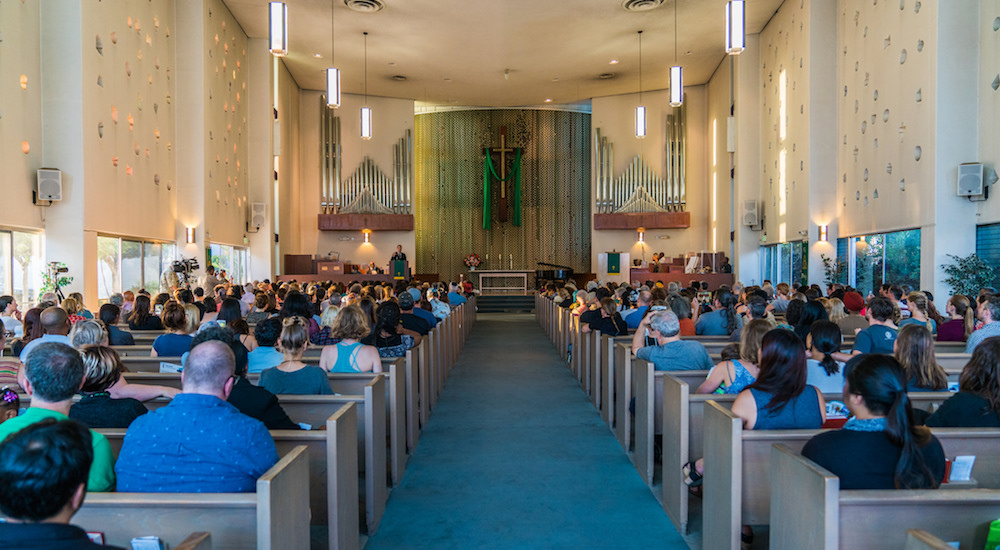
A diverse crowd of several hundred Angelenos filled the pews of Holman United Methodist Church in mid-city to condemn white nationalist violence rocking the streets of Charlottesville, Virginia.

A collection of the city’s faith leaders and faith-based organizations banded together Aug. 13 to organize the “Love Transcends Hate” interfaith prayer vigil. Local congregation IKAR, whose Miracle Mile area sanctuary sits just across the 10-freeway from Holman’s, was one of the co-sponsors for the event.

Holman Pastor Kevin Sauls welcomed guests, including dozens of Jews in attendance, explaining that a national conference call with Christian leaders the day prior sparked the idea to hold vigils across the country. He and others reached out to a citywide base of interfaith leaders and organized their own event in under 24 hours.

“The coming together of our faith leaders, elected officials and all of you sends a powerful message,” he said, surveying the packed church. “It says that truly love is more powerful than hate.”

Mayor Eric Garcetti and Councilmember Marqueece Harris-Dawson looked on from the front row. IKAR Rabbi Sharon Brous sat next to Mayor Garcetti.

After Pastor Saul’s opening remarks, a troupe of Holman women in colorful dresses adorned with ringing chimes danced on stage and through the aisles. A lively drumbeat accompanied the performance as guests clapped along. An organ player and the Holman choir also led the audience in a rendition of “Ain’t Gonna Let Nobody Turn Me Around”.

Speeches from elected officials and faith leaders followed. Rabbi Brous delivered a brief speech that referenced Israel’s ancient port city of Jaffa, which neighbors Tel Aviv.

“[Jaffa] is a place where Jews and Christians and Muslims, Israelis and Palestinians, secular and religious all find a way to live together as equals in harmony, which is very challenging for many people in a region that’s seething with polarization,” she said. “A few years ago a group extremists came to sow division and hatred in this precious town and to break the delicate balance. But the citizens of that town stood together, arm in arm, blocking the arteries and shouting, ‘Hell no. Not in this place. We reject your violent rhetoric. We reject your racist screed.’ They created a sanctuary of love and justice, which is precisely what we are here to do today across this nation.”

Councilmember Dawson, who is African-American, shook his head in disbelief after Brous’ speech.

“Only in Los Angeles does the rabbi come in to a black church and preach like nobody’s business,” he said, eliciting laughs from Jews and many of Holman’s African-American congregants.

In his speech, Mayor Garcetti, who had just returned from a weekend in New Orleans holding meetings with mayors of other major American cities, took digs at the Trump administration for not placing sole blame on white supremacists for the troubling events in Charlottesville. He directly addressed President Trump’s comments made during a recent press conference in which the president doled out blame to “many sides” for the “hatred, bigotry and violence”.

“There is still, I believe, good and bad, right and wrong, truth and lies,” Garcetti said. “There are not always two sides to a story. To my fellow ancestors who died because they were Jewish, there wasn’t another side to the story.”

Yalley Beth Shalom Rabbi Noah Farkas, Temple Beth Hillel Senior Rabbi Sarah Hronsky and Jewish attorney Wendy Heimann, who co-founded “RiseUp LA”, a grassroots sociopolitical movement committed to protecting progressive values, also spoke.

Farkas, who was one of the event’s organizers, delivered  closing remarks. He told the assembly that, “the best way to respond to organized hate is with organized love.”

38-year-old Adam Overton, a young religious leadership fellow at Clergy and Laity United for Economic Justice (CLUE) who attended and wore a yarmulke, said Holman was the perfect setting for the vigil.


Photo courtesy of L.A. Mayor’s office.

“It was very special to be with everybody in the space and to just really feel the power of Holman United Methodist Church, which is really a ground zero for a lot of social justice in Los Angeles,” he said. “I found myself feeling really connected to the history of social justice throughout this country.”

Leonard Muroff, a community rabbi who mainly specializes in hospice care, wore a blue Dodgers shirt with “Dodgers” spelled out in Hebrew. He will be traveling to Virginia Tech University’s Hillel next month to help out with High Holy Day services. The Blacksburg, Virginia campus is about a two and a half hour drive from Charlottesville.

“I will be there standing with those against hate,” he said. “Hearing the mayor tonight was very instructive. I just want to bring strength and love and peace to Virginia when I’m there.”

Interfaith L.A. vigil decries Charlottesville hate march Read More »