
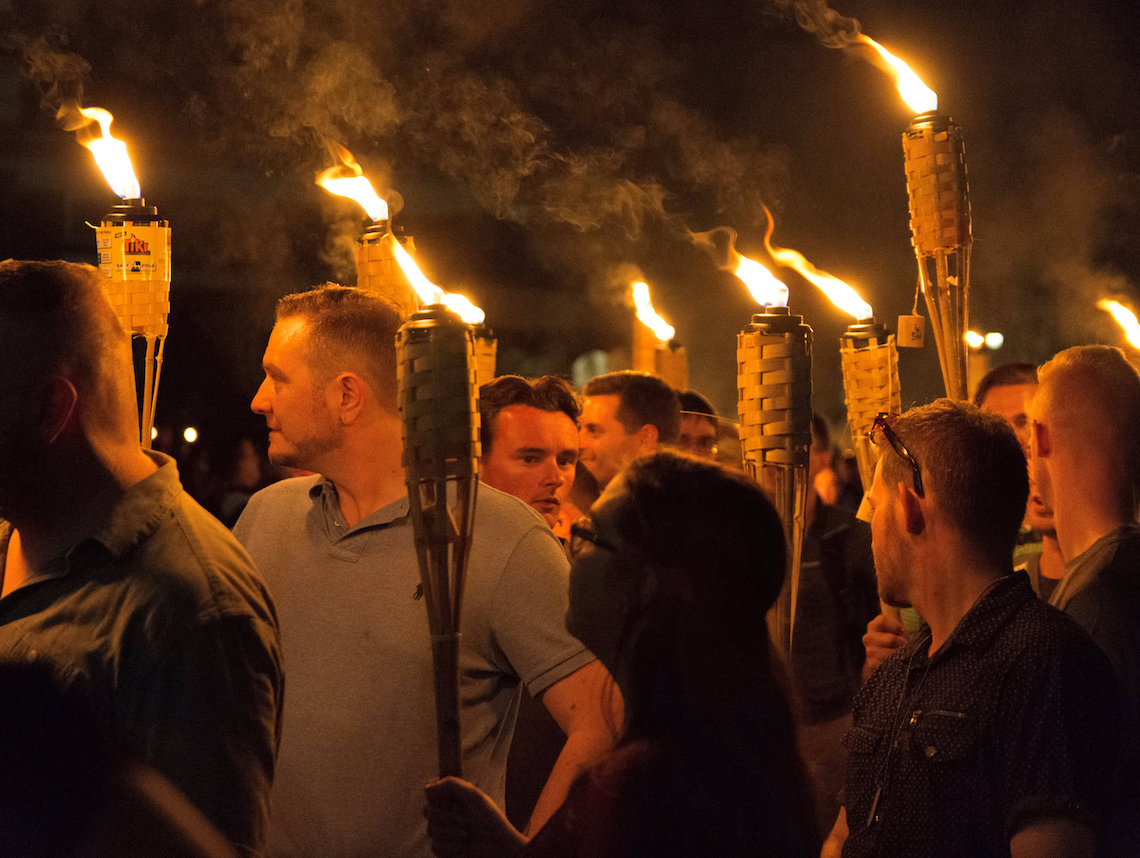
After 20-year-old James Alex Fields Jr. drove his car into a crowd of peaceful protestors in Charlottesville, Virginia, over the weekend, his former high school teacher Derek Weimer reported that his student had been fascinated by the Nazis at school. Weimer’s classroom was not where Fields’ fascination began, but where he was able to express himself openly and publicly with pride. The Second World War and the entire period of Nazi power was indeed fascinating, but Weimer realized that Fields’ interests lay in a deeper and darker place.
Weimer touchingly confessed that once he knew of Fields’ leaning towards white supremacy, and did not manage to dissuade him from his unhealthy interest in the Nazis, that he “failed” as a teacher. In fact, we failed Weimer.
Our society has had such a focus on the threat from extreme Islamist terrorism, that white supremacy has been portrayed like some tribute band, reprising dated covers with no contemporary threat and little relevancy. So much so, the leadership of its ideological cousin, the so-called alt-right, festers in the White House, veering policy down a dangerous path, enabling the far right to believe they can unite. Unite the Right, the alt-right, and James Fields share the same ideological DNA. It is an ideology that is always exclusive and ultimately violent. The labels we use for the various strands of far right groups mislead us. White supremacy, alt-right, neo-fascist, neo-Nazis: There is nothing alternative or new about them. They are self-declared fascists drawing directly from the well of a genocidal past. To term current-day Nazis as “neo-Nazis,” when in fact they themselves want to emulate the actions of Hitler and consider themselves to be Nazis, is to delude ourselves about their intent and the threat they pose.
Currently, eight states have laws on the books that mandate the teaching of the Holocaust and genocide. Of those, only five have a state commission or task force to keep genocide education comprehensive and up to date. No states mandate the provision of resources to support teacher education in this subject or the kind of mentorship that would have benefitted Fields’ high school teacher.
To prevent more students treading this dangerous path requires a concerted effort among the U.S. Department of Education, state education boards, school districts, and the many private sector organizations that teach about the Holocaust and the prevention of racism and discrimination. There needs to be support for intervention when a teacher notices a student in a dangerous situation.
The reason we teach about the Holocaust is because hatred as expressed by Nazi ideology is not abstract history. It has real, ongoing power that can rapidly manifest in violence at any time. We do not teach it to engage students in morbid fascination, but to alert them, to prepare them, and to provide them with tools to resist this kind of evil.
A high school recently called USC Shoah Foundation because its football team greeted members of the opposing team who were Jewish with the “Heil Hitler” salute. The school leaders could have ignored it, but in seeking help, they were able to work with a well-equipped organization. The students were brought together and the issue was worked through. With a safe context and expert support, the gap was closed, and students got to know each other as people, not as stereotypes. It took some time and was a difficult process, but hate was taken out of the situation and replaced with respect.
We need to worry about what we have seen in Charlottesville. This is not the last we will see of the far right. But if we really want to prevent such violence, we need to invest in our classrooms. Otherwise, there will be many more James Fields in the future.
Stephen D. Smith is Finci-Viterbi Executive Director of USC Shoah Foundation.