You can’t miss it as you drive down Melrose Avenue in West Hollywood — a trio of angular, glass-façade buildings in blue, green and red. It’s the iconic Pacific Design Center, the home of nearly 100 showrooms for furniture, textiles, wall coverings, and kitchen and bath products.
But unless you’re an interior design professional, the Pacific Design Center, at 8687 Melrose Avenue, can seem like an impenetrable fortress where everyday people enter upon pain of death — or at least face withering stares.
It is true that, officially, the showrooms are open only to members of the design trade. But nonprofessionals looking to furnish or remodel their homes can, in fact, browse for inspiration and, in certain cases, make purchases. You just have to know the inside scoop.
Anyone can enter the building
The design center’s “Blue Whale” building, where most of the showrooms are located, is open to the public. At the main entrance on Melrose, you can walk right in. No one will ask for your identification or the reason you are there. After all, the building houses public spaces such as restaurants, a screening room and even temporary art exhibitions.
Going into showrooms
Individual showrooms have varying policies regarding nontrade professionals. Some allow individuals to enter only when accompanied by an interior designer. Others will allow you to enter alone as long as you carry a letter of introduction from a designer. From my experience, despite the official policies, most sales representatives in the showrooms do not check for any qualifications and will allow anyone to walk in and browse.
Making purchases
While you generally can browse all you want, making purchases is another matter. Technically, the way the showrooms work is that a design professional buys a piece at a trade discount and then sells the item to you with a price markup. But those who aren’t working with a designer can take advantage of the design center’s Consulting & Buying Services program, which enables people to purchase a limited number of items at a trade discount plus an administrative fee. Find out more about the program at the concierge desk in the lobby.
Understanding pricing
A key to walking into a showroom and looking like you know what you’re doing is understanding how pricing works. The price displayed on an item generally is the retail price, not the trade price. The trade discount varies by showroom, so you need to ask what the “net” price is — that’s the lingo for the trade price.
Some showrooms do not use prices, and instead display a code such as 1355/60 that only designers understand. The secret to deciphering this code is the “5/10 rule.” You subtract $5 from the number before the slash and 10 cents from the number after. So 1355/60 actually translates to $1,350.50. And if this is the list price, and the trade discount is 50 percent, then the net price would be $675.25.
Ask to see a catalog
If a particular piece of furniture in a showroom interests you, but you aren’t finding exactly what you’re looking for, ask to see a product catalog. Because not everything is on display, showrooms have binders full of their collections you can peruse, and you’ll also find out what fabrics and finishes are available.
Taking photographs
Some showrooms do not allow photography, so ask before you take any snapshots. Better yet, showrooms usually can give you “cut sheets,” or spec sheets of products that include a photograph and dimensions.
Dress appropriately
In this pantheon of style, you need to dress accordingly. The design center is one of the few places in perpetually casual Los Angeles where you still need to dress to impress. Up your fashion quotient when you enter, and you will be taken more seriously.
Parking the car
Since this is Los Angeles, the question before going anywhere always is, “Where do I park?” The entrance to the Pacific Design Center parking garage is on Melrose just east of San Vicente Boulevard. The first 20 minutes are free, and it’s $1.50 for each 20 minutes after that. There is also a West Hollywood municipal parking lot across the street on San Vicente where the first hour is free.
Jonathan Fong is the author of “Walls That Wow,” “Flowers That Wow” and “Parties That Wow,” and host of “Style With a Smile” on YouTube. You can see more of his do-it-yourself projects at jonathanfongstyle.com.
Last November, Joey Maya Safchik, 18, a senior at Charter High School of the Arts in Van Nuys, gathered some of her closest theater friends in the living room of her Tarzana home.
They sat on the floor, ate popcorn and read through one of Safchik’s favorite plays, “Dog Sees God: Confessions of a Teenage Blockhead.” Bert Royal’s racy dramedy, which ran Off-Broadway in New York a decade ago, finds Charles Schulz’s Peanuts gang in the halls of high school dealing with sex, drugs, suicide, bullying and LGBTQ issues.
Safchik knew the play was good but, after studying productions on YouTube, she also knew that much older actors typically played the teen roles. After the reading, she sensed that her young cast could pull it off onstage.
“We just thought, let’s do it as a play,” Safchick recalled recently at a Sherman Oaks cafe.
Seated beside her, 30-year-old Jonah Platt, a West Hollywood-based actor and older brother of Tony Award-winning Ben Platt, beamed like a proud parent.
“That’s the cutest thing I’ve ever heard,” he said, hearing Safchik recount the reading for the first time.
Soon after the living room session, Safchik and three close friends created Worst First Kiss Productions, a socially conscious theater company run by teens for teens. They acquired the rights to put on Royal’s play, raised $3,000 and staged a few performances over a February weekend at the Blank Theatre in Hollywood.
Half of the funds came from a Jewish Federation of Greater Los Angeles program called “The Teen Innovation Awards,” which supports teen ventures that educate and enrich the Jewish community. The program also connects participants with adult mentors like Platt.
After getting paired with Safchick as her mentor, Platt came to the final performance in February and said he saw potential.
“I got to see everything these kids were bringing to it, but I also got to see everything that wasn’t there yet,” Platt said. “I knew exactly what to do. That really meant digging deeper into the subtext, the character relationships and the individual arcs of the show.”
Platt, who previously played Fiyero in “Wicked” on Broadway, agreed to direct the teenagers, replacing the original director. The transition went smoothly, said Safchick, who plays the character based on Sally, Charlie Brown’s sister, in the production.
As rehearsals with Platt began, he instantly breathed new life into the work, said James Sanger, 19, an Oakwood School alum who plays Beethoven, based on the piano-playing “Peanuts” character Schroeder.
“The more we did this play and the more we worked with Jonah, we found more and more places that could get better,” Sanger said.
The young people’s production company staged six sold-out performances during a two-week run in June as part of the Hollywood Fringe Festival.
“We had to turn people away, and I even had to boot my mom out of one,” Safchik said. “She’d already seen it several times, though.”
Coming off the success of that run, the group has scheduled additional shows at the Blank Theatre on July 15, 16, 22 and 23. Worst First Kiss Productions has been donating 15 percent of ticket proceeds to the Genders & Sexuality Alliance Network — formerly the Gay-Straight Alliance. So far, the company has raised $800.
A central storyline of the play is the Charlie Brown character’s questioning and exploration of his sexuality. Safchik believes that performing the play with a cast of teenagers, some of whom are gay or bisexual, can help bring into the open certain topics that are taboo for their age group.
“Part of our company’s initial mission was to choose works that are socially relevant and that we can easily connect to issues that teens face on an everyday basis — and that we see our friends struggle with, especially in school,” she said. “This play really focuses on LGBTQ tolerance and inclusion. I think putting this onstage will really help to remove the stigma of some of these issues. It helps to have young people like us playing the roles too.”
The play is normally performed by older actors in their mid- to late 20s. In fact, Royal, the playwright, has discouraged younger actors from attempting the raunchy, adult-themed material since it premieredat the New York International Fringe Festival in 2004.
At Platt’s invitation, Royal attended one of the June performances and said he was impressed.
“Seeing your beautiful production of the play yesterday made me realize that — in the right hands — this play SHOULD be performed by younger actors,” he said in an email to Platt. “Granted, IF they are as insightful and nuanced and talented as your lot are.”
“I was crying in a restaurant when I read it,” said Safchik, who plans to study journalism at Northwestern University this fall. “I printed it out.”
“Dog Sees God: Confessions of a Teenage Blockhead” will be performed beginning July 15 at the Blank Theatre. For more information, visit http://wfkdogseesgod.brownpapertickets.com.
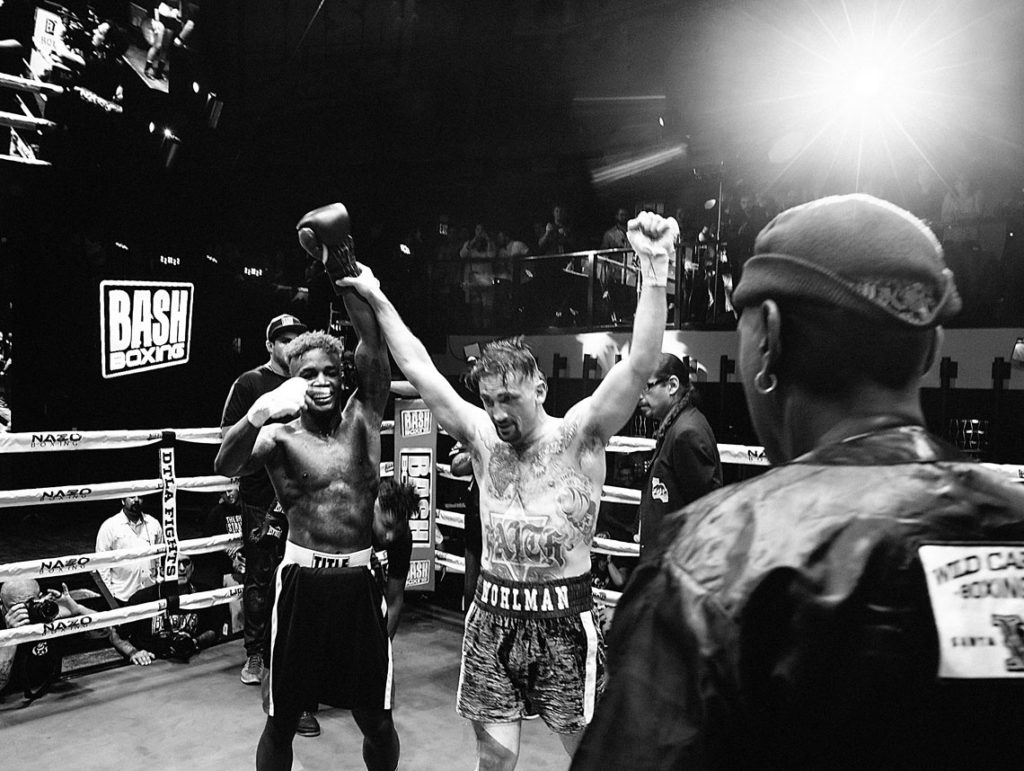
On a recent Thursday night downtown at the Exchange LA, Zach Wohlman, aka “Kid Yamaka,” stood at the center of a boxing ring, awaiting the decision.
He was ready to be declared the winner, he told the Journal later, but the judges felt otherwise, ruling the June 22 match against Matt Murphy a draw. The crowd booed loudly, Wohlman remembers, and he put his hands to his head in shock.
Still, he knew that just getting back in the ring was a victory, considering the dramatic roller-coaster ride he’d taken the past few years.
Wohlman, 29, grew up in the San Fernando Valley. He started boxing while in military school, where he was sent as a teenager. He fell in love with the sport shortly after, finding in it a discipline through which he could funnel frustrations from a difficult childhood.
His work ethic and ring smarts were noticed by Boxing Hall of Famer Freddie Roach. With Roach’s help, Wohlman won L.A.’s Golden Gloves amateur competition by age 20 in 2009. A year later, he turned pro as a welterweight, and has since won 10 of his last 14 fights, two of them by knockout. But fierce as he is, vanquishing his inner demons has proved difficult.
Two years ago, after breaking his jaw while sparring at the gym, Wohlman developed an addiction to OxyContin — a common hazard for fighters. Last summer, he said he was “at the end of his rope.”
The ups and downs of addiction were wreaking havoc on his friendships. A fight scheduled for last August was canceled when he told his coaches he wasn’t ready. In the past, Wohlman had used daily prayer to help him stay sober. Now, he said, he asked, “God, remember when we were friends?” He had every intention of getting clean but couldn’t seem to get off the merry-go-round.
He has now been clean and sober for more than 4 1/2 months.
In a macho sport, one’s cultural background is not just a factor — it’s a point of distinction. When his coaches learned he was Jewish, the first thing they thought of is a yarmulke, which is how Wohlman’s nickname came about. Though he is not devoutly religious, Wohlman is proud of his Jewish background — a large Star of David tattoo covers most of his abdomen and several other stars adorn his boxing robe. Two of his grandparents were Holocaust survivors, and he holds on to his identity with the awareness that “there aren’t that many of us left.”
Other than Wohlman, there appears to be only a handful of other Jewish professional boxers active in the United States. A dearth wasn’t always the case. From the late 1920s until the end of World War II, dozens of Jews went into boxing as a way to make money at a time when the doors to higher education were closed to them. Between 1910 and 1940, there were 26 Jewish world champions, according to Allen Bodner’s “When Boxing Was a Jewish Sport.”
Wohlman loves investigating that history. Last summer, he carried around the comic book “The Boxer” by Reinhard Kleist, a true story of a Polish Jew who was forced by SS officers to fight while imprisoned at Auschwitz. He went on to become a professional boxer in the U.S. in 1948 just as Jewish boxers were leaving the sport.
Wohlman said he finds a source of strength in “seeing the struggle that the people of my blood line have gone through.” Bar mitzvahed at the age of 20 at the addiction treatment center Beit T’Shuvah, where he sought treatment for drugs and alcohol, he said he likes the ritual of slowing down on Shabbat. But since leaving Beit T’Shuvah, he said he has been unable to find the right place or a community in which to spend Shabbat.
If anything, boxing itself is his spiritual practice.
“Being present, being in the moment, for three minutes at a time [in boxing rounds], you can’t buy that type of self-awareness,” he said. “That adrenaline, you can’t match it.”
Although Jews in the early 1900s found boxing as a way around closed doors, for Wohlman, it worked the other way around. Boxing has opened up a world of new opportunities.
A young filmmaker, intrigued with Wohlman’s talent and gift for quotable phrases, created a short film titled “Kid Yamaka,” which captures his hardscrabble past and the nuances of his relationship to a violent sport. In the film, director Matt Ogens interweaves Judaism and boxing using visual metaphor, cross-cutting the wrapping of Wohlman’s fists before a fight with images of him binding them with tefillin.
The 14-minute film was used to sell an eight-part TV series centered on Wohlman. Shot in the spring, the series follows Wohlman around the world, meeting professional fighters in far-flung places, positioning Kid Yamaka as a sort of “Anthony Bourdain of fighting,” Wohlman said.
The series, called “Why We Fight,” also reflects Wohlman’s personal journey. As he connected with fighters in Cambodia and Mongolia, helping to relay their stories, he also squared off against himself, his addiction and his past. The docu-series will be out this fall on Complex’s Go90. In addition, Wohlman is writing articles for Vice online.
And as for boxing — he’s already training for his next fight.
AMIE SEGAL is a documentary producer living in Los Angeles.
Sporting a black hat and a long, black beard in a Sherman Oaks backyard, Alex Klein raised the Havdalahspices to his nose to consecrate the passage from Shabbat into a new week. Taking a whiff, he let out a whoop: The small silver container held a pungent helping of cannabis.
Klein led the blessings for “Chai Havdalah,” a cannabis soiree signaling an increasing openness toward the plant in the Jewish community and beyond. For the cost of a $36 ticket, guests sampled catered courses of cannabis-infused cuisine and tested the wares of weed entrepreneurs, all the while passing around as much pot as they could smoke.
When Klein and his wife, Shifra, arrived at about 9:30 p.m. July 8, the party was in full swing, enveloped in a pungent cloud. Unlike the mostly nonobservant Jewish attendees, the pair, Chabad devotees, were late because they needed to wait to turn on their phone and get in a car — and, of course, to use a lighter.
“You know what I’ve been doing on the way over here,” Klein joked over the PA system as he worked the crowd during the Havdalah service.
As soon as the Kleins extinguished the ritual candle in a saucer of wine to conclude the rites, a softcore reggae band picked up where it had left off, moving harmoniously from a Jewish hymn, “Od Yavo Shalom Aleinu,” to the stoner classic “Pass the Dutchie.” Meanwhile, guests picked at platters of pastries provided by the Kleins, who together run Mitzva Herbal Co., which touts Orthodox Union certification. A party subcontractor, Venice, Calif.-based WeedBar LA, used electronic bongs to serve up concentrated marijuana.
The event exists in a legal gray area, according to Catherine Goldberg, the marijuana marketer and entrepreneur who organized the event. All cannabis products used were donated by growers and producers, so guests only paid for the music, snacks and atmosphere.
“People are welcome to come and consume whatever they want, but there’s no financial transaction,” Goldberg said.
She decided to host the event after moving to Los Angeles about a year ago and attending a number of weed gatherings. Simultaneously, she started to notice a profusion of Jews in the weed industry.
“Jewish people are anxious and weed helps with anxiety,” she said. “I knew it just went together perfectly.”
Goldberg, who grew up attending a Reform synagogue in Miami, said she’d attended only one Havdalah service before, but felt the event would be a good chance to bring together Jewish cannabis enthusiasts and showcase local entrepreneurs like the Kleins. She said she plans to host Chai Havdalah on a seasonal basis, and also to launch smaller, more intimate “Chai Shabbat” events for Friday evenings.
With tickets available on Eventbrite.com, many of the 50 or so guests who attended Chai Havadalah found it online, or otherwise through the local cannabis community, and came to network or to let loose.
Maddy Le Mel, a 75-year-old Jewish mixed-media artist whose work appears in galleries around Los Angeles, came with two Jewish friends, also 75.
Le Mel said that when she started smoking cannabis 40 years ago she couldn’t have imagined one day attending a publicly advertised event where consenting adults came together to get legally stoned. “Never thought it was going to happen,” she said.
She found the party to be a welcome reprieve from her home life, where she deals with her husband’s dementia and other family struggles.
“These girls were like, ‘Let’s just bust out!’ ” Le Mel said. “I just want a really light, fun time, because my life is heavy.”
One of her friends, who also has a husband with dementia, chimed in solemnly: “My husband does not know I’m here.”
“This a very odd experience,” added the third woman.
Both of Le Mel’s friends declined to give their names, worried it could impact their licenses to practice as psychotherapists. Each started smoking within the past year to relieve chronic pain.
The evening’s chef, Holden Jagger, said the party was the first legal Jewish cannabis event he was aware of. He prepared two weed-infused loaves of challah and spiked chocolate baba ghanoush, along with non-psychoactive brisket, latkes and double-fried kugel.
Jagger, 33, a graduate of a local Jewish day school, the Wise School, co-founded a cannabis catering service, Altered Plates, with his sister Rachel after leaving a more conventional culinary career that included a stint as the pastry chef of Soho House in West Hollywood. Before the switch, he worked under the name Holden Burkons; he now uses his middle name as his last.
During his journey into the world of cooking with cannabis, Jagger has come across a good number of Jews — although never before gathered to partake in a Jewish ritual. He hoped to cater other such events in the future.
“I’m excited to do more,” he said. “I don’t know what it is, but there’s a lot of Jews in the cannabis industry. We tend to like cannabis quite a bit.”
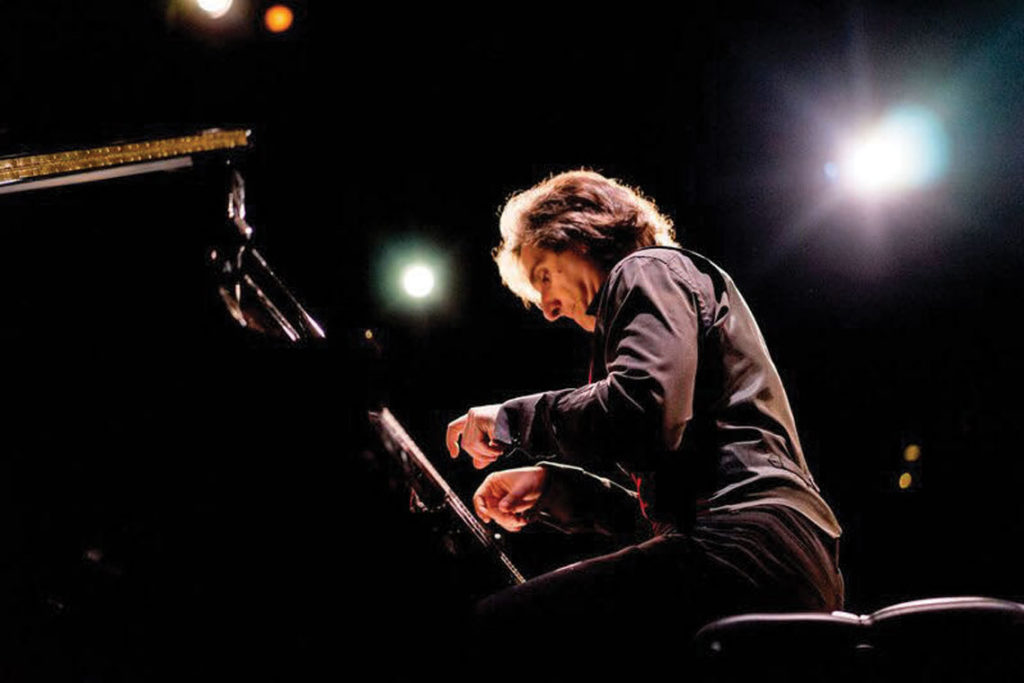
Hershey Felder, who has brought to life onstage the world’s great classical and popular composers — from Beethoven and Chopin to George Gershwin and Irving Berlin — is bringing to Los Angeles the soaring music and tormented life of Pyotr (Peter) Ilyich Tchaikovsky.
Felder’s talents and skills as a pianist, actor, playwright, composer and producer will dominate the Wallis Annenberg Center for Performing Arts stage in Beverly Hills from July 19 to Aug. 6 in the concert-play “Our Great Tchaikovsky.”
The production will be a homecoming of sorts for the Canadian-born Felder, 49, who started his series of interpreting great composers some 22 years ago in L.A.
Audiences will get a generous sampling of the Russian master’s works, from such favorites as the “1812 Overture,” “Marche Slave,” selections from “The Nutcracker” and “Swan Lake,” as well as the little-known “Jurisprudence March.” Also on the program are parts of the Fourth, Fifth and Sixth symphonies, “Romeo and Juliet,” “Eugene Onegin,” and the first movements of the Piano and Violin concertos.
But beyond the music in his one-man show, Felder explained in a phone interview, he aims to create, or re-create, the character of his protagonist and, in this case, illustrate the process of “becoming Tchaikovsky.”
Before embarking on this complex creation, Felder and his associates spent 18 months researching the many aspects of the composer’s life (1840-1893) as well as the political atmosphere in Russia during the reign of the czars and today.
A persistent torment of Tchaikovsky’s life and work was his fear of being outed as a homosexual in a harshly intolerant time and society, which became “an ongoing theme in his life and work” much as a hidden Jew in Nazi Germany might constantly fear exposure, Felder said.
Tchaikovsky’s relationship with Jews and anti-Semitism was complex. In one letter, for example, he described a group of men gathered at a railroad station as “a mass of dirty Yids, with that poisoning of the atmosphere which accompany them everywhere.” And yet, in contrast to such remarks, Tchaikovsky provided a scholarship for a young Jewish violinist, maintained a deep friendship with composer-conductors Anton and Nikolai Rubinstein, and defended Felix Mendelssohn against Richard Wagner’s anti-Semitic slurs.
Felder, who was raised in a Yiddish-speaking home mainly by his widowed father, a Holocaust survivor, has considered the matter of alleged anti-Semitism by some great artists at considerable length and depth.
“This is a very complicated matter,” he said repeatedly, explaining that “Tchaikovsky was a man of his time,” when the intelligentsia of Russia and other European countries was anti-Semitic almost by reflex.
As an analogy, Felder noted that in the following century George Gershwin, living in New York and Los Angeles, commonly referred to his path-breaking work “Porgy and Bess” as his “n—– opera.”
“Did that make Gershwin anti-Black?” Felder asked. “We can’t correct or apologize for history, and I don’t feel that I have to go into this aspect [of Tchaikovsky’s life] in my stage presentation.”
In 1891, Tchaikovsky crossed the United States for a monthlong conducting tour and was mobbed by fans who, the Russian composer observed, seemed to be more familiar with his works than his compatriots.
Tchaikovsky was a complex artist and even the cause of his death, at 53, remains controversial. Initially, his death was attributed to cholera, but the alternate belief that he committed suicide has never been put to rest.
How does Felder select the composers whose lives will make for interesting stage presentations? One factor is what people like to see and hear. One group urged Felder to impersonate Lady Gaga. He politely declined.
In any case, Felder vowed that after Tchaikovsky he would do one more concert-play on a great composer, not yet chosen, and then concentrate on his other artistic interests. One focus will be on his own compositions, which now include the concerto “Aliyah,” the opera “Noah’s Ark” and a compilation of works called “Love Songs of the Yiddish Theatre.”
Besides serving as a launching pad for his one-man shows, Los Angeles holds other associations for Felder. It was here where he met his wife, Kim Campbell, a former Canadian prime minister, while she was serving as her country’s consul general.
In addition, in 1994 Felder worked briefly for Steven Spielberg’s Shoah Foundation, interviewing Holocaust survivors for the foundation’s oral history program.
“Our Great Tchaikovsky,” directed by Trevor Hay, includes weekend matinees and will be performed in The Wallis’ Bram Goldsmith Auditorium, which Felder described as “one of the really great music venues.”
“Our Great Tchaikovsky” will run from July 19 to Aug. 6 at the Wallis Annenberg Center for the Performing Arts. For more information, call (310) 746-4000 or go to at www.TheWallis.org/Felder.
The first time I touched the Western Wall was on a Young Judea trip from Los Angeles to Israel back in 1997 — and can I just tell you? I felt … nothing.
Absolutely nothing. And, oh man, I wanted to feel something. Everyone said I would. From our rabbi in Culver City, to all my Sunday school teachers, to my friends who had been to Israel, to my mother and my grandmother who had touched the wall.
“It’s unlike anything else in the world,” they all said.
I felt like there was something wrong with me for feeling nothing when I touched it. So I nodded along with everyone else when they went on about how spiritual and meaningful it felt — but honestly? I can tell this now: I felt just a wall.
But I did feel other things that summer: Namely, a deep and abiding love of this little strip of land, this geographic fingernail that holds so much potential and so much promise. And more than that, I felt a powerful, permeating love of the people — all the people — living there.
Now, 20 years later, after immigrating to Israel nearly seven years ago, I have those feelings even more. I also feel that the wall matters to many of the people underneath this big huge tent with me. This little piece of wall is a symbol of how the Romans tried to crush us, and we survived. More than that: We thrived. We became bigger and more flexible. We became more diverse in our culture and religious experience. This little piece of wall symbolizes the journey we are still on as a people, honing our values — a small but mighty and insistently surviving people who disagree and come together. That means something to me.
Sarah Tuttle-Singer
But then Prime Minister Benjamin Netanyahu reneged on a deal to create an egalitarian prayer space for Jews who are not Torah observant. And that makes me livid. Because in doing so, Netanyahu basically said, “Screw you” to our big, huge tent. He basically said, “Screw you” to Jews like me and Jews like many of you.
If you’re a Diaspora Jew who believes in pluralism, chances are you’re angry right now, and that’s good. And I’m glad you’re angry because we need you to be angry. But I need you to come with me a step further, and feel something even more meaningful: People.
Our government does not give a damn about certain people despite great protestations to the contrary. I’m just going to give you a few examples. Many Holocaust survivors are in abject poverty. One out of four, actually. We have a lovely ceremony every year on Yom HaShoah, Holocaust Memorial Day, but our leaders basically do nothing to focus on the living who need help. And each year the number of survivors gets smaller and smaller, until — very soon — there will be no one left. And it really feels right now that despite the ceremony, despite ample reference to the Holocaust in political speeches abroad, that our government is just waiting for these people to die already. Because if that weren’t the case, wouldn’t we make sure that not a single Holocaust survivor was freezing in the winter, hungry all year round or alone? Is this an Israel you support?
In Israel, you can’t marry outside your own religious group or outside your own group’s strictest religious interpretation. Jews can marry only Jews. Christians can marry only Christians. Muslims can marry only Muslims. And if you’re Jewish and want to get married with a Reform rabbi in Israel, you can’t. Unless you go abroad and get married there, and then come back with a certified marriage license, and go through ridiculous legal and bureaucratic hoops and blah blah blah. This is unacceptable. Who we love and choose to make a life with is not anyone’s business but our own, and we shouldn’t have to jump through these hoops if we have enough faith to commit to someone for the rest of our lives. Is this an Israel you support?
Migrants and refugees are invisible to most Israelis — they work in the back of the kitchen, or they’re out there sorting garbage. They are poor and in need, and they are ignored. Or harassed. Or locked away. With the rare exception of people at such places as Terem Medical Center and the Association for Civil Rights in Israel, no one looks after them. Because it’s easier to look away than face their pain and our moral shortcomings. Is this an Israel you support?
Arab citizens of Israel (sometimes referred to as Palestinian citizens of Israel) get racially profiled daily. They are humiliated. Daily. They are stopped and questioned and even searched. Daily. Mahmoud can’t get a building permit, but Moshe can. Their streets are not always paved, and trash builds up along their sidewalks. They’re told, “You have it better than you would in Syria” — a disgusting thing to hear because, despite being citizens, they are still not treated as equals of their Jewish neighbors. Is this an Israel you support?
Our child poverty rates are way too high. Our schools are de facto segregated into separate and not equal systems where basically zero effort is made by the government to help integrate communities in after-school programs. Our housing prices are way too high because so much of our money goes toward building settlements, further entrenching us in a conflict that gets harder and harder to end. Is this an Israel you support?
This little piece of wall symbolizes the journey we are still on as a people, honing our values — a small but mighty and insistently surviving people who disagree and come together. That means something to me.
I don’t support that Israel. But I do support Israel. I support the Israel that raises money to help a Palestinian guy pay a fine he got for wearing the wrong bathing suit on the beach — after 20 years of not seeing the shoreline because he lives behind a different wall.
I support the Israel made up of the civil rights workers and the human rights workers who are giving their lives — and in some cases, risking their lives — to defend the downtrodden and the disenfranchised.
I support the Israel whose citizens run toward a terror attack and not away from it because they want to help in any way they can.
I support the Israel whose citizens speak out against 50 years of occupation — an occupation that hasn’t made us any safer or any stronger, an occupation corroding us from within and teaching our children that some people are more equal than others.
I support the Israel whose citizens volunteer in South Tel Aviv with the migrant babies, who show up to help take care of impoverished Holocaust survivors, who send their kids to mixed schools between religious and secular Jews, and the Arabs and Jews who want their children to know their neighbors even when those neighbors come from different worlds.
I support the Israel whose citizens understand something fundamental: The Western Wall is a very important symbol of our faith and our strength as a people — but it is just a wall. Just a wall. It was the hands that placed those stones back in the day that were holy, and it is the hands that touch them today that are holy.
So, American Jews — and everyone else dismayed by the true face of our government that you are now seeing — please don’t give up on Israel. Speak out and vote with your wallets.Don’t boycott us, because that will only make the extremists on all sides that much stronger. Support us by giving to organizations that support a just and equal Israel for all her holy people, such as Hiddush, New Israel Fund, Oasis of Peace: Wahat al-Salam––Neve Shalom, and Women Wage Peace.
The Israel I support and I love and I will give my life for understands that people are, above all, the most important — and treating people with dignity, respect and, yes, equality —should be our holy mission on this earth.
I hope you will support that, too.
Sarah Tuttle-Singer is a writer in Jerusalem working on a book about the Old City. The Venice, Calif., native climbs on roofs and drinks scotch.
Though few in number, North Korean loyalists in Los Angeles are dedicated and prolific in their public adulation of the brutal dictatorship, now flexing its muscles as a nuclear power. Woven into their Korean-language propaganda is the idea that Jews manipulate the international order, turning it against their beloved tyrant, Kim Jong Un.
At least two L.A.-based contributors to a local, pro-North Korean website, Lee Insook and Yai Joung-woong, are using the platform to spread anti-Semitic conspiracy theories. Similar groups based on the East Coast and abroad also participate in spreading outlandish stereotypes of Jews, drawing on age-old tropes such as “Protocols of the Elders of Zion.”
“The black shadow government of the United States Jews is said to approve a civil war on the Korean peninsula,” Yai wrote in May on the Korean-language propaganda site Minjok Tongshin (minjok.com), which translates to “National Communication.”
With its ever-expanding nuclear program and missiles now judged powerful enough to reach the United States, North Korea has become a top policy concern for the Donald Trump administration as it searches for strategies to thwart its nuclear ambitions.
The country has grabbed recent headlines through high-profile missile tests and by repatriating a comatose Jewish American, Otto Warmbier, who had been imprisoned for more than a year. He died shortly after he was released to his family in Ohio.
Meanwhile, North Korea’s apologists in Los Angeles have been busy singing its praises.
Yai, a naturalized American citizen who pled guilty in 2003 to acting as an unregistered agent of the North Korean government and served two years in prison, currently resides in Los Angeles.
Speaking by phone through an interpreter, he said he has a “certain respect for Jewish people,” adding that “they are brilliant, they are easy to understand and they are very liberal.”
Rather than originating the conspiracy theories, he said he mostly reads them on blogs based in China and merely repeats them, saying that he has a “tendency to not believe, but to follow the stories.”
He said that while he doubts that Jews secretly manipulate world events, he nonetheless believes Jews wield a great deal of power in the United States and worries they could use that power to the detriment of North Korea, which he admits he holds in high regard.
Lee, a nurse, lives in Torrance.
Writing on Minjok Tongshin, she has asserted that Israeli Jews are responsible for the creation of the Islamic State and that Jews in general are a Satanic race.
“The God of the Jewish race created by Israel does not really exist, but is an abstraction and a devil which has made the world a living hell,” she wrote recently on Minjok Tongshin in an article titled “Demons hate the work of angels.”
Lee could not be reached for comment.
Roh Kilnam, who runs Minjok Tongshin out of his Glendale home, distanced himself from the two writers while defending their freedom of speech.
He said in a telephone interview they were “just freelancers,” but declined to say whether he had reviewed the anti-Semitic material before it was published.
Asked if he stood by the writers, he said, “We don’t support the content, but there’s freedom of press, you know. They have their own ideas and their own right to express.”
But Roh appears to enjoy a close relationship with both contributors.
After Yai was imprisoned, Roh visited him at the Taft Correctional Institution in Kern County. Yai has since appeared as a keynote speaker at events organized by Minjok Tongshin.
Lee wrote more articles than any other contributor in 2014 and 2015, and Roh presented her with an award for her writing, the website reported.
Roh declined to answer additional questions and hung up after a three-minute conversation.
A Facebook page in his name posted a laudatory statement last week about North Korea’s July 4 test launch of an intercontinental ballistic missile, which read in part, “The test launch did not have any negative effects on the world’s safety and the safety of the surrounding countries.”
Roh’s website speaks frequently in adoring tones about North Korea and its leader, Kim Jong Un. The editor has claimed in media interviews to have visited the rogue state dozens of times. During a visit in 2014, he received the Kim Il-Sung Prize, named for the country’s founding leader.
Lawrence Peck, an L.A.-based expert on pro-North Korean activism in the United States, said Minjok Tongshin has “direct, strong, ongoing ties to the highest levels of the North Korean regime.”
He said the ties most likely run through North Korea’s United Nations mission. Requests for comment by the mission were not returned before deadline.
Roh Kilnam. Photo from Facebook
Peck, who is Jewish and earns his living trading stocks, has spent more than two decades monitoring groups and individuals who either openly or covertly work to advance North Korean interests in the United States. He called his watchdog activities “a 24-hour hobby” that often involve media interviews and speaking trips to South Korea.
He said anti-Semitism among overtly pro-North Korean elements such as Minjok Tongshin is widespread, though it goes mostly unnoticed by the Jewish community.
“Because it’s only in Korean, it flies under everyone’s radar,” he said in an interview at a Koreatown coffee shop.
Peck brought the issue to the attention of the Simon Wiesenthal Center, a local human rights group.
In 2014, during a flare-up of anti-Semitism in pro-North Korean media tied to Israel’s incursion into Gaza, the Wiesenthal Center issued a statement condemning the rhetoric. It pointed to anonymous comments posted on Minjok Tongshin message boards, such as, “Is there any difference between Jews and Nazis? No. No. No.” and “It is beyond doubt that Jews control the U.S. media.”
In a recent interview with the Journal, Rabbi Abraham Cooper, the associate dean of the Wiesenthal Center, said that while North Korean anti-Semitism wasn’t an immediately pressing issue, “I wouldn’t dismiss it out of hand.”
“Korean Americans and Jewish Americans have a good relationship,” he said. “If you have a steady flow of invective that comes down, that spills over into part of the overall scenario here in California. It’s not something we would like to see happen, to say it mildly.”
The pro-North Korean community seems to account for a relatively small number of Korean Americans.
“There are over a half million Korean Americans in Southern California. Mostly they are pro-South Korea and pro-USA,” Korean-American journalist Tom Byun wrote in an email. “Among them, it is a small group that has pro-North opinions.”
Byun, who spent four decades as the editor of America’s largest Korean daily newspaper, the L.A.-based Korea Times, added that most Korean Americans hold favorable views toward Jews, and relatively few frequent sites like Minjok Tongshin.
“Many Koreans in America do not know of the existence of the Minjok Tongshin site,” he wrote. “Ordinary people of LA Koreatown do not recognize the names of Roh Kilnam, Insook Lee and Yai Joung-woong.”
But Minjok Tongshin is not alone among U.S.-based, pro-North Korean groups that engage in anti-Semitic rhetoric. A group called the Korean American National Coordinating Council (KANCC) wrote in a July 3 Korean-language statement that “American politics serves exclusively to benefit Jews and capitalists.”
One of the leaders of KANCC is Kil-sang Yoon, a Methodist minister in the Inland Empire’s Moreno Valley. Lee also contributes frequently to KANCC’s website, sometimes reposting the same articles on Minjok Tongshin.
The roots of Jew-hatred among pro-North Korean elements appear to be various.
One reason for the rhetoric, Cooper said, is North Korea’s alignment with anti-Israel elements such as the Iranian and Syrian regimes and the Hezbollah terrorist group.
Peck echoed Cooper’s reasoning, adding that pro-North Korean elements in the United States tend to ally themselves with far-left groups critical of Israel’s government.
Pro-North Korean anti-Semitism could also come from a general tendency to believe conspiracy theories, he said: Someone who mistakes a brutal dictatorship that starves and tortures its own people for a humanistic and benevolent government may be willing to adopt other peculiar ideas as well, such as Jews controlling the world order.
“Whenever you’re dealing with fringe elements, nuts, extremists, you always find that anti-Semitism is present,” Peck said.
Although careful not to overstate the impact of anti-Semitism from pro-North Korean websites on the Korean-American community at large, he said they can sometimes wield influence on the margins.
“There are people who are reading this garbage, and they are being influenced more so than if these sites didn’t exist and they didn’t see that rhetoric — because they wouldn’t necessarily go to the Stormfront neo-Nazi page,” he said, referencing the nation’s most popular white supremacist website. “But if it’s in Korean, they’re more likely to see it.”
Last week, the Democrats released a new bumper sticker for their 2018 Congressional campaign: “I mean, have you seen the other guys?”
It’s not a bad political notion so far as it goes — opposition in politics is an effective tool, as Democrats learned from Republicans, who campaigned against Obamacare and Democratic spending policies to the tune of 1,000 state legislature seats, 12 governorships (including in states such as Michigan and Massachusetts), 10 Senate seats and 63 House seats. Now Democrats hope to reverse the math.
But there’s something else going on here, too. Democrats hope that campaigning as #TheResistance will suffice to prevent voters from looking too hard at their own moral and political shortcomings. That’s because for all the talk by Democrats about Republican extremism, Republicans actually have moved closer to the center on policy, while Democrats have embraced an ugly combination of Bernie Sanders-style socialism and college campus-style intersectionality.
Leave aside the boorish antics of President Donald Trump and the incompetence of Congressional Republicans. Here is the fact: Trump is the most moderate Republican president since Richard Nixon. He has successfully passed almost no major policy in seven months. His foreign policy on North Korea and Syria is barely distinguishable from former President Barack Obama’s. His approach to the Israeli-Palestinian conflict has been praised by Palestinians and former Obama officials. He’s the most pro-LGBT Republican in presidential history; his stance on abortion has been vague; his White House chief strategist has openly embraced higher taxes on upper-income earners, as well as a massive infrastructure spending program; he has embraced the central premises of Obamacare. Trump may act in ridiculous ways that defy rationality — his Twitter feed is littered with stupidity and aggression, of course — but on policy, Trump is closer to Bill Clinton of 1997 than President Obama was.
Democrats, meanwhile, are moving hard to the left. When former Clinton adviser Mark Penn wrote an op-ed for The New York Times calling for Democrats to move back to the center, he was roundly excoriated by the leading thinkers in the Democratic Party. He was an emissary of the past; he had to embrace the new vision of the leftist future. That leftist future involved radical tax increases, fully nationalized health care, and — most of all — the divisive politics of intersectionality. Sens. Sanders (I-VT) and Elizabeth Warren (D-Mass.) may own the policy side of the Democratic coalition, but the heart of the Democratic coalition lies in polarization by race, sex and sexual orientation. Forget a cohesive national message that appeals to Americans regardless of tribal identity: The new Democratic Party cares only about uniting disparate identity factions under the banner of opposing Republicanism.
The clearest evidence for that alliance of convenience came earlier this month, when Democratic darling and Women’s March organizer Linda Sarsour was caught on tape promoting “jihad” against Trump. Sarsour said that the sort of “jihad” she liked was “a word of truth in front of a tyrant or leader.” But she deliberately used the word “jihad” because of its ambiguity, not in spite of it: Sarsour has stated that pro-Israel women cannot be feminists; she supports the imposition of “Shariah law” in Muslim countries; she has stated of dissident and female genital mutilation victim Ayaan Hirsi Ali that she wishes she could take her “vagina away”; she has long associated with the terrorist Muslim Brotherhood; she opened her “jihad” speech by thanking Siraj Wajjah, an unindicted co-conspirator in the 1993 World Trade Center bombing who has repeatedly advocated for a violent form of “jihad.”
Democrats hope that campaigning as #TheResistance will suffice to prevent voters from looking too hard at their own moral and political shortcomings.
Democrats rushed to her defense nonetheless, hoping to preserve the intersectional concerns that animate their base. Never mind that Sarsour is no ally to LGBT rights, or that she blames “Zionists” for her problems. She represents an important constituency for Democrats, and so she must be protected. More than that, she speaks anti-Trumpese fluently, and thus is an important figure for Democrats.
This isn’t rare on the left anymore. Much of the Democratic establishment supported Rep. Keith Ellison (D-Minn.), a longtime Nation of Islam acolyte who spent years defending that group’s most extreme anti-Semitic rhetoric — a man so radical that he openly associated with the Campaign to End the Israeli Occupation, which recently labeled Democratic Senate Minority Leader Chuck Schumer (D-N.Y.) an “Israel Firster.”
Even as the Democratic Party embraced Sarsour and defended her ambiguous use of the word “jihad” — after all, she was opposing Trump the Impaler — leftist spokespeople rushed to microphones to denounce President Trump’s speech in Poland, in which he called for a defense of “the West” and “our civilization.” Leftist columnist Peter Beinart labeled the speech racist. As Jonah Goldberg of National Review points out, we now have a Democratic Party that spends its time defending the use of the word “jihad” against the president but labeling the phrase “the West” a problem.
Bold strategy, Cotton. Let’s see how it works out.
And so Democrats must focus on President Trump. They must hope that he smacks himself in the face with a frying pan. They must bank on some sort of Trump-Russia collusion revelation. They must pray that the focus stays on Republicans rather than turning back to Democrats. After all, Sanders-Sarsour doesn’t sound like a winning combination.
BEN SHAPIRO is editor-in-chief at The Daily Wire, host of the most listened-to conservative podcast in the nation, “The Ben Shapiro Show,” and author of The New York Times best-seller “Bullies: How the Left’s Culture of Fear Silences Americans.”
California family trying to retrieve Nazi-looted artwork can sue the Thyssen-Bornemisza Museum in Madrid, where the painting hangs, for its return, the 9th U.S. Circuit Court of Appeals ruled on July 10.
“Every now and then, to have something go right, that’s a good thing and a reminder that people should behave better,” David Cassirer, a plaintiff in the Cassirer v. Thyssen-Bornemisza Collection case, told the Journal, referring to the museum’s refusal to return the painting. “Today was a major ruling in a major case in this category of Nazi-looted art, or the broader category of Holocaust-era asset claims.”
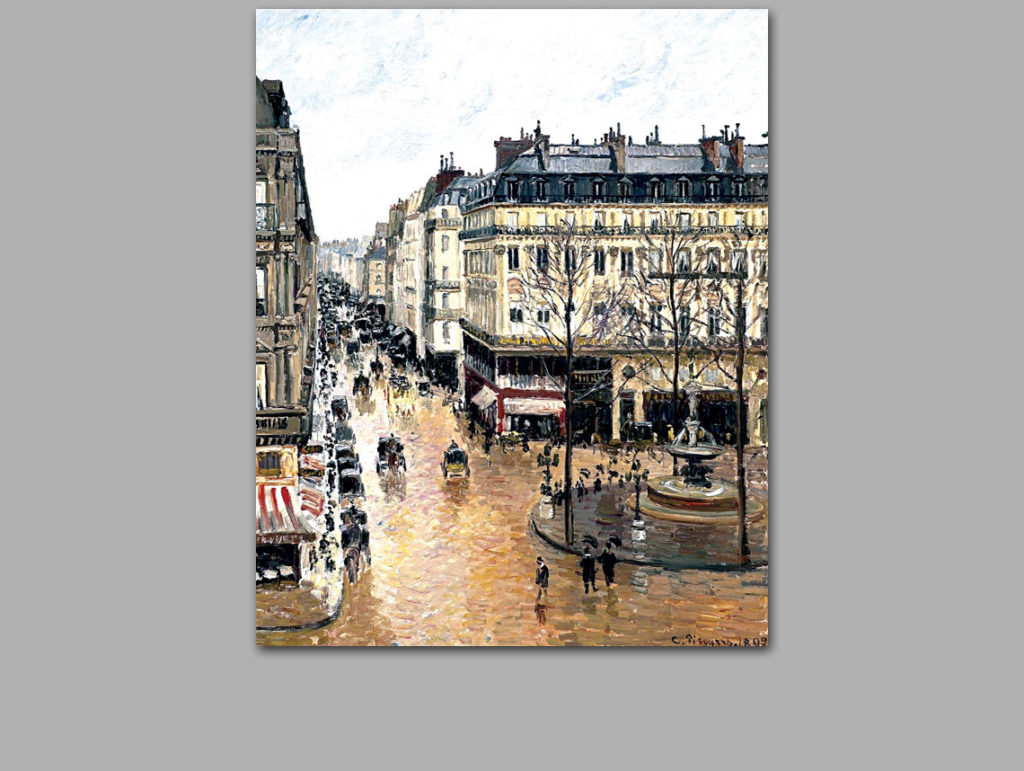
The painting, Camille Pissarro’s “Rue Saint-Honore in the Afternoon, Effect of Rain,” a Paris streetscape valued at more than $30 million, belonged to Lilly Cassirer, whose family bought it directly from Pissarro’s art dealer.
Cassirer, a German Jew, and her second husband, Otto, traded the painting for exit visas in 1939 after Kristallnacht.
Later, the piece was smuggled into the United States, where it was traded among specialists in Nazi-looted artwork in galleries in Los Angeles and New York until 1976, when Baron Hans Heinrich Thyssen-Bornemisza purchased it. It has hung in the Madrid museum since it opened in 1992.
In 1958, the German government gave $13,000 to Lilly Cassirer to cover the painting’s loss.
The Cassirer family thought the piece had been destroyed during the war. The family discovered its existence in 1999 after a friend of David Cassirer’s late father, Claude, Lilly’s grandson, saw the painting in a museum catalog and notified the family. Ever since, the Cassirer family has tried to get it back.
The recent court decision was a reversal of a 2015 dismissal by a Los Angeles District Court of the Cassirer family’s lawsuit against the Thyssen-Bornemisza Collection Foundation.
The plaintiffs in the appeal are David Cassirer and his sister, Ava, and the United Jewish Federation of San Diego County.
In the 60-page appeals court opinion, the presiding judge, Carlos Bea, said the district court decision left open the question of whether Thyssen-Bornemisza was an “accessory” to the theft of the painting.
The case is one of many instances of Jewish families affected by the Holocaust attempting to regain artwork that was taken from them under duress by the Nazis.
The Cassirer family watched closely the 2004 U.S. Supreme Court decision in the Maria Altmann case, which also dealt with Nazi-looted artwork. That ruling established that individuals seeking to recover stolen artwork do not need to go to the countries holding the artwork but can proceed with civil action in U.S. courts.
“When the Supreme Court said we don’t have to go to the country holding it, this became doable and practical,” said David Cassirer, who divides his time between California and Colorado.
“We were able to pitch it to attorneys who would help us. We can have Spain come here and answer us for their action.”
The Cassirer family’s legal team includes David Boies, who represented Al Gore in the case that decided the 2000 presidential election, Bush v. Gore, and the plaintiffs in the challenge to California’s ban on same-sex marriage, known as Proposition 8.
In the current case, the plaintiffs argued that the museum’s claim to the painting — that it had been in the collection for more than six years and thus, under prescriptive Spanish law, belonged to the museum — was void. They further claimed that even if the museum purchased the painting not knowing it was looted, it benefited by having the painting and was thus an accessory to the theft.
The appeals court ruling said Lilly Cassirer’s acceptance of payment from the German government did not foreclose her claim to the painting.