fbpx

July 12, 2017

Moving & Shaking: Garcetti inauguration, LAMOTH vigil, AFMDA gala

IKAR Senior Rabbi Sharon Brous delivered the invocation at the inauguration ceremony for Los Angeles Mayor Eric Garcetti’s second term.

“Holy One, protect and strengthen our mayor, who wears the clothes of a politician but has the heart of a prophet,” Brous said on July 1 at Los Angeles City Hall.

Garcetti, 46, the city’s first elected Jewish mayor, took office in 2013. He was re-elected in June. Because of a shift in the city’s election calendar, Garcetti’s second term will last 5 1/2 years instead of the standard four-year term.

Garcetti’s father, former L.A. County District Attorney Gil Garcetti, is Mexican American with Spanish, Native-American and Italian ancestry. His mother, Sukey Roth, is the granddaughter of Russian-Jewish immigrants.

Garcetti regularly studies Torah with Brous. The two co-starred in a comedy sketch titled “Clergy in Cars Getting Coffee” — a takeoff on a similar Jerry Seinfeld internet video series — for the 2016 IKAR Purim spiel.

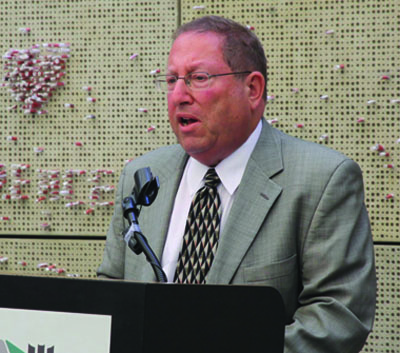
The inauguration ceremony also featured the swearing-in of newly elected and re-elected L.A. City Councilmembers, including L.A. City Councilman Paul Koretz, whose district includes the heavily Jewish Pico-Robertson neighborhood.

Brous highlighted how local elected officials have fostered religious unity during polarizing times:

“Our mayor and our city leaders have turned this city into a holy hot spot, an oasis of love and justice, a place where Jews and Christians and Muslims and Sikhs and Buddhists and Hindus and Catholics and atheists stand together against hate crimes, form holy alliances to fight homelessness and combat racism, work side-by-side to strengthen and support our immigrant communities, declare our commitment to protecting one another and our fragile planet.”


From left: Consul General of Israel in Los Angeles Sam Grundwerg, AJC Los Angeles Director Dan Schnur and Consul General of Azerbaijan in Los Angeles Nasimi Aghayev commemorate 25 years of friendship between Israel and Azerbaijan. Photo by Anna Rubin

Consulate General of Israel in Los Angeles Sam Grundwerg and the Consulate General of the Republic of Azerbaijan in Los Angeles Nasimi Aghayev commemorated 25 years of friendship between Israel and Azerbaijan on June 7 at Sinai Temple.

The event featured Grundwerg and Aghayev in a conversation moderated by Dan Schnur, director of the L.A. office of American Jewish Committee, a global advocacy organization.

Sinai Temple Rabbi David Wolpe opened the event by recalling his trip to Azerbaijan in 2015 with 50 members of his congregation, which sponsored and delivered a Torah to the mountain Jews of Baku.

Grundwerg and Aghayev discussed their backgrounds, their respect for each other and the friendship between their two countries. “Israel was one of the first countries that recognized Azerbaijan following its independence in 1991,” Grundwerg said. The two countries have been diplomatic partners ever since.

Aghayev highlighted his Muslim-majority country’s history with the Jewish people. “The Jewish people have been in Azerbaijan for more than 2,000 years,” he said, adding: “The Jewish people have been safer in Azerbaijan than anywhere else in the Middle East.”

Chinedu Nwogu, a Nigerian foreign exchange student at Cal State Northridge, attended the event and said he found the discussion encouraging. “It was inspirational to attend this event and see the strong friendship between Israel and Azerbaijan, despite the country’s Muslim majority, and it gives me hope that one day such a friendship will exist between Israel and Nigeria,” Nwogu said.

Additional attendees included philanthropists Naty and Debbie Saidoff; former Beverly Hills Mayor Jimmy Delshad; Consul General of Japan in Los Angeles Akira Chiba and Consul General of Germany in Los Angeles Hans Jörg Neumann.

The Shalhevet High School choir sang a rendition of “Jerusalem of Gold,” recognizing the 50-year anniversary of Jerusalem’s 1967 liberation in the Six-Day War.

Mati Geula Cohen, Contributing Writer


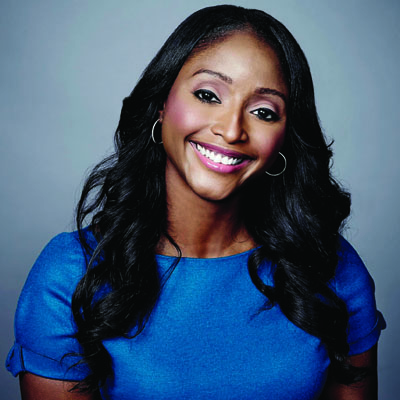
CNN International anchor Isha Sesay. Photo courtesy of CNN

CNN International anchor Isha Sesay spoke about her experiences reporting on women’s rights violations, particularly the terrorist group Boko Haram’s April 2014 kidnapping of 276 schoolgirls from the Chibok region of Nigeria, when she addressed a group of about 50 people after the Beverly Hills Jewish Community’s June 24 Shabbat services at the Beverly Hills Hotel. She emphasized the moral imperative to mobilize against such global atrocities.

Rabbi Avraham Berkowitz, a member of the World Economic Forum’s Civil Society, introduced Sesay and described his own activism against the torture of Yazidi women and girls by ISIS in Iraq. Berkowitz has worked with Chaldean Christian groups to advocate for the Yazidi girls to the United Nations and the White House. He said he became passionate about the cause after he learned of it from the news and, as the father of four girls, felt he could not stand idly by.

“I recalled the phrase from Psalms: ‘Karati, v’ein oneh’ — ‘I called, and there was no answer,’ ” Berkowitz said. “It seemed that the world heard the Yazidi girls and did not answer. We as a Jewish community have an obligation not only to help our own, but wherever and whenever there’s injustice and suffering.”

Sesay related her passion for international women’s rights to her upbringing in Sierra Leone, where she said 90 percent of women are subject to genital mutilation. She said she hoped to balance journalistic objectivity in her news reports with her personal commitment to human rights activism.

“It is not enough as a journalist to sit at the desk and read a prompter,” Sesay said. “Some stories cannot be left at the studio door. You must use every tool at your disposal to keep the story alive.”

Sesay, who currently is writing a book about the Boko Haram kidnappings, urged congregants to be “upstanders” rather than bystanders, and to engage with nonprofit organizations already working to empower women in developing countries.

Sesay’s appearance was sponsored by the Jewish Journal and organized by the Jewish Platform for Advocacy and Community Engagement, and the Beverly Hills Jewish Community’s speaker initiative.

— Gabriella Kamran, Contributing Writer


Los Angeles City Councilman Paul Koretz appears at the Los Angeles Museum of the Holocaust for a vigil commemorating the refugees aboard the MS St. Louis in 1939. Photo by Jill Brown/Los Angeles Museum of the Holocaust

The Los Angeles Museum of the Holocaust (LAMOTH) held a community vigil to commemorate the refugees aboard the ocean liner St. Louis in 1939. The St. Louis was full of Jewish refugees when it was turned away by the United States after leaving Nazi Germany.

At the June 11 event, the 85 attendees remembered those who were killed after being sent back to Europe, while LAMOTH highlighted the importance of helping present-day refugees. Those who attended came from various synagogues and organizations, including University Synagogue, Cool Shul, Temple Sinai of Glendale, Kehillat Israel, Leo Baeck Temple, USC, HIAS (formerly known as the Hebrew Immigrant Aid Society), IKAR, the Anti-Defamation League, Temple Beth Am and Temple Isaiah.

LAMOTH Director of Education Jordanna Gessler said it was important for the museum to hold the event because lessons of the Holocaust are relevant today, and important for members of the Jewish community to come together to “learn about the past, reflect on the present and change the future.”

LAMOTH was founded in 1961 by a group of Holocaust survivors whose narratives are at the core of the museum’s galleries and education.

Henry Slucki, a Holocaust survivor, was a participant at the commemoration who spoke about his experiences of being a refugee. Slucki said his family was assisted by HIAS, which for 130 years has protected refugees and helped them rebuild their lives.

L.A. City Councilman Paul Koretz also spoke at the event about his father’s experiences as a Holocaust survivor and refugee.

Beth Kean, LAMOTH executive director and a grandchild of Holocaust survivors and refugees, discussed honoring the memory of those who died as a result of the events surrounding the St. Louis.

— Caitlin Cohen, Contributing Writer


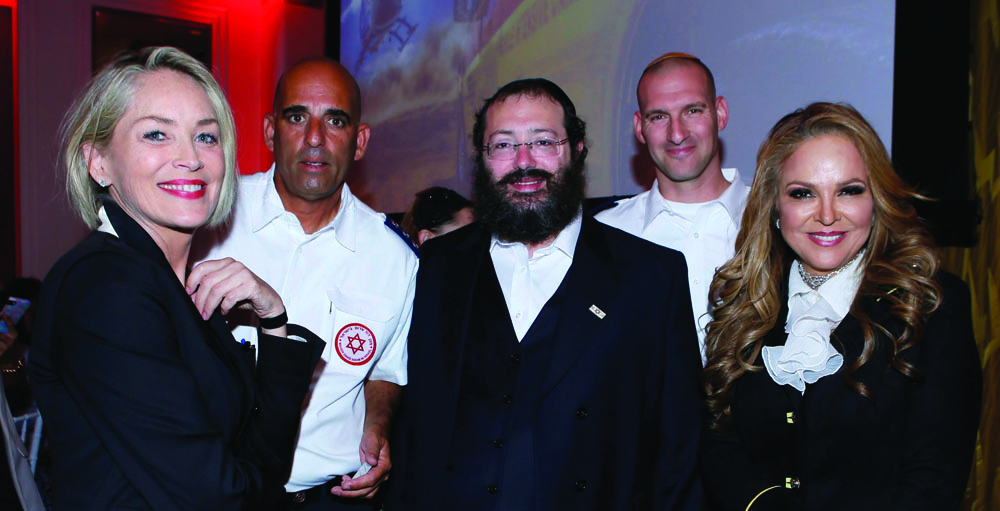
From left: Actress and activist Sharon Stone, Magen David Adom (MDA) Chief Operations Officer Ori Shacham, new MDA Chairman of the Board Rabbi Avraham Manela, MDA paramedic Naty Regev and American Friends of MDA Western Region President Dina Leeds. Photo by Orly Halevy

American Friends of Magen David Adom (AFMDA) held a June 21 luncheon at the Waldorf Astoria Beverly Hills to mark the launch of its Iron Dome Protectors of Israel Women’s Division for Magen David Adom (MDA) in L.A.

The event featured a discussion with actress and peace activist Sharon Stone and philanthropist and businessman Michael Milken.

Organized by AFMDA Western regional chair Dina Leeds, the Jewish National Fund and Israel Bonds, the event drew more than 200 women in support of the Eshkol region of Israel, which has been a target of terrorist groups’ rocket and mortar attacks in recent years, and is not protected by Israel’s Iron Dome.

“We want to offer love and resources to our brothers and sisters in Israel who need it most due to the high-risk parts of the country they live in,” Leeds said. “Where there is no literal Iron Dome anti-missile system, we will be their ‘Iron Dome’ of emotional and lifesaving support.”

The event also raised funds to purchase two ambulances for the emergency-response efforts MDA performs in Israel and around the world.

“We unite people of Israel, of all ethnicities, backgrounds and religions,” Leeds said. “We have paramedics who are Jewish, Christian and Muslim, all serving the singular task of saving lives.”

Beverly Hills Mayor Lili Bosse participated in the event via video.

“I commend each and every one of you for being such strong and determined women, each of you leading by example and making a difference,” Bosse told the attendees.

Carolyn Ben Natan, director of public affairs for the Consulate General of Israel in Los Angeles, also attended.

“We stand on the shoulders of those righteous and fearless biblical women of the Exodus,” Natan said, “and now we have modern Israeli women on the world stage, and there is a direct line from Golda Meir to Gal Gadot.”

Other attendees included Beny Alagem, owner of the recently opened Waldorf Astoria Beverly Hills; David Suissa, president of TRIBE Media/Jewish Journal; philanthropist Gina Rafael; Susan Azizzadeh, president of the Iranian American Jewish Federation; Jodi Marcus, associate director of the Jewish National Fund in Los Angeles; Yossi Mentz, AFMDA Western region director of major gifts; and Gadi Yarkoni, mayor of the Eshkol region.

— Mati Geula Cohen, Contributing Writer

With this issue, the Jewish Journal is proud to announce our newest columnist, Ben Shapiro.
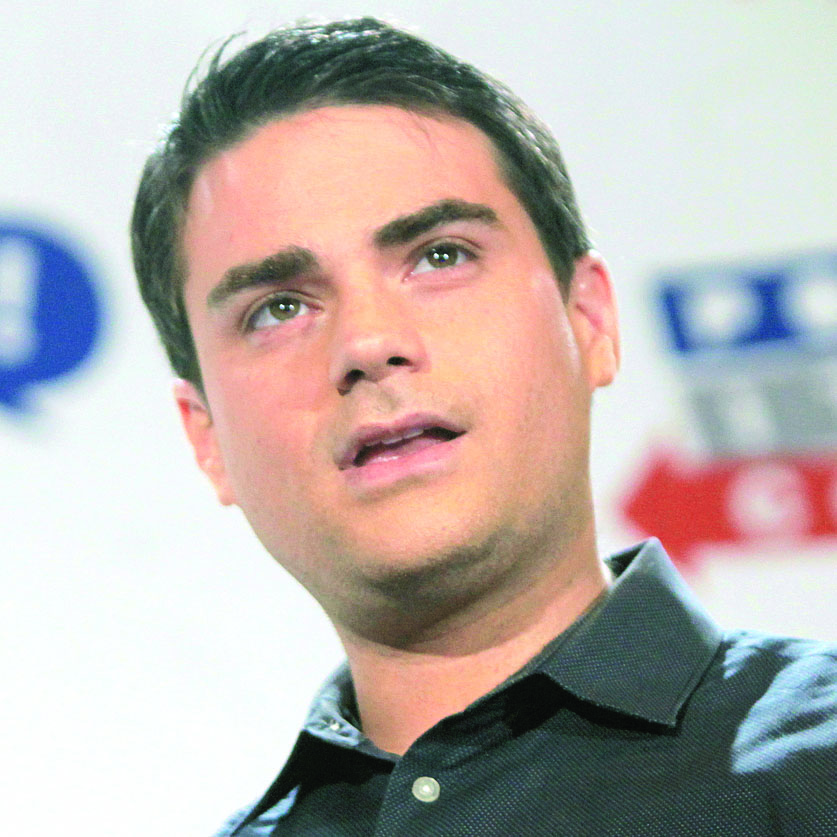
Ben Shapiro. Photo courtesy of Jewish National Fund

Shapiro, 33, was born and raised in Los Angeles, where he attended Yeshiva University of Los Angeles Boys High School. He went on to UCLA, where he graduated summa cum laude and Phi Beta Kappa at age 20, with a bachelor of arts degree in political science.

He graduated cum laude from Harvard Law School in 2007 and subsequently practiced law at Goodwin Procter LLP. Today, he runs a Los Angeles independent legal consultancy firm, Benjamin Shapiro Legal Consulting.

Shapiro, who lectures widely on college campuses across the United States, has written seven books, including 2004’s “Brainwashed: How Universities Indoctrinate America’s Youth.” He currently writes a column for Creators Syndicate and is editor-in-chief at The Daily Wire. He is the co-founder and former editor-in-chief of the media watchdog group Truth Revolt and former editor-at-large of Breitbart News. He resigned from Breitbart after what he felt was the website’s insufficient support of its reporter Michelle Fields after she was allegedly assaulted by Corey Lewandowski, Donald Trump’s former campaign manager.

In a March 1, 2016, cover story for the Jewish Journal, “Why the Republican Party Is Dying,” Shapiro decried the candidacy of now-President Trump.

Shapiro’s other books include “Primetime Propaganda: The True Hollywood Story of How the Left Took Over Your TV” and “Bullies: How the Left’s Culture of Fear and Intimidation Silences Americans,” which appeared on The New York Times’ best-seller list.   

He married Mor Toledano, an Israeli citizen of Jewish-Moroccan descent, and lives in Los Angeles. They have two children and belong to an Orthodox congregation.

Shapiro’s column will appear in the Journal twice monthly, alternating with Marty Kaplan.

The Journal is devoted to presenting a pluralistic forum for the many strong, divergent voices in the community, and we are thrilled that Shapiro’s voice now will be among them.

We also want to thank Dennis Prager, who contributed loyally to this publication over the years. He will continue to contribute occasional columns as his time and schedule permit.

— Rob Eshman, Publisher and Editor-in-Chief


Moving & Shaking highlights events, honors and simchas. Got a tip? Email ryant@jewishjournal.com. 

Moving & Shaking: Garcetti inauguration, LAMOTH vigil, AFMDA gala Read More »
Parashat Pinchas: You are what you consistently do

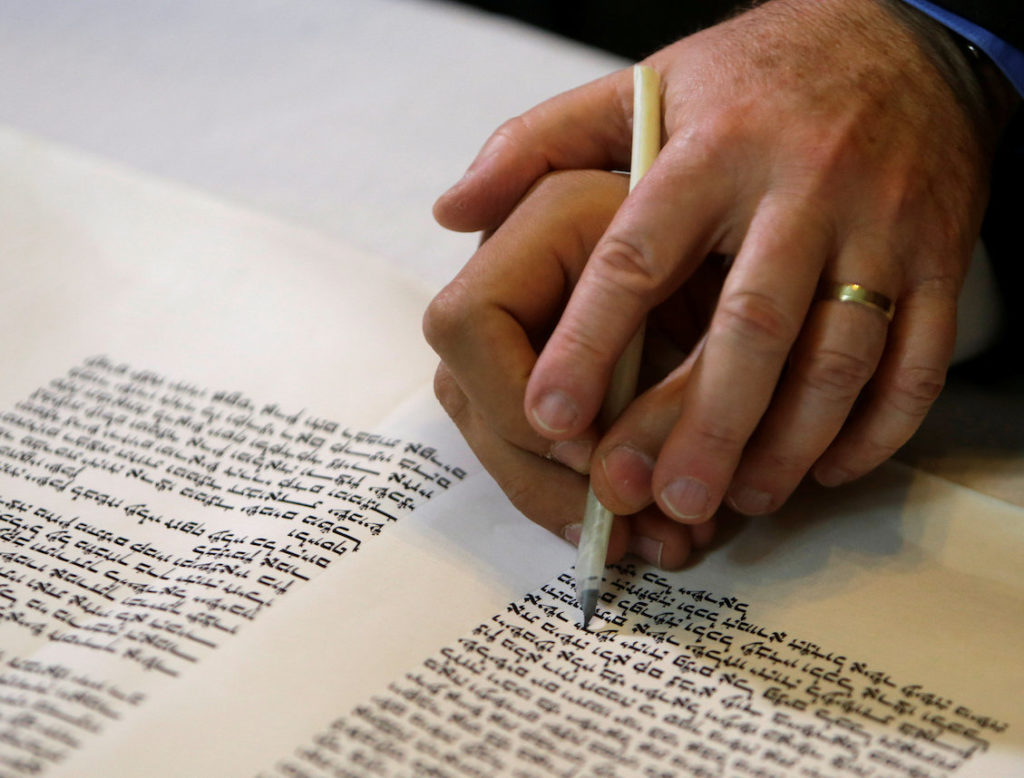
If somebody asked you to name the most important verse in the Torah, what would you say? The Jerusalem Talmud actually discusses this question. In this talmudic passage, Rabbi Akiba proposes the verse: “Love your fellow person as you love yourself” (Leviticus 19:18).

No doubt, Rabbi Akiba’s choice is a worthy one. Loving your fellow person as yourself is about putting yourself in another person’s shoes. It is about the foundational ethical and emotional imperative of empathy, of being attuned and sensitized to the feelings and sentiments of another person.

This perspective also is endorsed by Rabbi Hillel the Elder in the Babylonian Talmud. When asked by a prospective convert to recite the entirety of the Torah while standing on one foot, Hillel famously stated: “Don’t do unto another that which is hateful to you. The rest is commentary, now go and learn.”

But not everybody concurs with this answer that loving another person as you love yourself is the “klal gadol baTorah (fundamental Torah principle). According to Ben Azzai, a second-century contemporary of Rabbi Akiba, the overarching metaprinciple of the Torah is to be found in Genesis 5:1, a verse which includes the statement that man is created “in the likeness of God.”

If Rabbi Akiba’s choice was to opt for a verse that is a cornerstone of human psychology, then Rabbi Ben Azzai opted for a verse with far-reaching consequences for political thought. According to Rashi, Ben Azzai argues that because we all are fashioned in the Divine image, we all possess innate, intrinsic and nonnegotiable human dignity and worth, and thus must not be dehumanized, discriminated against or murdered.

Indeed, the Torah and the rest of the Hebrew Bible are quoted hundreds of times in the works of political theorists such as Jean-Jacques Rousseau, Thomas Hobbes, Immanuel Kant and John Locke, who envisaged modern-day representative democracy. There is a clear and pervasive linkage between the Torah’s revolutionary notion that we all are in God’s image and the modern application of this sacred ideal in the American Declaration of Independence (“All men are created equal”) and the Declaration of the Rights of Man and of the Citizen, endorsed by the French National Assembly after the French Revolution. 

The prayer “Shema Yisrael, the Lord is our God, the Lord is one” (Deuteronomy 6:4), also can be regarded as the central verse of the Torah. Spiritually and theologically, the Shema may indeed be the prime verse of the Torah, as it captures the monistic unity of God, and also the kabbalistic-panentheistic insight that everything which exists is contained within the infinity and eternity of the oneness of God.

In addition to the three cardinal verses discussed so far, there is a fourth contender for the most central verse in the Torah.

In the midrashic anthology “Ein Yaakov,” compiled by the 15th-century Sephardic sage Rabbi Yaakov ben Habib, we find this verse, which is brought forth in the name of Rabbi Shimon ben Pazi. According to ben Pazi, the chief verse of the Torah appears in this week’s parsha, and it reads: “You shall offer the first lamb in the morning, and the second lamb during twilight” (Numbers 28:4).

This is most perplexing. After all, this verse seems to be discussing a mere administrative technicality, namely, what is the prompt and opportune time at which to bring forth the Temple offerings. A contemporary reader might easily glance over this verse and dismiss it as mere ancient esotericism.

Nothing could be further from the truth. The reason ben Pazi crowns this precious verse as the most cardinal one in the Torah is because he has the genius to understand that there is only one thing that truly attests to a person’s character — his deeds.

The key to success and growth in any field of human endeavor, this verse implies, is daily regularity. For example, if I want to be a spiritual person, then I should pray every day, thrice daily, and not just “when the spirit moves me.”

All too often, people seek a breakthrough in their lives and strive to attain growth in one large stride. That’s not the most effective way, implies our verse. The best way to become your highest self — to “awaken the giant within,” in the words of Tony Robbins — is simply to put in the work, day in and day out.

Or as the late Stephen Covey explained in his masterful work “The 7 Habits of Highly Effective People,” it is precisely our habits, the things we regularly do, that define us, who we are and what we stand for. 

No non-Jewish sage appreciated and internalized the veracity of this universal truth better than Aristotle, who already observed 2 1/2 millennia ago that “excellence is an art won by training and habituation. We are what we repeatedly do. Excellence, then, is not an act but a habit.”

Shabbat shalom.  


Rabbi Tal Sessler is senior rabbi of Sephardic Temple Tifereth Israel. He is the author of several books dealing with philosophy and contemporary Jewish identity.

Parashat Pinchas: You are what you consistently do Read More »

Thoughts on the Maccabiah games from local star athletes

Madeline Aibel, 14

Santa Monica

Rhythmic gymnastics

“My experience has been an eye-opening, unforgettable adventure. This is my first time in Israel. When I first found out about the Maccabiah Games, I thought it was the perfect opportunity to visit this amazing country and experience a once-in-a-lifetime opportunity to compete in the games.”

Aidan Blain, 15

Santa Monica

Track and field

“Meeting new people from different countries who are all connected by Judaism and athletics is amazing, and it has been one of the best experiences of my life. The Maccabiah Games is one of the best opportunities I have ever come across, and I’m overjoyed that I was able to take advantage and compete in these games.”

Joseph Leavitt, 43

Santa Monica

Basketball

“Competing in the Maccabiah Games allows me to experience a full spectrum of emotions, from the joy of walking into the stadium at opening ceremonies to the thrill of victory to the agony of defeat. … Not many people my age get an opportunity to leave their desk job in the U.S. to go to Israel to compete again at a high level.”

Elijah Lichtenberg, 22

Beverly Hills

Soccer     

“My experience has been nothing but incredible. Meeting athletes from each delegation has been a unique experience, and competing in athletic competition in the land of the Jewish people has been very special for me.”

Steven S. Davis, 64

Beverly Hills 

Tennis

“Nothing is better for me than being in Israel, being able to play tennis every day and meeting wonderful Jewish people from both Israel and around the world.”

Thoughts on the Maccabiah games from local star athletes Read More »

Embodying the ‘Spirit of the Jewish Athlete’ at Maccabiah Games

Samuel Telanoff is only 14 years old, but he already knows what it means to represent his country in international swimming competitions.

On July 6, he and his teammates marched behind the American flag at the opening ceremonies of the 20th Maccabiah Games in Teddy Stadium in Jerusalem.

The Maccabiah Games, an Olympic-style event held every four years during the year after the Summer Olympics, have connected Jewish communities from around the world since 1932, with athletes competing in four divisions: junior, open, masters and paralympics. Since the first gathering, more than 62,000 athletes have competed. This year’s events continue through July 18.

“There is no way to describe just how awe-inspiring it was to walk out with Team USA in front of thousands of cheering people,” said Telanoff, a sophomore at Santa Monica High School. “It was overwhelming, and I was grinning the whole time.”

Telanoff is one of 1,100 American athletes competing at the games, also known as the Jewish Olympics.

Nearly 10,000 athletes from 80 countries are participating in 47 events in such sports as basketball, fencing, archery and wheelchair tennis. 

Among the American athletes is Emily Surloff, a Los Angeles native who plays basketball for Columbia University. On July 9, Surloff helped her team, which competes in the open women’s basketball division, defeat Russia, 101-71. 

“It’s a once-in-a-lifetime experience and opportunity to represent my country,” the 20-year-old said. “I am extremely excited to be connected to my faith and religion and meet other athletes like myself. We came here to win gold and that is our ultimate goal.”

Israel defeated the American team the next day, 68-62. The final game of the preliminary round was scheduled for July 12 against Australia.

Justin Greenberg, 49, the assistant coach and co-chair of the youth men’s soccer team, said he views participating in the games as a way to support Israel.   

“Many of our players had not been to Israel, and to witness their absorption and understanding of this country’s need for survival is compelling,” said Greenberg, who attends Wilshire Boulevard Temple.

Greenberg grew up in Jerusalem and lived there during the Yom Kippur War. In 1972, his father was on a plane from Vienna to Tel Aviv when it was hijacked by a Palestinian terrorist group.

“Sharing some of my own story with them has been a treat,” said Greenberg, who moved to the United States in 1977. “Witnessing our young group of 20 men come together as a unit has been an absolute highlight. As a young boy knowing little English, soccer was my main form of communication. I run a soccer business now, and appreciate the connection between sport and spirit of the Jewish athlete.”

Chess player Iris Kokish spent nine months preparing for the games, which she said she finds meaningful in many ways.

“Chess is an important part of my identity, but so is my being Jewish,” the 27-year-old Angeleno said. “So when I learned that Maccabiah USA was seeking chess players, I knew I wanted to be a part.”

Kokish said the games gave her a chance to visit Israel for the first time and helped her “better understand my Jewish identity, my people and my role within my Jewish community.”   

On July 9, Telanoff won the bronze medal in the 200-meter breaststroke.

“I hoped for a medal, but did not expect one,” Telanoff said. “I swam faster than I ever swam before. I was so thrilled to have moved up to third place and win a medal.”

Telanoff said he enjoyed the games because they gave him an opportunity to compete against the best athletes in his category.

“I am a very competitive swimmer, and this represents an opportunity to compete at a high international level,” he said. “There is also something special about being able to learn more about my Jewish identity while pursuing my passion for competitive swimming.” 

For another Angeleno, Noah Rothstein, 34, who plays futsal, a variation of football, competing in the games means honoring his father’s memory. 

“Beyond how much I love these trips and being able to compete as a representative of the United States, the one thing my dad loved more than anything was watching me play,” he said. “I feel very much that going to the Maccabiah Games honors his memory.”

The experience enabled Rothstein to compete in the sport he admires and explore “the amazing country of Israel, and make friends and memories for the rest of my life.”

Many participants agree that, while winning medals is important, building friendship with fellow athletes is invaluable.

“The first goal has been achieved, with our group coming together as one,” said Greenberg, the soccer coach. “My hope is that the relationships created within our group and beyond, while here at the games, last a lifetime.” 

Embodying the ‘Spirit of the Jewish Athlete’ at Maccabiah Games Read More »

Iranian-Americans celebrate new ‘Freedom Sculpture’ in Century City

Massive fireworks blazed through the Century City sky on July 4, not only to celebrate Independence Day but also to honor the unveiling of a $2.5 million sculpture that brought nearly 75,000 local Iranian Americans and other Angelenos together for a festival of freedom.

Organized by the Farhang Foundation, a Los Angeles nonprofit established in 2008 to promote Iranian culture and art, the “Freedom Sculpture” is a modern interpretation of the ancient clay Cyrus Cylinder, an artifact recognized by archeologists as one of the world’s first declarations of human rights and freedom for all individuals as set forth by the Persian king Cyrus the Great.

The 20-foot-long stainless steel sculpture, weighing more than 20,000 pounds, features a series of curved pieces with zig-zag patterns. The original cylinder concerns the conquest of Babylon in 539 B.C.E., and it has special meaning for modern Iranian Jews because Cyrus has been identified as the liberator of the captive Jews in Babylon.

“Honoring and commemorating Cyrus and his declaration of human rights is really honoring and remembering the special bond Jewish and Iranian people have had for over 2,500 years,” said George Haroonian, a board member at Nessah Synagogue, an Iranian congregation in Beverly Hills. “We, the Iranian Jewish community, the children of this bond, are conscious of our special position here.”

The Freedom Sculpture’s unveiling at Santa Monica Boulevard and Century Park East resonated with many attendees who fled Iran during the past four decades, seeking freedoms and better lives in the U.S.

“This event taking place on July Fourth was very special for us as Iranians living here because it was a gift from us to this city and country that welcomed us to resettle here, gave us opportunities to prosper here — and now we are showing our appreciation to this great country with this sculpture,” said Joe Shooshani, an Iranian Jewish businessman and current Beverly Hills planning commissioner.

Alireza Ardekani, the Farhang Foundation’s executive director, said reaction has been tremendously positive.

“The night of the event there was so much love, peace and positive energy from everyone who came — Iranians and non-Iranians alike in the city,” Ardekani said.

The event’s attendees enjoyed traditional Persian cuisine at booths set up by local restaurants and live performances from popular Iranian singers and musicians.

Ardekani said the idea for the sculpture project came about after an exhibition of the original Cyrus Cylinder visited the Getty Villa in 2013. That exhibition was sponsored by the Farhang Foundation.

The design for L.A.’s new sculpture, created by British artist Cecil Balmond, was selected out of 300 submissions.

“The judges who were curators from the different museums here in L.A. and a few of our board members chose Cecil’s design because of the aesthetics, the concept and the message of freedom and coexistence proclaimed by Cyrus from the original cylinder,” Ardekani said.

The majority of the money raised for the Freedom Sculpture project came from crowdfunding, with individuals and community groups donating from $1 to $250,000, Ardekani said.

Farhang Foundation board members credited Shooshani; Alex Helmi, a local Iranian-Muslim businessman who organizes the annual Persian New Year celebrations in Westwood; and former L.A. Convention Center General Manager Pouria Abbassi with connecting them to key L.A. city officials and City Council committees needed to help greenlight the project. Helmi specifically thanked City Councilman Paul Koretz for his help in making the sculpture a reality.

Koretz, whose Fifth District is now home to the sculpture, was among those who spoke at the unveiling. He called on L.A. residents to embrace one another in a spirit of brotherhood despite their many differences.

“This piece of artwork encompasses the ideals that make humanity a species unlike any other,” Koretz said in his address. “It serves as a reminder to each of us that difference does not mean separation. It asks us to extend our hands rather than raise our fists, to open our hearts rather than close our minds.”

Official figures are hard to come by, but community leaders estimate that 500,000 Iranians live in Los Angeles, Orange and San Diego counties today, many of whom maintain close ties with the Christian, Islamic, Jewish, Baha’i and Zoroastrian faiths.

Those leaders said they hope the Freedom Sculpture will serve as a symbol of harmony amid that diversity.

“We as Iranians are a people who come from an ancient heritage of human rights, freedom and respect for all people,” Helmi said. “This sculpture represents the ideals of democracy set forth by Cyrus 2,500 years ago, which we hold dear as Iranian Americans. And I hope people will see us in that light, instead of judging us based on the current political situation in Iran.”

Iranian-Americans celebrate new ‘Freedom Sculpture’ in Century City Read More »

Sumud Freedom Camp: A vision of peace in the Hebron Hills?

There is something new under the unforgiving South Hebron sun.

A disparate group of Palestinians, Israelis and Diaspora Jews came together this spring to create Sumud (Steadfastness) Freedom Camp, an effort to show that a seemingly intractable conflict might yet be resolved through a grass-roots movement of people who refuse to be enemies.

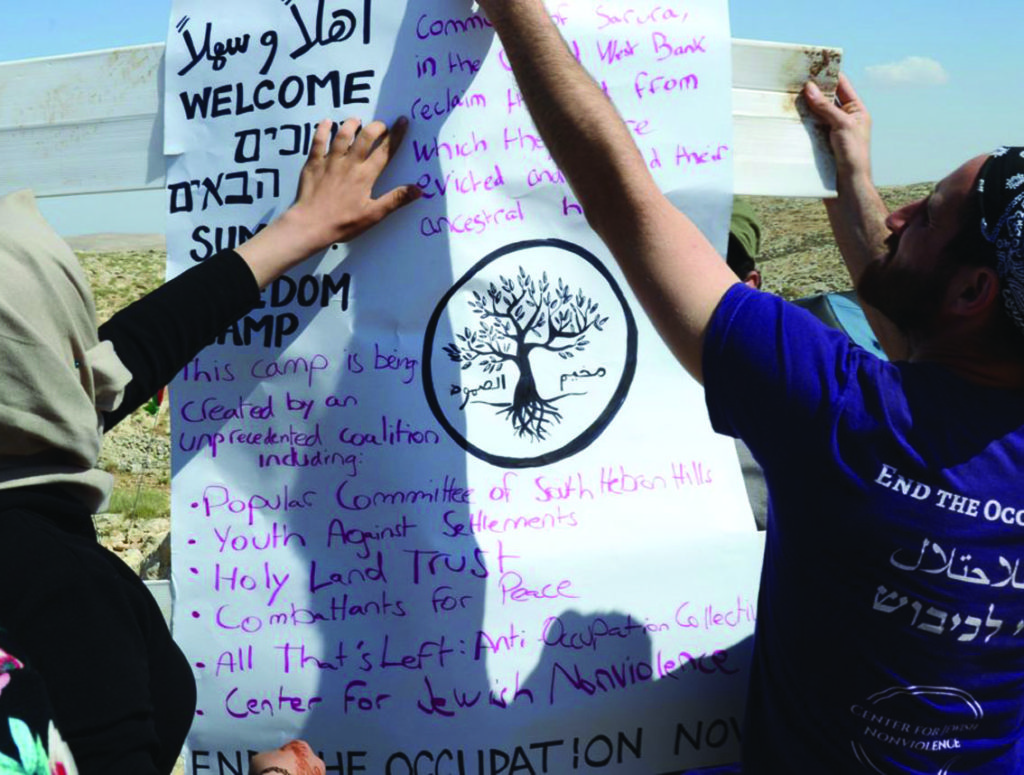
Sumud campers from the Palestinian and Jewish worlds are making different political choices from many of their own community leaders. Sumud’s founding organizations include the Center for Jewish Nonviolence (CJNV), the Holy Land Trust (HLT), Youth Against Settlements (YAG), All That’s Left, Combatants for Peace, and the Popular Resistance Committee of the South Hebron Hills.

At the outset, two projects drive the mission: First, to exist as a “safe, nonviolent, unarmed space where all those who believe in a future founded on justice, freedom, and equality can come together to build a foundation that will sustain a just peace.” Second, to renovate housing at the site of Sarura, a village displaced by an Israeli military zone, hoping to return families to their homes.

The HLT, organized by Sami Awad in 1998, chooses to work with Israeli and Jewish activists in the context of extreme care taken by  Palestinian leaders to build any collaborations such that they do not normalize Israeli domination. While not a religious organization, HLT takes inspiration from the teachings of Jesus Christ as well as Mahatma Ghandi, embracing nonviolence as a guiding principle.

Awad calls Israel/Palestine a place of “many narratives.” Sumud includes people who regard 1948 as a miracle and others who see it as a naqba, a catastrophe. Rather than waiting for some magic day when everyone’s story collapses into a master narrative, Sumud campers are trying something new: creating a space where people can be together in their differences, joy, pride and pain to build relationships based on mutual respect.

Youth Against Settlements is a direct-action group committed to nonviolent civil disobedience, the right of each of its members to their own religious beliefs and women’s equality. A founder and leader of YAG, Issa Amro, who has led actions such as the creation of Cinema Hebron, a closed factory revitalized as a movie theater (which was shuttered by the Israeli military), faces prosecution in Israel for “assaulting a soldier” during a demonstration in which Amro was injured. He is accused of pushing and calling a soldier “stupid,” as though tactlessness could really be a crime in Israel.

Israeli authorities have ordered an August trial for Amro, who has been successful at turning young Palestinians away from violence and fundamentalism.

For its part, the Diaspora Jewish delegation, organized by CJNV, has gathered members of politically disparate organizations who do not always speak civilly, let alone work together at home, such as J Street, Jewish Voice for Peace and If Not Now.

The only agreements CJNV delegates had to commit to were the organization’s three guiding principles: opposition to the occupation, an unshakeable commitment to nonviolence and “belief in the shared humanity and full equality of Palestinians and Israelis alike.” This includes people who favor a one-state solution in Israel/Palestine, others who favor two states and people who don’t really believe there should be state power anywhere on earth.

The oldest Jewish camper, a man in his 80s, worked with the Student Nonviolent Coordinating Committee fighting for African-American equality in the U.S. South. The youngest camper was 18. There were Jews of many colors, economic backgrounds and varieties of Judaism, from very observant to proudly atheist. Palestinian participants ranged from old to young, urban to rural, academic to working class, Muslim, Christian and none of the above.

Sumud Freedom Camp was created on the site of Sarura, a village located in Area C, the part of the occupied West Bank that is entirely under Israeli military control. Sarura and most Palestinian villages in Area C have been declared military zones, which means that whole communities live under constant threat of summary demolition. They are not allowed to file Master Plans with the Israeli authorities, but any construction made without a Master Plan is illegal. Hence, any improvement to a building, paved road, mosque, school, water tower or solar power plant can be, and often is, torn down — but not until its builders labor to its completion and are forced to watch the destruction.

The South Hebron Hills are a particularly challenging place to live when one is denied access to electrical power, filtered water and a sewage system — all of which are available to the Israeli settlements, including Sumud’s neighbor, Ma’on Settlement, which, in its founding, was illegal even under Israeli law.

Despite its beginnings, Ma’on enjoys water, power and green space sufficient to render it indistinguishable from a remote Southern California desert suburb. Its residents also, with impunity, engage in harassment of Sarura and other nearby villages. Even on Shabbat, settlers rode three-wheelers through the village close to the Sumud camp, scaring animals and taunting people.

Adjacent to prosperous (and younger) settlements, Har Hebron villages struggle to wrest a living based on herding and agriculture from the stingy, dusty soil. The residents live sustainably, micro-irrigating crops and allowing animals to roam free, which often results in confiscation by settler youth that goes uncompensated and unpunished.

Everything in the South Hebron Hills fights back: soil limned with sharp rocks and heavy stones, the scouring wind, the blazing heat of day, the frigid cold of night, even barbed and sticky weeds that compete with fragile crops for precious water. It is from this soil that the nonviolent youth movement, dedicated fiercely to education and self-improvement, is emerging.

Local Palestinians from neighboring villages such as Umm al-Khair and al-Tiwani have been supportive of Sumud, sheltering travelers on their way to the camp and spending the night themselves. Young men from the neighboring villages help renovate caves that have housed Palestinians for generations. The caves, naturally insulated from the heat and cold, are made livable by caulking the places where snakes and scorpions might hide, plastering the ground and installing doors and screens to make rooms.

Despite concerns that it might prove “triggering” for Palestinians to hear Jews praying in Hebrew, several Palestinians joined Shabbat celebrations, among them representatives from Roots/Shoreshim, a group founded by a self-defined “settler rabbi” and a Palestinian activist who had spent time in Israeli prison. Actual neighbors, they acknowledged that they had never spent time face-to-face with each other. They began to build friendships simply by introducing their children to one another and sharing personal histories.

During Kabbalat Shabbat, Shoreshim representatives shared their group’s vision of “a social and political reality that is founded on dignity, trust, and a mutual recognition and respect for both peoples’ historic belonging to the entire Land.”

The Israeli army continues to harass the Sumud camp, shoving people around and taking away tents, a generator, even a car. Most of the international campers have left, but the camp is being maintained by local Palestinian activists, Israeli Jews, and some Diaspora Jews who stayed.

Sumud Freedom Camp does not represent a retreat from politics. Rather, it is an experiment in building a political program from the grass roots up, based on real relationships and investments in one another’s well-being that cross national and religious divides.

Peace activists are often asked, “So where are all the nonviolent Palestinian activists?” Actually, they aren’t hard to find. A better question is, “Why isn’t the Israeli government acknowledging and trying to partner with such people instead of repressing them?”


Rabbi Robin Podolsky teaches Jewish Thought at Cal State Long Beach and serves as affiliated clergy at Temple Beth Israel of Highland Park and Eagle Rock.

Sumud Freedom Camp: A vision of peace in the Hebron Hills? Read More »

Supreme Court decision on funding for religious entities divides Jewish groups

A church playground in Missouri has become the unlikely focus of a sharp difference of opinion among Jewish organizations over issues of separation of church and state, following a June 26 Supreme Court decision on funding religious institutions.

Trinity Lutheran Church sued the state of Missouri for denying it a grant, offered to nonsectarian nonprofits, to enhance children’s safety by rubberizing its playgrounds. The case is Trinity Lutheran Church of Columbia, Inc. v. Comer. As Director of the Missouri Department of Natural Resources, Carol S. Comer is the named defendant.

The Supreme Court ruled for the church in a 7-2 vote that said denying a religious institution public funds for which it is otherwise eligible penalizes the free practice of religion. Four justices from the majority signed a footnote that limited the decision’s scope to public funding of religious institutions for a secular purpose, such as health or safety.

The Orthodox Union, which filed an amicus brief in support of Trinity Lutheran, is celebrating the ruling as a powerful refutation of religious discrimination. Other Jewish organizations, as well as several Los Angeles Jewish educators, echo concerns raised by the Anti-Defamation League (ADL) that the ruling erodes the separation of church and state and constitutes government overreach into religious activity.

“Allowing churches and other religious groups to compete for direct government funds is bad for religion,” Jonathan A. Greenblatt, the ADL chief executive, said in a statement. “States should not be in the religiously divisive business of choosing who, from among diverse houses of worship, should receive public dollars.”

Seven organizations signed the ADL’s amicus brief in support of Missouri, including the Central Conference of American Rabbis, the Union for Reform Judaism and the Interfaith Alliance Foundation.

Nathan Diament, executive director of the Orthodox Union’s Advocacy Center, dismissed the ADL’s position as an extreme stance on separation of church and state

“The ADL would be better served to deal with constitutional law as it is, rather than how they wish it would be,” Diament said.

The ruling however, is far from a cut-and-dried legal precedent. The majority opinion, written by Chief Justice John Roberts and joined by Justices Neil Gorsuch, Clarence Thomas, Elena Kagan, Samuel Alito, Anthony Kennedy and Stephen Breyer, leaves many questions unanswered, including whether direct government funding would tie religious institutions to any government regulations.

“The constitution treats religion differently. That idea appears to have been lost [in Trinity Lutheran v. Comer].” —Rabbi David Saperstein, senior adviser on strategy and policy for the Union of Reform Judaism

“They who control the purse strings control the vision and direction of an institution,” said Bruce Powell, head of school at de Toledo High School in West Hills. “We have to be very careful in taking public dollars and not ceding control of our educational processes.”

Powell said he is ethically opposed to taking money directly from the government. He is hesitant to divert state funds from the public school system, and said he worries that religious schools could become dependent on fickle government funding decisions.

Rabbi Aaron Panken, president of Hebrew Union College-Jewish Institute of Religion, said his primary concern is that the ruling opens the possibility that the government could be more favorable to certain religions in choosing which sectarian institutions to fund.

A danger also exists that the legal precedent for treating religious institutions exactly as nonsectarian institutions are treated could undermine special privileges and protections afforded to religious institutions.

“Only religion has an establishment clause,” said Rabbi David Saperstein, senior adviser on strategy and policy for the Union of Reform Judaism. “The constitution treats religion differently. That idea appears to have been lost [in Trinity Lutheran v. Comer].”

Saperstein said he worries that fear of losing government funding might chill religion’s historical function of preaching truth to power.

Yet, for all the hypothetical risks the ruling presents, its immediate legal repercussions in California are slight.

California is one of 38 states with a constitutional provision called a Blaine Amendment, which prohibits the use of public funds to support religious institutions. Michael Helfand, associate professor of law at Pepperdine University and co-author of the Orthodox Union’s brief, said he is unaware of any existing California funding programs that exclude sectarian institutions solely for their religious character. Nor does California operate any sort of voucher program to help residents pay tuition at private schools.

Security funding — a secular benefit that religious schools are eager to obtain — is handled primarily at the federal level by the Department of Homeland Security, where there is no prohibition against funding religious institutions with taxpayer dollars.

Helfand said the ruling is symbolic, particularly in its weakening of state Blaine Amendments.

“We have seen a spike in hate crimes against religious institutions — a limited spike within the Jewish community, and an even higher spike within the Muslim community,” Helfand said. “This type of statement from the Supreme Court that everybody deserves funding to protect their institutions is vital at this juncture.”

It is plausible that Trinity Lutheran v. Comer is only a precursor to a broader expansion of funding for religious institutions. Justices Roberts, Thomas and Gorsuch did not sign the footnote limiting funding to secular benefits, leaving open the possibility that the legal wall prohibiting government funding for religious activity might eventually be broken.

Helfand and Diament said that such a development would be an unwelcome encroachment by the government on religious activity, even for a group such as the Orthodox Union, which wants state funding for secular benefits.

Unless the Supreme Court expands its decision or California offers sectarian schools a grant, Jewish schools in the state shouldn’t see any tangible benefits — or harm — from Trinity Lutheran v. Comer.

Supreme Court decision on funding for religious entities divides Jewish groups Read More »

In Hiroshima, thinking of North Korea

I spent my birthday in Hiroshima.

We didn’t plan it that way, it’s just where we happened to end up in the midst of a summer trip to Japan. It didn’t occur to me what it would mean, or how I would feel, to be celebrating my birthday in a restaurant at the foot of the Aioi Bridge.

The Enola Gay was aiming to drop Little Boy above the bridge, but missed by 800 feet. Instead, the world’s first atomic bomb used in combat exploded 1,900 feet over Shima Surgical Clinic on Aug. 6, 1945.

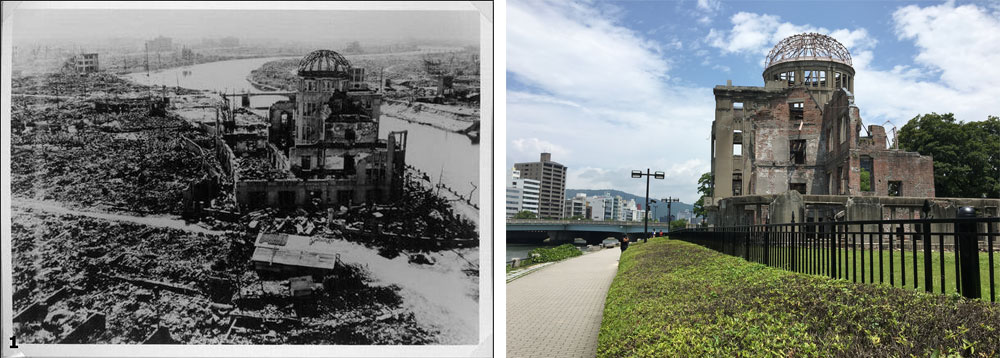
From Caffe Ponte, where we chased our pizza Margherita with sake shots, we could see the shattered remains of what had been the city’s Product Exhibition Hall, its skeleton now preserved as a memorial.

It wasn’t hard for me to imagine what the rest of Hiroshima looked like that day, because that afternoon we had visited the Hiroshima Peace Memorial Museum.

In a flash, the city was obliterated. About 150,000 people died, many in that instant, more from injuries and radiation poisoning. For miles around, the Exhibition Hall was one of only a few buildings left standing.


Left: Hiroshima, Japan, after the United States dropped the first atomic bomb on the city, August 5, 1945. The standing building is now preserved as the Hiroshima Peace Memorial.

Right: Genbaku Dome was the only building left standing near the hypocenter of the A-bomb’s blast. Every year, thousands gather at the iconic dome, now the Hiroshima Peace Memorial. Photo by Rob Eshman


If you’ve been to Holocaust museums and memorials, you’ll feel a sense of déjà vu visiting the one in Hiroshima. Yes, of course, the circumstances of destruction couldn’t be more different. But even so, we have a limited vocabulary for recalling carnage.

There are the relics of dead children — a charred tricycle, which a grief-stricken father buried alongside his 2-year-old son killed in the attack. There are the photos — of the fireball, of blackened bodies, of huddled survivors. There are the video testimonies of survivors — the woman who woke from a blinding flash to find her house had disappeared around her, leaving only her son and daughter behind, both dead. There is an Anne Frank whom kids can relate to — Sadako Sasaki, a girl whose diary became the basis for the book “One Thousand Paper Cranes.”

And there is the abiding theme of “Never Again,” in this case framed as an emphasis on nuclear disarmament.

But for humans, “Never Again” turns out to be a difficult ask.

Since the Holocaust, there have been many genocides. And 72 years after Hiroshima, the world is again on the brink of a potential nuclear conflict. Japan, hard as it is to believe, is again a potential ground zero.

Just as we were leaving Japan, on July 4, North Korea launched a KN-17 liquid-fueled missile that landed in the Sea of Japan, in the country’s exclusive economic zone where fishing and commercial vessels are active.

It was that nation’s first successful flight of a missile capable of carrying a nuclear warhead as far as North America. Experts say North Korea, which already has eight to 10 nuclear bombs, is a couple of years away from developing the technology to fit them on a warhead that could reach us. No one wants North Korea President Kim Jong Un to be able to do that.

“What has kept the world safe from the bomb since 1945 has not been deterrence, in the sense of fear of specific weapons, so much as it’s been memory,” John Hersey wrote. “The memory of what happened at Hiroshima.”

Hersey traveled the desolate city shortly after we dropped the bomb; his reporting became the basis for his masterful book, “Hiroshima.”

But he’s wrong, unfortunately. Of all the tools President Donald Trump has at his disposal to control North Korea’s weapons, sending Kim Jong Un to the Peace Museum may be the least effective.


[evp_embed_video url=”http://jewishjournal.com/wp-content/uploads/2017/07/IMG_9668.mp4″]

A lone floutist plays on the banks of the Ota River, just at the foot of the Aioi Bridge, the initial target of the first atomic bomb.  Across from him is the Hiroshima Peace Memorial.  Video by Rob Eshman


As the Journal reported in a 2014 cover story, the concentration camps President Kim maintains around North Korea — where tens of thousands of dissidents are tortured, abused and executed — are not the work of a man who cares about anything but his own individual survival. His murder of Otto Warmbier last month is yet another demonstration of Kim’s insolent evil.

But what to do? If you haven’t read or heard any of the hundreds of pundits and experts weighing in on North Korea, let me cut to the chase: There’s no good option. That’s what they all conclude.

The three bad options are: 1) a preemptive strike obliterating the country’s weapons of mass destruction and taking out the regime; 2) a smaller “warning” strike; 3) more diplomacy and sanctions, to induce the Supreme Leader to compromise.

After running through the scenarios, all but a handful of experts end up on No. 3. Military options would provoke North Korea into launching devastating attacks on Japan and South Korea. Casualties could reach a million. I’m no expert, but I’ve now seen Tokyo at rush hour. It’s what they call a target-rich environment.

Little Boy was highly ineffective, using only 1.7 percent of its fissionable material. The power and number of bombs we have today would make the Korean Peninsula and Japan look like one endless Hiroshima.

If the people of Hiroshima were concerned about North Korea’s newest provocation — or the fact that their fate is in the hands of Donald Trump — they didn’t show it. The city thrums with energy. The malls are packed. Buzzed salarymen stroll from bar to bar, lovers embrace by the riverbanks, cars stream toward Mazda Stadium to see the Carp play another baseball game, and tourists line up for the famous okonomiyaki noodle cakes. It’s a river-crossed Phoenix of a city.

We crossed the Aioi Bridge on the way back from dinner, stopping at a memorial for the thousands of children killed in the blast. Never again? We’ll see.


ROB ESHMAN is publisher and editor-in-chief of TRIBE Media Corp./Jewish Journal. Email
him at robe@jewishjournal.com. You can follow him on Instagram and Twitter @foodaism
and @RobEshman.


In Hiroshima, thinking of North Korea Read More »

Letters to the Editor: Diaspora Jews, ‘Oslo,’ Kotel and TJ Leaf

Prayer for Israel

David Benkof writes that when American congregations recite the Prayer for the State of Israel, it strengthens the connection between congregants and Israel (“Diaspora Jews Cannot Expect Veto Power Over Jewish State,” July 7). We agree; prayer and ritual do reinforce the values of the community that offers them.  Therefore, it matters what the actual prayer says.

At Temple Emanuel of Beverly Hills, the prayer we have chosen to recite is the one written by Anat Hoffman, the director of the Israel Religious Action Center and chair of the board of Women of the Wall. We have pasted it in the prayer book in Hebrew and in English. Reciting this prayer every week reinforces our values and strengthens our resolve that Israel matters to us and that we must continually work to help this vision of Israel be realized:  

My God,

In this sacred moment, give us hope for Israel and her future.

Renew our wonder at the miracle of the Jewish state.

In the name of all those whose labors made the land bloom — give us the tools to cultivate a diversity of expression in Israel.

In the name of the fallen — give us courage to stand up to the words and ways of zealots, those in our own midst and those among our neighbors.

In the name of Israeli inventors who have amazed the world with their innovations — help us apply the same ingenuity to finding a path to peace.

In the name of all these women and men — grant us the strength to conquer doubt and despair in Israel. 

Replacing doubt with action.

Replacing despair with hope.

And let us say: Amen

Rabbi Jonathan Aaron, Rabbi Sarah Bassin, Rabbi Laura Geller
and Cantor Lizzie Weiss 


Groundwork Laid in Oslo

I read David Suissa’s column about “Oslo” with interest (“The Missing Drama in ‘Oslo,’ ” July 7). Clearly the Oslo process was largely a failure and Suissa’s carapace of cynicism is justified. Let him and other cynical supporters of Israel be fortified by Israel’s national anthem “Hatikvah” (The Hope). Hopefully, I say as a naive pragmatist and optimist, future Israeli and Palestinian negotiators will build on these accords, perhaps even several decades in the future, to solidify and stabilize the relationship between a safe, defensible Israel and the Palestinians.

Ian R. Tofler via email


Fissure Over the Kotel

Rabbi Yitzchok Adlerstein, in his response to the Kotel controversy, claims that while he understands the “letdown” felt by Reform and Conservative Jews, he “cannot understand charges that this is a repudiation of their Jewishness” (“Local Rabbis React to the Controversy,” June 30). The rabbi might refer to the article just above his (“Outcry No Match for Charedi Political Power in Freeze of Western Wall Plan,” June 30), in which Israeli Health Minister Yaakov Litzman, welcoming the Cabinet decision states flat out, “This decision sends a clear message to the entire world that Reform Judaism has no access to or recognition at the Western Wall.”  

Does that aid your understanding, rabbi?

Jesse Winfield, Los Angeles


Israelis in the NBA Draft

In the story about T.J. Leaf, Oren Peleg erroneously stated that Leaf was the second Israeli-born basketball player to be drafted by the NBA (“Israeli-Born T.J. Leaf Makes a Bit of History in NBA Draft,” July 7). Actually he was the third. In addition to Omri Casspi and Leaf, Doron Sheffer, out of the University of Connecticut and Ramat Efal, Israel, was drafted No. 36 in the second round by the Clippers in the 1996 draft. He chose to pursue his professional in Israel, however.

Ephraim Moxson, Co-Publisher, Jewish Sports Review


Seniors Should Wait Before Returning to Facility

We were deeply disappointed by the Journal’s inclusion of a quote that suggests that former residents should return to Westwood Horizons, at least at this time (“Westwood Seniors Get Reprieve From Orders of Eviction,” July 7). As Bet Tzedek’s and the city’s consultants found, the building is in a serious state of disrepair, and the much-needed renovations will create significant disruptions.

The building is a former UCLA dorm built more than half a century ago. Its mechanical, electrical and plumbing systems are aged and vulnerable to outages, leading to potentially unsafe conditions, especially for a community of seniors.

Westwood Horizons’ residents will have to be moved to other apartments and/or nearby hotels at certain points during the construction process because power, water, heating and cooling will have to be turned off for extended periods of time. We regret this inconvenience, and we certainly don’t want to inconvenience even more residents. 

Former residents have been invited to return to the building after the renovation. But suggesting that they return before then would only put them at undue risk and inconvenience. For the health, safety and general comfort of all residents, we continue to urge them to move out of the building during the renovation, and we will help them find a new place to live. 

David Barnes, President of Watermark Retirement Communities, which manages
Westwood Horizons

Letters to the Editor: Diaspora Jews, ‘Oslo,’ Kotel and TJ Leaf Read More »

A Hollywood ending: Hiring employees with disabilities

The entertainment industry has a poor track record of casting people with disabilities, and in rare instances when characters with intellectual or physical disabilities are written into scripts, those roles are all too often played by actors who don’t have a disability. The percentage of people with disabilities employed by the entertainment industry behind a camera is a tiny sliver of the 20 percent of the American population who have a disability, as classified by the Americans With Disabilities Act (ADA), which became law in 1990.

Given that background, I was surprised to learn that a major Hollywood talent agency has quietly employed an adult with intellectual/developmental disabilities for close to a decade. I recently attended an award event in Beverly Hills where Paradigm Talent Agency, listed among the top seven talent agencies according to The Hollywood Reporter, was named the “Vanguard Employer “of the year by Best Buddies International, the sister nonprofit to Special Olympics. Founded in 1989 by Anthony Kennedy Shriver, Best Buddies works for the social integration and economic independence of people with Intellectual and Developmental Disabilities (I/DD).

For the past nine years, Best Buddies participant Bradley Gunther, 62, has been working three days a week at Paradigm, where he is now the longest serving employee in the mailroom. And as was clear from his interactions with his colleagues, he is not only appreciated for the sunny personality he brings to his job, but well loved as a friend. In his acceptance speech, Gunther thanked Paradigm employees for taking him out on the weekends, and even bringing him groceries to his home when he was out during a medical leave.

The partnership between Paradigm and Best Buddies started when TV and movie producer and writer Ben Silverman, a member of Best Buddies’ board of directors, called Debbee Klein, co-head of Paradigm’s literary department, and encouraged her to take on a Best Buddy participant as an employee.

“It was not really a request; it was more of a demand,” Klein told the audience, laughing.

Thanks to Silverman, Best Buddies has been able to place other adults with I/DD in other entertainment workplaces, including Fox and Warner Bros.

There’s Zvi Burston, an observant Jewish young adult with cerebral palsy who uses a wheelchair and works as a production assistant on the Netflix series “Fuller House.” He does the same kind of work as any production assistant, such as helping with supplies and answering phones and emails. But because it can be tough to navigate a wheelchair around cameras, he sometimes needs to have his hours scheduled differently than other staff members.

An unexpected consequence of hiring an employee with disabilities is how it can change the entire workplace. At Paradigm, employees realized that having Gunther on board contributed to a more positive overall perspective.

“This is a tough business,” Klein told The Hollywood Reporter. “It can get very intense and competitive. Most of us are so wrapped up in our deals and our clients’ lives, but Bradley reminds us every single day, when he walks the hall with a smile on his face, of what’s important in life. I’ve never not seen him like that, ever.”

As an employer of a Best Buddy participant at the nonprofit Jewish Los Angeles Special Needs Trust, I have found this overall impact to be true. When we launched last year, our board and senior staff members were supportive of the idea that one of our first hires should be an adult with I/DD. In fact, we created a part-time office clerk position with that goal in mind.

With Best Buddies, an employer gets to interview various candidates from its participant pool and receives ongoing job coaching, which is key to a successful work experience. Although I’m a parent and professional in the disability field, I quickly realized that I wasn’t so good at breaking down a task into its component parts, which often is necessary for people with certain types of disabilities. Enter the job coach, who quickly can figure out the best way to explain an assignment, often using visual prompts.

In Los Angeles, the nonprofit Rosies Foundation also is dedicated to creating employment opportunities that empower people with diverse abilities through professional development and social enterprise. One of its first projects is a repurposed short school bus that is now an ADA-accessible food truck, selling popsicles and other frozen treats at various venues, with its crew members taking on the various roles and responsibilities.

Since adults with disabilities continue to be the single largest minority of Americans who aren’t working — 82.1 percent in 2016, according to the U.S. Department of Labor — this is a good time for more employers to create positive change and hire an adult with I/DD. To paraphrase Frank Sinatra, if it can work in Hollywood, it can work anywhere.


MICHELLE K. WOLF is a special needs parent activist and nonprofit professional. She is the founding executive director of the Jewish Los Angeles Special Needs Trust. Visit her Jews and Special Needs blog at jewishjournal.com/jews_and_special_needs.

A Hollywood ending: Hiring employees with disabilities Read More »