Like many in the Diaspora I have been dismayed, then shocked, then angry, then sorrowful, concerning the events of this past week.
Both the delay of the agreement concerning non-Orthodox praying at the Western Wall, and the confirmation, if it passes, enabling only the Chief Rabbi and those designated by him, to rule in conversions, are, as you know by now, anathema to Diaspora Jewry.
Prime Minister, as Israel is the spiritual and emotional home of the Jewish People, these two insults confirm that only a certain denomination or Jew is welcome. To my knowledge, no other country in the world denies any Jew based on denomination.
We who love Israel and the Jewish People are left to ponder our relationship with Israel – and particularly with the coalition you lead. Significant damage has been done to our relationship in the last years because of reasons to which I need not allude. These two new issues will ensure that our youth will be more and more estranged from the great Nation that we adore..
Yes, a Birthright trip, which your Government generously funds, helps. But I foresee a decline in registration that will affect the future of our younger Jews. And polls among our youth who have. It experience Birthright demonstrate forcibly that their majority now feel estranged from Israel. What a shame!
And what a shame for all those fighting BDS throughout the world!
Prime Minister, I believe that it is your duty to do what’s right, rather than what’s politically expedient.
Please immediately instigate the Agreement spearheaded by Natan Sharansky. And please withdraw your support of the Conversion Bill.
Joshua Kahan Brody. Photo courtesy of Theatre Center Group
Combine a director’s Jewish roots with a playwright’s Chinese heritage and the result is a quirky comic play that shows the two cultures have more in common than you might imagine.
That’s the case with Joshua Kahan Brody directing Lauren Yee’s “King of the Yees,” opening July 16 at the Kirk Douglas Theatre in Culver City. It is set in a San Francisco Chinatown universe well beyond Brody’s Eastern European Jewish background, but reflects abundant parallels with his family’s history of immigration and assimilation.
“I feel the same way that the play does, which is that it’s important to honor our heritage and to not forget who we are,” Brody, 32, said during an interview backstage at the Douglas. While he said he understood how previous generations might feel the need to be protective of their ethnicity and to immerse themselves in exclusively Jewish enclaves, he added, “I don’t really feel that need myself.”
In “King of the Yees,” the playwright’s assimilated alter ego, also named Lauren Yee, struggles to understand her father’s commitment to Chinatown and his dwindling civic group, the Yee Fung Toy Family Association.
Like her character, Yee grew up in San Francisco, but not in Chinatown, she said in a telephone interview. As a child, she did not speak Chinese and was less than enthused with having to attend the Yee Fung Toy banquets. She is married to a secular Jewish attorney, as is the fictional Lauren Yee.
In the play her father, Larry Yee, goes missing and her character sets out on a magical quest to find him, traversing Chinatown’s mysterious customs and politics. Ultimately, the character’s odyssey connects her with her father and centuries of ancestors in a way she never could have foreseen. In the process, the fictional Lauren enlists the help of a Chinese gangster who expresses — in a politically incorrect way — his admiration for Jews. He says he loves the tribe because they are “just like us. The hard work, the good food … the cheapskate, the mom so loud always control the son, the dad bad at sport cannot throw the ball. … The Jew know you gotta stick together, make sure they don’t erase you from your story.”
The scene is a tricky bit of social satire, but Brody insisted the references are not racist. “Lauren isn’t making fun of Jews,” he said. “Instead, she gets away with it because these things are both self-deprecating about Chinese stereotypes and sort of teasing about Jewish ones. Frankly, there’s no malice in the play, no bad intent. And I’m pretty good at getting a group of people on the same stage and making something with warmth and a great deal of love.”
Yee, for her part, said she chose Brody to direct “because he understands my sense of humor and what I find funny. He also can walk into a play called ‘King of the Yees,’ which is about Yees — which he is not — and then about Asian-American identity in the 21st century, which is something that is not in his everyday life. He approaches it with a wonderful sense of openness and curiosity and respect that allows him to support
this world.
“Then there’s also the fact that he has a Jewish background. He brings to the play a related but slightly different perspective in terms of cultural identity.”
Brody spent his early years in New Jersey before moving to London with his family after his father, an investment banker, transferred there for work.
Both sets of his grandparents were Bundists but “very culturally Jewish,” he said.
Brody’s maternal grandfather hailed from Vilnius, Lithuania, and survived Bergen-Belsen and other concentration camps
during the Holocaust. Brody’s maternal grandmother escaped the Warsaw Ghetto with a bullet injury, then helped smuggle Jewish children to safety as part of the Polish resistance movement.
“My mother’s first language was Yiddish, and when the extended older relatives were around it was all Yiddish,” he said. “I regret that I never learned my family’s language, which is similar to what Lauren’s character feels in the play.”
Brody said his family’s Judaism fell away somewhat after they moved to England. “Lauren’s parents grew up in Chinatown, but she didn’t grow up there,” he said. “She experienced the lack of day-to-day interaction with those people, and the same thing happened to me.”
Even so, Brody on his own decided to continue his Jewish education for two years after he became bar mitzvah at a large Reform congregation in London. “It was because I had a real intellectual curiosity about Judaism, and also it was a bit of an identity thing for me,” he said. “I still identify so much as Jewish. Yet, I’m not religious today. So my question is, what does it mean to have an ethnic identity that is tied to a religion, but is not actually religious?”
Brody first met Yee, also 32, when both were undergraduates at Yale University. Later, they attended the theater master’s degree program at UC San Diego. There, Brody directed one of Yee’s student plays the same year he also tackled a version of S. Ansky’s Jewish ghost story “The Dybbuk.”
“To me, the subject of that play is also fundamentally about identity: What is the soul of a person? If a person dies and the soul inhabits another body, who is that person?” he said.
At the La Jolla Playhouse last year, Brody directed Jeff Augustin’s “The Last Tiger in Haiti,” which revolves in part around the cultural havoc that followed Haiti’s devastating earthquake in 2010. “That play also deals with questions
of assimilation, and specifically the virtue of authenticity and who gets to tell one’s story,” he said.
To understand Yee’s family history, Brody immersed himself in research, including listening to the hours of interviews the playwright recorded with her father, as well as visiting Yee Fung Toy associations throughout the United States, which were established to maintain contacts among and work for the benefit of members of the Yee clan. He also spent time with Larry Yee, who turned out to be just as exuberant and iconoclastic as his character in the play.
When Brody first read “King of the Yees,” he thought the Larry character was over the top. “And then you meet Larry, and you realize it isn’t,” he said. “This literally happened when Francis Jue, who plays Larry, said, ‘Am I doing too much?’ And we were like, ‘No, keep going. We feel like Larry is in the room with us.’ ”
“King of the Yees” opens July 16 at the Kirk Douglas Theatre in Culver City. For more information about “King of the Yees,” visit centertheatregroup.org.
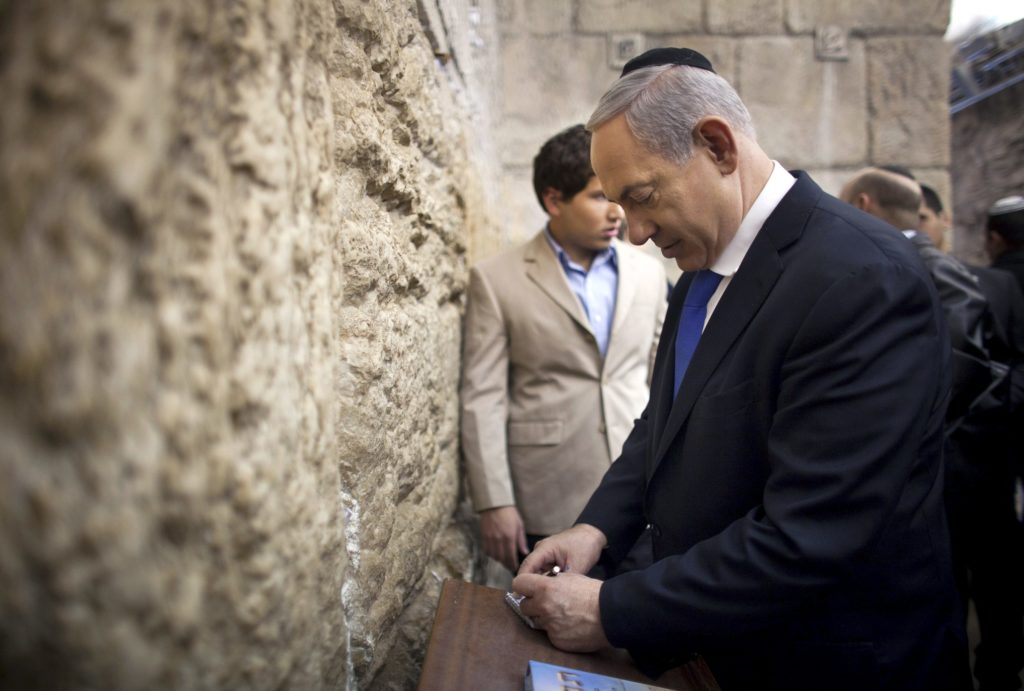
In January 2016 the Israeli government, and the Rabbi of the Western Wall, agreed to legally cordon off a section of the Wall for egalitarian prayer services — a sort of miniature Kotel that would entail official government management and funding. Last week Netanyahu’s cabinet passed a motion formally freezing all plans for the site until further notice.
Before we explore the reaction to this move a few critical facts should be established. Firstly, women as individuals can pray as they wish at the regular section of the Western Wall. If they prefer to wear a prayer shawl and tefillin, noone prevents them. All they are not allowed to do is read from the Torah scroll. Secondly, they can read from the Torah scroll by the Southern side of the Western Wall, where any and all prayer services have been permitted for nearly twenty years. All the cabinet freeze means for egalitarian Jews is that for the time being the Southern Wall won’t be officially cordoned off for their exclusive use.
There were certainly some Israelis who shunned the move, but not all that many. Protests in the wake of the decision drew only a few hundred participants. In Israel, a country that has more politically-driven demonstrations than any other on earth,[1] that isn’t much. To put it into perspective, two thousand Israelis recently protested the kidnapping of Yemeni Children nearly seventy years ago, with another 7,000 Israelis taking to a Tel Aviv square in 2015 to protest a gas deal. A year before that, over 300,000 protesters gathered to the streets in Israel to decry Israel’s planned draft plan, and three years before that 450,000 took to the streets to push for improvements in social justice. So, a few hundred people holding placards outside the Prime Minister’s home doesn’t indicate any exceptional outrage. At least, not in Israel.
And, it’s also fairly easy to understand why. Israelis have proven remarkably indifferent to the Reform and Conservative movements, with less than 3% and 2% of Israelis identifying themselves with each of those movements, respectively. Moreover, the Chairman of the Union of Synagogues and Communities in Israel, Eliezer Sheffer, has reported that there are over 10,500 synagogues in the State of Israel. Of that number, only about forty identify with Reform Judaism — less than 0.4%.
Thus, it was largely the American Jewish community that would form the brunt of the backlash, with leading Jewish-American organizations swiftly condemning the move.
In an Op-Ed published in the New York Times, Lesley Sachs, the Executive Director of Women of the Wall, took a harsher approach. Resorting to unfortunate orthodox-bashing tropes, Sachs described efforts of the Western Wall Foundation to provide shawls to immodestly dressed women as “medieval.” Guards, she went on to claim, forced women to pray silently lest they send the men into a “sexual frenzy.”
Most surprising, however, was the decision by real estate tycoon Isaac Fisher, himself a leading fundraiser in the Greater Miami Jewish Federation and member of the board of AIPAC, to freeze his philanthropic activities for the Jewish state unless the government reversed its decisions.
But Israel is a sovereign democracy and its decisions must reflect the will of its citizens rather than that of foreign Jewish donors. As for Lesley Sachs’ claims of the “medieval” practice of “enforcing” modest-dress, women are offered scarves at the Kotel but cannot be forced to take them. If the mere suggestion seems intrusive, one should consider that there are plenty of memorials throughout the United States that enforce a dress code, such as wearing shoes. They do so not to oppress but to accord respect to hallowed ground. If that level of respect can be demanded at a memorial going back just a hundred years, the holiest site of the Jewish Nation should be granted similar latitude.
With regard to Sachs’ claims that female singing is not allowed, any visit to the Western Wall on any Friday night this summer will bear witness to hundreds of Jewish women singing and dancing to their heart’s content.
When my son and I visited the Blue Mosque in Istanbul, we had to take off our shoes and rinse our hands regardless of what our own religious beliefs were because that was the custom the local orthodoxy upheld. No modernist interpretations of Islam, however popular, would expect to exert its customs in the mosque either. The same can be said of the Church of the Holy Sepulcher in Jerusalem — protestant services cannot be held there, though it is considered a holy site to Protestants as well. The Western Wall should not be faulted, in a similar vein, for preserving the customs of those who administer it — namely, Israel’s orthodox Rabbinate.
I have seen some ultra-orthodox Jews behave disgracefully at the Kotel, including toward my own family this past Shavuot when I was teaching a Torah class in middle of the night to approximately 60 young men and women gathered in a circle. My children were pushed by extremists who were offended by even the idea of men and women merely sitting together in the very back of the Kotel plaza. These fundamentalists disgraced themselves. But they are no more representative of Judaism than Sachs’ tirade against the State of Israel is representative of egalitarian Jews.
The lesson, as always in the Middle East, is that the real danger to peace is not from people of good will but from extremists and fundamentalists who only know how to disagree with their opponents by demonizing them.
Rabbi Shmuley Boteach, “America’s Rabbi,” whom The Washington Post calls “the most famous Rabbi in America,” is the international bestselling author of 30 books including his most recent “The Israel Warrior.” Follow him on Twitter @RabbiShmuley.
[1] Alan Dowty, in Politics and Society in the Contemporary Middle East, 2nd ed., edited by Michael Penner Angrist, (Boulder, CO: Rienner Publishers, 2017), p. 309.
Steven Weitzman is the Abraham M. Ellis Professor of Hebrew and Semitic Languages and Literatures and the Ella Darivoff Director of the Katz Center of Advanced Judaic Studies at the University of Pennsylvania. Professor Weitzman received his Ph.D. from Harvard University after completing his B.A. at UC Berkeley and spent several years teaching in the Department of Religious Studies at Indiana University, where he served as director of its Jewish Studies program for six years. Before moving to Penn, he was the Daniel E. Koshland Professor of Jewish Culture and Religion and the director of the Taube Center for Jewish Studies at Stanford University. Professor Weitzman is the author of several books, including Surviving Sacrilege: Cultural Persistence in Jewish Antiquity (Harvard University Press, 2005); Religion and the Self in Antiquity (Indiana University Press, 2005); The Jews: A History (Prentice Hall, 2009); and a biography of King Solomon (Yale University Press, 2011).
At the end of your last answer, you said the following:
I must acknowledge that the book will probably frustrate some readers, especially those who want a clear-cut answer or want to be reaffirmed in what they already believe. If I was to offer an accurate and comprehensive depiction of the scholarship, I would have to introduce readers to theories and information at odds with how some Jews see themselves and consider some challenging ideas and ways of thinking.
My second-round question: where, in your opinion, are there the biggest and most substantial gaps between the general Jewish public’s perception of their origins and the scholars? What information and debates are most “at odds with how some Jews see themselves”?
Yours,
Shmuel
***
Dear Shmuel,
For decades, archaeologists from places like Tel Aviv University have been challenging the conventional understanding of Jewish origins by calling into question the existence of Abraham and the other ancestors described in Genesis, the Exodus from Egypt, Joshua’s conquest of Canaan and other events known from the Bible. Archaeologists have also challenged the Bible’s claim that the earliest ancestors of the Israelites came to Canaan as outsiders by uncovering continuities between ancient Israelite culture and earlier indigenous Canaanite culture. Many archaeologists now hold that the earliest Israelites were in fact Canaanites who came to see themselves as non-Canaanites for some reason.
This kind of research isn’t exactly new, but it remains unfamiliar to many people and continues to upset and provoke opposition because of the way it challenges Jewish self-understanding. This challenge—the clash between how people see themselves and how their history has been reconstructed by scholarship—is part of what can make it difficult for readers to have an open-mind about some of the scholarship I am describing in the book.
The problem here isn’t just that people are working with different understandings of what counts as a fact or who counts as an expert: the real gap runs deeper than that, reflecting a clash between different ways of thinking about origins.
My understanding of my own origin as a Jew is one I absorbed as a child. Why do I attend the Passover meal every year and try to visualize myself as if I had been present during the Exodus? Why do I feel kinship with Jews in Tel Aviv or Paris who I have never met? It is in part because of an origin story I learned as a child from parents and Hebrew school teachers who taught me that Jews share ancestors who went through the Exodus and were present at Sinai together. This answer to the question is something I imbibed early on from the people who shaped my sense of identity, and it is tied up with my feelings for them.
Secular scholarship, on the other, tends to be skeptical of the kinds of origin stories told by earlier generations, and this is true not just of how it accounts for the origin of the Jews but for how it explains the creation of the universe, the origin of humanity, and so forth. Apart from wanting to be true to reason and the evidence, scholars initially embraced such theories because they were seeking to liberate themselves from the grip of religion and tradition, of having to think in certain ways because the Church or rabbinical authorities told them they had to think in that way. To challenge the biblical account—to argue that the world originated in a way that was different from what religious tradition taught—was to challenge religion’s power to define what was true and to assert one’s freedom from its control.
The clash between these approaches to origin—religious/personal versus secular/scholarly—is one reason why I expect the research I am reporting on will provoke frustration and anger from some readers: some of this scholarship challenges their religious beliefs or their beliefs about who they are, and it can be hard to think clearly about the subject because the scholarship can feel like an attack on one’s sense of identity and feeling of connection to one’s forbearers.
Another reason for a divide between the scholarship and some parts of the public is political, the way the scholarship has become part of Israel’s conflict with the Palestinians.
In one chapter, I look at a book entitled The Invention of the Jewish People by Shlomo Sand which provoked controversy a few years ago because of its critique of Zionism. Sand makes his argument against Israel by trying to disprove the origin story which he believes underpins Zionism’s claim to the land of Canaan and justifies Israel’s mistreatment of the Palestinians. I subject Sand’s approach to critique, but it should be noted that the right has produced its own share of origin stories that can be critiqued on the same grounds. I just read a report about a book called A History of the Palestinian People that was a best-seller on Amazon last week before it was removed from the site. What was offensive about the book is that it is completely blank, the author’s way of arguing that the Palestinians are not a real people and have no real history—an argument that other scholars have made in more conventional ways. This is Sand’s argument in reverse, applied to the Palestinians instead of the Jews, and it is wrong for very similar methodological and historical reasons even though it is coming from the other side of the political spectrum and makes its argument in a different way.
Here I am sympathetic to those who want to keep their distance from the scholarship. To me, it is fair to be skeptical of scholarship that wants to be accepted as true because of its appeal to the facts and yet so clearly misrepresents those facts—or buries them—to advance a particular political argument. This book is not an attempt to convince the public to accept the scholarship: it is an effort to present its pros and cons to help readers form their own informed opinions.
The scholarship I review can never answer the question of Jewish origin in the personally satisfying way that religion can—in truth, it may never be able to answer the question at all—and that may be a reason for some readers to simply ignore it. But for me, as a scholar and as a Jew committed to learning as a supreme value, I think the best way to counter objectionable or confusing scholarly ideas is not to brush them off but to learn about them and engage them.