fbpx

June 13, 2017

Oslo

The missing drama in ‘Oslo’

The first thought that popped into my mind after seeing “Oslo,” which just won a Tony award for Best Play, was: “That’s it?”

The play left me empty. The brilliant acting and stage directing couldn’t overcome my disappointment that “Oslo” added little to the conversation and only reinforced Western stereotypes about conflict resolution.

The play deftly dramatizes the behind-the-scenes efforts of a Norwegian diplomat-couple who bring Israelis and Palestinians together to sign the 1993 Oslo Accords. As you can imagine, to get these parties to agree to anything, there is endless coddling, nudging, arguing and agonizing. It’s in those twists and turns that the play finds most of its drama.

But there’s an elephant in the room, and it looms over everything. No matter how much drama you see on stage, you can’t help but feel the distracting drama of that elephant, which is this: The agreement which the play worships has turned out to be a dud, a failure of the highest order. The light at the end of the Oslo tunnel was really an oncoming train.

So, as much as I enjoyed the acting and the story, I felt its emptiness. Because the play makes such a powerful claim to historical truth, that truth comes back to haunt it. The play wants to have it both ways: It wants us to enjoy the history it shows, but ignore the history that annoys. In my case at least, it was too much to ask for.

The tragedy of Oslo makes the drama in “Oslo” almost trivial. The real drama of the Oslo story is not in its excruciating negotiations, but in its stunning failure. For all the difficulty that the play dramatizes, the agreement itself is very modest. It doesn’t tackle the most serious issues of contention. It kicks the can down the road in the hope that mutual trust will build between the parties. Of course, the opposite happened. The violence and mistrust have gotten significantly worse since Oslo.

In real life, that kind of tragic outcome can be demoralizing. It’s almost too much to bear. But that’s why we need great art—to make us confront ugly truths. Great art is not there to manufacture hope. That’s what preachers are for. Great art should have the courage to take us where we don’t want to go.

The Israeli-Palestinian conflict is an existential conflict where core narratives are rejected, mistrust rules, resentments accumulate and hatred flourishes. Brilliant negotiators are useless in the face of such hardened conditions. A play that would have tried to capture that tragedy would have captivated me.

Would it have won a Tony? Probably not. Tragedy doesn’t sell. Hope sells. Hope is the elixir of the civilized mind. No matter what reality tells us, we must show some hope. The price we pay for this obsession is that we don’t learn our lessons. In the case of Oslo, the great lesson is that when a foundation is corroded, you can’t build anything.

From the standpoint of the Palestinians, that foundation means your society marinates you in Jew-hatred from birth, you are taught that the Zionist narrative is a fraud and Israel is a land thief, and you are promised that millions of refugees will eventually return to that hated Israel and take over. How does a piece of paper negotiated in a Norwegian ivory tower by people you don’t trust counter any of that? It doesn’t and it can’t, even if it’s signed on the front lawn of the White House.

I hope a playwright will tackle the Oslo story one day without fear of going to the depressing depths of the conflict. As they say in Alcoholics Anonymous, sometimes you have to hit your own bottom before you can see the way up. Maybe the playwright can write an alternate, imaginative story where the heroes are not clever dealmakers but hard-nosed changemakers who try to build something real from that ugly bottom.

“Oslo” never takes us to that bottom. It prefers the comfortable Western cliché that savvy and determined negotiators can accomplish anything. That may be true on Broadway, but it’s not in Ramallah or Jerusalem.


David Suissa is president of TRIBE Media Corp./Jewish Journal and can be reached at davids@jewishjournal.com.

The missing drama in ‘Oslo’ Read More »

Former Israeli tennis star killed using popular NY bike-sharing service

A former Israeli youth tennis star and coach is the first person to die while using Citi Bike, New York City’s bicycle-sharing service.

Dan Hanegby, 36, of Brooklyn, died after he swerved to avoid a parked car and hit a bus in the Chelsea neighborhood of Manhattan on Monday, according to The New York Times. Hanegby was an investment banker at Credit Suisse and a married father of two.

Hanegby, who grew up in Tel Aviv, at 16 rose to become the top-ranked player in Israel’s youth tennis league, according to the Israeli business publication The Marker. He held the ranking until he entered Israel’s mandatory military service at 18, serving during the second intifada. He studied at Binghamton University in New York following his discharge, and transferred to Brown University in Rhode Island, where he continued to play tennis.

After graduating, Hanegby became a tennis coach and briefly coached Israeli standout Shahar Peer in 2006.

Neighbors told the Times that Hanegby enjoyed spending time with his children on the weekends.

Former Israeli tennis star killed using popular NY bike-sharing service Read More »

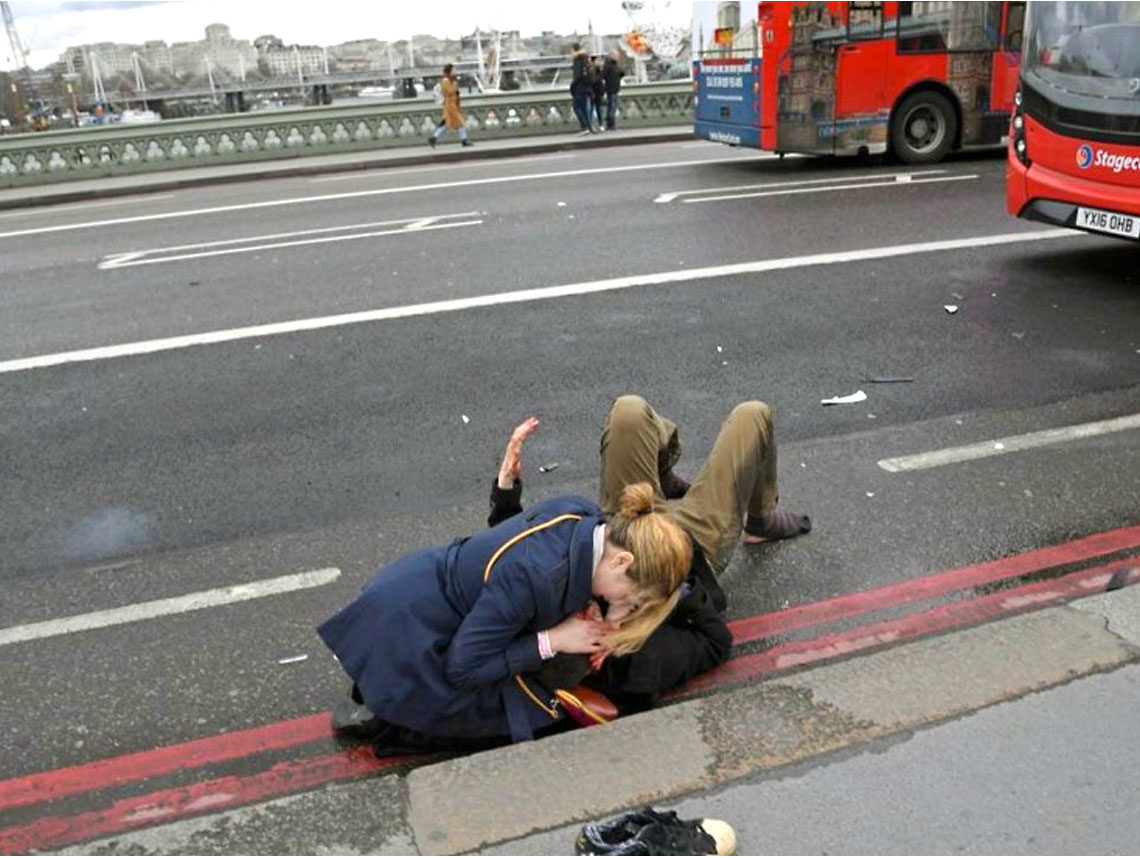
What happens to basic decency during terror attacks coverage?

Let’s talk about decency.


Last week was the perfect example of the double-standards that dominate the global media – vowing to battle terror, but only when it’s outside Israel.


How can a Muslim extremist butchering innocent civilians be framed as a horrific terror attack when happening in Europe, and as a young teen being chased by police when happening in Israel?


To answer this question, we might need to go one step backwards, and ask ourselves how can a terror attack can even be called anything but what it actually is?


When terror strikes Israel, something strange happens to the global media. A terrorist becomes “a young teen,” his motive turns from hatred and extremism to “frustration from the ‘occupation’,” and he will never be neutralized and captured by heroic police officers, but “chased and killed by Israeli police.” Almost never will you read about the victims of the attack, because when it comes to Israel, the world turns upside down.


This severe issue of double standards was almost undetectable until Islamic terrorism started taking over Europe a few years ago. After years of Palestinian terror in Israel going almost unnoticed globally (as there was always a “justification” in the form of the “Israeli occupation and frustration,) we thought the tragedies that struck Europe would be a wake-up call to the world. These horrific attacks of innocent people outside of stadiums, on the street and in public transportation were supposed to be the tragic circumstances that will unite the world.


Sadly, it didn’t happen. The world, Israel included, united with Europe, but terror in Israel is still considered “justified.”


With every terror attack, we think “This is it. Now the Western World will unite against terror.” But sadly, Israelophobia gets in the way…


I recently stumbled upon a video of a lecture by journalist and public speaker Dennis Prager, at Oxford University. He was sitting in front of a room full of young men and women and asked the following question: “In the 1930’s was there a debate over the following proposition: that Great Britain is a greater threat to peace than Nazi Germany, or if Nazi Germany is a greater threat to peace than Great Britain?” Then, he said: “Nazi Germany was to Britain what Hamas is to Israel. Whether you agree with the Israeli policy or not – it is irrelevant.”


This is where international media lacks decency, and shows double standards and hypocrisy. Terror is terror is terror, no matter where. Justifications can always be found, because at the end of the day, news items are nothing but stories with carefully written plots. But just imagine what will happen if CNN or BBC will report an “armed teenager frustrated with Britain’s immigration policies was shot and killed by police after letting out his rage, resulting in 40 civilians killed.”


Can’t even imagine? This is what we see, to our deep sorrow, every time terror strikes us.


What happens to basic decency during terror attacks coverage? Read More »

If you want more Jews in America, you cannot ignore these facts

There’s a good chance you’ve read The New York Times report about the political affiliations of American clergy. If so, you probably were not surprised to learn that most Jews are Democrats and that Jewish clergy tilts even more Democratic.

“Leaders and congregants of Unitarian and African Methodist Episcopal churches are overwhelmingly Democratic, as are those of Reform and Conservative Jewish synagogues,” the analysis says. It finds that Conservative clergy is relatively old, while Reform and Orthodox clergy are relatively young, and all Jewish clergy, generally speaking, lives comfortably in neighborhoods of high-income, well-educated (and white) residents.

That is an interesting study, but it’s hardly the most important one about Jews in America in the past week. The Jewish People Policy Institute, for which I work, just released a study called “Raising Jewish Children: Research and Indications for Intervention.” It ought to make anyone who cares about having a Jewish future in America pause. It ought to make anyone who refuses to ignore the data at least somewhat anxious.

The authors found that 50 percent of non-Charedi American Jews ages 25 to 54 are not married, 21 percent are married to Jews, and 29 percent are intermarried. Just under one-third, 31 percent, are raising children as Jews in some way. They concluded that “a solid majority (perhaps 60 percent) of American non-[Charedi] Jewish adults will never have the experience of raising children in Judaism.”

The tables presented in the study are illuminating and sobering. Non-Orthodox Jews in America do not have spouses in large numbers, and if they do, then the spouses are not Jewish. They also do not have many children, and when they do, they do not raise them Jewishly. Like it or not, criticize it or criticize those who criticize it, believe that it can change or believe that it is a fact Jews must learn to live with — whatever you think, ignoring it would be a mistake.

This is a picture of a numerically declining Jewish community — unless you believe that an infusion of non-Jews into the community could keep its numbers up.

Family configurations for all non-Haredi American Jews ages 25-54

Alas, the numbers do not support such a belief. Having a Jewish spouse means a much better chance for a demonstrably Jewish home. On most questions — Are you a member of a synagogue? Do you have Jewish friends? Is being Jewish important? Are you attached to Israel? — the intensity is similar: Those with a non-Jewish spouse score low, those with no spouse score somewhat higher, those with a Jewish spouse score highest.

The authors of the study make it clear: “Marriage to Jews and the raising of Jewish-by-religion children are key to the current and future Jewish vitality of American Jewry, as well as to its transmissibility. The family first, and then community and friendships, create the conditions for formal and informal Jewish education to take place.”

Of course, there is a chicken-and-egg situation here. If one does not believe that being Jewish is important, one is less likely to insist on having a Jewish spouse and a Jewish home. If one does not have many Jewish friends, one also is less likely to have a Jewish spouse and less likely to have a Jewish home, even in cases where there is an initial desire to have one. If one does not have a spouse, one is less likely to have children to carry on the tradition. If one marries late, one might be less picky choosing a spouse of a certain tradition.

The bottom line is clear: If non-Orthodox Jews keep doing what they do, and if current trends do not change, the decline is all but guaranteed. The authors see a remedy for that in bolstering and emphasizing “the revival of Jewish social capital for Jewishly ‘impoverished’ families through the establishment of new Jewish social circles.”

I hope they are right, but for this to work, there is a need for Jewish leaders to acknowledge the challenge, define it as a problem and accept this remedy and its implications. Obviously, certain recent political developments have made a bad name for any call for parting with political correctness. But there’s clearly a need for that, too.

This is not, nor should it be, about disparaging Jews who make life choices as they see fit. And it is not, nor should it be, about alienating the non-Jewish partners of Jews. It’s not about forcing young Jews into marrying partners they dislike. And not about telling Jews what they should do. And not about saying that Jews who decide not to stick with Jewishness are in some fashion lesser people than those who choose to remain Jewish.

This is about looking at facts, acknowledging them and learning from them. It is about what we — those who want to see more Jews and more engaged Jews — can do to improve our chances of getting them.

If you want more Jews in America, you cannot ignore these facts Read More »