fbpx

June 13, 2017

Five iconic film locations you must visit in 2017

We’ve all got a favorite movie or two, and might even have daydreamed about starring in them from time to time. Unless we’re outrageously talented, lucky or driven (preferably all three and then some) we’ll never get to appear on the big screen, so the next best thing is to visit the scenes and sets. We’re lucky that many of the best movies of all time have been filmed in The States – including these five locations.

Hawaii – Elvis


The recent Disney hit Moana has brought Hawaii back onto the big screen, carrying on a long tradition of movies featuring these paradise islands. A quick snapshot would include Godzilla (which used 200 local people as extras on Waikiki Beach), Pirates of the Caribbean: On Stranger Tides, Hunger Games, 50 First Dates, Pearl Harbour, and the Jurassic Park Series. In Oahu, you can even pay for a 90-minute tour of many of the scenes from more than 50 movies.

Among those 50 are the works of The King himself – Elvis Presley. Perhaps the most well-known are Blue Hawaii from 1961, which was shot at the Coco Palms Resort in Kauai and featured the famous wedding scene. Although abandoned since Hurricane Iniki in 1992 and demolished last year, the hotel is currently being rebuilt as part of the Hyatt Unbound Collection – so disciples might choose to wait until then.

Girls! Girls! Girls! followed in 1962, while the final Elvis movie shot in Hawaii was the 1966 comedy Paradise, Hawaiian Style, and you’ll find a number of locations still remain including the Maui Sheraton Hotel and the LDS Polynesian Cultural Centre in Oahu.

Las Vegas – Ocean series


We probably think immediately of Fear and Loathing in Las Vegas and Leaving Las Vegas when considering Sin City. But there’s a clearly whole lot more to be seen than these eponymous movies, and perhaps the movies that evoke certain scenes of Vegas locations are the Ocean’s series.

The original Rat Pack version sees Sinatra and co carry out an audacious heist on five casinos in a single night; sadly, only one out of those five is still there in its original form. The Sands was demolished in ’96 and replaced by the Venetian; The Sahara is now known as the SLS; The Desert Inn was closed at the start of the century and the Riviera was demolished in 2015-16. Only the Flamingo remains.

On to the sequels, and who wouldn’t want to recreate the glorious conclusion in front of the Bellagio Fountains in the remake? For that matter, catching a fight at the MGM Grand Garden is still a must for many fight fans, although you’re unlikely to see long-retired heavyweight champ Lennox Lewis in the ring again.

Fremont Street is the original location for high-stakes and heavy drinking, and has featured in Dodgeball to Honey I Blew Up the Kid to Diamonds Are Forever. On the Strip, Caesar’s Palace is one of the most used casinos. It features in Rainman and Iron Man, and devotees of the original Hangover might want to revisit the debauchery in flamboyant style in one of the grand suites.

Finally, if you just want to live like the movie star A-Listers, rooms at the Julius Tower start at just $1,949 a night, while some at MGM Grand cost up to $10,000. The Napoleon Suite at the Paris is so exclusive that there is no price tag.

New York – Taxi Driver


For the movie fan, a trip to New York is essential and unforgettable, although worth researching as it’s all too easy to simply walk past many of the more famous spots. As an example of the less obvious destinations, consider the 1976 vigilante movie Taxi Driver. The poster looks as if it could be taken anywhere in the city, but the actual location is the West Side of Eighth Avenue, just below West 47th Street. Looking for this is made that little bit more difficult by the fact that the adult movie signs in the background have long gone, to be replaced by pharmacies and information centers. The big shootout at the end takes place in a tenement block at 226 East 13th Street.

Other movies filmed in New York include The Seven Year Itch (with ‘that’ Marilyn Monroe scene); Big, with the famous duet between Tom Hanks and Robert Loggie on the giant keyboard (now in Philadelphia) and Where Harry Met Sally – at Katz’s Delicatessen in East Houston Street.

Fans of Ghostbusters will recall that two of the most famous scenes in 80s film history involved giant apparitions strolling through the Big Apple; the Stay Puft marshmallow man in the original, and an inhabited Statue of Liberty in the sequel. Surprisingly, the scene in the hotel where we’re first introduced to Slimer was actually filmed at the Biltmore Hotel in Los Angeles, so you won’t be able to stay there – but any one of New York’s many hotels will suffice for a tour of this great city!

New Orleans – Benjamin Button


The list of movies filmed in the Big Easy is as extensive, vibrant and diverse as the city itself. Bourbon Street witnessed a jazz/voodoo funeral in Live and Let Die in 1973; 21 Jump Street and 22 Jump Street filmed various scenes around Riverdale High School and Lafreniere Park, and various John Grisham book-to-film adaptations such as the Pelican Brief have been filmed on Riverwalk. Elvis filmed at the fabulous French Quarter in King Creole, which also hosted scenes from Interview with the Vampire on Royal Street.

Fans of the Brad Pitt movie The Curious Case of Benjamin Button should head for Nolan House on Coliseum Street, the near 8,000ft mansion where much of the filming took place.
Apparently, director David Fincher was so set on using the house that he flew to Houston to have dinner with owner Mary Nell Porter Nolan, in the aftermath of Hurricane Katrina.
Some scenes were also shot in (or designed to replicate) the numerous cemeteries in the city, while something more romantic might be found at the wonderful Newman Bandstand in Audobon Park, a popular venue for the wedding and private events.

Philadelphia – Rocky statue and steps

Quickly – what’s the name of the building with the 72 steps that Rocky runs up in ‘that’ scene? Even though it’s one of the most recognizable scenes in movie history, you might be unaware that the answer is the Philadelphia Museum of Art – which is well worth a look in its own right.

The Oscar-winning film series has given the sport of boxing and cinema history so much; from the iconic ring entrance music used by so many, to the unusual training techniques of chasing chickens and sprinting up snowy mountains. And it continues to flourish, with the latest iteration Creed 2015 sweeping more awards and picking up much critical acclaim.

While there, have your picture taken with the Sylvester Stallone statue, donated by Sly in 1980, although expect a small queue of other fight film fans eager to participate. The steps, filmed with a Steadicam to bring more realism, have been used in several of the movies and give an outstanding view of Eakins Oval, City Hall, and Benjamin Franklin Parkway.

So lace up the gloves and get up those steps – you never know, the great man himself may even be around….


Five iconic film locations you must visit in 2017 Read More »

Tillerson: Palestinian Authority to stop paying terrorists’ families

U.S. Secretary of State Rex Tillerson told senators that the Palestinian Authority will stop paying the families of terrorists who have attacked or killed Israelis.

“We have been very clear with them that this is simply not acceptable to us,” Tillerson said on Capitol Hill Tuesday at a meeting of the Senate Foreign Relations Committee. “They have changed that policy and their intent is to cease the payments to the families of those who have committed murder or violence against others.”

Tillerson noted that he and President Donald Trump both spoke with Palestinian Authority President Mahmoud Abbas about the issue during recent meetings in Washington and Bethlehem.

The American Jewish Committee welcomed Tillerson’s remarks.

“If a firm U.S. stance actually leads to the end of this outrageous practice, as Secretary Tillerson said will be the case, AJC would be the first to applaud,” AJC CEO David Harris said in a statement.

According to Times of Israel, an Israeli general told parliament last month that the Palestinian Authority has paid out nearly $1.2 billion to terrorists and their families over the past four years.

Tillerson: Palestinian Authority to stop paying terrorists’ families Read More »

WONDERBOOM_Waterproof

Review: UE Boom 2 and Wonderboom

There’s something wonderful about music that can enrich almost any experience. BBQ’s, lazy days by the pool, going for walks or sitting down to do some work, the right music can add flavor and enjoyment to just about anything. And now that we can have all the world’s music in our pocket, there’s even more opportunity to have music in our lives.

I recently had the opportunity to play around with the UE Boom 2 and Wonderboom portable bluetooth speakers to see how they might fit into my musical life.

TLDR: I like them a lot as portable speakers, with a few minor caveats.

Both devices feel premium, a lot more solid than I expected them to feel. Both are covered in a colorful mesh, with rubber buttons on the side and top. The UE Boom 2 is taller and thinner, while the Wonderboom is shorter and fatter. The Wonderboom also has a little elasticky rope loop on it, so you can easily hang it from a hook (showerboom, anyone?) or attach a carabiner to clip it to a backpack, or bike, or just about anywhere. The Boom 2 doesn’t have the loop. They both come in a variety of colors to suit just about any taste.

They both paired easily with my phone, and after initial setup, I was able to hit the power button and start playing music almost immediately, but that’s to be expected with any modern bluetooth device.

UE Boom 2


Both the Boom 2 and the Wonderboom are billed as take anywhere speakers and I found that they really were. I had no problem throwing them in my bag and lugging around all day. I did find that the Boom 2 faired better because it was longer and narrower, making it slip more comfortably in a packed bag. The shorter stubbier Wonderboom felt like it needed more space.

I brought these speakers with me to the beach, to the park, to swimming pools, really anywhere where I might enjoy music, and I was never worried about damaging them. They’re both waterproof, and the Wonderboom even floats, making it perfect for a day out on the water.

Both the Boom 2 and Wonderboom sound pretty great for small portable Bluetooth speakers. The Wonderboom is loud and the music is fun, and I wouldn’t have thought anything about the sound quality if I didn’t have the Boom 2 to compare it to. The Boom 2 sounds better in just about every way. The bass is deeper, the sound is louder, the music sounds more rich and true to life. Going back to the Wonderboom, it suddenly sounded anemic in comparison. Not that the Wonderboom was bad, but I found myself reaching for the Boom 2 more often for on the go music, and saving the Wonderboom for podcasts.

Wonderboom


One great thing about these speakers is you can carry them anywhere. I found myself constantly moving them around the house to have some music with me as I went about my day, but these are clearly meant to be mobile speakers. My ideal speakers would be able to go anywhere (like the Boom 2 and Wonderboom) but can also operate as wired home speakers for when I’m not on the go. The Boom 2 and Wonderboom aren’t great for that. On the Boom 2, the USB charging plug as well as the Aux cable jack are both on the bottom of the device, which seems like an odd design choice. The only way to listen while plugged in, or while listening to an outside source, like Chromecast audio, is to lay the cylindrical device on the side, where it’s not very stable and can roll around. Not sure why they’d put the Aux jack on the bottom of the device since you can’t stand the speaker up when using it, and to be honest, I can’t think of any scenarios where it would be useful on the bottom at all. If the power and Aux jack were on the back of the Boom, they’d both be much more useful. The Wonderboom doesn’t have an aux jack. In short, if you’re looking for speakers to leave around the house, to leave plugged in, or to use with an auxiliary source like Chromecast, these are not the speakers for you.

UE claims that you can pair multiple Wonderbooms together, or multiple Boom 2’s together for a more room filling sound, but I couldn’t find a way to pair a Boom 2 with a Wonderboom. This might be fixable with a software update, but seems like another odd choice for these otherwise great speakers.

The Boom 2 and Wonderboom are both pretty great speakers for what they are. If you’re looking for a great sounding portable bluetooth speaker you can toss in a bag and take anywhere, with a 15 hour battery life, for a full day of wireless tunes, I’d definitely give these a look. If you’re looking for a device that can also be used mostly wired, or with non-bluetooth sources, these might not be your first choice.

The Wonderboom is 100 dollars, and the Boom 2 will run you $200.

Review: UE Boom 2 and Wonderboom Read More »

A French Jew’s killing provides a test for the new Macron administration

Before he threw Sarah Halimi to her death from a window of her third-story apartment in Paris, 27-year-old Kobili Traore called his Jewish neighbor “Satan” and cried out for Allah.

These and other facts about the April 4 incident that shocked French Jewry are known from testimonies and a recording made by a neighbor, according to the National Bureau for Vigilance Against Anti-Semitism watchdog.

Years before the attack, Traore called a daughter of his 65-year-old victim, whom he beat savagely before killing, “a dirty Jewess,” the daughter said.

Despite these accounts Traore, who reportedly has no history of mental illness, was placed under psychiatric evaluation as per his temporary insanity claim. Prosecutors presented a draft indictment against him for voluntary manslaughter that contains no mention of the aggravated element of a hate crime.

The omission, along with the perceived indifference of authorities and the media in France to a crime that was largely eclipsed by a dramatic elections campaign, has left many members and leaders of the country’s traumatized Jewish community feeling marginalized and angry at a society they say is reluctant to confront anti-Semitism head-on.

“The authorities’ failure to state the terrorist and anti-Semitic nature of this murder is nothing unusual,” Shmuel Trigano, an author of 24 books and a scholar on anti-Semitism, said in an interview on Radio J three weeks after the killing.

Trigano for years has been accusing French authorities of turning a blind eye to anti-Semitism – including at times when leaders of French Jewry praised their government for taking extraordinary measures to protect Jews, particularly for deploying thousands of armed soldiers around Jewish institutions for their protection following the murder of four Jews at a kosher supermarket in Paris in January 2015.

Yet amid silence by authorities and the national media about the April 4 killing, l’affaire Halimi has emerged as a rallying issue for Jewish leaders, activists and prominent thinkers. They say the investigation is indicative of a deeper problem in French society and the community’s first major test for the administration of the newly elected president, Emmanuel Macron.

“Everything about this crime suggests there is an ongoing denial of reality” by authorities, 17 French intellectuals wrote this month in an open letter published in Le Figaro. “We demand all the truth be brought to light in the murder of Sarah Halimi,” added the authors, including Alain Finkielstein, a Jewish philosopher and member of the Academie Francaise — the guardian of French language and culture.

Amid growing criticism by its constituents CRIF, the umbrella group of French Jewish communities, substituted its calls for patience for authorities’ handling of the investigation with open criticism over its handling and bid to intervene legally.

“A Jewish woman, a physician who ran a kindergarten, was murdered at her home amid cries of ‘Allah hu akbar,” CRIF Vice President Robert Ejnes wrote in a statement titled “An Increasingly Heavy Silence” nearly two months after the incident. The phrase “Allah hu akbar,” which means “God is great” in Arabic, is sometimes linked to terrorist attacks.

The judiciary, Ejnes added, “has not referenced the anti-Semitic character of the murder but it is clear that Ms. Sarah Halimi of blessed memory was killed because she was Jewish by a murderer motivated by Islamism.”

And the media “has practically not spoken about this, as though the defenestration of a woman is not unusual in Paris in 2017!” he wrote, giving voice to one of the aspects of the affair that many French Jews say is among its most painful aspects.

But it was the open letter by the 17 intellectuals on June 4 that broke the silence in the national media about that affair, according to Hervé Gardette, a journalist for the France Culture state radio station. On June 8, Gardette investigated the case in a program titled “Is There a Denial of Anti-Semitism in France?”

Long before the Halimi case, Jewish leaders and thinkers have been complaining for years of a reluctance in society to face inconvenient truths about crimes when their victims happen to be Jewish.

Gardette, who is not Jewish, acknowledged this on his show.

“Strikingly, this murder immediately brings to mind another older murder, of Ilan Halimi in 2006, 24 days after his abduction, and how long it took back then for the anti-Semitic character of the crime to be admitted by the detectives and journalists. So nothing has changed,” he said. “Is there a denial of anti-Semitism in France?”

Ilan Halimi (no relation), a Jewish phone salesman, was abducted, tortured and murdered by a gang led by a career criminal with a history of targeting mostly Jewish victims.

In an open letter addressed to French Interior Minister Gerard Collomb, the French-Jewish philosopher and historian Alexandra Laignel-Lavastine suggested the silence around the Sarah Halimi case stems from the establishment’s desire not to offend Muslims — and to deprive the anti-Muslim far right, led by the leader of the National Front party Marine Le Pen, of campaign fodder.

“Insisting on not calling a spade a spade, minimizing (‘isolated acts’ and ‘lone wolves’), euphemizing (‘children lost to jihad’), justifying, banalizing and playing psychiatrist will get us nowhere,” Laignel-Lavastine wrote.

As for Macron, his official platform speaks of “fighting with determination against all radical streams that distort the values” of Islam, and the distrust of institutions, conspiracy theories and anti-Semitism they represent. But Macron has remained vague on solutions, proposing to conduct the fight by “helping French Muslims to achieve the [restructuring] of their institutions.”

Those who believe that France, despite its previous government’s strong mobilization to protect Jews, has a denial problem cite a long list of cases that they say have been swept under the carpet.

According to Trigano’s research, the French government under former President Jacques Chirac suppressed the anti-Semitic characteristics of at least 500 assaults recorded in the years 2000-02, when anti-Jewish incidents grew from a few dozen annually to hundreds of incidents each year.

More recent cases included the omission of an anti-Semitic motive in a draft indictment against the alleged perpetrators of a 2014 rape and robbery of a Jewish family in the Paris suburb of Creteil. The hate crime element was added following a public outcry.

In 2015, a man who stabbed three Jews near a synagogue in Marseille while crying Allah’s name was initially labeled mentally ill by police, who revised their indictment to omit any reference to mental health following criticism by Jewish leaders.

The question about denial “needs to be asked, and in those terms,” Alain Jakubowicz, president of the International League Against Racism and Anti-Semitism – the French counterpart of the Anti-Defamation League – said during the June 8 radio broadcast. “There is a denial of reality when it comes to this new form of anti-Semitism, which is as deadly as the previous and which poses a problem particularly in France.”

Scholars and watchdogs also worry that anti-Semitic acts are labeled and minimized as “anti-Israel.” The scrapping this year of a documentary about this phenomenon — what some call the “new anti-Semitism” — by the Franco-German Arte television channel “shows the specific treatment of this subject in France, as opposed to other countries,” said Jakubowicz.

Magali Lafourcade, president of the French government’s National Consultative Commission on Human Rights, said she welcomes the debate over whether authorities downplay anti-Semitism and hate crimes. However, referring to the Halimi case during the France Culture broadcast, she said “we need to let the judiciary do its job” and detectives need time to review all aspects of the case.

In March, Lafourcade’s commission reported a 50 percent drop in the number of anti-Semitic crimes, which it attributed to the deployment of troops outside synagogues, Jewish schools and other institutions deemed at risk of anti-Semitic attacks. But her report questioned the existence of the “new anti-Semitism” and noted only far-right perpetrators of anti-Semitic crimes, stating that other perpetrators could not be classified one way or another.

Jakubowicz rejected Lafourcade’s call to wait for word from the judiciary on the Halimi case.

“The entire reason for this mobilization,” he said in the radio program, “is that the judiciary is not doing its job.”

A French Jew’s killing provides a test for the new Macron administration Read More »

Rabbi

A response to my critics

I thank my colleagues and friends Rick Jacobs and Noah Farkas, and many others, who wrote in response to my opinion piece “Why I Keep Politics Off the Pulpit” in the June 9 edition of the Jewish Journal. I offer the following points:

1. “Moral issues” are almost always “political stances I agree with” and “partisan politics” are stances with which I differ. Self-righteousness is a potent drug, and politics has enough of it without adding religion, as our Founding Fathers knew. The passion with which you hold a conviction says absolutely nothing about its correctness. Nothing. Even-handedness feels tepid and uninspiring, but for that reason it is all the more important. We demonize each other by pulpit pounding proclamations of “Torah true” positions. Using the rabbinate to promote policies is exploiting one form of authority to enforce another.

2. Every rabbi should preach values, of course. Values are not policies and not embodied in politicians. This past Shabbat, I spoke about Judaism and the sin of racism. Policies to combat racism are a more complex matter. There are studies, statistics, successes, failures — in other words, solutions best left to those who master the field and know something, and to our capacity to argue as citizens. I’ve spoken and written about immigration, war, poverty and other issues to clarify values but not to endorse policies. Congregants often know more about specific policy issues than I. Rabbinic training does not provide the gavel to judge between the economic contentions of John Kenneth Galbraith and Milton Friedman. Gun control measures, however much I may favor them, were not outlined in the story of Korach or the Book of Proverbs. Colleagues who miraculously locate the policies of their party in each week’s Torah portion are no more credible than so-called kabbalists who find in the Torah’s “codes” predictions of the future or confirmations of the past.

3. I’ve asked several correspondents a simple question and received not one satisfactory answer: What policies do you support on major questions that differ with what you would believe if you were not a religious Jew? If Judaism supports all the policies you believe anyway, can’t you be at least a little suspicious that your politics are guiding your Torah, and not your Torah leading to your politics?

4. Politics and campaigns are inherently divisive, and never more than now. If as a rabbi you have a perfectly homogenous shul, then I congratulate you on your frictionless life. But I have too often heard of people leaving shuls feeling politically disenfranchised by the rabbi’s preaching. Synagogues should not be tax-exempt campaign offices.

5. Yes, I know Rabbi Abraham Joshua Heschel marched with the Rev. Martin Luther King Jr. Honestly, I do. But issues like slavery and civil rights are very rare, once in a generation, and invoking them for everything from social welfare policy to Dodd-Frank to the methods of vetting immigrants is both dishonest and cheapening a great moral legacy. If you are using the march on Selma to religiously validate your views on the minimum wage, shame on you.

6. Many people privately ask about my political views and I’m happy to answer. But not from the bimah. As a rabbi, my task is to bless, to teach values and texts and ideas and rituals, to comfort, to cajole, to listen and learn, to grow in spirit along with my congregants, to usher them through the transitions of life, to create a cohesive community, to defend the people and land of Israel, and to reinforce what most matters. The great questions of life are not usually political ones. When political questions do arise, the rabbi should clarify the Jewish values involved and expect congregants to decide which candidates and policies best fulfill those values. Aren’t there enough disastrous examples in the world where clergy set public policy for us to be humble about our political wisdom?


David Wolpe is the Max Webb Senior Rabbi at Sinai Temple. His most recent book is “David: The Divided Heart” (Yale University Press).

A response to my critics Read More »

Why my friend David Wolpe is wrong: A ‘politics free’ pulpit is an empty pulpit

There are few colleagues for whom I have more respect than Rabbi David Wolpe. His books, sermons, articles and his personal character and warmth show all of us what being a rabbi means. I count him as both a teacher and a friend.

Which is why I was struck by Rabbi Wolpe’s recent op-ed in the Jewish Journal (“Why I Keep Politics Off the Pulpit,” June 7). How could someone who is usually so right be so wrong on something so important?

Rabbi Wolpe is, of course, correct when he writes “You can love Torah and vote for Trump. You can love Torah and think Trump is a blot on the American system. What you may not do, if you are intellectually honest, is say that the Torah points in only one political direction.” But I want to suggest that although one can certainly love Torah and follow different political paths, one cannot claim to be a lover of Torah and not care about how our society treats those in need, the weak, the vulnerable, the stranger and the oppressed.

Let me be clear: Our synagogues should never be places of partisanship. People of all political stripes should feel welcome within our walls. For that reason, I have argued against repealing the Johnson Amendment that bars clergy and houses of worship from endorsing or opposing candidates or parties. Repeal would turn synagogues into just another partisan tool, when in fact we should be moral goads, always free to speak truth to power and lift our voices to affirm our 3,000-year-old mandate to “Speak up, judge righteously, champion the poor and the needy” (Proverbs 31:9) as an expression of our care and concern for the world around us.

Sermons that “speak up” on the great moral issues of our world and our lives may address politics and policy as a means of addressing such moral issues but they are not about politics. On the contrary, they are about our Jewish values; the values we teach and the values we pass on to our children; the values that have kept us together as a people for centuries.

The role of the rabbi is not to eschew such issues in their sermons but rather to lift up the insights of our tradition that can illuminate these debates and model civil discussion in a manner that shows respect for differing views and avoids divisive language or ad hominem attacks on those who disagree.

The Judaism that I believe in does not limit Torah lessons to the parchment of our sifrei Torah (Torah scrolls), nor to the tables around which we convene for communal Torah study. The Judaism that I live compels me to use those lessons to understand the most urgent challenges we face. And since the beginning of the enlightenment, rabbis of all streams have felt compelled to use the evolving institution of the sermon to bear prophetic witness to pressing societal and communal challenges their congregants faced.

As Rabbi Stephen S. Wise, one of America’s most influential rabbis of the first half of the 20th century, responded to criticism by those who made the argument Rabbi Wolpe made, that he should not address political issues from the pulpit, such as the power of monopolistic corporations and the abusive treatment of their workers:

“If, however, there is a larger and a higher duty, it is the duty of the Synagogue pulpit. … [T]he pulpit of the synagogue is charged with the responsibility of the prophetic memories and prophetic aspirations. If the Jewish pulpit ought to speak out at this time concerning the industrial situation, then upon the pulpit in which I stand, pledged to the truth-speaking under freedom, there lies a most solemn and inescapable duty. I could not with self-respect remain silent. … ”

Now, more than ever, with millions of refugees suffering the crushing burden of wars and dislocation, the planet on the verge of confronting the irreversible, devastating consequences of climate change, Muslim and Jewish Americans fearful in the face of escalating hate crimes, and millions at risk of losing lifesaving health care access, rabbis cannot — nor should not — abdicate the call of the prophets and the teachings of the rabbis by “standing idly by the blood of our neighbor.”

Rabbi Wolpe refers to our “tradition of argument, debate and compromise.” Those are indeed core values of our tradition. While our sages welcomed the debate, ensuring that majority and minority opinion were respected, in the end, despite differing viewpoints, the decisions were made on what the law would be; guidance was given to the Jewish community, even when compromise and common ground were elusive. Our rabbis should do no less nor offer any less guidance regarding the urgent issues our communities, our nation, Israel and the world face today.

I am moved by Rabbi Wolpe’s referencing that the mezuzot at the very doors of our homes are hung not horizontally nor vertically but rather at “an angled compromise.” He is right about the importance of compromise, but we must not miss the key lesson here: the mezuzot are, in fact, hung!


RABBI RICK JACOBS is president of the Union for Reform Judaism.

Why my friend David Wolpe is wrong: A ‘politics free’ pulpit is an empty pulpit Read More »

Rabbis must navigate politics and morality

Like many others, I read Rabbi David Wolpe’s op-ed on politics and the pulpit with a sense of profound ambivalence (“Why I Keep Politics Off the Pulpit,” June 9). I found myself caught between ovation and objection.

The ancient rabbis begin in a similar place. Religion has no place in the public square because the town center is full of sin, it is depraved and consumed with self-interested politicians. “Be wary of the government, for they befriend no one unless it is out of self interest.” (Pirkei Avot 2:3).

The English word for holy spaces, “sanctuary,” comes from the Latin “sanctus,” meaning separate. Religion is a refuge against all that’s dirty and repugnant in the world. We come to the sanctuary to find comfort in one another’s embrace, protection from the harshness of the political world.

There is a something comforting about hunkering down against the weekly tweetstorm. Something heartwarming and freeing to not be bothered by CNN for a few hours. It feels good to rest.

However, our tradition forbids us to pray in a room without windows. We must be able to look outside and see the hour, including the pressing hour, the sha’a dakhaq, upon which our world is squeezed ever more presently.

The rabbis tell us, “Anyone who is able to protest against the transgressions of the entire world and does not is punished for the transgressions of the entire world.” (Shabbat 55a). There is no sanctus in Judaism, nothing takes us out of the world. There is only kedushah a sense of holiness that pushes us back into it.

Hence my ambivalence toward the good rabbi. Every leader must make a decision for his or her community, and I believe ultimately that the false distinction between religion and politics makes both worse. It makes religion a reverential Polaroid of ancient times. It makes faith static, metaphysics frozen, and theology moribund. If religion has nothing to say about the world we live in, if it addresses no reality outside our door, especially when that reality causes anguish and pain, what then do we need religion for? We risk slipping into the great void where all our windows become mirrors.

A state without a transcendent moral ethic of religion can become imperiled. George Washington, in his farewell address, understood that, “Of all the dispositions and habits which lead to political prosperity, religion and morality are indispensable supports.” One of Washington’s great fears was that a society that is based in freedom would eventually free itself from morality and succumb to the bare clash of naked self-interest. As my teacher Rabbi Harold Schulweis z”l writes, “Religion … acts as a check on the State’s politics affirming that that which is harmful to the general good is impious and must be altered immediately.”

Religion is a durable good for society; it can hold the conscience and aspiration that make democracy work. Religion gives a tailwind to those who want to see that the injustices of yesterday cannot dictate the freedoms of tomorrow. The rabbi’s role is not to pick winners and losers in both party and personality, but to be the navigator, making sure that both congregant and congressman do not run aground on shoals of selfishness.

I fear, however, that Washington is proving to be right. In an article in the Atlantic Magazine, Peter Beinart shows convincingly that as Americans participate less in religious activities, the more polarized our politics become. “For whatever reason, secularization isn’t easing political conflict,” Beinart concludes. “It’s making American politics even more convulsive and zero-sum.”

It is because religious spaces like synagogues are some of the only platforms of mediation today between those who look and act enough like us so that we can listen to differing points of view. When we hear a rabbi teach an ethic of selflessness, transcending the ego in service to ideals higher than our own narrow desires, we can build havens of communication and solidarity in the chaos of the political world.

With the loss of these religious spaces we easily lose our affection for one another. Without sacred humility we lose the capacity to hear one another. If we leave all politics at the door when we enter the synagogue, then we lose a crucial nurturing structure that knits together our society.

Church and state can and should remain separate. But religion and politics are joint authors of our book of life.


Rabbi Noah Farkas is a clergy member at Valley Beth Shalom in Encino; founder of Netiya, a Los Angeles Jewish nonprofit that promotes urban agriculture through a network of interfaith partners; and the author of “The Social Action Manual: Six Steps to Repairing the World” (Behrman House).

Rabbis must navigate politics and morality Read More »

Sumud Freedom Camp: A Vision of Jubilee

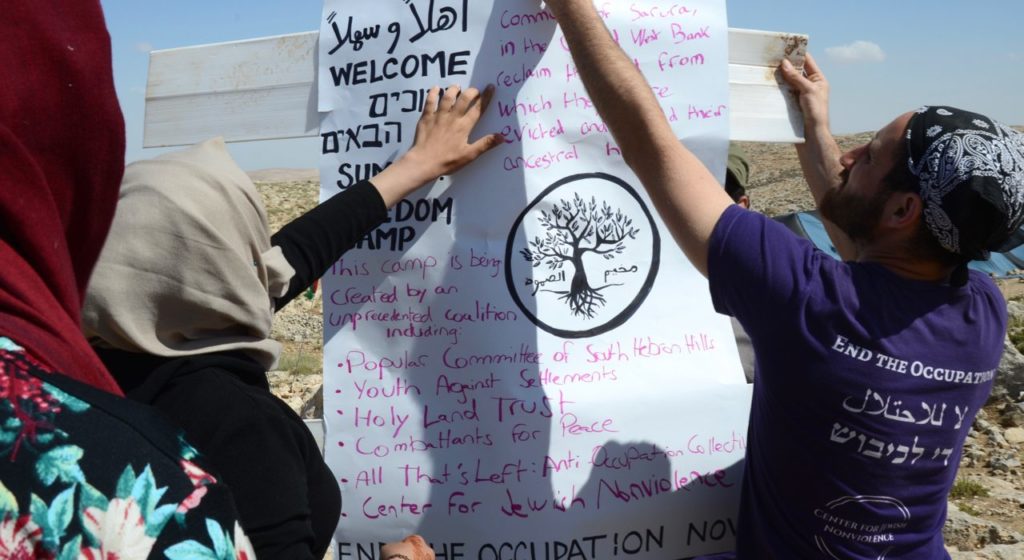
This spring, along with over 130 diaspora Jews, I traveled to Israel/Palestine to work with Palestinian and Israeli non-violent activists who oppose the occupation that keeps millions of Palestinians under military control. Ours was a diverse delegation with regard to politics (Zionist, non, and anti-), ethnicity (Jews of many colors), and religious observance (most denominations and ranging from orthopractic to atheist). With our new friends, we created Sumud (Steadfastness) Camp in the South Hebron Hills, a physical space dedicated for nonviolent activism, located in Area C which is entirely under Israeli military control. We worked, ate, prayed, danced and slept under the stars together even after the Israeli army came and tore our tents down. Beleaguered as it is, Sumud Camp, as of this writing, is alive.

Here, on the JStreet blog, are several accounts of our journey (including another of my own). PLEASE check out the words and images brought by these dedicated Jewish activists. Meanwhile, in an earlier post, I promised you a Shabbat story, so here it is:

Pirkei Avot 4:1Ben Zoma says: Who is wise? The one who learns from all persons, as it says, “I have acquired understanding from all my teachers” (Psalms 119:99). Who is mighty? The one who conquers impulse, as it says, “slowness to anger is better than a mighty person and the ruler of his spirit [is better] than the conqueror of a city.” (Proverbs 16:32). Who is rich? The one who is happy with his portion, as it says, “When you eat [from] the work of your hands, you will be happy, and it will be well with you” (Psalms 128:2). “You will be happy” in this world, and “it will be well with you” in the world to come. Who is honored? The who honors the created [human] beings, as it says, “For those who honor Me, I will honor; and those who despise Me will be held in little esteem” (I Samuel 2:30).

Just prior to Shavuos, I had the honor to share Shabbat with someone who is wise, mighty, rich, and honored. One of our projects at Sumud Camp was the rehabilitation of housing that had been lost when the village was dispossessed by the Israeli army about 20 years ago. Families from the original village of Sarura, where Sumud Camp is located, had joined us with the goal of returning home, among them a gentleman named Fadal Aamer who had been born in Sarura 55 years prior. Fadal’s family were among those Hebron Hills families who had, for generations, converted the region’s many caves into homes—calking the walls to keep out snakes and scorpions, plastering the ground and creating rooms with doors that close. This is a brilliant way to live in the land’s demanding climate; cave homes are insulated from heat by day and cold by night and do not, of course, deface the landscape or take up soil that could be used for agriculture or herding. All Fadal’s family wanted was a return to their familial land and their traditional way of life.

The first Shabbat that our group spent at Sumud Camp coincided with our learning of parashat Behar-Bechukotai. And Fadal became our teacher.

Fadal joined our Shabbat shachrit service just as we were beginning our study of the Yovel (Jubilee), that half-century mark when, our Torah teaches, slaves in Eretz Yisroel go free, debts are forgiven, and all land that had been bought and sold is returned to familial ownership. “כִּי־לִ֖י הָאָ֑רֶץ כִּֽי־גֵרִ֧ים וְתוֹשָׁבִ֛ים אַתֶּ֖ם עִמָּדִֽי” we read, “For the land is Mine [says HaShem], and you [the ancient Hebrews] are resident aliens with Me.” (Leviticus/Vayikra 25:23) We learn that our tenancy upon the land depends on the ways in which we treat one another, other peoples, and the earth itself.

Our group included both English and Hebrew speakers, Fadal among the latter. In Hebrew, he offered his teaching on the parashah: Each person—Jew, Muslim, Christian, Buddhist—everyone, is given a portion by God. The ikar (the key point) is to live well in gratitude, righteousness, and peace without displacing or harming anyone else. If we do live just that way, there is room on this earth for all of us. After our discussion of the parashah, Fadal excused himself and we returned to the Shabbat Shachrit liturgy. His gentle, gracious presence had been a blessing.

I would learn, after returning home, that Fadel Aamer had been knocked to the ground by Israeli soldiers who had raided the camp. An ambulance was called for him and he was pronounced well enough not to be hospitalized. He and his family remain hopeful that this new movement for nonviolent activism will make it possible for them to remain with their caves, their wells, and their way of living in harmony with the land.

Historians remain divided on the question of whether the Yovel was ever enacted. However, its vision of debts forgiven and slavery ended continues to inspire. The vision of Yovel, the Jubilee is now threaded into the American popular imagination. African-American slaves took up the story, working for the day when they would be freed from their own bondage. Union troops, entering the South during the Civil War, sang “Hurrah, hurrah, we bring the Jubilee, Hurrah, hurrah, the flag that makes men free…” In our own century, movements against the debt bondage that has ruined so many lives invoke the Jubilee. And on Shabbat, in the South Hebron Hills, a Bedouin/Palestinian peace activist raised us up with a vision of his own family returned to their holdings living with their neighbors in peace.

Sumud Freedom Camp: A Vision of Jubilee Read More »

5-year-old Arabella Kushner loves Israel and wants to be a Marine. But should Ivanka be sharing this?

By now, some of you may know a bunch of random but adorable facts about 5-year-old Arabella Kushner, the granddaughter of President Donald Trump. For instance, she likes Israel more than she likes ants, she loves fidget spinners and she wants to be a Marine when she grows up.

We know all this because her mother, Ivanka Trump, posted Arabella’s answers to a questionnaire made by her kindergarten classmates on social media last week.

News outlets pounced on the story, as Arabella is the daughter of the country’s most talked about Jewish power couple and anything that Ivanka Trump or her husband, Jared Kushner, do is intensely scrutinized. Besides, Arabella is really cute and her answers were priceless.

But should she be dragged into the political arena?

Ivanka’s tweet about her daughter’s harmless kindergarten quiz — like so many of her other social media posts — provoked a stream of hateful and political comments.

https://twitter.com/karterhol/status/873501831523176449

Ivanka put Arabella at the center of a social media post just two days before the questionnaire post, tweeting an image of Arabella learning the basics of coding — which, unsurprisingly, also produced negative comments.

Arabella is not a special adviser or unpaid public aide to the president of the United States. She is not advocating for any government policies or defending the president against public criticism. She’s a kid — and she may not want tens of thousands of people to know that if she were a bird, she would eat 1,000 worms a day.

When Ivanka posted her daughter’s answers on Twitter and Facebook, she was likely doing so as the doting mother that she is. She probably just adored her daughter’s answers and wanted to share them with her friends and supporters. And there were some nice responses to the tweet.

But Trump’s Twitter account is hardly “personal.” It combines her roles as presidential adviser, self-help entrepreneur and brand manager, with frequent tweets about all three. In this promotional environment, mentions of her children appear to be in service to her political and professional agendas — inviting the kinds of push-back that Ivanka herself only yesterday called “vicious.”

Ivanka might not pay attention to the hateful responses. But maybe she should think twice before involving her 5-year-old daughter so personally on social media pages that she uses to promote the administration she serves and the businesses she runs. Maybe she should post these wonderful disclosures about her kids on a separate Facebook page only viewable to real family and friends.

Arabella may be partial to ice cream and rainbows and the Star of David — but she deserves to be treated as a real and private little girl, not a prop.

5-year-old Arabella Kushner loves Israel and wants to be a Marine. But should Ivanka be sharing this? Read More »

St. Louis man pleads guilty to cyberstalking in 8 bomb threats against Jewish institutions

A St. Louis man accused of making eight bomb threats against Jewish institutions pleaded guilty to cyberstalking charges.

Juan Thompson, 32, also pleaded guilty on Tuesday in a U.S. District Court in Manhattan to a charge of conveying false information and hoaxes, The Associated Press reported. In April, the former journalist denied the charges.

The cyberstalking charges are for eight threats against Jewish community centers and the Anti-Defamation League, which federal prosecutors say were copycat crimes during a wave of nearly 150 bomb threats to Jewish institutions during the first three months of this year. Nearly three weeks after Thompson’s arrest, an Israeli-American teen was arrested in Israel for allegedly making the bulk of the threats.

In Thompson’s case, the government collected evidence from about two dozen laptops, tablets and cellphones seized from his home, according to the AP.

Thompson, who previously worked as a journalist for The Intercept news website and was fired last year for ethics breaches, including manufacturing quotes, had said earlier that he had no anti-Semitic beliefs and was being framed as a black man. Prosecutors allege that the JCC bomb threats were part of a larger plot to take revenge on an ex-girlfriend.

He was arrested March 3 for the threats, which carry a penalty of up to five years in prison and a fine up to $250,000. Bail was denied at the time of his arrest.

The FBI complaint says Thompson threatened institutions including the ADL, JCCs in San Diego and New York City, schools in New York and Michigan, and a Jewish history museum in New York City.

St. Louis man pleads guilty to cyberstalking in 8 bomb threats against Jewish institutions Read More »