Taking care of our elderly parents or grandparents can be a tiring, daunting, and sometimes thankless task. In the US, we are a melting pot of a wide variety of cultures that have settled here and bring in their own ideas on how we care for the family. When it comes to caring for our elderly, we can take great inspiration from the Jewish community.
Inspiration Found in Wisdom
Much of what Judaism teaches is based on the understanding that with age comes wisdom. The longer we live, the more we experience, and the wiser we become. In many Jewish communities, one does not learn the Kabbalah until they are 40 or older. They need wisdom to fully learn and wisdom does not mean that you stop learning. Rather the wise are more open to learning from all their experiences. Because of this important focus on the elderly and all the wisdom they possess, caring for the older folks in the community is equally as important.
Caring in Sharing the Responsibilities
It is Jewish law that the children of the elderly care for them in every capacity possible. Depending on the severity of illness or aging, that can be easy or difficult. When it’s easy, it could be nothing more than installing a stair lift, outfitting the bathroom with shower chairs, or widening hallways to allow for a wheelchair to get through the house. Day to day tasks can be accomplished by driving the elderly on their errands, giving them the freedom to still do things and yet keeping them safe. Hiring a housekeeper, someone to mow the lawn, or taking turns helping with the upkeep of a home are all ways to care.
Many opt for moving the elderly into their own homes. For many cases, it makes it easier to care for their elderly by keeping them close and not worrying about the upkeep of two homes. While some of us may stress over the idea of moving their parents in, for the Jewish this is the way of life that they have witnessed since childhood. One simply doesn’t think that there are any other options available to them.
In the US, we have seen a rise in facilities that will make taking care of our elderly. They range from retirement communities to assisted living facilities and convalescent homes. They are designed to provide care for the elderly and allow families to enjoy their elderly rather than stress over their care. This works for many families but in some cases, it creates division. Adult children who need to work full-time and care for their own children full-time, find themselves in a predicament trying to spend time with their own parents who are conveniently cared by experts. It may seem easy in the Jewish faith to care for their own but what happens when someone needs nursing around the clock and the convalescent home suddenly seems like an easier option?
Ultimately, Jewish law states that adult children must care for their elderly. However, a growing number are starting to question the intent behind using a nursing home for care. Some argue that if the aging parent can still make decisions and wants to go, the children can place them in the home as a reasonable act of love. We will see if that becomes a trend or if the Jewish community will stay devoted as they have for so long.
It’s important to note that the Jewish faith honors all sorts of life stages. From the Bar/Bat Mitzvah to motherhood, to the elderly, there is much to appreciate and honor that happens in our lives!
Not long ago, a teen in our congregation walked past the above sign in the front office and into my study. (I wasn’t in there at the time). When I heard her voice, I went to my study, marched her out to read the sign, and waited for her response.
“I wasn’t here to see you,” she began with a smile. “I was here to get candy from your jar.”
I tried, I really tried not to burst out laughing. But I failed.
What can you do? To her credit, she was a very quick thinker.
It’s really important to be able to laugh in these circumstances. They offer a moment in time to deepen ourselves with reality, ground our hearts with levity, and lift our souls with joy. Seek out those moments, as they are the building blocks of life!
With love and Shalom,
Rabbi Zach Shapiro
Photo taken by Jeremy Gimbel
A change in perspective can shift the focus of our day – and even our lives. We have an opportunity to harness “a moment in time,” allowing our souls to be both grounded and lifted. This blog shows how the simplest of daily experiences can become the most meaningful of life’s blessings. All it takes is a moment in time.
Rabbi Zach Shapiro is the Spiritual Leader of Temple Akiba, a Reform Jewish Congregation in Culver City, CA.
That stereotypical ritual of the man making breakfast for the wife once a year on Mothers Day kind of falls apart in a home where the husband is the family cook. I made Naomi breakfast the Sunday before Mothers Day too, and the Sunday before that. And every Sunday of every year that we’ve been home. Making these pancakes still made this Mothers Day different from all others.
The week before Naomi was in New York. She came home raving about the Lemon Ricotta Pancakes at Café Luxembourg on the Upper West Side. When I asked her what she wanted for brunch on Mothers Day, she said Lemon Ricotta Pancakes. I made my version of them for her, adapting a recipe from pintsizedbaker.com. Two days later, I made them again, for dinner. This coming Sunday? I might make them again.
[RECIPE] Lemon Ricotta Pancakes with Blueberry Sauce
5 tablespoons unsalted butter, plus more for coating the frying pan and serving
1 cup whole milk
1 1/4 cups all-purpose flour
1 1/2 teaspoons baking powder
3/4 teaspoon salt
3 large eggs, yolks and whites separated
2 tablespoons granulated sugar
1 ½ tablespoons packed finely grated lemon zest (from about 3 to 4 medium lemons)
1/2 teaspoon vanilla extract
2/3 cup whole-milk ricotta cheese
Powdered sugar,
Blueberry Sauce
INSTRUCTIONS
Place butter and milk in a small saucepan over medium-low heat, stirring occasionally until butter has melted; remove from heat and let cool slightly.
In a medium bowl, sift together flour, baking powder, and 1/2 teaspoon of the salt; set aside.
Place egg yolks, 1 tablespoon of the sugar, lemon zest, and vanilla in a large bowl and whisk to combine. Whisk in a quarter of the milk-butter mixture (this will temper the eggs and prevent them from curdling), then whisk in the remaining milk-butter mixture until smooth.
Add the reserved flour mixture and stir with a rubber spatula until just combined (do not overmix); set aside.
In a medium bowl, whisk egg whites to soft peaks (they should bend like soft-serve ice cream; make sure the bowl and whisk are perfectly clean with no traces of grease, or the whites will not whip properly). Halfway through whisking them, sprinkle in the remaining 1 tablespoon sugar and 1/4 teaspoon salt. Using the rubber spatula, fold the whites into the reserved batter until just combined.
Gently fold the ricotta into the batter, being careful not to break down the texture of the cheese (the batter will be lumpy and streaked with ricotta); set aside.
Heat a large nonstick frying pan, griddle, or seasoned cast iron skillet over medium heat until hot, about 4 minutes. Test to see if the pan is hot enough by sprinkling a couple of drops of cold water in it: If the water bounces and sputters, the pan is ready to use.
Lightly coat the pan’s surface with butter, then use a 1/4-cup measure to scoop the batter into the pan. Cook until bubbles form on top of the pancakes, about 4 to 5 minutes. Flip and cook the other side until the bottoms are golden brown, about 1 to 2 minutes more. Repeat with the remaining batter. Serve immediately with powdered sugar and blueberry sauce.
Blueberry Sauce
INGREDIENTS
3 cups fresh blueberries
1 T. sugar
INSTRUCTIONS
First, taste the blueberries. If they are sweet, stick to a tablespoon of sugar. If they are tart, add more.
Put blueberries and sugar in a small saucepan. Heat over medium-high flame until the berries begin to pop and melt. You can speed the process by crushing them with a potato masher or heavy spoon. Bring to boil then lower heat and simmer until saucy but still fresh, about 10 minutes.
Let cool slightly. You can make ahead and refrigerate, covered, for a thicker sauce.
The Trump administration reportedly will not be moving the U.S. Embassy to Jerusalem from Tel Aviv for now.
An unnamed senior administration official on Wednesday told Bloomberg News that it would be “unwise to do it at this time” as President Donald Trump is getting ready to restart Israeli-Palestinian talks to move the embassy.
“We’ve been very clear what our position is and what we would like to see done,” the official said, “but we’re not looking to provoke anyone when everyone’s playing really nice.”
Congress recognized Jerusalem as Israeli in 1995, but successive presidents have waived a provision in that law that requires the United States to move the embassy there from Tel Aviv.
Trump campaigned on a pledge to move the embassy, but has retreated from it since assuming office. Next week he will be the first sitting U.S. president to visit the Western Wall in the Old City, but his team rejected a request from Israeli Prime Minister Benjamin Netanyahu to accompany him.
Trump’s national security adviser, H.R. McMaster, demurred this week when asked to say whether the administration regarded the Western Wall as part of Israel. However, the ambassador to the United Nations, Nikki Haley, said the same day that she sees it as Israeli.
The Orthodox Union, which had complained earlier in the week about McMaster’s comments, was “disappointed” in the news that Trump would not be moving the embassy now, said Nathan Diament, its Washington director.
However, Diament said in an interview, his group was still watching to see whether Trump would exercise the six-month waiver of the 1995 law, which every president has done since the law was passed, and which he must do by June 1.
“If he were to announce next week or the week after that he’s not signing the national security waiver and if the process of evaluating how the move would take place were to begin, that would be a step in the right direction,” he said.
Meanwhile, a celebration at the Capitol marking the 50th anniversary of Jerusalem’s reunification drew top Congress members from both parties. Among those on hand were Rep. Ed Royce, R-Calif., the chairman of the U.S. House of Representatives Foreign Affairs Committee, and Rep. Steny Hoyer, D-Md., the House minority whip.
A number of Republican congressmen at the event alluded to McMaster’s refusal to name the Western Wall as Israeli territory and called for moving the embassy to Jerusalem.
Event sponsors included the Religious Zionists of America and another 24 pro-Israel and Jewish groups. The celebration coincided with the annual congressional lobbying day for one of the groups, NORPAC, among the preeminent pro-Israel political action committees.
Reps. Tom Suozzi, D-N.Y., and Francis Rooney, R-Fla., marked the celebration by introducing a nonbinding resolution celebrating Israel’s capture of the eastern portions of Jerusalem in the Six-Day War in 1967.
President Donald Trump waived nuclear sanctions on Iran, keeping in place the Iran nuclear deal he has derided, but added new sanctions relating to Iran’s testing of ballistic missiles.
The waiver Wednesday of sanctions related to Iran’s nuclear program has been expected since last month, when Secretary of State Rex Tillerson declared Iran to be in compliance with the 2015 agreement that relieves sanctions in exchange for rollbacks in Iran’s nuclear program.
Tillerson at that time said the Trump administration would nonetheless review the terms of the deal because of Iran’s violation of U.N. Security Council resolutions related to ballistic missile testing, as well as its backing of terrorism and taking sides in regional unrest. Iran backs the Assad regime in its bid to suppress the civil war in Syria, among other involvements in the region.
Missile testing and Iran’s involvement in terrorism and regional violence were not covered by the nuclear deal, and the Obama administration kept in place sanctions targeting Iran for those activities.
Trump during his campaign had derided the nuclear deal as the worst he had ever seen and said he would reconsider it, but unlike other Republican primary candidates, he did not say he would scrap it.
Under Obama, the United States joined five other major powers in forging the pact. Pulling out in the absence of clear Iranian violations would likely upset U.S. allies and other nations involved in making the deal work.
The new sanctions, added by the Treasure Department, target two senior Iranian officials and entities based in China and Iran that are supporting Iran’s missile program.
“This administration is committed to countering Iran’s destabilizing behavior, such as Iran’s development of ballistic missiles and support to the Assad regime,” Treasury Secretary Steven Mnuchin said in announcing the sanctions.
Separately, the State Department said it might add new sanctions targeting Iran’s human rights abuses, which also are not covered under the nuclear deal, also known as the Joint Comprehensive Plan of Action.
“As we continue to closely scrutinize Iran’s commitment to the JCPOA and develop a comprehensive Iran policy, we will continue to hold Iran accountable for its human rights abuses with new actions,” Stuart Jones, the acting assistant secretary of state for Near East affairs, said in a release.
Jones’ remarks accompanied the State Department’s semi-annual report to Congress on sanctions targeting Iran’s human rights abuses.
By eighth grade, Micha Thau knew he was gay. But he also knew that being gay was not acceptable in many of the Orthodox spaces he inhabited. So he buried that part of himself.
But it didn’t stay buried. He began to suffer headaches, vertigo and other physical symptoms he attributes to his feelings of intense isolation. He relished days when the symptoms would send him to the doctor, just because “I got to leave the hellhole that was my life.”
“There were times when it was just crushing,” said Thau, 18, who graduates from Shalhevet High School next month. “I thought it was over, like I really could see no light at the end of the tunnel.”
Youth in Thau’s position face few options, none particularly rosy. They can quit Orthodoxy and live out gay lives, either as secular Jews or within another branch of Judaism. They can stay in Orthodoxy and renounce a part of themselves, living in celibacy or difficult relationships. Or they can do as Thau did and fight for openness and inclusion, and risk becoming poster children.
Still, as the secular world increasingly has embraced same-sex couples, the Orthodox has not been left totally behind. A number of congregations and communities, pulled by the conscience of some of their members, are taking a hard, wrenching look at their laws and traditions, and how they impact Orthodox youth.
When Thau came out during his sophomore year to Rabbi Ari Segal, Shalhevet’s head of school, and Principal Rabbi Noam Weissman, he was literally shaking. The administrators were surprised by the toll it had taken just to talk to them.
“We thought we had done an amazing job” promoting inclusion, Segal told the Journal. “And it turned out he had waited to come out to us because he was scared — he didn’t know what the school’s position was.”
Shalhevet student Micha Thau last summer at the Jerusalem gay pride parade. Photo courtesy of Micha Thau
Segal has since emerged as an advocate for teens like Thau. In an opinion column in the Shalhevet school newspaper, he called the dilemma they face “the biggest challenge to emunah [faith] of our time.”
Thau’s coming out has turned into something like a coming out for the entire Modern Orthodox community in Los Angeles: a highly visible test case for a virtually invisible issue. Thau has joined with Shalhevet’s administration to reshape perceptions of lesbians, gays and bisexuals in a religious community pulled in opposing directions — toward acceptance by its modernity and toward silence by its Orthodoxy.
The letter of the law
For the young people caught up in that struggle, the root of the problem lies in Leviticus, which labels gay sex a toevah, most often translated as an abomination, and, a couple of chapters later, prescribes the death penalty as punishment.
Strains of Judaism differ in how this law, like most laws, is applied. Reform Judaism suspends the prohibition, allowing clergy to officiate same-sex marriages. The two greater Los Angeles synagogues with outreach programs for gay, lesbian, bisexual and transgender members, Congregation Kol Ami in West Hollywood and Beth Chayim Chadashim in Mid-City Los Angeles, are aligned with the Union for Reform Judaism.
Conservative Judaism openly grapples with the law. As of a 2006 Rabbinical Assembly decision, gays and lesbians have been welcomed into Conservative congregations and rabbinical posts, but sex between men remains prohibited — the 2006 ruling did not address sex between women — and deliberations continue on same-sex marriage.
Orthodoxy generally adheres to the letter of the law, and homosexuality is no exception. Though outright hostility toward gays, lesbians and bisexuals is less common in the United States than it was before legalized same-sex marriage, so too is unconditional acceptance. Orthodox teens struggling with their sexual orientation in this environment can’t be sure how their communities will react if they come out, or whether they will risk losing friends and family.
Photo by Fabio Sexio/Agencia O Globo
It’s impossible to know how many teens are caught between their Jewish faith and their sexual orientation. Within the general population, multiple studies have found that around 3.5 percent of respondents self-identify as gay, lesbian or bisexual. But even those studies may not reflect an accurate count because not all respondents provide truthful answers, and many surveys, including the U.S. Census Bureau, do not ask about sexual orientation.
At Shalhevet alone, a school with an enrollment of slightly more than 200, general population estimates suggest there are something like eight lesbian, gay or bisexual students. Thau said he currently is the only out gay student at the school.
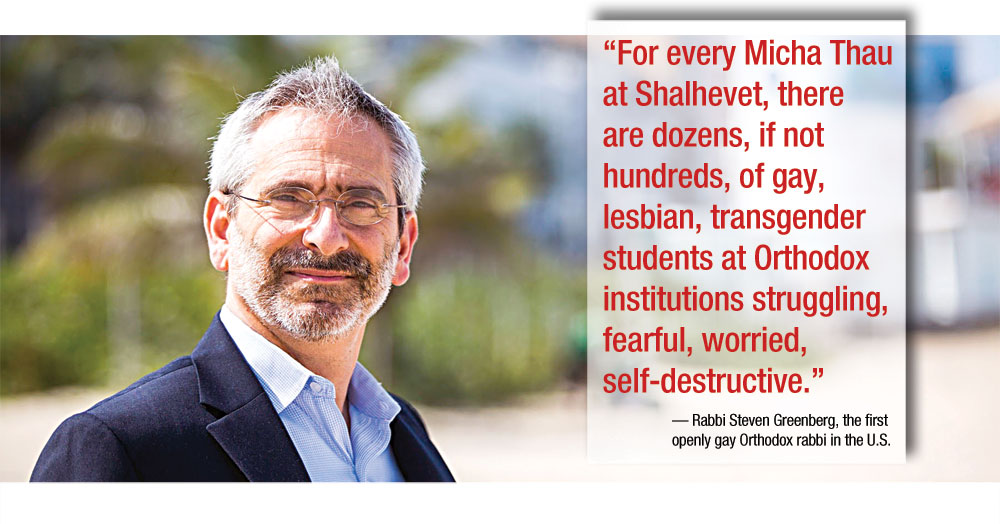
“For every Micha Thau at Shalhevet, there are dozens, if not hundreds, of gay, lesbian, transgender students at Orthodox institutions struggling, fearful, worried, self-destructive,” said Rabbi Steven Greenberg, the first openly gay Orthodox rabbi in the U.S. and an activist for LGBT Jews.
Walking a fine line
For Modern Orthodox communities, the word of biblical law translates practically into a stance that neither embraces same-sex partnerships nor outright condemns those who choose to undertake them.
“On the one hand, we’re not going to support it,” Rabbi Steven Weil, senior managing director of the Orthodox Union, one of the major national Orthodox institutions in the United States, told the Journal. “But on the other hand, we’re going to do everything we can to make sure that gay and lesbian members feel as much a part of the community as anyone else.”
Nonetheless, the model of an Orthodox marriage, without a doubt, is a husband and wife. Weil said, “Where there’s a little bit of pushback is where a couple wants to be discussed as ‘Mr. and Mr.’ or ‘Mrs. and Mrs.’ ”
For teens contemplating their romantic and religious futures, the range of answers they might receive from rabbis and school administrators is wide. For now, Shalhevet seems to represent the most progressive response they might receive in Los Angeles.
Valley Torah High School in Valley Village occupies a more conservative place on the spectrum. Reached by phone, Rabbi Avrohom Stulberger, the head of school, was quick to note that intolerance against gays, lesbians and bisexuals is not welcome.
“With my students, I feel it’s important that they understand that this is not something that we look down upon,” he said. “This is not a choice that people make.”
However, he wouldn’t budge on the issue of Jewish law: The rules are clear, and a student who wanted to live an out gay or lesbian life at the Orthodox high school would run into trouble.
“This would be inconsistent with the atmosphere — for a kid to say, ‘I’m gay, I’m acting out on it and I want to be a member of Valley Torah in good standing,’ ” he said. “It’s inconsistent from a halachic viewpoint.”
Asked whether such a student could, for instance, lead prayer services or school activities, he answered, “In 31 years, it hasn’t happened. But honestly, let’s just sort of change the question. I’d have the same dilemma if a kid came to me and said, ‘Rabbi, I love Valley Torah but I’m just eating at McDonald’s every night. That’s who I am.’ ”
At YULA Girls High School, the policy on gay, lesbian and bisexual students is in flux.
“We’ve had internal discussions, but we haven’t yet formulated a policy,” said Head of School Rabbi Abraham Lieberman, who plans to leave YULA Girls this summer after leading it since 2008. “It would obviously include the greatest amount of respect for the students and understanding of whatever they’re going through.”
He said the heads of the area’s Orthodox schools — including YULA Girls, YULA Boys, Valley Torah and Shalhevet — meet periodically to discuss important issues, including this one. As of now, they haven’t formulated a conclusion. But Lieberman expects that soon most local Orthodox schools will provide statements or policies on the matter.
As attitudes about homosexuality have shifted, with gay rights and narratives becoming more mainstream, hard-line positions have become more difficult to maintain.
Thau recalled telling his grandfather that he was gay and getting a surprising answer.
“He said, ‘So?’ ” Thau recalled. “And he said, ‘If you had told me that 10 years ago, I would have had a very different reaction.’ ”
Thau went on, “As much as the Orthodox community tries to isolate itself from the secular world, there are always cracks in the wall — no matter how high the wall is. Culture will always bleed through.”
Caught in the middle
But ensconced behind the walls of a Torah-observant lifestyle, many teens still face an awful choice between God and love.
“When you’re living in the Orthodox community, being gay and being religious — they’re not cohesive,” said Jeremy Borison, 25, who grew up in Cleveland and now lives in Los Angeles. “So me, if I had to choose one, I was gonna stay with the religious side of it.”
He said he’s now able to balance his faith and sexual orientation — but only because he found a welcoming community in B’nai David-Judea, an Orthodox synagogue in Pico-Robertson, where Senior Rabbi Yosef Kanefsky has been outspoken in favor of greater acceptance of gays and lesbians.
Others, like David, a gay man in his 20s who grew up in an Orthodox family in Los Angeles, no longer feel like they have a place in the Orthodox community.
Some of the gay and lesbian individuals interviewed for this story, including David, asked not to be identified by their real names or even the schools they attended, fearing they and their families would face sigma and untoward gossip. David still is wary about sharing his story publicly, for that reason.
At the Orthodox high school he attended in L.A., he knew he was attracted boys, but thought it was a phase, something all teenagers go through. There were no Orthodox Jews who were gay, as far as he knew; it simply wasn’t conceivable.
He had a good time during his high school years, though, enjoying his religious education and even getting close to some of the rabbis. But by the time he found himself in yeshiva in Israel, in a completely different environment, he realized his feelings weren’t going to go away. His first reaction was to treat them as something wrong with him that needed to be fixed.
A good deal of therapy later, David is leading an out gay life, but he finds that he’s uncomfortable in Orthodox spaces. His experience didn’t make him hate Judaism; he’s still finding his place in the religion. But he no longer considers himself Orthodox. How could he feel welcome in a community that considers who he is to be a great sin?
Every problem begs a solution
From time to time, students approach Stulberger, the head of school at Valley Torah, struggling with feelings of attraction to members of the same gender. Stulberger said he has “helped many students over the years in their struggle — but in a private way.”
His first reaction when students come to him with this issue is to assure them, “We are here to talk to; we are here to help you.” But after that he draws a line: “What I won’t do is give the indication that giving into your same-sex attraction is something that’s acceptable.”
To these students, he presents two options. One is celibacy. The other is to “get help, find the right professional who can help you to reorient.”
Stulberger alleges there are thousands of young men who have changed their sexual orientation with professional help. While the scientific and LGBT communities dispute its effectiveness, the internet is filled with testimonies from people who claim to lead happy, heterosexual lives as a result of “reparative therapy.” Stulberger even knows a handful of them, he said.
One of those is Naim, an Orthodox man in his early 30s who attended Valley Torah and who asked to be identified only by his middle name. For years, he struggled with his attraction to men but rejected the idea of living an out gay life.
“I didn’t want that lifestyle,” he said. “I wanted to get married. I wanted to have a family. I wanted to do what men do — period.”
Photo by Eitan Arom
By the time he was 28, he said, he’d been in and out of rehab for drug addiction and was addicted to gay porn. Then, he made an electrifying discovery on the internet.
“There’s a whole community out there — Jews and non-Jews alike — that don’t want to live that lifestyle and have struggled with it and gotten help, and now they’re married,” he said. “I thought, ‘Wow, this is incredible, God is talking to me right now. Why did it take 28 years to tell me this?’ ”
He enrolled in reparative therapy designed around what he called a “gender wholeness model.” He identified factors such as a troubled relationship with his father and an unhealthy identification with traits he admired in other men as the cause of his same-sex attraction, which he referred to as SSA. He treated it like a condition that needed to be fixed, he said, and he began to heal.
“My attraction for men has diminished significantly,” he said. “Usually, my SSA, on a scale of 1 to 10, is at a 0.”
Now, he’s looking for a wife.
“There are still days when I struggle every once in a while,” he said. “Thank God it doesn’t happen very often.”
Taking a pledge
Told that a Los Angeles high school recommends reparative therapy, Rabbi Rachel Bat-Or of JQ International, a West Hollywood-based Jewish LGBT support and education organization, was horrified.
“What it does is, it encourages people to kill themselves,” she said. California law bans the practice for mental health providers.
David moved away from his Orthodox community after high school and hasn’t returned, but some of its stigmas and taboos lingered with him. He sought out reparative therapy while in college, and while he didn’t find it particularly traumatizing, he said it made him hate himself. Since then, he’s blocked much of it out in his mind.
Now, Segal and Thau at Shalhevet are asking other Jewish schools to affirm in a pledge, written jointly by Thau and the administration, that they “will not recommend, refer, or pressure students toward ‘reparative’ or ‘conversion therapy.’ ”
“We believe that’s damaging,” Segal said of the practice.
The pledge includes five other points — which Segal insisted schools can adopt altogether or individually — including an assurance that gay, lesbian and transgender students won’t be excluded from school activities and will be provided with support services. The full statement is available online at jewishschoolpledge.com. As of now, Shalhevet is the only school to have signed it.
Asked about the pledge, Lieberman, the head of YULA Girls, said, “It’s very powerful,” adding that if YULA Girls were to issue a policy about LGBT students, “it would definitely gravitate toward that.”
The idea of the pledge has its origins in Thau’s coming out to Segal and Weissman.
“What could we do?” Segal said he asked the teen. “What could we have communicated to you, Micha, that would have helped?”
Photo courtesy of Builders of Jewish Education
The administrators realized that communicating anything at all would have been a good start. Even though both men assumed a gay student would be welcomed, Thau struggled through years of uncertainty because they had never said as much publicly.
“Schools and communities and shuls should have this conversation and decide what they believe, and then publish it,” Segal said — even if it is less progressive than what Shalhevet came up with.
Bat-Or said she hopes other schools will follow Shalhevet’s lead and take steps toward inclusiveness, for instance by circulating JQ’s helpline for LGBT Jews and advertising their counselor’s offices as safes spaces for students questioning their sexual orientation.
“On a scale of 1 to 10, this is a 150,” she said of Shalhevet’s efforts. “I really mean that. It took huge courage for [Segal] and for Micha to get together and to do this.”
A movement in the making
Cases like Micha’s make it increasingly difficult for Orthodox communities to ignore issues faced by their lesbian, gay and bisexual members.
“Centrist Orthodoxy is conflicted and not admitting the conflict,” said Greenberg, a Yeshiva University-ordained rabbi who came out years later and co-founded Eshel, a Boston-based organization that promotes inclusiveness in Orthodox communities. “They are pulled by much more traditional frames, and they are pulled by the human realities they’re facing.”
At least in some communities, that conflict has meant a long, slow drift toward acceptance.
Elissa Kaplan, a clinical psychologist who came out as lesbian 15 years ago while living in an Orthodox community in suburban New Jersey, has watched attitudes change before her eyes.
“The world has changed since then,” Kaplan, 55, said. “Gay marriage is legal now in the civil world. That’s enormous, and it has an impact. It matters. Even people who say they are not influenced in their attitudes by what happens in the secular world — it’s just not true.”
She’s felt the impact of those changes herself, she said.
“My wife and I would go into one of the kosher restaurants in the area and might get dirty looks from people,” she said. “That really doesn’t happen anymore.”
In Los Angeles, that change has played out in parlor meetings where community members get together to grapple with the issue of inclusiveness. In March, some two dozen Jewish teens and parents gathered in the dining room of a Beverlywood home, sitting on folding chairs and nibbling on cookies and cut fruit as they listened to Greenberg speak.
The parlor meeting was the work of Eshel L.A., a local group allied with the Boston-based organization. It first convened in June 2015, when Harry Nelson, a local health care attorney, invited community members to his home to meet Greenberg and Eshel’s other co-founder, Miryam Kabakov, the group’s executive director.
From there, they formed a steering committee. That December, they had the first of many parlor meetings on topics like how to curb homophobic comments at the Shabbat table and how to talk to their children about same-sex couples.
“The thing that struck me most with this issue is that the Orthodox tradition that I so value and the Orthodox lifestyle I so love were creating pain, intolerable pain, for people who are gay,” said Julie Gruenbaum Fax, one of Eshel L.A.’s principal organizers and a former Jewish Journal staff writer.
Fax and her peers are looking to create Orthodox spaces where lesbians, gays and bisexuals can exist openly and comfortably. Sometimes, that entails actually grappling with Jewish law. At the parlor meeting in March, Greenberg, 60, who has salt-and-pepper stubble and a professorial air, moved fluently through the halachah and commentary on the topic of homosexuality.
On the face of it, the law as it is appears in the Torah seems clear enough. Leviticus 18:22 states, “Do not lie with a male as one lies with a woman; it is an abhorrence.”
But Greenberg pointed out to his Beverlywood audience that the rabbinate has created work-arounds for all kinds of mandates and prohibitions, such as those against carrying objects outside the home on Shabbat or farming during a jubilee year. The laws governing these exceptions are complex, but the point is, they are negotiable — unlike homosexuality, for most Orthodox rabbis.
During his presentations, Greenberg is careful to allow room for dissent and questions, and community members frequently take him up. One woman at the meeting, who wore a long black skirt and said she’d adopted Orthodoxy later in life, admitted that the concept of full acceptance for gays and lesbians in the Orthodox community makes her uncomfortable.
“I did this to bring boundaries to my life, to my kids,” she said of her decision to begin strictly observing Jewish law. “So when we start to open things up,it scares me.”
She continued on the topic of boundaries: If you’re going to toss out the prohibition on gays and lesbians, she suggested, why not let women wear jeans instead of skirts?
Thau was sitting in the front row. As the woman went on, he turned around and began to cut her off, looking upset, but Greenberg gently put a hand on his shoulder, and Thau sat back in his chair. During an interview a week later, Thau said he was grateful to Greenberg for stopping him from saying something he might regret.
“I’m always in the hot seat as the poster boy for gay people, answering all the questions,” he said. “And it’s not a role I’m unwilling to take, but it is very difficult to be perfect all the time.”
Inching forward
Becoming a poster child is exactly what Nechama wants to avoid if she decides to come out.
A student at Shalhevet who asked that her real name not to be used, Nechama said she’s only questioning her sexual identity. But if she were to come out, she would be hesitant to speak about it with too many people at her school.
“I just feel very uncomfortable with the idea of being gay in a Modern Orthodox school,” she said.
While the school itself is progressive enough, some students come from more conservative backgrounds, she said.
She said she hopes to remain Orthodox, even though she struggles with some of the Jewish laws she’d be obligated to observe. To the community at large, her only plea was for empathy.
“We’re teenagers and we’re going through confusing times,” she said. She urged peers and parents “just to hear everything out, because it’s kind of hard to be alone in something like this.”
For his part, Greenberg is clear-eyed about the work in front of him: Creating a fully accepting Orthodox community will be neither quick nor easy. But he holds it as the responsibility of Orthodox leaders to sympathize with members of their communities who struggle with their identities.
“If you’re not willing to suffer with that kid who is caught in the crosshairs of this cultural and religious conflict,” he said, “if you’re not willing to be with that kid, then you don’t deserve the role of leadership.”
Mort Klein, President of the Zionist Organization of America (ZOA), on Wednesday released a statement calling on President Donald Trump to fire the administration’s designated point person on the Israeli-Palestinian conflict, Kris Bauman, labeling him a supporter of the terrorist group Hamas.
“The ZOA has asked General McMaster, Director of the National Security Council, to reconsider his appointment new National Security Council advisor on Israel-Palestinian matters, pro-Hamas Kris Bauman,” Klein said in the lengthy statement. “This administration should be “cleaning out the swamp” from proponents, architects, and protégés of the Obama administration’s dangerous Middle East policies. Mr. Bauman’s ideas are particularly dangerous.”
Bauman was appointed as the National Security Council’s point person for the Israeli-Palestinian issue earlier this month, replacing Yael Lempert who left to work at the State Department. Bauman was General (Ret) John R. Allen’s Chief of Staff when Allen served in the Obama administration as Senior Advisor to the Secretary of Defense on Middle East Security. During the last round of peace talks (2013-2014), Gen. Allen drafted a comprehensive security plan for the day after a peace settlement is reached.
The ZOA’s Klein — who was one of the few public defenders for a pair of controversial Trump advisors, Steve Bannon and Sebastian Gorka — is blaming recent White House decisions that he disagrees with on other advisors, including Bauman, and outside consultants, such as the former Secretary of State James Baker.
In an interview with Jewish Insider earlier this week, Klein claimed the President “is getting bad advice from some of his aides.” He added that he’s worried about Rex Tillerson, citing the current Secretary of State’s relationship with Baker. “I am concerned that Tillerson will begin to pressure Israel to take stands that they can’t take,” he said. “I am worried.”
According to Klein, Bauman’s plan would force Israel to make “dangerous concessions to terrorists” and establish “unacceptably risky security arrangements in exchange for Israel retreating to the indefensible 1967 lines with swaps, to make way for a Hamas-Fatah (terrorist) state” in the West Bank. “ZOA sincerely hopes that the President will drain the swamp at the National Security Council, once and for all,” Klein concluded.
Former U.S. Ambassador to Israel Daniel Shapiro called Klein’s statement “ridiculous” and “offensive.”
“Kris Bauman is a veteran, a patriot, and a dedicated friend of Israel,” Shapiro, who served as Ambassador to Israel from 2011-2017, told Jewish Insider. “He has worked for years, side-by-side with senior IDF leaders, to develop arrangements that would ensure Israel’s security in a two-state solution. To equate such efforts with being ‘pro-Hamas’ is beyond offensive — it’s ridiculous. It means that anyone who works for a two-state solution with provisions to protect Israel’s security is a terrorist supporter. That’s the majority of Israeli citizens, American Jews, Members of Congress, and IDF officers.”
Shapiro said that instead of getting into “overheated rhetoric,” the Trump administration should be commended for appointing Bauman to this position. “In my time working with Kris, I knew him to be conscientious, detail-oriented, and deeply committed to helping Israel maintain its security,” he stated. “But what most impressed me was the high esteem in which he was held by the IDF officers who worked with him. He earned their trust and friendship, which will serve him well in his new post.”
Michael Cohen is the first to admit his was not the typical path for a Jewish kid from Nashville.
After college, he enlisted in the Army with a plan to become an Army chaplain. He served five years before transitioning from active duty to the reserves to pursue his rabbinical studies at Hebrew Union College-Jewish Institute of Religion (HUC-JIR) in Los Angeles, and on May 14 he was ordained with 12 classmates at a ceremony at Temple Emanuel of Beverly Hills.
“In the Nashville Jewish community, much as in the national Jewish community, no one serves in the U.S. military,” said Cohen, 32, whose wife, Emily Hyatt Cohen, also was ordained on May 14. He added, recalling his childhood, “My parents are both from New York and were very anti anything that looked like military.”
Cohen attended Sunday school at a Reform synagogue but his parents were not particularly religious. In a community where Judaism was not universally embraced, he learned to keep his religion quiet. His father, who died when Cohen was 16, did become more observant toward the end of his life. “That inspired me,” Cohen said.
His parents’ military sentiments aside, Cohen was inspired by his Boy Scout troop leaders, many of whom served in the Vietnam War.
“I learned from an early age that national service is one of the highest forms of [giving] back to a nation that has provided freedom for us,” he said.
Cohen’s experiences in the military continue to inform his work as a chaplain — in 2015 he became the Army’s first Jewish chaplain to serve after receiving a master’s degree; all others had been ordained.
In the Army, Cohen served in psychological operations — or, in layman’s terms, marketing. The goal was to get the local population to embrace the Army’s objectives through various media. Following the devastating 2010 earthquake in Haiti, he was with the 82nd Airborne Division, on a four-month humanitarian mission in support of the United Nations. Later, he spent a year in Afghanistan.
His most memorable interaction with an Army chaplain during his early service was far from positive. “I had a chaplain try to convince me that Judaism was proven false, was an antiquated religion,” Cohen said.
Other experiences with chaplains, while limited, weren’t much better, with one major exception. During his last year of active duty, Cohen had the opportunity to shadow a chaplain, an Eastern Orthodox priest and former officer, who was consistently friendly, accessible and comforting, Cohen said. “He was the chaplain I saw myself wanting to be.”
Cohen met Rabbi Larry Goldmark during his second year of studies at HUC-JIR. Goldmark was the leader of Temple Beth Ohr in La Mirada from 1979 to 2008 and for the past eight years has been a volunteer at the college, working closely with rabbinical students.
As a member of the reserves, Cohen sometimes wore his uniform to school, prompting Goldmark to offer that he, too, had been an Army chaplain. “We shared stories,” Cohen said.
From that day, Goldmark became one of Cohen’s closest confidantes.
“At different points in time, I felt a little browbeaten for my choice in career, stance on the military and support of the military,” Cohen said of his years of study. He recalled several occasions when a faculty member asked to reschedulea meeting because Cohen wore his uniform, rather than civilian clothes. Another time, a professor told him that people who join the military are naturally more inclined to be violent. Cohen made clear his disagreement.
“I felt a little bit like a pariah,” he said. “I would go to [Goldmark]. I would talk to him. He would comfort me and console me. He would be the person who understood what I was doing. He helped me maintain my faith.”
Cohen attributes the negative responses he faced to liberal and progressive attitudes toward the military that harken back to the Vietnam era and the mandatory registration for the Selective Service draft. “I compare it to nowadays when we have a professional, 100 percent volunteer army,” Cohen said. “It certainly isn’t what it was.”
He also faced other kinds of prejudice in the Army. He recalled adrill sergeant who called him “bagel” for four months. “A lot of things like that happened,” he said. “I had to push my Judaism aside and emphasize the soldier part. Now, I literally wear my religion on my chest.” Above his name on his uniform is an image of the two tablets of the Ten Commandments and a Jewish star.
Cohen’s experiences in the military continue to inform his work as a chaplain — in 2015 he became the Army’s first Jewish chaplain to serve after receiving a master’s degree; all others had been ordained.
One lesson he learned early on is the importance for a soldier to remain true to his religion.
“When service members come to me and say, ‘Can we do a Shabbat service?’ or do a certain thing here, in one part of my brain I have to think, maybe this is the only point during the week or month that this soldier can act Jewish,” he said.
Cohen, who has a young child, will return to active service in June, based at Fort Stewart in Georgia, and will spend much of 2018 in South Korea with the Third Infantry Division.
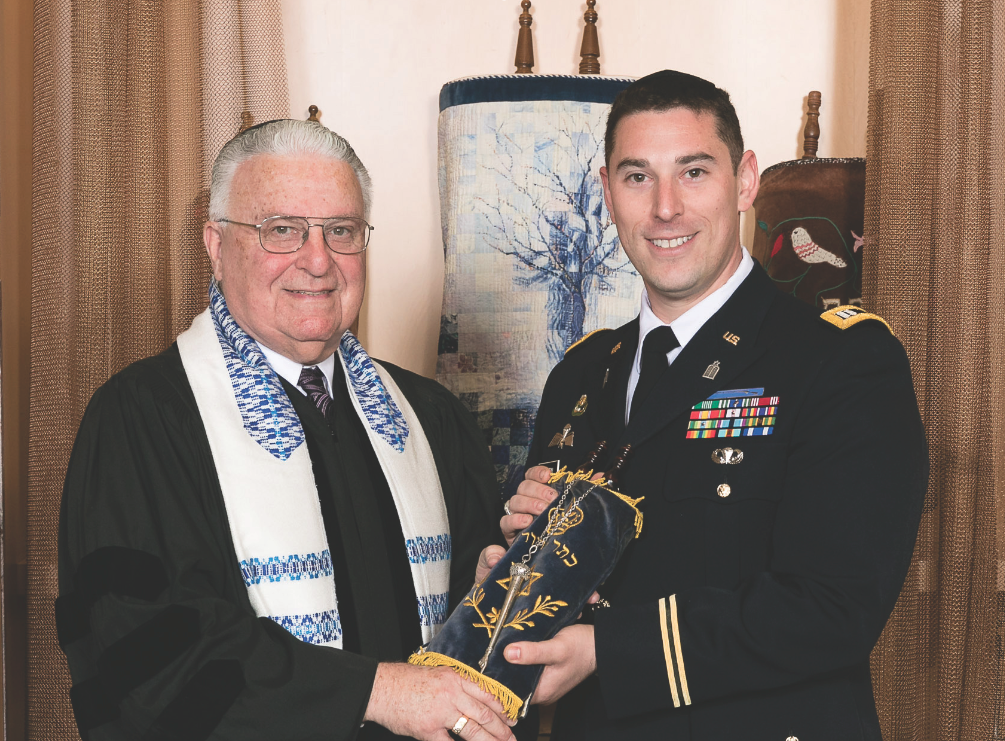
Rabbi Larry Goldmark’s Torah was a graduation gift to Rabbi Michael Cohen. Photo by Marvin Steindler
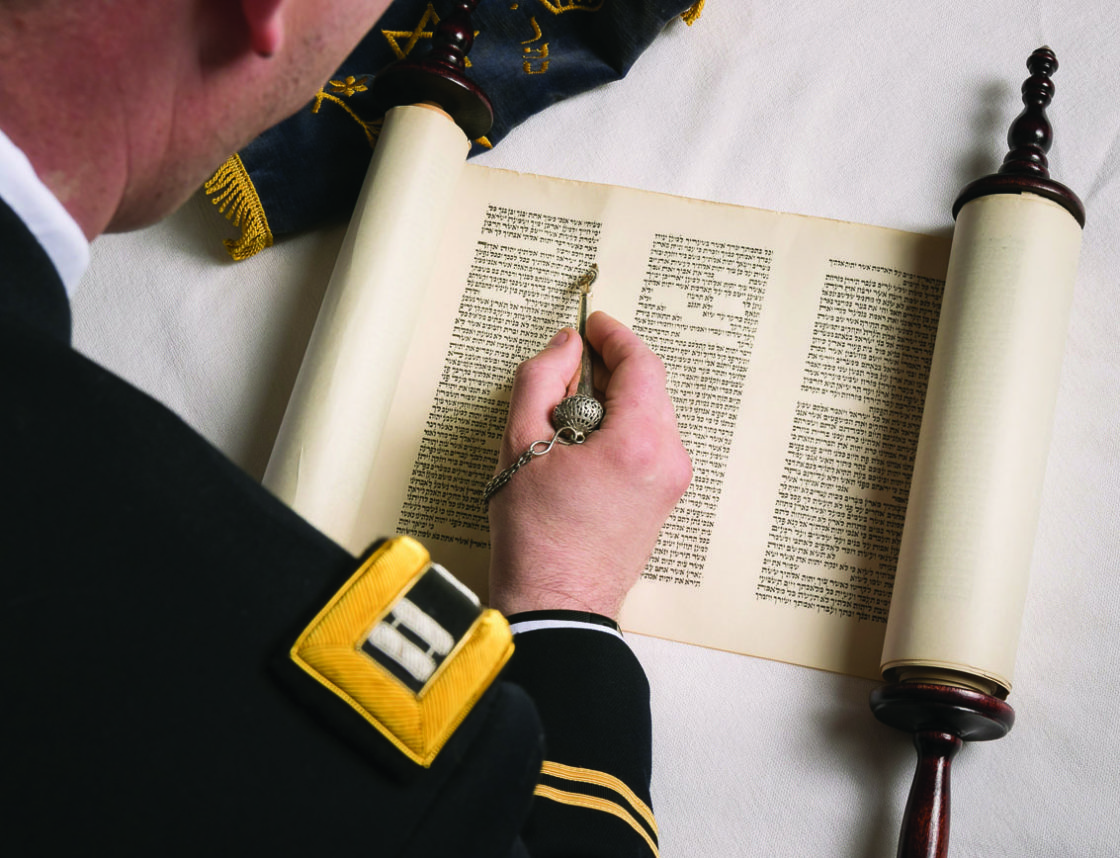
This time, he will have a beautiful hand-calligraphed Torah to use for Saturday morning Shabbat services and other occasions. The Torah was a graduation gift from Goldmark, who received it nearly 50 years ago when he began his military service. It was part of a kit given to him by the Jewish Welfare Board, now the Jewish Chaplains Council, that also included a Kiddush Cup and candles.
“[Michael’s] dedication, to both the military and being a rabbi, I find so overwhelming,” Goldmark said. “It led me to this idea of giving this Torah to him. … I wanted it to be perpetuated with the next generation of Jewish chaplains rather than sit in my library. I want it to be used, to have an immediate impact on the people that Michael is serving.”
Cohen initially declined, believing it was more than he could accept. He suggested he would take it on the condition that it was a loan.
“His response was, ‘No, it needs to be with soldiers. I want you to have it,’ ” Cohen said. “Ultimately, I was very appreciative and grateful, and I expressed that to him. … To me, a tallit or kippah or a siddur, all these things are sacred and have these mystical qualities. So when someone says, I am going to give you a Torah, that just kind of blew my mind.”
Cohen added, “I have this really wonderful idea that when I am done with my 20 years and retiring, that I can pass it along to someone else. … It’s not like there’s an updated version with a new chapter. … It will transcend Larry and myself and have its own legacy [of] providing service to soldiers.”
An array of Jewish organizations has joined forces to tell lawmakers in Sacramento to stand up for immigrants, protect houses of faith and reduce child poverty.
The Jewish Public Affairs Committee of California (JPAC) is the largest single-state coalition of Jewish organizations in the nation, comprising local Jewish federations, Jewish community relations committees and councils, and other Jewish community advocacy groups such as Hadassah, the Anti-Defamation League and the Jewish Family Service.
Every year, its members converge at the Capitol to lobby state senators, assemblymembers and legislative staff on behalf of issues that its member organizations deem important to the Jewish community. This year’s message was carried on May 9.
“Lawmakers want to hear from their constituents, not just from a lobbyist,” said Julie Zeisler, executive director of JPAC.
“They want to know that there’s actual community organizing going on that will impact them and their electability. They also need to know that the community really cares about these issues.”
In past years, JPAC members lobbied for issues of particular interest to Jews, such as support for Israel, divestment from Iran and opposition to the Boycott, Divestment and Sanctions (BDS) movement against Israel. They have also focused on universal issues such as renters’ rights, mental health services, gun control, human trafficking, employment retaliation and school bullying.
“We do a very detailed ranking system, because there are many issues that the Jewish community cares about,” Zeisler said. JPAC’s organizations then work to reach a consensus on the issues of greatest importance to their members.
Zeisler is a recent graduate of The Jewish Federation of Greater Los Angeles’ Rautenberg New Leaders Program. The program, which includes professionals working in government, law and entertainment, took part in JPAC this year. (Full disclosure: I am a current participant in the program and was invited to attend the event but did not take an active role in the lobbying meetings.)
This year, JPAC advocated for AB 1520, a bill that commits the Legislature to a goal of reducing child poverty in California by 50 percent over 20 years. It would achieve this through a designated task force and additional resources for social safety net programs, such as child care, housing subsidies and cash assistance.
JPAC also asked members to support the 16-member California Legislative Jewish Caucus’ request for $2 million for security grants for nonprofit centers, following a wave of threats against centers dedicated to Jewish, Muslim, LGBT, immigrant and other groups. The money could be spent on reinforced doors and gates, alarm systems, security trainings and other expenses.
The third focus of this year’s advocacy day was a package of seven bills related to immigration. These bills would counteract recent measures by President Donald Trump’s administration to ramp up deportation of undocumented immigrants and restrict citizens of six Muslim-majority countries from entering the United States.
The immigration bills would accomplish a number of things, including:
• Train public defenders on immigration rights.
• Prohibit landlords from threatening to report tenants to immigration authorities.
• Restrict Immigration and Customs Enforcement agents from freely entering a public school.
• Prevent the creation of a Muslim registry (or one for any religious, ethnic or national group).
• Prohibit state and local law enforcement from engaging in immigration enforcement.
While JPAC holds an advocacy day once a year, it also employs a lobbyist, Cliff Berg, to meet with lawmakers year round. Berg has represented JPAC for nearly 20 years and is seeing an increase in civic engagement.
“The Trump administration has served as a lightning rod for galvanizing Californians of all faiths and ethnicities to get more engaged in the political process and stand up for California values,” Berg said. “We are not a partisan organization, but I think our member organizations reflect the concerns and policy priorities of the majority of Californians.”
This year, JPAC invited Jewish student leaders from UCLA and Cal State Northridge to attend its advocacy day. As college campuses have become ground zero for debates about Israel and the BDS movement, “this is really important for our students’ leadership development, and it’s a great personal growth and learning opportunity for our students,” said Amir Kashfi, the incoming president of UCLA’s student Israel advocacy organization.
Before meeting with lawmakers, JPAC attendees listened to a series of speakers at a hotel near the Capitol address concerns about health care and immigration.
They also heard from two keynote speakers. The first, California Secretary of State Alex Padilla, encouraged residents of the state to take their issues to the Statehouse and their elected leaders. He said that when he’s asked what California can do to combat Trump’s policies, it comes down to “legislation, litigation and organization.”
The second, California Attorney General Xavier Becerra, a son of working-class Mexican immigrants, reminded the crowd that “there wasn’t a group that came to the U.S. that didn’t get vilified, that wasn’t ostracized, at first.”
Becerra has filed several lawsuits against the federal government on environmental issues, such as defending the Clean Power Plan and energy efficiency standards, while others targeted immigration actions, including the threat to withhold federal funds from so-called “sanctuary cities” and states that refuse to work with federal immigration agents.
“I’m talking to a crowd that understands the scourge of having labels applied to them,” Becerra told the audience.
Fully armed with data about health care and immigration, the JPAC crowd divided into small groups to meet with state lawmakers and their staffs.
But even if no decisions were reversed and no lawmaker was persuaded to change a vote, participants all seemed to agree that the effort to lobby lawmakers on behalf of the Jewish community is worth it.
“They are so excited to meet with us. They want to talk to us, they want to hear what we have to say,” said Stacey Dorenfeld of Hadassah Southern California. “The fact that we care makes them want to care.”
The topic of Israel divestment and higher education returned, front and center, last week as students at two Southern California universities voted on the issue — with differing results.
The student government at Cal State University Long Beach on May 10 voted in favor of Israel divestment while students at the UC Santa Barbara (UCSB) voted against it a day later.
Associated Students Inc., an advocacy group at Cal State Long Beach, passed a resolution calling on the university to divest from companies that the resolution alleges perpetuate Israeli oppression against the Palestinians, citing such companies as Caterpillar, General Electric and Hewlett-Packard. The vote was 15-7, with one abstention.
“I was very disappointed with the passage of the bill,” Jeffrey Blutinger, the Barbara and Ray Alpert Endowed Chair in Jewish Studies and the director of the Jewish studies program at Cal State Long Beach, told the Journal. “While I’m not going to say [all] anti-Zionism is anti-Semitic, this one is.”
The resolution is titled “Suggestions for Socially Responsible Investing: Companies Complicit in and Profiting from Palestinian Oppression.” General Electric, according to a draft of the resolution, has provided supplies to the Israel Defense Forces “used in violent attacks on people living in Israel and Palestine.”
The vote followed an April 26 statement by Cal State Long Beach President Jane Close Conoley expressing opposition to the resolution. She said she could not support it despite her reservations about the Israeli treatment of the Palestinians.
“A careful study of the BDS [Boycott, Divestment and Sanctions] movement illustrates to me that this movement is opposed to the existence of the State of Israel,” Conoley said.
Blutinger, faculty adviser at Beach Hillel, which serves Cal State Long Beach, said Conoley’s opposition to the resolution garnered criticism from pro-divestment faculty members.
“I thought that was nonsense. The fact that she spoke out does not prevent them from speaking out, and the fact she is the president of the university does not mean she doesn’t have the right to express herself,” he said. “If she was supporting them, they would have been happy.”
While the passage of the resolution at Cal State Long Beach is more symbolic than practical — it will not impact Cal State Long Beach investments — Beach Hillel Executive Director Rachel Kaplan said last week’s events reinforced the unwelcoming environment facing pro-Israel students. “In terms of campus climate, we have a lot of work to do,” Kaplan said.
Further north, the Associated Students of the University of California, Santa Barbara, the UCSB student senate, voted 16-0 with seven abstentions against an Israel divestment resolution, according to the Daily Nexus, the campus newspaper. The vote followed an all-night debate that concluded at 4 a.m. with more than 400 students and observers attending. Among them was Rabbi Evan Goodman, the Edgar M. Bronfman Executive Director at the Santa Barbara Hillel.
“Resolutions like this are symbolically attempting to destroy Israel, so I don’t stand for it and our students don’t stand for it,” Goodman said in a phone interview on May 12.
This was the fourth time in five years that a resolution calling for divestment in Israel has come before the UCSB student senate. Goodman described last week’s meeting as more agreeable than previous ones.
“It was a pretty civil discussion overall, and the comments made [on both sides of the debate] were by and large appropriate,” he said.
Rose Ettleson, a sophomore and president-elect at Santa Barbara Hillel, said a familial atmosphere galvanized the pro-Israel side.
“On our side, it really felt almost like a family gathering. There were lots of rabbis from the local Chabad. And the local Jewish Awareness Movement, JAM, they brought food for everyone. Hillel staff brought food. People were studying. People were writing what they were going to say,” she said. “Some people were sleeping in some moments.”
The campus group Students for Justice in Palestine on April 23 proposed the UCSB resolution, titled “Divest From Companies that Profit From Human Rights Violations in Palestine/Israel.”
The university “has the highest percentage of Jewish students in the UC system and probably the largest total number of undergraduate Jewish students,” Goodman said.
In statements released May 11, pro-Israel organization StandWithUs, which works with college students to combat anti-Israel sentiment, hailed the UCSB vote while condemning the vote at Cal State Long Beach.
Tali Shaddaei, a fifth-year Cal State Long Beach student from Pico-Robertson, said the intention of the resolution’s supporters at her school was to quiet pro-Israel advocacy on campus. But the 22-year-old founder of 49ers for Israel, a pro-Israel education club at Cal State Long Beach, said the passage of the resolution could have the opposite effect.
“My hope is it ignites a fire within the pro-Israel community to fight stronger and be more united in our efforts,” she said.