fbpx

April 26, 2017

Within Israel’s cauldron of conflict, George Deek wants to redefine the future

On a balmy day last summer, a charming young Israeli is touring me through Jaffa, where he lives, trying to talk over the noisy gusts blowing off the Mediterranean.

He stops on the Mifrats Shlomo Promenade, a few blocks from the beach, and looks up to admire the Mahmoudiya Mosque.

“This was built, like, 400 years ago by the Ottomans,” he says, almost boastfully. “You see those upside-down pillars there? It’s because, when the Ottomans used to conquer places, they’d come here and bring pillars from the place they conquered. Then they would place the pillars upside down as a show of conquest.”

Unfazed by the wild summer winds, he shows off this 4,000-year-old port city with the excitement of a child showing off his toys. As cars whiz past in HaShaon Square, he points to the famous Jaffa clock tower. “It was built by Sultan Abdul Hamid II,” he tells me. “It was the first mechanical clock in the Middle East.”

It’s clear my guide knows the history of this city as well as any scholar, and he rejoices in telling the stories behind every stone. He is an evangelist for Jaffa, elegant, ancient city of the Bible and multicultural melting pot of modern Israel.

Tel Aviv? “Rushed.” Herzliya? “Boring.” But Jaffa? “Proud, ancient, confident.”

Everywhere he looks, he sees the torrents of history fuse with the miracles of modernity: an old prison has become a luxury hotel; a dumping ground once known for crime and economic exploitation is now a beautiful seaside park. His rosy views are unusual in a complicated place like Israel. Most people associate the Jewish homeland with conflict, violence and endless Jewish-Arab tension. But not my guide. He sees only coexistence and possibility.

Jaffa is the place his family has called home for generations, and he possesses a passion for this city so typical of Jews for their homeland.

Only, my tour guide isn’t Jewish. Nor is he a tour guide.

He’s Arab. And he’s an Israeli diplomat.

Meet George Deek, the 33-year-old wunderkind from Israel’s Ministry of Foreign Affairs and, currently, the agency’s highest-ranking Arab statesman. Although his career there began only in 2008, Deek already has made his mark: He served as ambassador to Nigeria at the tender age of 25, and at 28 became acting ambassador in Norway, serving as Israel’s most senior spokesperson during the 2014 Gaza War.

Deek’s position makes him a striking anomaly in a country that has a tenuous relationship, at best, both with the Arabs within its borders and the Arab nations across the Middle East. As such, he’s viewed through a kaleidoscopic lens — as a symbol of the role Arabs could play in Israel’s democracy, but also as a subject of suspicion: Whose side is he really on?

And yet, for those seeking to move past the black-and-white dichotomies of the Arab-Israeli conflict, Deek represents something new: He is part of a growing movement of Arab Israelis who, rather than fight for a Palestinian state, are choosing to improve the quality of their lives within Israel. Both Jews and Arabs look to him as a kind of test case, and wonder: Will this work?

Elad Ratson, director of research and development for Israel’s Ministry of Foreign Affairs and a longtime friend of Deek’s, describes him as a pioneer in a societal shift. “The Arab community of Israel is beginning to understand that there’s a way to promote their own community needs by working from within the system,” Ratson told me.

“What George represents is the early [wave] of Arab Israelis that are saying, ‘Wait a minute, this Arab-Israeli conflict is ongoing, and Palestinian identity is getting more and more defined, and it doesn’t include me. I am an Arab Israeli; I am not Palestinian. I live in Israel. And I have no intention of packing my stuff and moving.”

When Deek first enrolled in the academy that trains candidates for the ministry, Ratson said some dismissed him as the agency’s “pet Arab” and assumed he’d “never be allowed access to real power.” Deek proved them wrong.

“All the skeptics from 10 years ago were not only wrong,” Ratson said, “George has surpassed many of them professionally. Today, he is handling the agendas of the most sensitive organizations in Israel. I cannot go further than that.”

A graduate of Radzyner Law School in Herzliya, Deek recently took time off from the ministry to study on a Fulbright Scholarship at Georgetown University in Washington, D.C. During his spare time, he bolstered his credentials — and his reputation — on the American-Jewish speaking circuit. But his most significant achievement came in March, when the ministry promoted him to adviser to Yuval Rotem, director general of the Israel Ministry of Foreign Affairs. That effectively places Deek in the ministry’s inner sanctum, among the most powerful few in Israel’s foreign service after Prime Minister Benjamin Netanyahu.

In a small, competitive country like Israel, where good jobs are not easy to obtain — even if you’re Israeli — Deek’s resume is exceptional. Even staunchly pro-Israel groups that resist dialogue with Arabs have invited Deek to speak, embracing his inclusive message. His very existence in Israel’s upper echelon seems to suggest that Arabs have it good there.

But Deek is in a difficult position. He’s part of a distrusted minority in Israel that must fight for equal opportunity at every turn. He’s an outsider among Israeli Jews and and outlier among Israeli Arabs. And as accomplished Arabs in Israel discover sooner or later, successful integration can bring accusations of betrayal.

“Arab society is more tribal than Western society,” Ratson told me. “George has to take into account his tribe way more than you or I have to. So if George continues to do what he’s doing, it’s because, at the end of the day, he gets the OK of the tribe.”

With or without  approval, George Deek is the eternal optimist, and his vision for the future of Israel and the Middle East sounds as promising and hopeful as those articulated by former Israeli leaders Yitzhak Rabin and Shimon Peres.

The question is: Is Israel’s democracy confident enough to indulge his aspirations?

“Allahu akbahr … Allahu akbahr.

In midafternoon, the Muslim call to prayer begins and the city trembles with sound. Deek chants along with the muezzin as we walk through an outdoor amphitheater near the Orthodox church where he worships. Dressed in khaki shorts and a T-shirt, he retains a dignified air. He has handsome, chiseled features and speaks in a confident tone. For a public official, he is surprisingly relaxed and candid, blending in easily as an ordinary citizen, even as most everyone seems to know him. “I’m more careful when I wear a suit,” he quips.

Deek may be the ultimate hyphenate, considering himself a Palestinian Arab-Israeli Orthodox Christian from Jaffa. Although he laments that it narrows the pool of eligible women he could marry, he mostly sees his identity as a professional advantage. If he were a Jewish diplomat, audiences might tune him out as predictable.

As we walk, another mosque nearby begins its afternoon prayers.

“Ohhh, now the competition beings,” he says, with a laugh. “My house is between three mosques, so I always go into different rooms just to listen to each one.”

Deek sees Israel’s multiculturalism as its life force, the very thing that distinguishes it from its more monolithic Arab neighbors. In many ways, Israel’s struggle to exist as a Jewish-majority state in an Arab-majority region mirrors Deek’s own. 

“People think there is a clash between living in a Jewish state as a minority,” he says. “They say, ‘If it’s a Jewish state, why do you care about it? Why do you put yourself in a position to get into clashes with your own people?’ ”

Many would prefer that Deek follow the playbook of Arab leaders in the Knesset, who use their leadership to criticize Israel and defend the Palestinian cause. But Deek believes Arab citizens of Israel want something different.

“If you look at the last survey of the Israeli Democracy Index, 75 percent of Arabs in Israel believe it is possible to be Arab or Palestinian and be a loyal, integrated citizen within the State of Israel,” he says. “The problem is that 60 percent of Israeli Jews don’t believe it’s possible to have two identities, and Arab leaders within Israel prefer to be part of the opposition rather than the decision- making process.”

For as long as he can remember, Deek bobbed back and forth between disparate worlds. He grew up with two sisters near the Ajami neighborhood of Jaffa, where his father ran a successful tax advising office. He was active in Boy Scouts and marching band, and he participated in Arab-Israeli coexistence programs. But even as he involved himself in his Arab Christian community, he was always surrounded by diversity: Catholics who spoke French, Muslims, Christians, Druze and Jews. His description of primary school sounds like a comedy sketch: “It was a Christian school with a majority of Muslim students in a Jewish state in the Arab Middle East.

“It was a big mess,” he recalls. “Some people think it’s crazy; other people say, ‘Oh, my God, it’s beautiful.’ For us, it was just normal.”

In the late 1990s, he attended a Jewish high school where he was the only Arab in his class. He remembers this as a “pivotal period” that shaped his politics.

“We went from ‘the new Middle East’ of Shimon Peres, where peace and coexistence was just around the corner, to the intifada.”

Integration into Israeli society came naturally to Deek, but there was always a gnawing feeling that he was a fish out of water. When he started at the foreign ministry, he quietly forged ahead, letting the world believe he was just another Israeli. But later, he felt compelled to “come out” as Israel’s Arab diplomat, during a speech he gave in Oslo in 2014. And ever since, he’s had to justify his choice to serve Israel’s government: Jews tend to test his loyalty to Israel while Arabs test his loyalty to his tribe. Europeans don’t know what to make of him.

“It took me six years to get personal,” he explains. “I was always afraid of being tokenized. I wanted people to respect me for who I am and for what I can do, not because I fit some checklist.”

cov-deek-giving-speech

George Deek delivers a speech in Jaffa on the occasion of the dedication of a square in his father’s honor in 2015.

Deek ultimately told his family story out of political necessity: “I wanted to prove Arabs could be good diplomats.”

It wasn’t only Israel he wanted to convince, but the entire Arab world.

“It’s not despite being Arab that I am representing Israel. It’s because I am Arab,” he says. “If we as a people in the Middle East care about being able to be minorities in our own countries and our own societies, how can we be intolerant to a minority state? A rejection of a Jewish state is the beginning of an intolerance that over time spills to others.”

Deek draws easy comparisons to what has happened in recent years to other Middle Eastern minorities such as Yazidis, Kurds,  Christians in Arab lands, Sunnis in Shia lands, Shia in Sunni lands and so on.

“You know how they say the hate that begins with Jews doesn’t end with Jews? If we [Arabs] are unable to accept a Jewish state, then we’ll be unable to accept other minorities in our midst. Our only chance of surviving as a people in the region is by accepting a Jewish state.

“I’m not saying despite the fact that it’s a Jewish state I will work for Israel and represent it. It’s exactly because of it. Nothing is more important to me than that it remains a Jewish state.”

And yet, the creation of the Jewish state tore apart Deek’s family. Today, he has Palestinian relatives scattered all over the world, and Israel’s immigration policies haven’t made it easy for them to return. But where some see a legitimate critique of policies designed to preserve Israel’s Jewish character, Deek sees charges of racism.


“If you look at the last survey of the Israeli Democracy Index, 75 percent of Arabs in Israel believe it is possible to be Arab or Palestinian and be a loyal, integrated citizen within the State of Israel.” — George Deek


“Every country has the right to control its own immigration laws,” he says. “The fact that you discriminate against people who are not your citizens doesn’t make you undemocratic. Every country does that. Israel has one criterion: That if you’re Jewish, you can be a citizen. All the Palestinians who left at the Nakba time [in 1948], including my family? I’m all for them returning to Palestine. If we create two nation-states, Palestinians can have a law of return for themselves.”

When Israel was fighting for its independence, Deek’s grandparents fled to Lebanon. As he tells it, Arab leaders convinced the community that if they stayed in Israel, the Jews would slaughter them. If they left temporarily, they could return after the Arabs won the war. But when that didn’t happen, many in the Palestinian community found themselves displaced and disillusioned.

Deek’s grandparents did not wish to spend their future living as refugees in Lebanon, so they risked the return to Jaffa, smuggling themselves over the border into Israel, where they were then illegal refugees. Deek’s grandfather was quickly arrested and thrown in jail. Jewish co-workers came to his aid and enabled his return to Jaffa. But by then, the city was traumatized and abandoned, a shadow of its former self.

“Out of 70,000 Arabs who lived there, less than 4,000 remained,” Deek says. “So it wouldn’t be surprising or disappointing if my grandparents spent the rest of their lives in sadness. They had every reason to sit and grieve, to be angry. They even had reason to seek revenge. But they didn’t. Instead, they built a family, they found work, they built careers, educated their children, and provided them with opportunities.

“The reason I am sitting here with you as an Israeli diplomat and not a Palestinian refugee, and not a frustrated Arab in Israel, is because my grandparents realized something very important: Instead of asking, ‘Who did this to me?’ You ask, ‘What can I do now that wasn’t possible before?’ ”

Deek’s constructive thinking is a lot to ask of an aggrieved people. How can a community afford to be generous when it has lost? Deek says this is the wrong question for Arabs to ask.

“I hate the position of victimhood,” he says. “I think it is devastating and destructive.”

The problem he sees with Arabs in Israel — including Palestinians in the West Bank and Gaza — is that they’ve adopted a narrative of victimhood that has led to political and intellectual intransigence. Once one side perceives itself as perennially oppressed, it is unwilling and unable to compromise.

“A lot of our problems here are because we tell the wrong story about the right events. Nineteen forty-eight is a very important year,” he says, but insists that too many Arabs remember it in a way that leaves them “captive in the chains of resentment.”

“Both sides did bad things,” he adds.

The Arabs, of course, aren’t the only ones who think of themselves as victims in Israel. Jewish victimhood has been a reality of Jewish life beginning with biblical slavery and has its own set of consequences that endure. But where exile and a lack of political emancipation drove Jewish intellectual pursuits, Deek believes Israeli Arabs, in large measure, have been stymied by their own ideological obstinacy. As a result, Deek’s push for progress makes him a target. “I won’t show you Facebook messages calling me a traitor,” he says.

“Look,” he adds, “you can disagree with me and debate me and still like me. And we can argue and we can try to seek truth. Or you can delegitimize my opinions or demonize me as a person.”

Maintaining ideological hegemony can be unifying, but it also prevents the influx of new ideas. “You limit people’s growth when you limit their ability to think and speak freely. This is part of the problem I see in the Arab world. It’s why, in many ways, there’s [little] progress in sciences, in medicine, in agriculture, in art. When you can’t accept opinions that are outside the box, you’re never going to have ideas that are outside the box.”

The success of Arabs in Israel is one of Deek’s passionate pursuits. He often cites Arab Israelis, like himself, who have transcended communal small-mindedness to contribute to the world. He speaks in heroic terms of people like Johny Srouji, the Haifa-born tech wizard who serves as a senior vice president at Apple in California, and Ayman Sikseck, an Arab-Muslim author and literary critic from Jaffa, who writes in Hebrew.

“It is thanks to the establishment of the State of Israel that we, as a community, were able to revive ourselves and have people who today are leading,” he says. “Everyone knows Israel is the ‘Startup Nation,’ but it is an Arab Christian” — Srouji — “who is the most prominent Israeli figure in the high-tech world today.”

Deek wishes Israelis — and Jews — would give Arab Israelis more credit for their contributions. He laments that there hasn’t been a new Arab city established in Israel since 1948, even as dozens of Jewish cities have been established. He also rues the fact that so few Israelis speak Arabic, calling it “an embarrassment.” And he argues for more affirmative action policies designed to help Arabs avoid discrimination, something he has experienced firsthand.

After graduating from law school, Deek began applying for jobs and for months received nothing but rejection letters. “I got replies like, ‘Thank you, but we’re not recruiting,’ ” he recalls. But when Jewish friends whom he outperformed in school were invited to interviews, Deek said he became suspicious. He performed a little experiment by sending out resumes with a “Jewish Ashkenazi name” and eliminated the note of his proficiency in Arabic. He says he heard back from about half of the law firms.

“I had a dilemma over what to do with the result because I was shocked,” he says. He considered publicly shaming the guilty parties or even showing up to interviews to say, “Gotcha!”

“I didn’t do either,” he says, “because if I did, no one would take me seriously. [I’d be] the guy who was discriminated against, the victim. So I took the ‘Benyamin Zalmanovich’ CV and put it in a drawer, and continued applying under my name.” Eight months later, he finally landed a job. But he soon grew bored with routine legal work and decided to answer a newspaper ad seeking applicants for the foreign service.

Deek’s manifold identity — Arab, Israeli, Palestinian, Christian — anchors him firmly on the fringe. At times, it seems he is at home everywhere; at other times, nowhere.

One evening, Deek invites me to dinner in Tel Aviv with some of his Jewish friends, most of whom serve in intelligence or other roles in the Israel Defense Forces. Deek never served in the Israeli military because Arabs are exempt from the requirement, and perhaps it was for the better: He is critical of the army’s primacy in Israeli society. Some might even call Deek a pacifist for his belief that any culture deeply rooted in readiness for war and trained in violence is not a totally healthy one. 

But at the dinner, differences are set aside, and Deek is treated as an honored and beloved guest. As we sit at a long, rectangular table on the balcony, I start to feel a strange split myself. I am there as Deek’s guest, but suddenly I am sitting among my people and he is the outsider. Here, he is in the position of the Jew.

A few days later, as we walk through a Jaffa park, Deek asks me what I thought of the dinner. I tell him I experienced it through his eyes, just as I am experiencing Jaffa — and really, all of Israel — for the first time, through Arab eyes.   

“I had doubts about bringing you to the dinner,” he confesses. “It’s a very specific world, very ‘Israeli PR,’ hasbara, that kind of world. But it’s still a world that I’m proud of.”

Then he says something that really shocks me, because it’s so Jewish:

“Did you see the ‘Seinfeld’ episode with ‘Independent George’? You know, where he’s dating Susan, and he doesn’t want her to meet his friends? He’s like, ‘No. These are two different worlds. Here I’m this, and there I’m that, and when they meet, you’re killing Independent George!’ I always have the fear that my worlds will meet.”

This strikes him as odd, because “something diplomats usually do — or they should do — is bring people together and make connections,” he says. “But there’s something very comforting about those worlds being separate.”

Even as a diplomat, Deek is a divided soul. He tends to compartmentalize diplomacy outside of Israel and diplomacy within Israel. “When I’m abroad, I am Israeli in the eyes of the world. But when I’m here, I’m an Israeli citizen, one of 8 million, and my focus is not representing my country to others, but rather, representing the values of my community and promoting the things I believe in.”

At its core, there is a thread to Deek’s story that is a thoroughly Jewish one: the sense of being an outsider, of alienation, of belonging to the world but also to a specific community, of balancing loyalty to a tribe with loyalty to a country.

The day after I first met Deek for an interview, at a Coffee Bean in Los Angeles, we coincidentally wound up on the same flight to Israel. That’s when we decided to meet in Jaffa, a more appropriate setting for this story. With time to kill before the flight, I sent Deek to Book Soup at LAX. When I next saw him, sitting a few rows behind me on the connecting flight from New York to Tel Aviv, he was reading “The Book of Aron” by Jim Shepard, a World War II story about a Jewish boy whose Polish family is driven by the Germans into the Warsaw Ghetto.

“What can I say?” he says, a little embarrassed. “I’m an Ashkenazi Arab.”

Indeed, throughout our conversations, which took place over several months, Deek quoted a number of Jewish sources, religious and secular, from Rabbi Joseph Soloveitchik to Woody Allen. For a while, he told me, he attended Talmud classes on Sheinkin Street taught by his best friend, an Orthodox Jew.

Although we spent many hours together, the elephant in the room was always Israel’s conflict with the Palestinians. While Deek is prolific in his macrocosmic thinking about the Arab world and hopeful about the rising fortunes of Arab Israelis, he is less voluble on the subject of the Palestinians in the West Bank and Gaza. He remains a proponent of a two-state solution but doesn’t seem entirely confident that there will be one. When I ask if he would prefer to live in a Palestinian state if that should come to pass, he says, “No.” Jaffa is his home, and there’s never been a question about Jaffa going to a Palestinian state. So, even though it may never be the place where he can live out full self-determination, it is his one and only homeland. And it is Israel.

cov-deek-with-Tel-Aviv-Mayor

George Deek (center) walks with (from left) the Archbishop of Jaffa; Tel Aviv-Jaffa Mayor Ron Huldai; his mother, Nadia; and his sisters, Vera and Sandra, during a ceremony naming a city square after his father, Joseph Deek, in May 2015.

On the other hand, I can’t help but wonder what the Palestinian situation might be if a George Deek were among its leaders. In Israel proper, will he be able to go as far as he dreams? Could he ever win enough support to become prime minister someday?

“Why do you hate me so much?” he jokes, the question striking him as the holy grail of his craft.

But he takes it seriously.

“I always say that the fate and destiny of the Arabs in Israel and the fate and destiny of the State of Israel are intertwined. If we have a better life in this country, the country will be in a better position; and if the country will be in a stronger position internationally, our status as citizens of the country would improve, as well.


“I always say that the fate and destiny of the Arabs in Israel and the fate and destiny of the State of Israel are intertwined. If we have a better life in this country, the country will be in a better position.” — George Deek


“Rabbi Soloveitchik said something that I like. He speaks about brit — the covenant of faith and the covenant of destiny. The covenant of faith is when you and others come together because of circumstances. He speaks about the Jews in Egypt, that because you are all slaves, and you happen to be in the same place, you have to work together to free yourself from slavery.

“The destiny part comes at Sinai, when [the Israelites] are already free and then they choose a future together when they accept the covenant and the Ten Commandments.

“In a way, in Israel, we’re in the same situation. Israel today is a covenant of faith,” he says. Circumstances brought Jews and Arabs together. “So we are forced to be together. We have to make it work. The question is, how can we make the Israeli identity not just a covenant of faith, but a covenant of destiny? So we choose what we want to be when we ‘grow up’ and make it our own.

“I want to live in a country where it doesn’t matter if the prime minister is Arab or Jewish; where, even if there is an Arab prime minister, it will still be the homeland of the Jewish people.”

Within Israel’s cauldron of conflict, George Deek wants to redefine the future Read More »

Reflections on the 1992 civil unrest: Examining the Jewish response

The civil unrest in Los Angeles 25 years ago, sparked by the beating of Rodney King, represented a landmark moment not only for the city as a whole but also for the Jewish community.  The riots that followed reshaped the city’s political discourse, shifting the traditional focus from a Black-white (Jewish) conversation to multiracial and culturally diverse discussions. The Jewish community was centrally involved in these conversations and the actions that would follow.

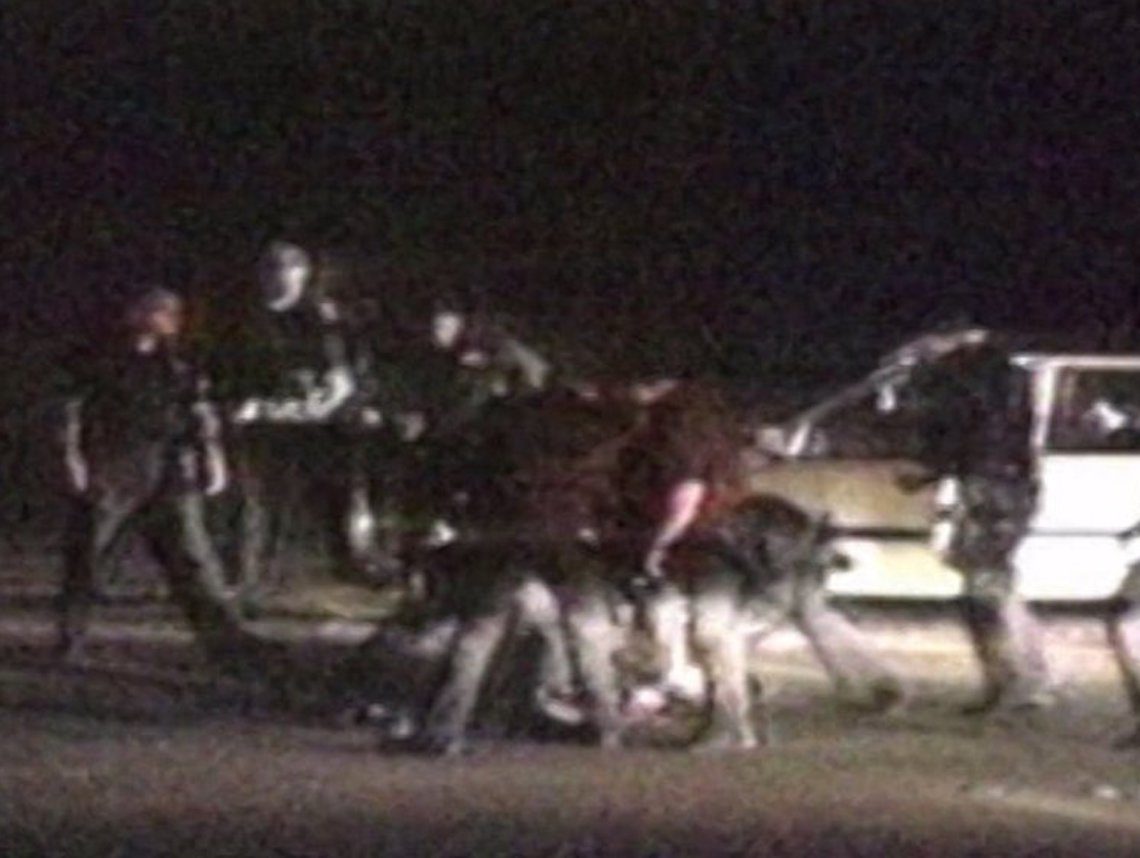
King was arrested by Los Angeles police officers on March 3, 1991, after leading police on a high-speed chase. (King had been convicted of robbery in 1989, sent to prison, and was out on parole.) During the course of his apprehension, he was kicked, hit multiple times and tased by the four officers at the scene. A videotape of King’s arrest led to charges against the officers.

Thirteen months later, after seven days of deliberation in a Simi Valley courthouse, the jury acquitted the arresting officers of assault and of using excessive force. That evening, Rabbi Laura Geller, then the director of the American Jewish Congress’ Pacific Southwest Region, and I were asked by then-Mayor Tom Bradley’s office if we would join him and hundreds of community leaders at the First African Methodist Episcopal (AME) Church, west of downtown. The goal was an attempt to “keep a lid on things.”

Yet, even before our arrival at the church, the city was convulsing with the start of riots that peaked over the next two days. A dusk-to-dawn curfew was imposed, and the deployment of the California Army National Guard enabled law enforcement to gain control over the situation.

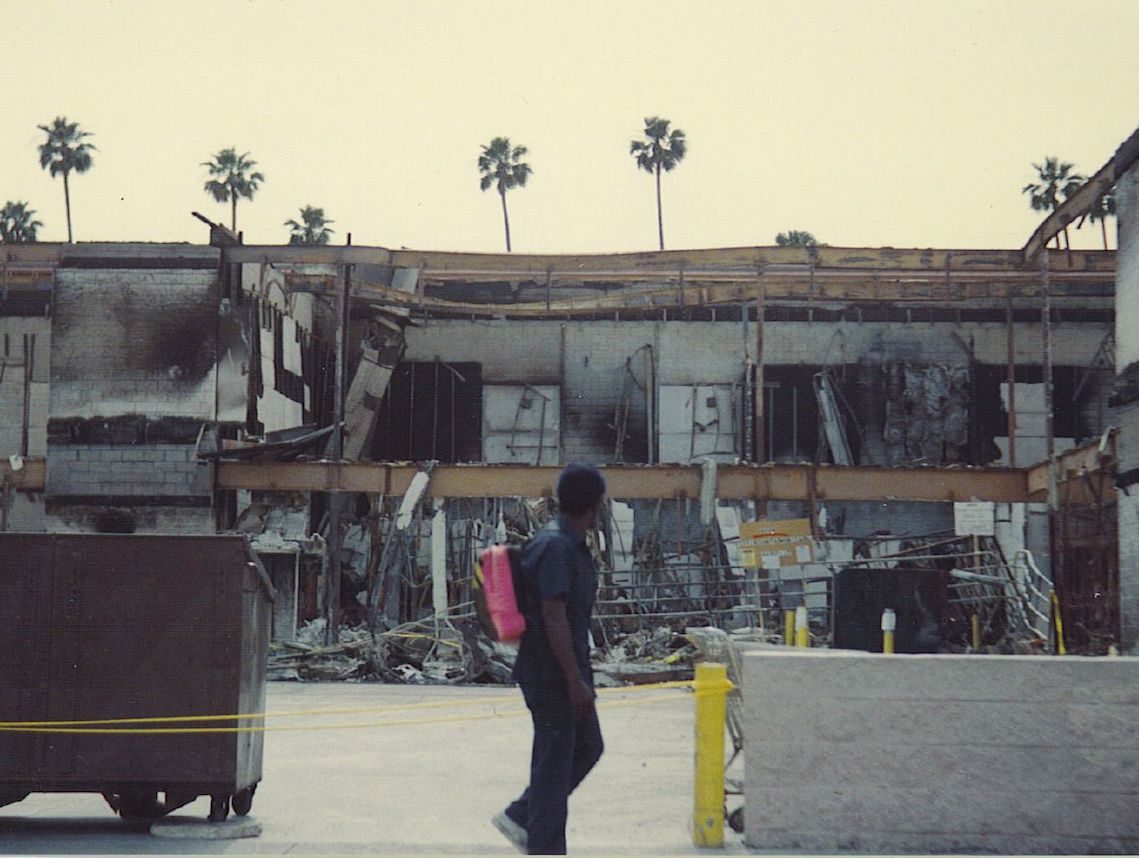
By the end, there were 55 deaths, at least 2,000 injured, 11,000 arrested, $1 billion in property damage, 1,100 buildings destroyed and 3,800 fires.

Much of the property destroyed involved Korean-owned businesses in South Central Los Angeles. Some 3,500 stores and businesses owned by Korean merchants were attacked and nearly every building in Koreatown was damaged. As a result of the violence, tens of thousands of city residents lost their livelihoods. For Korean Americans, and Asian Americans more generally, the riots represented a shattering of their “American dream” and “brought focus to their tenuous hold on economic mobility and social inclusion in a society fraught by racial and ethnic tension,” according to historian Shelley Lee.

In the aftermath of the riots, the Jewish community became a central resource and contact point for many of L.A.’s major ethnic and racial groups.

Rabbis joined their colleagues in the African-American, Latino and Asian communities, fostering an exchange of pulpits and congregational visits. Community relations agencies sought to expand their connections and contacts with key civic officials from within each of the city’s urban communities.

Working with leaders from Jewish social service, philanthropic and community relations organizations, Korean leaders set out to achieve their goals of rebuilding their community, which included the creation of the Koreatown Youth + Community Center, the Koreatown Immigrant Workers Alliance and the National Korean American Service & Education Consortium. Korean officials looked to other ethnic and racial groups, including the Jewish community, to better understand the tools and resources necessary for political organizing.

Organizational connections emerged with other Asian-American communities and Latino groups. The civil unrest created a political consciousness among ethnic communities in how they perceived their roles in relation to the general culture.  The Jewish community was seen as politically “connected” and socially “organized,” equipped to meet the needs of its own constituencies.

The late Rabbi Harvey Fields served as both chair of the Interreligious Council of Southern California and The Jewish Federation of Greater Los Angeles’ Community Relations Committee. In response to the riots, he helped form the Interfaith Coalition to Heal L.A.  Two months after the riots, he joined Rev. Cecil L. Murray of the First AME Church to plan “Hands Across L.A.,” which brought together 15,000 Angelenos from a spectrum of ethnic, racial and religious backgrounds to join along a 10-mile stretch of Western Avenue for a demonstration of racial solidarity. 

Fields was instrumental in creating the Los Angeles African American/Jewish Leadership Connection, involving key clergy committed to strengthening relations between the two communities.

Bradley established Rebuild L.A., asking Peter Ueberroth to be its first chair, with a number of prominent Jews serving on its board. Rebuild L.A. continued its work for five years before it was dissolved amid questions over how much new investment it actually drew to South Central Los Angeles.

In the aftermath of the King beating, the city established the Christopher Commission, named for its chairman Warren Christopher, a prominent L.A. lawyer who later served as secretary of state under President Bill Clinton. Its final report called for a police commission, which led to Mayor Richard Riordan appointing five people, including Rabbi Gary Greenebaum, the regional director of the American Jewish Committee at the time, to serve on a newly created police commission.

Greenebaum was elected the commission’s first president and, in an interview at the time, cited three areas of concern: increasing the size of the police department; implementing the commission’s remaining recommendations; and addressing problems of police morale by working with the city government’s key stakeholders to “reinstate strong support for the city’s police officers.”

What has changed since these events of 25 years ago? Latinos have emerged as the city’s dominant ethnic community. In turn, African-Americans have seen their political power diminish as the Black population has moved to other communities within and beyond Southern California. The Korean community has evolved into a more consolidated community, with a growing list of social service organizations and community leaders.

The level of Jewish civic involvement within the inner city has shifted, from connections with urban leaders, civic organizations and religious institutions to more “ceremonial” sets of relationships with high-profile officials and politicians.

At the same time, a period during which the Jewish community leaders served as “connectors” to other civic groups and individuals has ended, and with it, valuable personal relationships and organizational connections.

As the community’s public advocacy institutions have diminished their presence from the local scene, a new generation of Jewish political elites and rabbinic figures has emerged to represent the community’s interests.


STEVEN WINDMUELLER is professor emeritus at the Jack H. Skirball Campus of Hebrew Union College-Jewish Institute of Religion. From 1985-95, he was director of the Jewish Community Relations Committee of The Jewish Federation of Greater Los Angeles.

Reflections on the 1992 civil unrest: Examining the Jewish response Read More »

From Rodney King to a transformed L.A.

On March 3, 1991, a video camera recorded four Los Angeles police officers beating an African-American man, Rodney King. Civil disorder struck the city on April 29, 1992, after a jury in Simi Valley chose not to convict any of the officers involved.

On June 2, only a few weeks after the violence subsided, the city’s voters approved Proposition F, an unprecedented change in the governance and oversight of the Los Angeles Police Department (LAPD) that would have seemed inconceivable only a year before.

In that one year, a sea change occurred in the city’s democratic institutions. And the Los Angeles Jewish community played an important role in those historic events.

For more than four decades, the LAPD had prevented civilian authority from holding it accountable for police misconduct in minority communities. After the appointment of Chief William Parker in 1950, the LAPD intimidated and overshadowed elected officials, who feared the chief’s secret intelligence files and were reluctant to challenge the department’s carefully burnished public image. The police chief was more visible and more powerful than the mayor.

It was not until Tom Bradley, an African-American retired LAPD officer, joined the city council in 1963 that any credible counter-force developed. Bradley constructed a historic coalition of African-Americans, Latinos and liberal Jews to fight for police reform. During his 10 years on the council, and then in his record 20 years as mayor, Bradley and his allies fought to bring the department under civilian control. The core of the movement was in the African-American community, where decades of police abuse had built a political resistance of great duration. But coalition partners helped mightily.

With the help of councilmember Zev Yaroslavsky, whose Fifth District contained the largest share of Jews in Los Angeles, important changes were made, including the elimination of intelligence gathering on prominent public officials and well-known Angelenos. Yaroslavsky earned the enmity of Chief Daryl Gates, who disparaged “Zev and his Marxist friends.”

Despite some important victories, Bradley could not shake the city charter, which featured, among other provisions, extending the chief civil service protection. Nor could Bradley easily counter the political power of the police. Los Angeles was a whiter, less liberal city than it is today, and the police enjoyed strong support outside the African-American and white liberal communities.

As Bradley’s mayoralty drifted near the end of its fifth term, he struggled with declining popularity and a weakening of his Black-Jewish coalition. It seemed that the department would survive its greatest challenge and that its special role above democracy’s reach would continue. The Bradley regime seemed on its last legs.

The video of the beating of Rodney King, who reportedly was speeding and then led police on a high-speed chase (at the time, he was on parole for a robbery conviction), changed everything. Bradley called on Gates, who had consistently fought Bradley’s push for oversight since he took over as chief in 1978, to resign. Gates refused. Bradley’s appointed police commission placed Gates on leave. The city council overturned the commission’s decision and restored Gates to office.

Bradley appointed the Christopher Commission (named for its chairman, Warren Christopher), which issued a dramatic report blasting the department’s behavior, called for fundamental reform and demanded that Gates resign. In a dramatic change, the council overcame its own sorry history of caving in and voted to put most of the commission’s recommendations on the June ballot as Prop F. If the voters approved, the chief’s civil service protection would be gone, and the chief would be limited to two five-year terms. Gates’ popularity plummeted and support for reform grew. His disapproval was particularly high among African-Americans and Jews. The frayed liberal coalition was coming together for one more big battle.

With the stunning “not guilty” verdicts on April 29, civil disorder erupted. Just weeks before the climactic June vote that would decide the fate of Los Angeles democracy, rage and violence spread.  Gates was derelict in his duties, abandoning police headquarters to attend a Brentwood cocktail fundraiser against Prop F., an action that shocked Police Commission President Stanley Sheinbaum, who confronted Gates in the parking lot.

Even in a polarized and frightened city, though, voters embraced police reform. The searing visual impact of the King tape, the obvious insubordination and reckless leadership of Gates, and the prestige of the Christopher Commission made the case. Gates had few handholds to grasp. After the civil disorder, his disapproval rating reached a staggering 81 percent. 

On June 2, Prop F. passed with 62 percent of the vote, drawing large majorities from African-Americans, white liberals, especially Jews, and Latinos. It was the most startling and important achievement in Los Angeles democracy in a half-century. The Eighth District, in the heart of the Black community, and the Jewish Fifth District cast overwhelming vote margins for Prop F, accounting for the largest share of the winning totals.

The LAPD we know today, more diverse and with a much more positive relationship in the community than in years past, and with police chiefs who no longer stand astride the local political system like political bosses, grew from that dramatic and shocking year, and from the ashes of the civil disorder. It was a far closer call than we might imagine. Reform has not brought miracles, but it has opened the door both to democratic accountability for the police and a far more popular department. 

Without the shocking events that pulled Los Angeles into the depths of polarization, a thoroughly unpopular chief and an interracial coalition that rose from the floor one more time, true reform might never have come.

This issue is, of course, very much alive today, especially after U.S. Attorney General Jeff Sessions announced that he will review all consent decrees between the Department of Justice and local governments and their police departments. 

Now, more than ever, local governments from California to Ferguson, Mo., to Miami and beyond will have to depend on their own democratic institutions to bring about change. Fortunately, there are numerous police departments and chiefs who do not want to return to the days before police reform and civilian accountability. The struggle that Los Angeles faced and surmounted shows that only persistence over time and the building of a strong coalitions will meet the task.


Raphael J. Sonenshein, executive director of Cal State Los Angeles’ Pat Brown Institute for Public Affairs, is the author of  “Politics in Black and White: Race and Power in Los Angeles” (Princeton University Press, 1993).

From Rodney King to a transformed L.A. Read More »

LAMOTH makes Holocaust personal with ‘Names Instead of Numbers’

In early 1945, when a Russian-Jewish soldier rode in on horseback to help liberate Auschwitz-Birkenau, 21-year-old Renee Firestone was there, barely alive. Her mother and sister, victims of Nazi atrocities, weren’t so lucky. With odds heavily stacked against her, Firestone began life anew.

“Without a penny in my pocket, not even underwear, wooden Dutch clogs on my feet, emaciated and with my shaved head, I re-entered the world, the same world that put me in [Auschwitz] 14 months ago,” Firestone, now 92, said, addressing a crowd of nearly 800 at Pan Pacific Park as part of the 25th annual Los Angeles Museum of the Holocaust (LAMOTH) Yom HaShoah commemoration on April 23.

“How does one become a human again?” Firestone asked, as the audience, which included 50 other Holocaust survivors, sat in silence.

Universal lessons of shared humanity was a prominent theme as survivors, community leaders and special guests honored the 6 million Jews lost in the Holocaust.

One of the featured survivor artists was 87-year-old Eva Zuckerman-Warner, who spoke to a small group that included her grandson Jerry. As a young girl who designed clothes for her own dolls, Zuckerman-Warner longed to attend art school. Hungarian anti-Jewish laws prevented her from doing so.

“I think I was born without a left brain,” she joked. “I only got the right brain. I’ve always been this way.”

Zuckerman-Warner sat beside one of her 20 sculptures, a life-size clay-molded face with a gaping mouth crying out in agony. She said the work is a tribute to the nameless, faceless Jews who perished in the concentration camps, an example of how the tragedies of her past dominate her work and often help her cope.

“For me, art is a way to reflect on the trauma of the Holocaust, the horrors I experienced,” she said. “This came from my heart. I wear my heart on the outside.”

Guests were invited to visit a new international traveling exhibition, “Names Instead of Numbers.” An in-depth look inside Dachau concentration camp, it features artifacts, letters, photographs and personal testimonies both from LAMOTH’s collection and from the Dachau Concentration Camp Memorial Site in Germany.

“What’s really unique about this exhibit is that it shows the personal experiences of people who were persecuted by the Nazis,” Jordanna Gessler, LAMOTH’s director of education, told the Journal. “Each part of the exhibition is curated to highlight these individual stories.”

One of those individual stories is that of a young Polish man identified on a dilapidated, 1948-issue German driver’s license as Idel Aleksander. After his liberation from Dachau, he drove around Germany looking for surviving family members. He found none. Now 94, Joseph Alexander stared at his old driver’s license on display.

“I like that it’s here. I like that people will see it,” Alexander said. “It’s important that we share personal stories like mine in this way. There are still deniers out there in the world. I’m the living proof; so are these documents. People need to know these things happened to me. We have to keep talking about it.”

Paul Nussbaum, president of LAMOTH and a child of Holocaust survivors, opened the ceremony by reading aloud a letter sent by Los Angeles Mayor Eric Garcetti. He then delivered a fiery speech in which he spoke not just of a need to look back into tragic parts of history like the Holocaust, but also to recognize similar historical patterns forming today.

“We must bear witness now, because as I look across the landscape of Europe, Great Britain and — shamefully, I must admit — our beloved United States, the seeds of otherness have sprouted and are being fertilized by the sowers of hate, fear and intolerance,” he said.

John Emerson, the U.S. ambassador to Germany from 2013 until early this year, and his wife, Kimberly Emerson, a lawyer and human rights activist who now sits on the board of Human Rights Watch, served as keynote speakers. Both touched on the importance of Holocaust education to prompt change in future generations and to eradicate genocide in all forms. John Emerson made his point by illustrating the difference between history and memory.

“Historians conduct research, they fix dates and interpret the significance of events,” he said. “But memories are kept alive through storytelling, through teaching, sensitive writing, commemorations, even judicial proceedings, and especially at places such as this that are devoted to preserving survivors’ stories.”

Pairs of survivors and young grandchildren lit commemorative candles. A quartet of teenage classical musicians from Los Angeles County High School for the Arts performed “Tracks,” a melancholic composition written by Noah Daniel, a Milken Community Schools student. Alyssa Jaffe, a Santa Monica High School student, sang the U.S. national anthem and “Hatikvah,” Israel’s national anthem. A delegation from the Knesset looked on.

In her speech, Israel’s minister for social equality, Gila Gamliel, said, “The difference between today and some 75 years ago is that today we have a strong State of Israel. This is our pledge. This is our bond. This is our unbreakable link. This is our ‘never again.’ ”

Firestone plays her part by traveling the globe as a public speaker. She told the crowd she felt compelled to take control over the tragedies of her past by sharing her story. A longtime Los Angeles-based fashion designer, she capped her speech by offering advice and hope.

“To parents, I say speak to your children and teach them to respect each other and help each other,” she said. “To the schoolteachers, on the other hand, I tell them to tell their students to put their cellphones in their pockets. This way, they may just find out that most of them want to live in peace, and by learning to respect and care for each other, maybe — maybe — we can make that happen.” n

LAMOTH makes Holocaust personal with ‘Names Instead of Numbers’ Read More »

Kindertransport passenger shares a different kind of survivor story

It was not until a movie about the Kindertransport came out in 2000 that Ruth Moll began to consider herself a Holocaust survivor.

Moll was 10 years old when she and her two sisters boarded a train to escape Nazi Germany shortly after Kristallnacht in November 1938. They were among the 10,000 children saved in the Kindertransport, a series of rescues organized by Great Britain before World War II began.

So, unlike many of the stories recounted around Yom HaShoah, Moll’s evasion of Nazi persecution does not involve ghettos or concentration camps. But that does not make her experience less harrowing or, as she insists, less critical to relate.

“It’s very important for people to know,” Moll told the Journal after a memorial candlelighting at a Cedars-Sinai Yom HaShoah ceremony on April 21.

As a contrast, she cited the example of the MS St. Louis, an ocean liner that was filled with hundreds of European Jewish refugees but turned back from the United States in 1939.

“To think a country like America could have done that — it’s not very nice,” Moll said. “And that’s why I stress that if it wasn’t for England, I wouldn’t be talking to you today.”

Now 89, Moll volunteers in various nonclinical roles at Cedars-Sinai, where she was one of several survivors who participated in the memorial candlelighting. The event included an address from Rabbi Marvin Hier, dean and founder of the Simon Wiesenthal Center, before a crowd of 200 or so members of the extended hospital community.

Born Ruth Schmidt in Stuttgart, Germany, Moll enjoyed a traditional Jewish childhood before the horrors of Kristallnacht ravaged her community. She remembers hearing the sound of shattering glass from inside her home. Weeks later, the Gestapo came looking for her father, a successful businessman. Luckily, he wasn’t home.

Sensing the immediacy of the Nazi threat, the Schmidt parents sought to protect their three daughters, ages 12, 10 and 9 at the time. With the help of a wealthy aunt, they secured travel documents and tickets for their children on a train bound for the Netherlands coast. A ferry would take them the rest of the way to England.

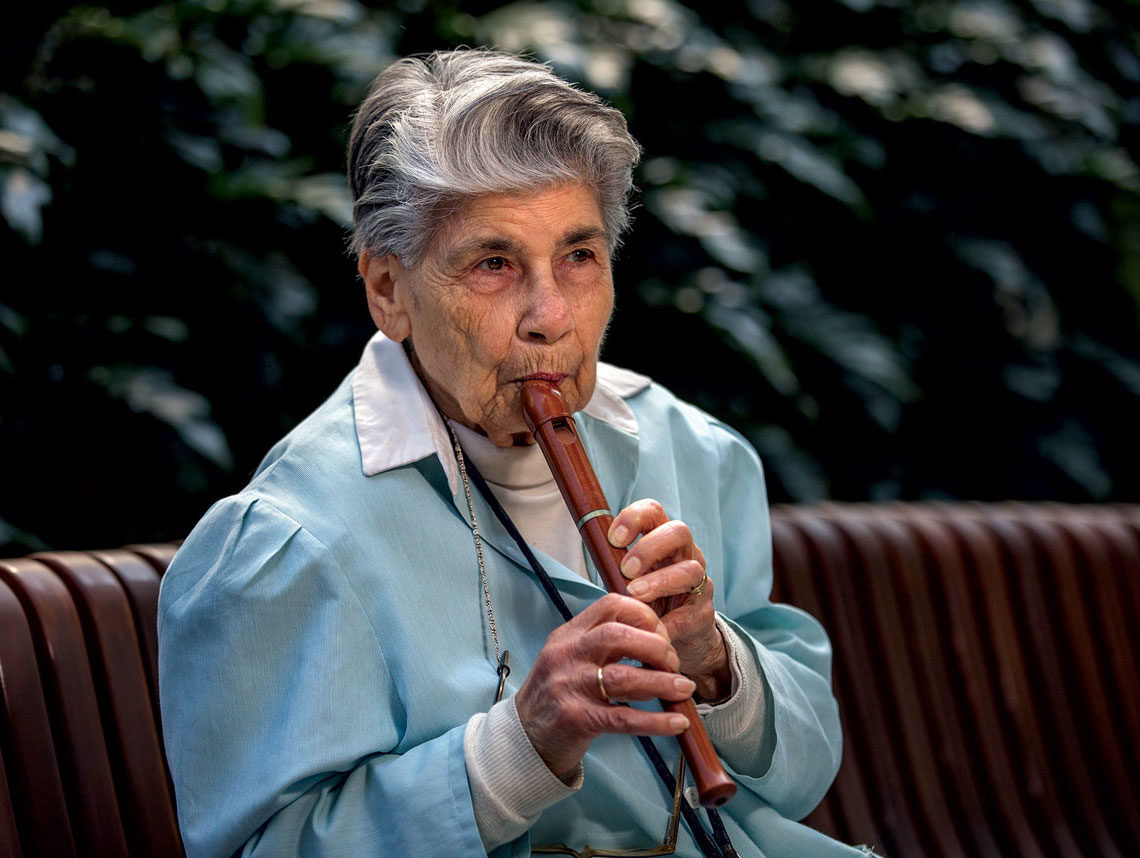
The children were permitted one small overnight suitcase each; no sentimental items could be accommodated. But Moll managed to smuggle her wooden recorder, on which she had been playing children’s songs since kindergarten, in her bag. She has kept the instrument to this day.

“It meant a lot to me because I was the only one of the three of us [who played] an instrument,” she told the Journal. She joked that she would probably need some breathing practice before she could play the wind instrument again. “I’m an old woman,” she laughed.

She left home not knowing if she ever would see her parents again, and upon arriving in England, on Feb. 3, 1939, the Schmidt girls were met by a relative, who enrolled them in a Christian boarding school. Moll’s parents later gained passage to England, mere weeks before the war started, and while they were able to visit their daughters at the boarding school, the family was not fully reunited until after the war.

Unfortunately, many of the other children saved by the Kindertransport never saw their families again. That includes her late husband, Rudy Moll, whom she met after moving to California in the 1950s.

Moll’s flight from Nazi persecution was made possible in the aftermath of Kristallnacht when a group of British Jewish and Quaker leaders appealed to Parliament for the admission of unaccompanied Jewish children as refugees from Nazi territories. British authorities agreed to take in an unspecified number as temporary migrants, with the assumption that they would return to Germany once the danger had passed.

Jewish organizations inside Germany and its territories planned the extraction, prioritizing especially vulnerable children, such as orphans, and organizing the travel from major cities like Prague, Vienna and Frankfurt, where Moll and her sisters were dropped off at the train station by the family maid.

Ruth Moll as a child

Overall, around 10,000 children made it safely to England, mostly by train and ship, with a few arriving by airplane. The Kindertransport ceased operating in May 1940, when Dutch forces surrendered to the German army, making the last leg, the ferry, unnavigable.

“England was the only country who was willing to open their doors to save 10,000 children,” Moll said, “and they would have saved more if they would have had the money.”

Still, since she never saw the inside of a concentration camp, she never thought of herself as a Holocaust survivor. “Into the Arms of Strangers,” a documentary about the Kindertransport, changed her perspective.

“Now when people ask me, I tell them I’m a survivor,” she said. “It seems to have some kind of impact, which is really what I’m happy about.”

She sees the rescue effort that saved her life as a moral imperative for future generations, one that’s never been more pressing than today. With this in mind, she talked about the refugee crisis in Syria and Europe, saying that people today aren’t listening to what’s going on in Syria and noticing the parallels with the Holocaust.

“I’m scared for what’s happening in the world, for myself,” Moll said. “Because we said never again, but who knows?”

Kindertransport passenger shares a different kind of survivor story Read More »

Daily Kickoff: Trump to Israel next month? | The Steinmetz-Kushner partnership | Will Theo Epstein enter politics? | NBA to visit Israel this summer

Have our people email your people. Share this sign up link with your friends

KAFE KNESSET — by Tal Shalev and JPost’s Lahav Harkov: Israeli sources tell Kafe Knesset that there are early attempts to coordinate President Trump’s first visit to Israel by the end of May.

According to Channel 2’s Udi Segal, the visit could take place on May 21 or later in the month. [Twitter]

Worth noting: Yom Yerushalayim, Jerusalem Day is on May 23rd and June 1st is the deadline for the waiver on moving the Embassy to Jerusalem…

Putin says ‘Nyet’ to Liberman: Defense Minister Avigdor Liberman is off to Moscow for the first time since taking this office last year. On the top of the agenda for the visit, which includes meetings with his Russian counterpart and Foreign Minister Sergei Lavrov, is the Syrian issue and the Israeli concern with a growing Iranian influence in the Middle East. Who is is missing from Liberman’s itinerary? President Vladimir Putin. Of course, diplomatic protocol does not require Liberman be granted such a high-level meeting, but in the past, he was Putin’s guest of honor. In 2009 and 2011, when Putin was Prime Minister, he didn’t care about diplomatic protocol that much and he met Liberman, then Foreign Minister, during both of Liberman’s Russian visits.

Putin’s cold shoulder is interesting against the backdrop of recent events in Syria. After the Idlib chemical attack earlier this month, Liberman was the first to point a direct finger at the Assad regime, and Putin didn’t like it, expressing his discontent in a phone call with Netanyahu a few days later. Read today’s entire Kafe Knesset here[JewishInsider]

TOP TALKER: “White House Intervened to Toughen Letter on Iran Nuclear Deal” by Jay Solomon and Carol Lee: “Top White House officials said the initial letter the State Department submitted was too soft because it ignored Tehran’s destabilizing activities in the Middle East and support for regional terrorist groups… Mr. Trump personally weighed in on the redrafting of the letter… Mr. Trump also told Secretary of State Rex Tillerson to follow up the next day with a strident public message that the new administration was planning a shift on policy toward Iran, putting the nuclear deal in play, these officials said… The initial State Department letter on Iran, senior U.S. officials said, was drafted by career diplomats who played leading roles during the Obama administration in negotiating and implementing the Iran deal.” [WSJ; Bloomberg

The other night, Trump discussed the Iran deal review at WH reception with conservative media… “We can never let Iran have nuclear weapons,” Trump said… “Israel wouldn’t have a chance,” he added. “They’ve broken the feel of a deal,” he said. “We’re going to have a big report. It’s not going to be a positive report for Iran.”[Powerline]

Politico/Morning Consult poll: “47% said that they are more likely to support the Iran nuclear deal now that the U.S. said the nation is complying with the agreement.” [Playbook]

“Royce chides Obama administration on proliferation” by Josh Meyer: “Rep. Ed Royce made the request in a letter to Secretary of State Rex W. Tillerson and Attorney General Jeff Sessions… “Needless to say, the Obama Administration appears to have done serious damage to our national security,” wrote Royce (R-Calif.) and Rep. Brian Mast (R-Fla.), who co-signed the letter… urging Sessions and Tillerson to make the request a top priority within the Trump administration’s broader review of the Iran Deal and U.S. policy toward Tehran that was announced last week… “We have received the letter, and will respond to Chairman Royce and Ranking Member [Eliot] Engel. Generally speaking, we remain committed to prosecuting, regardless of citizenship, those who violate our export control laws and the U.S. trade embargo on Iran,” a State Department official said.”[Politico

“At Holocaust event, Trump pays tribute to ‘those who survived history’s darkest hour’” by Philip Rucker and David Nakamura: “This is my pledge to you: We will confront anti-Semitism,” Trump said, receiving applause from the audience. “We will stamp out prejudice, we will condemn hatred, we will bear witness and we will act. As president of the United States, I will always stand with the Jewish people, and I will always stand with our great friend and partner, the state of Israel.” Vice President Pence, senior White House adviser Jared Kushner, Treasury Secretary Steven Mnuchin and National Economic Council Director Gary Cohn were among the guests sitting in the front row. Kushner, the president’s son-in-law, has acted as Trump’s top adviser on Israel, helping write his first speech on Israel during the campaign.”

“Before Trump spoke, Ron Dermer, Israel’s ambassador to the United States praised the U.S. missile strike on a Syrian airfield that Trump authorized… “That decision was a defiance of indifference,” Dermer said. “And if evil triumphs when good men do nothing, we should all seek to live in a world that defies indifference.” Dermer went on to say that the civilized world should be “prepared to use military might to confront barbarism.” Trump returned the praise, saying of Dermer that “he’s done a great job and said some wonderful words.” [WashPost]

— “White House officials said that Trump decided himself that he wanted to speak at Tuesday’s Days of Remembrance event, and he took personal ownership of the drafting of his remarks.” [WashPost

HOW IT PLAYED — “Trump’s Holocaust Remembrance Day speech was normal — for any other president” by Sarah Wildman: “Solemn as they were, the most remarkable aspect of the speech were not the words themselves, but the identity of the man giving them — and the continued controversy over the administration’s past comments about the Holocaust and anti-Semitism… On the Holocaust, Trump has, at last, finally begun sounding like his predecessors — and in a good way.” [Vox

“A New Donald Trump? Moving Holocaust Speech Wins Praise From Jews, Derision From Alt-right” by Allison Kaplan Sommer: “After the speech, there was widespread speculation in the media as to how influential his Jewish family members had been in the crafting of the text.” [Haaretz

Andrew Weinstein, a member of the Holocaust Memorial Council who attended the event, shared with us his personal opinion of Trump’s remarks:“I thought Donald Trump delivered a well written and long overdue speech at the Days of Remembrance ceremony today. Remarks by the president of the United States have enormous influence, and it was important for the world to see this president recognize the incomparable tragedy of the Holocaust and the enormous suffering of the Jewish people. I was also pleased to see him strongly and unequivocally denounce anti-Semitism.”

“That said, while the words were powerful, it is difficult to reconcile the comments made today with the continuing actions of the Trump administration. How does the president continue to justify his positions concerning refugees and immigration? Why did he offer praise for Marine Le Pen? And how does Sebastian Gorka still have a job in his White House? These questions and many more need answers before I am satisfied that the speech he made today came from his heart and not just his teleprompter.”

Abe Foxman emails us… “President Trump’s speeches – to the World Jewish Congress and at the U.S. Holocaust Museum – should put to rest the debate about where POTUS stands on anti-Semitism. He stands very clearly with the Jewish community against anti-Semitism! it is also a very clear message to the alt-right and all those who support him who may espouse animosity to Jews. The Jewish Community should now stop blaming the President for the rise in anti-Semitism in the USA.”

“Ivanka Trump visits Berlin’s Holocaust memorial” by Regina F. Graham: “Crowds of people snapped cellphone photos and yelled out ‘Hi, how are you?’ as she entered the center to the Memorial to the Murdered Jews of Europe for a short visit Tuesday. The First Daughter walked slowly through the undulating grounds filled with concrete slabs, along with U.S. Embassy personnel. She paused occasionally to look at the slabs, meant to symbolize the chaos of the Holocaust, before emerging on the other side of the monument to a crush of cameras and onlookers.” [DailyMail]

HEARD YESTERDAY — U.S. Ambassador to the UN Nikki Haley touted her young pro-Israel record at the UN during a speech at the World Jewish Congress Plenary Assembly in NY: “I can safely say that it’s a new day for Israel at the United Nations.  I know it’s a new day for Israel at the U.S. Mission to the United Nations… The United States will no longer be silent as Israel is unfairly attacked at the United Nations. Silence is not my thing anyway, but that’s especially true when it comes to standing up for America’s friends.  And we have no better friend in the Middle East than Israel.”[Transcript]

ON THE HILL — Senate panel calls for cutting US aid to Egypt – by JI’s Aaron Magid: In overwhelmingly bipartisan fashion on Tuesday, Senators and three panelists invited by the Appropriations Committee called for Congress to reexamine its $1.3 billion annual funding to Egypt. The panelists invited were Elliott Abrams, former deputy national security advisor during the George W. Bush administration, Dr. Michele Dunne, Senior Fellow at Carnegie Endowment for International Peace, and Tom Malinowski, former Assistant Secretary of State for Democracy during the Obama presidency.

Senator Jerry Moran (R-KS) asked the expert witnesses if cutting US aid to Egypt would damage Cairo’s strong current relationship with Israel? (The US dramatically boosted its assistance to Egypt due to Cairo’s 1978 peace treaty with Jerusalem). However, Abrams was unconvinced. “Good relations with Israel are in the interest of Egypt. The army understands that. As Senator [Lindsey] Graham mentioned, they (Egypt) are getting help in the Sinai. I think the answer is no impact,” the former Bush official asserted. Dunne added that shortly after the 2013 military coup, when the Obama administration froze much of the US security assistance. “That was the heyday of Egyptian-Israeli relations. That really proved the point that the relationship now has its own logic and dynamic.” The Carnegie expert added that even with the tightening security ties, the people-to-people relationship between the Israelis and Egyptians under President Sisi is quite weak with almost zero study exchange and a relentless incitement campaign against the Jewish state in the Egyptian media often crossing into blatant anti-Semitism. [JewishInsider

TRUMP TEAM: “How Trump’s Pick for Top Antitrust Cop May Shape Competition” by Cecilia Kang: “Makan Delrahim, the nominee for chief antitrust cop at the Justice Department, was 10 when his family immigrated to the United States from Iran as Jewish political refugees. Unable to speak English, he struggled to keep up in school… “I came to realize that my values identified with the conservative viewpoints of personal responsibility, hard work, respect for individual rights and appreciation of a limited role of government,” Mr. Delrahim, 47, said in his first interview since being nominated last month by President Trump for assistant attorney general for antitrust. On Wednesday, Mr. Delrahim will have his confirmation hearing for the Justice Department position, where these views will be closely scrutinized by Congress. If he is confirmed — and he is expected to be — his philosophies will help shape the corporate competition landscape for the next few years.” [NYTimes]

“The Swamp Is Getting Tired Of Winning” by Adrian Carrasquillo and Ben Smith: “The source close to the administration said that the worst transgression of all is that Trump seems open to retaining Federal Reserve chief Janet Yellen… “I’m incredibly bothered that he said Yellen could be reappointed,” the source close to the administration said. “She’s the personification of the swamp, very much a detriment to the American worker. Great for Wall Street but terrible for most wage-earning, paycheck to paycheck Americans.”” [BuzzFeed

FARM SYSTEM: “Could Theo Epstein Perform a Miracle for the Democrats?” by Ben Strauss: “Plenty of others have speculated about Epstein’s political future. He is telegenic, well-spoken and has a demonstrated interest in public service, having started a foundation that has donated millions of dollars to support urban youth and families. His grandfather wrote the screenplay for “Casablanca.” Epstein’s father, Leslie, won a Rhodes scholarship to Oxford and is a Boston University English professor (He also happened to predict Trump’s defeat of Hillary Clinton.). When Epstein was hired by the Red Sox, then the youngest general manager in baseball history, his father quipped, “At Theo’s age Alexander the Great was already general manager of the world.” More recently, Leslie Epstein has mentioned that his son could run anything from the United Nations to the Ford Foundation after his baseball career… David Axelrod says his baseball management skills, honed in Boston and Chicago, could win for him in politics too. If he wants it, that is.” [PoliticoMag]

NYC 2017 WATCH: “NYC Dems asked to boot Council hopeful over anti-Semitic remarks” by Erin Durkin: “City Councilman David Greenfield is asking the Manhattan Democratic Party to boot a City Council candidate running on his opposition to “greedy Jewish landlords” off the party rolls. Thomas Lopez-Pierre, who is challenging Councilman Mark Levine for a West Harlem seat, has drawn attention for a series of anti-Semitic comments and racial slurs. “There’s no question that Lopez-Pierre’s campaign is based on good, old-fashioned, virulent anti-Semitism,” he said…  Quite frankly, if Lopez-Pierre wants to run for City Council he should do so by petitioning his way onto the Ku Klux Klan party. His views are very much in line with David Duke’s.” … Manhattan Democratic Party chair Keith Wright condemned Lopez-Pierre and said… “I have considered removing a whole lot of people from the party — I just never knew quite how to do it,” he said.“ [NYDailyNews]

** Good Wednesday Morning! Enjoying the Daily Kickoff? Please share us with your friends & tell them to sign up at [JI]. Have a tip, scoop, or op-ed? We’d love to hear from you. Anything from hard news and punditry to the lighter stuff, including event coverage, job transitions, or even special birthdays, is much appreciated. Email Editor@JewishInsider.com **

BUSINESS BRIEFS: This Hedge Fund — Renaissance Technologies — May Be Poised to Create the Most Billionaires [Bloomberg] • Israel Chemicals says in talks to sell IDE stake [ToI] • Why Derek Jeter and Jeb Bush are paying so much for the Miami Marlins [Yahoo] • The Other Chetrit: Isaac stitches together mini-empire in Garment District [RealDeal]

SPOTLIGHT: “Kushners Are Partners With One of Israel’s Wealthiest Families” by David Kocieniewski and Caleb Melby: “Gaia Investment Corp. is an Israeli company owned by Raz Steinmetz. A search by Bloomberg of real-estate documents revealed a Steinmetz-Kushner partnership. Asked about it, a spokesman for Kushner Cos. said, “Kushner Companies has a longstanding relationship with Raz Steinmetz and Gaia, who have been terrific partners.” … Gaia Investment lists Shlomo Meichor and Assi Arev as principals. Meichor previously served as chief financial officer of Ampal-American Israel Corp., a New York-traded investment firm that Raz Steinmetz and his father Daniel bought a controlling interest in from Bank Hapoalim in 1996. Bank Hapoalim is among Kushner’s lenders.” [Bloomberg

“WeWork’s office takeover continues with the launch of the Services Store” by Jordan Crook: “For WeWork’s streamlined partners, users can simply purchase software from the WeWork site like any other e-commerce transaction, and the software automatically gets information about the number of seats, name, and billing. For the CEO, that transaction is reflected as part of the WeWork invoice for that month…  WeWork’s Services Store launches with 100 launch partner, and SVP of digital product Ron Gura told TechCrunch that the partner list is expected to continue growing over time. Gura also explained that WeWork isn’t currently taking revenue on the Services Store, but he didn’t rule it out in the future.” [TC]

HOLLYWOOD: “Universal’s Insurer Says Studio Ignoring Realities of Warfare in 21st Century” by Eriq Gardner: “As evidenced by a clash between Universal Cable Productions and Atlantic Specialty Insurance Company over USA Network’s Dig, a mystery-thriller miniseries set in Jerusalem that premiered in 2015… In June of that year, three Israeli teenagers were kidnapped… On July 8, 2014, Israel conducted its own offensive campaign, Operation Protective Edge… In the midst of all this, producers were filming Dig… By July 10, the security assessment came that the crew’s safety could no longer be guaranteed, and the studio made the decision to postpone shooting… Dig later completed filming in New Mexico and Croatia… The studio contends that the Hamas rocket fire amounted to terrorism, and as such, there is no exclusion. Atlantic not only sees the events in question as warlike activity, but is also arguing that it doesn’t have to cover insurrection, rebellion, revolution or usurpation of power, nor cover use of a weapon of war including atomic fission or radioactive force.” [HollywoodReporter]

PERSON OF INTEREST: “Interview with Vox Founder and ‘Math-for-Jocks Poster Boy’ Ezra Klein” by David Hochman: “He briefly interned on Howard Dean’s presidential campaign in 2003 and, the following year, ran a blog—still called a “web-log” back then—from the Democratic National Convention. With a mind for large numbers and an ability to write fluently and fast on many topics, Klein was hired by The Washington Post in 2009 and soon gained a following with his intelligent, nuanced posts on Obama-era politics for Wonkblog, which he launched in 2011. When he left to start his own news operation in 2014, Klein was one of the country’s top political commentators—at least among those who appreciate five-alarm coverage of the ever-hardening right.” [Playboy]

IAC launches first legislative initiative: The Israeli-American Council will introduce its first national legislative project today in a Congressional resolution honoring the Israeli-Americans contributions to the United States. Sponsored by Representatives Lee Zeldin (R-NY) and Grace Meng (D-NY), the symbolic measure noted the 800,000 Israeli-Americans whose hundreds of startups have created tens of thousands of American jobs. “From high-tech to Hollywood, from agriculture to clean energy, Israeli-Americans are making their mark in the U.S. to strengthen our country’s security, economy, and future,” said Israeli-American Council CEO Shoham Nicolet.

SPORTS BLINK: “In tense political times, NBA heading to Israel this summer” by Jon Krawczynski: “Basketball Without Borders has visited cities across the globe since 2001… “We’re looking forward to the chance to bring all communities together for this program,” said Kathy Behrens, NBA president of social responsibility and player programs. “This is going to be about bringing the Jewish, Christian, Muslim, Druids and other communities together.” The camp will take place from Aug. 13-16 in Netanya. The top teenagers from over 30 countries, including Israel, Spain, Germany and France, will get coaching and tutoring from NBA and FIBA players, coaches and former stars, including former Spurs All-Star David Robinson.” [AP]

BIRTHDAYS: Billionaire businessman and philanthropist, friend of Warren Buffet and early investor in Berkshire Hathaway (and a member of its board of directors), David Sanford “Sandy” Gottesman turns 91… Former owner of the NBA’s Los Angeles Clippers (1981-2014) until its forced sale for $2 billion to Steve Ballmer, Donald Sterling(born Donald Tokowitz) turns 83… Computer expert, author, lecturer, Jewish genealogy researcher and publisher of Avotaynu, the International Review of Jewish Genealogy, Gary Mokotoff turns 80… CEO of the Jewish Community Federation of the Greater East Bay (Oakland, CA) until 2008, Loren Basch turns 73… Investment banker best known as the Chairman and CEO of Lehman Brothers through its bankruptcy filing in 2008, Richard S. Fuld Jr. turns 71… Professor of computer science and engineering at the Massachusetts Institute of Technology, Hal Abelson turns 70… President of Brandeis University since 2016, Ronald D. Liebowitz turns 60… Moscow-born, conservative journalist and political activist in Israel, Avigdor Eskin turns 57… Senior fellow at the Brookings Institution, contributing editor of The Atlantic, author of six books, previously a journalist for the National Journal and The Economist magazine, Jonathan Rauch turns 57… Member of the Maryland House of Delegates (2006-2010) and the Maryland State Senate (since 2010) where he serves as Majority Whip, Roger Manno turns 51… Senior staff editor on the international desk of The New York Times, Russell Goldman… Ahron Singer

Gratuity not included. We love receiving news tips but we also gladly accept tax deductible tips. 100% of your donation will go directly towards improving Jewish Insider. Thanks! [PayPal]

Daily Kickoff: Trump to Israel next month? | The Steinmetz-Kushner partnership | Will Theo Epstein enter politics? | NBA to visit Israel this summer Read More »

Moving & Shaking: Tom Hanks reads ‘Night,’ San Fernando Valley Breakfast for Israel and more

About 1,000 people attended a reading of “Night,” Elie Wiesel’s memoir of his experience during the Holocaust. The April 23 event at Wilshire Boulevard Temple (WBT) was held in observance of Yom HaShoah, the first since Wiesel’s death in July.

“This afternoon’s reading is a wakeup call … a call to activism, to compassion, to understanding,” WBT Rabbi Susan Nanus, one of the event’s organizers, said during her introductory remarks.

Steven Z. Leder, WBT’s senior rabbi, was the first to read from the memoir. He was followed by readers who, among others, included actor Tom Hanks; talk show host Tavis Smiley; Rabbis David Wolpe, Karen Fox, Daniel Bouskila and Laura Geller; philanthropist Sharon Nazarian; Jewish Journal senior writer and columnist Danielle Berrin; and the consuls general of Germany and Israel in Los Angeles, Hans Jorg Neumann and Sam Grundwerg, respectively.

After the conclusion of the reading, which lasted about three hours, the audience in the synagogue’s Byzantine-revival sanctuary stood and observed a moment of silence and then recited the Mourner’s Kaddish for the 6 million Jewish victims of the Holocaust.

A video of the reading can be watched at jewishjournal.com.

On the same day at Congregation Kol Ami, a West Hollywood Reform synagogue, Danny Maseng, chazzan and spiritual leader of Makom LA, recited prayers and lit memorial candles during a ceremony in commemoration of Yom HaShoah.

“Human spirit is the light of God,” Maseng said.

Attendees included David Straus, a board member of Jewish World Watch, and Rev. Keith Cox, spiritual leader at the Center for Spiritual Living Los Angeles.

—Eitan Arom, Staff Writer


jnf

From left: Doug Williams, Jewish National Fund Los Angeles board member; Sarita and Sam Grundwerg, Consul General of Israel in Los Angeles; and Shlomi Vayzer, a Jewish National Fund Israeli emissary in L.A. Photo courtesy of Jewish National Fund

The inaugural San Fernando Valley Breakfast for Israel by the Jewish National Fund (JNF) was held March 30 and included a panel discussion on the 50th anniversary of Jerusalem’s 1967 reunification.

The annual breakfast, which the JNF holds most years at a location in the Los Angeles Basin, this time was moved to the Warner Center Marriott Woodland Hills to connect with the large Israeli community in the San Fernando Valley.

Film and television producer Howard Rosenman moderated the discussion, which featured panelists Yoel Rosby, JNF’s Ammunition Hill Liaison; Larry Russ, a lawyer and supporter of the Ammunition Hill Memorial Site; and Phillip Yankofsky, an Israel Defense Forces (IDF) veteran of the Six-Day War.

Ammunition Hill holds great significance in the formation of the modern Jewish state. In the 1930s, the British built a police academy in North Jerusalem and stored ammunition on the adjacent hill, which came to be known as Ammunition Hill. In the 1948 War of Independence, Jordanians captured the site and Jewish Jerusalem was split in two. The hill sat at a crossroads and was the centerpiece of defense. Heavily fortified with dozens of trenches terraced into the hill, it was an intimidating obstacle to overcome. It became the historic site of the battle for the reunification of Jerusalem.

Early on the morning of June 6, 1967, about 150 Israeli paratroopers attacked the hill believing, based on erroneous intelligence, that they outnumbered the Jordanians 3 to 1. In fact, the Jordanian forces also had about 150 soldiers. Fierce hand-to-hand combat ensued. By 8 a.m., the Israeli forces had taken the hill, but not without sustaining losses — 36 were killed and 90 were wounded. Seventy-one Jordanians died in the battle. On June 7, 1967, IDF commander Motta Gur announced, “Har HaBayit beyadeinu!” (“The Temple Mount is in our hands!”), the realization of a 2,000-year-old dream for Israelis.

Consul General of Israel in Los Angeles Sam Grundwerg discussed how JNF is cultivating the land of Israel and enriching the lives of its people. He also provided an overview of the region and the changing realities in the Middle East, from the latest security threats to the newest security innovations.

— Ayala Or-El, Contributing Writer


aju

From left: Jeff Goldstein, general manager at Hillside Memorial Park and Mortuary; Professor Laurie Levenson; retired judge Burt Pines; UC Irvine School of Law Dean Erwin Chemerinsky and Rabbi Gary Ezra Oren. Photo courtesy of AJU Whizin Center for Continuing Education

Nearly 500 people filled Gindi Auditorium at American Jewish University (AJU) in Los Angeles on March 26 to take part in AJU’s 14th annual biblical trial, “The Book of Jonah: The People v. The Sailors for Attempted Murder.”

Rabbi Ed Feinstein of Valley Beth Shalom in Encino started the event by introducing the biblical text and the case for attempted murder against the sailors who threw Jonah overboard.

Laurie Levenson, a professor at Loyola Law School in Los Angeles, prosecuted the sailors. Erwin Chemerinsky, dean of the UC Irvine School of Law, acted as the sailors’ defense attorney. Levenson and Chemerinsky had participated as opposing counsel in the event’s previous years. Past cases included “The People v. Abraham,” “The People v. King David” and “The People v. Moses.”

Burt Pines, a retired Los Angeles County Superior Court judge, presided over the mock trial, which included opening arguments, rebuttals and closing arguments.

“Where else will you find almost 500 Jews from all over Los Angeles gathered together on a Sunday morning to learn about our ancient texts?” said Rabbi Gary Oren, vice president and dean of AJU’s Whizin Center for Continuing Education.

After the two-hour program, a vote by the audience serving as the jury found the sailors not guilty. It was a familiar verdict, as defendants have been acquitted in all 14 of the biblical trials.

Hillside Memorial Park and Mortuary sponsored the event.

— Oren Peleg, Contributing Writer


book

From left: Samara Hutman, executive director of Remember Us; child survivors Henry Slucki, Eva Brettler and Marie Kaufman; and novelist Mona Simpson at Diesel, A Book Store in Brentwood. Photo by Deeana Goodman

Holocaust survivors and their families, friends and guests gathered on April 19 at Diesel, A Bookstore in Brentwood to celebrate the release of the second edition of “How We Survived: 52 Personal Stories by Child Survivors of the Holocaust,” a self-published book by the group Child Survivors of the Holocaust, Los Angeles.

As evening fell, some two dozen participants gathered in the bookstore’s courtyard, surrounded by the illuminated windows of neighboring boutiques. Child survivors Eva Brettler, Henry Slucki and Marie Kaufman, the book’s lead editor, read passages from their accounts in “How We Survived.”

The new edition includes a foreword from Samara Hutman, executive director of Remember Us: The Holocaust Bnai Mitzvah Project. Hutman, who helped organize the event, joined the survivors on a panel moderated by novelist Mona Simpson.

Slucki said that as the ranks of Holocaust survivors began to thin in the first decade of the 21st century, “it became an urgent matter for us to get this published before we couldn’t tell our stories any longer. No two stories are alike.”

A committee worked on the book for five years before its 2011 publication.

Kaufman said the book would impress on her descendants and those of other child survivors that they owe their lives to the kindness of strangers who protected Jews during the Holocaust.

“I want them to know why they are in this world — because of people who cared,” Kaufman said.

Brettler echoed that sentiment.

“The only way that 8-year-old could survive,” she said, referring to herself, “was through the compassion of strangers. And I am fortunate to have grandchildren who keep that compassion alive.”

— Eitan Arom, Staff Writer


ms-tess

Tess Cutler. Photo by Lynn Pelkey.

Tess Cutler has joined the editorial staff of the Jewish Journal of Greater Los Angeles as a video producer.

Cutler will head the Journal’s efforts to produce original videos and will work with writers to add video content to their stories. Her position is made possible by a grant from the Jewish Venture Philanthropy Fund.

“Tess has been a longtime Jewish Journal contributing writer while she has been studying and working in video production,” Jewish Journal Publisher and Editor-in-Chief Rob Eshman said in a statement. “We are excited to have her on board full-time in her new role.”

Cutler interned at Tablet magazine in New York and attended Santa Fe University of Art and Design in New Mexico, where she earned a bachelor’s degree in creative writing/English literature.

“I’m ecstatic to flourish and grow with the Jewish Journal family,” Cutler said. “I think that’s what I’m most excited about, to turn my lens on or use my lens to capture the great community that we have.”

Moving & Shaking highlights events, honors and simchas. Got a tip? Email ryant@jewishjournal.com.

Moving & Shaking: Tom Hanks reads ‘Night,’ San Fernando Valley Breakfast for Israel and more Read More »

Here’s to you, Paul Simon: Skirball showcases his ‘Words & Music’

In 1964, a Jewish music executive, Goddard Lieberson, then the president of Columbia Records, told his newest act, a harmonizing duo inspired by the Everly Brothers, to use their “ethnic” names.

Goodbye, Tom and Jerry. Hello, Simon and Garfunkel.

“[Paul] Simon didn’t think people were going to buy folk songs sung by two middle-class Jewish men, but he embraced it,” said Erin Clancey, curator of “Paul Simon: Words & Music,” the Skirball Cultural Center’s latest exhibition.

“Words & Music,” which runs through Sept. 3, presents this curious piece of music industry trivia and much more, in a retrospective of his creativity that spans more than 16 albums — from Simon’s early work with Art Garfunkel to his 2016 solo album, “Stranger to Stranger.”

The exhibit is on loan from the Rock and Roll Hall of Fame and Museum in Cleveland. Its chronological sections display more than 150 items  — scratchpad notes, awards, the first jacket he wore on “American Bandstand” and his first acoustic guitar, a 13th birthday gift from his father, Louis, a professional bass player.

Additional items from the early years include correspondence between Simon and Garfunkel when Simon was away at summer camp that shows the two were friends before they were collaborators. “Send my love to Marilyn and any other nice lookin’ girls up there,” Simon wrote in one letter. It also features the duo’s first recording contract with Columbia, from 1957.

One section of the exhibit, “Simon and Garfunkel,” features nearly 35 photographs, sheet music and handwritten lyrics encapsulating the duo’s brief, impactful six years together when they recorded such baby boomer hits as “Mrs. Robinson,” “Homeward Bound” and “America.”

Clancey recalled a Skirball staffer looking at a photo of Simon and saying, “Hmm, that looks like my dad.”

“That’s kind of who we’re pitching this to — dads,” she said. “I guess that could be described as the core audience for this, people for whom this music is the soundtrack to their youth, the soundtrack to their young adulthood.”

The treasures include a photo of Simon and Garfunkel seated on the floor of a CBS studio while recording tracks for their debut album, “Wednesday Morning, 3 A.M.,” which sold poorly and prompted the duo to disband. Simon moved to England and immersed himself in the folk music scene. Included in the exhibition is a diary of his performances in the U.K.

Without either of them knowing it at the time, Tom Wilson, a music producer who had worked with Tom and Jerry, provided their big breakthrough. Responding to the growing popularity of folk-rock, Wilson overdubbed electric instruments onto “The Sound of Silence,” which Simon had written in response to the assassination of President John F. Kennedy. The record topped the Billboard Hot 100 chart.

Notified of his hit record, Simon returned to the United States. From 1966 to 1970, he and Garfunkel recorded blockbuster albums, including “Sounds of Silence,” “Bookends” and their last together, “Bridge Over Troubled Water.”

Included are handwritten lyrics of “The Boxer,” from “Bridge Over Troubled Water,” that Simon scribbled onto an inflight airline magazine.

The examination of Simon’s versatile solo career shows how he has stayed relevant even as popular music has evolved. “Mother and Child Reunion” helped introduce Western audiences to reggae music; “Me and Julio Down by the Schoolyard” showcased his love of language; and “Still Crazy After All These Years” is Simon the songwriter at what he has called his peak.

Still, creative frustration hit him in the mid-1980s before a trip to Johannesburg, South Africa, in pursuit of township sounds he’d heard on a cassette tape, led to a career rejuvenating fusion of South African and American music on his 1986 landmark record, “Graceland.”

Handwritten lyrics from the title track and from “Diamonds on the Soles of Her Shoes,” the Album of the Year Grammy Award for “Graceland,” and annotated sheet music highlight the exhibition’s section on “Graceland.” On May 12, Skirball is screening “Under African Skies,” a 2012 documentary examining Simon’s bold decision to record music in South Africa in the 1980s, when the country was still under apartheid rule. In the documentary, Simon “talks about how perhaps he didn’t understand the fullness of the situation, the crisis of South Africa,” Clancey said.

One section of the exhibition, “Paul Simon in Popular Culture,” is unique to the Skirball. Included is a movie poster from “The Graduate,” which featured the song, “Mrs. Robinson,” originally “Mrs. Roosevelt” until Simon changed the lyric to match a character in the film at director Mike Nichols’ request.

“We’ve included sections that deal specifically with Paul’s popularity, his icon status, his place in our cultural consciousness, which I think was not so much the focus of the rock hall’s exhibition,” Clancey said. “They’re focused on music, of course, and the various instruments and songs, lyrics, etc. We’re interested in Paul as a cultural figure, first, and as a musician, second.”

Further distinguishing the Skirball exhibition is an interactive music lab Skirball developed in partnership with Roland Corp., an electronic music equipment manufacturer and distributor. It enables people to sing and jam with Simon.

“They have a drum circle where you can listen to songs that have a very distinctive drumbeat like, ‘50 Ways [to Leave Your Lover].’ You can harmonize along with Simon and Garfunkel to ‘Mrs. Robinson.’ I expect that to be a very, very popular attraction,” Clancey said.

Skirball and Roland previously partnered in 2008 for the Skirball exhibition “Bob Dylan’s American Journey, 1956-1966.”

Meanwhile, listening stations provide an opportunity to hear nearly 30 songs.

Simon, 75, was born in Newark, N.J., on Oct. 13, 1941. His parents were Hungarian Jews who immigrated to the U.S. at the beginning of World War II. Simon grew up in Queens, N.Y., which is where he met Garfunkel. He has been inducted into the Rock and Roll Hall of Fame as a solo artist and with Simon and Garfunkel. Twice previously married, including to the actress Carrie Fisher, he currently is married to folk singer Edie Brickell.

The rock hall displayed the Simon exhibition in 2015. Simon did not see it but nevertheless provided two of the museum’s officials, Karen Herman and Craig Inciardi, with an “oral history, of his life story,” Herman said. “We had a guitar next to him and said, ‘If you feel like it, go ahead and play,’ which he did a few times. We wanted to get at what makes Paul Simon Paul Simon.

“He was gracious with his story. He was gracious with his archives.”

The exhibition at the Skirball also suggests a musician’s concern for social justice is key to relevancy.

“Beyond just the fact of his Jewish identity and his pop cultural icon status, he’s also a person who fits very well with our mission, which is a sort of a dual mission of celebrating influential cultural figures but also people who have something to say with regard to social justice,” Clancey said. “His work, his lyrics, have often reflected the frustrations of the people. They have been very pointed at times with regard to social justice. We felt that was a good match.”

“Paul Simon: Words & Music” runs through Sept. 3 at the Skirball Cultural Center. For more information, go to skirball.org. n

Here’s to you, Paul Simon: Skirball showcases his ‘Words & Music’ Read More »

History lesson in 210 words

When I was a child, I was told
that when Aunt Bella left Germany in the late 1930s,
she went to Palestine.
Which didn’t mean that she went to a country called “Palestine,”
because no such country existed.
As I grew older, I learned the details of this history:
that when the Ottomans controlled the territory,
where Jews had, in fact, long lived,
the label “Palestine” applied, unofficially,
to the land south of Syria,
but by no means to any one people or nation-state;
that when the Ottomans lost control, after World War One,
the word “Palestine” was used to describe
the territory placed under British Mandate,
which included not only what is now Israel,
but also what is now Jordan;
that until Israeli independence in 1948,
it was not uncommon for Jews (not Arabs)
who lived in the territory —
like Aunt Bella and her husband and baby daughter —
to be called “Palestinians”;
that time (1947) after time (2000) after time (2008),
for just a few clear examples,
those the world now calls “Palestinians”
rejected every opportunity for a state of their own
to thrive beside the Jewish one;
that, in sum, and to say the very least,
this history is complicated
and requires more than 210 words to explain.


Erika Dreifus is the author of “Quiet Americans: Stories,” which was named an American Library Association/Sophie Brody Medal Honor Title for outstanding achievement in Jewish literature. Visit her online at erikadreifus.com and follow her on Twitter @ErikaDreifus, where she tweets “on matters bookish and/or Jewish.”

History lesson in 210 words Read More »