A St. Louis man has been charged for making at least eight bomb threats against Jewish community centers and the Anti-Defamation League.
Juan Thompson, 31, made some of the threats in the name of a former romantic partner he had been cyberstalking, according to a statement Friday by the U.S. Attorney of Southern New York. Thompson has been charged with cyberstalking, which carries a maximum sentence of five years in prison.
“Today, we have charged Juan Thompson with allegedly stalking a former romantic interest by, among other things, making bomb threats in her name to Jewish Community Centers and to the Anti-Defamation League,” U.S. Attorney Preet Bharara said in a statement. “Threats of violence targeting people and places based on religion or race – whatever the motivation – are unacceptable, un-American, and criminal. We are committed to pursuing and prosecuting those who foment fear and hate through such criminal threats.”
Thompson made some of the threats in his victim’s name and some in his own in an attempt to portray himself as being framed. In a series of Twitter posts this week, he claimed his victim was in fact making the threats and framing him. He also tweeted sympathetic messages expressing support for the Jewish victims of the threats.
But the FBI complaint against Thompson says he was behind at least eight of the threats made in January and February, mostly via email. The complaint says Thompson threatened institutions including the ADL, JCCs in San Diego and New York City, schools in New York and Michigan, and a Jewish history museum in New York City. In the threats to the schools, made on Feb. 1, Thompson referred to a “Jewish newtown,” a reference to the 2012 mass shooting at an elementary school in Connecuticut.
In total, more than 100 Jewish institutions, mostly JCCs, have received bomb threats since the beginning of the year. The last two weeks saw vandalism at Jewish cemeteries in Philadelphia, St. Louis and Rochester, New York, as well as two more waves of bomb threats called into JCCs, schools and institutions across the country, representing the fourth and fifth waves of such harassment this year. No explosive device was found after any of the calls.
“The NYPD and the FBI have done an outstanding job in this regard,” Paul Goldenberg, director of the Secure Community Network, which coordinates security for Jewish institutions, told JTA on Friday. “We at SCN and the Jewish Federations of North America commend them and hold them in the highest regard.”
The threats prompted clamor for President Donald Trump to condemn the anti-Semitism behind the targeting of Jewish institutions.
After initially demurring to comment directly when asked about the spate of recent anti-Semitic incidents, Trump eventually called the threats to the community centers “horrible” and “painful,” and Vice President Mike Pence paid a visit to a Jewish cemetery vandalized near St. Louis.
FBI, NYPD, and NYS police told us arrest made in bomb threats against ADL;several other Jewish institutions. Thx 2 them!More info as get it.
I Let them make for me a sanctuary. The first
Jewish contractors.
II
This bread is so cool
it gets its own show. It’s still
in syndication.
III
Six golden fingers
will light the way. Don’t forget
the purple curtains.
IV
No wall on the east
side of the Tarbernacle.
Learn from that Orangy.
V
How many curtains
does it take to get to the
holy of holies?
VI
If you encounter
an altar with four horns. Odds
are God is close by.
VII
It is a good time
to invest in copper and
all materials.
Los Angeles poet Rick Lupert created a the Poetry Super Highway (an online publication and resource for poets), and hosted the Cobalt Cafe weekly poetry reading for almost 21 years. He’s authored 20 collections of poetry, including “I’m a Jew, Are You” (Jewish themed poems) and “Feeding Holy Cats” (Poetry written while a staff member on the first Birthright Israel trip), and most recently “Donut Famine” (Rothco Press, December 2016) and edited the anthologies “Ekphrastia Gone Wild”, “A Poet’s Haggadah”, and “The Night Goes on All Night.” He writes the daily web comic “Cat and Banana” with fellow Los Angeles poet Brendan Constantine. He’s widely published and reads his poetry wherever they let him.
There are increasingly more people who are giving up on a two states for two peoples resolution of the Israeli-Palestinian conflict and are, instead, supporting a one state democracy that stretches from the Jordan River to the Mediterranean Sea.
In my view, this represents for the Jewish people a defeat of historic proportions.
The State of Israel was founded on the basis of it being a Jewish state that is democratic in character and affirms the principles of justice and equality for all its citizens, Jews and non-Jews alike.
As time passes and the Jewish settlement enterprise continues and as the status quo is maintained a one-state reality becomes more probable. If that is the end result, the question remains as to what kind of state it will become.
The Arab and Jewish populations between the Jordan River and the Mediterranean Sea including Gaza are nearly equivalent (5.5 million Israeli Jews and 5.5 million Arabs of which only 1.5 million are Israeli citizens and the remainder live under occupation in the West Bank or are ruled by Hamas in the Gaza Strip).
There are essentially three options:
Two states for two peoples (Israel and Palestine) with established borders, Jerusalem as a shared capital, Palestinian refugees enjoying the right of return to Palestine and not Israel, Palestinian acceptance of the legitimacy of the Jewish state of Israel and Israeli acceptance of the legitimacy of the State of Palestinian, and assured security;
A one-state democracy in which all citizens share equal rights including the right to vote in national elections and to serve at the highest levels of government;
A one-state undemocratic Jewish State of Israel in which Arab citizens do not share equal rights with Israeli Jews.
The first option preserves the Jewish and the democratic State of Israel.
The second represents the end of Zionism.
The third ushers in a new form of Apartheid in which Israel ceases to be a democracy and risks further international isolation, the weakening of the American-Israeli relationship, and the alienation of large segments of world Jewry from Israel.
Yesterday (March 2, 2017) in the Israeli daily Haaretz there appeared an interview with Member of the Knesset Ahmed Tibi (of the Arab List). The interview offers a realistic glimpse into what a one-state non-Jewish democracy might look like (see link to article below)
A few highlights of Mr. Tibi’s comments:
“I belong to those who support the two-state vision, have fought for it and continue to fight for it. I think it’s the optimal solution for the existing situation. The international community wants it and the majority on both sides wants it, even though that majority is diminishing according to the surveys I see, among both Palestinians and Israelis. And with 620,000 settlers in the West Bank and Jerusalem, and two separate judicial systems, there’s a reality today of one state with rolling apartheid.” …
“[In a one-state solution] We will annul the [Israeli] Declaration of Independence and in its place write a civil declaration that represents all citizens: Jews, Muslims, Christians, Druze. The entire public. It’s untenable for a democratic state to have a declaration of independence that is fundamentally Jewish.” …
“That [the Jewish right of return] would automatically be annulled because the country would no longer be a Jewish state as it is today. The single state will not resemble the present-day State of Israel. It will be something different. Why should Jews be able to return here and Palestinians not?” …
“…With one, equal state, the State of Israel in its present format will not exist. All its symbols will change, and the narrative will be different. The unifying element in one state will be different from what it is today because it will be a state of everyone, not a state of the Jewish collectivity in which there is a tolerated minority that is thrown a bone in the form of gestures like new roads and the establishment of well-baby clinics. In an equal, single state, equality is a supreme value.”
Those who support the status quo in effect are supporting option #3.
According to American Middle East envoy Martin Indyk who spoke at the recent J Street National Conference in Washington, D.C., the status quo might seem to be sustainable in the short term, but in the long term “there will be an explosion.”
If that happens, the dream of the founding generation of the State of Israel will be lost.
The Night of 100 Stars Oscar viewing party is always the place to be with celebrities elbow to elbow on the red carpet! Hollywood turned out in support of fellow actors and long-time friends to watch the Oscars at the swanky Beverly Hilton Hotel. This year there was a mix of both film and television stars who couldn’t miss the top Oscar viewing party of the evening.
Actor Tony Denison discussed his long-running TNT series MAJOR CRIMES on which he stars opposite Mary McDonnell. Their current season promises to be one to remember.
Actress Naomi Grossman, unrecognizable from her role in AMERICAN HORROR STORY, discussed the decision to shave her head when she booked the part on the series. She also talked about the best types of fan encounters.
Finally, previous Oscar nominee Bruce Davison of the X-MEN franchise discussed the audition process for established actors in Hollywood.
For all of these interviews, take a look below:
—>Looking for the direct links to the videos? Click here for Tony Denison. Click here for Naomi Grossman. Click here for Bruce Davison.
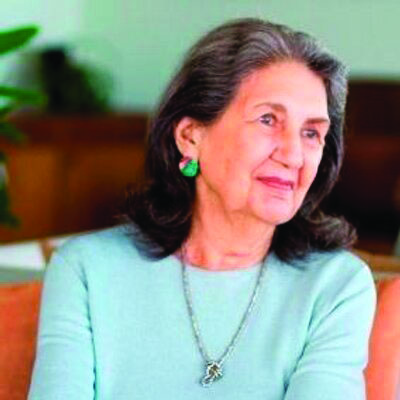
Harriet Rochlin, a noted writer and historian sometimes called the “Mother of Western Jewish History,” died Feb. 6 at her home in Westwood. She was 92.
The youngest of three children, she was born Nov. 4, 1924, and raised in the diverse East Los Angeles neighborhood of Boyle Heights. During the first 20 years of her life, she was immersed in its foods, languages and multicultural social character.
Without a scholarship or financial assistance from her parents, she left home at age 20 and put herself through college at UC Berkeley, earning a bachelor’s degree in Hispanic Studies. It was there she met Fred Rochlin, her future husband.
Between raising their four children, Harriet Rochlin began a career as a journalist and novelist. She spoke four languages: Spanish, Portuguese, English and Yiddish.
In the early 1960s, inspired by the emerging ethnic history movement, she delved into her past as a woman, Jew and Westerner. Her pursuit soon launched a quest for Jewish roots in the Spanish, Mexican and American West, and ultimately resulted in “Pioneer Jews: A New Life in the Far West,” a landmark social history co-authored with Fred, first published in 1984, reprinted more than a dozen times and frequently used as source material, notably by David Milch in creating his HBO series “Deadwood.”
Rochlin next wrote the fictional “Desert Dwellers Trilogy”: “The Reformer’s Apprentice: A Novel of Old San Francisco,” “The First Lady of Dos Cacahuates” and “On Her Way Home.”
She also amassed two Western Jewish collections — one historical, the other photographic — both now housed at UCLA’s Charles E. Young Research Library.
She then instituted the first comprehensive guide to Western Jewish historical societies, museums and archives, The Rochlin Guide, which can be found online at rochlin-roots-west.com. She was 90 when she completed her final book, “A Mixed Chorus: Jewish Women in the American West, 1849 to 1924.”
Rochlin is survived by daughters Judith (Mitch Fink), Davida (Fred Marcus) and Margy Rochlin (Robert Abele); son Michael J. Rochlin; three grandchildren; and sister Charlotte Ginne.
She was predeceased by husband Fred in 2002. They were married for 55 years.
Donations in Harriet’s memory can be made to the Harriet Rochlin Memorial Education Scholarship at lightbringerproject.org. The annual scholarship will benefit a graduating senior from her alma mater, Roosevelt High School.
Joseph Albert Wapner, star of “The People’s Court” and the man who many would judge to be television’s first reality star, died Feb. 26 at his home in Los Angeles. He was 97.
His son David told The Associated Press that the retired Los Angeles judge died in his sleep after being hospitalized a week earlier with breathing problems and that he had been under hospice care at home.
Wapner was born in Los Angeles in 1919 into an Orthodox family, the son of immigrants from Eastern Europe; graduated from Hollywood High School (where he dated future movie star Lana Turner) in 1937; and earned a bachelor’s degree in philosophy from USC in 1941.
During World War II, he served in the Army in the Pacific theater and was wounded by sniper fire in the Philippines. He later received a Purple Heart and Bronze Star.
In 1948, he earned a law degree from USC and during a break in his studies, met petite Mickey Nebenzahl, a Texas native, on a blind date. Abandoning his usual sober deliberations, Wapner became engaged and married Mickey within two months of their first meeting.
Professionally, he went on to private practice until being appointed by California Gov. Edmund G. Brown as an L.A. municipal court judge in 1959. In 1961, he was selected to preside over the Superior Court system. He served for 18 years and retired in 1979.
Among the Jewish causes closest to the hearts of Joe and Mickey Wapner was the Brandeis-Bardin Institute (BBI) in Simi Valley. The couple was among the institute’s founding members and made a large donation to renovate and expand its library.
In 1992, Wapner was elected as BBI’s president and in 2007 initiated its merger with the University of Judaism (now American Jewish University). His involvement with BBI could be found in his childhood roots, or, as he put it, “Since I was a little kid, Judaism has meant a great deal to me and I am very proud to be a Jew.”
Colleagues who knew Wapner as judge and fellow officers at BBI used almost identical words to describe the character of the man: judicious, steady, fair, penetrating, principled, humane. Also, when the occasion warranted it, tough, demanding, a mite testy in the face of bootless arguments and, at times, intimidating. These characteristics carried over into his tennis game, in which he was a ranked senior player.
One of his most famous cases took place during his final year on the bench, when he presided over the divorce trial of Jack Kent Cooke, former owner of the Los Angeles Lakers, Los Angeles Kings and other sports franchises, and Cooke’s first wife, Jeannie Carnegie. The $49 million settlement set a world record.
Wapner didn’t settle into a leisurely retirement. In 1981, according to The New York Times, television producer Ralph Edwards (of “This Is Your Life” and “Truth or Consequences” fame) approached him to wield the gavel on a new show inspired by “Divorce Court” but involving real-life litigants and actual cases. This he did until 1993, handing down small claims rulings on 2,484 cases involving issues as varied as female oil wrestlers who didn’t follow the rules to siding with a defendant who refused to pay a reward offered for return of her dog when the missing pet’s remains were delivered.
“Everything on the show is real,” Wapner said in an interview with The Associated Press in 1986. “There’s no script, no rehearsal, no retakes. Everything from beginning to end is like a real courtroom, and I personally consider each case as a trial.”
He was memorialized in the 1988 film “Rain Man” by Dustin Hoffman’s character counting down the “minutes to Wapner” to ensure that Tom Cruise’s character would get him to a TV in time to watch the show. He wrote a popular memoir filled with anecdotes, titled “A View From the Bench,” that was published in 1987. And in 2009, Wapner even got a star on the Hollywood Walk of Fame.
The true measure of his popularity was probably best captured in a 1989 poll by The Washington Post that found two-thirds of people surveyed could not name any of the nine justices on the U.S. Supreme Court, but 54 percent knew that Wapner was the man in charge on “The People’s Court.”
In addition to his son David, Wapner is survived by his wife of 70 years, Mickey; another son, Frederick, a judge on the L.A. Superior Court; two daughters-in-law; four grandchildren and a great-granddaughter. A daughter, Sarah, died in 2005.
The vast majority of tourists who visit Jerusalem go to the Old City and, depending on their interests and beliefs, make a point of seeing archaeological sites, eating in the Mahane Yehuda Market or visiting the Israel Museum.
What few get to experience is an authentic Shabbat meal in the home of a Jewish family.
Six years ago, Michelle Cohen and her husband, Nati, a young Jerusalem couple, decided to offer Shabbat dinners to groups and individuals seeking a genuine Shabbat dinner experience.
Sensing a business opportunity as well as a way to share the best of Israel with tourists, they launched Shabbat of a Lifetime, a company that Cohen said has grown to more than 70 host families that have offered a Shabbat dinner experience to more than 30,000 visitors from 100 countries.
For a fee that Cohen says is roughly equivalent to the cost of a Friday night dinner in a hotel restaurant, hosts offer Shabbat dinner (including ones customized for a variety of dietary needs, like allergies) tailored to overseas guests. Rituals are explained and questions encouraged.
The goal, Cohen said, “is to create positive encounters between them and Israelis. The tourists have a positive experience and return home as [goodwill] ambassadors.”
Cohen said she and her husband got the idea for Shabbat of a Lifetime after spending six months in India.
“During our time in India, we realized that the most meaningful part was meeting the local people and learning about their culture. There are maybe 2 million non-Jewish tourists who come to Israel every year, and we asked whether they are getting the opportunity to meet local Israelis in their homes. The answer was no.”
About 95 percent of guests come as part of a tour group, while the rest book directly via the company’s website (shabbatofalifetime.com). Ninety-nine percent are non-Jewish tourists or Jewish tourists who are not religiously observant.
“Let’s say you’re part of a group of 15 Chinese businessmen [who are] in Israel to understand how to invest in Israel. One part of your trip will be to join a Jewish family at a Shabbat meal to learn about Jewish culture and Shabbat traditions. Or, let’s say you’re an unaffiliated Jewish family who [is] in Israel to celebrate a daughter’s bat mitzvah. Rather than spend Friday night in a hotel, you can join an Israeli family.”
Some of the tourists hosted by Shabbat of a Lifetime are in Israel on dual-narrative tours that offer visitors the opportunity to spend time with Israelis and Palestinians.
“In the morning, they visit Palestinian farmers, and on Friday night, they’re sitting with a Jewish family in Jerusalem and having chicken soup. We’ve hosted a group of African pastors, students on university programs and Jewish women looking to strengthen their Jewish identity” and who had rarely or never experienced Shabbat before visiting Israel, Cohen said.
While the tourists learn about Israeli culture and food, “it’s eye-opening for the host, as well,” Cohen said. “We’ll have encounters between German tourists and a religious family, for example, and we have many, many groups from China.”
From her observations, Cohen said, Chinese tourists “tend to be very interested in the entrepreneurial mind of Jews and Israelis. They want to know what it is about these traditions that create the foundation for Israeli innovation.”
All families that host meals for Shabbat of a Lifetime observe Shabbat, “but there is a whole range of backgrounds and communities they identify with,” Cohen said. Families also must have the capacity to host a group of 14. One family can host 50.
“We prepare the host family about what it will entail to host, say, 30 Southern Baptists,” Cohen said. Although the food is important, so too is an understanding of their guests’ unique backgrounds.
“Our purpose is to facilitate genuine encounters,” not formal, stiff, overly polite dinners, Cohen said.
Yehoshua Looks and his wife, Debbie, have hosted more than 150 Shabbat of a Lifetime meals during the past four years. “We host up to 36 people and it sometimes ends up being a couple more,” he said, laughing. “We turn over our living room-dining space to Shabbat of a Lifetime. They provide the food, the tablecloths, the chairs. We like to serve on actual china, which goes into the dishwasher.”
Looks said his family became religiously observant long ago, “and part of our process was being involved in a very warm community in St. Louis.”
Even back then, Looks, an Orthodox rabbi, said, “we’d set a couple of extra place settings,” in anticipation of guests at the Shabbat dinner table. “We created a family dynamic of having an open home and welcoming people from all types of backgrounds.”
At Friday night dinner, Looks and his wife explain the reason Jews sing “Shalom Aleichem” and “Eshet Chayil,” and bless their children before reciting blessings over the wine and challah.
“With some groups, the reaction is more cultural, for others, it’s more spiritual,” he said. “We get a lot of Christian evangelicals who are fascinated by the idea of Shabbat.”
Regardless of their religious or cultural backgrounds, Looks said, his guests seem to enjoy discussing the Sabbath.
“We live in a world where we’ve lost the experience of rest. I’m 60-something and grew up in a world where, on Sundays, the stores were closed. There was more time and space for family bonding.”
Looks likes to tell his guests that Shabbat is his time to disconnect. “I share with all the groups that my favorite Friday afternoon activity is to unplug my internet, close down the routers. I even challenge some of our guests to try to shut off their cellphones for 24 hours.”
Looks hopes his guests — who include many secular Jews from abroad — come away with the sense that Shabbat “isn’t about what you can’t do but instead [is] a time to open ourselves up and connect on a more spiritual level to our families, our communities and to God.”
Although hosting week after week can be tiring, Looks said the “incredible warmth” his guests bring has enriched him and his family beyond measure.
“After living in Israel for 20 years, it’s easy to become a little complacent about Israel,” Looks admitted.
“To hear stories from people who see Israel with fresh eyes invigorates us. It makes us excited about living in Israel all over again.”
The entirety of Parashat Terumah consists of God instructing Moses, during their first 40-day “retreat” alone together atop Mount Sinai, on the details of the mikdash/Mishkan (holy place/Sanctuary) that God wants the Israelites to build. In fact, with the exception of chapters 32 through 34, which tell the stories of the golden calf and the giving of the Ten Commandments, the last 15 chapters and last five Torah portions of the Book of Exodus — starting with Terumah — focus on the construction of the Sanctuary.
God instructs Moses to tell the Israelites, “Let all those whose hearts are moved to do so, bring Me terumah (offerings/gifts)” (Exodus 25:2). Then God provides a list of precious gifts they might offer, including gold, silver, brass, fine linen, animal skins. God further explains how those gifts should be used: V’asu li mikdash v’shokhanti b’tokham — “Let them make Me a Sanctuary that I might dwell among them” (Exodus 25:8). Commentators often note God’s desire to dwell among them (the people), rather than in it (the Sanctuary).
Why so much detail about this portable Sanctuary in the wilderness? It’s not as if later generations were going to use the same blueprints for their places of worship. Was God a control freak? Did God think the human designers couldn’t figure it out? That they were incapable of making something beautiful enough to honor the Holy One?
Contemporary commentator Richard Elliott Friedman points out that God is going to be associated with this tabernacle for many generations. Friedman notes that in 2 Samuel (7:6), God reports to King David that since bringing the Israelites out of Egypt I have been “going about in a tent and a Tabernacle.” And the haftarah that accompanies Parashat Terumah reports that King Solomon began to build the Temple in Jerusalem in the 480th year after the children of Israel came out of Egypt. Perhaps so much detail on the traveling Sanctuary is simply because it will be in use for a very long time.
Or perhaps God did originally imagine the detailed descriptions would be guides for generations to come, for future sanctuaries (including Solomon’s), places built from heartfelt gifts and by skillful hands. Perhaps the details were so exacting precisely because God did not want every sanctuary to become a place of competition, each builder or each congregation vying with the others to make the most elaborate, the most expensive.
As I consider the current discussions in the news, in synagogue and church boardrooms, in city council chambers and state houses about offering sanctuary, it seems that our introduction to the first sanctuary in chapter after chapter of Exodus might provide an opportunity for a more contemporary midrash: What if God’s intention in encouraging the building of so elaborate a sanctuary as that described in Parashat Terumah was to provide a comfortable place to live for humans seeking sanctuary?
After all, included in the “furnishings” of the Tabernacle were thick curtains for privacy, bowls for washing, lamps for light, fire for cooking, tables for bread, altars for protection, and a copy of the Law — God’s Covenant with us.
What if God intended the beauty of the Sanctuary design as a sign of respect for those who might need to live (hide) there? Perhaps God thought, “Until they’d contribute so willingly and create so beautifully for people who need their help, I’ll tell them it is for Me.”
In this Torah portion, Moses has not yet received the first set of tablets up on the mountain. We know it’s coming soon, though, for also included in the Tabernacle God describes is the ark in which will be placed “the Testimony which I will give you” (Exodus 25:16). And over the Testimony Ark there is to be an “atonement cover” (kaporet), with two cherubim made of gold placed at either end of the cover.
No one knows for sure what these winged cherubim were like. Some Jewish sources say they had children’s faces; others that they were fierce looking. But God tells Moses that the cherubs will be “spreading wings above, covering the atonement dais with their wings, their faces each toward its brother: the cherubs’ faces shall be toward the atonement dais. … And there I shall meet with you and speak with you from above the atonement dais, from between the two cherubs that are on the Ark of the Testimony, everything that I shall command you to the children of Israel” (Exodus 25:20, 22).
My midrash continues: “When you come to understand My choice to speak to Moses from between two golden brothers — faces turned toward each other — atop the Ark of the Covenant I have made with you, then will your hearts be moved to build a beautiful place of sanctuary to protect the vulnerable in your midst; and then indeed will you become a people in whose midst I will choose to dwell.”
Rabbi Lisa Edwards is senior rabbi of Beth Chayim Chadashim (bcc-la.org), an inclusive L.A. congregation founded in 1972 as the world’s first lesbian and gay synagogue.
Bet Tzedek Legal Services honored donors and employees with awards Feb. 21 at its annual gala dinner, which was attended by more than 1,200 people at the JW Marriott Los Angeles L.A. Live.
The organization helps low-income clients deal with a range of legal issues, from housing to elder abuse.
Prominent Los Angeles lawyer Alan Rothenberg and his wife, Georgina,received the Luis Lainer Founder’s Award. The Eisner Foundation, a nonprofit that invests in intergenerational programming, received the Rose L. Schiff Commitment to Justice Award. Bet Tzedek elder-fraud attorney Nicholas Levenhagen received the Jack H. Skirball Community Justice Award.
Most Rev. José H. Gomez, archbishop of Los Angeles, delivered the evening’s invocation.
Philanthropists Art and Dahlia Bilger, who donated $50,000 on the occasion of the gala, were among the dinner’s co-chairs, along with Mayor Eric Garcetti; retired California Chief Justice Ronald George and his wife, Barbara; and former U.S. Secretary of Commerce Mickey Kantor and his wife, writer and former broadcast journalist Heidi Schulman.
Bet Tzedek reported that it raised more than $2.1 million from the dinner.
— Eitan Arom, Staff Writer
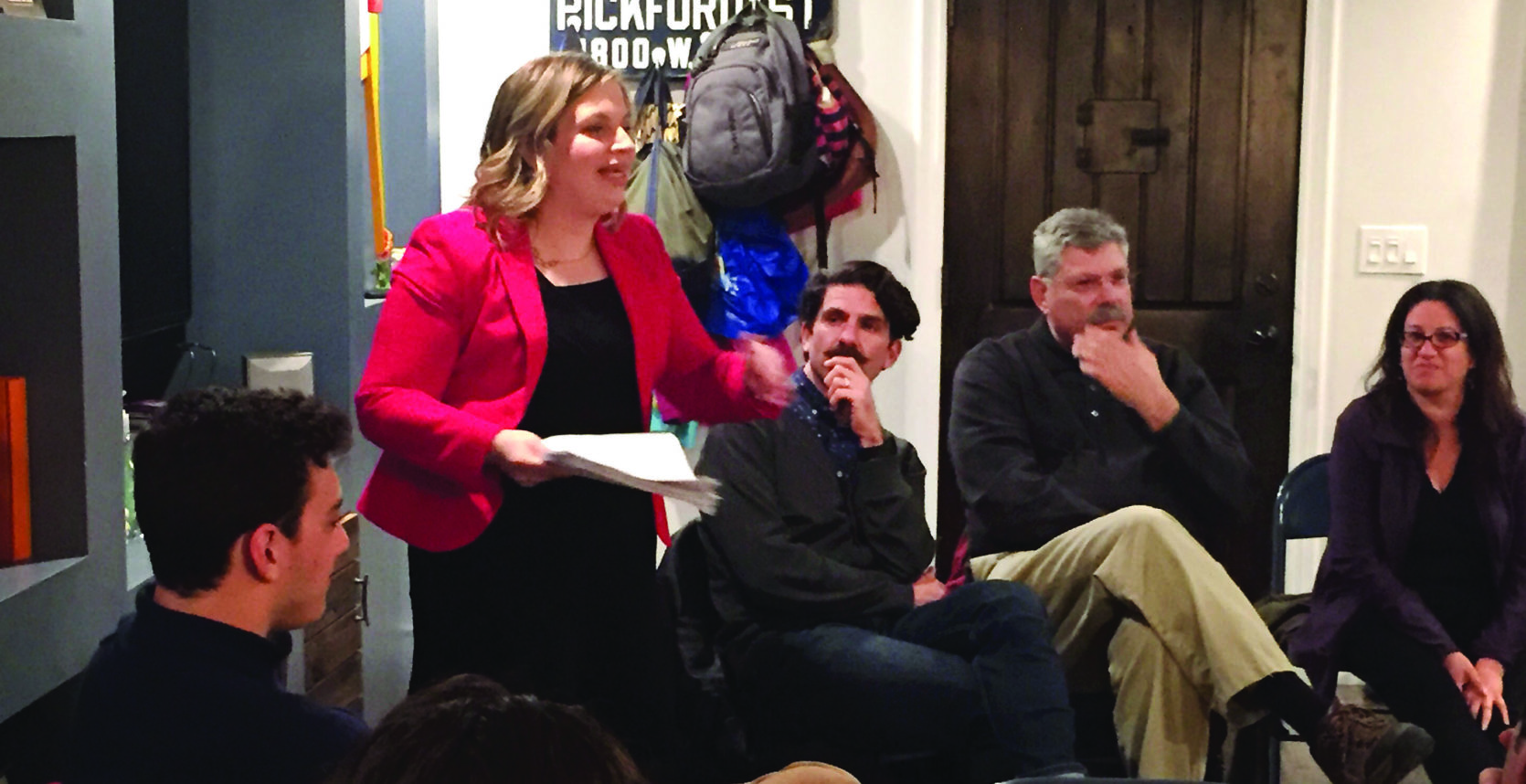
Rabba Yaffa Epstein led a salon-style, Purim-focused learning session on Feb. 24. Photo by Esther Kustanowitz.
Rabba Yaffa Epstein, director of strategic partnerships at the Pardes Institute of Jewish Studies and a 2015 graduate of Yeshivat Maharat, led a salon-style, Purim-focused text study at the West Adams home of Abby Fifer Mandell, executive director of the Brittingham Social Enterprise Lab at USC’s Marshall School of Business, on Feb. 24.
Yeshivat Maharat is the self-described “first yeshiva to ordain women as Orthodox clergy.”
Over the course of two hours, participants at the gathering split up intopairs and examined texts from the megillah, the Mishnah and more. They discussed the importance of celebrating Purim in a communal setting and what distinguishes Purim from other Jewish holidays. Attendees included Jewish Journal Contributing Writer Esther Kustanowitz, organizer of the event; actress Mayim Bialik (“The Big Bang Theory”); Fifer Mandell’s husband, Avram Mandell, executive director and founder of Tzedek America; current Tzedek America fellows Gabe Melmed and Emily Heaps; Todd Shotz, founder and executive director of Hebrew Helpers; and consultant Wendy Jackler.
Cheese and wine were served to attendees, many of whom were affiliated with LimmudLA, a volunteer-led Jewish learning community, and the Wexner Graduate Fellowship, a leadership development program for Jewish communal professionals. Limmud Bay Area co-founder Mila Wichter was among the participants.
“The opportunity to sit around in someone’s living room and talk about what makes Purim different from all the other holidays provided a burst of energy at the end of a long day,” Kustanowitz said.
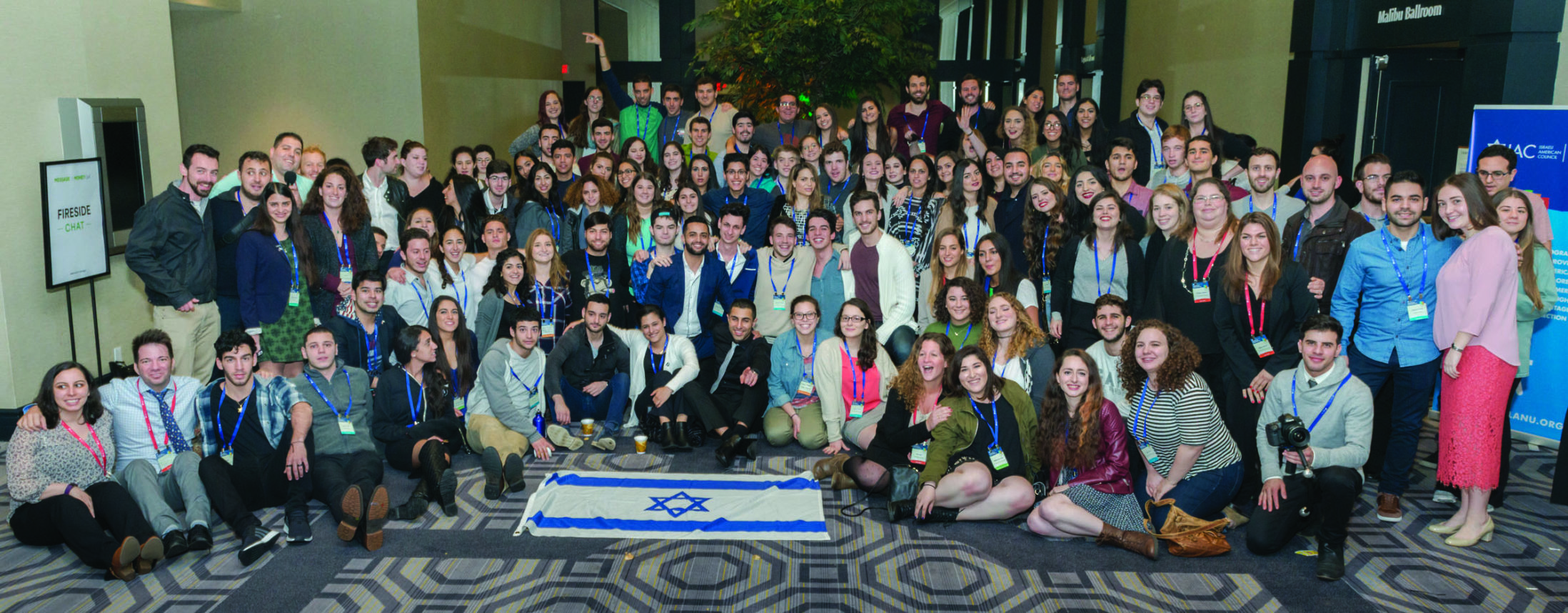
Approximately 400 Israeli-American students from across the country attended the Israeli American Council Mishelanu conference. Photo courtesy of Israeli American Council.
Israeli American Council (IAC) Mishelanu held its third national conference Feb. 17-19 at the Sheraton Gateway Los Angeles Hotel.
Mishelanu, a college campus program, provides a home for Israeli-American students who explore their Israeli-American and Jewish identities through culture, language, heritage and a strong connection to Israel. The national network is present on 96 campuses.
About 400 Israeli-American students from across the country attended the conference. The students spent the weekend participating in breakout sessions on initiative-building, networking, policy and political organizing, strategic leadership, social media campaigning, Israeli-American media and Israeli music.
Speakers included entrepreneurs, business leaders and nonprofit professionals. Among them were Guy Katsovich and Yair Vardi, managing partners of Splash Ventures; Roy Dekel, CEO of SetSchedule; and Yotam Polizer, co-CEO at the humanitarian response organization IsraAID.
Also appearing were Israeli journalist Ben Dror Yemini; educator Neil Lazarus, an expert on the Middle East and Israeli politics; and Moti Kahana, the Israeli-American founder of Amaliah, an American organization aiding Syrian refugees.
IAC leaders in attendance were Chairman Adam Milstein, CEO Shoham Nicolet, Chairman Emeritus Shawn Evenhaim, board member Naty Saidoff and Los Angeles regional director Erez Goldman.
The program reaches nearly 1,000 students in 17 states.
“IAC Mishelanu students are our ‘secret sauce’ on campus,” Nicolet said in a statement. “They speak both ‘Israeli’ and ‘American’ and can serve as a unique bridge within the university’s student body, spreading love and passion for Israel.”
Manny Dahari,23, astudent at Yeshiva University and a Mishelanu student leader, was among those who attended the conference.
“I’ve attended all three Mishelanu conferences and it only gets bigger and better each year,” Dahari said. “This year’s conference was fantastic, as always. I believe the Israeli-American community is getting stronger and Mishelanu will only continue to grow around the country.”
— Mati Geula Cohen, Contributing Writer
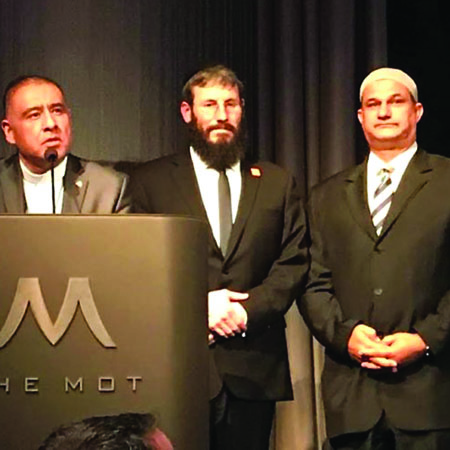
During the first Interfaith Tolerance Awards, Consul General of Azerbaijan in Los Angeles Nasimi Aghayev honored Pico Shul Rabbi Yonah Bookstein, Churches in Action founder Bishop Juan Carlos Mendez and King Fahad Mosque member Mahomed Akbar Khan in recognition of their efforts in promoting peace, tolerance and harmony among the three major religions.
The Feb. 21 event at the Museum of Tolerance also featured the screening of the documentary “Running From the Darkness.” Produced by J-Connect, an organization with which Bookstein is involved, and the One Wish Project, the film spotlights the 1992 Khojaly Massacre, when Armenian armed forces committed a mass murder of Azerbaijani civilians in the town of Khojaly. In 2015, Bookstein visited Baku, Azerbaijan’s largest city and home to a little-known community of mountain Jews.
About 200 people attended the awards event, including Liebe Geft, director of the Museum of Tolerance; Josh Kaplan, president of J-Connect; and Neuriel Shore, a Pico Shul congregant and senior campaign executive at the Jewish National Fund.
A live performance of Azerbaijani and European classical music followed the ceremony and screening.
Samara Hutman, director of Remember Us,an organization dedicated to preserving the memory of the Holocaust, participated in a Feb. 18 forum at the Japanese American National Museum addressing the 75th anniversary of the signing of Executive Order 9066.
Signed by President Franklin D. Roosevelt in 1942, Executive Order 9066 resulted in the forced incarceration of 120,000 Japanese Americans.
Hutman was on a panel that featured African-American, Japanese-American, Muslim and Latina speakers, including Norman Mineta, who served as President George W. Bush’s secretary of transportation; former Congressman Mike Honda; and Haru Kuromiya, a 90-year-old Japanese-American placed in an internment camp after Roosevelt’s executive order.
The event’s speakers drew parallels between the executive order of 1942 and President Donald Trump’s recent executive order, which, though ultimately blocked by the judicial branch of government, would have barred citizens of seven Muslim-majority countries from entering the United States.
Hutman and others stood before a banner-sized petition opposing “executive orders and laws that attack our civil and constitutional rights.” In addition, she read three poems, one by a child who was in the Terezin concentration camp during the Shoah and two by Japanese children placed into internment camps in the 1940s.
The event coincided with the opening of a new exhibition at the museum titled “Instructions to All Persons: Reflections on Executive Order 9066,” which runs until Aug. 13.
Moving and Shaking highlights events, honors and simchas. Got a tip? Email ryant@jewishjournal.com.
One month into the Trump presidency, I flew to Paris to escape.
I was suffering from an acute case of Trump Fatigue, exhausted by the endless bad news, the moral outrage, the hysteria of the left, the hypocrisy of the right, the mass protests and activist meetings — not to mention the sleepless nights, the fear and uncertainty, the hundreds of articles about the future of American democracy, U.S. foreign policy, an ever-complicated Israel, and how the world as we know it is basically going to hell.
It turns out that although my capacity for outrage is apparently endless, my stamina for expressing it begins to ebb at a certain point, and then it’s time to do something dramatic, like follow through on my threat to leave the country.
So I flew to Paris thinking I’d walk the streets of Le Marais, stare at Monet’s “Water Lilies,” skulk around the gardens of Musée Rodin and eat a lot of cheese. I would revive myself with a renewed commitment to Bohemian ideals of truth, beauty, freedom and love — like in the movie “Moulin Rouge!” — and reclaim a sense of optimism for the future. What better way to restore some joie de vivre to my battered American soul than visit the place that invented joie de vivre?
I made it about as far as the cab ride from the airport when I realized that the stark political realities I had hoped to leave behind were in some ways closer than ever.
To enter Paris, my driver had to pass a small tent city of homeless people, who weren’t typical homeless people at all, but scores of women wearing hijabs, crowding the intersection with cardboard signs that read, “Je suis Syrien.”
To see up close what in the United States is discussed mainly in the abstract was shocking in its realism. In an instant, the only thing separating me from the Syrian civil war that destroyed and displaced millions of lives was the door of a cab.
Within an hour, it was easy to see why politicians such as Marine Le Pen have capitalized on France’s immigration “problem,” which is ripe for politicization. The evidence France has not well integrated many of its immigrants is creeping farther and deeper into Paris.
Homelessness and idleness were visible on street corners and in metro stations. And it isn’t only Syrians you see, but Algerians, Malinese and Senegalese, all trying to make their way in a country that, like the U.S., contains factions that are becoming increasingly nationalistic and hostile to outsiders. If you are inclined to seek reasons for why immigration is a threat to France’s fantasy of itself, you can easily find them.
Perhaps that’s why some Parisians are sympathetic to Trump’s anti-immigrant tactics. At a concert at the Maison de la Radio, I sat next to a sophisticated middle-aged woman who told me she didn’t much mind President Donald Trump. “The Clintons would have been much worse,” she whispered between Prokofiev and Shostakovich. “They wanted war. Trump only wants the money” — which she pronounced “Monet,” like the artist.
Some Parisians couldn’t care less about Trump’s atrocious identity politics, his nepotism or his greed —as long as he doesn’t drag Europe into another Iraq War.
But that comment seemed somewhat ironic, only a few days later, during dinner with Italian expatriates who are much more worried about the damage France may do to itself should Le Pen get elected and have her way. Over homemade tortelli with brown butter and crispy sage, an academic from the prestigious Sciences Po, the Paris Institute of Political Studies, warned that if European nationalist trends continue — resulting in more referendums like the one that led to Brexit — the porous borders and economic cooperation that have cemented European peace since World War II could disappear, producing renewed potential for regional conflict. Recently, this professor said, one of the top deans at his school suggested renaming his course track from “Negotiation” to “War Studies.”
“It’s like we’re going backward,” the professor said. “All the progress we made after the war — the focus on human rights, peace and prosperity for all — it’s as if it doesn’t matter.”
Europe, like America, is divided. And they’re watching us very, very closely. Even the French daily Le Monde is obsessed with the reality show that is the Trump White House and is now publishing a regular column called La journée de Trump — a roundup of the president’s day.
So much for my glamorous escape.
Political anxieties are alive and well in Paris, too, and no amount of aperitifs or digestifs can distract from a world in flux. “Travel robs us of refuge,” wrote French philosopher Albert Camus. He believed that we cannot hide ourselves when we travel — that we are “stripped of all our props, deprived of our masks … completely on the surface of ourselves.”
I used to come to Paris and feel only its wonders; now I also see its stains.
Danielle Berrin is a senior writer and columnist at the Jewish Journal.


 H
H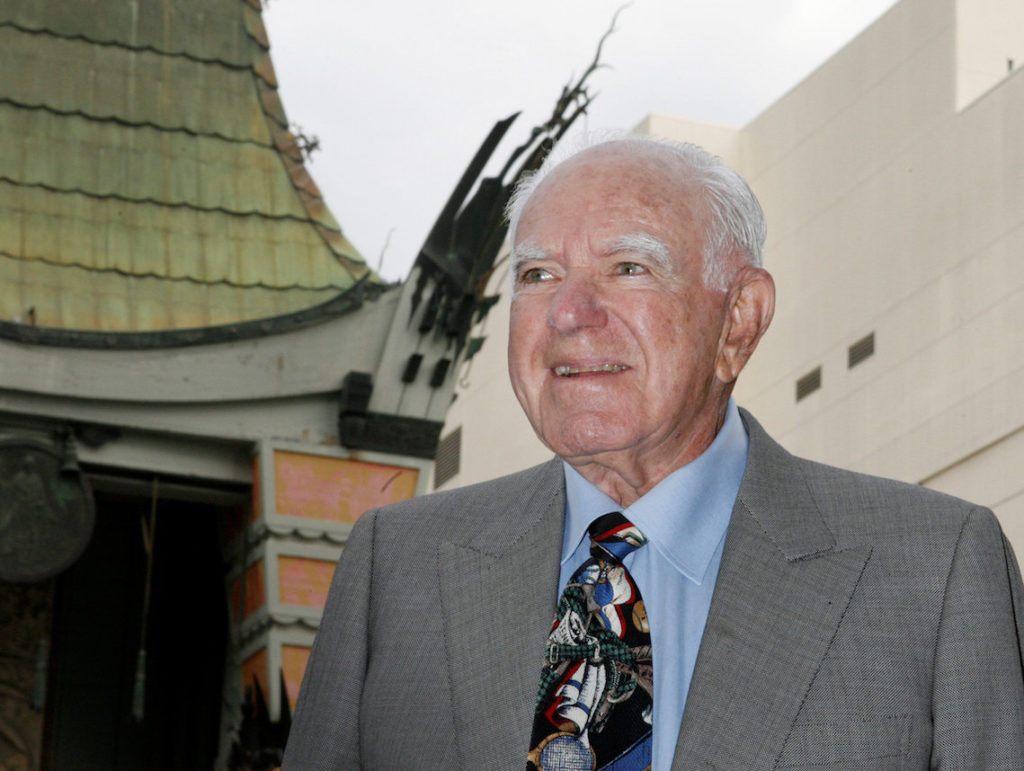



 Du
Du Sa
Sa