fbpx

March 1, 2017

5 ways to fight back against anti-Semitism

So it turns out that in the year 2017, we need a strategy to combat rising anti-Semitism.

Go figure.

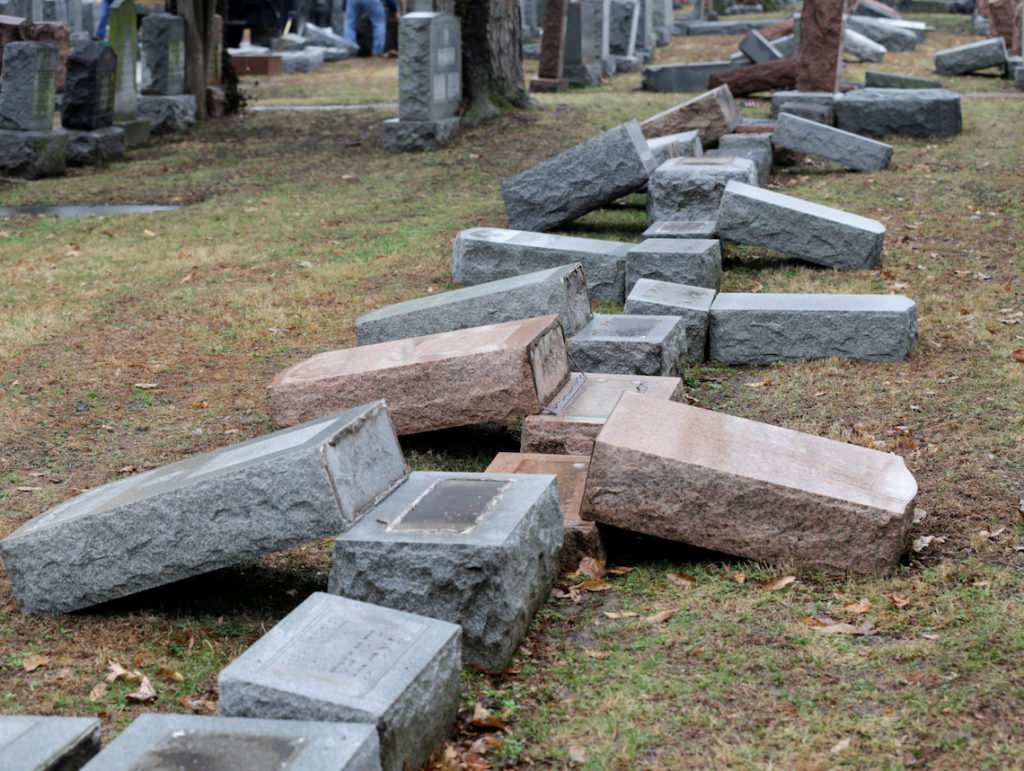
Since the beginning of this year, there have been 100 bomb scares at Jewish institutions nationwide. Last month vandals attacked and desecrated a St. Louis-area Jewish cemetery, toppling more than 170 tombstones. The New York Police Department reported a doubling of anti-Semitic crimes in 2017 through Feb. 12 compared with last year, from 13 to 28. Los Angeles Mayor Eric Garcetti told the Jewish Journal there’s been a doubling of hate incidents in Los Angeles since the November election as well.

This week began with the vandalism of 75 to 100 gravestones at a Philadelphia Jewish cemetery. On Monday, there was a new wave of bomb threats to Jewish community centers, including the Westside JCC.

And since the Journal goes to press Tuesday, you’ll have to read this online for updates. The week’s not over yet.

Our response to all of these fresh outrages have ranged from the ridiculous to the sublime.

In the former category is Israeli opposition leader Isaac Herzog’s call for his country to prepare for a flood of American Jews fleeing to Israel. In response, Atlantic editor-in-chief Jeffrey Goldberg offered a perfect one-word tweet: “Chill.”

A less hysterical response came from Anti-Defamation League CEO Jonathan Greenblatt, who published a 10-point plan the Trump White House could follow to counter rising anti-Semitism from the left and right sides of the political spectrum.

Greenblatt called on the administration to fund a civil rights investigation into the bomb threats, convene a federal inter-agency task force on fighting hate led by an appointed coordinator, support state and local legislation protecting college students from religious harassment and discrimination, breathe life back into the Countering Violent Extremism program, address cyber-hate in a comprehensive manner, increase federal funds for anti-hate content in local schools and “call out bigotry at every opportunity.”

While he is holding his breath for a White House reply to these sensible, minimal steps, I want to offer another list as well, this one aimed at what American Jews could do.

Until now, most of us have done little more than repost reports of anti-Semitic acts on Facebook with sad emoticons and snide remarks about the president or his Jewish daughter and son-in-law. But it is time to stop playing defense, to stop being passive spectators to our own persecution. Here’s my Jewish community to-do list:

1. More cameras, more guards. Your local used car lot has more security cameras than many cemeteries. That has to change. We don’t need Paris-style security cordons around our synagogues and centers, but we do need to beef up surveillance and private interdiction. 

2. Anti-Semitic “SWAT” teams. Remember those volunteer lawyers who swooped down on airports in the immediate aftermath of Trump’s Muslim travel ban?  We need teams of former prosecutors, law enforcement experts and lawyers at the ready who can, in coordination with existing Jewish organizations, help local authorities catch and convict hate perpetrators. And high-profile guard watches at Jewish cemeteries and elsewhere will likely scare off most of the cowards who creep out at night.

3. Fight non-Jewish hate, too. The hate virus is highly contagious. We need to fight it wherever it breeds. Breitbart.com and “The Alex Jones Show” are two Petri dishes of hate.  Every time a Muslim says “boo” in Sweden, there’s a front-page splash on Breitbart, but more than a week since the hate-crime murder of an Indian immigrant at a Kansas bar, Breitbart still has not featured it. Meanwhile, Breitbart did find home page space to attack the Forward newspaper for reporting Trump adviser Sebastian Gorka’s ties to anti-Semitic Hungarian groups.

4. Join forces. Those Muslim groups helping repair Jewish cemeteries? Embrace them. Thank them. Come out when they need help. Yes, you probably don’t see eye to eye with them on Israel or women’s rights, but we’re going to need allies. We are in this particular fight together.

5. Don’t do their job for them. Hate crimes begin with hate speech. The strategy of the alt-right and the Trump administration is to pit Jew against Jew. They want to divide conservative, more religious, Bibi-supporting Jews from more liberal, secular, pro-two state Jews. It was shameful to see mainstream Jewish organizations like Jewish Federations of North America line up behind Trump ambassadorial nominee David Friedman after he used hate speech to describe other Jews — language that only fuels hateful acts.

Look, we needn’t be hysterical, but neither do we have to be passive. I don’t think the American-Jewish community is under dire threat, and I certainly don’t predict a flood of us heading to Israel any time soon. Think of it this way: There are an estimated 200,000 Israelis living in the United States. Many of them are trained by the Israel Defense Forces and have access to America’s bounty of guns and ammunition. I don’t see them running away because some troll speed-dialed a JCC. When push comes to shove, I see them — and all of us — taking the fight to the enemy.


ROB ESHMAN is publisher and editor-in-chief of TRIBE Media Corp./Jewish Journal. Email
him at robe@jewishjournal.com. You can follow him on Instagram and Twitter @foodaism
and @RobEshman.

5 ways to fight back against anti-Semitism Read More »

A Moment in Time: When Small Things Make a Big Impression

Dear all,
IMG_0735This incredible photo appeared on my Facebook feed last week.  Perhaps it did on some of yours as well.  I am in awe of the photo.  But it made an even greater impression on a different level.
While our lives are finite, our soul print has no boundaries. The little things we do during our short window of time can have larger than life implications.
The smallest of gestures can inspire others toward goodness.
The simplest of expressions can transform others with motivation.
Our body language,
Our ability to be receptive,
Our willingness to embrace,
Our capacity to show empathy …
In a world where uncertainty has mounted (especially in the past few weeks), we need more than ever to make a difference through one another.  One person at a time.  One heartbeat at a time.  One moment in time.
With love and Shalom,
Rabbi Zach Shapiro

A Moment in Time: When Small Things Make a Big Impression Read More »

Sharing love, lessons in the face of hate rally

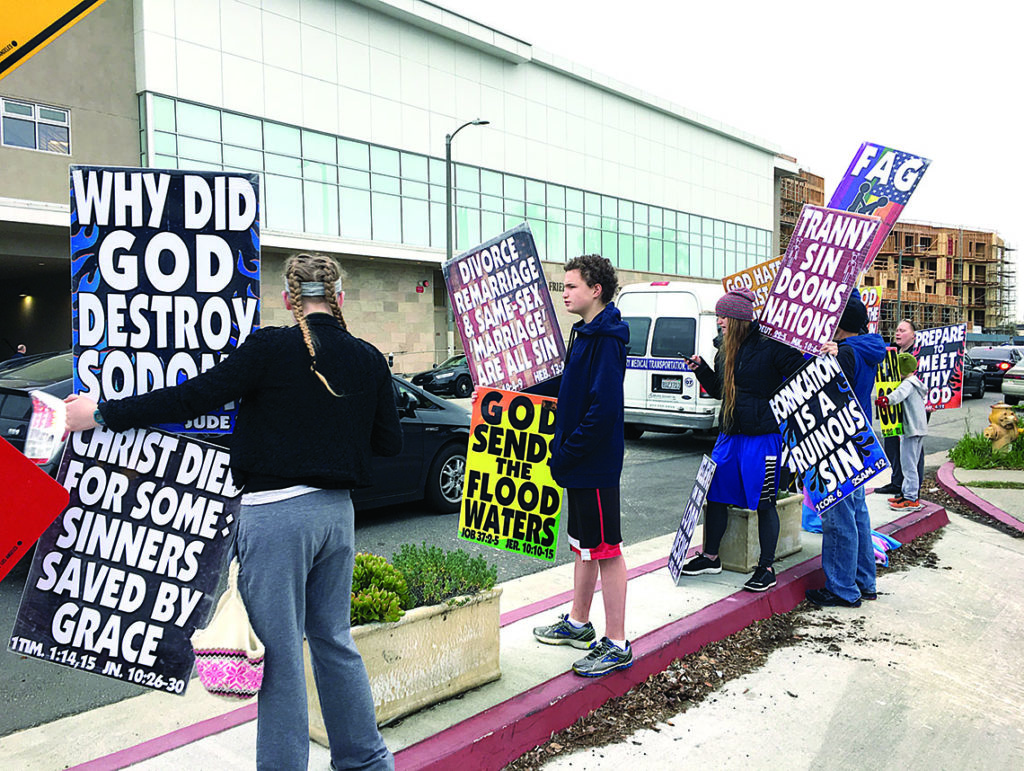
Nine members of the Kansas-based Westboro Baptist Church, which is known for hate speech directed at Jews and the LGBT community, staged a 30-minute demonstration early on the morning of Feb. 27 outside Shalhevet High School, a Modern Orthodox high school in the Miracle Mile neighborhood.

The protesters had flown to Los Angeles to hold a protest outside the Academy Awards ceremony Feb. 26 in Hollywood. They also demonstrated outside the Islamic Center in Hawthorne over the weekend.

The Southern Poverty Law Center, which tracks domestic hate groups, calls Westboro Baptist Church “arguably the most obnoxious and rabid hate group in America.” According to the church’s website, it has held  more than 59,000 demonstrations in 994 cities.

In an email to the school community several days ahead of the demonstration, Rabbi Ari Segal, Shalhevet’s Head of School, said classes would start at 9:30 a.m., about two hours after the demonstrators were scheduled to be dispersed. He also said extra Shalhevet security, as well as Los Angeles Police Department (LAPD) officers, would be on hand and urged against any counterprotest, on advice from school security officials.

“This group is looking to incite a response. I strongly urge our entire community to not give them the satisfaction of an argument or a response,” he wrote.

The protestors — teens to middle-aged adults — gathered on a busy section of Fairfax Avenue directly across the street from Shalhevet’s gated parking lot entrance. With LAPD officers and Shalhevet’s armed security guards on alert, protestors played music on a stereo, sang along and held up signs, including those that said “Tranny Sin Dooms Nations” and “144K Jews Will Repent,” a reference to scripture, the protestors claimed. The group believes Jews to be ardent supporters of homosexuality and the murderers of Jesus.

Timothy Phelps, 53, the son of Westboro’s founder, Fred Phelps, was among the protestors, but he did not offer much of a reason for choosing Shalhevet over other Los Angeles Jewish schools. He cited its location near a busy intersection, saying the group would get to other Los Angeles Jewish schools, such as YULA, in due time. He went on to refer to Judaism as a “dead religion” and talked about how sin in various forms is synonymous with Judaism.

“Idolatry, adultery, sodomy, fornication, pride, all of those … it’s rampant in the Israeli culture, in the Jewish culture,” he said.

With some in the Shalhevet community calling for a counterprotest off-site, Principal Noam Weissman favored the idea of a special learning program as a response to “virulent anti-Semitism.”

“We didn’t want to give them the attention they were seeking,” Weissman said. “We thought: Why not respond from a Jewish perspective and use this hatred as a springboard to be more proud of our Judaism?”

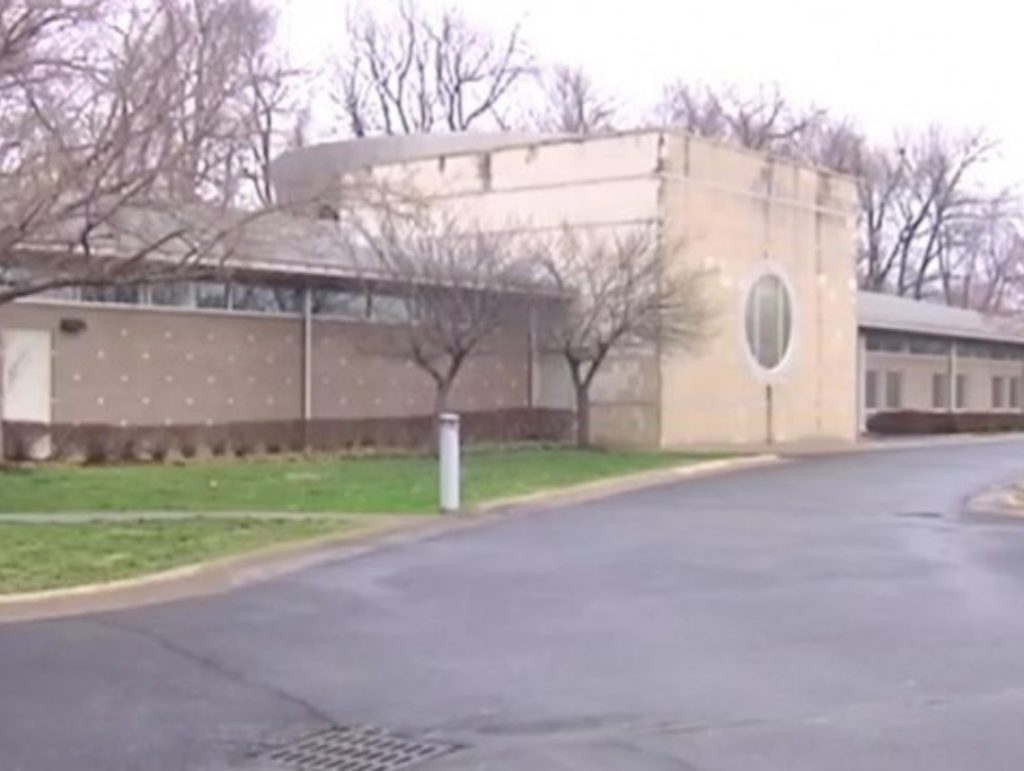
Segal found a willing partner in Beth Jacob Congregation, an Orthodox synagogue in Beverly Hills, which offered use of its facility. Heads of three area Jewish high schools — de Toledo High School, YULA Girls High School and Milken Community Schools — expressed an interest in having their students participate in whatever Shalhevet planned. Approximately 60 students from the three schools joined nearly 240 Shalhevet students and some parents who gathered at Beth Jacob at 8 a.m. for a tefilah service and Torah learning centered around Purim.

“This brought out the best in so many people,” Segal said. “Whatever Westboro was hoping to do, they accomplished the exact opposite.”

Weissman added: “They preached hatred and we celebrated love, friendship and peace in a most incredible way.”

After the program, Shalhevet students walked the 40-minute route back to campus in what Segal and Weissman called “the peace and love march.”

Segal said the rest of the day went smoothly, though he called the day as a whole “one of the craziest” during his time there.

In response to the protest, IKAR, a Jewish community that holds prayer services inside Shalhevet’s gymnasium, sent an email to its community, urging donations to the Trevor Project, an organization that provides life-saving support for transgender youth and adults. IKAR also collected donations from its members for a separate fund that was used to purchase sweets that were delivered Monday afternoon to Shalhevet students.

Segal said he was touched by the support from colleagues and the students at other schools. However, he added that he hopes moving forward, Jewish schools can look to come together in a proactive way, rather than just in reaction to troubling circumstances.

“I spoke with the leaders of the other schools and we all agreed that it shouldn’t just be something negative that brings us together,” Segal said. “The schools coming together to do good things together shouldn’t just be a reaction to people coming to tear us down. It should also happen to celebrate something positive.”

Staff writer Eitan Arom contributed to this report.

Sharing love, lessons in the face of hate rally Read More »

Trump and the power of English

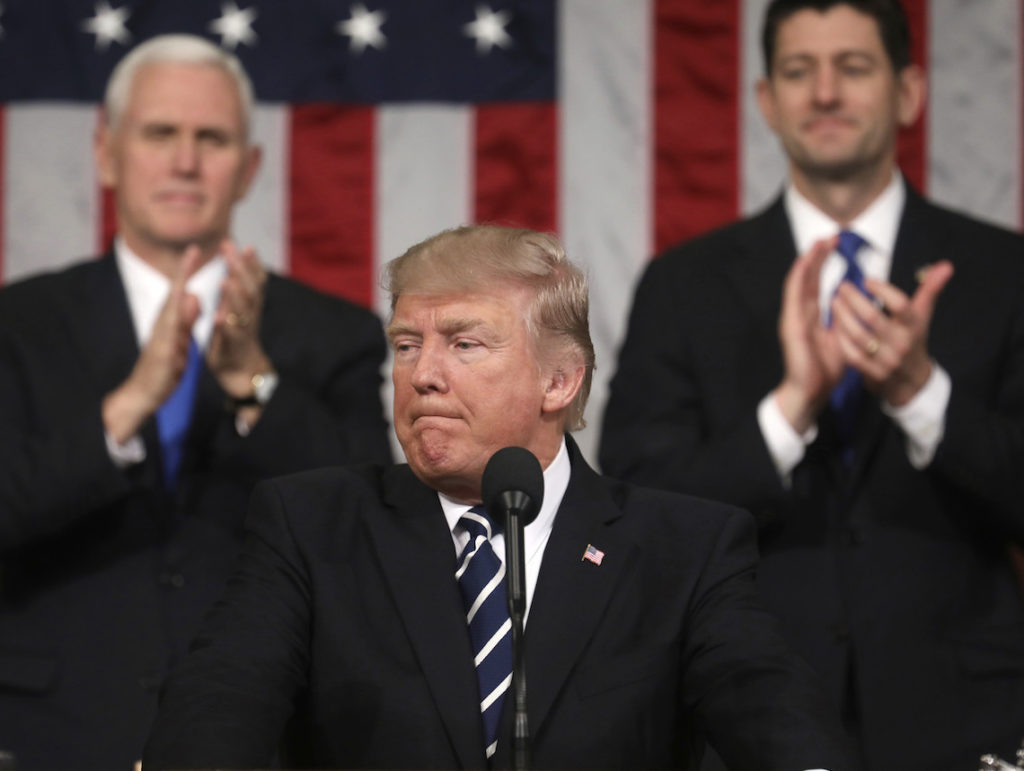
Well, was that all that difficult? President Donald Trump delivered a very nice speech last night in front of Congress and the media headlines this morning were … normal. After a month of craziness and chaos, normal feels like a miracle.

In a New York Times piece titled, “A Radical Move for Trump: A Conventional Address,” Glenn Thrush wrote that “At precisely the moment he needed to project sobriety, President Trump delivered the most presidential speech he has ever given.”

Chris Cillizza, in The Washington Post, wrote that “This may have been the best speech Trump has given since he entered politics in June 2015, and people rooting for his imminent demise may be disappointed.”

Over at Fox TV, Charles Krauthammer called it “without a doubt the best speech he ever gave. In fact, this should have been his inaugural address, a version of it. And it would have actually had an effect on the launch of his presidency and vastly reduced the hysteria that has emerged in the country on the left.”

Indeed, if Trump’s inaugural address was steak tartare, his speech last night was more like tiramisu.

What happened?

English happened. Life happened. Someone in the White House — it could be Trump himself, it could be an evil PR genius, it could be his daughter Ivanka, it could be the Dalai Lama on Skype — had this staggering insight that it’s OK to be nice.

Yes, it’s OK to be nice. It’s OK to say nice things, even if your preference is to say mean, divisive, macho things. In fact, one of the incredible truths about life is that you can say nice things and no one will think you’re a wimp or a loser.

Great presidents — strong, confident, powerful presidents — have been saying nice things since the founding of our nation and no one ever held these words against them. Last night, Trump tried to catch up with them.

“We are a country that stands united in condemning hate and evil in all its forms,” he said at the beginning of his address, noting our current celebration of Black History Month and recent acts of anti-Semitism.

“Each American generation passes the torch of truth, liberty and justice — in an unbroken chain all the way down to the present,” he continued. “That torch is now in our hands. And we will use it to light up the world. I am here tonight to deliver a message of unity and strength, and it is a message deeply delivered from my heart.”

A man known for his bullying speaking from his heart. Who knew?

A friend of mine who can’t stand Trump complained that, “He was just reading a speech, for heaven’s sake. It’s just words.”

Well, yes, it’s just words, which is precisely the point.

Insults are also “just words.” But words take on a reality of their own. Words, if repeated often enough, can shape reality.

It’s quite possible and even plausible that few of the words last night were written by Trump. But having delivered them, they are now his. He owns them. That speech is like a building with a big, flashy Trump logo on top.

Of course, not everything Trump said last night was nice—far from it. There were flashes of the dark side he showed in his inaugural address, and the press has covered it. But the point is this: When you frame your overall message in a positive way, when your tone is calm and sober rather than incendiary, you buy yourself some forgiveness. You buy yourself more positive headlines.

Do you move people who hate you? I doubt it. Trump haters are too far gone– there is zero trust and zero faith. As The Los Angeles Times reported, the speech was “inspiring to some, frightful to others.”

So, we shouldn’t get carried away with one speech, even if it represents a radical departure. By the time you read this, Trump may already have spoiled the whole thing with a series of nasty Tweets.

Still, for one night at least, our president showed us the power of positive language. If I were his chief adviser, I would do a mash-up of all his uplifting words and make sure he sees it every night before going to sleep, and every morning before going to work. And I would make sure to crank up the applause.


David Suissa is president of TRIBE Media Corp./Jewish Journal and can be reached at davids@jewishjournal.com.

Trump and the power of English Read More »

Palestinian intruder shot dead by his Israeli stabbing victim in West Bank

A Palestinian man who stabbed a Jewish settler in his West Bank home was shot dead by the knifing victim.

The resident of the Mor Farm outpost, in the south Hebron Hills, was lightly wounded in the Wednesday afternoon attack before using his gun to shoot the stabber. The knife attack and shooting occurred in front of the man’s children, according to reports.

Paramedics who arrived at the home treated the injured man, 33, and pronounced the Palestinian infiltrator dead.

Israeli troops later searched the outpost and the nearby Teneh Omarim settlement for a second intruder but did not find one.

Palestinian intruder shot dead by his Israeli stabbing victim in West Bank Read More »

Episode 27 – Unholy Matrimony in the Holy Land with Jessica Fishman

The right of return for the Jewish people states that anyone with at least one Jewish grandparent may become a citizen of the State of Israel. The reasoning: this was the criteria by which the Jews were persecuted under the Third Reich.

On the other hand, if you want to have an ordained marriage in the State of Israel, the par is set a little higher: your mother must be Jewish.

This dissonance leads to an inevitable rift in Israeli society: people who live here as lawful citizens, but are unable to legally marry their partner.

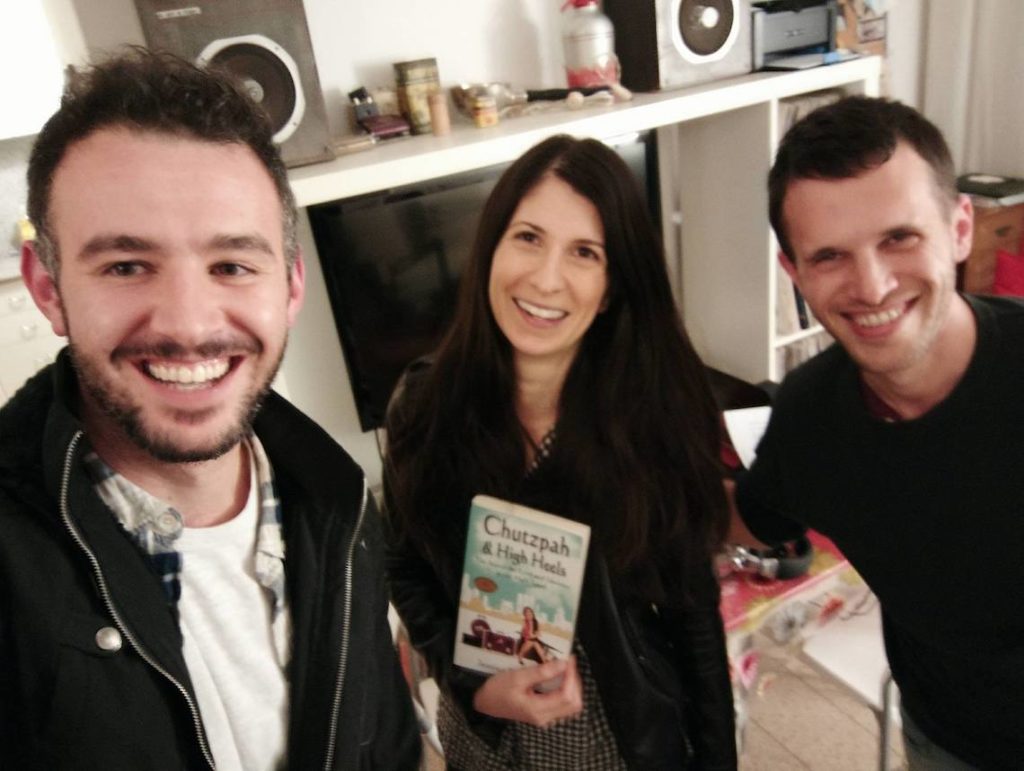
Jessica Fishman, author of the new book “Chutzpah and High Heels”, joins Two Nice Jewish Boys to share her story of Aliyah and talk about her devastation at the hands of this little known discrepancy in Israeli law.

Listen here:

Jessica’s book tour dates.

Episode 27 – Unholy Matrimony in the Holy Land with Jessica Fishman Read More »

4 Jewish takeaways from Trump’s big speech to Congress

President Donald Trump’s speech to a joint meeting of Congress is getting rave reviews for the subdued, “presidential” style of his delivery, and positive feedback from the Jewish community for opening remarks denouncing anti-Semitic acts as examples of “hate and evil.”

But there ensues the inevitable Trumpian conundrum: What did he actually mean?

Here are four takeaways from the speech and what it says about bias and the Jews:

1. What did he condemn exactly?

From the very first paragraph:

“Tonight, as we mark the conclusion of our celebration of Black History Month, we are reminded of our Nation’s path toward civil rights and the work that still remains. Recent threats targeting Jewish Community Centers and vandalism of Jewish cemeteries, as well as last week’s shooting in Kansas City, remind us that while we may be a Nation divided on policies, we are a country that stands united in condemning hate and evil in all its forms.”

That second sentence – the one that’s been getting the plaudits – gets thorny once it’s held up to the light. According to the logic of the sentence, it is the “recent acts” that “remind us that … we are a country that stands united in condemning hate and evil in all its forms.”

But what actually reminds us that we are united are the responses to such acts, like the thousands of dollars raised by Muslim activists to rebuild a vandalized Jewish cemetery, a labor union’s pledge to pitch in to fix damaged gravesites, a strongly worded statement from the White House.

It was the lack of the last item that had riled Jewish groups in the weeks after the first spate of JCC bomb threats and the first cemetery attack. In both instances, combined with Trump’s failure to comment for six days on what appears to be the bias killing last week of an Indian worker in Kansas, it was Trump’s failure to respond at first – indeed, his hostility to reporters who asked him to respond to the spike in anti-Semitic incidents – that raised hackles.

2. What’s not in the passage

A mosque near Tampa, Florida, was set ablaze last week. Another in Texas was burned down in January and one in Florida, where the killer in the Orlando massacre had occasionally worshipped, suffered a similar fate in September.

Why not include a reference to bias crimes against Muslims? It would be especially apropos given Trump’s overarching theme of unity because Muslims have indeed raised funds to refurbish vandalized Jewish cemeteries and Jews are contributing to the rebuilding of the Tampa mosque.

(Speaking of the Orlando massacre, why not a reference to the LGBTQ community? Trump at the time held up the massacre as emblematic of the protections that gay Americans needed and he would bring as president.)

A reference to the mosques may have allayed concerns that his travel ban is aimed at Muslims, although it targets seven (or, as of this week, six) Muslim-majority countries, as well as refugees.

Further along in the speech, Trump mentions Muslims in a positive way, as allies against radical Islamic terrorism. But he was talking about moderate Muslims in the Middle East — an alliance that is far afield from the highways and byways traversed by American Muslims.

3. What’s the plan?

Jewish community statements praising the president for his remarks condemning anti-Semitism were almost uniform in asking for a specific government and law enforcement response to anti-Semitic and other hate incidents.

“I was very pleased, that was an important message,” Sen. Ben Cardin, D-Md., said at a meeting Wednesday morning of the Helsinki Commission, the body that monitors human rights overseas and in the United States. “But we need to do more.”

“Powerful for @POTUS to note anti-Semitism at top of speech,” tweeted Rabbi Rick Jacobs, president of the Union for Reform Judaism. “Key now is to investigate and end terror campaign.”

Calls for a plan came as Bloomberg News reported that the Trump State Department was considering doing away with the post of anti-Semitism monitor. Granted, the position studies developments overseas, but Jewish groups worry that its elimination would suggest that the administration is not taking the issue seriously. The American Jewish Committee on Monday asked its activists to write the president and urge him to preserve the office.

Cardin told JTA, walking out of the commission meeting, that if anything the office of the anti-Semitism monitor needed bolstering.

“Strengthen it, elevate it, give it more resources,” he said.

4. The other stuff

* Trump mentioned Iran and Israel: “I have also imposed new sanctions on entities and individuals who support Iran’s ballistic missile program, and reaffirmed our unbreakable alliance with the State of Israel.” He did not mention the Iran nuclear deal he once reviled, nor did he speak of the Israeli-Palestinian peace deal he has said he would like to achieve.

* He did go into some detail on his plans to expand school choice: ”I am calling upon members of both parties to pass an education bill that funds school choice for disadvantaged youth, including millions of African-American and Latino children. These families should be free to choose the public, private, charter, magnet, religious or home school that is right for them.”

That’s a proposal he campaigned on, and it has raised concerns among Jewish precincts that favor church-state separations, but also has garnered praise among Orthodox groups and other supporters of Jewish day school education.

On Wednesday, the Union of Orthodox Jewish Congregations of America welcomed Trump’s call for federal policy to support school choice.

“We believe there are several ways in which parental empowerment should be pursued to achieve educational opportunity, in the tax code and elsewhere, and we look forward to working with the administration on this priority issue for our community and American society at large,” the O.U.’s Washington director, Nathan Diament, said in a statement.

4 Jewish takeaways from Trump’s big speech to Congress Read More »

Gunshot fired through classroom window of Indiana synagogue

A gunshot was fired through a Hebrew school classroom window at an Indiana synagogue.

The bullet hole was discovered late Monday at Adath B’Nai Israel Temple in Evansville. The apparent attack was reported to police on Tuesday morning, according to reports.

Rabbi Gary Mazo told the Indianapolis Star that the shooter would have had to walk around to the back of the building and fire into the classroom from the playground. The attack is believed to have occurred on Sunday night.

“We’re in this climate now where acts of hate are happening everywhere,” the rabbi told the newspaper.

“The goal was to make us afraid, but we’re not going to let fear consume us. We’ll stand up to fear, we’ll stand up to hatred and we’ll stand together. We know this is not representative of our community. We know that we live in a community that supports each other.”

The Evansville Police Department and the FBI are investigating the incident.

Evansville Mayor Lloyd Winnecke visited the Conservative synagogue Tuesday morning and issued a statement condemning the attack and calling it “a disgusting act of hate and bigotry that cannot be tolerated.”

He added: “Our community must come together in support of religious freedom and stand together with our Jewish brothers and sisters.”

Indiana is one of five states that does not have a hate crimes law.

The incident occurred a day after proposed hate crimes legislation died in the Indiana state legislature and after the Indianapolis Jewish Community Center received a bomb threat, one of 28 JCCs and Jewish schools targeted that day across the country.

Gunshot fired through classroom window of Indiana synagogue Read More »

“Friedman’s ‘kapo’ comment should disqualify him as ambassador to Israel” – Dr. Charles Gati

Earlier this week, I was asked to participate with two others in a press conference in Washington, D.C. on behalf of J Street which was convening in its 6th Annual National Conference.

I joined Dr. Charles Gati, Senior Research Professor of European and Eurasian Studies of Johns Hopkins SAI, a former state department consultant and Holocaust survivor, and Dylan Williams, Vice President of Government Affairs for J Street. I was asked as a former co-chair of the Rabbinic Cabinet of J Street and now as the national chair of the Association of Reform Zionists of America.

We were being questioned about President Trump’s nomination of David Friedman to be the next United States Ambassador to Israel. All three of us were strongly opposed to the nomination.

We oppose Friedman because of his long-standing support of the settlement enterprise, his public opposition to the two-state solution, and his assaults against large segments of the American Jewish community that support the two states for two people’s resolution of the Israeli-Palestinian conflict.

We said that Friedman’s policy positions run counter to the long-held positions of every American President in the last 25 years who have supported the two-state solution, his slander of J Street supporters as “worse than kapos,” his charge that the ADL is led by a bunch of “morons,” and that President Obama and Secretary Kerry are anti-Israel and anti-Semites.

These positions and statements ought to disqualify Friedman’s appointment to any position in the government, let alone as the chief American diplomat in one of the most sensitive regions in the world.

I was asked by Al Jazeera English whether or not I accepted Friedman’s statements at his Senate hearing in which he recanted virtually every position he ever held and every statement he ever made vis a vis Israel and the Israeli-Palestinian conflict. I said that I do not accept anything he said in the hearings as reflective of his true beliefs and as an indication of how he would conduct himself should he be confirmed by the Senate in the next few days.

In particular, I was moved by Dr. Charles Gati. He was ten years old when the Nazis invaded Budapest in 1944 and ordered the expulsion and murder of all that city’s Jews. Charles was spared being shot and thrown into the Danube River due to pure luck.

His opposition to Friedman was based not only on his policy positions and ill-temperament but because Friedman showed how woefully ignorant he is of Jewish history and the history of the Holocaust when he callously used the word “kapo” to describe J Street supporters.

After hearing Dr. Gati, I told him and Dylan Williams that meetings ought to be arranged this week one-on-one between Charles and every reasonable Republican Senator. I am certain that Charles would persuade any reasonable leader to oppose this nomination.

Read:  Friedman’s ‘kapo’ comment should disqualify him as ambassador to Israel, The Hill

http://thehill.com/blogs/pundits-blog/international/321633-friedmans-kapo-comment-should-disqualify-him-as-ambassador

“Friedman’s ‘kapo’ comment should disqualify him as ambassador to Israel” – Dr. Charles Gati Read More »

The Becoming Jewish exchange, part 3: ‘Millions of Africans believe they are of Israelite ancestry’

Tudor Parfitt is distinguished professor and President Navon Professor of Sephardi and Mizrahi studies at Florida International University. He is also director of the Global Jewish Studies Program. He is a fellow of the Royal Historical Society and corresponding fellow of the Académie Royale des Sciences d’Outre-Mer, Belgium. He was professor—now emeritus—of Modern Jewish Studies at SOAS. His latest books are In The Shadow Of Moses: New Jewish Movements In Africa And The Diaspora, ed. D. Lis, W. Miles and T. Parfitt (Africa World Press, 2016); Black Zion, ed. Ed. Bruder and T. Parfitt (Cambridge Scholars’ Press, 2012) and Black Jews in Africa and the Americas (Harvard University Press, 2013).

This exchange focuses on Becoming Jewish, a new book edited by Professor Parfitt and Dr. Netanel Fisher. Parts 1 and 2 (with Dr. Fisher) can be found here and here.

***

Dear Professor Parfitt,

Becoming Jewish begins with a chapter you yourself wrote about people who are ‘re-joining’ the Jewish people in Africa, and the first strand of the book is dedicated to people “claiming descent from the ten lost tribes and forced converts.”

As we have seen in the previous rounds with Dr. Fisher, your book covers many different conversion and identity phenomana in the Jewish world. Why did you choose to start the collection with Africa? How big is the new African Jewish phenomenon, and what kind of effects can we expect it to have on the Jewish world?

Yours,

Shmuel

***

Dear Shmuel,

It is conventional to start an edited book with the contribution of the editor(s). So the African example was not intended to be highlighted particularly in this book, as the clear intention of the editors was to present a picture of a remarkable global phenomenon. Nonetheless, it must be admitted that the number of Africans who self-identify as Jews or Israelites is very high and growing fast.

In purely numerical terms, the two continents with the highest number of people self-identifying as Jews are South and Central America and Africa. However, it is very difficult to put a figure on the numbers concerned on the African continent. If we were to take the least engaged category – which is to say people who believe they are of Israelite and perhaps Lost Tribes ancestry, but who do not practice Judaism in any great sense – the number would be very many millions and would include populations in Nigeria, Cote d’Ivoire, Gabon, Cameroon, Rwanda, Zimbabwe, Kenya, etc. This general belief in an Israelite origin for certain tribes goes back to colonial times, but it is now developing into a more rounded identity with the addition of ritual practices, interconnection with other similar groups in Africa and elsewhere, and a shared sense of oppression. A number of scholars believe that some kind of Judaism viewed as a religion of freedom will compete very effectively in the African religious market place at a time when Christianity and Islam suffer from association with colonialism and the slave trade respectively.

If we were to peer into the future and consider the shape and complexion of the Jewish state in fifty years’ time, it is difficult to imagine that this powerful periphery of African Judaism and African Jews will be absent from the mix. Currently, however, these millions of Judaising Africans have no discernible interest in migrating to Israel. Some of them see Judaism as an African religion, one which is linked with Judaisms elsewhere, but which is destined to develop essentially in the African continent.

Many of these African Judaising movements emerge from Messianic Judaic – Christian religious movements. Much the same could be said of Central and South America where there is a remarkable shift in religious identification. A flexibility about religious affiliation is no doubt a central pillar of post modernity. In the United States more than half of those who self-identify as religious people are practicing a religion other than the one into which they were born. In Central and South America the movement is strongly from Catholicism to some kind of charismatic Christianity, frequently of a Messianic variety, which includes some aspects of Jewish praxis as well, very often as a conviction about Judaic origins – here not so much Lost Tribes associations as imagined descent from Spanish and Portuguese anousim or forced converts. One example would be in Nicaragua, where something like half the population now is charismatic where a generation back almost all Nicaraguans were Roman Catholic. Driving around Managua, the capital, it is easy to spot the charismatic/messianics: they have Israeli flag stickers on the back of the car and a growing number of them claim Sephardi ancestry. A similar phenomenon may be perceived in Papua New Guinea among a number of tribes who self-identify as Jewish or Israelite, through Lost Tribes models, and whose religious beliefs are a mixture of Christian and Jewish elements. On Israeli Independence Day in the capital Port Moresby you see more Israeli flags being carried by these ‘Israelite’ tribes than you would see in an Israeli town of similar size on the same day. It is difficult to know where these messianic movements may be leading. Over time they seem to become more and more Jewish and to adopt more and more Jewish rituals, and in some cases they emerge as new Jewish religions with a strong sense of Jewish historical origin with little or no Christian content. The spread of these massive religious movements as well as the wave of conversions described in detail throughout Becoming Jewish add up to a quite new phenomenon for Judaism. At a recent lecture, one of the contributors, Nathan Devir, the author of a remarkable book, The Changing Face of Global Jewry: New Jewish Groups from the Developing World, which will be published this summer, observed:  ‘the history of the Jews in the twentieth century was dominated by the holocaust. Jewish life in the twenty first century will be dominated by the unprecedented spread of Judaism, globally, and how the state of Israel and the Jewish world respond to this phenomenon.’

Tudor Parfitt

The Becoming Jewish exchange, part 3: ‘Millions of Africans believe they are of Israelite ancestry’ Read More »