fbpx

March 1, 2017

Trump notes anti-Semitic threats and vandalism in speech to Congress

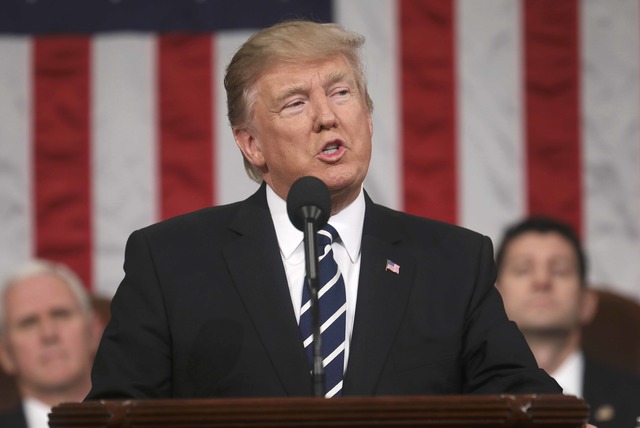
President Donald Trump noted recent bomb threats on Jewish institutions and vandalism of cemeteries in his first address to a joint meeting of Congress.

“Tonight, as we mark the conclusion of our celebration of Black History Month, we are reminded of our nation’s path toward civil rights and the work that still remains,” Trump said at the opening of his speech Tuesday night. “Recent threats targeting Jewish Community Centers and vandalism of Jewish cemeteries, as well as last week’s shooting in Kansas City, remind us that while we may be a nation divided on policies, we are a country that stands united in condemning hate and evil in all its forms.”

Close to a hundred Jewish institutions have been targeted with bomb threats since the beginning of the year. A bar patron in Kansas ejected from the establishment last week after hurling racial epithets at two workers from India allegedly returned with a gun and killed one of the men and wounded another as well as a man who tried to stop the attacker.

In all of these cases, Trump has come under fire for delayed responses. In the case of the threats on Jewish establishments, Trump at first deflected questions – and in one instance shouted abuse at a reporter – before calling the threats “horrible” last week. The White House did not address the Kansas shooting until Tuesday, six days after the attack.

Jewish leaders who had criticized the president for his fumbled responses praised the inclusion of the reference in his speech.

“Powerful for @POTUS to note anti-Semitism at top of speech,” Rabbi Rick Jacobs, the president of the Union for Reform Judaism, said on Twitter. “Key now is to investigate and end terror campaign.”

Jonathan Greenblatt, the Anti-Defamation League CEO, sounded a similar note.

“Thanks @POTUS for condemning #hate against Jews & immigrants,” Greenblatt said on Twitter. “Now let’s fight it. See our plan. Let’s do it together.”

Much of Trump’s speech was focused on his plans to restrict current immigration practices, impose law and order, repeal the Affordable Care Act, the Obama administration’s signature law, and reform trade agreements with other countries and, unusually, by excoriating his predecessors’ policies, “Overseas, we have inherited a series of tragic foreign policy disasters,” he said.

Trump also alluded to his efforts to improve ties with Israel, which were beset by tensions between President Barack Obama and Israeli Prime Minister Benjamin Netanyahu. He noted that – like Obama had – he imposed sanctions on Iran individuals and entities after the country tested a ballistic missile.

“I have also imposed new sanctions on entities and individuals who support Iran’s ballistic missile program, and reaffirmed our unbreakable alliance with the State of Israel,” he said.

Greenblatt in a tweet called on Trump to reaffirm the U.S. commitment to a two-state solution to the Israeli-Palestinian conflict; Trump earlier this month retreated from 15 years of U.S. commitment to the two-state outcome.

“POTUS reaffirmed unbreakable alliance w #Israel & threat posed by #Iran,” Greenblatt said. “Hope he also will reaffirm commitment to 2 state solution & true peace in region.”

Democrats sat silent through much of the speech, refraining from applause and making thumbs down movements when they disagreed. All the women in the Democratic caucus in the U.S. House of Representatives wore white, an initiative of Rep. Lois Frankel, D-Fla., who is Jewish.

Frankel told People Magazine that the white hearkened back to the Suffragettes, and was meant to protest Trump rollbacks of reproductive rights and other protections for women.

“Women all over this country are terrified right now,” Frankel told the magazine. “They’re afraid of losing access to reproductive choice, afraid of Planned Parenthood getting defunded, afraid of an Affordable Care Act repel, and losing access to affordable birth control.”

Seated next to one another were Rep. Debbie Wasserman Schultz, D-Fla., the Jewish congresswoman who was until last summer the chairwoman of the Democratic National Committee, and Rep. Keith Ellison, D-Minn., who last week lost his bid to replace her, but who secured the spot as deputy chairman of the party. Ellison is the first Muslim elected to Congress.

Their sitting together was a sign of Democratic unity after internal rivalries helped drive the party apart last year and contributed to the party’s defeat of Hillary Clinton in the presidential election and in both chambers of Congress: Wasserman Schultz is identified with the Clinton camp, while Ellison was close to Clinton’s primaries rival, Sen. Bernie Sanders, I-Vt.

Additionally, Wasserman Schultz is among the Democrats closest to the pro-Israel lobby, while Ellison came under fire during his DNC run for his critical postures on Israel policy and for his association decades ago with the anti-Semitic Nation of Islam movement.

Trump notes anti-Semitic threats and vandalism in speech to Congress Read More »

Report on 2014 Gaza War slams Netanyahu, military leadership

Israel’s prime minister, defense minister and army chief of staff did not update the Security Cabinet about the serious threat of Hamas tunnels from Gaza, the nation’s state comptroller said in a report on the 2014 Gaza War.

The Security Cabinet did not have enough information about the threat posed by the tunnels to make decisions about how to proceed during the war, leaving the Israeli military unprepared, Yosef Shapira wrote in the 200-page report released Tuesday afternoon.

The government led by Prime Minister Benjamin Netanyahu did not provide the military with clear objectives for the war and also failed in the one identified objective of what was dubbed Operation Protective Edge — to identify and destroy the tunnels. According to the report, which also scored then-Defense Minister Moshe Yaalon and former Chief of Staff Benny Gantz, the Israel Defense Forces only destroyed about half the cross-border tunnels.

The report also criticized the Security Cabinet for not holding discussions on and dealing with the humanitarian crisis in Gaza, including the collapse of infrastructure including water and electricity.

The comptroller also criticized Netanyahu for failing to consider diplomatic alternatives in Gaza and not presenting such a possibility to the Security Cabinet for its consideration.

In the year-and-a-half prior to the Gaza War, the Security Cabinet held 33 meetings on Gaza, according to the report.

Yaalon called the report “political” and said that it “examines partial aspects of the complex campaign.” He also acknowledged that the Security Cabinet at the time was “a superficial, political and populist Cabinet. A Cabinet of leaks, of speaking with two voices – one in the room and one in public.”

Netanyahu defended the handling of the Gaza conflict, saying “The unprecedented quiet that has prevailed  since Operation Protective Edge is a test of the results.”

Opposition leader Isaac Herzog called on Netanyahu to resign.

“The report clearly reveals how Prime Minister Netanyahu and the Cabinet which he led failed in their role of understanding the threats, setting strategy, understanding the reality, properly preparing soldiers and civilians, particularly residents of the south,” he said.

Report on 2014 Gaza War slams Netanyahu, military leadership Read More »

NAACP names Reform movement’s Religious Action Center head to its board

The NAACP named the director of the Reform movement’s Religion Action Center, Rabbi Jonah Pesner, to its board.

The National Association for the Advancement of Colored People announced on Tuesday that it was appointing Pesner, who has led the RAC since 2015 and served as senior vice president of the Union for Reform Judaism since 2011, along with the appointments of five other new board members, including three Christian pastors.

“Eliminating racism and expanding civil rights are intrinsic Jewish values,” Pesner said in a statement. “I could not be more proud to join the board of the NAACP to help advance those goals.”

Rabbi David Saperstein, Pesner’s predecessor at the RAC — the Reform movement’s legislative advocacy arm — also served on the NAACP board.

NAACP President and CEO Cornell William Brooks praised the new appointments.

“These new board members bring an amazing wealth of achievement, accomplishment and influence on issues from civil rights to religion to community-building and leadership,” he said Tuesday in a statement. “We are honored by their presence and welcome them into the inner family of the nation’s oldest, largest and boldest civil rights organization.”

The Religion Action Center and the Reform movement have a history of working with the NAACP and other civil rights groups. From 1966 to 1975, Kivie Kaplan, a vice chairman of the Union of American Hebrew Congregations — which later became the Union for Reform Judaism — served as the national president of the NAACP. The Civil Rights Act of 1964 and the Voting Rights Act of 1965, both landmark civil rights legislations, were drafted in the RAC building.

NAACP names Reform movement’s Religious Action Center head to its board Read More »

Rabbi Diaries: Chocolate Drinking in Eighteenth Century

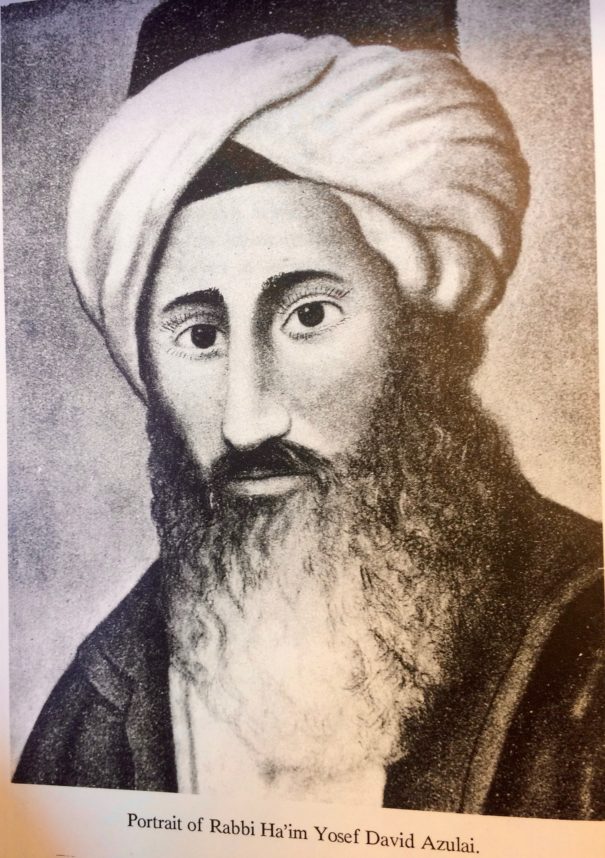
IMG_3712The diary of Rabbi Haim Yosef David Azulai (known as the HIDA who lived from 1724– 1806) may be the first document to identify the personal chocolate use of a rabbi. Azulai mentions chocolate at least ten times and reports widespread chocolate drinking among the Jews of Europe.

Selected to be a messenger from Israel to European Jewish communities due to his erudition, the HIDA, of Sephardi descent, was born and educated in Jerusalem . He published over 60 works of Jewish law and prayer, plus his travel diaries. Some consider him to be the greatest Sephardi scholar since Joseph Karo, author of the authoritative Jewish code known as the Shulchan Aruch. During his travels he drank chocolate, ate chocolate, and was gifted chocolate. On a very mountainous journey in a snow storm from Cuneo, Italy, to Nice, France, he confessed that he had become so ravenous that he “had some raw chocolate and I ate about a litre.” That was unusual then since chocolate was primarily a beverage and not produced as an edible. In Amsterdam the HIDA celebrated a bris with chocolate and sweets in 1777. After services in Montpellier, France, he drank chocolate with the synagogue’s main benefactor and other members. His hosts entertained him with chocolate in Italy, France and the Netherlands. Here are his chocolate diary entries:

5516/1755 25 Teveth from Nice to Cuneo.  Over snowy mountains, very hard trip…“ Mercifuly I had some raw chocolate and I ate but a litre…”

5534/1774, Iyar 20, just before Shavuot, Livorno, Italy. “And they brought me gifts: S. Leon, coffee and chocolate.”

5537/1776 Shevat 21, Trieste, Italy. Meeting with leaders of the council. “But the first and prime force in everything was S. Marco who sent me a large vessel full of coffee and chocolate … ”

5537/1776 Montpellier, France. Thursday. “I went to the synagogue established by the deceased Melinde and his widow supports the synagogue. They conduct themselves according to the rites of the Four Congregations [Carpentras, Avignon, Lisle and Cavaillon]. After prayers I drank chocolate with the said widow together with some of the Yehidim.”

5538/Heshvan 16 1778, France. “Later I went to drink chocolate with S. Samuel Astruc; then I went to dine at the home of … ”

5538/Kislev New Moon 1777, Sunday, Vayetse. “ … in the morning I drank chocolate at the home of S. Judah and Haim bar-Mordecai who are called by the name of Lange.” 

5538/Teveth 6 5538 1777, Monday. “I drank chocolate with Solomon Ravel.”

5538/1777-8 Teveth 27, Amsterdam. “The eve of Monday; we found in the village of Dragehave a Jewish householder living there with his family. On each holy Sabbath a minyan came there to pray and they had a Sefer Torah. We stayed there some three hours and they regaled us with chocolate and other delicacies.”

5538/1777-8 Amsterdam, Adar 27. “Thursday I went to visit some gentiles with S. ibn Dana: Britano, Pibelsman, Carlo Vernandi. They did me much honor, especially Pibelsman who gave me two pounds of home-made chocolate.”

5538/1777-8 Amsterdam Iyar 6. “Next morning, an hour before mid-day, I went to the circumcision [of the son of S. Moses ben Isaac Israel Soasso] where I found all the Parnessim, his friends. They made me stay for the meal which consisted of    and various sweetmeats. I did not wash hands for eating the bread but only ate some sweetmeats and chocolate.” 

The  European Jewish communities of the mid-eighteenth century enjoyed their chocolate, especially when entertaining a scholar and emissary from the Holy Land. Azulai was fortunate to have been sustained and warmed by that hospitable chocolate in his arduous travels and meetings. His hosts modeled a delicious welcome for rabbis.

Hida photo

Rabbi Diaries: Chocolate Drinking in Eighteenth Century Read More »

Listening to Mayor Garcetti — from the side

Public officials come to meetings armed with talking points. And who can blame them? They’re asked the same questions over and over. Their words are carefully dissected. One wrong phrase can destroy a career. It’s hard to improvise smart, knowledgeable answers. That’s why politicians must always be on top of their messaging: what they have accomplished, what they promised, what they plan to do in the future, and so on.

This is the world of public service, and it’s especially true for a high-profile position such as the mayor of a big city like Los Angeles.

So, when Los Angeles Mayor Eric Garcetti visited the Jewish Journal offices last week for an interview with our reporting staff, I fully expected to hear some well-crafted talking points, and he didn’t disappoint. On every subject, from crime and homelessness to housing and transportation, the mayor seemed to know exactly what he wanted to say.

There were a few moments, however, where he veered off course with a brief, offhand remark. I pay special attention to those moments because I can often tell a lot about a person by what they choose to emphasize.

The funny thing is, when I heard these offhand remarks, my reaction was: Why is he not making a bigger deal of these things? They make him look human and real. They make him stand out from other politicians.

The first remark came in the middle of a long response on the problem of homelessness. The mayor dissected the problem, gave us a candid take on the scope of the challenge and outlined the steps his administration had taken as well as his future initiatives. So far, so good. All good talking points.

Then, as he spoke of the need for “an army of social workers” to help fight homelessness, he made an offhand remark that he “goes out with these outreach teams all the time” and that “I know people by their first names on the street now.” That personal aside lasted a few seconds before he went back to discussing statistics, programs, and so on.

I thought to myself: Wow, a mayor who goes out on the street to talk to the homeless. That’s big. That’s the kind of politician I would vote for. Why didn’t he play it up more?

His next offhand remark was also very brief. He was talking about the problem of crime, and was making the connection between crime, mental health and the ubiquitous use of drugs. He quoted a psychiatrist at a local hospital that he had met recently. How did he meet her? Here’s what he said:

“I talked to a woman. I do office hours where people come in and talk to me, just kind of random people who can sign up. And the one who, one of the people who got through this last week to talk to me was a psychiatrist.” He then went right back to his main subject.

Again, I thought: Wow. A mayor who allows anyone to sign up and make an appointment with him. That’s what President Lincoln did! Why doesn’t Garcetti make a bigger deal of this stuff, especially in front of journalists?

The only explanation I could come up with is that this man is not a show off. A policy wonk, maybe, but not a show off. Putting any cynicism aside, maybe he does these “extra” human things not to look good but because he really wants to do them.

There was one more offhand remark that caught my attention. It happened while the mayor was talking about his administration’s efforts to bring the Olympics to Los Angeles in 2024.

Out of the blue, he looked out at the late afternoon view from our conference room, and said, “Don’t miss the sunlight on the Hollywood sign right now.”

He could have given me twenty well-crafted talking points about his love for Los Angeles, and it wouldn’t be worth the spontaneity of interrupting himself in front of journalists to admire a view of his beloved city.

His appreciation for that golden view may have something to do with the fact that he’s an avid photographer. That’s another human trait he downplayed – in fact, he never brought it up.


David Suissa is president of TRIBE Media Corp./Jewish Journal and can be reached at davids@jewishjournal.com.

Listening to Mayor Garcetti — from the side Read More »