fbpx

February 20, 2017

Does AIPAC prefer Pence over Trump?

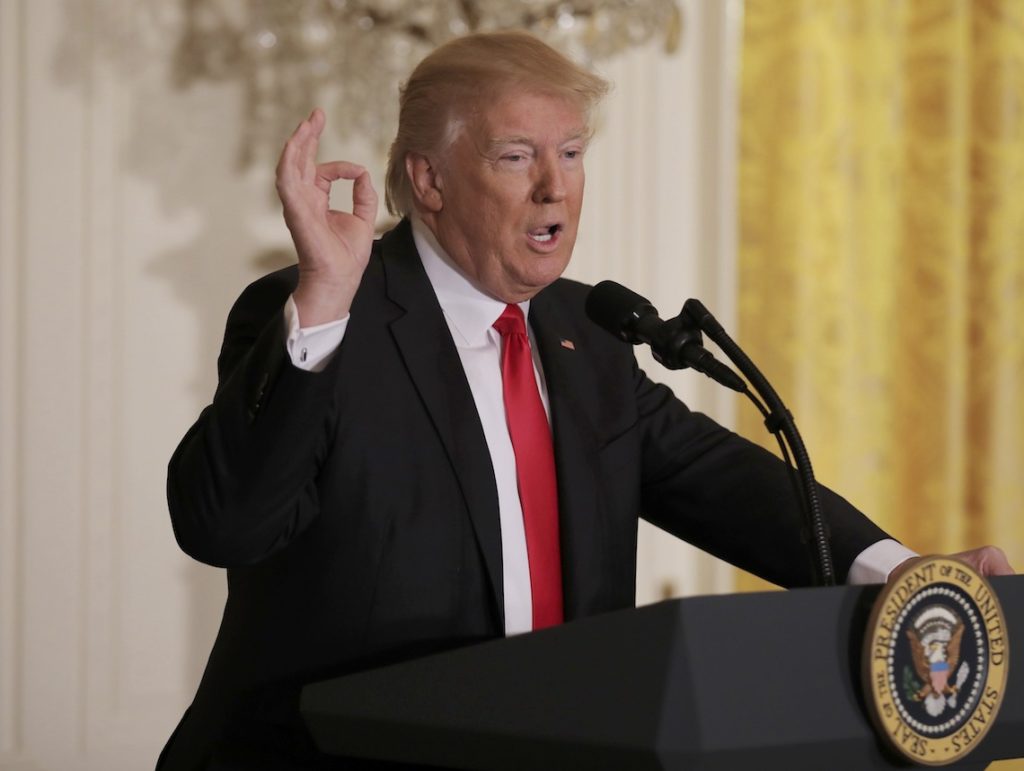
AIPAC confirmed on Friday that Vice President Mike Pence will be speaking at its annual Policy Conference in March. The pro-Israel group has remained mum about President Donald Trump implying, that unlike last year, the real estate mogul turned commander-in-chief is unlikely to attend this year’s gathering as well.

[This story originally appeared on jewishinsider.com]

“I am not surprised that Pence is going. AIPAC always plays it very straight,” Matt Nosanchuk,  former White House Jewish Liaison during the Obama administration, told Jewish Insider. “If the President would’ve wanted to go, I am sure — like last year — they would’ve welcomed him. But I also can tell you that not everybody would’ve welcomed him,” he added.

Josh Block, CEO of the Israel Project told Jewish Insider, “Pence was a strong leader on Israel-related issues in Congress and continued to be as Governor of Indiana is a sign from the White House to AIPAC and the pro-Israel community of the importance this administration attaches to the U.S. – Israel relationship.”

Last year, Trump delivered an impassioned speech at the conference calling for “dismantling” of the Iran deal and vowing to move the US Embassy to Jerusalem. The former GOP candidate also used his time to lash out at President Barack Obama. “He may be the worst thing that ever happened to Israel,” while adding, “President Obama [is] in his final year — yay!” The remark received some applause from the packed crowd in Washington’s Verizon Center arena.

The next morning, AIPAC President Lillian Pinkus publicly apologized for the applause and rebuked Trump. “Last evening, something occurred which has the potential to drive us apart, to divide us. We say, unequivocally, that we do not countenance ad hominem attacks, and we take great offense against those that are levied against the President of the United States of America from our stage,” Pinkus explained.

“Every time Trump speaks there is a layer of unpredictability. There is no doubt of that,” Tevi Troy, Deputy Secretary of Health and Human Services during the George W. Bush Administration, explained to Jewish Insider. Troy added, “Look I think it makes sense for all involved. Pence has a long history of being very, very pro-Israel. I think if Pence speaks there still might be some people who want to protest, but I think if the AIPAC folks said we’ve got to treat the administration and the Vice President with respect, then that would probably be heeded. But, I don’t think AIPAC is as confident that the same would happen if Trump were to speak.”

Other commentators emphasized that Trump not speaking at AIPAC is hardly unusual. Phil Rosen, a top GOP fundraiser and former foreign policy advisor to presidential candidates Mitt Romney and Marco Rubio, noted in an interview, “The last time a US President spoke at AIPAC was in 2012 when President Obama was running for reelection. There has not been a US president speaking at AIPAC since that date and in fact, Vice President Biden and others spoke on his behalf.”

Troy added, “He is the president and he has a lot of competing obligations and offers. I bet Trump wasn’t thrilled with the way it worked out last time. AIPAC obviously had some issues. This is the best solution for everyone,”

“Pence is well known and trusted in the AIPAC community — I would expect him to further burnish his credentials,” Noam Neusner, former White House Jewish Liaison in the George W Bush Administration, told Jewish Insider.

Does AIPAC prefer Pence over Trump? Read More »

Bomb threats called in to at least 10 JCCs in fourth round of harassment

At least 10 Jewish community centers across the United States were targeted with bomb threats on Monday, for the fourth time in five weeks.

The threats have been called in to JCCs across the country, according to Paul Goldenberg, the director of Secure Community Network — an affiliate of the Jewish Federations of North America that advises Jewish groups and institutions on security.

News reports indicated that threats were received by JCCs in Whitefish Bay, Wisconsin; St. Paul, Minnesota; Houston, Texas; Buffalo, New York; Albuquerque, New Mexico; and Birmingham, Alabama.

The threats were called in on Monday morning. It is not known if they were live calls or recorded.

“It appears to be the same serial caller” as in the prior incidents, Goldenberg told JTA.

Goldenberg said that some of the JCCs were evacuated and others were not.

“The JCCs are very well-equipped to handle this,” he said.

Goldenberg did not confirm where any of the threats occurred, saying they took place across the country and that his office “is monitoring the situation.”

Goldenberg said the fact that the threats were made on Presidents Day, when more people might be in the buildings during the daytime, does not appear to be a factor in the threats.

Last week, President Donald Trump was asked during a news conference about the prior JCC bomb threats and what the government’s response would be to “an uptick in anti-Semitism.” Although the reporter did not suggest Trump was anti-Semitic, the president answered by denying he is an anti-Semite and called the question “insulting.”

The  Harry and Rose Samson Family Jewish Community Center in Whitefish Bay, Wisconsin was evacuated at about 10:30 a.m. on Monday, and reopened at about 3 p.m., an hour after police and FBI officers said that everything was clear, according to local reports. A message on the JCC’s website read: “The JCC is currently closed and safely evacuated.” It is the second time in recent weeks that the JCC has been evacuated due to a bomb threat.

The Jewish Community Center in St. Paul, Minnesota, including an early childhood program, also was evacuated on Monday morning, according to Minnesota Public Radio. The students at the center were moved to a nearby fire station while police cleared the building and investigated.


A total of 48 JCCs in 26 states and one Canadian province received nearly 60 bomb threats during January. On Jan 31, some 17 JCCs across the United States were targeted with bomb threats. On Jan. 18, some 30 Jewish institutions in at least 17 states received bomb threats. On Jan. 9, such threats were called into 16 JCCs across the Northwest and South, forcing the evacuation of hundreds. All the threats were false.

Bomb threats called in to at least 10 JCCs in fourth round of harassment Read More »

Burned in the ovens, drowned at sea, rammed by vehicles, bombed to pieces or marched to death. Where does the world want Jews – or any of us – today?

I walked into a concentration camp in Germany – and I walked out. A Jewish woman leaving a Nazi camp defies the odds and realities of millions of human beings.

“If you are done with the alt-right you filthy kike, then fuck off to Israel or just get into the oven. Problem solved.” A man wrote me those words, which I read before coming face to face with the crematorium at a Nazi concentration camp in Germany, the very ovens where bodies of millions of Jews were incinerated.

I found myself unexpectedly terrorized, shaken to my core — a horrific feeling that resurges upon hearing of or seeing the now near-daily occurrences of anti-Semitism and hate crimes. Never did I imagine visiting a concentration camp. Despite being born to a Jewish mother, I had zero desire and felt no family connection to the Holocaust. But there I found myself in Sachsenhausen: standing trapped within barbed wire and walls, fighting the most intense bone chill of my life, losing hope in humanity and in myself.

On the heels of hearing a German parliamentarian negate that anti-Semitism is on the rise in Europe or worldwide, a cab driver affirm that Jews were responsible for 9/11, and a former neo-Nazi quote an Austrian military officer in saying his radical political beliefs would have been welcome had they won the war, I felt paralyzed – staring into the ovens in search of answers, of lessons, of direction.

Still, I walked out through the gates of the concentration camp on my own two feet – because I could. Because I can. I retraced the fatal footsteps of 35,000 prisoners who were forced through that very same gate on a now infamous Death March. Even late in World War II, when it was clear that the Nazis were soon to fall to Allied powers, no one stopped to help the fragile souls in the streets of local towns.

Houses were eerily close to the camp, adjacent to its walls, lining the perimeter, second story windows above the tops of the stone barriers. Residents cannot say they did not know what was happening, smell the burning corpses, note the ash falling from the sky, hear the screams of death, see the human beings forcibly marched by their doors.

Along one border of Sachsenhausen lie former SS barracks. This very building where Nazi forces who tortured and murdered tens of thousands trained, restocked and strategized is now a training ground for modern day German state police.

“They don’t see any connection between what was and what is now,” my tour guide responded, when I asked whether anyone recognized or vocalized the troublesome nature of that fact.

I found her statement to be particularly terrifying. While the stories are far from identical, if we do not learn from history, it is doomed to repeat. I am ever reluctant to equate anything with the Holocaust and agree wholeheartedly with the statement by Jonathan Greenblatt, CEO of the Anti-Defamation League, in response to President Trump’s tweet asking if we were living in Nazi Germany. “No one should cavalierly draw analogies to Nazi Germany, especially the next leader of free world. It is not only a ridiculous comparison on the merits, but it also coarsens our discourse and diminishes the horror of the Holocaust. The President-elect should apologize for the remark.”

We now find ourselves alive at a dramatically different moment in time – though striking similarities to 1930s and 1940s Germany continue to plague me in the form of troubling questions.

The Holocaust did not begin with death camps and gas chambers. We say “never again,” but are we doing enough to combat the perilous rise in anti-Semitism, extremism, racism, nativism, xenophobia, Islamophobia, white supremacy, isolationism, the list goes on?

Our country denied entry to the St. Louis during World War II; the majority aboard the ship were returned to Europe, where 254 Jews died. A young girl named Anne Frank was refused a visa to the United States; she perished in Nazi concentration camps at the hands of the very perpetrators she was attempting to escape. Is issuing a rash Executive Order to close our borders, ban refugees, and suspend visas to those fleeing veritable religious, ethnic and political persecution and violence the answer?

On Kristallnacht (the Night of Broken Glass) in November of 1938, many thousands of synagogues, as well as Jewish homes, schools and businesses were damaged and destroyed throughout Germany. Gravestones in countless Jewish cemeteries were overturned and desecrated. Just yesterday, eleven bomb threats evacuated Jewish centers in cities across the country, while over one hundred headstones were toppled or damaged at a St. Louis Jewish cemetery, violently uprooting peaceful, prayerful places of rest. How does a country, a people, a government, law enforcement respond to this latest act of violence in a string of anti-Semitic hate crimes, which make up the largest portion of religiously-motivated attacks in the US today?

“I was just following orders” was a claim made by many Nazis in attempt to defend the indefensible during the Nuremberg trials – and lies at the heart of an ongoing, widespread debate about what does or does not constitute a war crime. Are there not parallels between that and the President of the United States justifying his spreading of lies by saying, “I was given that information” by some other actor?

Government-ordered military deportation forces once rounded up millions of children and adults, permanently ripping apart families. The current administration is/was considering mobilizing as many as 100,000 National Guard troops to round up unauthorized immigrants, per an 11-page draft memo obtained by the Associated Press. Should any such action ever be put into motion, what is the best way to protect and defend the mental and physical safety of the most vulnerable, the minorities, the targeted in our own cities and towns – such that young people aren’t hiding terrified in attics?

The Nazis rose to power in 1933, as anti-Semitism surged. Anti-Jewish laws were enacted, death camps operationalized, professionals barred from service, work or practice, immigration restricted, synagogues destroyed, shops looted, students expelled from schools, masses forced into ghettos and deported, and six million murdered by 1945. Jews were far from the sole group persecuted: gay and lesbians, political opposition, Gypsies, physically or mentally disabled, communists, priests, the list goes on of other groups targeted because of race, action or belief.

“Fire up the ovens,” countless people have told me – in emails and across Twitter, Facebook, Instagram, and YouTube. “You’re the oven-dodging kike who doesn’t belong in America but in Hell,” I heard, reinforcing the idea that I do not belong in the country in which I was born, in which I am a citizen, in which I have created a life.

Where do they want me? Want us? Where do we turn? Where do we go from here?

I have never been more acutely aware of the fact that I am Jewish than at this moment in history, with the newfound spike in anti-Semitism and hate crimes throughout the campaign season and since the election of the new President.

When asked about the impact of his campaign rhetoric on spiking anti-Semitism in a recent press conference, Trump somehow responded by congratulating himself on his election victory margins – and stated that he knew Jewish people, including his son, daughter, and grandchildren without addressing the topic at all. When asked about how his administration plans to respond to the undeniable surge in anti-Semitism at a subsequent press conference, he responded by calling the Jewish reporter’s question unfair, saying he hated it and found it insulting, and instructed him to sit down without offering any answer whatsoever – aside from blaming the press. Trump called himself the “least anti-Semitic person that you’ve ever seen in your entire life,” though refuses to outright condemn by name, show up alongside, step up to protect the targeted, or order an investigation of the spike in hatred, hate-fueled violence and hate crimes against Jews or other peoples; the President and Administration are deafeningly and dangerously silent on anti-Semitism.

An unprecedented 67 bomb threats have been phoned in to 56 Jewish centers across 27 states and one Canadian province since the start of the year has barely made headlines, yet invoked a paralyzing fear and terror in thousands of families, staff and community members of all faiths. A truck purposefully running over young Jews in Israel made the news cycle briefly. New Yorkers discovering and erasing swastikas from subway cars was a feel good story spotlighted for but a moment. A Chicago synagogue defaced with swastikas and a broken window is barely even searchable online.

How many swastikas is too many? One. How many slurs? How many hate crimes?

We ignore, deny, trivialize and understate horrors and attempt to normalize discrimination or hate speech until there is no possible alternative, until we find ourselves at the entrance of a death camp – metaphorically or in reality. We must remain vigilant and stay sensitized to both language and action, subtle and overt, specifics and generalizations, popular sentiment and government policies.

As a Jew, I should not have walked out of that camp alive. I should have died within its walls, succumb to the most debilitating bone chill of my life, toiled until my body collapsed, withered away without adequate nutrition. But I did not. And I will not.

I said Kaddish for those who were murdered in death camps, for those who have been victims of crimes against humanity, for those who perish as the world watches, be it in Aleppo, in Chicago or in the Philippines. This is not solely about Jews, rather all of us, people of color, religious or ethnic minorities, the persecuted, the oppressed, the downtrodden, the needy, the victimized, the marginalized.

Who will be the next ones rounded up from their homes? Sent to camps? Targeted by hatred? Decimated in a genocide?

I want to be able to say that I would have been there to cross the bridge in Selma with Martin Luther King and John Lewis, that I would have been at the Salt March with Gandhi, that I would have been the one to harbor my Jewish neighbors when the Nazis came. So I stand, I speak, I march with my fellow females at the Women’s March, with my black and brown brothers and sisters in the streets of our cities, with my indigenous and native family at Standing Rock, with the immigrants and refugees who make our country what it is at the airports, with my LGBT community at Pride.

I am for myself and my Jewish people, as I am for others. Because this is our continuous struggle for justice – for our humanity, our dignity, our future.

Erin Schrode is an American social entrepreneur, environmental and human rights activist, speaker, brand consultant and Democratic Party Congressional candidate.

Burned in the ovens, drowned at sea, rammed by vehicles, bombed to pieces or marched to death. Where does the world want Jews – or any of us – today? Read More »

Remembering Korematsu today: A Jewish obligation

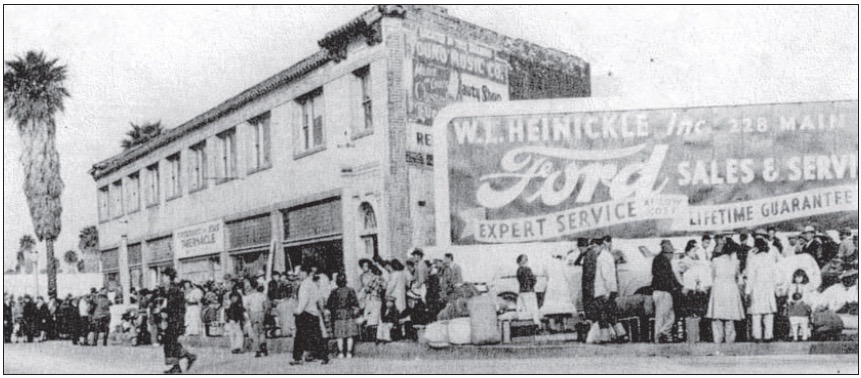
February 19, 1942. A day that will live in infamy. The call came to round up thousands of men, women, and children, citizens of a country that no longer believed them capable of loyalty to the homeland. They were pulled out of homes, schools, and work, quickly assembled at meeting points in their cities, and then abruptly sent off to concentration camps. In justifying the act, national officials spoke of the group in racial terms, as distinct and inferior to the majority white population.

A mere month after Nazi and German leaders met in Wannsee to decide on the contours of the Final Solution, President Franklin Delano Roosevelt, beloved hero of American liberals and progressives, issued Executive Order 9066 granting the right to military commanders to designate special areas from which any person could be excluded. The chief target of the Order were Japanese Americans, who, in the wake of the attack on Pearl Harbor on December 9, 1941, came to be regarded as hostile aliens, even those born in the United States. Over a hundred thousand people of Japanese origin were forcibly interned in in dozens of camps from Arkansas to California, most notably in our state’s annals, Manzanar. The United States Supreme Court, when called upon to assess the constitutionality of the Executive Order, ruled in a notorious judgment that the threat of espionage outweighed the individual rights of the Japanese American defendant, Fred Korematsu, who had refused the order to move to an internment camp

Seventy-five years ago, this country’s political and military leadership targeted a group that was neither disloyal nor hostile, as previously suppressed intelligence reports have since borne out. It is hard not to think of the echoes of this ignoble moment in American history when considering the current administration. Notwithstanding his rationalizations to the contrary, President Trump’s Executive Order of January 30, 2017 is directed chiefly against a single group, Muslims.

But there are differences between then and now. Unlike FDR, Trump has a long history of baiting the group whom he seeks to stigmatize and exclude. And unlike in FDR’s time, the American judiciary today has so far proven its unwillingness to succumb to fear-mongering and discrimination. In the Korematsu case, both the federal district court and the Ninth Circuit Court of Appeals stood on the side of the government against Korematsu, laying the ground for the Supreme Court’s memorably bad ruling. Later judicial observers regard the Korematsu as a gross miscarriage of justice. Even the arch conservative jurist Antonin Scalia declared in 2014 that “the Supreme Court’s Korematsu decision upholding the internment of Japanese Americans was wrong,” though he warned that “it could happen again in war time.”

By contrast, in the current instance of Trump’s Executive Order, both the district courts and the Ninth Circuit Court of Appeals have shown an unwillingness to submit to the President’s whim. They have issued a temporary restraining order against the ban on residents of seven Muslim countries. In one particularly clear-headed ruling, federal district court judge Leonie Brinkema declared that the state of Virginia has produced “unrebutted evidence” that the Executive Order was based not on national security concerns, but on “religious prejudice” toward Muslims. In response, the President is due to issue a revised Executive Order in the coming days.

In light of these developments, it is important to recall the Korematsu case as a precedent to be avoided. Jews, in particular, have a particular obligation to do so. In the first instance, remembering is a Jewish moral imperative. The historian Yosef Hayim Yerushalmi recalls that the Hebrew word for “remember”—“zakhor”—appears 169 times in the Bible, reflecting the centrality of memory in the world of the ancient Israelites. Indeed, memory has been the portable homeland of the Jews, to modify a well-known phrase.

It is important that Jews remember the past, especially in the face of resurgent expressions of antisemitism in our midst. But it is not enough to remember only the Amalekites and other enemies that have plagued our own history. The Jewish historical experience, during which our forebears were frequently cast as alien and hostile to their host societies, has imposed an added obligation to call attention to the injustices inflicted on others. This legacy of discrimination and persecution meets up with the Biblical mandate to defend the rights of the orphan and widow and to love the stranger (Deuteronomy 10: 18). As a group that was subject to stigmatization in and exclusion from many countries, including the United States, Jews have a responsibility to recall the black spot of Japanese American internment. Similarly, we have a responsibility to stand in vigilant opposition to attempts at stigmatizing or excluding groups that have become fodder for Trump’s toxic xenophobia, beginning with the Muslims targeted in his Executive Order. If Jews do not learn from the past, who will? If not now, when?


David N. Myers is the Sady and Ludwig Kahn Professor of Jewish History at UCLA.

Remembering Korematsu today: A Jewish obligation Read More »

The Ethics of Publicly Questioning Donald Trump’s Mental Fitness

Since I posted my blog (Should Trump’s Mental Condition disqualify Him as President – link below) there has been a great deal of discussion, commentary, and criticism among rabbis from around the world about the ethics of my having written such a piece. That discussion takes place on the restricted and confidential Reform Rabbi List Serve called RAVKAV where all kinds of issues are debated and discussed. Some have admonished me (and others who have done the same as I did) for committing L’shon Ha-ra and Rehilut  (Evil speech and Slander).

One particularly thoughtful posting was written by Rabbi Steven Ballaban, a Chaplain in the United States Navy stationed in Atsugi Japan. Rabbi Ballaban gave me permission to reprint his posting here (I have edited his original piece for brevity and included within his post in brackets explanations and definitions of Hebrew terms and concepts. The bolded passages are mine for emphasis).

I reprint his piece with gratitude:

Our colleague Rabbi ­­__ has admonished us, explaining that questioning the mental stability of President Trump constitutes both Lashon haRa and Rechilut. … Generally, the gold standard [concerning the ethics of speech]… for Jewish professionals in these matters is the Chofetz Chaim [Rabbi Israel Meir HaKohen Kagan. 1839 –1933] and his Sefer Chafetz Chaim [the most authoritative book on the ethics of speech written in the past 300 years]

In Jewish law there is an explicit duty to warn others in the case of one who is mesit et harabim [“one who would lead the multitude astray”]. Within this context, we find condemnations of specific individuals within the texts of Chazal [Acronym – “Our Sages, may their memory be blessed.”].

Two come to mind and apply here. The first is Acher [Rabbi Elisha ben Abuyah – First century CE rabbi who served in the Sanhedrin but became a heretic and was ostracized by the rabbinic authorities of his era], who deliberately destroyed the minds of the young and set out to poison them against Jewish values and, if necessary, assist the Romans in killing those who refused to relinquish their attachment to Judaism.

In the case of our President, he has encouraged Jewish youth to engage in xenophobia, nationalism, discrimination against the disabled, and racist populism in direct contradiction of the laws of our sacred Torah. Sadly, as has been the subject of a number of editorials recently, many of his staunch allies have been recruited from the ranks of young, financially successful, and nationalistic observant Jews.

The nomination of David Friedman as Ambassador, who has referred to his fellow Jews of J-Street as “Kapos” is an example of the type of nationalist “observant” Jew who seeks to threaten his own people. This clearly falls under the heading of mesit et harabim – one who would lead the multitude astray.

The second case, which applies here, is Ben Zoma [an exceptionally brilliant 2nd century CE rabbinic student who died before ordination]. In the Babylonian Talmud Hagiga 14b it states of Ben Zoma [one of four sages who ventured into the ‘garden of mystical speculation’]: “One looked and became mad.” In short, Ben Zoma is considered to have lost his mind because he taught traditions that contradicted accepted Jewish thought. The Talmud is not bashful in challenging the sanity of one of the sages of [the] Mishna once he taught heterodox opinions.

A president who teaches our people that persecution of minorities is kosher, that an ultra-nationalism that risks the future of the state of Israel is kosher, that humiliating a Jewish reporter and calling him a liar in public is kosher, is pushing a heterodox understanding of all that we hold sacred as Jews. I believe that the case of Ben Zoma [applies] here.

Modern responsa [questions to and answers by rabbinic authorities] in Israel have supported the idea that there is an explicit duty to warn others when life or limb are at risk. In the case of suspending the license of drivers with epilepsy, or poor eyesight, the rabbinic authorities have taught that the duty to warn supersedes the laws of Lashon haRa and Rechilut [evil speech and slander].

In the case of a nation at risk of war or infiltration by foreign agents of a government with a history of persecuting and murdering Jews, it should be clear that this is a case of al-achat-kama-v’chama [“so much the more so is this!”].

In short, questioning the sanity or stability of our President is not just NOT a violation of Jewish law, for some colleagues, it might very well be considered an affirmative duty.

Speaking personally, I am grateful for Rabbi Ballaban’s justification of the ethics of my having posted the offending blog in the first place. Based on his analysis in doing so, the dozens of psychiatrists and mental health professions who have called Trump mentally unbalanced and in one case a “malignant narcissist” are within the acceptable ethical bounds of speech according to Jewish law and tradition.

Should Trump’s Mental Condition Disqualify Him as President … https://rabbijohnrosove.wordpress.com/…/shouldtrumpsmentalconditiondisqualify-…


The Ethics of Publicly Questioning Donald Trump’s Mental Fitness Read More »

A Palestinian state – or security and stability?

Here is a fun fact that people tend to forget: When Israel attempts to make peace with its neighbors, it is usually not due to American mediation or initiative. Egypt and Israel made peace with the help of President Jimmy Carter, but the surprise initiative came from Anwar Sadat, an Egyptian president who decided to make history and come to Jerusalem. Israel and the Palestinians began their arduous and (still) unsuccessful journey to peace in Oslo. The US was invited to get involved only when the talks produced a promising – so the leaders of Israel thought at the time – beginning.

It is worth remembering that as we look at the confusing, and at times conflicting, messages and stories one reads in the papers about the prospects for yet another attempt at having peace. Last week, it was President Trump hosting Prime Minister Netanyahu and vowing to work for peace. This week it is the revelation (by Haaretz correspondent Barak Ravid) concerning a secret peace summit last year in Aqaba – in which Netanyahu met with Secretary of State John Kerry, Egyptian President Abdel-Fattah el-Sissi, and Jordan’s King Abdullah. Clearly, something is going on. Clearly, it involves Israel and a few Arab Sunni states who all have a mutual rival – or enemy – in Iran. Clearly, the Palestinian issue is on the table as only one component of a much larger agenda. Clearly, the road for turning any regional initiative into something concrete that will bring about peace is still long.

President Trump seems to see an opening: “Our administration,” he said last week, “is committed to working with Israel and our common allies in the region towards greater security and stability. That includes working toward a peace agreement between Israel and the Palestinians.”

Prime Minister Netanyahu seems to see an opening: “We can seize an historic opportunity because for the first time in my lifetime and for the first time in the life of my country, Arab countries in the region do not see Israel as an enemy, but increasingly as an ally.”

What is the purpose of an initiative that brings Israel and other Arab countries to the table? It is, as Trump said, to have “security and stability.” This means cooperation between countries that have a stake in containing Iranian expansionism in the region. This means cooperation between countries that all have a stake in quieting the Israeli-Palestinian conflict. Currently, the conflict is impinging on the Arab nations’ ability to publically work alongside Israel because of its impact on the “Arab street.” Since these countries – and Israel – all want to increase the level of coordination, a solution that tames the impact of the Palestinian issue on the larger, more important issues is necessary.

The Palestinians have few illusions. They know that the leaders of the Arab world don’t care much about them. But they have the power to disrupt any alliance with Israel by rallying the masses and forcing the issue back to the center of the Arab agenda.

Do Arab leaders also have power over the Palestinians? Can they assist in convincing them to accept a deal that Israel could live with? In theory, they do. In practice, this tactic has been tried and has failed more than once. Bill Clinton hoped to get the blessing of Arab leaders during the Camp David talks of 2000, and his book tells the story of his disappointment with their reluctance. They were not willing to tell Yasser Arafat that he needs to compromise on Jerusalem. They were not willing to force him into accepting a deal that forgoes the “right of return.” It is possible, of course, that in the current atmosphere, when the need for them to work with Israel becomes greater, their reluctance will be tamed and their enthusiasm will grow. But it is also possible that as Israel has become less inclined to accept a reality of a Palestinian State – it is willing to talk about a “state minus” or an “autonomy plus” – Arab leaders will be even more disinclined to pressure the Palestinians.

One thing is clear: A certain marginalization of the Israeli-Palestinian conflict is a fact. The world has better, more exciting things to think about. Arab countries have greater concerns. Israel has got used to the idea that a solution to the conflict is not forthcoming. Even some Palestinians are looking around and wondering if now is the best time to test the ability of their society to stand on its feet against a backdrop of Middle East upheaval.

So yes, the Palestinians can draw some encouragement from the fact that President Trump conveyed an interest in working towards a solution to their situation. They might also notice the fact that Prime Minister Netanyahu is successfully manipulating his rightwing coalition to prevent the establishment of more settlements in the West Bank. Both he and his Defense Minister stand firmly in their insistence that good relations with the Trump administration are more important to Israel than the construction of new settlements (although they do hope to keep building in existing settlement blocs and in Jerusalem).

But they surely notice that the main parties to negotiations are not them. They are Egypt, Jordan, Saudi Arabia, and Israel. It is an alliance of grown-up actors whose main interest is not helping the Palestinians to have a state, but rather making the Israeli-Palestinian conflict stop being a nuisance that distracts the minds and sucks the energy of leaders who need to deal with greater things.


A Palestinian state – or security and stability? Read More »

MOONLIGHT *Movie Review*

MOONLIGHT is a coming of age story that follows Chiron during three stages of life as he learns who about himself while he struggles with sexual identity.  During each stage, he is called by a different name, either Little, Chiron or Black.  MOONLIGHT was written and directed by Barry Jenkins.  It stars Mahershala Ali (HIDDEN FIGURES), Janelle Monae (HIDDEN FIGURES), Naomie Harris (SKYFALL), Alex R. Hibbert, Ashton Sanders and Trevante Rhodes.  Brad Pitt produced.

This is a really beautiful movie that’s more quiet and methodical than anything else.  Each scene feels unhurried, as though the audience is really experiencing a piece of life.  By leaping ahead and showing Chiron over three different stages of life, there’s a strong sense that life goes on and we as an audience are only privy to certain parts of it.  

While I was willing to accept the narrative gaps, at the same time I wanted more, particularly from Juan (Mahershala Ali) and Teresa (Janelle Monae).  Chiron’s story and life were interesting, but so were they. 

For more about MOONLIGHT, including how the color blue is used as a theme throughout, take a look below:

—>Looking for the direct link to the video?  Click here.


MOONLIGHT *Movie Review* Read More »