fbpx

January 28, 2017

Jews with roots in former Soviet Union protest Trump’s planned refugee ban

Hundreds of American Jews with roots in the former Soviet Union signed a petition protesting President Donald Trump’s plan to block the arrival of refugees from some Muslim countries to the United States.

The online petition was published Thursday following reports that Trump was planning to issue executive orders temporarily barring U.S. admission of asylum seekers from Syria, Iraq, Iran, Libya, Somalia, Sudan and Yemen.

“We, the undersigned Soviet Jewish refugees, write to express our support for the United States’ refugee resettlement program and our opposition to President Trump’s draft Executive Orders that would close America’s doors to vulnerable refugees desperately seeking our protection,” states the petition, which has received more than 400 signatures.

Most of the signatories indicated that they left the former Soviet Union after 1989, when Communist authorities, faced with the disintegration of their country, no longer jailed dissidents and significantly loosened restrictions on movement, free speech and religious worship. The United Nations definition for all refugees except Palestinian refugees is “someone who has been forced to flee his or her country because of persecution, war, or violence.”

In the petition, the co-signatories wrote: “The United States must not turn our backs on the human beings fleeing violence and persecution like our families did when we left the former Soviet Union, nor abandon our highest national values and the demands of basic decency.”

Jewish tradition, they added, “teaches us that our own experience as foreigners, immigrants and refugees must compel us to create a compassionate society where the rights of migrants are protected.”

Among the co-signatories is Masha Gessen, a well-known Russian-American journalist and author who has spoken critically of Trump and Russian President Vladimir Putin.

Last year, the United States gave asylum to nearly 85,000 refugees, according to a Pew Research Center analysis of data from the State Department’s Refugee Processing Center. Of those, 38,901 self-identified as Muslims. It was the highest number of Muslim refugees in any year since data on self-reported religious affiliations first became publicly available in 2002.

During an interview Thursday with Fox News, Trump defended his intention to issue executive orders suspending in part the refugee program.

“Right now, the FBI has over 1,000 [terrorism] investigations going on … and these are people that we let in. We don’t need this,” the president said. “Some people have come in with evil intentions. Most haven’t, I guess, but we can’t take chances.

“We’ve taken in tens of thousands of people. We know nothing about them. They can say they vetted them. They didn’t vet them, they have no papers. How can you vet somebody when you don’t know anything about them and they have no papers?”

Jews with roots in former Soviet Union protest Trump’s planned refugee ban Read More »
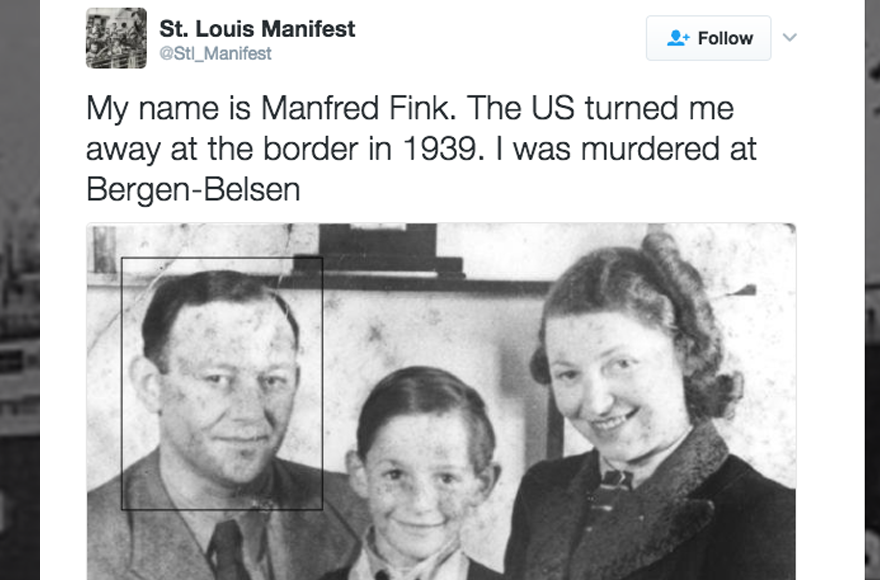
Twitter account tells tragic tales of Jewish refugees killed after US turned them away

In May 1939, as the Holocaust was beginning, the United States turned away the M.S. St. Louis, a ship carrying 937 mostly Jewish refugees from Europe. Returning to Europe, 288 were taken in by Great Britain; of those trapped in Western Europe when Germany conquered the continent, 254 died.

Now a Twitter feed is recalling their names and their deaths, one by one.

@Stl Manifest, launched Friday, International Holocaust Remembrance Day, goes line by line through the ship’s manifest, or list of passengers, then tells how each passenger was killed. Some of the posts include photos.

The St. Louis set sail from Hamburg carrying 937 Jewish refugees on May 23, 1939. Twenty-nine were able to disembark in Havana, though the Cuban government wouldn’t allow the rest to enter. Subsequent appeals to the United States to let the refugees enter through Miami were rejected. A 1924 law severely restricted immigration from Germany, and anti-immigrant sentiment was prevalent in the United States at the time.

The feed, a project of Russel Neiss, a Jewish educator, comes as the question of whether to admit refugees is again roiling the country. A draft order expected to be signed soon by President Donald Trump would temporarily bar all refugees from being admitted to the United States, and also would ban nationals of several Muslim-majority countries from entering.

Several Jewish groups have opposed the ban, citing the Jewish experience as refugees. In the description of @Stl_Manifest, Neiss wrote #RefugeesWelcome.

Twitter account tells tragic tales of Jewish refugees killed after US turned them away Read More »

Trump bans refugees, singles out Muslims

On Friday, the anniversary of the liberation of the Auschwitz concentration camps, President Donald J. Trump signed executive orders closing the country’s borders to refugees and blocking men, women and children escaping the carnage in Syria from finding safety in the United States.

His order also temporarily suspended immigration from several predominantly Muslim countries.

Many Jewish organizations reacted swiftly to condemn the orders, which echoed 20th century laws that barred Jews seeking refuge from aazi Germany.  Many of those turned away were murdered in the concentration camps.

In a press release, the non-partisan American Jewish  said it views with, “profound concern the Trump Administration’s plans to pose unjustified new obstacles in the path of refugees and asylum seekers.”

Trump called his actions part of the “extreme vetting” of potential Islamic terrorists that he promised on the campaign.

At the same time, Trump ordered that Christians and other non-Muslims from these same countries be granted priority over Muslims.

“We don’t want them here,” Mr. Trump said of Islamist terrorists during a signing ceremony at the Pentagon. “We want to ensure that we are not admitting into our country the very threats our soldiers are fighting overseas. We only want to admit those into our country who will support our country, and love deeply our people.”

The executive order suspends the entry of refugees into the United States for 120 days and directs officials to determine additional screening ”to ensure that those approved for refugee admission do not pose a threat to the security and welfare of the United States.”

The order also stops the admission of refugees from Syria indefinitely, and bars entry into the United States for 90 days from seven predominantly Muslim countries linked to concerns about terrorism. Those countries are Iraq, Syria, Iran, Sudan, Libya, Somalia and Yemen.

Numerous critics of the move took to Twitter to point out that the majority of perpetrators of the most serious terrorist attack on American soil, on 9/11, came from Saudi Arabia, which is not one of the countries listed.

In its rare, strongly worded response to Trump’s ban, the AJC pointed out that, “refugees from Syria, Iraq and other states in violent upheaval are already laboriously and intrusively vetted by U.S. immigration authorities, assisted by U.S. intelligence agencies, in cooperation with other nations’ intelligence services. For those approved, it generally takes 18 to 24 months to gain U.S. admission.”

“The terrorist threat attributed to refugees is a cruel and distracting fiction,” the AJC said,  “especially when viewed against the actual incidence of mass violence committed with chilling frequency – in schools, churches, shopping malls and other venues – against Americans by Americans. In the 14 years ending in October 2015, a period in which 784,000 refugees were resettled in the United States, there were exactly three arrests for planning terrorist activities (none of which occurred).”

Trump bans refugees, singles out Muslims Read More »

Taking comfort in the light

Parashat Va’era (Exodus 6:2-9:35)

My toddler children sleep with all of the lights on.

I do not remember how it started. It could have been loud noises, an odd shadow on the wall, a bad dream.

I do remember trying to trick them with a nightlight. The small flicker was almost offensive. Protests, crying, negotiating … and all that was by my husband and me. For weeks, my kids pushed, and for weeks, we pushed back. The closet lights, the bathroom light, the hallway light — all of them had to be on. The final straw was when my daughter explained, “But Mommy, it is so dark. The darkness gets darker. Please, just leave the lights on.”

And so the lights stay on. Because of that, we have three children who sleep through the night. Do not bother asking about our electric bill.

My daughter’s question remains. When we face dark times, what happens to our spirit when life seems to get darker? When we think we have hit rock bottom and, somehow, the bottom continues to give out beneath, is our soul damaged in the process?

I recently read an article about “cavers.” James M. Tabor, author of “Blind Descent: The Quest to Discover the Deepest Cave on Earth,” researches the men and women who descend on underground explorations for months at a time. Tabor questions the cavers’ mental and physical ability when experiencing extreme weather, isolation and absolute darkness.

A fascinating discovery is that each human being reacts differently to the dark. For some, all it takes is a day or two for anxiety to erupt. For others, it may take longer. The point being: Darkness affects all and, certainly, our minds become a casualty. It just depends on how much darkness someone can endure before reaching his or her breaking point. For those who think there is a point of no return, is salvation possible?

With the introduction of the plagues unleashed against Egypt in Va’era, we witness a darkening of darkness, a slow breakdown of the human spirit. During the Passover seder, we are accustomed to naming the plague of darkness. However, with a closer reading of the text, it is possible that several plagues of darkness befell Egypt, each plague darker than the former, slowly and intentionally weakening the hearts of the Egyptians.

“Then the Lord said to Moses and Aaron, ‘Each of you take handfuls of soot from the kiln, and let Moses throw it toward the sky in the sight of Pharaoh’ ” (Exodus 9:8). A taste of night comes as Moses throws dirt before Pharaoh’s eyes, impairing his sight. Later in the Torah, locusts suffocate Egypt and “the land was darkened” (Exodus 10:15). And with the penultimate plague, “The Lord said to Moses, ‘Hold out your arm toward the sky that there may be darkness upon the land of Egypt, a darkness that can be touched” (Exodus 10:21). 

rabbi-nicole-guzikExodus Rabbah teaches that this last darkness is the most crippling. A darkness as thick as a coin, similar to the film that forms when one has a cataract. A darkness that enters your throat and nostrils; a darkness that makes it hard for one to breathe, move or stand. A darkness that paralyzes the body and constrains the soul.

Bible scholar Avivah Zornberg explores this tortuous, systematic darkening of darkness. She contends that, according to the medieval commentator Rashi, no repentance is possible in this kind of dark. In this kind of darkness, it really may be impossible to return. 

Is it true? Is there a kind of darkness in which, once experienced, it is impossible to gain sanity?

It occurs to me that we must never let those we love get to this point. Or at the very least, we should try to save them with every possible attempt. Who experiences absolute darkness? Those who never feel the warmth of another or see sparks of hope breaking the gloom of night.

In our liturgy, we read “Or chadash al Tzion ta’ir, v’nizkeh chulanu m’heirah l’oro. Baruch atah, Adonai, yotzeir ham’orot.” Translation: “Shine a new light upon Zion, that we all may swiftly merit its radiance. Praised are You, Adonai, Creator of all heavenly lights.”

Commentators explain that this light is what the righteous will experience in the world to come. I humbly posit that this light is what the righteous offer in this world so that those drowning in seas of darkness have something to hold onto.

Rays of light: squeezing someone’s hand when they would otherwise feel utterly alone; calling someone in mourning and offering an “I’m thinking about you”; a handwritten letter to someone who needs lifting, healing. Repeatedly turning on the light. Never shutting the door to the possibility of hope.

Even the smallest flicker of a flame holds the potential to pierce the solitude of night.

The lights remain on in our home. My children are comforted. And that is fine by me.

Rabbi Nicole Guzik is a rabbi at Sinai Temple.

Taking comfort in the light Read More »

Letters to the Editor: Women’s March, President Obama and more

We agree with David’s column (“The women who could not march” Jan. 22) advocating for the women worldwide who could not march last Saturday, whose dire circumstances prevent them from being heard. Indeed, it has been the mission of Jewish World Watch to represent exactly these vulnerable peoples since Rabbi Harold Schulweis founded JWW in 2004. Through our advocacy to leaders in Washington, through education of Jews and non-Jews alike and through aid programs on the ground, we continue to fight to end genocide and mass atrocities in Sudan, South Sudan, Chad and the Democratic Republic of the Congo. Most recently we have been advocating, as well, on behalf of refugees of the civil war in Syria.

Indeed, our annual Walk to End Genocide, this year taking place on April 30 in Pan Pacific Park, embodies exactly the action David is arguing for. We invite everyone to join us in speaking out at this important community gathering. It is a clear way to respond to our imperative to not stand idly by.

Susan Freudenheim, Executive Director of Jewish World Watch

What Women Want: No Blanket Statements 

I can say that being able to earn a living in order to support your loved ones is an important part of a great marriage (“Do Women Need Men?” Jan. 13). The most loving, supportive partnership can founder due to illness, an economic downturn, unemployment that stretches for months or years, or any number of other types of bad luck.

And I can say that it’s been a long time since I’ve read the hoary, old, sexist trope about how being single makes women angry. Statements like “the happiest women are women in happy marriages” are but one way to make this happily married woman furious.

Jo Pitesky via email

Is It Wrong to Thank Barack Obama?

I read Rob Eshman’s column thanking and gushing over former President Barack Obama and could not believe it (“Thank You, Obama,” Jan. 20). As a Jew — and your wife a rabbi — how could you possibly thank Obama after what he did on Dec. 23 to Israel at the U.N.?

Thank God we have new leadership and will flourish with the leadership of President Donald Trump.

Fran P. Jackson via email

Thank you for understanding and so eloquently putting on paper what many don’t understand, or want to. [On Jan. 21], my wife and two daughters were part of the protest downtown, as a way of expressing their dissatisfaction with the new president. We all need to do our part … you just did.

Allan Kretchman via email

A typical column from a liberal American Jew who wouldn’t know the difference between good and bad while living in a world of relative morality.

It’s reassuring to know that the future of Jews like you in the United States is very limited because intermarriage, lack of affiliation and a lack of belief in God will take its toll faster than you can imagine. There is not much holding you and your children to the heritage you were born with. Good chance your grandchildren will not even identify as Jewish.

Fred Moncharsh via email

I thoroughly enjoyed Larry Greenfield’s op-ed “A Legacy of O” (Jan. 20), in which he detailed all of the destructive policies of the Obama years. It was an extremely well-written op-ed. Very enlightening and revealing. With clarity and conciseness, Greenfield touched on every subject, bringing together all the pieces. Obama had been the most polarizing, anti-American president in history and, thankfully, we have come to the end of the era of America’s radical transformation to begin the process of the rebuilding of America.

Karen Reissman via email

In the Jan. 20 issue, I read Rob Eshman’s column (“Thank You, Obama.”) To me, Eshman came across as shallow and delusional.

I must insist Eshman read Larry Greenfield’s op-ed, “A Legacy of O.” He will see a vast difference in point of view and clarity.

To me, the “Legacy of Obama” can be explained in one word: Trump.

Hallie Lerman via email

Convert Wants to Read the Whole Story

Regarding “Katie Piel: She Kept Hearing a Message,” Jan. 13: I have followed your stories about Jews by Choice for many years. I, as a convert to Judaism, have one major complaint with your stories: They invariably tell the beginning of the journey that we Jews by Choice embark upon, but they never seem to tell the story of how the journey unfolds over a lifetime. I converted when I was 19 years old and am now 70. My life, and the lives of many longtime converts who I know, have been truly remarkable since we embarked upon exploration into Judaism.

How can one understand any story if they only read the first chapter? I would like to suggest the Jewish Journal also publish stories about those who have chosen Judaism, and have lived most of their lives as new Jews. I think it would be most enlightening to your readers. Just as Judaism has a real story to tell, so do we.

Peter Robinson, Woodland Hills

Letters to the Editor: Women’s March, President Obama and more Read More »