fbpx

May 26, 2016

US Jews are not an ‘asset’ – they are a partner

In a series of meetings and ceremonies, Israel’s Knesset marked 100 years of ties between the Jewish State and the US Jewish community yesterday.

The timing corresponds with the American Jewish heritage month. The topic of celebration was the contribution made by US Jews to building Israel. The agenda was full: a Knesset committee “discussions on the American Jewish contributions to Israel’s security, social welfare, absorption of new immigrants and educational system, as well as a marking of the subject in the Knesset plenary.” And in addition, an exhibition of photographs and films sketching the involvement of the American community in strengthening Israel. Labor MK Nachman Shai and the Ruderman Family Foundation should be commended for orchestrating this effort.

It is important for Israel to recognize the contribution of US Jews to its founding and wellbeing. It is important to recognize this contribution in the right way and with the right approach. Relations between these two great Jewish communities are changing, as we all know. Once upon a time Israel was the little brother, but it is now the big brother. Once upon a time Israel was too fragile to worry about such things as thanking US Jewry and considering US Jewry when it enacts policies, but it is now mature enough to do such things.

Keeping these relations realistic is advisable. Keeping these relations with the proper goals and issues in mind is advisable. Not all Israelis understand this – and not all Americans do. On both sides of the ocean Jews seems to have the unhelpful habit of talking about these relations in ways that do not always correspond with actual social realities.

Former Mossad chief Efraim Halevi, for example, made the following observation in a Foreign Affairs and Defense Committee hearing on “American Jewry as a strategic asset to Israel’s security”: “The problem in our relations with American Jewry is that we are losing many young people… because of the fact that we do not consider them Jews according to Halacha…This is a strategic issue…”.

There are at least two problems I see with the Knesset discussion and with Halevi’s analysis.

The first problem concerns the context – that is, Israel’s tendency to focus much too much on Jewish Americans as a “strategic asset” rather than as a partner in the Jewish journey. American Jews, of course, do play a significant role in strengthening Israel materially and politically, and thus are a strategic asset. But Israel’s frequent tendency to look at them instrumentally as an “asset,” instead of thinking about them as a partner, was evident at the Knesset discussion and throughout yesterday’s celebration. It makes the conversation dull. It makes it, at times, even somewhat cynical. Israel’s bond with the largest non-Israeli Jewish community has value in and of itself. It has value even if US Jewry ceases to be a “strategic asset” in the simple sense.

Then there is the issue of what Halevi Said. He said that we are “losing many young people” – and that is possible, even if far from certain. He said that we are losing “many” young people “because of the fact that we do not consider them Jews according to Halacha” – and that is plain wrong. A. because Israel legally does not recognize people as Jews according to Halacha, B. because there is no evidence supporting Halevi’s contention that Israel is losing anyone because of its definition of Jewishness, C. because if Israel is indeed losing “many” young Jewish Americans, it is probably first and foremost due to social processes within the American Jewish world, and not due to nuanced Israeli policies on complicated matters such as the definition of Jewishness.

Having said that, Halevi is not wrong to claim that Israel has problematic policies on matters concerning the recognition of Jewishness. It does have a problem with its policies dealing with conversion, and those governing the rabbinate and its different functions, and those complicating its relations with Reform and Conservative Judaism. Israel has problem, and it should try to solve these problems.

But making these problems the cornerstone of its relations with US Jewry would be a mistake for both sides. It would be a mistake for Israel because a change in these policies is not going to alter deep-rooted trends that impact the psyche of Jewish Americans and their relations with Israel. It would be a mistake for Jewish Americans because the likely outcome of focusing on this point will be disappointment (the new initiative by notable American Jewish leaders to “press for a two state solution” will have the same disappointing effect – but that’s a topic for another day).

Israel, as Foreign Ministry Director Dore Gold said yesterday, does “not need to reinvent itself to maintain the relationship.” It does not need to do such a thing – and it will surely not do such a thing. It will have policies that Israelis find desirable – as much as US Jews will follow the trends that they find desirable. Thus, the focus of these two communities should not be on changing one another, but rather at learning to live with differences and structuring a shared Jewish agenda that takes these differences into account.

US Jews are not an ‘asset’ – they are a partner Read More »

Donald Trump agrees to debate Bernie Sanders for charity

Donald Trump agreed to debate Bernie Sanders ahead of the California primaries.

Sanders, a candidate to be the Democratic presidential nominee, challenged Trump to the debate Wednesday night on “ABC’s “Jimmy Kimmel Live!” Trump, the presumptive Republican presidential nominee, was a guest on the TV show, and host Jimmy Kimmel read Sanders’ challenge to him.

“Yes I am. How much is going to pay me? Trump responded. “If I debated him, we would have such high ratings, and I think I should take that money and give it to some worthy charity.”

Sanders quickly tweeted to confirm.

The hashtag #BernieTrumpDebate, which had generated nearly 60,000 tweets, was trending on social media Thursday afternoon.

As Kimmel noted on behalf on Sanders, the Clinton campaign announced the candidate would not debate Sanders in California before the June 7 primary. The Democratic rivals agreed in February to add four debates to their calendar and have participated in three.

Sanders said Monday he was “disturbed but not surprised” that Clinton backed out of the planned debate. Most polls have Clinton leading Sanders in the California primary race by less than ten points.

CBS News reporter Sopan Deb tweeted Thursday that multiple sources close to Trump say he was joking about the debate.

Donald Trump agrees to debate Bernie Sanders for charity Read More »

‘Renew our days as of old’

Israeli democracy is under threat. Incitement against human rights organizations proceeds with little trace of official censure; cabinet ministers aim to impose new ideological litmus tests in the realm of education and culture; government-sponsored bills place Jews on a higher plane than other citizens; and the state’s Ashkenazic chief rabbi declares, “Israel is first and foremost Jewish, and only then democratic.”

These acts deviate sharply from principles that were clearly and forcefully articulated before, during and after Israel’s Declaration of Independence was approved May 14, 1948. Those earlier principles, drawn from a range of diverse perspectives, reflected the mix of enlightened Jewish and Zionist ideals at a crucial moment of formation. A number of these first principles figure centrally in a series of broadsides that are on display at the Yitzhak Rabin Hillel Center for Jewish Life at UCLA. In observance of Israeli Independence Day, we present excerpts from them in translation below.

Sixty-eight years ago, in the face of intense pressure from inside and out, powerful voices were heard calling for the anchoring of robust democratic principles in the foundation of the new state. They figured in Israel’s Declaration of Independence, which called for “complete equality of social and political rights to all its inhabitants irrespective of religion, race or sex.”

On the same day the declaration was issued and as the nascent state was confronting the invasion of five Arab armies, the provisional government published a decree calling on all residents to prepare for struggle and sacrifice in the coming days. Concomitantly, the decree proclaimed:

“Within the confines of our State, citizens of the Arab people continue to live — for most of them this war is loathsome. Their rights as equal citizens we are duty-bound to uphold. We look to peace. Our hands are extended to them as partners in building the homeland.”

This striking call to recognize Jews and Arabs as equals was offered in the shadow of the Holocaust and in the face of an ongoing conflict understood as a war of survival. Seven months earlier, an even more soaring expression of this principle appeared in a broadside published Oct. 19, 1947 in Hebrew and Arabic by the left-oriented League for Jewish-Arab Rapprochement in Jerusalem. It announced:

“JEWS AND ARABS! Let us end this Satanic dance! The Jewish and Arab masses do not want chaos and bloodshed! The Jewish and Arab masses do not want a war of one people against another! The Jewish and Arab masses want a life of peace and creativity, a life of freedom and progress! Whatever the ultimate political outcome of the question of the Land of Israel will be, it will be meaningful only to the extent that it will guarantee peace and cooperation between two peoples whose fate is linked in an unbreakable bond to the fate of the land. Only Jewish-Arab unity can create enduring facts in the Land of Israel; only Jewish-Arab unity can advance this land toward independence and true freedom, toward progress and efflorescence.”

Despite what some might assume, this sentiment was not confined to the secular left. A coalition known as the United Religious Front — comprising the religious Zionist Mizrachi party, the non-Zionist Agudat Yisrael, a range of yeshiva deans, the Chasidic rebbes of Belz and Ger and a host of municipal rabbis — published a broadside in 1951 that laid out its vision for the new state. While calling for the Torah to serve as a key pillar, the poster also insisted that the state be fully democratic and recognize the complete equality of non-Jews as a matter of nationality and religion. The following are two of the planks in its platform:

“THE DEMOCRATIC STRUCTURE OF THE STATE: BASIC RIGHTS AND FREEDOMS. Beloved is Adam (all humanity) who was created in God’s image” (Avot 3:14). We are commanded to guard with extraordinary care the sanctity of life, the freedom and the dignity of every human being. It is the task of the State of Israel to take pains to assure that the rights of the individual, and his/her freedom of speech and conscience, will not be compromised.”

“RIGHTS OF ETHNIC AND RELIGIOUS MINORITIES. In the State of Israel, full equal rights shall be extended to all citizens irrespective of their religion or race. Most especially, in the wake of our suffering and torment through millennia of wandering among the nations when we were bereft of civil rights, we ought to remember the exalted morality captured in the words of our Torah: ‘A sojourner (ger), you are not to oppress: You yourselves know the feelings of the sojourner, for you were sojourners in the land of Egypt’ (Exodus 23:9).”

The passage of time has not been kind to these notions. Citizens in Israel today confront stiff challenges to the values of democracy and equality. Rather than lapse into despair, they would do well to recover the range of foundational principles that were present at the birth of the state and are contained in the above texts. They represent an important antidote to the current scourge of chauvinism and a repository of some of the most exalted ideals of the Jewish and Zionist traditions.

Chaim Seidler-Feller, who recently retired after 40th year as director of UCLA Hillel, is director of the Hartman Fellowship for Campus Professionals.

David N. Myers is the Sady and Ludwig Kahn Professor of Jewish History at UCLA. Many of the posters in this article are from Seidler-Feller’s private collection.

‘Renew our days as of old’ Read More »

Jewish leaders express concern over proposed changes to Dem platform on Israel

Bernie Sanders’ appointments of Cornel West and James Zogby as his representatives to the Democratic party’s platform drafting committee are drawing strong condemnation from U.S. Jewish leaders.

In an interview with the “>tweeted on Thursday.

“The Democrats’ platform should support [the] two-state solution but also make 100 percent clear that long-standing policy [of] supporting Israel will not waiver,” he added.

Malcolm Hoenlein, executive vice chairman of the Conference of Presidents of Major American Jewish Organizations, told the New York Times that West’s inclusion on the committee is “disturbing” and raises concerns that the Democratic Party could “adopt positions that could be seen as hostile to Israel” at their national convention in Philadelphia. “For us, the concern is that it legitimizes and potentially puts into a major party platform” a point of view “that undermines the principles of the Israeli-U.S. relationship that have been bipartisan for decades,” Hoenlein was quoted as saying.

“Of all the social activists that Senator Sanders could have nominated to help advance his message, we are particularly troubled by the selection of Cornel West, a prominent supporter of the Boycott, Divestment and Sanctions (BDS) movement,” American Jewish Congress President Jack Rosen said in a statement. “Ultimately, we will judge the committee based on their actions at the Democratic Convention in Philadelphia this July, but considering Sanders’ extremely misinformed comments about Israel last month, the American Jewish Congress is especially concerned about West’s policy positions on the Middle East.”

Professor Alan Dershowitz, a Democrat, told the “>on Friday that no matter the wording, “This year, Democrats will once again approve a platform that speaks to our commitment to a strong US-Israel relationship.”

Sanders indicated that he would seek “consensus” on the party’s policy towards Israel in a statement to the New York Times. “I have always and will always be 100 percent supportive of Israel’s right to exist and live in peace and security,” the Democratic presidential hopeful wrote in a statement. “I also believe that lasting peace in the region will not occur without fair and respectful treatment of the Palestinian people. I believe that most Democrats agree with that position and that a strong consensus will be achieved at the Democratic National Convention.”

Jewish leaders express concern over proposed changes to Dem platform on Israel Read More »

Moving and shaking: Black Earth, David Siegel, Chiune Sugihara and more

Yale historian Timothy Snyder, author of the 2015 book “Black Earth: The Holocaust as History and Warning,” discussed the causes of the Holocaust on March 21 at Wilshire Boulevard Temple’s Audrey and Sydney Irmas Campus.

“How could a people so established on a continent suddenly come to a violent end?” Snyder asked of 1930s European Jewry.

The answer, he suggested, is that Adolf Hitler was an anarchist who thought it natural for human beings to compete for the world’s finite resources. The German leader was committed to the destruction of a state system that considered all kinds of people equal, and this, more than anti-Semitism, enabled the Holocaust, he said.

“Many genocides make a lot more sense if we see the failure of the state as the cause,” said Snyder, who also is the author of the 2010 book “Bloodlands: Europe Between Hitler and Stalin.”

During the Q-and-A, a Shoah survivor, Renee Firestone, stood up from her seat and said: “The Holocaust cannot be explained!”

Caught off guard, Snyder agreed that historians cannot capture the essence of the Shoah. But, he told the Journal later, one can try. “We can, and have to try to, understand,” he said. 

Wendy Lower, John K. Roth professor of history and George R. Roberts fellow and director of the Mgrublian Center for Human Rights at Claremont McKenna College, moderated the discussion, which was organized by the United States Holocaust Memorial Museum (USHMM). 

Approximately 150 people attended, including USHMM Western Region Director Steven Klappholz, who delivered closing remarks. “This is really the beginning of a conversation,” he said.


The Jewish National Fund (JNF) honored Consul General of Israel in Los Angeles David Siegel with the Shalom Peace Award at the Women for Israel (WFI) Yom Ha’Atzmaut Luncheon on May 12. 

From left:  Fred Toczek, with his daughter, Ella, who is the youngest Jewish National Fund (JNF) Chai Society member in the country and Consul General of Israel in Los Angeles and JNF honoree David Siegel. Photo courtesy of Jewish National Fund 

“I am so deeply appreciative for this recognition,” Siegel said at the luncheon. “My relationship with JNF is deep and personal. Having grown up near a JNF forest, I’ve seen firsthand the work of JNF and its significant impact in Israel. JNF has been a vital and close partner during my tenure: from supporting local fire stations on Sept. 11, to educating hundreds across the southwest at JNF Water Summits.”

Luncheon co-Chairwoman Gina Raphael remarked that “Consul General Siegel has led our Jewish community in Los Angeles for the last five years, and he has been a true friend to JNF, and to me by helping bring my commitment to Israel to life. … We are so honored to celebrate Yom HaAtzmaut with him and help raise money for a fire station in Jerusalem, one of the many important projects JNF works on in Israel.”

Ariel Kotler, the JNF Israel operations development officer, spoke about Israel’s firefighters, and Israel’s Eurovision star Moran Mazor performed “Jerusalem of Gold.” Cantor Nati Baram and Siegel performed a rendition of “Avinu Shebashamayim,” the prayer for the State of Israel. 

The amount of money raised at the event is not yet known, but it will enable JNF Los Angeles to pass its $7 million fundraising goal. 

— Avi Sholkoff, Contributing Writer


Temple Ramat Zion honored the late Chiune Sugihara at its Holocaust memorial commemoration on May 1. Sugihara was a Japanese consul general to Lithuania who in the 1940s ignored his government’s regulations and issued visas to thousands of Jews, saving their lives by enabling them to leave Lithuania. Sugihara, who died in 1986, was sanctioned by his country and spent time in a Soviet prison as a result of his actions.

Consul General of Japan in Los Angeles Hidehisa Horinouchi. Photo by Caryn Baitel

Attendees at the recent event included the current consul general of Japan in Los Angeles, Hidehisa Horinouchi, who delivered a tribute to Sugihara at Temple Ramat Zion, and spoke of Sugihara’s 1984 recognition as one of the Righteous Among the Nations by Yad Vashem in Israel.

Other speakers included the German consul general in Los Angeles, Hans Jorg Neumann; Temple Ramat Zion Rabbi Ahud Sela; Temple Ramat Zion Cantor Daniel Friedman; Valley Beth Shalom Cantor Herschel Fox; Northridge United Methodist Church Rev. Karen Murata; Our Lady of Lourdes Catholic Church, Northridge Rev. David Loftus; the Temple Ramat Zion Choir and Temple Ramat Zion USY members. 

— Avi Sholkoff, Contributing Writer 


Hilda Eisen donated an ambulance to Magen David Adom in honor of her 99th birthday and in memory of her husband, Harry, who died in 2012. The event took place May 8 at her home in Beverly Hills. 

Hilda Eisen donated an ambulance to Magen David Adom in honor of her 99th birthday and in memory of her husband, Harry. Photo courtesy of Michael Rubinstein

Both Hilda and Harry survived the Holocaust. Harry survived Auschwitz and was president of the Lodzer Organization, a local group of philanthropic Holocaust survivors. He founded Norco Ranch, which until 2005 was the largest egg producer west of the Mississippi. Hilda was a partisan fighter in the Parczew forest during the war. 

Yossi Mentz and Tricia Harris, from the American Friends of Magen David Adom (AFMDA), along with Michael Rubinstein and Rita Statman, Eisen’s grandchildren, helped organize the event. Mentz, the Western regional director of AFMDA, spoke at the event and detailed the process of building the ambulances. 

— Avi Sholkoff, Contributing Writer

Moving and Shaking highlights event, honors and simchas. Got a tip? Email ryant@jewishjournal.com

Moving and shaking: Black Earth, David Siegel, Chiune Sugihara and more Read More »

Looking back at war on Memorial Day

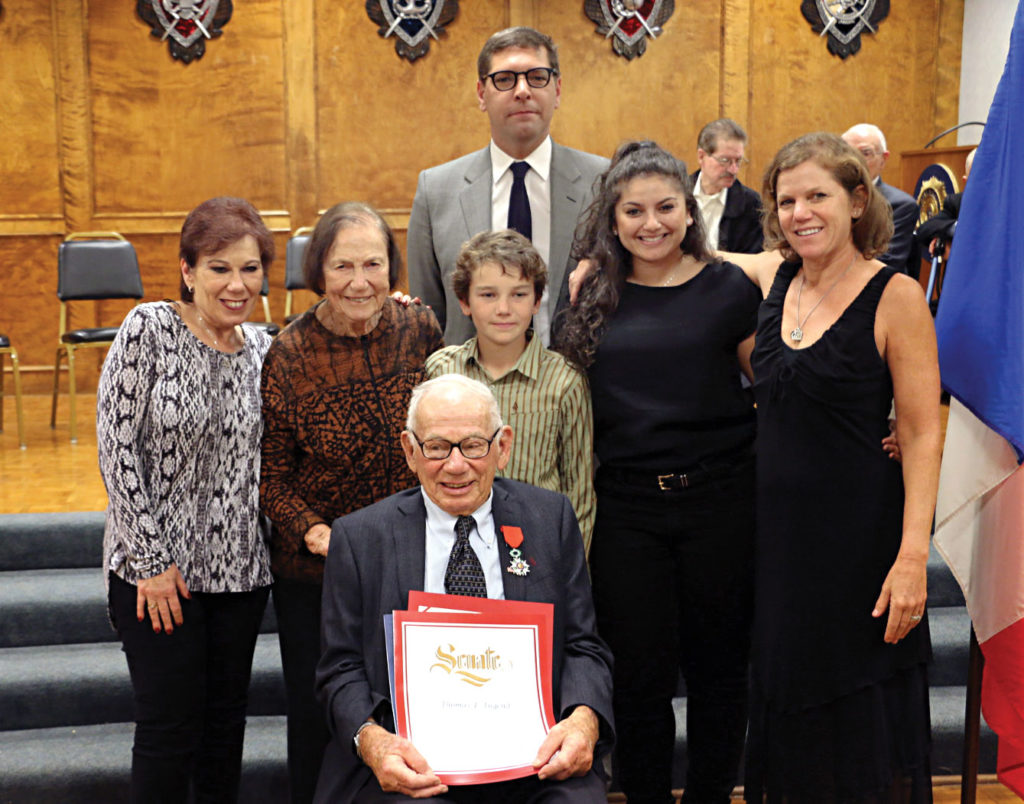
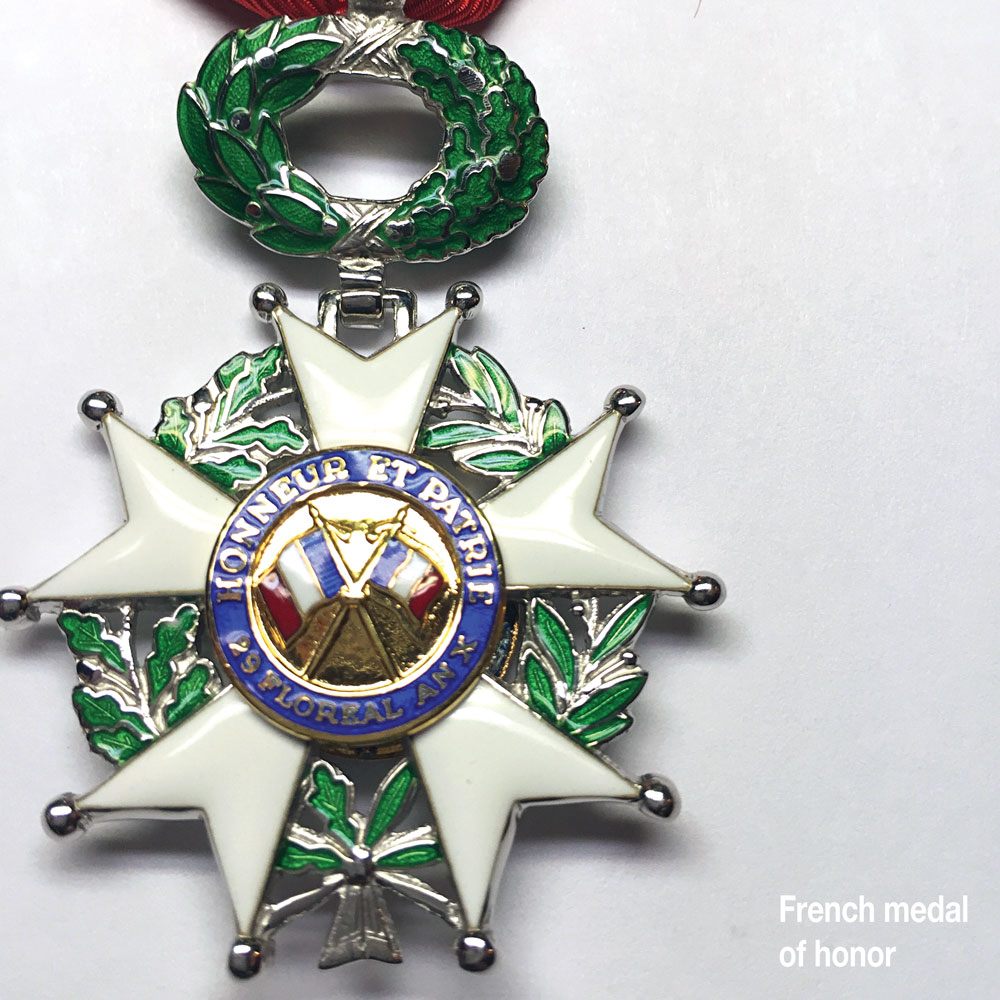
In the name of the president of the French Republic, Consul General of France in Los Angeles Christophe Lemoine inducted me on March 9 into his country’s Legion of Honor, a distinction established by Napoleon in 1802. As a result of this, I now hold — with some pride and considerable disbelief — the rank of Chevalier, or Knight.

The honor harks back more than seven decades, to World War II, when my unit, the U.S. 254th Infantry Regiment, fought alongside the First French Army in the liberation of France. We’d fought through the sub-zero winter of 1944-45, reputedly the coldest in Europe in 50 years, not a pleasant season to spend in icy foxholes atop the Vosges Mountains.

As Lemoine pinned the medal onto my lapel, however, I found myself flashing back some 77 years to a rather different scene.

The date was April 20, and my mother, my sister and I — a 13-year-old in shorts — were leaving Berlin, the city where my ancestors had lived for generations. It was then, as now, the capital of Germany, the nation in whose army my father, a prominent pediatrician, had served for four years in World War I.

On the taxi ride to Tempelhof Airport, we looked out at the streets festooned with gigantic swastika banners marking not our departure, but Adolf Hitler’s 50th birthday.

I had observed my bar mitzvah the previous year in one of the city’s synagogues — a sanctuary that, only a few months afterward, was torched during Kristallnacht.
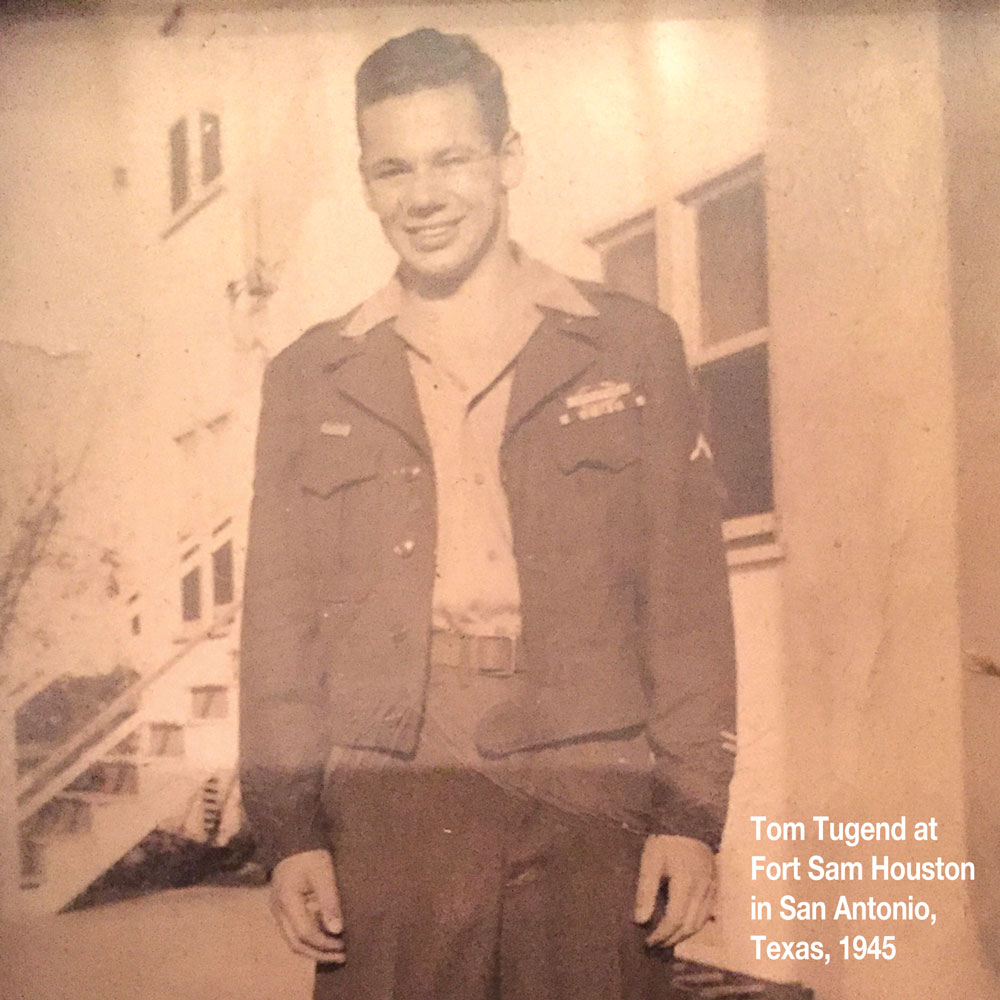
cov-wwiiSix years after our departure, I returned to Germany, in January 1945, this time wearing the uniform of an American soldier. My unit entered the country of my birth unceremoniously by breaking through its defensive Siegfried Line from southeastern France after the bitter battle against elite Wehrmacht units at the Colmar pocket in Alsace.

Curiously, I was not even an American citizen when I enlisted in the U.S. Army in March 1944. On the contrary, the U.S. government classified me as an “enemy alien” because I had been born in Germany. But unlike those of ethnic Japanese descent, including U.S.-born citizens living mainly on the West Coast, my family was not interned for our alien status. We were, however, required to have a permit to travel any long distances within the country and had to give up our shortwave radio. (I remember baby-sitting for some neighbors and sneaking in some overseas broadcasts.)

I spent my three months of intensive basic training at Camp Blanding, in northern Florida, which offered another type of education. My barrack mates were mostly rural Southerners, and for the first time I came face to face with unvarnished segregation and racism in America.

Most of the guys had never met a Jew, but, like most Americans of that time, had suckled more or less overt anti-Semitism in their mothers’ milk. One day, a fellow GI asked me about my religion, and when I answered “Jewish,” he refused to believe me, assuming that a Jew must have horns on his head and always talk about money.

Finally, when I convinced him, he paid me his highest compliment. “Tom,” he said, “you’re a white Jew.”

Just before embarking for overseas, an officer addressed our company and lifted everyone’s spirits by saying, “Take a look at the man on your left, and then on your right. One of you isn’t coming back.”

About a month before the war’s end, someone figured out that I spoke German fluently, and I was transferred — first to regimental headquarters and then to the Army’s Counter Intelligence Corps.

That assignment compensated for the bitter winter. We lived in a “liberated” mansion overlooking the Neckar River and wanted for nothing, with eager Germans bowing and scraping. Heady stuff for a 19-year-old only a few years past refugee status.

There was a myth abroad at the time that retreating Germans would leave behind in each village a die-hard Nazi to organize sabotage and resistance to the occupation. My job was to go from village to village and find that elusive Nazi.

In every town, whoever I interrogated, the story was the same: “I was never a National Socialist, indeed in my heart I was against the Hitler regime. But my neighbor, my brother, my cousin, my boss, they were all Nazis, and I’ll show you where they live.”

Finally, in one village in southwest Germany, I was told of an 80-year-old blind poet who was an ardent admirer of Adolf Hitler. So I went to the man’s home and told him of the accusations by his friends and neighbors. Yes, said the man, “I have always been a loyal follower of the Fuhrer, and I will love him until I die.”

I returned to my headquarters and told my commanding officer, “I believe I deserve a decoration. I have found the only Nazi in all of Germany.”

In July 1945, two months after the war in Europe came to a close, the idyll ended, and I was shipped back to the States to prepare for the invasion of Japan. At the time, experts estimated 1 million GIs might die on Japan’s beaches, and I had no burning desire to be part of that grisly statistic.

So, with chutzpah and aided by lax security unimaginable now, I, about the lowest of enlisted men, went to the Pentagon and asked to speak to the general in charge of manpower. I was admitted and told by the fatherly general how he envied my chance to fight on the front lines. In turn, I told him that I could be more valuable to the country as an interrogator in Germany than a casualty on the beaches of Japan.

He said he would look into the matter (“Fat chance,” I thought). Then, the next month, Japan surrendered. I was sent to Fort Sam Houston in Texas, where I was taught typing — on a manual typewriter, of course — so I could fill out the discharge papers of returning soldiers.
I figured I would remain in that position until my own discharge, but one day, the first sergeant ordered me to report to his office. I did so and was told that by orders direct from the Pentagon, I was to leave the next day for Governors Island in New York Harbor. “What for?” I asked. “Don’t know,” the sergeant replied. “It’s top secret.”

On Governors Island, I was assigned a bunk and told to report the next day to an office on Wall Street in Lower Manhattan. Again, information about the assignment was classified as secret.

At the Wall Street office, the story was the same. My orders were to report to the office every morning, but I could spend the rest of the day as I wanted, including checking in occasionally at the USO for a free front-row ticket to the best Broadway show that evening.

After about two weeks, the good times ended, and I got orders to travel to Fort Eustis in Virginia, near Washington, D.C.

There, the Pentagon, which, its critics charged, knew how to win a war but not the peace, had organized a six-day course to “re-educate” German prisoners of war and, upon graduation, send them to serve as small-town mayors and middle-rank civil servants in the American zone of occupied Germany.
cov-medalThe POWs tagged the course as the “Six-Day Bicycle Race,” and the idea was that the men chosen would be nonpolitical, or even “political unreliables,” who the German army had consigned to a separate, closely watched division.

Though well meant, the concept quickly ran into trouble. During the war, American authorities had left the running of the POW camps (primarily in Southern states) to the inmates, which resulted in the most fanatical Nazis, many veterans of Field Marshal Erwin Rommel’s Afrika Korps, taking de facto control.

When those Nazis spotted a political “unreliable,” they frequently threw him out the window or killed him, then made it look like an accident.

So when it came to the selection of participants in the re-education course, there were frequent confrontations, pitting two POWs against each other, one maintaining that another was a vicious Nazi who had murdered his friends, while the accused ardently denied the allegations.

It was now our job as German-speaking GIs to listen to the conflicting versions and decide who was telling the truth. Hoping to find out more, one evening I put on a prisoner’s uniform and, with the help of a “good” German prisoner, was introduced as a newly arrived POW. I learned no secrets, and rather suspect that my “friend” had tipped off his comrades as to whom I really was.

Looking back, it seems strange that I felt no burning hatred for the Germans, beyond that of any soldier toward the other guy shooting at him.

Living in cosmopolitan Berlin was easier for Jews than living in smaller towns. I’d gotten nearly all my education in a Jewish environment, and, as a youngster, my obsession with my soccer team obliterated even the experience of Kristallnacht.

I was too self-absorbed to grasp the agony of my parents, especially of my father, and, perhaps most important, the horror of the Holocaust had not yet sunk in.

After I turned down offers to work as an interpreter for what turned out to be the Nuremberg war crime trials, the U.S. Army and I parted ways, with no regrets on either side, in May 1946.

Thanks to the GI Bill, I enrolled at UCLA — no tuition, no parking fees, but few girls — and then went on to UC Berkeley.

Later, in the summer of 1948, I would become a soldier again, when I traveled clandestinely to the nascent State of Israel to serve as squad leader in an anti-tank unit during the War of Independence.

My motives for that move were, as always, mixed — restlessness, my youthful Zionist indoctrination and a sense that because a new Jewish state arose only every 2,000 years or so, I didn’t want to miss it, as I probably wouldn’t be around for the next time. Also, by this time, some Holocaust survivors were beginning to talk about their experiences, lending weight to the need for a Jewish state. (I have written about this experience in a previous article for the Journal.)

Then, in my third war in six years, I was recalled by the U.S. Army at the outbreak of the Korean conflict in 1950, but this time I lucked out. Instead of being shipped out immediately as cannon fodder at the Chosin Reservoir, my newly minted bachelor’s degree in journalism from UC Berkeley got me a cushy assignment as editor of an Army newspaper based at the Presidio in San Francisco.

After all that, I finally settled down and got a job at the San Francisco Chronicle, moving from copy boy to writing obits and shipping news to the police and court beats. I went to Spain for a year, got married, had three daughters, and I’ve reflected only rarely on my wartime years.

About a year ago, I received an email from a retired U.S. Air Force colonel who had heard, again by random chance, about my wartime service in France.

He told me that the French government had a program to honor and thank U.S. soldiers who had taken part in the liberation of France from the Nazis. Would I be interested in filling out some forms to get the ball rolling?

The forms slowly wended their way from the French consulate in Los Angeles to the embassy in Washington and then to some special presidential committees in Paris.

Finally, I joined nine other grizzled vets at an American Legion post in Pacific Palisades, and, when my turn came, received a very impressive medal and a kiss on the cheek by the consul general, followed by the handout of three handsome scrolls signed respectively by the mayor of Los Angeles, the city council and the Board of Supervisors.

When it was over, my 11-year-old grandson, Zach, expressed his disappointment that my knightship didn’t come with a horse, lance and armor, and went on to ask, “Saba, are you a hero?”

Having thought and written a good deal about the nature of heroism, I quickly answered Zach’s question with a “no.”

Actually, I consider the word “hero” to be perhaps the most misused — and overused — four-letter word in the English vocabulary (well, maybe not the most overused four-letter word).

I consider it ludicrous that every man and woman in uniform, even if the majority of them have never heard a shot fired in anger, are reflexively labeled “heroes.” More obscenely, I keep getting letters from certain fundraising organizations offering me the designation of “hero” if I send $50 to this or that cause.

In general, I’ve found that Israelis are much less given to phony hero-worship or bragging than most Americans. I had known my Jerusalem-born wife, Rachel, for a considerable time before she casually mentioned that she had joined the underground Haganah during the British rule of Palestine — when she was 15.

Most everything in war is a matter of random chance, from the initial assignment to a given branch or company, to who will live and who will die. In my own case, while I happened to be assigned to an infantry regiment that distinguished itself in battle, I was not called upon to perform any particular Hollywood heroics.

I felt more akin to Kilroy — whose name and outsized nose was scrawled on just about every shattered wall and building in the European war zone, with the legend “Kilroy Was Here.”

That’s really the point — to be there when it counts, to do your job, to become a small part of history.

So who are the true heroes? They are those who stand up, day by day, for their beliefs, be it in the workplace or against the convictions of their societies.

By that measure, I would put sincere conscientious objectors to wartime service in that category, such as the Quakers, who enabled my own family to leave Germany for the United States when few other non-Jews were willing to help.

In my lifetime, however, the ones I believe who most deserve to be called heroes have been the righteous gentiles who shielded hunted Jews — complete strangers — during the Nazi era, at the risk of their and their families’ lives.

Back around 1990, I covered a conference at Princeton University attended by leading Holocaust scholars whose assignment it was to determine what had made such rescuers tick. In other words, what were the special characteristics and circumstances that made one average citizen shelter a hunted Jew, while most, under the same circumstances, turned a deaf ear to the pleas, or turned the Jews over to the authorities.

In every town, whoever I interrogated, the story was the same: “I was never a National Socialist, indeed in my heart I was against the Hitler regime. But my neighbor, my brother, my cousin, my boss, they were all Nazis, and I’ll show you where they live.”

Attending the Princeton conference was a middle-aged Polish woman who had worked as housekeeper in a large Polish villa requisitioned by a German major. In Poland, the penalty for helping Jews was the most draconian in all of Nazi-occupied Europe, namely death.

In the cellar of this villa, she hid half a dozen Jews. Day after day, she found ways to smuggle strictly rationed food to the Jews, removed their excrement, found medicine for them when they were sick, and so forth.

One elderly Jewish woman, near death, told her protector she was worried. “How will you get rid of my body after I die?” she asked. “I might give you all away.”

So after the woman’s death, the remaining Jews hacked the dead woman’s body into little pieces, and the housekeeper smuggled out the parts and buried them.

Would you be able to do the same, not one time, but day after day for years? For me, and I suspect for 99.99 percent of the human race, the answer is a categorical no.

After three days of discussion, the participating scholars were unable to define uniform characteristics for those rescuers. They had been laborers and professors, devout Christians and atheists, people from happy and contentious homes, and so forth. There were even a few anti-Semites who told underground rescuers, “I can’t stand the Jews, but if you ask me to hide a Jewish child, I will do it.”

And so, in best academic fashion, the gathered experts came to a tentative conclusion — these rescuers viewed the persecuted not as members of a certain race, religion or nationality, but simply as human beings who needed help.

Despite my disclaimers, I admit to having enough of an ego to enjoy the praise and respect my French medal brings me. But I wear it in the full knowledge that there are levels of true bravery, true moral courage, that I will never reach.

Looking back at war on Memorial Day Read More »

Barbara Boxer’s gloves come off

Politics isn’t for sissies.

That’s the essential message of California Sen. Barbara Boxer’s new memoir “The Art of Tough,” a 270-page reflection on her 40-year career in politics — from the Marin County Board of Supervisors to the House of Representatives, and ultimately, the Senate, where she has served four terms.

“I wasn’t always so nice,” Boxer writes in her casual, matter-of-fact style. 

At 5 feet tall, “maybe five-foot-three in heels,” the Brooklyn-born Jewish senator had to toughen up early: In sixth grade, then the audacious Barbara Levy, she stopped a boy who was bullying her by stabbing him with a pencil. 

Though she immediately regretted her “loss of control,” she’s never stopped sticking it to those who’ve abused her. Years later, when John McCain insulted her on the Senate floor, she threatened to leak his misbehavior to the press — until Joe Biden diplomatically intervened and delivered McCain’s apology note. To this day, Boxer writes, “Whenever I am in John McCain’s sphere, I never know whether he is going to give me a hug or the evil eye.” 

At 75, Boxer has decided not to run for re-election — and not because of “all the partisan fighting” in Congress, or even “because of my age,” she admits — but because in the “battle for America’s soul” she feels she can be more effective fighting elsewhere. And besides, one battle she’s happy to retire is the struggle to fundraise: She’ll never again have to worry about raising as much as $40 million just for the campaigns to keep her job. “All that time, stress, and the constant pressure of raising the money for myself: it’s awful for me,” Boxer writes in the book.

Boxer has never minded going toe-to-toe with colleagues in Congress, though, even when it made her unpopular there: She famously railed against the war in Iraq, fought “climate deniers” in the Senate on bills that would damage the environment and defended Bill Clinton against charges of impeachment. As a junior member of Congress, she made a name for herself denouncing inflated military spending, famously appearing on the front page of The Washington Post holding up a $7,600 coffee pot and declaring, “It might as well be gold.” 

Her chutzpah extended to foreign powers: On an official visit to the Middle East early in her career, she defiantly walked out on the King of Morocco, one of Israel’s close allies back then, when he referred one too many times to the machinations of “the Jewish mind.” Some colleagues complained that she had risked an international incident, but Boxer stood firm: “ … the king’s remarks were not about one person; they were about the Jewish people, and they came from someone who I had thought was a friend of Israel.” In the end, the king apparently forgave, sending off the American delegation with boxes of hand-painted chocolates.

“I’ve always done it my way,” Boxer writes in the book. “I’ve always had this emotional fire, this art-of-tough way of operating. I’ve always believed if you are pleasing everyone, then you’re probably not doing a heck of a lot. And doing nothing for me is not an option.”

Boxer grew tough because she had to be. As a woman aspiring to a career in politics in the 1970s, the odds were against her — and many sought to discourage her from the pursuit.  

“It was really difficult to run for office in the early ’70s,” Boxer told me during an interview this week. “There was a huge amount of prejudice. If you were a mother, you were abandoning your kid; if you were married, you were abandoning your husband; if you were single, there was something wrong with you. Coming out of the ’50s, after World War II, women were expected to stay home. That was the role for women. So anyone questioning that, there was something wrong with them. They weren’t a good mom or a good wife, or they were gay, or a spinster.”

When Boxer was first elected to the Senate, she was one of only six female senators; today, as she prepares to depart, she is one of 20. So the odds are improving, even if some of the old prejudices remain. Boxer can run off a litany: “ ‘She can’t do the math.’ ‘How can she understand weapons?’ ‘What does she know about guns?’ ‘She’s too emotional.’ ‘She’s too strident.’ All those old prejudices still exist,” she said. “But, at the end of the day, there are people who actually would prefer a woman.”

For her part, Boxer is gunning to see the first female president. And she has an unusual relationship with the Democratic front-runner: Boxer’s daughter, Nicole, married Hillary Clinton’s youngest brother, Tony, in a 1994 ceremony in the White House Rose Garden while Bill Clinton was in office. They had a child together but later divorced. In the ensuing years, Boxer and Clinton have remained friends, and Boxer is throwing her weight behind Clinton’s candidacy.  

“One of the things men have to come to grips with,” Boxer told me, “is that they think they’re being macho when they vote for a man over a woman. But I think the opposite is true: I think strong men vote for women because they’re not threatened, and they’re willing to share power. 

“I want to make a button that says, ‘Real men support women.’ ”

Danielle Berrin is a senior writer and columnist at the Jewish Journal.

Senator Barbara Boxer will appear in Los Angeles with Paula Poundstone on Sunday, June 12, 2016 at 4:00pm

Presented by The Wallis and Writers Bloc

Barbara Boxer’s gloves come off Read More »