My husband Neil spent his childhood years at the old Sephardic Hebrew Center in Ladera Heights, home to the last Rhodesli synagogue in Los Angeles. It seemed that everyone there was somehow related to each other or at the very least had known each other’s families for generations. This congregation was made up of people who had emigrated from the idyllic island of Rhodes in the early years of the 20th century. They shared a deep love of Sephardic Jewish tradition and a philosophy of life that filled the soul. They shared lots of laughs and jokes in Ladino and they sang the beautiful tunes that they had learned in the old country, transmitting these songs to the next generation.
In the ’60s, ’70s or ’80s, it seemed that almost every Sunday they would gather for potluck suppers at the synagogue or in a friend’s backyard. Oftentimes, they would gather at parks near the beaches of Redondo, Santa Monica and Marina del Rey, the Pacific Ocean standing in for the turquoise blue of the Aegean Sea.
For many people, there are comfort foods that bring special memories: mac and cheese as an after-school snack, a stack of fluffy pancakes with melted butter and warm maple syrup on Sunday mornings, or crunchy fried chicken with mashed potatoes and gravy at family gatherings.
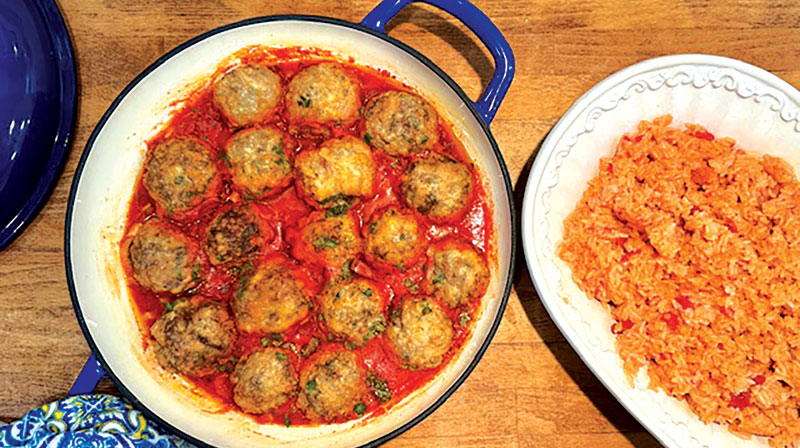
But for the Jews of the Ottoman Empire, one of the most classic comfort foods has always been “keftes de carne con arroz” (fried breaded meat balls with Spanish red rice). These fluffy meat patties were almost always on the table at those Rhodesli get togethers. The ground beef is simply seasoned with parsley, salt and pepper, then dipped in flour and beaten eggs, then pan-fried. The burst of fresh, savory flavor comes from simmering the keftes in tomato sauce with lots of tangy lemon and earthy celery. The sweet, citrusy complex flavor of the tomato sauce and hearty, meaty keftes are the perfect accompaniment to the Spanish red rice.
For the Jews of the Ottoman Empire, one of the most classic comfort foods has always been “keftes de carne con arroz” (fried breaded meat balls with Spanish red rice). These fluffy meat patties were almost always on the table at those Rhodesli get-togethers.
Recently, Neil and I were reminiscing about those Sunday potlucks. He said “Those days seem like a lifetime ago and I miss them.” So I did the best possible thing I could do and made a pot of keftes de carne and some perfectly steamed Spanish red rice. We sat around our Friday night table and created new memories, while eating this most luscious, comforting food.
—Rachel
Keftes de carne
Meat Patties
Vegetable oil, for frying
1 medium carrot, for frying
2 pounds ground beef
3 large eggs
1/4 cup matzah meal or potato starch
1/4 cup finely chopped parsley
2 tsp salt
Pepper, to taste
1 cup flour
2 large eggs, beaten
In a large bowl, gently combine the meat, eggs, matzah meal, parsley, salt and pepper. Do not overmix.
Shape the meat mixture into 12 thick, round patties. Set aside.
Warm one inch of oil in a frying pan over medium heat. Then add a piece of the carrot to the oil, to prevent oil from turning black.
Coat each meatball in flour, then dip into the egg.
Carefully place the meatball into the hot oil.
Fry until both sides are golden brown.
Place on a wire rack.
Notes:
Adjust salt according to taste.
Store in a tightly sealed container in the refrigerator for up to 5 days.
Sauce
2 Tbsp extra virgin olive oil
2 cloves chopped garlic
3 stalks of celery with leaves, chopped
1 14 oz can tomato sauce
1 cup water
1/2 tsp sugar
1 tsp salt
Juice of 1 lemon
In a heavy pot, warm the olive oil over medium heat.
Add the garlic, celery, tomato sauce, water, sugar, salt, and lemon juice.
Stir well and allow to simmer for 5 minutes.
Gently place the fried patties into the sauce, lower heat and simmer for 30 minutes.
Check occasionally and add a little more water if the sauce appears too thick.
Serve warm over rice.
Sharon Gomperts and Rachel Emquies Sheff have been friends since high school. The Sephardic Spice Girls project has grown from their collaboration on events for the Sephardic Educational Center in Jerusalem. Follow them
on Instagram @sephardicspicegirls and on Facebook at Sephardic Spice SEC Food. Website sephardicspicegirls.com/full-recipes.