When I was in my mid-20s, I fought a long, messy and entirely internal struggle over whether to move to Israel.
Many young Jews living in the Diaspora — more than you think — face this choice. We spend some time there, either as part of an organized program, or, as I did, on our own. Then we have to choose.
Israel, small as it is, exerts a strong pull.
I was 25 in 1985. I had lived in Israel for a year; worked hard to learn Hebrew, find a job and an apartment; built the beginnings of a life. I had a girlfriend, Miki, and a group of Israeli friends — Jews, Arabs, South Africans, French, Australians, Angelenos — whose company inspired me. We worked or went to school, then spent the evenings visiting, drinking really bad Carmel Hock wine or powdered Turkish coffee, arguing, laughing, dreaming.
None of us had money, and the country itself was simple and poor compared to the States: no cell phones, two brands of beer, two TV channels.
Maybe it’s the same with all 25-year-olds. At that age, you enter a kind of second childhood, you sponge up whatever culture you happen to find yourself in. I have friends from Encino who spent those post-college years in London and returned with full-on English accents, never quite able to lose them.
In any case, Israel felt like my new home, and I wrestled with whether I could separate myself from my family and make a career there.
Because I tend to relate to the world through food, my memories of those years are tied to foods I discovered for the first time there. One day, Miki and I befriended an elderly man named S.E. Yardeni, who lived in a simple home on a relatively large plot of land in Jerusalem. Yardeni was a pioneer who had come to settle the land. His agile mind invented the locks that still bear his name. He founded his company in 1947, a year before statehood, and by the time we met him, he was retired and devoting himself to his garden. He had the money to live anywhere in the world, in style, but he was rooted, like his fig, olive and pomegranate trees, to the land.
One hot summer day, he showed us how he made pomegranate wine. It was served cold and was mildly alcoholic, the color of rubies. To this day, I’ve never tasted anything quite so perfect. He made us a salad of the lettuce and tomatoes he grew, and he poured tea for us that was unlike any I’d ever tasted: sweet, lemony, minty.
“What is it?” I asked him to show me.
In his yard, he ran his hand over a bush with elegant, soft green spiked leaves. “Louisa,” he called it. As his rough hands stroked the leaves, that fragrance filled the warm air. How could I ever leave Israel?
In winter, we visited Yardeni again, and he made another tea, this time from sage leaves.
“The Arabs drink louisa in summer, sage in winter,” he explained. “It warms you up.” It did.
By spring, I was back in Los Angeles. I can’t say I ever really definitively decided whether to stay or to leave. Miki and I were breaking up, and I thought it would be a good thing to get a bit of distance between us for a bit, like 10,000 miles. Not that we were married, but in the separation, she got the country.
And me, I ended up like a helluva lot of other middle-aged men and women I know. We look back on the years we spent in Israel and can’t help wondering: What if? How close did we really come to taking a leap that, in the end, so few successfully take? Instead, we raise our kids speaking a bit of Hebrew, stay involved in the life and politics of the country from a distance, make a point to befriend Israelis here (and let’s face it, a lot more of them follow their hearts to us than vice versa).
It’s not a chapter that ever seems to close. And as the years tick by, as our kids grow up and move on, and a part of us — of me — can’t help but think: If the right opportunity were to arise … if the right job offer came through. But of course, a real leap doesn’t require a great opportunity; it starts with the courage to sacrifice for possibility, for a dream, for what if.
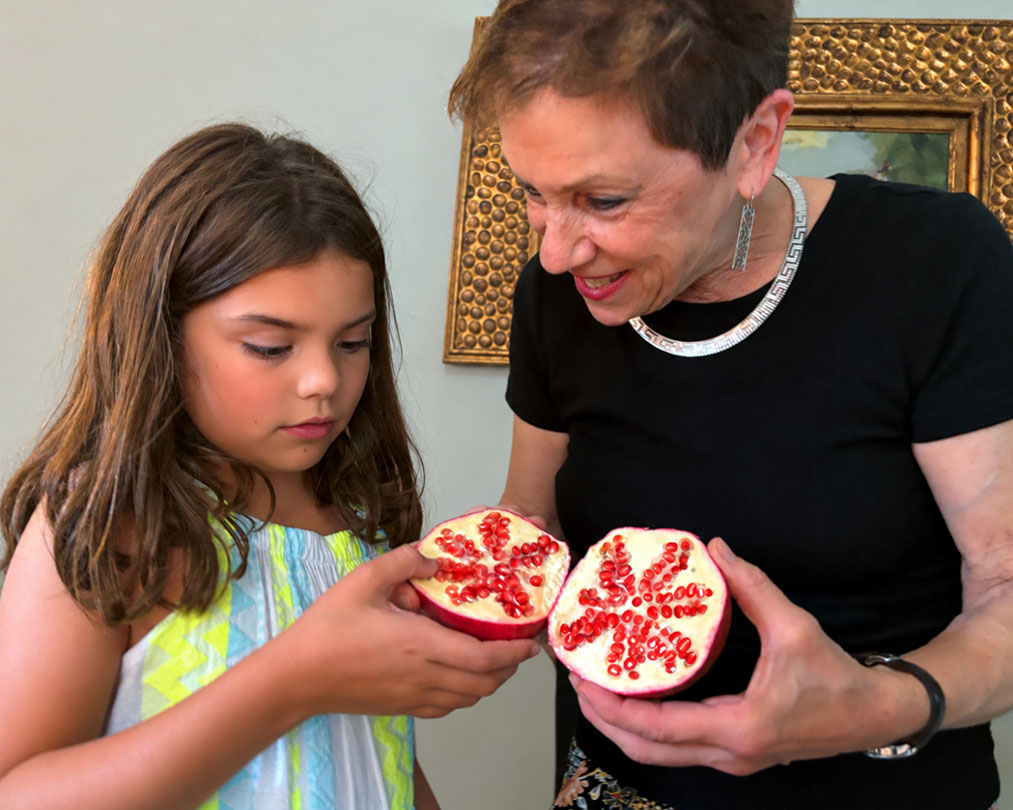
In my garden in Venice, I planted two pomegranate trees. The large one yielded more than 100 pounds of fruit last year. I never learned to make Yardeni’s wine, but I do make a pretty good vodka after I pick, seed and crush the fruit.
I looked for a year for louisa in the local nurseries, until I learned that it has a common English name, lemon verbena. I planted five plants in the back garden, one in the front.
Louisa goes dormant in the winter. Three months of the year, it looks dead. At the peak of spring, light lime-colored leaves sprout along the branches, and the plant begins a new cycle of spindly growth.
On a beautiful spring morning last week, I decided to drink my coffee by the garden. I sat and took in the peaceful morning, the beauty of where I live, the good fortune of my life. Unknowingly, I brushed my hand along the newly formed louisa leaves, and their fragrance released and enveloped me.
And I began to cry.
Lemon Verbena Sorbet
This is adapted from The Herbfarm Cookbook, by Jerry Traunfeld.
Nothing but vibrant and refreshing it’s lemon heaven.
Makes 1 quart, 8 servings
1 1/2 cups (gently packed) fresh lemon verbena leaves
1 cup superfine sugar
1/4 cup freshly squeezed Meyer or Eureka lemon juice
3 cups cold water
Grind the lemon verbena leaves and sugar together in a food processor until the mixture turns into a bright green paste, about 30 seconds; stop to scrape down the sides as necessary. Add the lemon juice and process for 15 seconds longer, then add the water. Strain the resulting liquid through a fine sieve to remove any bits of leaf. Freeze in an ice cream maker according to the manufacturer’s directions.
Lemon Verbena Tea
I serve this at the end of just about every meal beginning in early summer, when our verbena plants… leaf out.
12 fresh large lemon verbena leaves
1 T. sugar
4 cups boiling water
Steep leaves in boiling water. Add sugar to taste.
Rob’s Pomegranate Cordial
Wash ripe pomegranates. Submerge in a large bowl or tub of water. Cut open and with your fingers pry out the seeds. They will fall to the bottom of the bucket while the pith will rise to the top.
Scoop off and discard pith, drain all the water, then re-rinse seeds, drain well..
Using your hands, squeeze the seeds to extract the juice. Strain through damp cheesecloth, squeezing well.
Make a simple syrup by boiling water and sugar 1:1. Let cool.
Fill a clean bottle half way with juice. Add 1/8-1/4 syrup and the rest vodka. Shake and taste. Add more juice, syrup or vodka to balance flavor. It should be sweet, tart and juicy with a slight alcohol kick.
Seal and refrigerate a few days to mellow the flavors. Serve in cordial glasses, well chilled, or mix with Prosecco, champagne or white wine.