Some theater patrons prefer to switch off their brain cells and watch a light-hearted play, while others opt for strenuous mental exercise.
The latter can be guaranteed a vigorous workout in “New Jerusalem: The Interrogation of Baruch de Spinoza at Talmud Torah Congregation, Amsterdam, July 27, 1656,” in a staged reading July 13-15 at the Skirball Cultural Center.
The play, by David Ives, is presented by L.A. Theatre Works, a low-key but important Los Angeles institution, which drafts high-profile actors to read scripts, without costumes, lighting and other traditional stage effects. The performances are recorded for later radio broadcast.
Such performances may not be to the taste of action aficionados, but as Susan Albert Loewenberg, the group’s producing director, pointed out, “When you sit a few feet away from the stage, without any distractions, you hear the words in a way you’ve never experienced before. It’s a compelling encounter.”
Such a promise, and approach, seems especially suitable in a drama of powerful ideas, such as “New Jerusalem.” Although leavened with humor, the play deals primarily with Spinoza’s arguments for replacing religious tradition with rational, scientific reasoning.
If such an idea appears heretical in the “enlightened” 21st century — imagine any current politician in his right mind espousing such views — to the pious Dutch burghers of 17th century Amsterdam the concept shook the very foundations of their society, however tolerant they were compared to the rest of Europe.
As the subtitle of “New Jerusalem” indicates, the focus of the play is on the historical interrogation of Spinoza by rabbinical and civic authorities, which led to the philosopher’s excommunication from the synagogue and the provision that he be “cut off from the Nation of Israel.”
Spinoza, a descendant of Portuguese Jews fleeing their homeland’s Inquisition, dabbled in painting and was a younger contemporary and admirer of Rembrandt, who lived in the same neighborhood.
This allows playwright Ives to coin one of the great throwaway lines in all literature. In the opening scene, as Spinoza hoists one in a pub, he turns to a friend and casually suggests, “Let’s drop in on Rembrandt.”
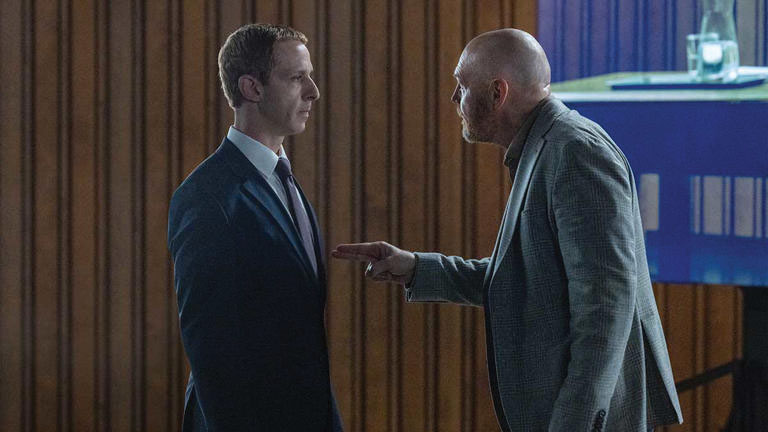
The chief intellectual sparring partner and interrogator of the then-24-year-old Spinoza is his revered Sephardic rabbi and mentor, Saul Levi Mortera. Although Mortera is fond of his brilliant and rebellious ex-pupil, and is even half-convinced by some of Spinoza’s reasoning, the rabbi sees no option but to excommunicate Spinoza.
What is at stake, the rabbi feels, is not only the basic foundation of his faith, but the good will of the Dutch authorities, whose religion is as much threatened by the heretic’s views as is the Jewish community.
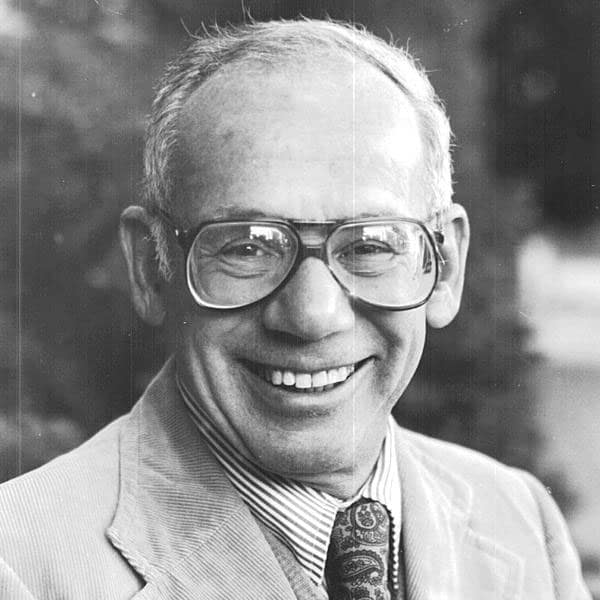
The key role of Rabbi Mortera is taken by veteran actor Richard Easton, who essayed the same part in the full-scale off-Broadway production of “New Jerusalem,” backed by Yiddish theater star Fyvush Finkel as a synagogue lay leader.
The Montreal-born Easton, 77, has performed in 71 Shakespeare productions, and his classical diction comes across even in a phone interview.
His repertoire also includes contemporary drama, and in 2001 he won a best actor Tony Award for his role in Tom Stoppard’s “The Invention of Love.” He played the title role of Benjamin Franklin in the Emmy-winning PBS series.
Easton said he was initially worried, as a non-Jew, about playing the part of a famous rabbi, but overcame the concern with the help of Jewish friends.
In any case, Easton said, “Spinoza believed that he was sent by God to break the rules. That is not only a Jewish message, but a universal one.”
Producer Loewenberg, who has guided L.A. Theatre Works since its founding in 1974, now disposes of a digital database of more than 300 plays, which are disseminated widely through public radio stations (locally KPCC-FM) and educational institutions.
She collaborates frequently with Britain’s BBC, and many of her productions have enjoyed successful runs at performing arts venues in the United Kingdom.
After more than a decade at the Skirball, L.A. Theatre Works will move this fall to UCLA’s James Bridges Theater. The change of venue will open up Saturday evening performances, not available at the Skirball, Loewenberg said.
“New Jerusalem,” directed by Rosaline Ayres, will open with an evening performance on July 13, followed by both matinee and evening shows July 14 and 15. (The play lasts 90 minutes, which means the Friday evening performance will be over ahead of the announced 10 p.m. closure of the 405 Freeway). For tickets and general Theatre Works information, call (310) 827-0889, or visit www.latw.org.