
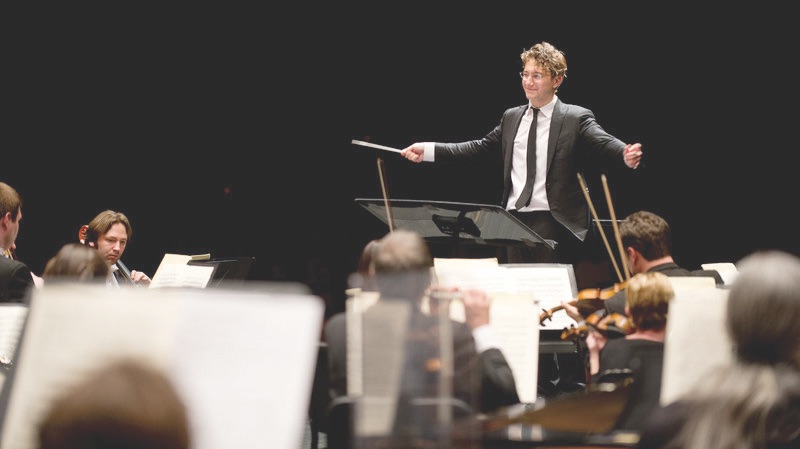
How does a nice Jewish boy from the San Francisco Bay Area end up in Louisville, Ky.? Just ask Teddy Abrams, the dynamic music director of the once-storied Louisville Orchestra who has an upcoming debut with the Los Angeles Philharmonic. When he took the orchestra’s reins in 2014, at the age of 27, the conductor-composer faced many challenges, including dealing with a dispirited organization that recently had emerged from bankruptcy and a long-fallow performance period.
Now, more than three years into his tenure, Abrams is seeing a turnaround in the orchestra and the Louisville community. The musicians have a new contract, ticket sales are up, and the subscriber and donor bases have doubled.
“It’s a different organization,” Abrams said by phone from his home in Louisville, adding he didn’t know much about the city, except that Jerry Abramson, a Jew, had served as mayor in the 1980s and ’90s.
“I knew bourbon came from here and the Kentucky Derby ran here,” he said. “It’s a tolerant, nonjudgmental place. There’s a beautifully ingrained Jewish population and identity, one of the oldest in America, and one that’s very involved in the arts and culture.”
Abrams’ career is poised to take a leap when he makes his debut with the L.A. Philharmonic at Walt Disney Concert Hall on March 2 and 3, conducting the U.S. premiere of Andrew Norman’s whimsical opera, “A Trip to the Moon,” directed by Yuval Sharon.
Simon Rattle led the Berlin Philharmonic in the work’s premiere last June, but Abrams said changes have been made since then. “The L.A. production has been trimmed, a few roles modified, and there are updates to the staging and integration of the children’s components,” Abrams said.
“Norman creates a hybrid art form — film, drama, highly original and creative music,” Abrams continued. “The opera’s almost like a Pixar animation film and should immediately appeal to all ages.”
For now, Abrams is heartened by the positive response the Louisville Orchestra’s recent Decca Gold album, “All In,” has received. The revitalized ensemble’s first recording in almost 30 years, it reached No. 1 on Billboard’s Traditional Classical chart. The album features two of Abrams’ works: a colorful orchestral piece, “Unified Field,” and “The Long Goodbye,” which is given a swing-era vibe by a Louisville favorite, chanteuse Storm Large.
“The kind of music I love takes many different forms,” Abrams said. “I prefer looking for the interconnections between various styles of music, which is what ‘Unified Field’ is all about.”
“You name a genre or venue, from a café to a homeless shelter, and I’ve been there.” — Teddy Abrams
The recording’s grand finale features Abrams as the soloist in Aaron Copland’s Clarinet Concerto, a 1948 score commissioned by Benny Goodman. Incidentally, Abrams, who also is a fine keyboard player, began studying the concerto when he was 12 with Michael Tilson Thomas, the San Francisco Symphony’s music director.
“We worked on the opening of the concerto — that slow part — worked on those first couple of measures over and over again,” Abrams recalled. “Michael took a very talmudic approach. It wasn’t about doing it ‘right,’ because there isn’t just one way. It was about having a relationship with the music.”
Abrams, who guest conducts the New World Symphony in Miami Beach and also is music director of the Britt Music & Arts Festival in Oregon, grew up performing klezmer music. He was 10 when he performed in an amateur klezmer musical based on the tragic 1911 Triangle Shirtwaist Factory fire in New York.
Just as unusual was Abrams’ first gig with his Sixth Floor Trio about nine years ago, which featured fellow graduates of the Curtis Institute of Music in Philadelphia. “We were playing klezmer music with Marvin Hamlisch for a temple fundraiser in the middle of North Carolina. You can’t make this stuff up.”
For Abrams, music is about being “all in” — as the album title aptly puts it — and thrives best as a communitywide endeavor.
“You name a genre or venue, from a café to a homeless shelter to the rock festival here, and I’ve been there,” he said, “dragging my keyboard and performing.”















 More news and opinions than at a Shabbat dinner, right in your inbox.