My husband’s family hails from Toledo, Ohio, a city that proudly claims kinship with Toledo, Spain. That’s one reason I didn’t want to miss this Castilian hill town 42 miles southeast of Madrid. There’s also the fact that El Greco’s “View of Toledo,” a spectral view of the city’s spires by moonlight, has long been one of my favorite paintings.
What I didn’t know until recently is that Spain’s Toledo contains — along with spires, damascene jewelry and scrumptious marzipan — a treasure trove of Jewish memories.
Back in 1200, under the benign rule of a Catholic king, Toledo housed some 12,000 Jews, who contributed mightily to the city’s dynamic intellectual life. Of the many synagogues that once dotted the winding lanes, two have survived. Both were converted into churches following the expulsion of Jews from Spain, but they now have been preserved as national monuments.
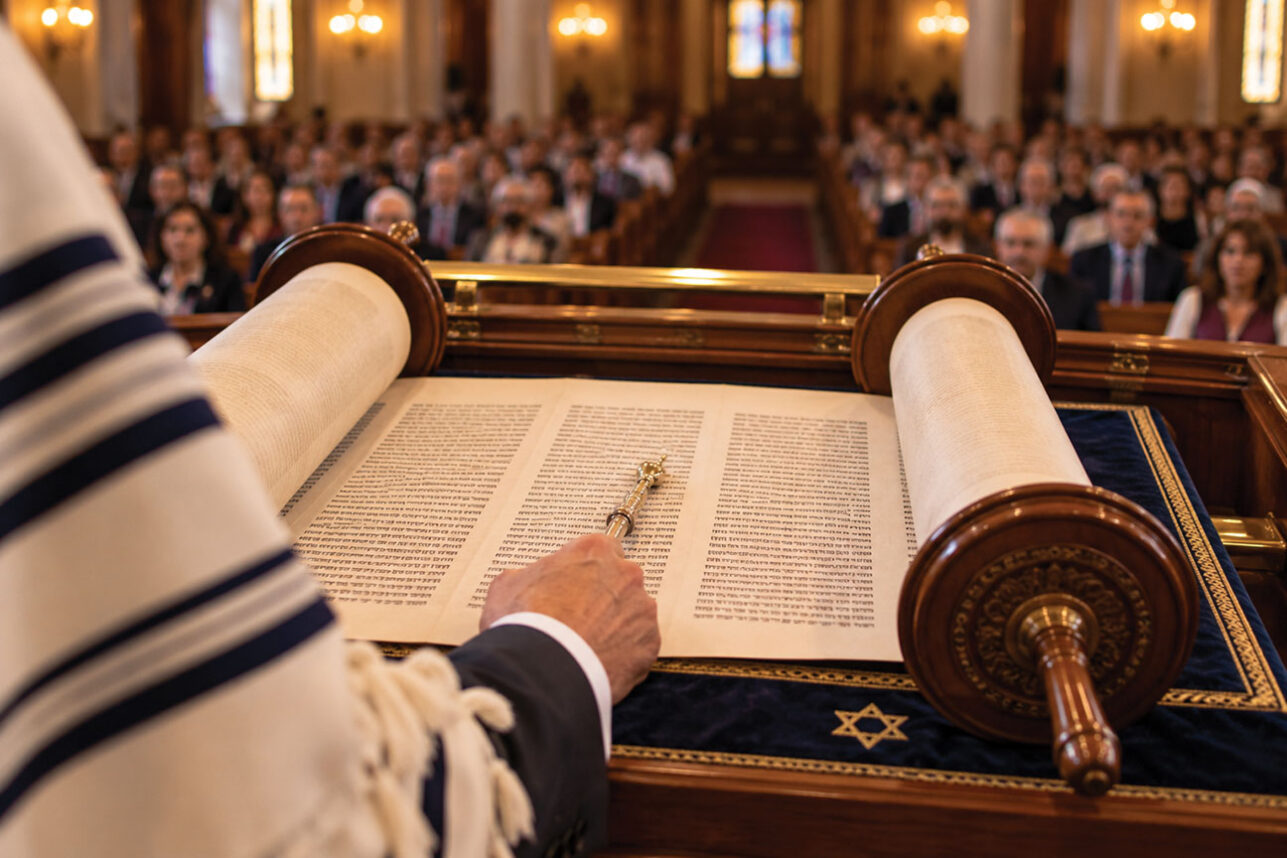
The 14th century house of worship built by the wealthy and powerful Samuel HaLevi is known today as the Transito (Assumption) Synagogue. Its grandly carved bimah and magnificent ceiling are still intact.
Equally impressive in its way is the Sephardic Museum located in what was once the women’s gallery. It contains Jewish antiquities, many borrowed from Israeli collections, and there’s also heartwarming video footage of modern Jews celebrating holidays and life-cycle events: proof for Spanish visitors that Judaism lives on.
This is worth underscoring, because the guards on the premises have little sense of exactly what they’re guarding. When I asked in my best schoolgirl Spanish if there were any modern synagogues in Spain, all I got was a shrug.
The second surviving synagogue on the street now called, Reyes Catlicos (Catholic Kings), is the austerely beautiful Santa Mara la Blanca, dating from the late 12th century. It was built in the Moorish style, with stately rows of white columns reaching upward into rounded arches. High off the ground, above the archways, long-ago artisans etched lacelike patterns into the plaster.
I had heard that when this synagogue became a church, the Jewish symbols among the plaster adornments were obliterated. But there remained, I was told, a single Magen David as a token of what once had been.
Naturally, I set out to find it. Again, the guards and other employees were of little help. One acknowledged that the star existed but wouldn’t budge from her post at the gift shop cash register to point it out.
Finally, persistence paid off. Above the first pillar to the right of the doorway, and some 25 feet off the ground, we saw the faint but visible six-pointed star representing our people.
As we strolled along Reyes Catlicos, a bilingual sign promising information about Jewish Toledo led us into a narrow alley, Calle del Angel. Here we found Casa de Jacob, a spacious, modern store selling Jewish ritual items, kosher foods from Israel and serious Jewish texts in Spanish, Hebrew and English. It also offers a map detailing the archaeological remnants of Jewish life within Toledo’s ancient walls.
According to David, the pleasant young man behind the counter, Casa de Jacob is unique in Spain. It’s lovingly operated by David’s family, most of whom believe they descend from Jews forced to accept Catholicism at the time of the Inquisition. (He said his father’s brother, however, is still in denial.)
Our chat with David allowed us, as we moved on to Toledo’s magnificent cathedral, to feel a little more at home in this very Catholic place.
Later, as we watched the sun set over the city from the spot where El Greco had painted his masterpiece, I was feeling profoundly affectionate toward my surroundings. Holy Toledo, indeed!
The map can be viewed on the Web at www.jewishtoledo.com, and the store’s informative and wide-ranging site can be found at www.casadejacob.com