Imagine sitting down at a Passover seder and receiving a visitor who wants to kill you. That visitor is not the prophet Elijah or the Fifth Son — the one absent from the table — who has a change of heart. No, he’s a killer who hates Jews and wants to destroy them.
Fifteen years ago, on March 27, 2002, Abdel-Basset Odeh left his home in the West Bank and walked into a Passover seder in Netanya’s Park Hotel. He then blew himself up, killing 29 mostly elderly Jews and wounding 64 more.
The Jewish world was horrified but not shocked. That’s because the Netanya massacre was part of a murderous Second Intifada that lasted several years and killed more than 1,000 Israeli Jews. It seemed as if every week was marked by a similar calamity — a Palestinian would enter Israel from the West Bank and blow up Jews in restaurants, ice cream parlors, discos, cafés and public buses.
Since this year marks the 50th anniversary of Israel entering the West Bank after the Six-Day War of 1967, critics have come out in full force urging Israel to “end the occupation once and for all.” For the majority of Israelis, however, it’s a lot more complicated than that.
You see, Israelis remember something that happened right before Jews were being blown up every week by Palestinian terrorists. They remember that their prime minister, Ehud Barak, had, in fact, offered to end the occupation once and for all — and the Palestinians walked away.
It happened in July 2000, when President Bill Clinton brokered peace talks at Camp David. A year later, in a Newsweek article titled, “Clinton to Arafat: It’s All Your Fault,” the U.S. president let the world know who he felt was most responsible for the agonizing failure.
When Palestinian leader Yasir Arafat told him, “You are a great man,” the president replied, “The hell I am. I’m a colossal failure, and you made me one.”
What Israelis remember, above all, is that after the failure of peace, Arafat started a war. Israelis remember that after Barak offered to end the occupation, they started getting blown up by Palestinians entering from the West Bank.
And they remember that after the Netanya Passover massacre, Israel said, “Enough.”
Israelis remember that after Barak offered to end the occupation, they started getting blown up by Palestinians entering from the West Bank.
The Jewish state was left with no choice but to double down on the occupation and go right to the source of the terror — the West Bank.
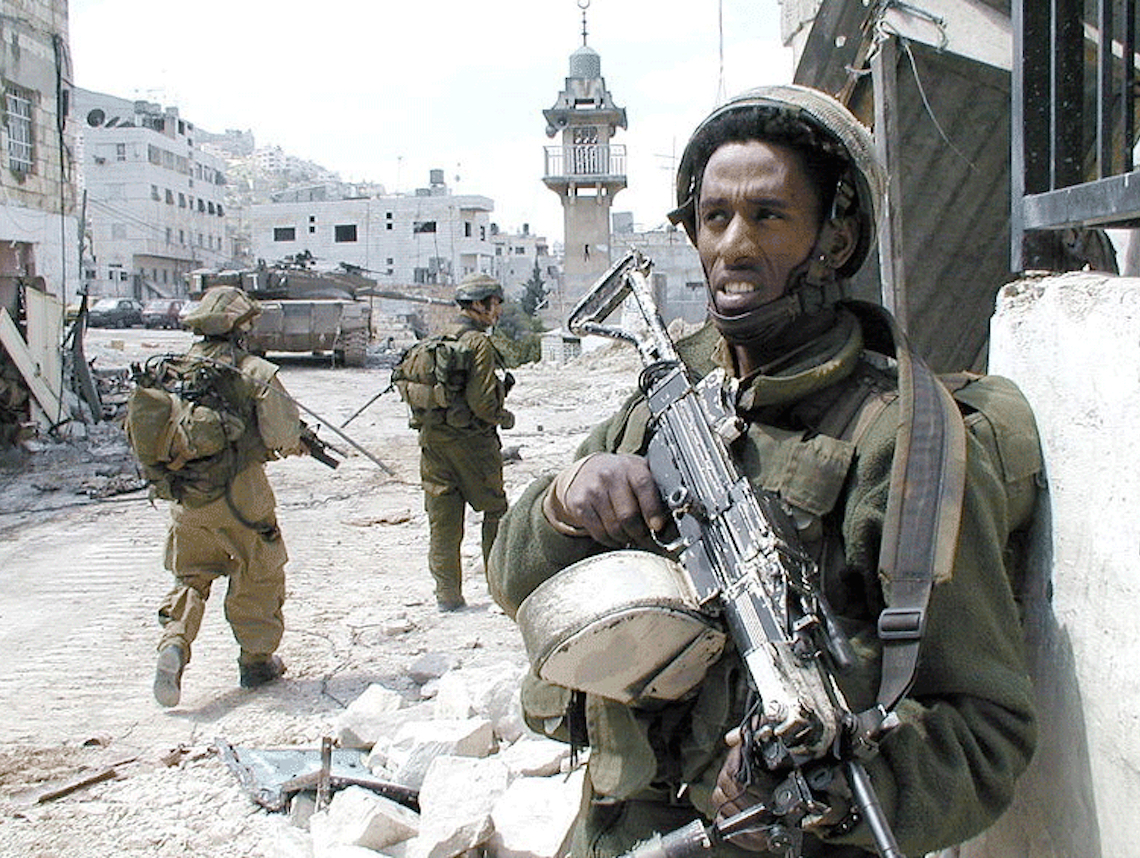
So Israel launched Operation Defensive Shield in 2002, calling up reservists and sending troops and heavy weaponry deep into the hearts of six major Palestinian cities, surrounding towns and West Bank refugee camps.
The goal was to stop terrorist attacks by regaining control of the West Bank, in particular the cities in Area A that were under the sole control of the Palestinian Authority.
What did they find when they regained control? Just what they expected. As reported in JPost, Israel uncovered 23 explosives laboratories and seized enormous quantities of weapons.
“The situation we had back then — with suicide bombers coming into the center of the country blowing themselves up — we don’t have that now,” Lt. Col. Yair Pinto, a commander during Operation Defensive Shield, said recently to JPost.
Indeed, in our zeal for peace, it’s easy today to forget the dark days of the past. Those were the days when Israelis would risk their lives any time they took their kids for ice cream, got on a bus, met a friend for coffee or sat down for a Passover meal inside a hotel.
So, yes, bemoan the occupation. Lecture Israel on the need to end it. I have as much sympathy as anyone for the need to shake up the status quo and make a durable peace between Israelis and Palestinians.
But I also have sympathy for Israelis who remember that when Israel was traumatized by daily terror, it wasn’t less occupation that saved them, it was more.
David Suissa is president of TRIBE Media Corp./Jewish Journal and can be reached at davids@jewishjournal.com.