Last summer, I watched the disturbingly iconic reel of black-and-white footage that revealed the shameful truth of Bergen-Belsen.
The grainy footage, which many of us have seen, was taken at the concentration camp in Germany, a few days after the liberation on April 15, 1945. It offered one of the first glimpses into the hell that was the Holocaust. Under the armed command of liberators from the British Army, SS men are seen unloading the skeletal corpses of the Jews they’d murdered from the back of a pickup truck, and carrying them to a mass grave.
I was struck by two things I hadn’t noticed before:
First, the reel shows a woman screaming at the SS men laboring under the gun of the liberators.
Second, in an extraordinary moment of reckoning, a young Polish-Jewish woman named Hela Goldstein — who appeared to be the same woman who’d been screaming in the earlier shot — steps up to a microphone and delivers, in German, a short account of what had transpired at the camp, while standing against the backdrop of a massive open grave. As I watched her interview — which lasts all of 93 seconds — it occurred to me that this was likely the first audiovisual Holocaust survivor testimony ever recorded on camera.
I wondered if Goldstein was among the nearly 54,000 Holocaust survivors who later gave their testimonies to the USC Shoah Foundation, whose Visual History Archive features a powerful search engine.
Thanks to the remarkably detailed work of the archive’s indexers, I was able to locate a woman in Houston named Helen Colin. Colin had previously been known as Hela Goldstein — and she was liberated at Bergen-Belsen. I called a friend at the Holocaust Museum Houston, who provided contact information for Helen’s daughter Muriel. After connecting with Muriel, I immediately booked a flight from Los Angeles to Houston.
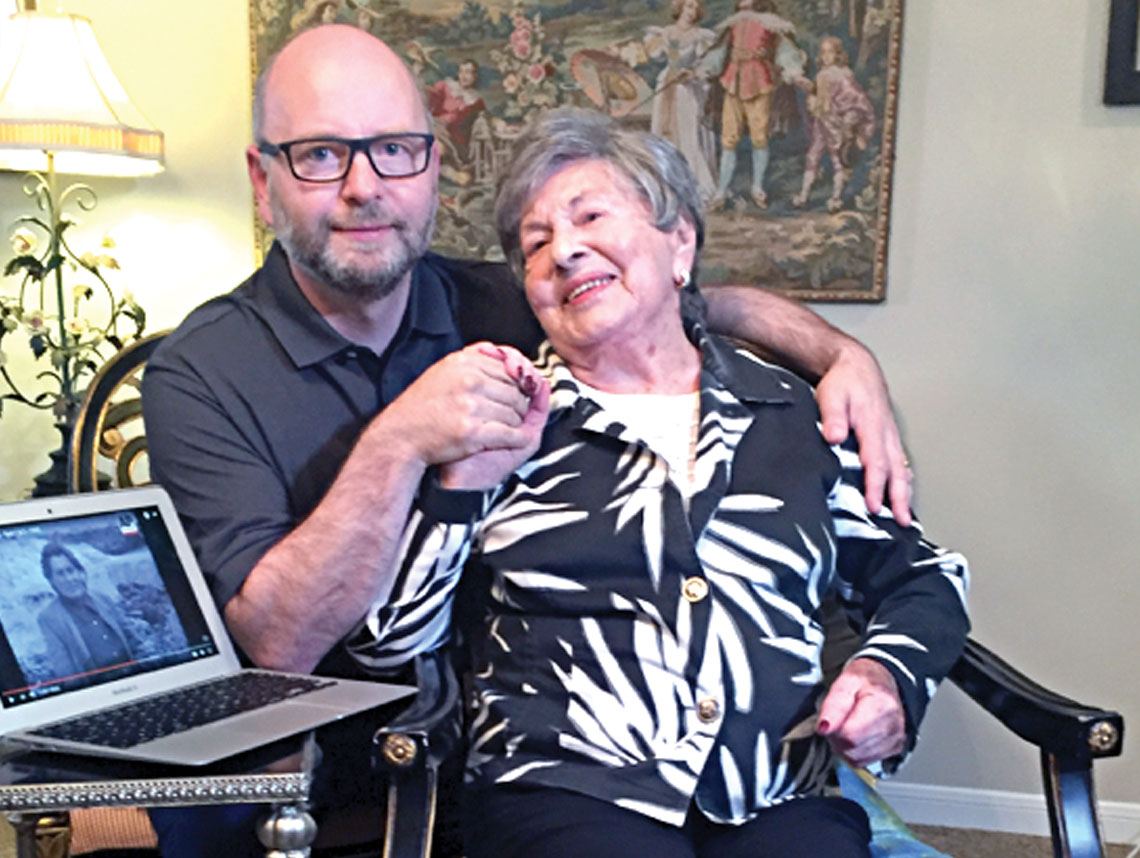
The next day — June 8, 2016 — I arrived at Helen’s house for the purpose of interviewing her for the USC Shoah Foundation again. In her first interview, recorded in 1996, Helen had never mentioned the statement she’d made to the British film crew at Bergen-Belsen, where 50,000 innocents (including diarist Anne Frank) were murdered during World War II.
I filmed the 93-year-old Helen watching her 1945 testimony. Then I asked her what it was like to stand in front of a microphone as a woman in her early 20s and speak about what had happened.
“I was very, very scared,” she said, adding that the British officers had forced the SS men to listen.
Here she was, staring her former captors in the face, with a camera rolling, telling the world what they’d done. Despite the presence of the British Army, she feared reprisal in the form of a sniper’s bullet from the guard tower above. But it was unoccupied.
Helen also confirmed that she was, indeed, the woman who’d been screaming at the SS men, who were grabbing and dragging bodies by the feet. What was she saying?
“I says, ‘You are not allowed to drag on this gravel such a precious people. They may be my family, they may be my mother, father — who knows?’ ”
She ordered the SS men to “immediately” begin carrying the bodies over their shoulders, to afford the victims a shred of dignity. The Nazis complied, as can be seen in the footage.
“They did it because the British were surrounding me,” she said.
April 15, 1945, was not just the day Bergen-Belsen was liberated; it was also Helen’s 22nd birthday. And as it happens, April 15 is my birthday too.
We bonded that day at her home, made even more hospitable by her lovely daughter Muriel, so eager to ensure that her mother’s story be told. After the interview, Helen and I agreed to get together again, but this time for the purpose of celebrating our birthdays, on April 15, 2017.
That was not to be. Helen died just weeks after our interview. So, in lieu of the party we’d planned, this piece will celebrate her memory.
With Yom HaShoah just a few days away, when we recall the testimony of survivors, Helen Colin’s legacy rebuts a longstanding popular misconception — that Holocaust survivors were silent after the Holocaust. Many did speak, but in fact their words all too often fell on deaf ears.
As that young woman stood in front of her captors with the dead piled up behind her, it took courage to speak. Helen that day was prepared to speak even though she feared lethal retaliation. But survivors have felt other fears: that words may be twisted for nefarious purposes; that their memories might not be respected; that they must re-live the trauma.
Helen, like all the survivors who have shared their stories — who lost her mother, father, younger brother and little sister to the Holocaust — was among the brave. Happy birthday, Helen.