fbpx

April 13, 2017

L.A. rabbis arrested at ICE protest

Several area rabbis were among more than 30 protesters arrested April 13 in downtown Los Angeles for an act of civil disobedience to call attention to the treatment of undocumented immigrants.

The group was taken away after blocking a driveway to the Metropolitan Detention Center (MDC) Los Angeles, booked at Los Angeles Police Department (LAPD) headquarters and released by mid-afternoon.

Bend the Arc Rabbi-in-Residence Aryeh Cohen said the act of civil disobedience demonstrated a refusal to accept Immigration and Customs Enforcement (ICE) treatment of undocumented immigrants.

“What it says to ICE, the institution, is that we are intending to put our bodies in between them and … deportations and detentions of people who have been in this country for a long time,” Cohen said in a phone interview. “I think what it said to LAPD is our fight is not with them but with ICE.”

The protest, which began around 10 a.m. several blocks away, brought together Jewish, Muslim and Christian faith leaders and community members who chanted, “Exodus from detention!” as they marched toward the Detention Center, from where vans leave to round up immigrants. The center, itself, is a federal jail downtown that holds individuals for immigration-related crimes, among other offenses.

Participants in the protest, which came on the third day of Passover, drew parallells between the Israelites’ Exodus story from bondage to liberation and the plight of undocumented immigrants who live in fear of being detained.

“I’m standing with my brothers and sisters in faith … on behalf of the undocumented and the refugee and immigrant communities that are being targeted now. Especially now during Passover, it is time we remember our own liberation,” Rabbi Sarah Bassin, associate rabbi at Temple Emanuel of Beverly Hills, told the Journal, as she was locking arms with Wilshire Boulevard Temple Rabbi Susan Goldberg, before their arrest.

Approximately 200 members of Bend the Arc: A Jewish Partnership for Justice, Clergy and Laity United for Economic Justice (CLUE) and other faith-based social organizations turned out.

Among those arrested were Bassin, Goldberg, Cohen; Rabbi Chaim Seidler-Feller, director emeritus at Hillel at UCLA; and Rabbi Susan Laemmle, dean of religious life at USC.

Goldberg said the purpose of blocking the entrance to the detention center was to prevent ICE vehicles from doing roundups.

“We’re making sure that ICE vans don’t have the ability to leave and round people up and deport them during this week of Passover,” she said.

Locking arms with Shakeel Syed, executive director at Orange County Communities Organized for Responsible Development, Seidler-Feller said lessons gleaned from Passover obligate him to stand up for undocumented immigrants.

“At Passover we understand we are all strangers and citizens of the world together,” he said.

Syed, who is Muslim, echoed the importance of interfaith unity in the face of injustice.

“Today, I am a full human being standing in solidarity with all my Jewish brothers and sisters,” he said.

From left: Rabbi Chaim Siedler-Feller, Shaklee Syed and Rabbi Jonathan Klein lock arms outside the Metropolitan Detention Center. Photo by Ryan Torok


Police charged those arrested with willfully disobeying a police officer.

Bassin said she was released shortly after her arrest. The police treated her professionally, she said, adding that the charge is equivalent to a traffic violation.

The event kicked off with people congregating in the historic La Placita Church near Olvera Street, where Cohen expressed his frustration with the Donald Trump administration’s treatment of undocumented immigrants.

“We are here to say this as loud as we can,” Cohen said, addressing packed pews inside the church. “We will not abide by this anymore.”

As they proceeded, protestors stopped at the Federal Building, which conducts immigration processing, at 300 N. Los Angeles St., and chanted, “Not one more deportation!” Officials from the Department of Homeland Security stood at the entrance to the building.

Rabbi Laura Geller of Temple Emanuel of Beverly Hills addressed protestors during an action expressing opposition to the treatment of undocumented citizens. Photo by Ryan Torok


Two officers, who declined to be identified, said they did not know beforehand the interfaith group would be showing up.

“Passover is the ultimate Jewish story of liberation,” David Bocarsly, a 26-year-old USC graduate student in public policy, said as the group marched on to the MDC. “The reason we retell is we don’t forget. This is a holiday not just for Jews but for all people.

“Passover is the story of God’s social justice work,” Bocarsly added. He, too, was arrested.

The group arrived outside the detention center just after 11 a.m. and formed a circle around a seder table set up in the middle of the closed-down street. Matzo, grape juice and bitter herbs sat on the table.

Holding up a piece of broken matzo, Seidler-Feller said it symbolized families broken apart by the country’s immigration policy.

Clergy, community members and others formed a circle in the middle of Aliso street outside the Metropolitan Detention Center in protest of the treatment of undocumented citizens. Photo by Ryan Torok


“This is a broken matzo,” he said. “It’s broken families, broken hearts, broken people.”

Rabbi Jonathan Klein, executive director of CLUE, held up bitter herbs “to call out the bitterness of ICE sweeps, of fathers detained in front of their children, of the bitterness of imprisonment for no crime,” he said.

Rabbi Laura Geller, rabbi emerita at Temple Emanuel of Beverly Hills, held up a cup of grape juice.

“We set aside a cup for Elijah, and open the door to announce the coming of redemption,” Geller said. “We fill this cup from our own cups to remind us that bringing to redemption to our world is up to us all.” She was not arrested.

Rabbi Danny Mehlman, spiritual leader of Ner Tamid of Downey and a chaplain at North Kern State Prison, stood in the group watching the seder. He was born in Argentina and lived in Israel for 13 years before coming to the United States with the American-born wife he’d recently married. He said when he became a citizen, the pathway to citizenship was much easier. This was before the terrorist attacks of Sept. 11, 2001, he acknowledged, but he said he wanted to see a return to a more sensible naturalization process for the undocumented.

“There hasn’t been a change in immigration law, which is necessary,” he said, wearing a tie that was decorated like a matzo, “the tie of affliction,” said Mehlman, who did not partake in any civil disobedience because of his role as a prison chaplain.

Mehlman said he hoped the the event raised awareness about the challenges facing the undocumented community.

“One of the points of the seder is to increase awareness,” he said. “Indifference is the enemy of awareness, of action, and that’s what’s needed.”

L.A. rabbis arrested at ICE protest Read More »

Three extraordinary lives: Kirk Douglas, Abe Zarem and Max Webb

The rabbis teach that Abraham was the first who had the merit of looking old. Notice the word — “merit.” It was considered, by our tradition, a good thing; it meant you had lived and learned. We compliment people by saying, “You look so young!” Accomplishment and wisdom counted more to our ancestors than vitality; innocence was not as valued as experience. For our tradition, what lay before you was not as important as what was behind you.

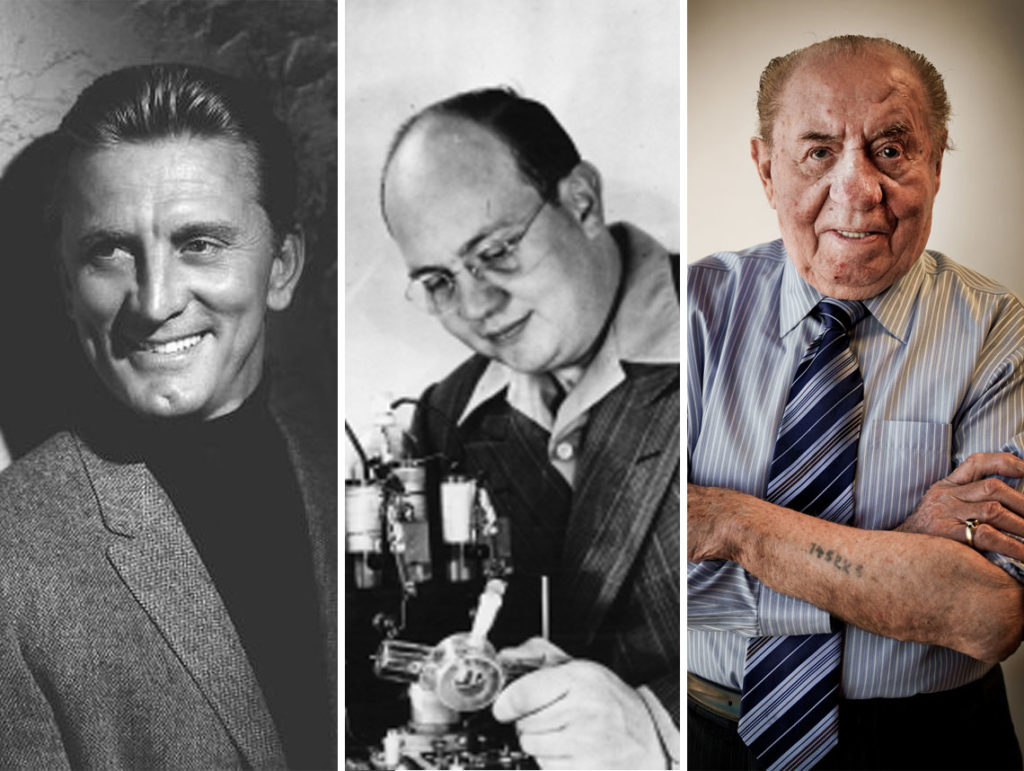
Recently in my synagogue, we celebrated three remarkable individuals who reached their 100th birthdays. One hundred years is a long time when measuring a human life. Each was distinguished in different fields, and together, they summed up the Jewish experience of the 20th century.

I am proud and privileged to introduce you to the star, the scientist and the survivor.

It is a privilege and a blessing to know each of them. The first is the star: Kirk Douglas, born Issur Danielovitch. 

One day in the mid-’90s, I was preparing to move back to New York to teach at the Jewish Theological Seminary. The phone rang and when I answered, the voice on the other end of the line said, “This is Kirk Douglas.”

Yes, I wanted to say, and I’m the queen of England.

But it was! He had seen me on a TV show about the Bible and wanted to study together. But I was leaving. Two years later, when I came to Sinai Temple, we reconnected and have been studying together ever since.

The first time I met him, he told me that because of his stroke, he spoke slowly and felt a little guilty for it. I said, “Don’t feel guilty, everyone uses what they have. Didn’t you always use the fact that you were handsome and charming?” I asked. “You know,” Douglas answered, “I never thought I was handsome.”

“Really?” I marveled, “and what about charming?”

“Oh,” he said, “I always knew I was charming.”

Kirk Douglas grew up so poor that his father would pick up rags off the street and resell them. On a hot day when I was marveling at air conditioning, I said to him, “My God, in your day, you had a block of ice and a fan.” He fixed me with his famous stare and said, “Who had a fan?”

But he roared out of Brooklyn and onto the stage and screen. He named his production company after his mother, Bryna. She lived to see it in lights on Broadway. Surrounded by friends and family, he celebrated his 100th birthday.

He and his wife, Anne, have dedicated almost 500 playgrounds, enabling kids from poor neighborhoods to have beautiful, modern facilities on which to play. In addition to his other charities, they named the Early Childhood Center here at Sinai Temple.

The scientist, Abe Zarem, was born in Chicago. Abe is among the dwindling number of surviving people who worked on the Manhattan Project, the greatest cooperative scientific endeavor of modern times. Physicist Robert Oppenheimer directed the Los Alamos Laboratory in New Mexico, where scientists dedicated themselves to building an atomic bomb before our enemies accomplished it.

After such an auspicious beginning, Abe went on to the Stanford Research Institute and became vice president of Xerox. He is also responsible for the invention of the camera with the fastest shutter speed in the world.

But Abe is gifted not only with an extraordinary scientific mind. His mother told him when he was young that his life’s mission was to meet gifted people and make them better than they would have been if they hadn’t met him. So Abe mentored thousands of people — scientists and CEOs and more than a couple of rabbis.

When Abe first took me under his wing, he told me he was a mentor and a tormentor. He pushed, encouraged and gave honest feedback. 

Our Chumashim are dedicated by Abe and Esther as a legacy of this man. Each time we follow along in the Torah, it is because of the philanthropy of Abe Zarem, whose foundation gives to causes near and far.

 On Yom Kippur, this then-99-year-old man chanted the Book of Jonah — the entire book — in a voice the entire congregation could hear. It rang out, and we were stunned by the vitality and skill of someone who has seen so much and done so much.

And the survivor: Max Webb. Max was born in Lodz, Poland. He and his family were taken by the Nazis. He trained himself as a medic and survived 18 concentration camps. He saw the worst of human beings.

But he knew he would survive if it was possible. He told his mother when the Nazis were coming that if she heard he was shot or hanged, it might be true, but if she heard he starved, don’t believe it. He knew he had the smarts and resources to survive.

After the war, he became a dance instructor. And the same grace and spirit that animated his dance has woven throughout his life.

Max’s success as a builder touches all areas of his life. He promised that if he survived, he would help rebuild Jewish life. And he has — here and in Israel. Apart from the actual buildings he has created, many synagogues, schools and even university programs owe their existence to this remarkable man.

I could not be more proud to be the Max Webb Senior Rabbi of Sinai Temple.

No life can be adequately summarized in a few sentences. Even more, no 100-year-old life can. And most of all, not lives as rich and fascinating as those of Kirk, Abe and Max.

In these three lives is the story of our people. The star, the scientist, the survivor. One created works of art that millions admire. The second created products and ideas that benefited the lives of countless people. The third supported Jewish life here and abroad and told the story of our people over and over again to young and old.

All three have unbelievable life force. These are men who, even at 100, sparkle with life and give you life when you are with them. They have seen incredible changes; they were born at the end of World War I, an era of trench warfare and silent pictures. These men and a few others like them took that world and brought it kicking and screaming into the 21st century.

Not only their talents, but their longevity enabled these three titans to contribute so much to our community and to the world. We are fortunate to be the beneficiaries of their goodness, generosity and wisdom. The rabbis were right: The blessings of age are often greater than the blessings of youth.


David Wolpe is the Max Webb Senior Rabbi at Sinai Temple.

Three extraordinary lives: Kirk Douglas, Abe Zarem and Max Webb Read More »

Daily Kickoff: Where in the world are Jared & Ivanka for Passover? | Bret Stephens leaves WSJ for NYTimes | Trump team asked Safra Catz to join admin

Have our people email your people. Share this sign up link with your friends

Ed note: Enjoy this quick mid-Passover briefing. We’ll be back after Passover…

EXCLUSIVE — Where In The World Are Jared and Ivanka for Passover? — by Jacob Kornbluh: Jewish Insider has learned exclusively that the President’s daughter and son-in-law have been spending the Passover holiday at the Four Seasons Resort in Whistler, a resort town in British Columbia, Canada. A Jewish Insider reader shared a photo with us of Ivanka in ski gear filling up a plate of matzah while chatting on her cell phone a few hours before Monday night’s Seder. [Pic

In past years, Ivanka has joined Jared’s family for Passover at the Biltmore in Arizona, at a program near the Mayan Ruins in Mexico, and last year at Ivanka’s own Trump National Doral in Miami. In fact, Jared first met Avi Berkowitz, now his deputy at the White House, on the basketball courts at the Biltmore Passover program.

— Among the featured speakers at the Whistler Passover program this year is Ami Horowitz. Horowitz is a frequent Fox News contributor and is credited with sparking President Trump’s controversial remarks in February about Sweden… After the backlash, Trump clarified via Twitter that he first heard about the stories in Sweden from Tucker Carlson’s Fox News segment with Horowitz… 

No word yet on whether Ivanka’s friend, Canadian Prime Minister Justin Trudeau will visit the First Family in Whistler. [JewishInsider

MEANWHILE… Canadian Prime Minister Justin Trudeau joined a Seder with Jewish members of the Liberal caucus and staff [Facebook

“The White House hosted a Passover Seder, but without President Trump” by Juliet Eilperin and Julie Zauzmer: “Several aides to President Trump gathered in the Eisenhower Executive Office Building to commemorate the annual Jewish holiday… But Trump did not attend the ceremony… After the Seder, a White House official… said that guests included Veterans Affairs Secretary David Shulkin and Jeremy Katz, deputy director of the National Economic Council… The three Obama campaign staffers who initiated the tradition — Arun Chaudhary, Eric Lesser and Herbie Ziskend — all celebrated separately this year, and without the Obamas. “Hopefully President Trump is able to attend a White House Seder at some point because I think retelling the ancient story of liberation from persecution is an important exercise for the leader of the free world. Especially this one,” Ziskend said in an email. “Maybe he will do so next year…in Jerusalem!”” [WashPost]

The Seder – a Glatt Kosher meal – took place in the Indian Treaty Room in the Eisenhower Executive Office Building – the same room where the Seder was held by staffers of the Clinton administration in 1993. [Twitter] • Photo of the Seder shared by Sean Spicer — with a cameo from Menachem Shemtov [Pic

MEDIA WATCH: “Bret Stephens leaves Wall Street Journal for New York Times” by Hadas Gold: “Bret Stephens, the Journal’s deputy editorial page editor, will be The New York Times’ newest op-ed columnist, both papers announced on Wednesday. “He’s a beautiful writer who ranges across politics, international affairs, culture and business, and, for The Times, he will bring a new perspective to bear on the news,” Times editorial page editor James Bennet wrote in a memo… In a tweet, Stephens said he is “profoundly grateful for many years at an extraordinary newspaper. Looking forward to many more years at another.”” [Politico]  

DRIVING THE CONVERSATION: “‘I Screwed Up’: Sean Spicer Apologizes for Holocaust Comments” by Michael Grynbaum: “One day after he delivered a stunner of a gaffe from the White House lectern — favorably comparing Hitler to President Bashar al-Assad of Syria, then clumsily referring to Nazi death camps as “Holocaust centers” — Mr. Spicer gave an abject apology on Wednesday… Mr. Spicer offered no excuses, describing his remarks as “inexcusable and reprehensible” and acknowledging that the timing — during Passover and the Christian Holy Week — “compounds that kind of mistake.”” [NYTimes

“Spicer, under fire, says he’s not going anywhere” by Josh Dawsey: “Spicer did not seem to be at risk of losing his job, two White House officials and two advisers said, even though the President was displeased with his comments… “Until you’ve stood at that podium, you have no idea how hard it is day in and day out to never make a mistake,” said Ari Fleischer, a press secretary for George W. Bush. “Sean made a big one today. He handled it properly. He apologized. Now, he’s going to take a pounding, and he’s going to move forward.” … Spicer called the office of Republican mega-donor Sheldon Adelson, a major giver to Jewish causes, soon after making the statements, according to Andy Abboud, an Adelson spokesman. “Sean called shortly after and said he made a terrible mistake and apologized if he was offensive,” Abboud said.” [Politico; CNN

ICYMI — Spicer’s comments that caused the uproar: “You look — we didn’t use chemical weapons in World War II. You had someone as despicable as Hitler who didn’t even sink to using chemical weapons… I think when you come to sarin gas, he was not using the gas on his own people the same way that Assad is doing… There was not — he brought them into the Holocaust center, I understand that. But I’m saying in the way that Assad used them, where he went into towns, dropped them down to innocent — into the middle of towns.” [CSPAN; CSPAN]  

HEARD LAST NIGHT — at Republican Rep. Mike Coffman’s town hall in Aurora, Colorado: “The tensions came to a head with the final question of the evening, from a woman who said her great-grandparents had died in Auschwitz. She expressed dismay at what she said was a “president who has anti-Semitic people” in high-ranking positions, and slammed White House press secretary Sean Spicer for saying Syrian leader Bashar al-Assad ‘s actions were worse than Adolf Hitler’s. “Spicer made a terrible mistake yesterday,” Coffman began. “If you’re not familiar with what he did…” But the audience let it be known that it wanted no excuses about Spicer. Throwing up his hands, Coffman finally said about Spicer: “He needs to go.” [CNN]

PALACE INTRIGUE: “Trump won’t definitively say he still backs Bannon” by Michael Goodwin: “I like Steve, but you have to remember he was not involved in my campaign until very late,” Trump said…He ended by saying, “Steve is a good guy, but I told them to straighten it out or I will.” [NYPost

“Inside Bannon’s struggle: From ‘shadow president’ to Trump’s marked man” by Philip Rucker, Ashley Parker and Robert Costa: “Trump also is increasingly embracing more mainstream policy positions championed by daughter Ivanka Trump, son-in-law Jared Kushner and their allies, including ascendant National Economic Council Director Gary Cohn, instead of Bannon’s brand of combative nationalism…Trump’s three oldest children — Donald Jr., Ivanka and Eric — and Kushner have been frustrated by the impression of chaos inside the White House and feel that their father has not always been served well by his senior staff, according to people with knowledge of their sentiments.” [WashPost; NYTimes

“Trump kneecaps Bannon” by Mike Allen: “Axios AM is told that President Trump didn’t like the stories about Bannon as the Svengali, or leaks against Jared and Ivanka, or planted stories that he blamed Bannon for.” [Axios

Bill Kristol: “I hope Trump dumps Bannon. But to be honest it would be a mistake: Trump’s new friends still won’t respect him & his enemies won’t fear him.” [Twitter]

“Trump adviser compares Kushner to Alexander Hamilton” by Max Greenwood: “Anthony Scaramucci, an informal adviser to President Trump, compared White House senior adviser Jared Kushner on Tuesday to Alexander Hamilton, the first Treasury secretary and one of the nation’s Founding Fathers. “I think he’s like an Alexander Hamilton,” Scaramucci said on CNN’s “New Day.” “He’s a young man who has a tremendous amount of maturity about him.”” [TheHill] • What is the Kushner Doctrine? [NYMag]

“CEOs gaining power in Trump’s White House” by Josh Dawsey and Ben White: “The president is a business person, so he’s very comfortable being around business people and he learns best by talking to people and observing things,” Stephen Schwarzman (CEO of Blackstone Group) said in an interview after meeting on Tuesday with Trump and other business leaders. “I think he looks forward to these things and he likes being with business people who have run businesses that are bigger than his. It’s just a highly supportive environment, whether it’s Gary Cohn or Jared, certainly Steve Mnuchin and Wilbur Ross and Dina Powell, these are all people who’ve had very similar experiences.” [Politico]

“Trump Team Talked to Oracle’s Safra Catz About an Administration Post” by Brian Womack: “The previous month, the Trump’s inner circle had shown interest in Catz, and spoken to her about the positions of U.S. Trade Representative and the Director of National Intelligence, according to people familiar with the matter. While she didn’t take a formal job, she assisted in the run-up to the inauguration, sitting on the executive committee of the transition team and penning a column for The Hill in support of Steve Mnuchin, the future treasury secretary.” [Bloomberg]

KAFE KNESSET — by Tal Shalev and JPost’s Lahav Harkov: Q — What could possibly unite such disparate figures as Prime Minister Benjamin Netanyahu, opposition leader Isaac Herzog, Bayit Yehudi leader Naftali Bennett, Defense Minister Avigdor Liberman and Yesh Atid Chairman Yair Lapid? A — The latest provocation from Ha’aretz, of course. An op-ed published by Ha’aretz on Wednesday claimed that religious Zionists are more dangerous than Hezbollah and car accidents, and lamented that the government can’t kill them… The outrage-filled comments came very quickly. Netanyahu called it “shameful and delusional,” adding that Ha’aretz has “totally lost it,” and that “the religious-Zionist public is the salt of the earth; their sons and daughters serve in the IDF and national (civilian) service for the State of Israel and Israel’s security. I am proud of them, as I am of most citizens of the state. Ha’aretz must apologize.”

It is Passover, so we have to ask: Why is this article different from all other articles? Yes, it’s a despicable thing to write, but Ha’aretz has plenty of in-house provocateurs like Rogel Alpher, Gideon Levy and Amira Hass, who have written all kinds of outrageous things, for example, justifying Palestinians throwing boulders at moving cars. The author of the article, Yossi Klein, is not very well-known, but reached a new level of infamy in the past day. The reason is that, well, it is Passover. Everyone is busy with their families, and not much else is going on from a political perspective. The politicians don’t have much to say this week that will get them into the newspapers or shares on Facebook – so they’ve latched on to the latest hate-filled diatribe from Ha’aretz. In other words, today is a slow news day. Happy Passover! Today’s Kafe Knesset [JewishInsider] • Response from Haaretz [Haaretz]

TEHRAN WATCH: “Hard-line ex-leader Ahmadinejad stuns Iran with election bid” by Amir Vahdat and Jon Gambrell: “Former President Mahmoud Ahmadinejad registered Wednesday to run in the country’s May presidential election… Though Ahmadinejad still might not be approved for the ballot by Iran’s clerically overseen government, merely the mention of the Holocaust-questioning populist might energize discontent hard-liners who want a Persian answer to U.S. President Donald Trump… The May 19 election is seen by many in Iran as a referendum on the 2015 nuclear agreement and other efforts to improve the country’s sanctions-hobbled economy.” [AP• Chances that Ahmadinejad’s candidacy will be approved are slim [JPost

** Good Thursday Morning! Enjoying the Daily Kickoff? Please share us with your friends & tell them to sign up at [JI]. Have a tip, scoop, or op-ed? We’d love to hear from you. Anything from hard news and punditry to the lighter stuff, including event coverage, job transitions, or even special birthdays, is much appreciated. Email Editor@JewishInsider.com **

BUSINESS BRIEFS: Ron Perelman acquires online coupon site RetailMeNot for $630 million [TechCrunch• Barry Rosenstein’s Jana Partners Takes Nearly 9% Stake in Whole Foods [WSJ] • LeFrak sells Rego Park office building to tenant for $140M [RealDeal] • Geoffrey and Matthew Chaiken’s startup just raised another $90 million to help people save money on prescriptions [BusinessInsider]

SPOTLIGHT — “The making of Adam Schiff: Why is this man taking on the president?” by Ryan Torok:“Adam became a bar mitzvah at Temple Isaiah, a Reform congregation in Lafayette, Calif., in June 1973. “I certainly do remember making tape recordings of my [bar mitzvah] practice sessions on cassette tape with a little cassette recorder, and I think I may even have one of those,” Schiff said. “It’s funny to hear your voice back then.” … Rabbi David Wolpe of Sinai Temple in West L.A. met Schiff five years ago at a memorial service at Forest Lawn-Hollywood Hills. Wolpe was leading the service, and Schiff said he was impressed with how eloquently and powerfully he spoke. The two struck up a friendship, exchanging book recommendations via email.” [JewishJournal

LongRead: “The Conservative Pipeline to the Supreme Court” by Jeffrey Toobin: “Leonard Leo has for many years been the executive vice-president of the Federalist Society, a nationwide organization of conservative lawyers, based in Washington. Leo served, in effect, as Trump’s subcontractor on the selection of Gorsuch, who was confirmed by a vote of 54–45, last week… Leo’s role in the nomination capped a period of extraordinary influence for him and for the Federalist Society. During the Administration of George W. Bush, Leo also played a crucial part in the nominations of John Roberts and Samuel Alito. Now that Gorsuch has been confirmed, Leo is responsible, to a considerable extent, for a third of the Supreme Court.” [NewYorker]

PROFILE: “Brian Stelter has been training for this moment his entire life ” by Ellen McCarthy: “After following Jamie’s tweets during a blizzard in December 2010, he wrote a private message to Pat Kiernan, anchor of her morning show: “two innocent and unrelated questions: does jamie shupak have a boyfriend? and how often is she asked out by viewers?” Stelter started using Twitter in 2008, and it quickly became integral to both his personal and his professional life. When he wanted to lose weight in 2010, he turned to Twitter to keep himself accountable — and shed 75 pounds… Last year, he wrote 439 articles for CNN.com — a number he had at his fingertips because he compiles a list at the end of each year.” [WashPost]

“Has the mystery of Banksy finally been solved?” by Alex Matthews: “William Kasper took a photograph of an artist in Bethlehem in December 2007, who he believed was Banksy. The painter in the photograph was later identified as James Ame – also known as aka AM72 – a UK painter who lives in Israel. But Mr Kasper has now reiterated his claims, insisting Mr Ame is one of four people who has been responsible for Banksy’s work the whole time. He came forward with the nine-year-old picture after recognising Mr Ame from a recent video, which another woman claimed showed Banksy at work in Israel… The graffiti artist’s identity has been shrouded in mystery for years, but some claim that he is Robin Gunningham, a man in his early 40s from Bristol.” [DailyMail]

DESSERT: “Ben & Jerry’s in Israel Has Passover Ice Cream—and Now, So Do We” by Amy Ettinger: “Because Ben & Jerry’s in Israel is run by an independent licensee, Avi Zinger, that branch has a bit more creative freedom to roll out a limited-edition Passover flavor. Zinger also once created a chocolate matzo crunch ice cream. At hearing the news, I began to dream of a combination of these Israeli flavors: matzo and chocolate in ice cream with chopped nuts. So I decided to develop my own concoction, using my mom’s guarded recipe for caramelized, chocolate-covered matzo with almonds… Instinct would indicate that the matzo wouldn’t stand a chance in the ice cream… But it holds its own… Take my advice: Buy a few extra boxes of matzo this week so you can enjoy the flavor year-round.” [Food52

BIRTHDAYS: Aide to President George W. Bush (2002-2006), then became the youngest-ever Federal Reserve Governor (2006-2011), married to Jane Lauder, a granddaughter of Estée Lauder, Kevin Warsh turns 47… Film director and choreographer, famous for “Singin’ in the Rain,” Stanley Donen turns 93… Curator and then director of the Louvre, Pierre Rosenberg, son-law of Alain de Rothschild, turns 81… Geneticist and Nobel Prize laureate, Michael Stuart Brown, turns 76… Actor who won a Golden Globe for his portrayal of Vincent in the television series “Beauty and the Beast,” Ron Perlman turns 67… Longtime drummer for Bruce Springsteen’s E Street Band and the bandleader for Conan O’Brien on The Tonight Show, Max Weinberg turns 66… Member of the UK Parliament (1992-2005), she served as the UK’s first ever Minister of State for Asylum and Immigration under Tony Blair, Barbara Roche (née Margolis) turns 63… Pacifica Radio’s investigative journalist Amy Goodman turns 60… Guitarist and founding member of the rock group “Staind,” Aaron Lewis turns 45… Director of Operations at Israel on Campus Coalition, Ian Hersh… Glenn Dubin, Principal of Dubin & Co, turns 6-0…. Helene Cash

FRIDAY: Member of the US Securities and Exchange Commission (2008-2013), including a four-month stint as SEC Chair, Elisse B. Walter turns 67… Media executive Shari Redstone turns 63… Baltimore-born film, television, and theatre producer Marc Platt turns 60… Professional makeup artist and the founder of Bobbi Brown Cosmetics, Bobbi Brown turns 60… US Ambassador to Mexico since June 2016, previously Assistant Secretary of State for Western Hemisphere Affairs (2012-2016), Roberta S. Jacobson turns 57… Manager of MLB’s Detroit Tigers since 2014, previously an MLB catcher (1993-2010) and manager of Israel’s national baseball team, Brad Ausmus turns 48… Emmy Award-winning actress, producer, and entrepreneur, best known for her portrayal of Buffy Summers on the WB series Buffy the Vampire Slayer (1997-2003),  Sarah Michelle Gellar turns 40… Author of three books, journalist for Monocle and Bloomberg Politics, co-founder of Votecastr to track elections in real-time, Sasha Issenberg

Gratuity not included. We love receiving news tips but we also gladly accept tax deductible tips. 100% of your donation will go directly towards improving Jewish Insider. Thanks! [PayPal]

Daily Kickoff: Where in the world are Jared & Ivanka for Passover? | Bret Stephens leaves WSJ for NYTimes | Trump team asked Safra Catz to join admin Read More »

Politico, Trump, Chabad and the new anti-Semitism

Not every day do you wake up to find you run the world. That’s what I discovered reading Politico the day before Passover. According the long article, the key link between Putin and Trump is Chabad. You see, those Chassidim tentacles reach out everywhere. They are the cabal that binds Washington and Moscow. According to Politico, Jewish Russian oligarchs are buddies with Chabad rabbis in Russia who are connected in some convoluted fashion to Jared Kushner and others in the Trump orbit.

For centuries Jews would tremble before Passover, fearing a new blood libel that they were using Christian blood to bake matzahs. This went out style after the Mendel Beilis trial in 1914 in Czarist Russia. Next the Protocols of the Elders of Zion declared the Jews run the world. This too fell out a favor after the Holocaust. Now Politico has created a new version of the old story, only this time it’s not all Jews. The new kind of anti-Semitism is only against those guys in the black hats and the beards, the ultras, or Chassidim. And it’s not just Politico, CNN took a shot at the “ultra-orthodox” in hour long special a day before Passover. The production was so off base that even Israeli’s ultra-left publication, the anti-orthodox Haaretz, lampooned CNN for its bizarre depiction of orthodox Jews.

Politico’s theory is if you follow the connections — built over an abundance of lox and bagels served at a bris in New York, weddings in Mar-a-Lago and meetings in Trump Tower—they all lead to Chabad. To make these connections, Politico creates its own facts, distorting the development of the Jewish communal structure in Russia after the fall of Communism as having been orchestrated by Putin. It fails to reveal that Chabad sustained Judaism during the anti-religious Soviet Regime. Many of its rabbis sent off to Siberia and even death for keeping Judaism alive. With the collapse of the Soviet Union, Chabad emerged from the underground to continue its leadership. It wasn’t “brought in” by Putin. It was there, serving at a time of great danger, all along.

Politico claims it’s the Chabad connections that cement the bond between Putin and Trump. But why stop there? The article could have revealed the true depth of the Chassidic conspiracy. It didn’t mention the links between Chabad and the Democrats. Former Obama Chief of Staff Jack Lew, an observant Jew, attended the same synagogue that the Kushners do. Bernie Sanders’ closest friend and college roommate is a Chabad Chassid, beard and all. And what about Hollywood? Steven Spielberg dedicated a Chabad synagogue in LA , Beis Bezalel, in memory of his stepfather. His late mother was a member there. Mark Zuckerberg was caught dancing with the Chabad Rabbi at Purim party in Harvard. It’s even the New York Times! Tom Friedman recently attended the wedding of his niece in the Chassidic bastion of Crown Heights in Brooklyn.

If Politico had done the most basic fact checking it would have discovered that Chabad is unique amongst major Jewish groups — it never gets involved in politics. While others are busy with press releases on everything from immigration to who should be the US Ambassador to Israel, Chabad never says a word. Not in the US and not in the 90 countries around the world where it has centers. Chabad’s mission is Jewish education, outreach and social service. Its stays out of politics. It does not endorse anyone for any political position, even if it’s just for dog catcher in Iowa.

As a Chabad rabbi, I find Politico’s contentions bittersweet. Over forty years ago when I started as a young campus rabbi, we were viewed as a quaint cultural relic. Liberal Judaism was triumphant, those Chassidim from Brooklyn a bit like a gaggle of Tevyes from Fiddler on the Roof. However, Chabad taught as its central tenet the love of all mankind, the responsibility for Jewish destiny, the return of Jewish scholarship and spirituality as the foundation of Jewish life. Slowly Jews around the world were receptive to that message, and today Chabad is a global phenomenon. With size comes the lies and distortions. This Passover we have learned that not only are we popular, we are the secret cabal between the world powers.

Politico’s article is indicative of the new kind acceptable anti-Semitism. As long as the prejudice is directed at Jews who look very Jewish, live and love Jewish tradition to its fullest, it’s okay to mimic, mock and distort. If Politico has any journalistic integrity it will pull the article and make a public apology. Finally it needs to contact the HR department at the National Inquirer. The writers and editors responsible for this piece of fantasy journalism will fit right in there.


Rabbi David Eliezrie is the author of “The Secret of Chabad-inside the world’s most successful Jewish movement”

Politico, Trump, Chabad and the new anti-Semitism Read More »

Spicer and his critics are historically off

My Passover holidays were interrupted by the news, shared by friends in the synagogue, that the press secretary to the president of the United States had just said that Syrian President Bashar Assad was worse than Adolf Hitler because Assad gassed his own people.

I was astounded and saddened by the comment referring to an event in the village of Khan Sheikhoun on April 4. Press Secretary Sean Spicer’s remark was not, as my distinguished colleague professor Deborah Lipstadt said in The New York Times, “anti-Semitism,” masked or real, but ignorance pure and simple, an ignorance that should disqualify one from so exalted a position.

My mood didn’t lighten as I read critique after critique discussing the murder of German Jews by gas in such “extermination camps,” to use the Nazi term for killing centers, such as Auschwitz and Treblinka.

Their critique overlooked the origin of Germans gassing their own population, which had nothing to do with Jews.

Forgive the history lesson, but permit me to explain.

Mass murder began with the death of a few individuals. In October 1939, Hitler signed an authorization permitting his personal physician and the chief of the Führer Chancellery to put to death those considered unsuited to live. He backdated it to Sept. 1, 1939, the day World War II began, to give it the appearance of a wartime measure. In the directive:

Reich leader Philip Bouhler and Dr. Brandt are charged with responsibility for expanding the authority of physicians, to be designated by name, to the end that patients considered incurable according to the best available human judgment of their state of health, can be granted a mercy killing.

What followed was the so-called euthanasia program, in which men, women and children who were physically disabled, mentally deficient or emotionally disturbed were systematically killed. They were termed “useless eaters” and “life unworthy of living.”

Within a few months, the T-4 program (named for Berlin Chancellery Tiergarten 4, which directed it) involved virtually the entire German psychiatric community. A new bureaucracy, headed by physicians, was established with a mandate to “take executive measures against those defined as ‘life unworthy of living.’ ”

A statistical survey of all psychiatric institutions, hospitals and homes for chronically ill patients was ordered. At Tiergarten 4, three medical experts reviewed the forms returned by institutions throughout Germany but did not examine any patients or read their medical records. Nevertheless, they had the power to decide life or death.

Patients who doctors decided should be killed were transported to six main killing sites: Hartheim, Sonnenstein, Grafeneck, Bernburg, Hadama and Brandenburg. SS members and other health care personnel in charge of the transports donned white coats to keep up the charade of a medical procedure.

The first killings were by starvation: starvation is passive, simple and natural. Then injections of lethal doses of sedatives were used. Children were easily “put to sleep.” But gassing soon became the preferred method of killing; 15 to 20 people were killed in a chamber disguised as a shower. The lethal gas was provided by chemists, and the process was supervised by physicians. Afterward, black smoke billowed from the chimneys as the bodies were burned in adjacent crematoria. Communities adjacent to these facilities could see that smoke even in the heat of summer and they could smell the burning flesh.

Families of those killed were informed of the transfer. They were assured that their loved ones were being moved in order to receive the best and most modern treatment available. Visits, however, were not permitted. The relatives then received condolence letters, falsified death certificates signed by physicians, and urns containing ashes. There were occasional lapses in bureaucratic efficiency, and some families received more than one urn. They soon realized something was amiss.

A few doctors protested. Karl Bonhoeffer, a leading psychiatrist, worked with his son Dietrich, a pastor who actively opposed the regime, to contact church groups, urging them not to turn patients in church-run institutions over to the SS. (Dietrich Bonhoeffer was executed by the SS just before the end of the war.) A few physicians refused to fill out the requisite forms. Only one psychiatrist, professor Gottfried Ewald of the University of Göttingen, openly opposed the killing.

Doctors didn’t become killers overnight. The transformation took time and required a veneer of scientific justification. As early as 1895, a widely used German medical textbook made a claim for “the right to death.” In 1920, a physician and a prominent jurist argued that destroying “life unworthy of life” is a therapeutic treatment and a compassionate act completely consistent with medical ethics.

Soon after the Nazis came to power, the Bavarian minister of health proposed that psychopaths, the mentally deficient and other “insane” people be isolated and killed. “This policy has already been initiated at our concentration camps,” he noted. A year later, mental institutions throughout the Reich were instructed to “neglect” their patients by withholding food and medical treatment.

Pseudoscientific rationalizations for the killing of the “unworthy” were bolstered by economic considerations. According to bureaucratic calculations, state funds that went to the care of criminals and physically and mentally disabled persons living in institutions could be put to better use, for example by loans to newly married couples. Incurably sick children were seen as a burden for the healthy body of the Volk, the German people. In a time of war, it was not difficult to lose sight of the absolute value of human life. Hitler understood this. Wartime, he said, “was the best time for the elimination of the incurably ill.”

Historian and Auschwitz survivor Henry Friedlander traces the origins of the Final Solution to the “euthanasia” program. The murder of handicapped people was a prefiguration of the Holocaust. The killing centers to which the disabled were transported were the antecedents of the death camps. The organized transportation of the disabled foreshadowed mass deportation. Some of the physicians and other health care workers and hospital personnel as well as ordinary guards and mechanics who became specialists in the technology of cold-blooded murder in the late 1930s later staffed the death camps. All their moral, professional and ethical inhibitions had long been lost.

Psychiatrists, voluntary participants in the German “euthanasia” program, were able to save patients, at least temporarily, but only if they cooperated by sending others to their death.

Gas chambers were first developed at the “euthanasia” killing centers. The perpetrators cremated the dead bodies. In the death camps, the technology was taken to a new level: Thousands could be killed at one time and their bodies burned within hours.

The Roman Catholic Church, which had not taken a stand on the “Jewish question,” protested the “mercy killing.” Count von Galen, the Bishop of Münster, openly challenged the regime, arguing that it was the duty of Christians to oppose the taking of human life even if this were to cost them their own lives. It seemed to have an effect.

On Aug. 24, 1941, almost two years after the “euthanasia” program was initiated, it appeared to cease. In fact, it had gone underground. The total number of people killed in the Nazi “euthanasia” program is estimated to have been between 200,000 and 250,000. The majority were Germans, but Poles and Soviet citizens of various nationalities were also among the victims.

The killing did not end; mass murder was just beginning. Physicians trained in the medical killing centers went on to grander tasks. Irmfried Eberl, a doctor whose career began in the T-4 program, became the commandant of Treblinka, where killing of a magnitude as yet unimagined would take place.

Again, gassing did not begin with the Jews; it began with Germans who found the presence of fellow Germans of special needs an embarrassment to the myth of the “master race” and an economic hardship. Hitler initiated the process but the participation of German society and even its elite psychiatric community was as widespread as is was essential.


MICHAEL BERENBAUM is a professor of Jewish studies and director of the Sigi Ziering Institute at American Jewish University.

Spicer and his critics are historically off Read More »

A Moment in Time: Change Begins with Me

Dear all,

Ron and I recently walked by this church. I was so moved by the simple, yet powerful message on their digital billboard:

Believe
there is
good in the
world.

It’s one thing to hope and believe. It’s another to realize that change begins with us. We are partners in making the world a better place.

Right here. Right now. Make a difference by what you do. The best way to improve your life is to make someone else’s life better. So take a moment in time each day to bring goodness into the world.

With love and Shalom,

Rabbi Zach Shapiro

A Moment in Time: Change Begins with Me Read More »

A Mideast bonfire of the hypocrites

The day after more than 80 of his Arab brethren perished in a horrific gas attack in Syria, King Abdullah II of Jordan stood at a White House press conference and repeated the biggest lie of the past half-century: “The Israeli-Palestinian conflict … is essentially the core conflict in our region.”

For decades, this great lie has been a lifeblood for Arab leaders looking to change the subject from the vicious conflicts of the region and the oppression of their own people. Their countries may be in total meltdown, but if they pivot to the Israeli-Palestinian conflict, they know the international community and the media will lap it up.

Arab dictators are simply getting a good return on their investment in Jew-hatred. Thanks to their brilliant job of promulgating this hatred for so long throughout their societies, whenever things start to heat up, they can just serve up the perfect scapegoat: “It’s all about the conflict with the Jewish state!”

That is how we ended up with the sorry spectacle of an Arab king telling the world with a straight face that the conflict with the Jews is the key problem in the region.

Never mind that when Foreign Policy (FP) magazine announced its “Ten Conflicts to Watch in 2017,” the top three came from King Abdullah’s very own region, and, needless to say, none of the 10 mentioned Israel or the Palestinians.

The first was Syria and Iraq, where after nearly six years of fighting, an estimated 500,000 people have been killed and some 12 million uprooted.

The second was Turkey, which, as FP reports, “is facing worsening spillover from the wars in Syria and Iraq and a spiraling conflict with the PKK. Politically polarized, under economic strain, and with weak alliances, Turkey is poised for greater upheaval.”

The third was Yemen, where the war has created “another humanitarian catastrophe, wrecking a country that was already the poorest in the Arab world. With millions of people now on the brink of famine, the need for a comprehensive cease-fire and political settlement is ever more urgent.”

You can go down the list and find conflicts throughout the region that make the Israeli-Palestinian conflict look like a therapy session. From rampant Islamic extremism and political turnover to economic stagnation and age-old sectarian hatreds, the region is bursting with volcanoes that have absolutely nothing to do with Israel or the Palestinians.

I’m sure you remember the famous Arab Spring protests of 2011, when tens of millions of Arabs exploded onto Mideast streets because they couldn’t take it anymore. The funny thing is, none of the protestors was screaming about the Israeli-Palestinian conflict.

Instead, they were screaming for basic stuff like human rights, civil rights, freedom, economic opportunities and so on.

In other words, they wanted what their Arab brothers and sisters already have in Israel, where Arab judges have made it all the way to the Israeli Supreme Court. How’s that for dark irony?

That might explain why Arab leaders are so intent on making Israel the biggest problem of the region. They know the truth is the exact opposite — that Israel is not the problem but the solution to the Middle East.

As much as it pains them to admit it, they know their countries would be a lot better off if they were more like Israel. They see how constant innovation in Israel keeps improving the quality of life; how Israel’s open society has created a vibrant and progressive culture; how Israeli Arabs have more freedoms and economic opportunities in the Jewish state than in any country of the region.

If you’re an Arab leader raised on Jew-hatred, how humiliating must that be?

But there’s something else these hypocrites know well — they know the Israeli-Palestinian conflict won’t be solved anytime soon, certainly not with the region in violent turmoil and the prospect that the West Bank would turn into another terror state if Israel left. This is great news for leaders petrified of losing their power. It means their trusted Jewish scapegoat is alive and kicking.

These insecure dictators, who couldn’t care less about the welfare of the Palestinians or of their own people, know that as long as a solution to their favorite conflict remains far, far away, they can keep milking the Big Lie and live to see another day.


David Suissa is president of TRIBE Media Corp./Jewish Journal and can be reached at davids@jewishjournal.com.

A Mideast bonfire of the hypocrites Read More »

Stephen Smith’s quest to find survivor from Bergen-Belsen liberation film

Last summer, I watched the disturbingly iconic reel of black-and-white footage that revealed the shameful truth of Bergen-Belsen.

The grainy footage, which many of us have seen, was taken at the concentration camp in Germany, a few days after the liberation on April 15, 1945. It offered one of the first glimpses into the hell that was the Holocaust. Under the armed command of liberators from the British Army, SS men are seen unloading the skeletal corpses of the Jews they’d murdered from the back of a pickup truck, and carrying them to a mass grave.

I was struck by two things I hadn’t noticed before:

First, the reel shows a woman screaming at the SS men laboring under the gun of the liberators.

Second, in an extraordinary moment of reckoning, a young Polish-Jewish woman named Hela Goldstein — who appeared to be the same woman who’d been screaming in the earlier shot — steps up to a microphone and delivers, in German, a short account of what had transpired at the camp, while standing against the backdrop of a massive open grave.  As I watched her interview — which lasts all of 93 seconds — it occurred to me that this was likely the first audiovisual Holocaust survivor testimony ever recorded on camera.

I wondered if Goldstein was among the nearly 54,000 Holocaust survivors who later gave their testimonies to the USC Shoah Foundation, whose Visual History Archive features a powerful search engine.

Thanks to the remarkably detailed work of the archive’s indexers, I was able to locate a woman in Houston named Helen Colin. Colin had previously been known as Hela Goldstein — and she was liberated at Bergen-Belsen. I called a friend at the Holocaust Museum Houston, who provided contact information for Helen’s daughter Muriel. After connecting with Muriel, I immediately booked a flight from Los Angeles to Houston.

The next day — June 8, 2016 — I arrived at Helen’s house for the purpose of interviewing her for the USC Shoah Foundation again. In her first interview, recorded in 1996, Helen had never mentioned the statement she’d made to the British film crew at Bergen-Belsen, where 50,000 innocents (including diarist Anne Frank) were murdered during World War II.

I filmed the 93-year-old Helen watching her 1945 testimony. Then I asked her what it was like to stand in front of a microphone as a woman in her early 20s and speak about what had happened.

“I was very, very scared,” she said, adding that the British officers had forced the SS men to listen.

Here she was, staring her former captors in the face, with a camera rolling, telling the world what they’d done. Despite the presence of the British Army, she feared reprisal in the form of a sniper’s bullet from the guard tower above. But it was unoccupied.

Helen also confirmed that she was, indeed, the woman who’d been screaming at the SS men, who were grabbing and dragging bodies by the feet. What was she saying?

“I says, ‘You are not allowed to drag on this gravel such a precious people. They may be my family, they may be my mother, father — who knows?’ ”

She ordered the SS men to “immediately” begin carrying the bodies over their shoulders, to afford the victims a shred of dignity. The Nazis complied, as can be seen in the footage.

“They did it because the British were surrounding me,” she said.

April 15, 1945, was not just the day Bergen-Belsen was liberated; it was also Helen’s 22nd birthday. And as it happens, April 15 is my birthday too.

We bonded that day at her home, made even more hospitable by her lovely daughter Muriel, so eager to ensure that her mother’s story be told.  After the interview, Helen and I agreed to get together again, but this time for the purpose of celebrating our birthdays, on April 15, 2017.

That was not to be. Helen died just weeks after our interview. So, in lieu of the party we’d planned, this piece will celebrate her memory.

With Yom HaShoah just a few days away, when we recall the testimony of survivors, Helen Colin’s legacy rebuts a longstanding popular misconception — that Holocaust survivors were silent after the Holocaust. Many did speak, but in fact their words all too often fell on deaf ears.

As that young woman stood in front of her captors with the dead piled up behind her, it took courage to speak. Helen that day was prepared to speak even though she feared lethal retaliation. But survivors have felt other fears: that words may be twisted for nefarious purposes; that their memories might not be respected; that they must re-live the trauma.

Helen, like all the survivors who have shared their stories — who lost her mother, father, younger brother and little sister to the Holocaust — was among the brave. Happy birthday, Helen.

Stephen Smith’s quest to find survivor from Bergen-Belsen liberation film Read More »

Moving & Shaking: “Evening of Inspiration,” Suzy & Wally Marks Jr. Trailblazer Award and more

Unconditional love for Israel was in the air at the American Technion Society’s “Evening of Inspiration” on March 16.

“I’m here because I’m an Israel-loving, proud Jew, and because the Oscars never called,” comedian and event emcee Elon Gold said onstage in a ballroom at the Four Seasons Los Angeles at Beverly Hills.

The gathering, which sought to increase support and awareness for the Technion-Israel Institute of Technology, honored David, Janet, Jeffrey and Robert Polak with the Albert Einstein Award.

The Polaks, according to a press release, are “luminaries of the Los Angeles community and multigenerational supporters of the Technion.”

“This evening is more about the Technion than our family,” David Polak said upon accepting the award from Israeli biologist, Nobel Prize winner in chemistry and Technion distinguished research professor Aaron Ciechanover.

“No other institute can do the things we can do,” Ciechanover said, before presenting the Polak family with the award.

About 250 people attended the event, including Philip Gomperts, regional director of American Associates Ben-Gurion University of the Negev; financial adviser and pro-Israel philanthropist Barak Raviv; Jewish Federation of Greater Los Angeles Executive Vice President and Chief Development Officer Andrew Cushnir; StandWithUs CEO Roz Rothstein; Jewish Journal President David Suissa; evening co-chairs Rita and Steve Emerson; Helgard and Irwin Field; Denise and Bob Hanisee; and about 15 alumni of the Technion, which is located in Haifa, Israel.

During a showcase and cocktail-hour kickoff for the event, Yael Vizel, CEO of Zeekit and a former Israeli air force telecommunications officer, balanced the obligatory schmoozing with demoing Zeekit, an Israeli fashion startup enabling users to try on clothes while shopping online. She graduated from the Technion in 2010.


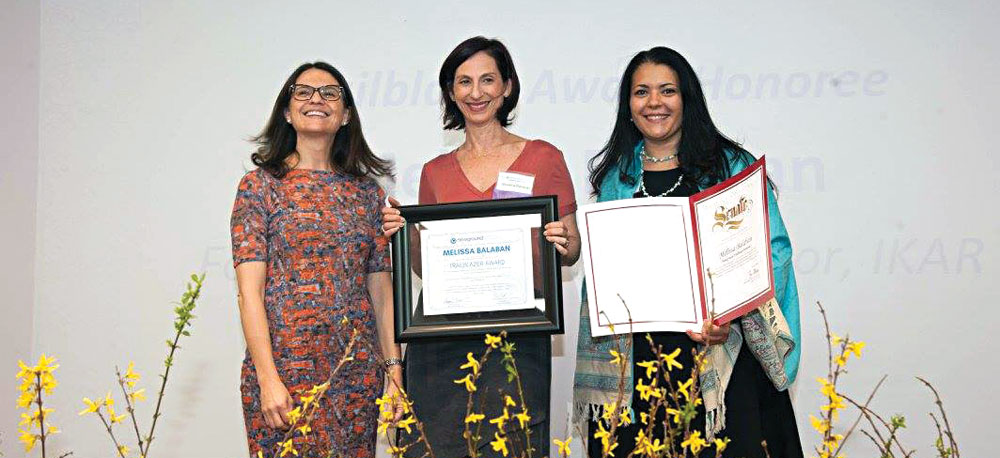
From left: IKAR Rabbi Sharon Brous; Melissa Balaban, founding president and executive director of IKAR; and NewGround Executive Director Aziza Hasan attend the Suzy and Wally Marks Jr. Trailblazer Award luncheon, where Balaban was honored. NewGround: A Muslim Jewish Partnership for Change organized the event. Photo by Shams Soomar

More than 300 guests attended the March 26 luncheon for the Suzy & Wally Marks Jr. Trailblazer Award at the IMAN Cultural Center in West Los Angeles. The event — organized by NewGround: A Muslim-Jewish Partnership for Change — exhibited the viability of interfaith work.

“This work between Muslims and Jews is more important than ever,” IKAR Rabbi Sharon Brous said as she addressed the audience. “We do this work because it’s right. Now, after a decade of working together to build these relationships in the city, we do it not only out of sense of obligation but also out of sense of love.”

During the ceremony, several guests received awards from NewGround, which marked its 10th anniversary earlier this year. The recipients of the Suzy & Wally Marks Jr. Trailblazer Award were IKAR’s founding president and executive director, Melissa Balaban, and the Aga Khan Council for the Western U.S. The Day School Exchange, a project of New Horizon School Pasadena and Sinai Akiba Academy in Los Angeles, was given the inaugural NewGround Change-Maker Award.

The event had more than 30 sponsors, including Suzy Marks; David Weiner, CEO at Social Studies School Service; the Islamic Center of Southern California; and Temple Emanuel of Beverly Hills. The Ismaili Choir of Los Angeles performed, singing a song in Hebrew, Arabic and English as the guests were served kosher and halal food.

Other guests at the event included Rabbi Sarah Bassin, of Temple Emanuel of Beverly Hills and former executive director at NewGround, and Andrea Hodos, program director at NewGround and creator of Moving Torah Workshops.

Daniel Tamm, Los Angeles Mayor Eric Garcetti’s interfaith liaison and Westside representative, said he is a big fan of NewGround.

“It’s one of my most favorite organizations in Los Angeles,” Tamm said. “I love it because it builds bridges instead of creating boundaries.”

The event raised $85,000 for NewGround, which promotes discussions and partnerships between Jewish and Muslim communities.

Olga Grigoryants, Contributing Writer


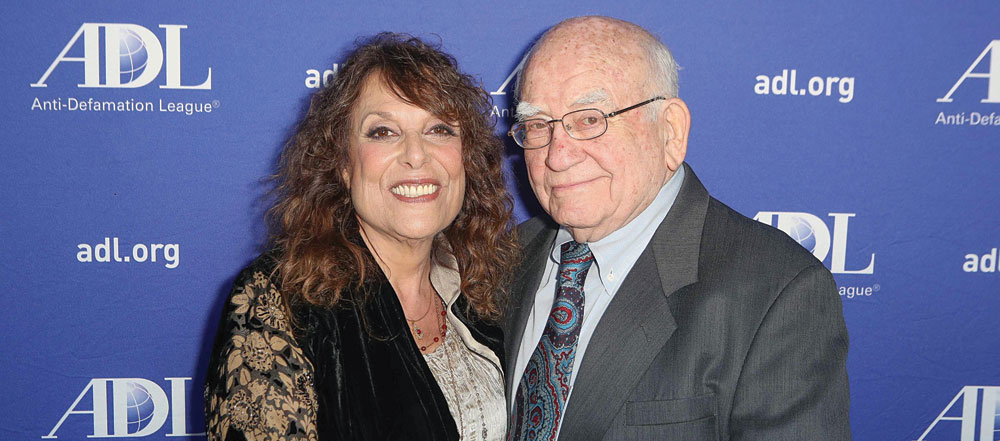
Zane Buzby, comedy producer and Survivor Mitzvah Project founder, and actor Ed Asner come together at the Anti-Defamation League annual Deborah Awards. Photo courtesy of the Anti-Defamation League

The Anti-Defamation League (ADL) held its annual Deborah Awards dinner March 30 at the SLS Hotel Beverly Hills, honoring women who exemplify professional leadership and civic contribution.

This year, the ADL honored comedy producer and Survivor Mitzvah Project founder Zane Buzby, sports and entertainment executive Francesca Leiweke-Bodie of Oak View Group, and AEG Executive Vice President Martha Saucedo, who leads the entertainment firm’s external affairs, including its charitable involvement.

“The ADL is honoring Zane Buzby,” actor Ed Asner joked in Buzby’s introduction. “What is that? Is that a condition?”

Oak View Group CEO Tim Leiweke presented the award to Leiweke-Bodie, his daughter, and Los Angeles City Councilman Gil Cedillo introduced Saucedo.

The black-tie event, with about 300 attendees, raised more than $300,000 for the ADL.

Among the celebrity guests were actors Topher Grace, Allen Leech, Frances Fisher and Emmanuelle Chriqui.

Cal State Northridge Police Chief Anne Glavin delivered an address thanking the ADL for its work training law enforcement officers, saying a recent four-hour training session had helped her staff differentiate between hate speech and hate crimes.

Telemundo executive Mónica Gil and longtime ADL supporter and donor Suzanne Prince acted as the event’s co-chairs. Actress and musician Janina Gavankar was the emcee.

Eitan Arom, Staff Writer


Julie Munjack
Julie Munjack

Julie Munjack, director of American Israel Public Affairs Committee (AIPAC) Los Angeles, was among 30 Jewish professionals and volunteer leaders from around the world selected by the Charles and Lynn Schusterman Family Foundation for the third cohort of the Schusterman Fellowship.

The foundation describes the fellowship as an “executive leadership program that features individualized professional development experiences.”

Fellows will gain leadership skills, develop strategic networks, and maximize their potential to affect “Jewish organizational and societal change,” the foundation said in a press release.

Munjack, who oversees a staff of eight and leads operations and development efforts for AIPAC’s second-largest market, is the only person from Los Angeles named to the latest cohort of fellows. She was selected through a competitive application process. Her goal, according to the Schusterman website, is to “grow the pro-Israel movement in Los Angeles and train our local leaders.”


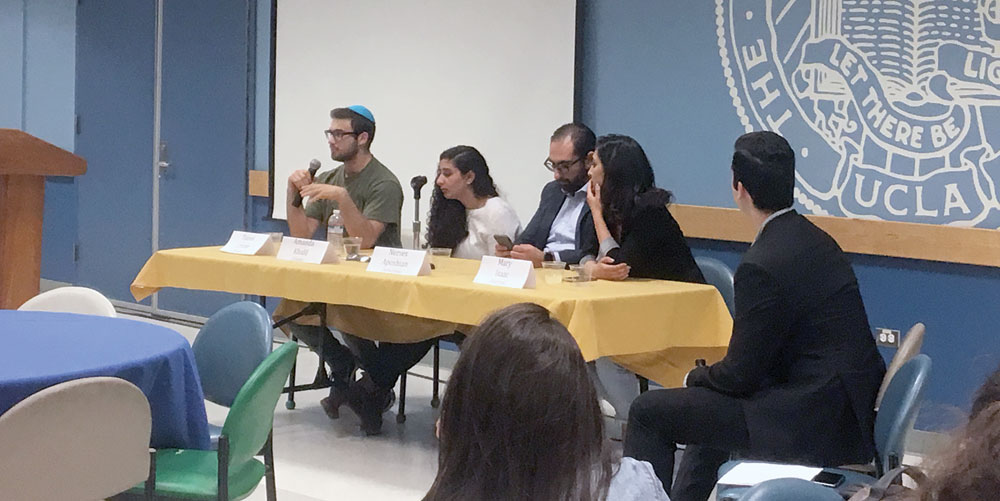
From left: Daniel Levine, Amanda Khalil, Nerses Aposhian, Mary Isaac and Darion Ouliguian participated in a panel titled “Indigenous People Unite.” Photo by Mati Geula Cohen

Students Supporting Israel at UCLA on March 9 held an event called “Indigenous People Unite,” which brought together representatives of the Armenian, Jewish, Assyrian and Coptic indigenous communities to speak about their identities, struggles and futures in the United States and in their homelands.

Speakers included UCLA graduate student Daniel Levine, speaking for the Jewish community; Loyola Marymount law student Nerses Aposhian, president of the Armenian Law Students’ Association; UCLA alumnus Mary Isaac, for the Assyrian community; and UCLA undergraduate student Amanda Khalil for the Coptic community.

The goal of the event was to recognize and bring attention to indigenous people and their stories, to create a dialogue between the communities and show the similarities between each other’s narratives.

Some of the topics focused on biblical Jewish history and modern Zionism, the current conditions of the Coptic Christian community in Egypt, the Armenian genocide and communities in the Diaspora, as well as the Assyrian people’s desire to return to their homeland and how their community maintains its identity.

At one point, in response to a question by a member of Students for Justice in Palestine about “the treatment of Palestinians by the Israeli government,” Liat Menna, president of Students Supporting Israel at UCLA, responded, “The reason why we are doing this event is so that conversations get started.”

The audience included UCLA students from various backgrounds, as well as UCLA professor emeritus and Daniel Pearl Foundation President Judea Pearl, and Zionist Organization of America’s West Coast Campus Coordinator Leore Ben-David.

Mati Geula Cohen, Contributing Writer

Moving & Shaking highlights events, honors and simchas. Got a tip? Email ryant@jewishjournal.com.

Moving & Shaking: “Evening of Inspiration,” Suzy & Wally Marks Jr. Trailblazer Award and more Read More »

Spicer, Hitler and the Soup Nazi: Why can’t this White House get the Holocaust right?

We interrupt this Passover to bring you two news bulletins:

Bashar Assad is worse than Hitler.

The Soup Nazi was almost a real Nazi.

Let’s start with the second revelation, since Sean Spicer’s Hitler gaffe is probably better known. Entertainment Weekly reported that, according to a former writer-producer for the sitcom “Seinfeld,” the dictatorial chef known as the Soup Nazi in a 1995 episode was almost given a much darker backstory.

“We joked a whole bunch about an end scene that would take place in the jungles of Brazil, a la ‘The Boys From Brazil,’ where the Soup Nazi would return to the other Nazis — the actual former Nazi war criminals — with his soup recipes,” David Mandel explained. “It was sort of half-serious, half ‘Should we do this?,’ half ‘We’re never going to do it.’ But it was much discussed. Going down a river and seeing lots of young boys with blue eyes from experimentation with the soups — it was a full coming-together of soup and Nazi. Probably just as well that we didn’t do that one.”

“Probably just as well that we didn’t do that one” is probably a phrase the White House press secretary would love to be saying about now after three days of apologizing for having claimed that Adolf Hitler never used chemical weapons. Discussing the Syrian dictator Assad’s sarin gas attack on the Syrian town of Khan Sheikhoun, Spicer asserted, “We had someone as despicable as Hitler who didn’t even sink to using chemical weapons.”

The reaction, starting with gasps from the assembled press corps, was swift and withering. Yad Vashem said Wednesday that Spicer’s “inaccurate and insensitive” comments “strengthen the hands of those whose goal is to distort history.” The American Jewish Committee’s CEO David Harris offered, “What did the Nazis use to exterminate millions of Jews if not chemicals in their death camps?”

Spicer responded with a few stabs at clarification that can only be described with the Yiddishism “funfering.”

“He was not using the gas on his own people, the same way that Assad was doing,” the press secretary said. “There was not — he brought them into the Holocaust centers, I understand that. But I’m saying, in the way that Assad used them, where he went into towns, dropped them down, to innocents — in the middle of town.”

Eventually, Spicer told CNN’s Wolf Blitzer, the son of Holocaust survivor parents, that he was sorry for his “inappropriate and insensitive reference to the Holocaust, for which frankly there is no comparison. And for that I apologize. It was a mistake to do that.” The next day Spicer said that he “let the president down.”

Any phrase that includes some version of “even Hitler” is not going to end well. Either you will wind up diminishing the horrific acts carried out by the Nazis or will exaggerate the sins of your intended target. Spicer ended up doing both.

If his point was that “even Hitler” didn’t use gas in the battlefield, his elision of what went on in the “Holocaust centers” — better known as the death camps — would seem to raise Hitler a notch on the morality scale. Maybe worse was his comment that Hitler “was not using the gas on his own people.” That is not only false but insidious — as if the 160,000 or more German Jews killed in the Holocaust were the alien “state subjects” that the Nuremberg laws said they were.

Spicer’s comments also seem of a piece with the White House’s inexplicable omission of the word “Jews” from its statement on International Holocaust Remembrance Day. What the two missteps share is the effect of “normalizing” Hitler and the Holocaust. Intentionally or not, this is the message of both statements: “Yes, it is a horrible thing that people died at the hands of the Nazi regime, and in such numbers. But it wasn’t just Jews who were targeted and lost, and even Hitler had limits on the tactics he would use to vanquish his enemies.” In essence, Hitler was bad, but he was no Hitler.

Someone at the White House either doesn’t understand the unique aspects of Hitler’s genocidal “Final Solution,” or finds it ideologically or politically convenient to ignore them.

As for inflating Assad’s crimes, arguing that the Syrian’s use of sarin in the battlefield makes him worse than Hitler is not just a debating point for scholars and historians. Such a stark comparison demands an equally stark reaction. If the administration now regards Assad as worse than Hitler, is it prepared to carry out the kind of all-out war that defeated the Nazis? And if not, does that mean the United States is indifferent in the face of Nazi-like atrocity?

Of course, Assad has carried out atrocity after atrocity, killing hundreds of thousands of men, women and “beautiful babies” with barrel bombs, cluster munitions and incendiary weapons. The West may yet be judged by its failure to intervene and put a stop to the slaughter, but the United States and its allies have neither the stomach nor popular support for the massive intervention that would entail. In this case, as in so many others, Nazi comparisons raise the stakes without clarifying a thing. Or as German Chancellor Angela Merkel’s spokesman put it, comparing Nazi crimes to current situations “leads to nothing good.”

The Soup Nazi episode of “Seinfeld” was criticized at the time for trivializing the Holocaust. If a chef could be labeled a Nazi for demanding discipline from his would-be customers, the critics argued, then the word “Nazi” has been drained of all meaning.

But “Seinfeld” was a satire, and the joke was on the shallow cast of characters who would blithely use the term “Nazi” to describe someone they found disagreeable. The show’s writers understood that it was a ridiculous conceit (and realized, too, we’re now told, that there were limits to how far they could push the joke). And in understanding the weight of the term, they reinforced the idea that “Nazi” describes the apotheosis of evil, not just another form of it.

It’s a lesson Spicer might want to take back to his colleagues on Pennsylvania Avenue.

Spicer, Hitler and the Soup Nazi: Why can’t this White House get the Holocaust right? Read More »