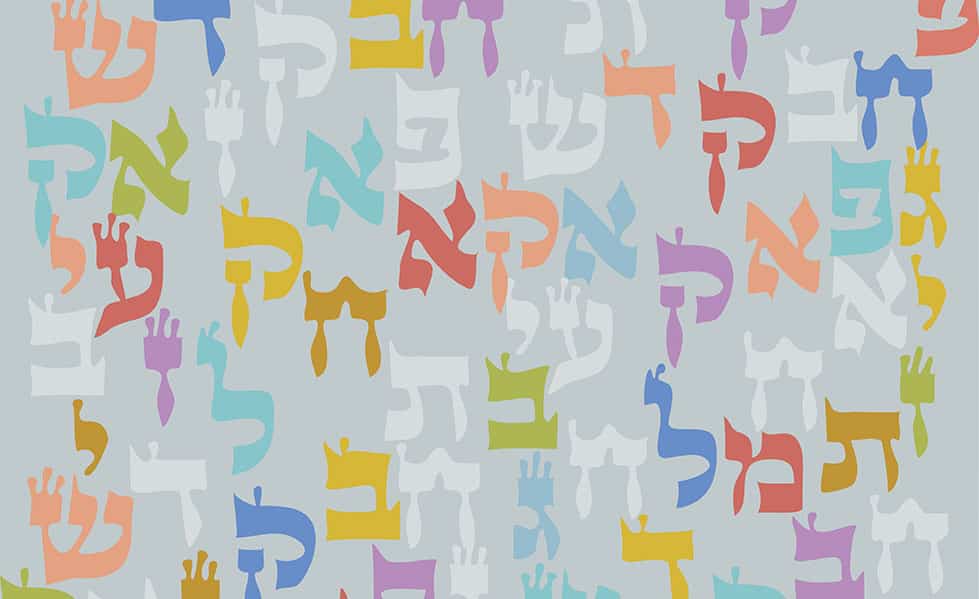
Recently, my six-year-old son asked me to sing the “Aleph Bet” song, which lists the Hebrew alphabet, with him. I reluctantly obliged and began to sing, “Aleph, Bet, Vet, Gimmel, Dalet, Hey, Vav—,” I paused insecurely, then added, “Nun, Kaf, Kooft—”
“Kooft?” he asked.
WIth a deadpan look, my husband, who was seated nearby and peeling a mango, said, “There’s no ‘kooft.’”
At that moment, I was grateful that, unlike my husband, my son doesn’t speak enough Persian to know that “kooft” roughly translates to “crap” in Persian. I say “roughly” because nothing can quite capture the gloriously complex meaning of “kooft” once it’s translated to English (or any other language). In fact, it’s post crap. There’s simply no equivalent for it.
“I didn’t mean ‘kooft,’” I responded, trying to save face. I then turned to my son and said, “You should learn Ivrit (Hebrew) with your dad and I’ll help you with English homework!”
I’m a modern Orthodox Jew, but I don’t speak or read Hebrew fluently. I often need nikkudot, those little diacritical signs above, beneath or inside Hebrew letters, to know what I’m reading. My lingual system for navigating life can be boiled down to this: I recite Jewish prayers in English and curse reckless drivers in Persian. If you ask me to recite a single chapter of Tehillim in Hebrew, it’ll take half an hour.
My lingual system for navigating life can be boiled down to this: I recite Jewish prayers in English and curse reckless drivers in Persian.
In my defense, my Hebrew-language illiteracy isn’t entirely my fault; I didn’t exactly learn the “Aleph Bet” when I began school in post-revolutionary Iran in the late 1980s because first, I had to learn my death chants. You know, “Death to Israel” and “Death to America”? I’m sure modern Hebrew would have been incorporated into the curriculum later that year, given Iran’s well-known fondness for Israel.
And once we arrived in America, my parents would have been inconvenienced if I had learned Hebrew before, or even concurrently, with English. I needed to learn English immediately, not only to survive (in my view and theirs), but also to help our family. My mother counted on me and my sister for everything related to English, from assuring her that hush puppies weren’t made from dog meat (she’s still a skeptic) to asking the fine bus drivers of the Los Angeles Metro system where to stop if we wanted to visit “that fabric store in downtown LA” that sold “the good cotton, not the cheap cotton.”
Back in post-revolutionary Iran, some Jewish kids learned Hebrew by attending weekly courses at small Jewish schools that taught Judaic studies (but weren’t full-time Jewish schools). I wasn’t one of those kids. Once in America, did many Iranian Jewish families enable their kids to learn both English and Hebrew? Of course. But it also helped that most of those kids attended private Jewish schools.
I attended public school for years and finally, when I was a 22-year-old senior at UC San Diego, began learning Hebrew under the guidance of the then-UCSD Hillel Executive Director, the wonderful Rabbi Lisa Goldstein. But somewhere between college (and college parties) and really growing up and having my own children, I stopped reading Hebrew until I managed to confuse “Kuf” with “kooft.”
I know how to read nearly each letter of the “Aleph Bet”; I can sound out most words (those nikkudot really help), but I don’t know the meaning of many Hebrew words. Last fall, when my son first began learning Hebrew in school, it was manageable: I could read and knew the meanings of words such as “abba” (“father”) and “dag” (“fish”). But after a year, the words have grown more sophisticated, such as “avate-ach” (“watermelon”) and “mafte-ach” (“key”). Mark my words: These “ach” words will be the end of me.
Why is it so important that my children learn Hebrew if I myself possess the Hebrew language skills of a five-year-old? It’s simple: I want to give them what I never had. There’s also the matter of Hebrew and Judaic Studies being part of their school-wide curriculum from early childhood to high school.
Why is it so important that my children learn Hebrew if I myself possess the Hebrew language skills of a five-year-old? It’s simple: I want to give them what I never had.
And then, there’s the matter of pride: When I help my first-grader with his English homework, I can sense my son’s pride in me; he feels secure because he knows his mother is a writer (he also knows how hard I worked as a little girl to learn English). Yes, when I help my son read and write in English, I feel like Jane Austen; when I help him read and write in Hebrew, I feel like a nursery student in a kibbutz classroom in Israel. And I worry I’ll fall right off of my pedestal (if I ever earned a place on top at all).
Surely, I can’t be the only one — the only Jewish parent whose children are receiving more of a Jewish education than she did, and whose children will easily out-read her in a year or so? There must be hundreds, perhaps even thousands of other parents like me, whether they were raised secular (or even traditional, in my case); whether they’re American or Argentinian Jews; whether they’re converts or plain, old Persian refugees who went to public school for many years. “It’s okay,” another Persian friend confided in me last month. “I once said ‘kooft’ too. It’s not our fault.”
Still, I refuse to read and speak Hebrew like a small child. There was only one thing to do: I ordered an “Aleph Bet” chart for both my son and myself on Amazon that’s been remarkably helpful; I might use a language app on my phone; at the very least, I can make more Israeli friends and then proceed to fight with them in Hebrew (I love their passion).
And I’ve been unabashedly honest with my son: “I was never taught Hebrew as a child, but I’m looking forward to working with you so we can learn it together,” I told him. Also, please pass the avate-ach.
I believe every Jew should have access to learning Hebrew. Ego concerns aside, it’s important for me to learn Hebrew, because Hebrew is the language of my soul.
Am I worried about falling off of my pedestal? Yes. But I believe children benefit when their parents are honest about their own imperfections while also showing a commitment to growth and learning.
In the end, I’ve comforted myself with fact-based reality: Language is a complicated matter when you’re a refugee or an immigrant. My mother speaks far more Persian than me; my children will speak far more Hebrew than me. But I can relax knowing that I speak English more good than all of them.
Tabby Refael is an award-winning weekly columnist and an LA-based writer, speaker and civic action activist. Follow her on Twitter @TabbyRefael