Surprisingly – or maybe not – many of our current debates were foreshadowed by ancient rabbinical disputes.
One such foreshadowed debate was our national conundrum about immigration, legal and otherwise.
In his book Judaism’s Ten Best Ideas, our Hebrew College professor Art Green recounts an argument between Rabbi Akiva and Simeon ben Azzai:
“What is Judaism’s most important teaching? Rabbi Akiva had a ready answer: ‘Love your neighbor as yourself’ (Lev. 19: 18) is the basic rule of Torah.’ His friend Simeon ben Azzai disagreed. ‘I know a more basic rule than that,’ he said. And he quoted: ‘This is the book of human generations: On the day God created humans, He created them in the image of God (tzelem elohim); male and female He created them, blessing them and calling them humans on the day they were created’ (Gen. 5: 1– 2).”
Ben Azzai found Akiva’s answer about loving our neighbor unconvincing for two reasons.
First, he didn’t see how we could be commanded to love others. He thought of love as a feeling: we either have it or we don’t. Moreover, some people are unlovable, either because they are obnoxious or evil. To solve that problem, he argued that what’s required is not a feeling, but a recognition that all people are made in the image of God. That basic level of respect is what we owe to everyone.
His second reason followed from the first. If all people are created in the image of God, then it applies whether or not they are our neighbors. We owe all people at least that same basic level of respect. We should not treat people as less than they are merely because they’re unfamiliar to us.
Ben Azzai had the better argument because he based it not on involuntary feelings, but on things we could control. We can recognize the truth that every person is sacred, and we can act consistently with that truth.
However, Akiva also raised an important question: Do we have the same obligations to everyone, or do we have greater obligations to our “neighbor” than to total strangers?
Ben Azzai’s argument does not answer Akiva’s question. He’s right that we should respect all people as embodying the image of God. He’s right that we should consider their welfare important. He’s right that other things being equal, we should avoid harming them and sometimes try to help them.
What about when other things are not equal? Do our “neighbors” have a greater claim on us than other people?
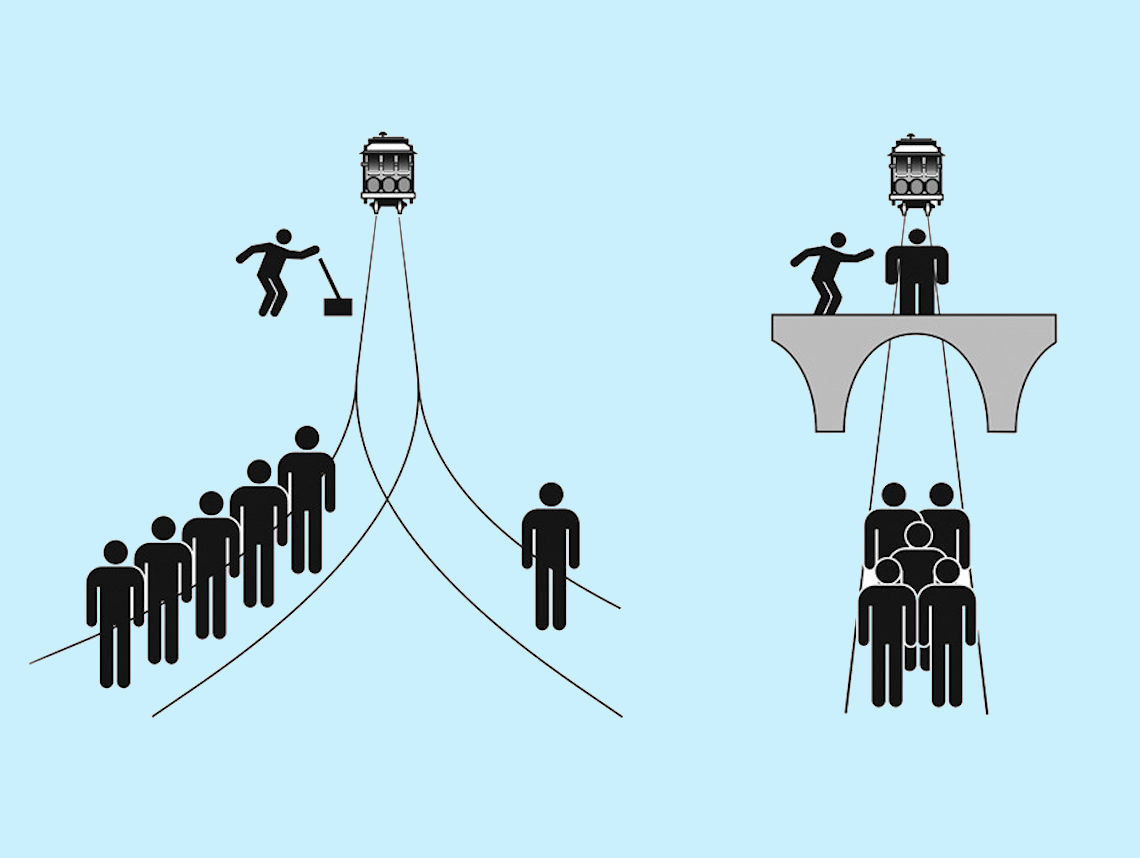
Moral psychologists have a story called “the trolley dilemma.” A runaway trolley car is about to hit five people, but you can save their lives by pushing one person off a bridge onto the tracks. What should you do?
Most of us recoil in horror at the thought of pushing a person off the bridge, even if it would result in a net saving of four lives. Such cold-blooded utilitarian calculation seems repulsive.
But what if the person on the bridge was a stranger, and the five people on the tracks were your family? Then the decision becomes much tougher – agonizing so.
In the abstract, the two cases are the same: kill one person to save five people. But in the two cases, the people involved are not the same, and that makes a lot of difference.
The trolley dilemma presents a situation where the costs and benefits are known with certainty. In real life, we rarely have that much certainty. And it balances the welfare of a complete stranger, for whom we have no personal feelings, against the welfare of people we love.
Maybe some of us would kill the stranger in both cases. But for those of us who wouldn’t, it’s a much tougher decision when it could save our family. The point is that even if all people deserve a basic level of respect, our moral intuitions say that some people deserve more.
After that point, our moral intuitions are less helpful. Which people? Why? How much more respect? And what about cases where costs and benefits are uncertain? In most real-life situations, we deal with probabilities, not certainties. We rely on subjective judgments, not only about risks but about values.
Consider the immigration debate. Both sides can probably agree on these facts:
– Most immigrants pose no physical threat to Americans.
– Most immigrants are not refugees, but are economic migrants.
– A tiny minority of immigrants pose a physical threat to Americans.
Beyond that, the debate is no longer about facts. It’s about our moral duty to prospective immigrants, our moral duty to our fellow Americans, and our subjective assessment of the costs, benefits, and risks involved. The last factor is less important than we think, because our assessment of the costs, benefits, and risks is heavily biased by our pre-existing moral feelings.
I don’t have a provable answer, because there isn’t one. People who are equally intelligent, educated, and morally conscientious are on every side of that particular debate.
It’s not quite like the old joke about asking two Jews and getting three answers. In this case, we get a thousand answers, and we find people at each other’s throats about which of the thousand answers is absolutely and totally right. Such disputes are best resolved through the democratic process and, where applicable, through the decentralized decision-making that was a vital feature of the U.S. Constitution.