fbpx

Art

Borrowed Spotlight Art Exhibit Pairs Holocaust Survivors with Celebrities

It has been 81 years since the last of the Nazi concentration camps were liberated. Today, there are an estimated 200,000 Holocaust survivors left in the world. It’s a novel sight in 2026 to see Holocaust survivors gathering in a loud, packed art gallery opening featuring a DJ, actors, models, influencers, agents and music producers.

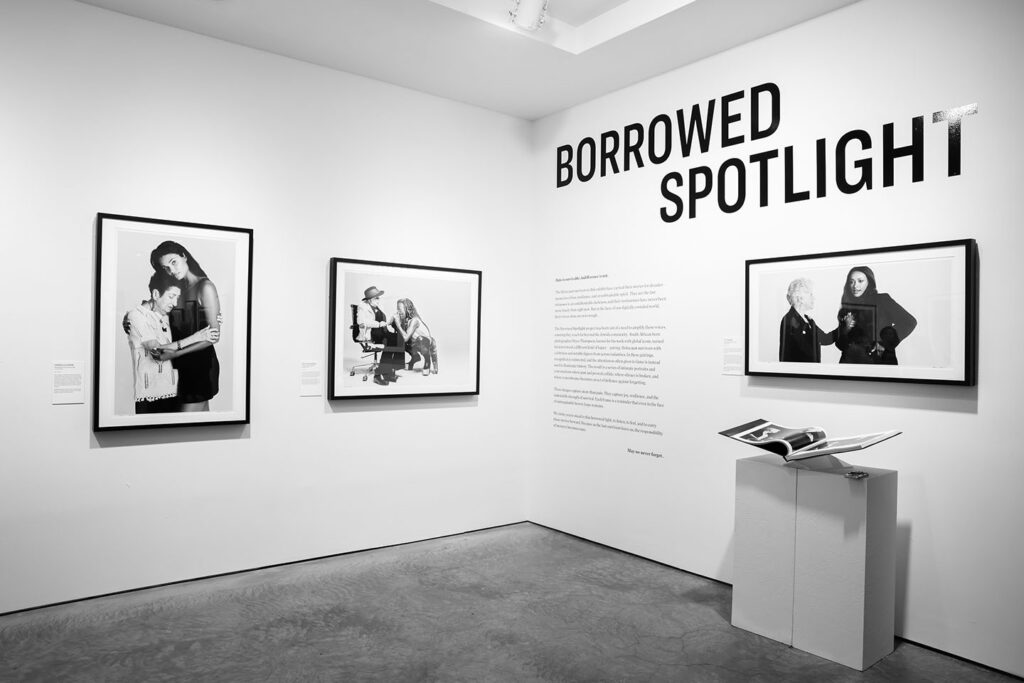
But on the walls were photos of those Holocaust survivors, each paired with one of the several of the most notable celebrities in the building. On Feb. 3, an estimated 250 to 300 people filled a gallery on La Brea Avenue in Hancock Park for the opening night of the “Borrowed Spotlight” exhibit.

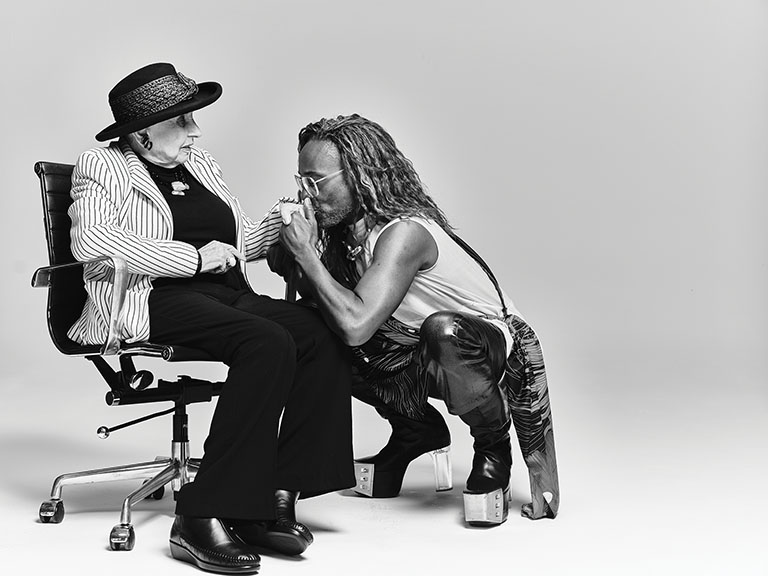
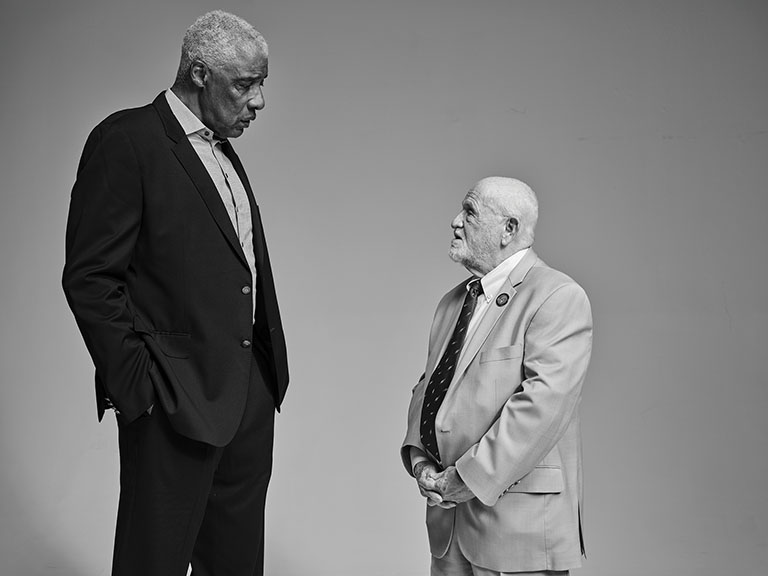
The show includes photos of 18 Holocaust survivors, ranging in age from 81 to well over 100 years old, posed with celebrities such as Cindy Crawford, Wolf Blitzer, Josh Peck, Julius “Dr. J” Erving, Kat Graham, Billy Porter, Chelsea Handler, George Stephanopoulos, Sheryl Sandberg, and Barbara Corcoran.

Television producer Daniella Greenbaum’s opening remarks were nearly drowned out by the noise of the crowd, but they went silent when Greenbaum revealed that 108-year-old Holocaust survivor Risa Igelfeld was in the gallery.
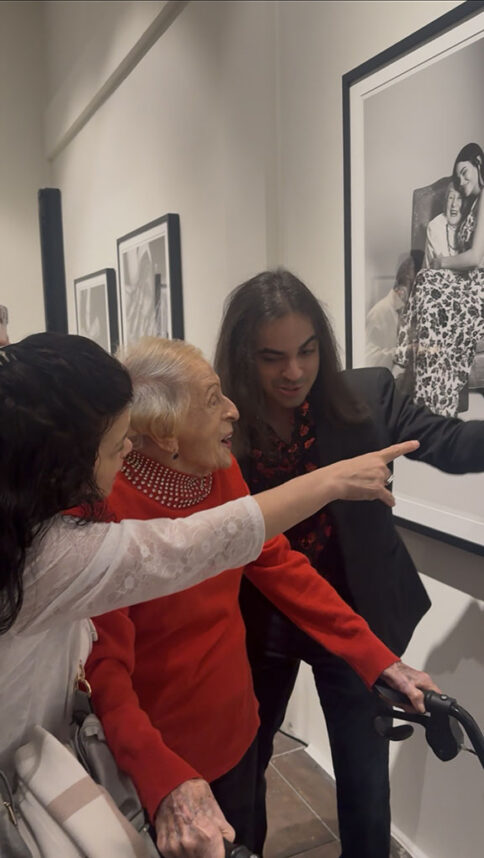
108 year old Holocaust survivor Risa Igelfeld (photo by Brian Fishbach)

An hour earlier, Igelfeld arrived at the exhibit with her daughter and grandson. She was wearing a bright red sweater that stood out against the gallery’s white walls. With her family members, she steadily moved towards the large black-and-white photo of her with actress Jenna Dewan on the wall. She’s seated on a plush chair with Dewan, in a flower print dress, on her lap. When Igelfeld saw her portrait for the first time, she broke into a wide smile, looked at her daughter and grandson then back to the photograph yet again.

Following the introductory remarks and a brief auction, guests approached Igelfeld one-by-one. Igelfeld gave a firm squeeze of every handshake offered to her. She didn’t say much besides “thank you” but she posed for at least two-dozen photographs. Several remarked that Igelfeld was the oldest person they ever met.

Dewan (Bailey Nune ABC’s “The Rookie” ), the celebrity whose spotlight was “borrowed” to bring awareness to Igelfeld’s story, teared up as she spoke directly to Igelfeld.

“When I met you, Risa, my soul recognized you and we danced,” Dewan said. “I was at Risa’s [108th] birthday party and we danced for the first five minutes. I was blown away. In my heart of hearts, I know what unimaginable darkness you have been through and that you have survived … And yet you offer light to the world. It’s real light, it’s earned light and it’s beautiful light. It changed me. I’m a changed person after this.”

In my heart of hearts, I know what unimaginable darkness you have been through and that you have survived … And yet you offer light to the world. It’s real light, it’s earned light and it’s beautiful light. It changed me. I’m a changed person after this.” – Jenna Dewan

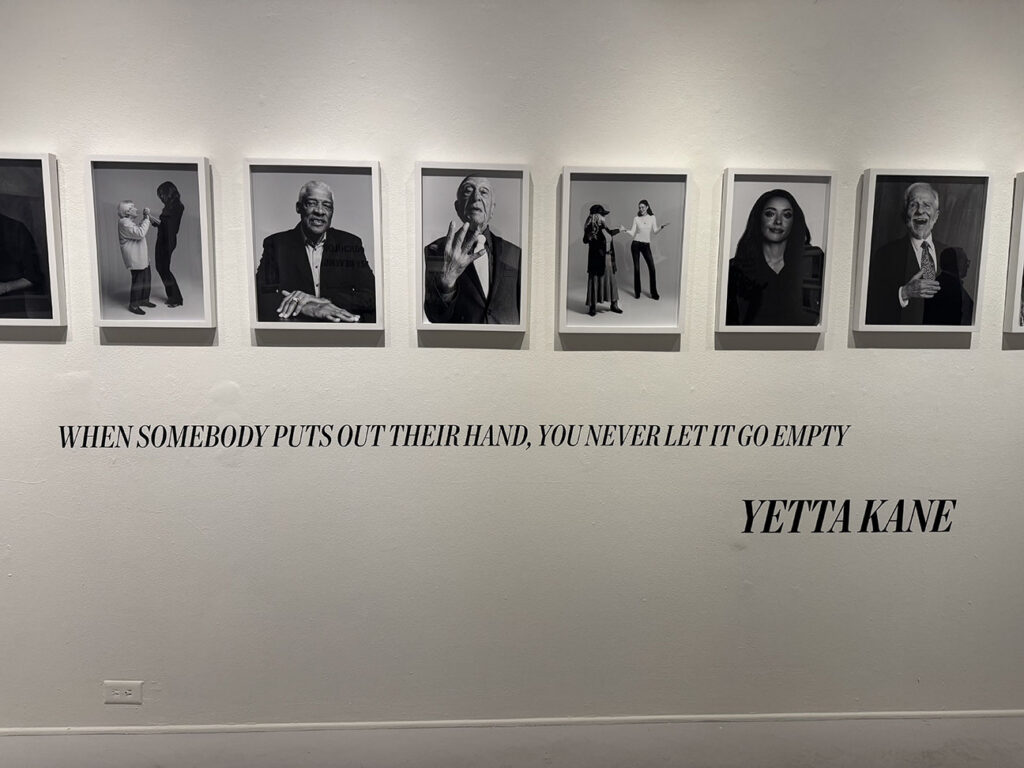
Yetta Kane, 93, who was photographed with actress and singer Kat Graham holding her hand, received one of the most rousing responses of the night.

“Each and every one of us is God’s soldiers,” Kane said. “We promote love, compassion, unity and people all over the world, especially today.” Wearing a blue sweater that matched the blue of the Israeli flag, she concluded her remarks by shouting, “Am Yisrael Chai.” Kane was only eight years old when the Nazis reached her hometown in what is now Belarus. After her father refused to attend a Nazi-ordered “meeting,” he hid his family and dozens of others in nearby forests. They joined the partisan resistance, moving constantly with little food or shelter. Because of her blond hair and blue eyes, Kane was sent between groups as a courier while German patrols searched the area.
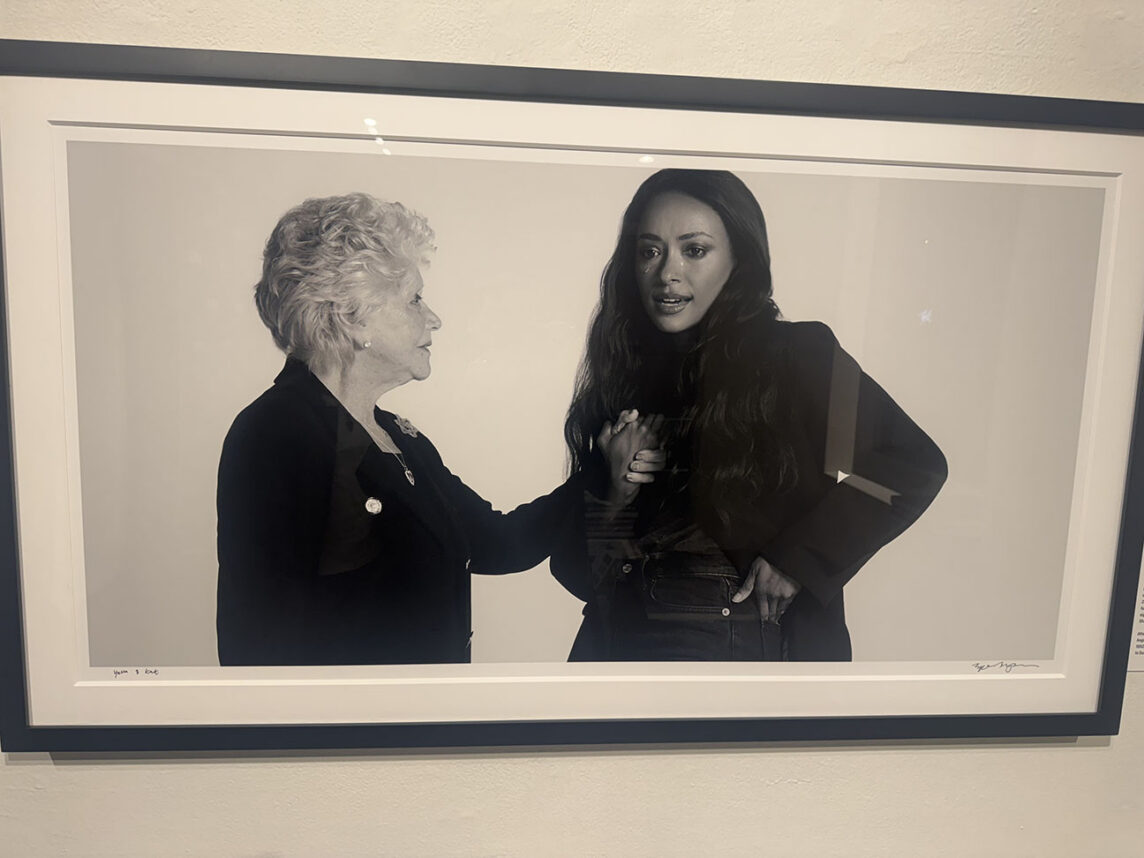
Holocaust survior Yetta Kane with actress and singer Kat Graham at the “Borrowed Spotlight” photography exhibit

“Borrowed Spotlight” is a project by photographer Bryce Thompson. He is quick to point out that he is not Jewish (his brother and sister are Jewish, after their mother converted in her second marriage). Thompson said he was living at home with his family in Connecticut when the idea for the project began in 2022.

“When there was a rise in antisemitism, I really felt like it was weird for me to consider that someone like my sister could be walking home from work and be attacked just because of her religion,” Thompson told The Journal. He began reaching out to Jewish friends who were vocal on social media to ask what he could do. Survivors were later brought into the project and sourced by the New York team. Early on, Thompson said the concept involved pairing two people together for a few photographs. Still, he said “it felt unnatural” until they had the survivors just tell their story.

The most important thing, he said, was “to capture was firsthand accounts of these stories — a photograph wouldn’t be enough without the voice.”.

He recorded audio and video with every photo shoot. A film is in the works, and a three-minute video plays in a small side room at the gallery, depicting moments between survivors and the celebrities who sat with them, listening to their stories.

During the four years he has been creating “Borrowed Spotlight,” Thompson said there were “countless” unplanned moments that stand out. One he shared with The Journal involved music executive Scooter Braun with (now 103 year-old) survivor Joseph Alexander of Los Angeles.

“While listening to Joe, Scooter sat down on the floor and explained, ‘I’m sorry, that’s how I sit with my grandfather when he speaks.’ So Scooter lowered himself below Joe to show respect, and sat down on the floor. Braun later encouraged Thompson to make a coffee table book component to “Borrowed Spotlight.”

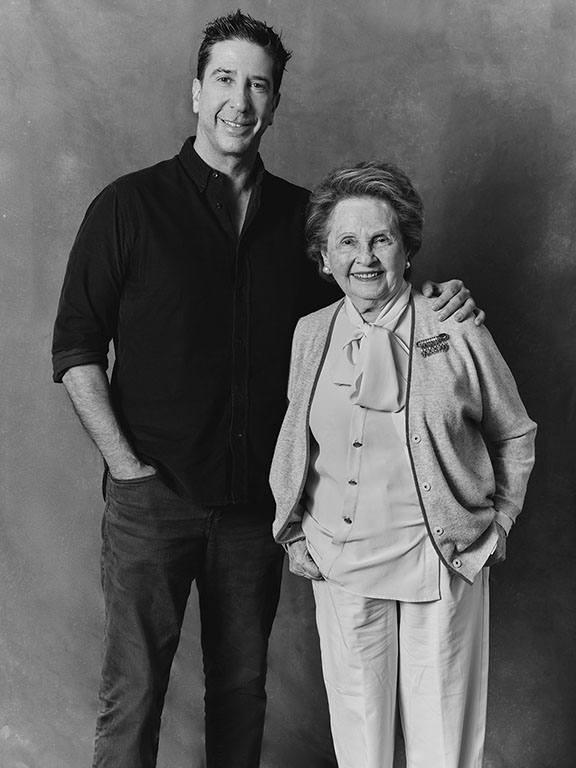
One of the survivor stories that jarred Thompson most was one told by Elizabeth Wilf, 92, to actor David Schwimmer at their shoot in Brooklyn.
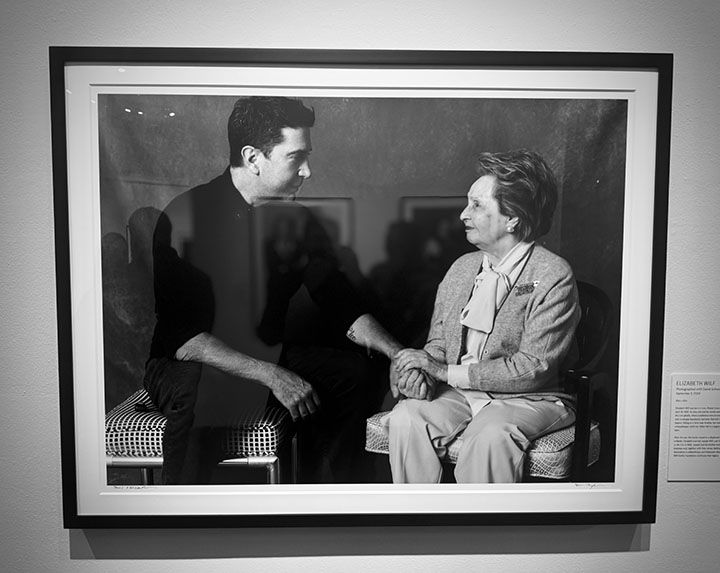
Actor David Schwimmer with Holocaust survivor Elizabeth Wilf in “Borrowed Spotlight” photography exhibit

Wilf described a family hiding in an attic with a crying baby that they could not quiet. Thompson said the mother left the child behind to save the others.

“That story really shook me, especially as a new parent,” Thompson said.

The last pair to be photographed were actress Selma Blair and Auschwitz survivor Michael Bornstein. Bornstein was only four when he was deported from Poland. In their July 2025 meeting, Bornstein told Blair how his mother “nearly took her own life by touching the electrical fence at Auschwitz, but her fierce determination to survive for her remaining children ultimately overpowered her grief.”

Although there was a photograph of Bornstein arm-in-arm with Blair at the gallery, they do not appear in Thompson’s book of photographs and stories. Blair and Bornstein will be featured in a second planned book. Thompson said sales of the $360 book go to funding future shoots and Holocaust education.

“We have survivors, we have stories to tell, we have lives to put on paper,” Thompson said.

In the exhibit, quotes from survivors are printed between the photos. One, attributed to Kane, reads: “When somebody puts out their hand, you never let it go empty.” But the quote that attracted the most attention was from Wilf, emblazoned in the back corner of the gallery: “My grandchildren are my revenge.”

But the quote that best reflected “Borrowed Spotlight’s” aim was from the

Los Angeles-based 95-year-old sculptor Gabriella Karin: “If you don’t tell your story, people won’t know.”

The “Borrowed Spotlight” exhibition is open Wednesdays through Sundays at 170 S. La Brea Avenue  from 11:00 am – 6:00 pm through March 1. For more information, visit https://www.borrowed-spotlight.com/home.  

Borrowed Spotlight Art Exhibit Pairs Holocaust Survivors with Celebrities Read More »

Unspoken Stories: Orthodox Cartoonist Chari Pere Transforms Trauma Into Healing Art

Chari Pere is an award-winning Orthodox Jewish cartoonist, writer, and filmmaker whose work delves into deeply personal and often taboo experiences. Through her “Unspoken” Cartoonmentary series, she explores miscarriage, pregnancy loss, reproductive grief, and the complexities of medical decision-making—always through a human and Jewish lens. Turning her own trauma, including a painful miscarriage, into purpose, Pere uses humor and animation to give voice to life’s most difficult moments.

Her short film, ‘Determination’ will debut on October 16 with a special screening at the SOHO Film Festival. The short is based on the true story of Abbie Sophia, a photographer who dreamed of having twin girls but faced devastating complications in her pregnancy.

The idea to create cartoons on difficult matters that aren’t much talked about, came to her after she suffered a miscarriage in 2014.

 “I couldn’t find any resource that would help me feel like I was less alone,” she said. “There were a few articles about people’s experiences, but I just wanted to know what to expect. Can I get pregnant right away, for example? I needed to hear from other people’s experiences,” she said.

A few years earlier, she created a three-page social action comic about an Aguna—a woman who managed to escape an abusive marriage after ten years of struggle. The project revealed to her the power of cartoons as a tool for education and emotional support.

 “I released the comic in 2017 and it went viral. Every year after that, I’ve released a new topic. I remember telling my husband, men don’t speak at all about miscarriages. An hour later, I received an email from someone who said, you should do a comic about a miscarriage from my husband’s perspective, because my husband had no outlet for his pain.”

That email led to her second story in the series, Michael’s Miscarriage. Later came a story about IVF abortion, determination and “The Diagnosis.”

The latest short is based on the true story of Dani Weiss Bronstein.

“I was pregnant with my rainbow baby, after my miscarriage and my friend was sharing her story online. It was a little cryptic about something going on with her baby, and it turned out eventually that her baby had Down syndrome. She was very open about it, and I was in awe of how strong she was.”

Pere asked Bronstein if she would like to collaborate and share her experience, and her friend readily agreed. “The Diagnosis” was originally slated for release in October, to coincide with Down Syndrome Awareness Month, but was later postponed to March. Within Orthodox communities, many families raise children with Down syndrome, as abortion is not an option they consider—making it a delicate and rarely discussed subject. Early support for the project has already come from actress and advocate Mayim Bialik, who will voice the main character, underscoring the impact of Pere’s work in fostering compassionate and nuanced dialogue around these deeply personal issues.
Pere explained that while she had previously volunteered with organizations supporting the Down syndrome community, she had never truly understood the experience from a parent’s perspective. She expressed deep gratitude to Bronstein for her openness in sharing her story.

“I’ve always been very open about myself, and I find that if something bad happens to me, it’s for a reason, and I need to share my experiences with others,” said Pere. “I found it to be very healing. You can never really take away the physical elements of anything, because that’s part of your DNA now, but the emotional trauma—it certainly helped ease the pain because I felt like something good came out of something really difficult.”

Pere and her husband, Eli Schiff, first met in the Catskills and were friends for years before getting married.

“He moved to L.A. to pursue his acting career, and then I went out there a couple of years later for the National Cartoonists Society that I belong to, and we kind of reconnected.”

The couple spent 11 years living in Los Angeles, in the Pico-Robertson neighborhood. During that time, Pere worked at an ad agency, while Schiff built a successful career in voice acting. When the pandemic hit in 2020 and Pere lost her job, the family decided it was time to return to New York. Schiff went on to win several awards for his voice work, and their three children, now ages 6 to 12, have also joined him as voice actors, contributing their talents to several major films.

 “Each of my kids had roles in different videos, but I try to shield them from the more graphic parts,” said Pere. “When “The Diagnosis” is finished, I’ll let them watch the whole thing because there’s nothing too graphic there. They enjoy being part of it and know that it helps people. They’re still at the stage where they think it’s cool to have a mom involved in comics and animation, and parents who both do voice work. They’ve already lent their voices to big movies and animated TV shows, so it’s also nice for them to see us create something from scratch and produce it ourselves.”

Most recently the entire family lent their voices to characters in King David animated movie which is coming out next year.

Pere’s work had been very gratifying, especially when people from all around the world reach out, after watching her shorts on YouTube. They often send her emails and tell her how watching her cartoons or reading her comics, had helped them.

“One time I was invited to speak at an event in the UK, and a woman came straight to me and said, ‘I cannot wait to speak to you because your comic came out the week that I had a miscarriage, and it really helped me through a time I really needed it.’”

She often releases her comics on meaningful dates. The first was published on Mother’s Day, and because October is Pregnancy and Infant Loss Awareness Month, she plans to release “Determination” on October 16.

“Miscarriages happen all the time, every day,” she said. “We have these designated months to mourn and talk about these things, but the reality is that grief doesn’t fit neatly into a calendar. I try to remind people that no matter what you’re going through—whether it’s 2 a.m. or 1 p.m.—there’s always a resource here for you, to help you feel less alone.”

Unspoken Stories: Orthodox Cartoonist Chari Pere Transforms Trauma Into Healing Art Read More »

Stage and Canvas: Fiddler on the Roof and the Art of David Labkovski at CSUN

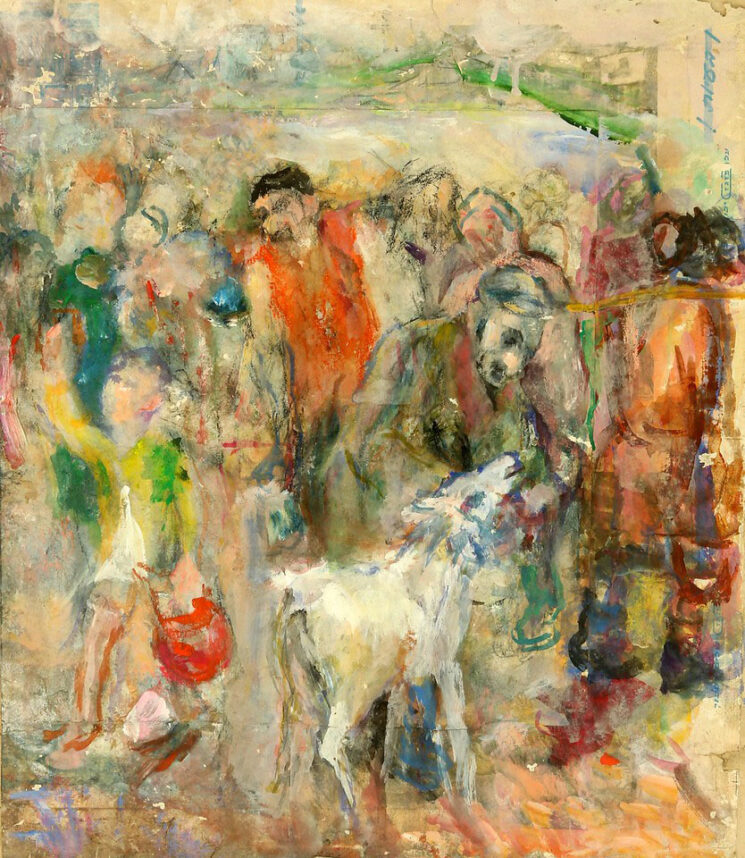
When Fiddler on the Roof was staged at The Soraya at CSUN, audiences encountered more than Sholom Aleichem’s beloved characters brought to life on stage. Alongside the production, the David Labkovski Project presented ‘Through the Eyes of David Labkovski: Sholom Aleichem and His Heroes,’ an exhibition that offered a visual journey into the shtetl world Aleichem immortalized in his stories.

Labkovski himself was born in Vilna, Lithuania, and endured extraordinary hardship. Arrested and sentenced to Siberia as an “enemy of the State,” he survived the brutal conditions there in part through his art. When he returned home after the war, Vilna—once a thriving center of Jewish culture—lay in ruins.  He stayed there for 14 more years and in 1958 he immigrated to Israel, where he continued to paint, determined to preserve not only the destruction he had witnessed but also the richness of Jewish life that had been lost. Those were the same landscapes that Aleichem described so vividly and lovingly in his stories.

Leora Raikin, the great-niece of Labkovski, became very close with her great uncle and great aunt as the two didn’t have any children of their own. She told the Journal they were more like  grandparents to her. Wanting to commemorate his legacy, she embarked with the David Labkovski Project (DLP) in 2016. She started working with de Toledo High School students and installed the first exhibit at the Los Angeles Museum of the Holocaust.

The educational initiative offers a unique approach to combating antisemitism and education about the Holocaust. It integrates history and art, empowering students with the skills to educate their peers and community. Through the artist’s paintings and sketches, viewers not only learn about the Holocaust but also lessons of life, survival, tolerance, acceptance and the importance of bearing witness to history.

The juxtaposition of Aleichem’s literary voices with Labkovski’s painted visions created a poignant dialogue between text, performance, and image. Though the performances have ended, the exhibit remains open, offering students and visitors the chance to reflect on the vibrancy of a world that once was, and on the enduring power of art to bear witness.

Raikin believes that her great-uncle’s art allows visitors at The Soraya to understand Jewish life both before and after the war.

“Through his art, you see what life looked like before and after the Holocaust—how people worked, dressed, and lived, all in vivid color,” said Raikin. “There is a generational element in connecting Sholom Aleichem’s world through Labkovski’s art.”

The classic musical Fiddler on the Roof, first performed on Broadway in 1964, went on to win nine Tony Awards. The popular show drew on universal themes of changing times and a household torn by young love. But the reality behind the production was not so simple. Tensions flared between lead actor Zero Mostel and director-choreographer Jerome Robbins, divided in part by their opposing views on the House Un-American Activities Committee. Some critics also faulted the musical for “whitewashing” Sholem Aleichem’s original stories, softening their depictions of Jewish persecution in Eastern Europe.

In 2018, the New York–based National Yiddish Theatre Folksbiene reclaimed Fiddler as a deeply Jewish story, translating the script and lyrics into Yiddish, with English supertitles. They assembled a top-tier Broadway cast led by Steven Skybell as Tevye. The results were historic—praised as fresh, authentic, and profoundly moving. New York Times critic Jesse Green wrote, “Even the jokes were making me cry.”

After pandemic-related delays, the Folksbiene finally brought Fiddler on the Roof to the West Coast in a special concert version, performed September 13–14, with Steven Skybell once again reprising his leading role.

One of the performers, soprano and part-time personal trainer Jessica Fishenfeld, told the Journal she was thrilled to be part of the production. Like many of her castmates, she does not speak Yiddish, but learned to sing in the language.

“As an opera singer, I’m used to singing in languages I don’t speak,” she explained. “I sing in German all the time, and Yiddish is actually pretty close. You learn it word by word with the phonetic translation. If you just translate literally, it won’t make sense in English, so you really have to learn the music of the words.”

Labkovski developed a remarkable affinity for Aleichem’s writing, creating a complete series of illustrations for the author’s centennial.

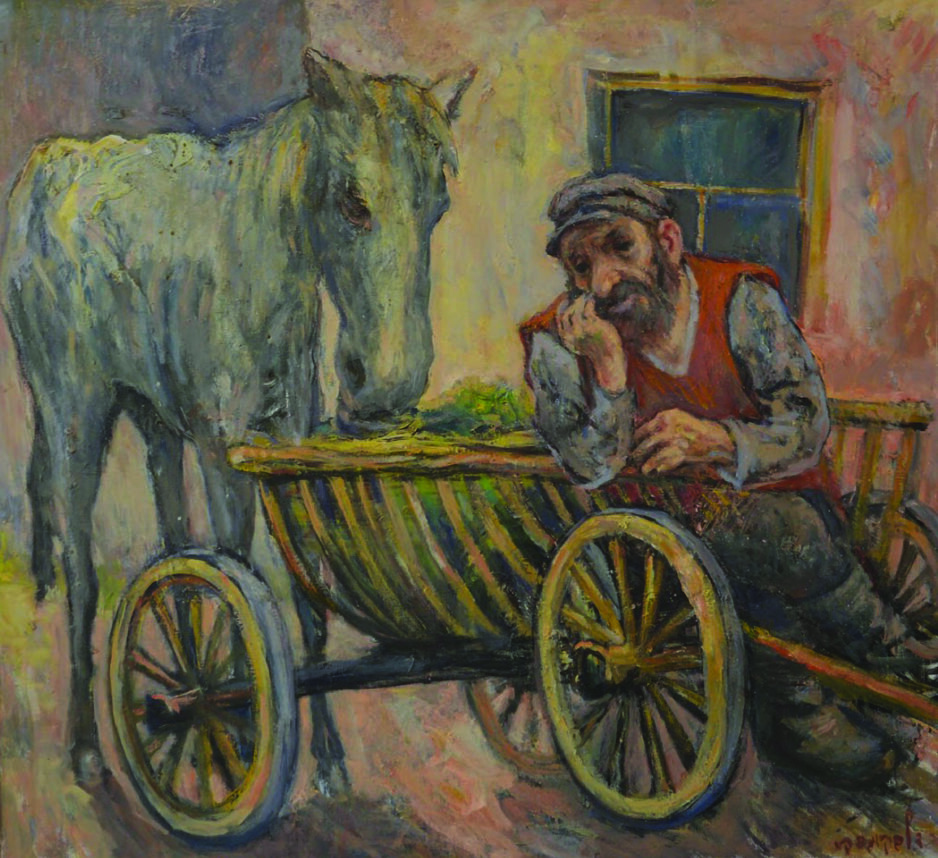
Raikin added that many people don’t realize that Tevye the dairyman, the central character of Fiddler, originated in Aleichem’s stories about his daughters. Labkovski’s illustrations of these tales offer not just images but a visual narrative of Jewish life in Eastern Europe before its destruction.

David Labkovski’s Tevye the Dairyman

“It serves as a cultural bridge to the wider community, because obviously not only Jewish audience would come to watch Fiddler on the Roof,” said Raikin. “This is education through art about that period of time. Students will be able to come on field trips, see the paintings, and place themselves within the stories. It’s a multigenerational experience that brings people together and exposes them to the art and the wonderful stories of Sholom Aleichem.”

Stage and Canvas: Fiddler on the Roof and the Art of David Labkovski at CSUN Read More »

Lea Shabat and the Art of Chasing Liberation

“I’m not a new world girl,” said artist Lea Shabat, sitting in her home studio in Montreal. “What can I get you?” she asked. “A coffee? Some tea?” She laughed and lamented that she could not offer me something to drink, given that I was in her home only by way of a computer screen. Perhaps there is always something mildly inauthentic about encounters that transpire by way of technology, but for me, getting to know Shabat and see some of her private work was a delight, even if we were nearly 4,000 miles apart.

Lea Shabat

Shabat is a rare jewel in the world of art and painting — certainly not undiscovered but also not as commonly known as one would expect when looking at her paintings. When I discovered her work last year, I wondered how it was possible I hadn’t come across it before. Perhaps it’s because Shabat, who says she is from “the old generation,” sees her art not as a commodity but as an extension of herself. “I don’t want to part [with my paintings],” she said. “It’s hard to let go of your children. I like to show my work, but I don’t want to think about the moment I have to part with it.”

Shabat was born in Casablanca in 1945 and left to France with her family for two years when she was young. From France, the family went to Israel aboard an immigration ship in 1950. In Israel, she and her family lived for a time in tents in one of the many ma’abarot (transition camps). I suspect her intense love for nature was nourished in this way, as she lived virtually as one with nature, without the confines (or conveniences) of building and structure.

“In Israel, I did my primary school, and we lived in tents,” she said, “and it was a beautiful life of nature … I was a little girl, and the Jewish community was very embracing. I also learned about different cultures like Yemenite and Russian.”

Shabat’s early exposure to transnational travel and to people from different cultures was a touchstone to the artistic journey on which she would one day embark. “But then I grew up,” she said, “and I went to secondary school, which was an agricultural school, so I had the experience of riding on a platform, you know, a pulled tractor with horses and sometimes camels … I love nature.”

She started painting at the age of five, and by the time she was an adult she longed to attend art school, but it was not part of her path. Instead, she had an arranged marriage to a man from Haifa. When she was in her mid-20s she moved with him to Montreal, “for love,” she said. They arrived alone in Montreal in the dead of winter, and she has resided there ever since. It’s a city that has been good to Shabat, who gave birth to two children there in addition to setting up her home art studio. “I’m not a party-goer,” she said. “If you see my backyard, it’s only trees, and I live with big windows and the sun shines on my face in the morning and at night, and I have no curtains. At night, I have the moon that comes and I’m really connected to nature. You can be one with nature, even in your home.”

But Shabat has always had an internal drive to be and feel free and unfettered. The idea of liberation is one she has explored not only in her work but also in her life. She has traveled all over the world and has lived in places like Cambodia and Indonesia and even Jordan, where she rented a little cabin in which to paint, for extended periods.

In Jordan, “I met the animals that I love,” she said. One of the first things I noticed about some of Shabat’s work is the prevalence of birds and other animals. In many cases they are, unsurprisingly once you know Shabat, moving and migrating; they are always in motion. In one piece — a triptych called “Mother Earth” — we see Shabat’s concern not just for animals but also for the world that sustains and nourishes them. In the top third of the triptych we see a woman’s body shaded in red with her arms raised above her with hands meeting above her head. From her breasts grow vines that work their way up to the surface of the mountainous ground, but it becomes heavier underneath.

“The turtle, the fish, the sea and the animals” are there, “and she’s feeding everyone from her belly … and the sea level is going down. We are losing a lot of nature … she’s feeding every form of animal,” Shabat said, looking at her painting. But “although the sea level is going down and we are losing a lot of nature, there is still hope.” She gestured to the top of the painting. “You see at the top, there are some sperm … [but] the earth is burning because the heat is on.” But though the sea is rising and the earth is burning, “she’s feeding everyone and everything, and she’s being depleted because she is not being nourished.”

I couldn’t help but wonder if Shabat sees some of herself in that figure, if she finds the endless job of women — to nurture and nourish others while pushing our own needs and desires from the forefront — as part of what drives her to paint in this way.

In “Out of the Rubble,” the figure of a person breaks out of a pile of colored bricks; white birds fly behind her as the person looks off into the distance. I asked Shabat about the birds and she was surprised by the question. “I don’t see birds,” she said. “I see liberation, being liberated from the traditional way.”

I couldn’t help but ask Shabat: What do you want to be free from? “Myself,” she said. “All I wanted to do is paint and read books and work in nature. And I raised my children on these principles. And I had a very nice partner who was a good man, but I wanted to go, you see?”

Shabat may long to be free, but in that longing for freedom she also finds a deep and intense love for children. It’s impossible to miss the shapes and forms of children throughout her work, usually appearing faceless. “They are present all the time,” she said, “the children in my paintings.” It seems like a bit of a paradox at first, to paint persistently of liberation, but then focus simultaneously on the presence of children. It isn’t that she paints them to point out that they are a burden; it’s the opposite. “It’s love,” she said, “and they are very intriguing. Children have their own mind, and that’s how I live.” 

When Shabat traveled to Cambodia, a friend told her there was a hospital for children. “I jumped on it,” said Shabat, “I said, give me a room there, and I will teach.” There were 50 children there, all struggling with their health, and Shabat did art with them and taught them to paint. “The kids and my life are entangled,” she reflected. She has also worked with children with special needs, and so it’s not surprising that children appear in her work, even if sometimes only faintly, again and again.

Shabat’s personal and artistic emphasis on nature and love for children is the same ethos that guided her when raising her own children. Her daughter Stephanie is a prominent figure in the art world who credits her upbringing as the reason she decided to enter the profession. In honor of Shabat’s recent 80th birthday, Stephanie created an Instagram page to showcase her work. Shabat’s son, Eric, works in human rights and environmental peacebuilding. One might say that her children embody Shabat’s most treasured ideals, and that their work is an extension of hers. Perhaps this too is the hope Shabat imagines in her triptych “Mother Earth.”

Shabat has many memories of her own childhood, and some of these stories inform her work. When she was a child, she would walk three to five times a week with her father to the water where they would eat sandwiches and catch fish together. But one day, he had his bike and his fishing rod and Shabat knew he was leaving without her and was distressed. 

“’Today, you’re not coming with me,’ he said. And I said, ‘Why?’ He said, ‘Because I will meet my friends there and my neighbors.’ He didn’t want me to be in company of adults. And I started to cry. So he went with his bike, and I was walking behind him and crying, ‘Take me! Take me!’ I remember this because I keep telling the story.” As Shabat got closer to her father on the bike, the hook from the fishing rod cut her neck, but her father did not realize. “I was crying. And he was looking away because he was on his bike, and he said, ‘Go home.’ But I kept running after him. Then the hook cut my leg, and he didn’t understand. I yelled, ‘Papa, look what happened to me.’ I went home and I took it out by myself. The fishing hook, you know, is for the fish not to run away.”
The irony of being caught — with a fish hook — by someone who is trying to escape you is not lost on Shabat, who chuckles as she tells the story. But I can tell that it is a deeply significant story for her. And I wonder if, in all the faceless children scattered throughout her work, one of them is her, longing to catch up with her father, to not be left behind even as the adult version of Lea Shabat runs the opposite direction, forever chasing liberation.

At the end of our talk, I asked her if being Jewish influences her art in any way. “Not at all,” she said. But I couldn’t help but smile because it’s easy to see the theme of tikkun olam in her work. Pushing a bit, I asked, “Did you grow up religious at all?” Her answer may be one of the best lines I’ve ever taken from an interview: “Religious, no. Shabbat, yes.”


Monica Osborne is a former professor of literature, critical theory, and Jewish studies. She is Editor at Large at The Jewish Journal and is author of “The Midrashic Impulse.” X @DrMonicaOsborne

Lea Shabat and the Art of Chasing Liberation Read More »

Artist Kimberly Brooks on Finding Her Way Back to Her Jewish Roots

Kimberly Brooks made quite a name for herself in the art world. Her collection of work, from realistic portraits to abstract landscapes and architecture, had been displayed at the Tokyo Metropolitan Museum of Art, the Whitney Museum of American Art in New York, and the Roosevelt Library in Texas, as well as locally at LACMA, Mash Gallery, and California Institute of the Arts. 

Now, after a few key events over the past decade, the New York City native turned Angeleno is focusing on capturing her Jewish roots in her new pieces and exploring her culture and religion.

“When our son and daughter were approaching the age of becoming bar and bat mitzvah, it very much felt like my actions were rote, like, ‘I had this bat mitzvah, and you will too,’” she said. “My father, Leonard Shlain, was this famous surgeon and author who wrote ‘Alphabet Versus the Goddess.’ After he passed away, I was going through his papers and organizing his books and I found an amazing book on his shelf called ‘Jews, God and History,’ by Max Dimont.  It was this brilliant, riveting, and metaphorical march through the history of religion and Jews. I couldn’t believe it.  I thought to myself, ‘How come I didn’t know any of this?’”

Brooks grew up learning about Israel; her parents were “very Zionist,” she said. “Being Jewish meant being Zionist.” Her grandfather had been a pilot in World War II and flew weapons to Israel during the War of Independence. 

While she went to a Reform Jewish Hebrew school and synagogue – and enjoyed learning Hebrew and helping kids prepare for their bar and bat mitzvahs – she was not deeply engaged with her Judaism beyond that. What she focused on was her love of literature and art. 

“I was always the kid who was drawing everything,” she said. “I’d say to someone, ‘Sit for me. I want to draw your portrait.”

Once she graduated valedictorian from UC Berkeley with a B.A. in literature, Brooks became a speechwriter for Walter Landor, a German Jew who escaped and started one of the biggest design firms in the world.

“I believe designers and painters are cousins,” she said. “You’re still dealing with the issues of composition, impact, message, and feeling. It’s extremely similar. Being in that world nurtured the part of me that was an artist.”

Brooks would draw and paint as a hobby, but when she had her daughter Claire, that’s when she decided to take her art career more seriously.

“I was doing a sunset horseback ride at Griffith Park, and it was absolutely magical with the horses galloping on the way back in the dark,” she said. “There was a full moon. The moon said to me, ‘What are you waiting for?’”

She promptly enrolled in painting classes at Otis College of Art & Design and pursued her passion for art while raising her children. She saw that they went hand in hand. 

“Motherhood is so important and integral to being an artist,” Brooks said. “When I first started showing work, there was this cerebral consideration about motherhood. My work was directly related to having a little girl follow me around the house. This is when I created the series ‘Mom’s Friends.’”

“Mom’s Friends” was one of Brooks’ early solo exhibitions which featured realistic portraits inspired by Polaroid photos from the 1970s of her mom and her mom’s friends. It explored the explosion of feminism during that time and recreated Brooks’ utopian childhood, right before their lives began to fall apart.

“Sophia Loren of Mill Valley” from the Mom’s Friends exhibit by Kimberly Brooks

“Every parent around me — in Marin County where I grew up — got divorced within the same two-year period,” she said. They even made a movie about it, called ‘Serial.’ “Being a child of divorce was maybe one of the most painful things I ever experienced.” 

She believed that Judaism was at odds with feminism, but when she sat down to actually study it, she found the opposite to be true.

“I have a new understanding of Judaism as a quite feminist religion,” Brooks said. “Reading the Torah while learning about the history of the Jewish people and their role in it made me reframe what it meant to be a woman and feminist and mother.”

Following her son’s and daughter’s bar and bat mitzvahs, Brooks then went to Israel with them in 2017. Though she’d gone before, it was for a brief visit. This time, she saw the beauty of the country and was fascinated with its history and architecture. Her paintings began to reflect her spiritual awakening; she created an oil, gold and silver piece on linen, calling it “Jerusalem,” which looks like a doorway into an ancient world, and paintings with frames inside of them capturing different stories from the Torah, like Sarah’s abduction.

“Jerusalem” by Kimberly Brooks

“My work is based on ancient texts,” she said. “I wouldn’t say I am a highly religious person, but I do keep Shabbat now, and I’m very proud to be a Jew.” 

Brooks kept painting, and she put out her first book during the pandemic, “The New Oil Painting.” When she went to promote it on an app called Clubhouse, she uncovered a “beehive of antisemitism on it that was underground,” she said. “I never knew it was there.”  
Then, when Hamas and Palestinian Islamic Jihad (PIJ) launched rockets into Israel in May of 2021, Brooks saw the bias against Israel in the media.

“Hamas started firing rockets into Israel, and CNN only said that Israel was shooting missiles into Gaza without saying why they were doing it,” she said. “I thought it was awfully unfair.”

Antisemitism and misinformation about Israel and the Jewish people were popping up everywhere, and Brooks wanted to protect her kids as they were going off to college. After Oct. 7, she teamed up with Emily Schrader, an Israeli American journalist, and Blake Flayton, another American writer who moved to Israel, to write “10 Things Every Jew Should Know Before They Go to College: An Illustrated Guide.” Both wrote about their personal experiences with antisemitism in college, as well as facts that Jewish students need to know. Brooks provided the illustrations. 

“We knew we had to get this information out,” she said. “We were sending young students into a sawmill of misinformation.”

Along with beginning to keep Shabbat, Brooks joined WIZO, where she interviewed pro-Israel voices like Schrader and Eve Barlow. 

She is continuing to create work with Jewish themes, even though she is up against antisemitism in the art world as well. 

“The art world is convulsing just like every other section of society,” she said. “I believe in my heart that sunlight and oxygen on the problem will have an impact.”

In discovering herself, and tapping into her Judaism, Brooks had discovered her life’s goal.

“My Hebrew name is Keren, which means rays of light,” she said. “That’s the impact I want to have in this world. I want to shed light.”

Artist Kimberly Brooks on Finding Her Way Back to Her Jewish Roots Read More »

Photography Exhibit Grapples with Meaning of Zionism

Artist Shlomit Levy Bard’s photography exhibition, “(RE)Defining Zionism: Portraits and Perspectives from a Post-October 7 Israel,” captures the complexity of what Zionism means in the aftermath of Oct. 7, challenges simplified narratives and highlights the diversity of Israeli society.

Currently on display at Hillel at UCLA, the exhibit is as much a storytelling exhibit as it is a photography display. Photographs of a cross-section of Israelis from all backgrounds and walks of life are surrounded by quotes handwritten on the frames of each photograph. The quotes are from each photographed individual, discussing what Zionism means to them. 

More than 60 Israelis, including ordinary citizens and well-known figures, are portrayed in the exhibition. Some proudly identify as Zionist. Others declare themselves “anti-Zionists.” Some rebuke the question altogether, saying circumstances demand that Israel make peace with its neighbors regardless of one’s ideology or political beliefs.

Among those pictured in the thought-provoking display is Basma Hino, a Druze woman and restauranteur. Since Oct. 7, Hino has prepared meals for Israel Defense Forces soldiers. When Hino learned that many of the soldiers couldn’t eat her food since it wasn’t kosher, she sought out kosher certification for her restaurant. 

Hino’s story, Levy Bard said during an event at her exhibit hosted by OpenDor Media on May 28, was “one of my favorite stories here.”

Another image in the exhibit depicts an ultra-Orthodox IDF soldier who makes handcrafts out of the shrapnel from rockets launched into Israel. Another shows a young woman who’s framed by a quote that reads, ”I grew up in a religious Zionist home, as one of six siblings. But I don’t know what to think about Zionism now.”

Another image features a woman whose head is covered. She’s dressed in modest clothing. The quote running alongside the photograph reads, “I’m a Zionist. My grandfather was an ultra-Orthodox underground fighter, and my grandmother grew up in Jerusalem. My other grandparents were Holocaust survivors.” 

And yet an image hanging nearby features an older bespectacled man, a biochemist, encircled by a quote that says, “I’m an anti-Zionist. I don’t believe that countries have the right to exist; people have the right to exist.”

Levy Bard described the display as a “traveling exhibit,” one with educational goals. She hopes the exhibit, as it travels to different universities, can be accompanied by a curriculum.

Photographer Shlomit Levy Bard speaks during a May 28 exhibition event at Hillel at UCLA. (Photo by Ryan Torok)

Levy Bard is originally from Israel and currently lives in Los Angeles. In capturing these images, she traveled across her native country, including in Haifa, Jerusalem, Tel Aviv, Beersheva and the Gaza border.

“We were dragging around a studio and studio equipment and setting up in all kinds of random places, in some cases in the middle of a dirt field, and in some cases in somebody’s house, and driving all over Israel,” she said.

She worked closely with Anushka Hauerstock, a recent LA transplant from Israel who produced the exhibit. In many cases, Hauerstock introduced Levy Bard to those pictured in the exhibit. 

“The first question that people usually have for me is, ‘How did I find all these people.’ In some cases, they were people who I was connected with, some of them on social media, and in some cases I was able to find them through my producer, Anushka,” Levy Bard said.

Others photographed include ZAKA volunteer Avichai Amusi as well as an Ethiopian Israeli woman whose very existence, Levy Bard said, challenges the idea of Israel being a Eurocentric, homogenous society.

“Basically, the goal was to photograph a wide cross-section of Israelis talking about what Zionism is, so that’s the question I came with,” Levy Bard said. “There’s a huge variety of perspectives that are presented here, and a huge diversity in who these people are and what they believe.”

For the photographer, some of the most gratifying exchanges have been with those who learned about a facet of Israeli society that had previously been unknown to them, including that there are Black Jews living in Israel.

Since the exhibit debuted at Hillel at UCLA, various educational events have taken place in the gallery space housing Levy Bard’s photographs. The recent event on May 28 was hosted by OpenDor Media, a nonprofit that produces videos and social media content about Israel, Zionism and Judaism.

The centerpiece of the recent event — a panel that examined the role of social media in the current debates around anti-Zionism and antisemitism — featured Eden Cohen, head of social and website at OpenDor Media; Matthew Nouriel, community engagement director at JIMENA: Jews Indigenous to the Middle East and North Africa; and Emmy-nominated Jewish journalist Jacki Karsh.

Levy Bard’s exhibit remains open at Hillel at UCLA through June 13, Monday-Friday, 10 a.m.-4 p.m., and by appointment June 13-August 15.

Photography Exhibit Grapples with Meaning of Zionism Read More »

Jack Kirby, King of Comic Books, Finally Gets His Moment in the Sun

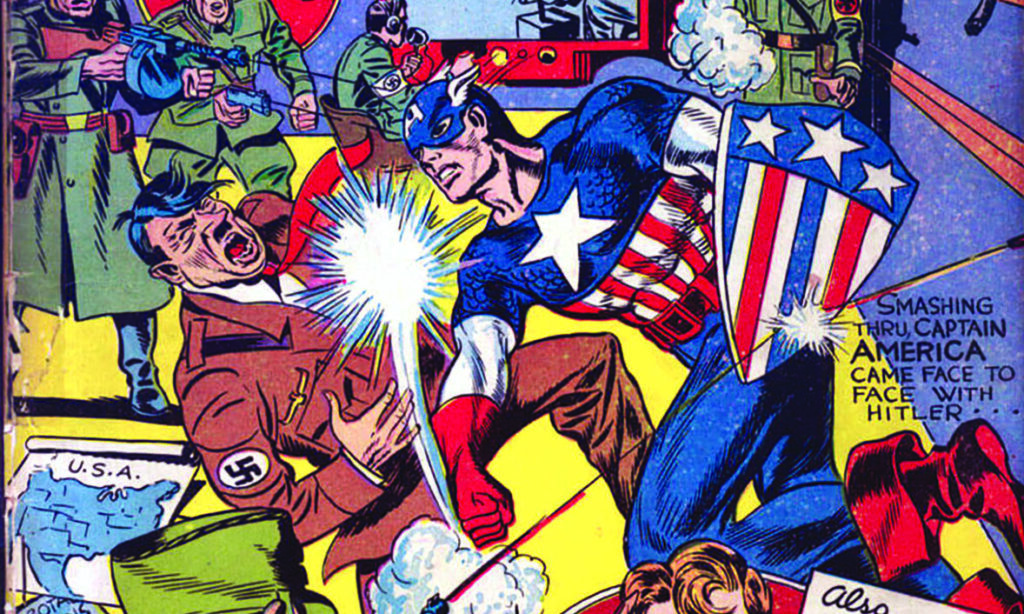
There is a famous story about Jack Kirby going on “The Tonight Show Starring Johnny Carson.” When Johnny read his intro off a card that said, “My next guest is known as the ‘king of comics,’” Johnny went off script and started laughing, saying, “Who is this guy to call himself the king of comics? I know all the great comedians, and I’ve never heard of this guy.” Of course, he would soon find out that comics was referring to comic books, and that his guest had co-created “Captain America,” “The Fantastic Four,” “The Black Panther” and so many more modern superhero mythologies.

From way back then with Johnny Carson until today, it seems not much has changed… until now.  

Thanks to the Skirball Cultural Center, Kirby is finally getting the honor and respect he deserves with his own exhibit, “Jack Kirby: Heroes and Humanity.” 

Kirby, who was Jewish and from the Lower East Side, was born in 1917. He was a comic book illustrator who co-created “Captain America” with Joe Simon, a writer and editor. Captain America was a character who fought Nazis to save the United States. Kirby fought off the page when he was drafted during World War II.  It’s cool to think that a Jew is behind the most American character of all time. 

In the 1960s, while at Atlas Comics, which later became Marvel, Kirby co-created characters like Ant-Man, Iron Man, the Hulk, the Silver Surfer, the X-Men, the Avengers and Thor. 

“It was important to have this exhibition because Jack’s story is such a compelling Jewish American story,” said Michele Urton, Skirball’s exhibitions manager. “I hope that people will come away understanding that so much of the world that we live in today in popular culture was really impacted by this one person.”

The exhibition includes Kirby’s comic books as well as his personal items, like his uniform from World War II, rare collages, original pieces and character costumes from the movies. His family was involved in helping put it together.

Ben Saunders, one of the co-curators for the exhibit as well as a professor of English at the University of Oregon — where he founded the Comic Studies minor — said, “Jack Kirby emblematizes, almost literally, the power of the imagination. His fingerprints are all over my mind.”

“Jack Kirby emblematizes, almost literally, the power of the imagination. His fingerprints are all over my mind.”
– Ben Saunders

Saunders and his co-curator, Patrick A. Reid, had to go to private collectors to get the pieces. Though it wasn’t an easy ask, it was worth it. 

“Even as a huge Kirby fan, I hadn’t seen a lot of these things,” Saunders said. “It was part of the excitement for me to be able to do this.”

For Reid, it was special that the exhibit is being held at Skirball. 

“Jack lived and worked in Los Angeles for the second half of his career,” he said. “He and his family were integral to the community here. He helped inspire the fandom that founded San Diego Comic Con, and he was a foundational part of fandom on the West Coast. To be able to do that here, in a cultural institution, and celebrate Jack and his family is just a dream.” 

If you are a fan of comic books, or you simply want to learn about the man behind so many characters that shaped pop culture and our collective imagination, make sure you visit “Jack Kirby: Heroes and Humanity,” which is on display until March 1, 2026. 

“I hope that when people come, they walk away with a sense of joy,” said Urton. “Jack Kirby’s family has been incredibly excited to see him finally get an exhibition of this scale. It’s long overdue.”  

Jack Kirby, King of Comic Books, Finally Gets His Moment in the Sun Read More »

Borrowed Spotlight: Celebrities Share Their Spotlights With Holocaust Survivors

“Hate is survivable; indifference is not,” said acclaimed fashion photographer Bryce Thompson. “These Holocaust survivors stand as living testaments, urging us never to forget that empathy and action are often the difference between life and oblivion.”

Thompson, who was born in South Africa, initiated a project titled “Borrowed Spotlight,” featuring intimate portraits of 18 Holocaust survivors alongside celebrities. The basic idea: the celebrities are “lending” their spotlights to the last living generation of Holocaust survivors, with the goal of sharing their stories beyond our usual echo chambers. The project culminated into an elegant 320-page coffee table book, which can be ordered at borrowed-spotlight.com.

The three-year project was initially fueled by the antisemitism that Thomson, who is not Jewish, saw his friends and mother, who converted to Judaism, have faced in recent years. The project assumed greater relevance after Oct. 7. Coinciding with Yom HaShoah, the exhibit launched at the Detour Gallery in NYC on April 22. 

Thompson is known for his ability to capture intimate moments that highlight resilience and hope. His portraits showcase not only the unwavering strength of all the survivors but also his commitment to using art to spark change.

“Holocaust survivors are few and far between. Special people with special stories, and I really felt like they need to be told,” Thompson said at the opening. “Firsthand was really important to me. Hearing a story from someone who has told a story is not the same as sitting in a room with someone who lived through something.”

With a Foreword by Cindy Crawford, the book features David Schwimmer, Jennifer Garner, Chelsea Handler, Daniela Braga, Julius Erving, Barbara Corcoran, Wolf Blitzer, Sheryl Sandberg, and Kat Graham, among others. 

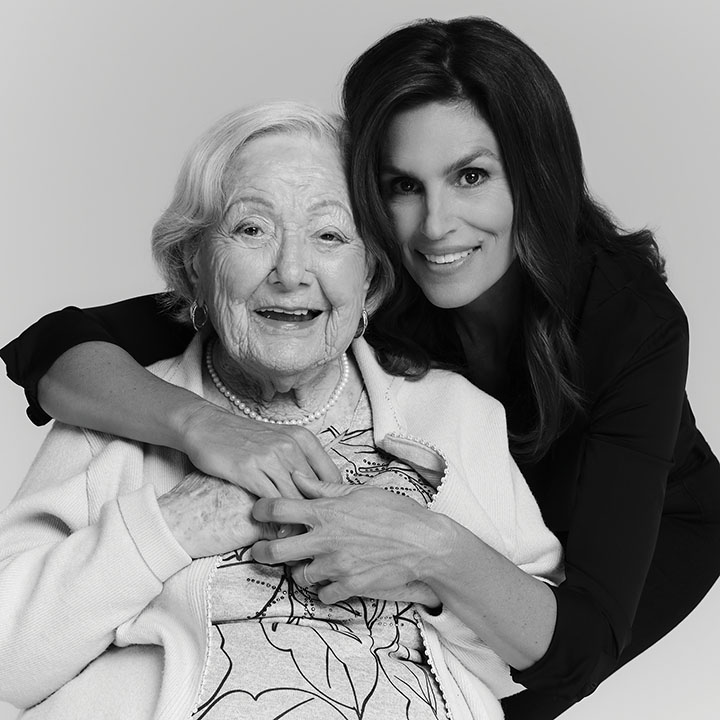
Cindy Crawford & Ella Mandel

“When I was asked to participate in this book, it was an instant yes. I’ve always believed in being part of the solution, not the problem,” Crawford writes in the foreword. “The opportunity to meet and converse with a Holocaust survivor felt deeply meaningful.” Crawford’s husband is Jewish, and their kids are being raised with an appreciation for both Christianity and Judaism.

One section of the book showcases notes written by some survivors about life, hope, and reflection. “I am writing this to urge the world to bring only positive thoughts to one another and let love flow,” writes Risa Igelfeld, 107.

The Holocaust survivors in the series include natives of Poland, Czechoslovakia, Hungary, Belgium, Romania and one man who was born in a Budapest ghetto basement during a bombing raid in 1944. The photographs feature survivors of the Warsaw Ghetto, Auschwitz and Bergen-Belsen concentration camps, and one person who survived 12 concentration camps. The photo series also highlights a survivor of the Farhud pogrom that targeted Jews in Baghdad, Iraq.

David Schwimmer & Elizabeth Wilf

“In these pairings, recognition is redirected, and the attention so often given to fame is instead used to illuminate history,” read a wall text at the exhibit. “The result is a series of intimate portraits and conversations where past and present collide, where silence is broken, and where remembrance becomes an act of defiance against forgetting.”

Jewish actress Kat Graham is photographed in the portrait series with Holocaust survivor Yetta Kane. At the exhibit opening, Graham said Thompson’s portraits capture “truth, resilience, and humanity.” Graham’s maternal grandmother fled Europe during the Holocaust. The photographs “build a bridge between generations; a conversation between memory and legacy.”

“This project is about remembrance but it’s also about responsibility,” she told the crowd. “We are the torchbearers now. It is up to us to keep these stories alive and to ensure that history is never forgotten. That the voices of survivors are not only heard, but felt. I invite you to see, to feel, and to carry these faces with you, long after you leave.”

“My grandmother, a Bergen-Belsen survivor, died earlier this year, so this project is especially close to my heart,” project producer Daniella Greenbaum told The Journal.

Billy Porter & Bella Rosenberg

There are currently more than 200,000 Holocaust survivors worldwide. According to a new report by the Conference on Jewish Material Claims Against Germany, nearly half of all Holocaust survivors will die within the next six years, while 70% will no longer be alive within 10 years. There are estimated to be more than 1,400 alive today who are over 100 years old.

And yet: 20% of people globally have never heard of the Holocaust; less than half recognize its historical accuracy; and more than 60% don’t know that 6 million Jews were murdered. In a world of fake “influencers,” this project is indeed a good use of fame.

Proceeds from the book sales will support Holocaust education. Proceeds from a private auction of select prints will benefit Selfhelp Community Services, which provides services and assistance to Holocaust survivors in New York and the United States Holocaust Memorial Museum.

Sadly, nothing is sacred in NYC anymore. The day after the opening, posters showing the portraits were ripped down, just like the hostage posters. Whatever moral clarity that was gained after the Holocaust and 9/11 is now gone. 

Julius Erving & Hershel Greenblatt

Still, nothing can diminish the profound elegance of the photos, the testimonies of the survivors, and the beautiful soul of the photographer. Thompson understands the historical and moral necessity of documenting the lives and testimonies of survivors — as well as the necessity in this superficial world of compiling them into an exquisite book. Memes can be deleted; videos erased; posters torn down. But this book remains: a project of respect, resilience, and hope.


Karen Lehrman Bloch is editor in chief of White Rose Magazine.

Borrowed Spotlight: Celebrities Share Their Spotlights With Holocaust Survivors Read More »

The Unexpected Guest at a Painted Passover in Jerusalem

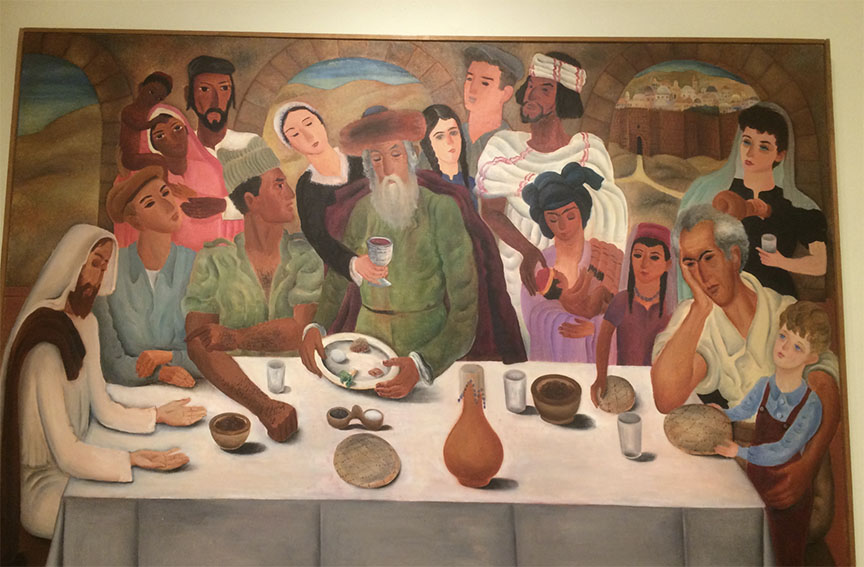
Reuven Rubin’s 1950 painting “First Seder in Jerusalem” at first glance seems like a simple but moving representation of a diverse group of Jews at a Passover table. There are secular-looking kibbutzniks, a Hasidic rabbi, two IDF-uniform wearing soldiers, immigrants from Africa, and a young Haredi boy with sidelocks. But at second glance, one notices what makes the assembled group really diverse. Seated to the left, with his palms turned upwards, is, yes, Jesus.

Rubin, né Zelicovici, was born in Romania in 1893, and would later serve as the nascent Jewish state’s first ambassador there. As a child, he demonstrated a precocious artistic ability and at age eighteen the local Zionist leader Dr. Adolf Stander sponsored his studies at the Bezalel school of art in Jerusalem. But, upset at being assigned to an ivory carving workshop, Rubin dropped out and continued his artistic studies in France before returning to Romania. In 1923, he returned to Mandatory Palestine where, five years later, returning from one of his art shows in New York, he met his wife Esther, a young woman from the Bronx who had won a free trip to Palestine in a Young Judea competition. 

Two years after Israel’s founding, Rubin painted “First Seder in Jerusalem,” inspired by the hope and potential of the developing Promised Land. It is steeped in symbolism. Jerusalem’s Old City walls can be seen through the windows. The white-haired figure embracing his son on the right is the artist himself. Behind him stands Esther, pouring some wine. And as even lay art historians might notice, the figures are positioned to mirror Leonardo da Vinci’s “The Last Supper.” That famous image depicts Jesus with his disciples, the evening before his execution by the Romans.

As Tsvi Sadan writes in “Flesh of Our Flesh: Jesus of Nazareth in Zionist Thought,” the revival of the modern Jewish state negated nearly two millennia of Christian thinking that the Jews had been supplanted on the stage of history. Rubin is therefore purposely playing off of the most famous rendering of Jesus’s Paschal meal. As the art historian Gabriel Goldstein has suggested, “the inclusion of the resurrected Jesus is to remind the world that the Jewish people also suffered and died but yet rose again to life in their own land. Rubin’s title stands in contrast to da Vinci’s – this is a first Seder not a last supper.” 

The dreamlike aura in the image is no accident. “The peaceful scene,” Goldstein continues, “is just a dream of a peaceful future that has not yet arrived,” an impression strengthened by Rubin’s rendering of himself resting on his hand, staring as if unaware of the others at the table, lost in thought. 

Rubin’s painting emerged from the modern-day exodus of Jews from across the globe to build the new state and their stunning defeat of surrounding Arab armies, the Pharaonic forces of their day. As the Rubin Museum curator Carmela Rubin has noted, “the exceptional new reality demanded a didactic mode of expression, one that would elevate his narrative beyond the reality of mundane existence.” 

Alas, the full realization of Reuven Rubin’s dream has not yet materialized. Social fissures in Israel and antisemitism worldwide have pushed off the peace of mind, and of Jerusalem, that Rubin hoped for. But the chords of Jewish unity remain strong despite challenges. And Christian Zionists are among the leading supporters of Israel in its fight against those who seek its destruction, with millions offering not supersessionism but support for their Jewish friends. 

Rubin’s image, then, is perhaps the perfect painting for our moment, a reminder of how close we are to meriting that era of ultimate redemption the Haggadah hopes for – perhaps even next year, in Jerusalem.


Rabbi Dr. Stuart Halpern is Senior Adviser to the Provost of Yeshiva University and Deputy Director of Y.U.’s Straus Center for Torah and Western Thought. His books include “The Promise of Liberty: A Passover Haggada,” which examines the Exodus story’s impact on the United States, “Esther in America,” “Gleanings: Reflections on Ruth” and “Proclaim Liberty Throughout the Land: The Hebrew Bible in the United States.”

The Unexpected Guest at a Painted Passover in Jerusalem Read More »

Haleh Mashian’s Journey of Resilience, Creativity and Community

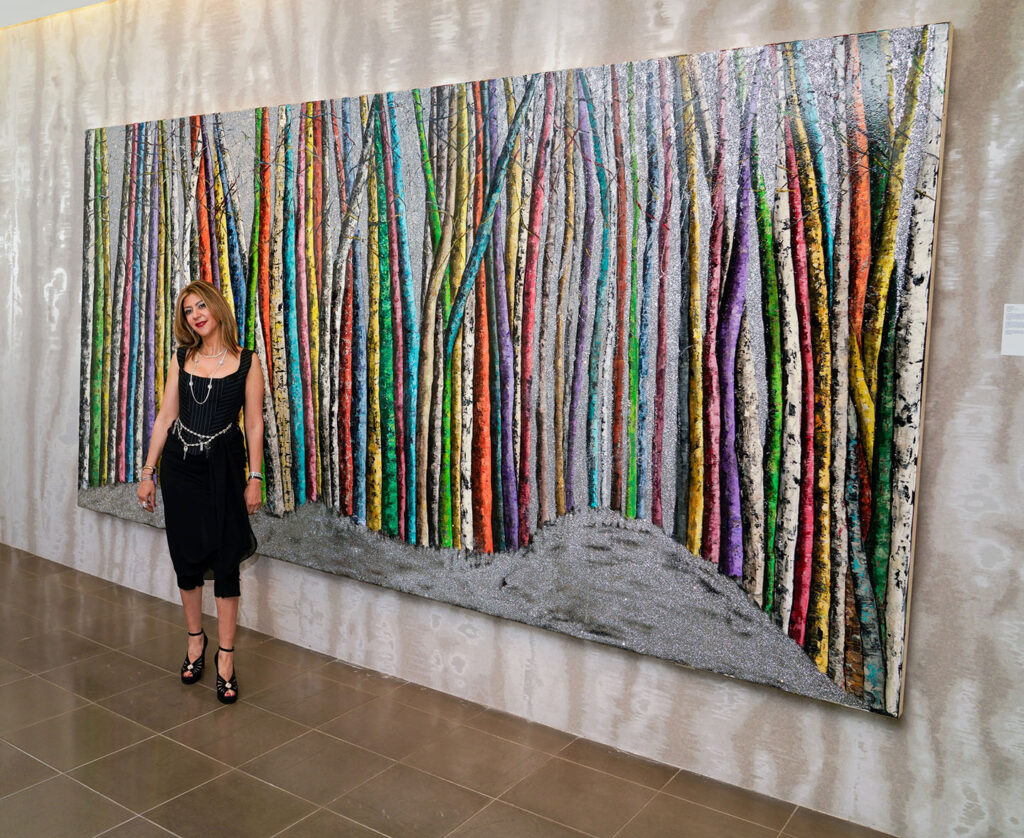
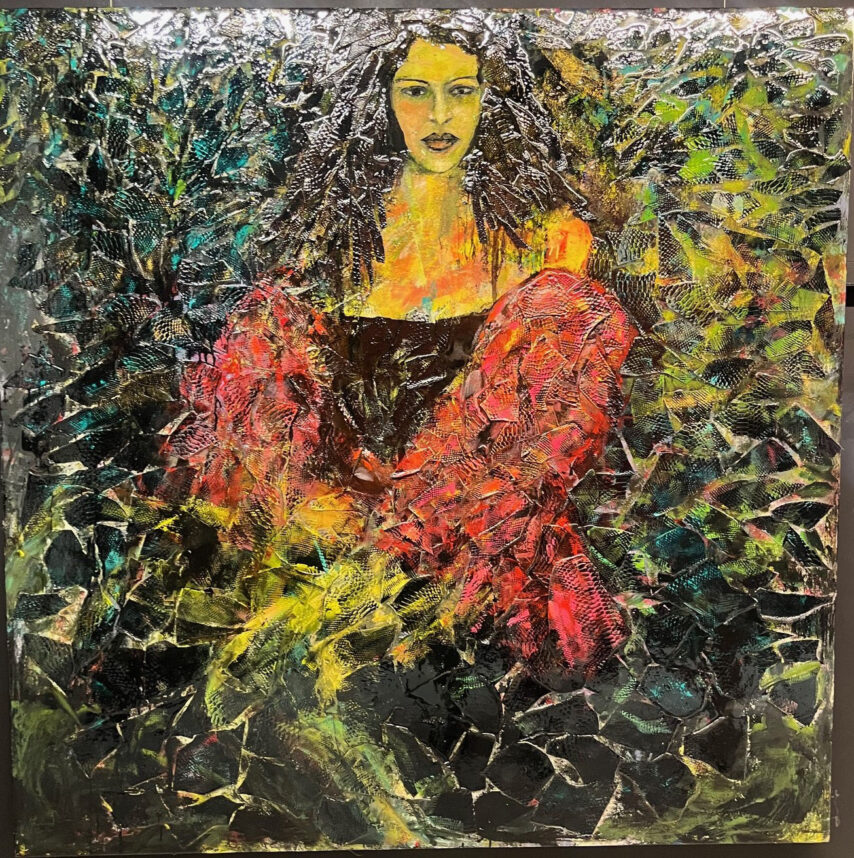
Haleh Mashian, the owner of Mash Gallery, loves to paint trees, flowers, water and nature. In her recent group exhibition, “À Gogo III” at the Pacific Design Center, several of her works were on display — huge paintings of trees forming a forest so dense that nothing was visible between them except tree trunks.

“I want to emulate trees because I feel they are resilient and rooted in the ground, just beautiful,” said Mashian. “They bend to anything that comes their way. They’re surrounded by the elements, but it makes them stronger. I feel their energy.”

In many ways, Mashian is like those trees. She, too, has had to bend and stand strong in the face of life’s challenges. One of the most harrowing experiences of her life began with the abduction of her father in Iran shortly after the 1979 revolution. Mashian believes he was kidnapped because he was Jewish, though no one ever admitted it or acknowledged that he had been taken by the Islamic government.

“Anyone who looked for him was asked, ‘Why are you looking for a Jew?’ So yes, I believe it had something to do with the fact that he was Jewish,” she said.

In 1986, at 20 years old, Mashian escaped Iran with her 13-year-old brother, traveling under Muslim names. “At the time, they didn’t let Jewish people leave the country, so we escaped from the northern part of Iran, first to Switzerland and then to Italy, where we stayed for four months until we were able to come to the U.S. in 1987.”

Her mother remained in Iran and did everything she could to find her husband, but to no avail.

“Imagine dealing with ISIS on a daily basis,” said Mashian. “She tried to get information from all these jihadi people, but they kept denying they ever took him. After all these years, she never got closure, and in the end, she came up empty-handed. They never disclosed what happened to him, but a few years ago, she found out that he was killed.”

Eventually, her mother, now 82, left Iran and immigrated to the U.S. a year ago. Had Mashian’s father been alive today, he would have been 93.

Mashian began painting later in life, at 25. Before that, she was a pianist but never had the opportunity to explore painting. Once she did, she couldn’t stop. “I realized that I was able to express my emotions through art, to let go of anything that needed to come out. No matter what series I do, there is a lot of energy in any art I create. Sometimes it’s beautiful, sometimes painful. I’m very appreciative that I have this outlet.”

Haleh Mashian painting

At first, she painted in her home studio, finding solace in art as a form of healing. But the solitude became isolating, leading her to open Mash Gallery in 2018 in the Downtown Los Angeles Arts District. In 2022, she moved the gallery to its current location on La Cienega in West Hollywood.

“I went to a meditation retreat led by Dr. Michael Gottlieb, and during one of these meditations, I saw myself in my studio alone all day, cut off from the world. In that moment, I knew I needed to engage with the world — find a way to be an artist, develop my craft, and continue creating while being part of a community. That’s when I went for it and opened my gallery.”

Initially, she wasn’t focused on representing other artists, especially in the age of Instagram, when artists can showcase and sell their work independently. But eventually, she began filling her gallery with works from other artists, each one unique, yet all resonating with her.

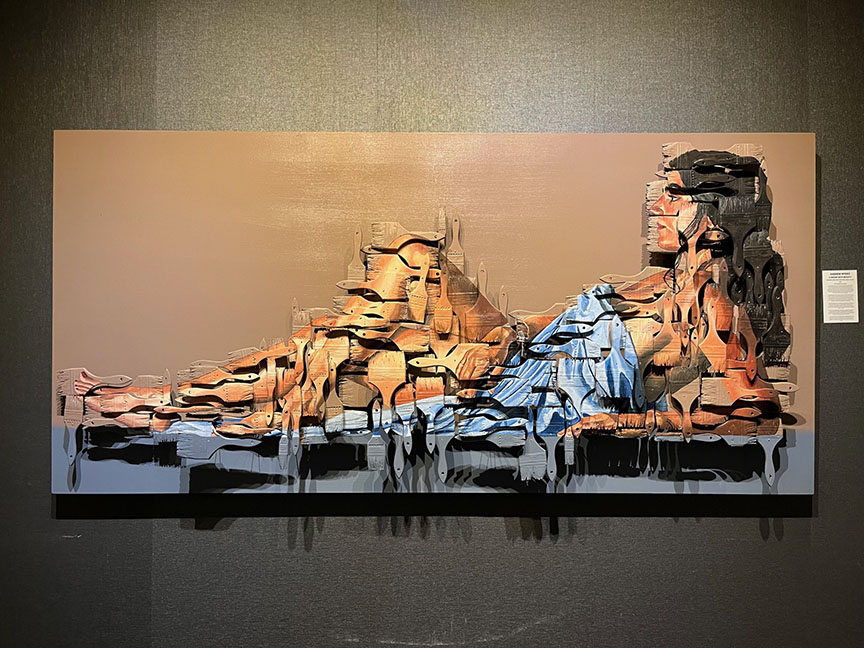
Andrew Myers painting, A Brush With Beauty (Photo by Ayala Or-El)

“I look at art differently. It can be pop art, colorful art, edgy art — any kind of art, really — but it has to have a soul, be inspiring and speak to me as an artist.”

Mashian curated “À Gogo III,” featuring a collection of works from over 50 artists of diverse backgrounds. The exhibition showcases an exceptional mix of contemporary pieces by local, national and international artists, featuring bold, pop-inspired works, from a massive wooden statue of King David to an impressive portrait of a woman made entirely out of paintbrushes.

Although she personally wasn’t affected by the Palisades fires, Mashian has friends who lost their homes or were evacuated and are still unsure when they will be able to return. She decided to donate 10% of the exhibition’s proceeds to LA Wildfire Relief, aiding communities impacted by devastating wildfires.

This is not the first time she has donated proceeds from her exhibits to important causes. After Oct. 7, she held a group exhibition of female Jewish artists at Mash Gallery and donated 100% of ticket sales and 50% of sales proceeds to female survivors of trauma and sexual violence in Israel.

Her husband, Bryan Mashian, a lawyer, was by her side, as usual, at the exhibit. The couple married in 1991 and have two children, a 28-year-old son and a 25-year-old daughter.

“He is my biggest supporter; he is my rock,” said Mashian of her husband. “He encourages my growth and believes in me and my work.”

Mashian has showcased the works of nearly 500 local and international artists since opening Mash Gallery. Some of her pieces have been purchased by overseas collectors who she has never met in person and who bought her work online without seeing it first.

“To me, it’s meaningful because they don’t know me, but they resonate with my art,” she said. “They feel a connection to it.”

With her local clients, she has a more personal relationship. One client arrived at her gallery with a bouquet of flowers, deeply moved by her art and wanting to show her appreciation. Some of these clients have become close friends.

“I wanted to create this space as an intimate place of gathering,” said Mashian of her gallery. “I believe that a lot of the old gallery model will become obsolete. I saw the need for people to connect and be part of a community, especially after COVID and the fires. There is power in being together. In my little corner on La Cienega, people come and engage with each other.”

When asked for her best advice to aspiring artists, she emphasized the importance of dedication and refinement.

“Create a cohesive body of work where one can see the intention behind what you’re creating. If you want to go commercial, you have to dedicate enough time and not fall in love with the first thing you do.”

Mashian also composes music for every art series, believing that the music and the art complement one another.

“Creativity is not limited to one act,” she said. “If you’re creative — and everybody’s creative in some way or form — it’s just a matter of bringing that quality to the surface. Whenever you create, you are touching your essence and that, in itself, has so much healing power.”

She continued, “I love celebrating other people’s creativity. If we all tapped into that aspect of ourselves, the world would be a much better place.”

Haleh Mashian’s Journey of Resilience, Creativity and Community Read More »